Line managers as implementers of HRM
The effect of line managers’ limitations on their HRM
implementation effectiveness
2
Line managers as implementers of HRM
The effect of line managers’ limitations on their HRM implementation
effectiveness
Student
Name:
A.M. Terhalle
Student number:
s0177040
Study:
Master of Business Administration
Track:
Human Resource Management
Telephone number: 00316 40347471
E-mail:
Supervisory committee
First supervisor:
Drs. A.C. Nehles
E-mail:
Second supervisor: Dr. M.J. van Riemsdijk
3
Preface
Hereby I present my master thesis which was written to complete my Maste rs degree in Business Administration at the University of Twente. It concerns an examination of the limitations that line managers experience in their HR responsibilities and the effect of these limitations on their HRM implementation effectiveness.
In the master of Business Administration I developed a deeper understanding and interest in Human Resource Management (HRM). Whereas in my bachelor education, internships and work experience the focus was on how to execute HRM practices, in the master of Busine ss Administration I learnt about HRM performance, strategic HRM and how to manage Human Resources. I did not have to hesitate long about the topic for my master thesis: line managers’ expanding HR role and the problems that go along with this was something I recognized from practice. Therefore, I contacted the expert on this topic: drs. A.C. Nehles. She offered me a concrete thesis on this topic, which I enthusiastically accepted. In the last months I learned how to perform an academic study, gained a lot of knowledge on the HR-role of line managers and can present you with surprising results.
However, I could not have achieved this without the help of a number of people.
I would like to thank my supervisors for their guidance and input. First of all, I woul d like to thank my first supervisor, drs. A.C. Nehles, for the pleasant collaboration in executing this research together and her valuable remarks and constructive feedback. I would also like to thank her for the possibility to attend a HRM conference in Spain, which was an unique experience for me. Furthermore, I would like to thank my second supervisor, dr. M.J. van Riemsdijk, for his interesting views and conviction.
I also would like to thank dr. P.A.T.M. Geurts, for his assistance with statistical data analysis.
I enjoyed writing my thesis at the university and appreciated the company of fellow graduates, PhD students and lectures. Finally, I would like to thank my family and friends, especially my boyfriend and parents, for their support and incentives.
Anouk Terhalle
Enschede, July 2009
4
Management summary
Rationale
Two aspects which are critical for HRM to be successful are the presence of HRM practices and the effectiveness of HRM implementation. Line managers are responsible for HRM implementation in an organization since they have to execute the HRM practices on the work floor. Nevertheless, research has indicated that line managers find implementing HRM practices difficult because of several limitations they experience in implementing HRM. HRM practices can be developed properly, but if line managers fail to implement them successfully on the work floor they are still not effective.
Research objective and questions
This research aims to measure to what extent line managers perceive the s uggested limitations as hindering and whether their employees perceive their HRM implementation as effective. Furthermore, it aims to examine to what extent line managers’ limitations influence their effectiveness in HRM (according to their employees). This research objective leads to the following research questions: 1) To what extent can line managers implement HRM practices effectively? and 2) What is the influence of the limitations that line managers experience in implementing HRM on their HRM implementation effectiveness?
Line managers’ limitations in implementing HRM
Many researchers expressed concern about line managers’ performance due to a number of limitations. First of all, line managers have a lack of desire to implement HRM. However, willingness is essential for someone to perform effectively. Furthermore, line managers do not have capacity to implement HRM, since they have other, more pressing, short term operational responsibilities. This short -range focus may result in people management that is generally less effective. Besides, line managers have limited skills and
competences in HRM due to a lack of training. It is suggested that these low competences are a significant constrain on the effective devolution of HRM responsibilities to line managers. Line managers are also hindered by a lack of support from the HR department and it is argued that line managers cannot perform their HR tasks effectively without the assistance of HR professionals. Lastly, line managers rely on clear
policies and procedures on what their HR responsibilities imply and on how to execute HRM practices. Without these policies & procedures, their HRM implementation effectiveness is likely to suffer. Based on this literature, I developed the following (positively formulated) hypotheses:
Hypotheses
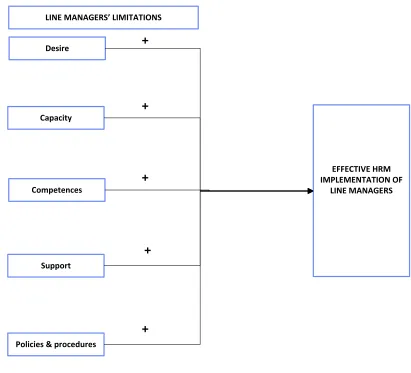
1: The more desire line managers have to perform HR tasks, the more effectively they will implement them on the work floor.
2: The more capacity line managers have to execute HR tasks next to their operational tasks, th e more effectively they will implemen t them on the work floo r.
5
implement them on the wo rk floor.
4: The more HR support line managers perceive toreceive from HR professionals in perfo rming their HR ta sks, the more effectively they will implement them on the wo rk floor.
5: The more policies and pro cedu res line managers have on their HR responsibilities and on how to execute HRM practices, th e mo re effectively they will implemen t HR tasks on th e wo rk floor
Methodology
l performed statistical data analysis to answer the research questions. Nehles (2006) developed a research instrument based on non-HRM literature to measure the limitations that li ne managers experience in HRM. Line managers’ HRM implementation effectiveness is measured by asking their subordinates’ opinion of their HR performance on five HRM practices. Nehles (2007-2008) collected data by means of questionnaires in two case organizations; an international naval defence company and a construction company. For measuring line managers’ limitations in implementing HRM, the research population was line managers at various levels of an organization responsible for the supervision of a tea m of employees. For measuring line managers’ HRM implementation effectiveness, the research population was line managers’ subordinates.
Results & conclusions
Contrary to earlier research, I found that line managers perceive themselves as effective as they do not perceive limitations in implementing HRM and they are also perceived as effective by their subordinates. Thus, line managers have found a way to perform their HR role to their own satisfaction as well as to the satisfaction of their subordinates.
6
Content
1. Introduction ... 9
1.1 Line managers and effective HRM implementation ... 9
1.2 Relevance ... 12
1.3 Research strategy ... 14
1.4 Thesis structure... 15
2. Literature review... 16
2.1 The importance of HRM implementation ... 16
2.2 Distribution of HR roles and responsibilities in an organization ... 18
2.3 Line managers’ limitations in implementing HRM ... 20
2.4 Research model ... 25
3. Methodology ... 26
3.1 Operationalization of concepts... 26
3.2 Reliability assessment... 31
3.3 Research population & data collection methods... 31
3.4 Preparation for data analysis... 34
4. Results ... 37
4.1 Line managers’ limitations in implementing HRM ... 37
4.2 Line managers’ HRM implementation effectiveness ... 39
4.3 The effect of line managers’ limitations on their HRM implementation effectiveness ... 40
5. Discussion ... 46
7
5.2 HRM implementation effectiveness of line managers ... 48
5.3 The effect of line managers’ limitations on their HRM implementation e ffectiveness ... 50
6. Conclusion ... 56
6.1 Research conclusions... 56
6.2 Research limitations ... 59
6.3 Suggestions for further research ... 60
6.4 Recommendations ... 62
References ... 68
Appendix... 72
8
List of Figures
Figure 1: The 5-P Model of Schuler (1992) page 17
Figure 2: Four HR roles of Ulrich (1997) page 18
Figure 3: Research model page 25
Figure 4: Limitations as perceived by line managers page 38
Figure 5: Adjusted research model page 59
List of Tables
Table 1: Operationalization of the independent variable page 29 Table 2: Cronbach’s alpha of constructs for the independent variables page 31 Table 3: Cronbach’s alpha of constructs for the dependent variable page 31
Table 4: Gender of line managers page 32
Table 5: Age of line managers page 32
Table 6: Educational level of line managers page 33
Table 7: Experience as line manager page 33
Table 8: Line managers’ span of control page 33
Table 9: How long do you work for your company? page 34
Table 10: How long do you work for you current manager? page 34
Table 11: Intraclass correlation coefficients page 35
Table 12: Average standard deviations for the departments page 36 Table 13: Means, standard deviations and correlations of line managers’ limitations page 37 Table 14: Line managers’ HRM implementation effectiveness page 39
Table 15: Multiple regression analysis page 40
Table 16: Rejected and accepted hypotheses page 43
9
1.
Introduction
1.1
Line managers and effective HRM implementation
Many researchers assume that the HRM strategy of an organization corresponds with the implementation of this strategy. However, HRM strategies are often implemented without a clear direction, or are not implemented at all. This can lead to significant differe nces between the developed HRM strategy and the actual implementation (Nehles & Boon, 2006). Two aspects which are critical for HRM to be successful are the presence of HRM practices and the success of HRM implementation (Gratton & Truss, 2003). Researchers have attempted to prove a linkage between HRM and firm performance by investigating the HRM practices while the success of HRM implementation has received little attention so far. The presence of well developed HRM practices is important for an organization’s performance but it is not enough to be competitive; equally important is the way how these HRM practices are implemented. The responsibility for the HRM implementation lies with the line managers of an organization since they have to execute the HRM practices on the work floor. Nevertheless, research has indicated that line managers find implementing HRM practices difficult because of several limitations they experience in implementing HRM. These limitations inhibit the HRM implementation effectiveness of line managers (Renwick, 2002; McGovern et al., 1997; Whittaker & Marchington, 2003; Hall & Torrington, 1998, Gennard & Kelly, 1997). HRM practices can be developed properly, but if line managers fail to implement them successfully on the work floor they are still not effective (Nehles et al, 2006). (First) line managers can be defined as (the lowest) line managers at the operational level, who manage a team of operational employees on a day-to-day basis and are responsible for performing HRM activities (Nehles et al,
2006, p. 256).
1.1.1 Research objective and question
Many studies have been carried out with the intention of identifying various limitations that hinder line managers in performing their HR role. This research does not aim to identify more limitations, but to measure to what extent line managers perceive the suggested limitations as hindering and to understand which of these limitations are salient for HRM effectiveness.
Therefore, the objective of this research is twofold:
10 Second, I aim to examine to what extent the limitations that line managers experience in executing HRM practices influence their effectiveness in implementing HRM.
This research objective leads to the following research questions:
1. To what extent can line managers implement HRM practices effectively?
2. What is the influence of the limitations that line managers experience in implementing HRM
on their HRM implementation effectiveness?
1.1.2 The changing role of the line manager
The role of the line managers has changed over the last twenty years. There is a widespread drive to give line managers more responsibility for the management of their staff and to reduce the extent to which human resource departments control or restrict line management autonomy in this area (Brewster & Larsen, 2000). HR professionals no longer have sole responsibility for the management of people, but share this responsibility with line managers. There is evidence that HR responsibilities are increasingly decentralized and devolved to line managers (Whittaker & Marchington, 2003; Renwick, 2002; Cunningham & Hyman, 1995; Kulik & Bainbridge, 2006). Brewster and Larsen (1992, p.412) define devolvement as “the degree to which HRM practices involve and give responsibility to line managers rather than personnel specialists”. The HR responsibilities of line managers include day to day operational HR activities like individualized pay awards, appraisal, training and development, motivating teams and on the job training (Cunningham & Hyman, 1995). With this development HR professionals focus more on strategic and long term aspects like HR-planning and industrial relations
(Kulik & Bainbridge, 2006).
Overlapping reasons of why line involvement in HRM is greater in recent years are indicated by Brewster and Larsen (2000). One of the reasons is that there is a need for a comprehensive approach to HRM. This approach is argued to be best achieved by unifying responsibilities under the manager
11 decisions. Besides this, waiting for the decision of a HR professional will slow down the decisio n-making process. The development of cost-centre or profit-centre approaches in organizations is another reason for the growing HR responsibilities of line managers. These organisations do not want to exclude Human Resources as the most substantial part of operational cost from line managers responsibilities. The final reason for line involvement in HRM is changes in the philosophy and organizational structure. Organizations want to be more competitive by trying to reduce overhead.
One of the ways to do this is reducing specialists and employees in the HR department, which results that some of their responsibilities are devolved to line managers.
1.1.3 HRM implementation by line managers
HR professionals are responsible for the design and development of HRM practi ces in an organization, while line managers are responsible for the implementation of these practices on the operational work floor. The way that HRM practices, designed by HR professionals, are implemented by line managers, has become an important determinant of success or failure of those practices. The implementation of HRM practices by line managers is more salient for employee behaviour, motivation and satisfaction than the design of the HRM practices by HR professionals. Therefore, line managers play a critical role in influencing employee attitudes and behaviours by the way in which they translate the designed HRM practices in to practice, and can be vital in making the difference between low performing and high performing organizations (Hutchinson & Purcell, 2003).
Unfortunately, research has pointed out that line management involvement in HRM is not without its difficulties (Renwick, 2002; McGovern et al., 1997; Whittaker & Marchington, 2003; Hall & Torrington, 1998, Gennard & Kelly, 1997). Line managers express reluctance to accept new responsibilities pushed upon them (Kulik & Bainbridge, 2006; Whittaker & Marchington, 2003). Several researchers suggests a number of limitations that explain the reluctance of line managers in implementing HRM, which are expected to decrease the effective implementation of HRM practices (Renwick, 2002; McGovern et al., 1999; Cunningham & Hyman, 1995; Brewster & Larson, 2000). Line managers can have a lack of desire or capacity to perform their HR responsibilities. Besides, they sometimes do not have the competences for managing people. Furthermore, line managers can experience difficulties because of a lack of support from the HR department or a lack of procedures and policies on how to perform their HR responsibilities.
1.1.4 Research motive
12 line managers experience limitations that can inhibit their effective HRM implementation (Renwick, 2002; McGovern et al., 1997; Whittaker & Marchington, 2003; Hall & Torrington, 1998, Gennard & Kelly, 1997). This research aims to contribute to existing literature by examining whether line managers can implement HRM effectively and to what extent the limitations that line managers experience in performing their HR responsibilities are salient for their effectiveness in implementing HRM. The principal of my research is the University of Twente, since it contributes to a PhD research on the HRM implementation effectiveness of line managers. It will be conducted within the department of Operations, Organizations & Human Resources (OOHR).
1.1.5 Definition of core concepts
In the research question a few concepts are mentioned. These concepts are explained and framed below.
(First)Line managers: (the lowest) line managers at the operational level who manage a team of
operational employees on a day-to-day basis and are responsible for performing HRM activities (Nehles et al., 2006, p. 256).
Limitations: factors that can constrain a line manager in implementing HRM successfully, for example
a lack of capacity, motivation, competences, support or policies and procedures ( Renwick, 2002; McGovern et al., 1999; Gennard & Kelly, 1997; Cunningham & Hyman, 1995; Brewster & Larson, 2000).
Effectiveness of HRM implementation: degree of satisfaction to which HRM practices are enacted or
put into practice as judged by employee experience (adapted from Gratton & Truss, 2003).
1.2
Relevance
1.2.1 Theoretical relevance
13 whether line managers are as constraint by limitations in their HR work as suggested in the devolution literature and which limitation(s) line managers perceive as most hindering.
Another contribution of this research is the examination of limitations from line managers’ point of view instead of HR professionals’ point of view. Previous case study research used HR professionals (sometimes in combinations with line managers) to identify limitations that line managers experience in their work. Line managers themselves have rarely been asked to what extent they perceive their limitations as hindering.
Besides, this research contributes to the discussion about the effect of line managers’ limitations on their HR performance. Because of the case study nature of e arlier research, we do not know what the effect of line managers’ limitations is on their actual HRM implementation effectiveness and which of the limitations is most salient. This research examines the relationship between line managers’ limitations and their HRM implementation effectiveness.
Furthermore, this research contributes to the discussion about HRM effectiveness. When HRM effectiveness is researched, the design of HRM practices or the performance of HR professionals is measured (Huselid, 1995; Delery & Doty, 1996; Arthur, 1994;). The implementation of HRM practices has received less attention in literature, although the importance is underlined (Schuler, 1992; Gratton & Truss, 2003). HRM implementation is certainly an important aspect of HRM effectiveness, because even bad HRM practices can be implemented in such a way that they are perceived by employees as effective. And the other way around: HRM practices can be properly designed, but if line managers are unable to implement HRM practices successful on the work floor they are still not effective (Nehles et al., 2006). This research contributes to the discussion of HRM effectiveness by examining how effective line managers’ HRM implementation is as perceived by their employees. Thereby this research also contribute to the discussion that HRM effectiveness should be evaluated by employees and not by HR managers and senior managers (Bowen & Ostrof, 2004; Purcell & Hutchinson, 2007). HRM practices are designed by HR managers and senior managers, but employees experience and interpret HRM practices and are therefore the best group to judge HRM effectiveness.
1.2.2 Practical relevance
This research also has practical relevance for organizations. First of all, it provides organizations with a research instrument which enables them to measure their line managers’ limitations in implementing HRM and the influence of these limitations on their effectiveness.
14 perform their HR activities according to their subordinates. Research of Purcell and Hutchinson (2003) shows that the higher employees rated their line managers in terms of the way they managed people, the more satisfied and committed they are. This in turn results in higher performance. Moreover, organizations get insights in to what extent the limitations that line managers experience in performing their HR responsibilities influence their effectiveness in implementing HRM. In other words: do they actually have an effect on line managers’ effectiveness? In additi on, organizations will be aware of which of the limitations are most salient for line managers’ HRM implementation effectiveness. Based on this information, HR managers can support line managers in their work to reduce the limitations and improve their effectiveness.
Therefore, organizations can make decisions that will help line managers to implement HRM practices more effectively which will contribute to improved HRM for the organization. Furthermore, organizations can decide whether it is sensible to devolve more HR responsibilities to line managers in the future.
1.3
Research strategy
In the devolution literature line managers’ limitations are discussed extensively. The seriousness of these limitations is often emphasized, since they are expected to reduce the HRM implementation effectiveness of line managers (Renwick, 2002; McGovern et al., 1997; Cunningham & Hyman, 1995; Brewster & Larson, 2000). In this research I will examine whether this is in fact the case, as I will study the effect of line managers’ limitations on the implementation effectiveness of HRM. Therefore, I will test existing empirical insights in practice. Based on the outcomes of this research these insights can be adjusted and refined.
This research is explanatory, since it aims to explain the relationship between line managers’ limitations in implementing HRM (independent variable) on their HRM implementation effectiveness (dependent variable).
1.3.1 Plan of approach
15 managers’ limitations (independent variables) and their HRM implementation effectiveness (dependent variables).
Nehles (2007-2008) collected data by means of a questionnaire in two case organizations; an international naval defence company and a construction company. For measuring the independent variable (line managers’ limitations in implementing HRM), the research population is line managers at various levels of an organization responsible for the supervision of a team of employees. For measuring the dependent variable (line managers’ HRM implementation effectiveness), the research population is line managers’ most important stakeholders: their subordinates.
1.4
Thesis structure
The next chapter of this thesis concerns the literature review, which discusses the importance of HRM implementation, the distribution of HR roles and responsibilities in an organization and line managers’ limitations in implementing HRM. Several hypothesis are developed based on the literature review. At the end of the literature review I present my research model. The third chapter explains the methodology applied for this research: the operationalization and reliability assessment of the variables, research population & data collection and preparation for data analysis. In the fourth chapter the results of this research will be presented: first the means of the independent and dependent variables (research question 1) and second the rel ationship between the variables (research question 2). The fifth chapter concerns a discussion and explanation of the results in comparison with the literature. The last chapter is the conclusion, which answers the research questions, discusses research limitations and provides suggestions for further research and
16
2.
Literature review
2.1
The importance of HRM implementation
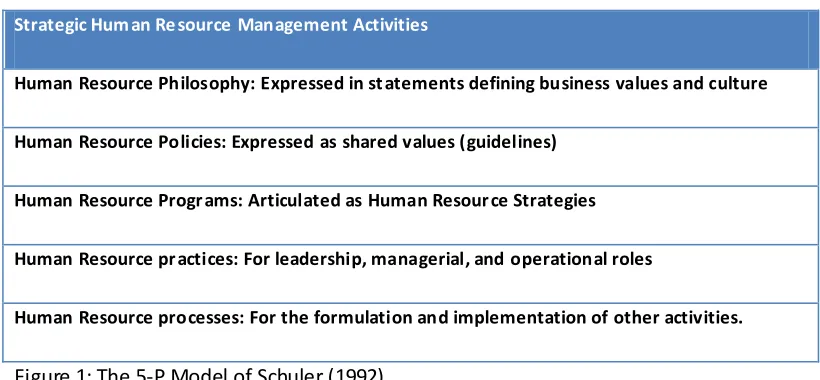
Researchers are looking for the holy grail of the connection between HRM and organization performance within the HRM literature (Huselid, 1995; Arthur, 1994; Wright, 1995; Gratton & Truss, 2003; Schuler & Jackson, 1987). Despite research about the “best practice” concept to discover a universal set of best HRM practices (Huselid, 1995; Arthur, 1994) and “best fit” research that focus on aligning HRM strategies to organizational strategies and environment (Wright, 1995; Gratton & Truss, 2003), there is no agreed conceptualization of how this relationship actually works. Many researchers advocate that for HRM to be successful, it should be embedded in the strategic needs of the firm. This means that there has to be a vertical alignment between the HRM strategy and the business goals (Gratton & Truss, 2003). HRM policies and practices should support and reinforce the business objectives in order to have a significant strategic role in the organization. For HRM policies and practices to reflect the business objectives, they should also be consistent and coherent to each other (Gratton & Truss, 2003). This is called horizontal alignment. The importance of horizontal and vertical alignment is discussed intensively in literature. They seem to go hand in hand but the two alignments operate at different levels. The fit of HRM with the business strategy, followed by consistency in HR choices was argued to be the initial purpose of HRM (Boxall & Purcell, 2008). Much writing about HRM argues that the horizontal and vertical alignment is sufficient. However, Schuler (1992) advocates that next to horizontal and vertical integration, HRM should ensure that HRM practices are accepted and used by line managers and employees as part of their everyday work. He suggested that HRM is comprised of five underlying levels: philosophy, policies, programmes, practices, and processes. According to Schuler (1992), a firm’s HR philosophy reflects “how the organization regards its human resources, what role the resources play in the overall success of the business, and how they are to be treated and managed. This statement is typically very general, thus allowing interpretation at more specific levels of action within an organization.”(Schuler, 1992, p.21 ) HR policies are statements that provide a procedure for action on HRM-oriented business matters
related to strategic needs. HR programmes are coordinated HR efforts that assist in implementing strategic business needs and HRM practices are used to obtain and reinforce needed behaviours by workers. Even the effectiveness of highly skilled employees can be limited when they are not motivated, but HRM practices can affect employee motivation by encouraging them to work better and harder (Huselid, 1995). Last but not least, HR processes define how activities are to be carried
17 Strategic Hum an Re source Management Activities
Human Resource Philosophy: Expressed in st atements defining business values and culture
Human Resource Policies: Expressed as shared values (guidelines)
Human Resource Progr ams: Articulated as Human Resour ce Strategies
Human Resource pr actices: For leadership, managerial, and operational roles
[image:17.596.64.474.97.287.2]Human Resource processes: For the formulation and implementation of other activities.
Figure 1: The 5-P Model of Schuler (1992)
The last level of HRM, HR processes, refers to implementation of HRM. Gratton and Truss (2003) advocate that this is a significant part of HRM although it has received little attention in literature. “The question of what actually happens once the strategy statement has been written or the policy document signed off has received scant attention” (Gratton & Truss, 2003, p.76). While HR managers are in general responsible for horizontal and vertical alignment, line managers have to make it happen in the day-to-day life of the organization. They are responsible for action and implementation of HRM practices.
Several researchers underline the difference between “intended” HRM practices and “implemented” HRM practices (Khiiji & Wang, 2006; Wright & Nishii, 2006). Intended HRM practices are practices formulated by HR professionals and senior management, whereas impleme nted HRM practices refer to practices implemented in organizations and experienced by employees (Khiiji & Wang, 2006). Although the presence of well designed intended HRM practices is important, implemented HRM practices impacts employees’ behaviour, motivation and satisfaction much more concrete than intended HRM practices. In other words, employees will be influenced not simply by management’ values and formal procedures but by the reality of what they perceive and experience on a daily basis (Boxall & Purcell, 2008).
18
2.2
Distribution of HR roles and responsibilities in an organization
Given this wide remit in HRM levels (Schuler, 1992), it should be obvious that HRM can never be the exclusive property of HR professionals. HRM is an aspect of all management jobs because it is an essential organizational process. Line managers, those who directly supervise employees engaged in the operations of the firm, are closely involved in HRM and almost always accountable for the performance of their team (Boxall & Purcell, 2008). “The HR function is not understood simply as the set of activities by the HR department, but as all managerial actions carried out at any level regarding the organization of work and the entry, development and exit of people in the organization so that their competencies are used at their best in order to achieve corporate objectives” (Valverde, 2001a, p. 19). Valverde et al. (2006) advocate that HRM activities are diverge in a wide range and are executed by a several different agents; this depends on the organization, its environment and other characteristics. They state that next to the HR department, top management, line management and external agencies are involved in HRM in organizations. The outcome of their research results in seven different groups with different ways to allocate HRM to the various agents. The group in which the HR function is the domain of the HR department supported by the line received the most support in their research.
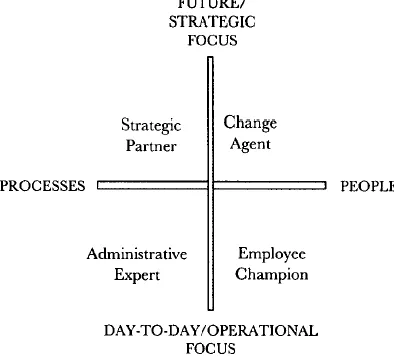
[image:18.596.197.394.540.719.2]Ulrich (1997) introduced a model that reinvented a new set of proactive roles of HR professionals. He defines four roles along two axes: strategy versus operations, and process versus people (see figure 2). “Strategic partners” aim to align the HRM practices with the organization’s choice of strategy and the organizations environment. “Administrative experts” implement an effective and efficient infrastructure. “Employee champions” increase the competences and commitment of employees. And “change agents” deliver organizational transformation and culture change.
19 Ulrich (1997) suggests that all four roles should be carried out simultaneously to create added value. But recent studies report an increased emphases on the strategic partner role of HR professionals (Hall and Torrington, 1998), which includes for example the design of HRM practices, HRM planning and industrial relations (Kulik & Bainbridge, 2006). People-focussed and operational HR roles are being devolved to line management as a consequence of the increased focus of HR professional on the strategic partner role (Hope-Hailey et al., 2005). What exactly is devolved and how it is devolved will vary considerably depending on each organization (Casco´n-Pereira et al., 2005). In general line managers are increasingly responsible for HR tasks like allocating individualized pay awards, appraisal, training and development, motivating teams and on the-job coaching (Cunningham & Hyman, 1995).
Some researchers state that the devolvement of HR roles to line managers is the end of the HR professional function (Storey, 1992), while others see opportunities for HR professionals to improve their presence at strategic level (Lowe, 1992; Gennard & Kelly, 1997). Both HR professionals and line managers are responsible for HRM and have to collaborate in a work relationship. Ulrich (1997) describes a vision of a successful and unproblematic partnership between line managers and the HR department: “Line managers of HR professionals acting in isolation cannot be HR champions, they must form a partnership. Line managers bring authority, power and sponsorship and have overall responsibility for the HR community. HR professionals bring technical expertise and a domain of final necessary competency credibility (Ulrich, 1997, p. 236)”. This is easier said than done, Schuler and Jackson (1997) note that this is not happening in all companies. According to Caldwell (2003) there is role conflict and ambiguity within the HR function because of competing demands made upon it by
20
2.3
Line managers’ limitations in implementing HRM
Line managers’ increased involvement in HRM has positive as well as negative sides (Renwick, 2003). “For example, by pushing HR decision making down to line managers, they should be able to make faster decisions that are more tailored to individual circumstances (Perry & Kulik, 2008, p. 263)”. Perry and Kulik (2008) examined the effect of devolution of HR tasks to line managers in organizations and they found that this has a positive effect on HRM effectiveness, as percei ved by HR professionals. However, many researchers expressed concern about line managers’ HR performance. Francis & Keegan (2006, p. 242) advocated that “it might be naïve to assume that line managers have the time, the training or the interest to give employee well-being the kind of priority it deserves”. Furthermore, McGovern et al. (1997) predicted that the prospects for devolvement to the line are not promising. “Attempts to devolve HRM to the line in any grand sense can only be regarded as quixotic“ (McGovern et al., 1997, p. 26).
The literature on devolution suggest that there are a number of limitations that can limit the performance of line managers in putting HRM policies in to practice (Renwick, 2002; McGovern et al., 1997; Whittaker & Marchington, 2003; Hall & Torrington, 1998, Gennard & Kelly, 1997). Line managers can have a lack of desire or capacity in implementing HRM. Besides, they do not have the right competences for managing people. Furthermore, line managers can experience difficulties because of a lack of support from the HR department or procedures and policies on how to execute their HRM responsibilities.
Line managers’ limitations in implementing HRM effectively are identified in case study research. In this research is underlined that these limitations are expected to reduce HRM implementation effectiveness of line managers (Renwick, 2002; McGovern et al., 1997; Cunningham & Hyman, 1995; Brewster & Larson, 2000). Based on these case studies hypothesis will be developed about the effect that line managers’ limitations have on their HRM implementation effectiveness.
21
2.3.1 Desire
Line managers can have a lack of desire or willingness to execute their HR responsibilities (McGovern et al., 1997; Harris et al., 2002; Cunningham & Hyman, 1999; Brewster & Larsen, 2000). However, willingness is essential for someone to perform effectively (Huselid, 1995). Some line managers are excited to have HR responsibilities as part of their function, but others are not and they express reluctance to execute these responsibilities. This reluctance can be the result of a lack of personal motivation. Line managers feel HR responsibilities are pushed upon them, while beforehand they
were the responsibility of the HR department (Harris et al., 2002).
Another reason for line managers’ lack of desire is that they do not feel any motivation in the form of institutional incentives. Their HR responsibilities are often not formally part of their performance
objectives or job descriptions (McGovern et al., 1997). Line managers have little motivation to invest in standardised and formal performance appraisals with subordinates because this would have scant influence on managers’ immediate performance goals. While such activity might be beneficial to both the organization and the individual it was not something which line managers considered to be a priority.
Line managers’ desire to perform HR tasks also depends on their understanding that executing HR tasks has added value for themselves, their employees and the organization. Line managers who recognize that executing HR tasks will benefit them are more willing to perform these tasks. However, some line managers feel that certain HR tasks should not be their responsibility (Hall & Torrington, 1996) and do not see the added value of spending time on the development of their employees because they do not understand that this can benefit themselves and their employees. It is remarkable, however, that more recent research of Whittaker & Marchington (2003) indicates that line managers claimed to be satisfied with the HR responsibilities that have been devolved to them and they are keen to take on activities that relate explicitly to the development of their team. When line managers want to perform HR tasks and realize that this gives them certain advantages, it is expected that they will perform their HR tasks more effectively:
Hypothesis 1: The more desire line managers have to perform HR tasks, the more effectively they will implement them on the work floor.
2.3.2 Capacity
22 than previously (McGovern et al., 1997). Besides, HR responsibilities are often devolved to line managers without reducing their original responsibilities (Brewster & Larsen, 2000). This places considerable pressure on their capacity to implement HRM next to their operational responsibilities. “Line managers report frustration that they are not able to devote sufficient time to HR issues, because harder priorities tend to dominate” (Whittaker & Marchington, 2003, p. 250). Cunningham and Hyman (1999) also observe in their research that dominance of hard priorities leave little time for line managers to devote to intangible areas, like the HRM aspects of their job.
The pressure of the operational tasks and the increasing HR responsibilities put excessive demands on line managers’ time and energy, and might result in role overload for line managers (McConville, 2006). Line managers perceive HR activities as a “poor second” to their more short term goals and this can result in devoting less attention to HR activities.“This short-range focus may result in people management that is fragmented, inconsistent and generally less effective” (Perry & Kulik, 2008, p. 263). To implement HRM practices effectively, it is important that line managers have sufficient capacity to implement HRM practices besides their (dominating) operational responsibilities. This leads to the following hypothesis:
Hypothesis 2: The more capacity line managers have to execute HR tasks next to their operational
tasks, the more effectively they will them on the work floor.
2.3.3 Competences
Many companies tend to promote line managers for their technical and engineering skills regardless of their business and people management competences (Gennard & Kelly, 1997). But when executing HRM responsibilities, line managers need knowledge and skills in HRM (Hall & Torrington 1998, Harris et al. 2002; Cunningham & Hyman, 1999). Many line managers lack these competences because they do not get sufficient training in HRM. Consequently, some authors have suggested that devolution may only be successful when organizations provide line managers with adequate training (Hall & Torrington, 1998; Renwick, 2003; Whittaker & Marchington, 2003). McGovern et al. (1997) suggests that low HRM competences of line managers are a significant constraint on effective devolution of HR responsibilities to line managers.
23 “Line managers’ skills and competences in HRM practices are limited and a lack of training in this area will undoubtedly affect a line managers” effectiveness” (McGuire et al., 2008, p.11). It is argued that line managers cannot execute their HR responsibilities effectively without the right competences or skills and therefore researchers advocate a need for their continual training (McGovern et al., 1997; Renwick, 2000). When line managers consider themselves more competent to exe cute HR responsibilities, for example because of training courses they followed, I assume their HRM implementation effectiveness will benefit:
Hypothesis 3: The more competent line managers perceive themselves to perform HR tasks, the more
effectively they will implement them on the work floor.
2.3.4 Support
Line managers need support from HR professionals to perform their HR tasks. Brewster and Larsen (2000) state that devolution of HR tasks to line managers is not possible without monitoring of HR professionals. Similarly, Lowe (1992) argues that if line managers were given sole responsibilities for HRM, they cannot perform at acceptable levels without the assistance of HR professionals. “In general are line managers without the support of HRM unlikely to acquire sufficient competences in people management skills to improve organizational effectiveness” (Gennard & Kelly, 1997, p. 35). HR professionals can coach and encourage line managers to perform their HRM activities. Unfortunately, HR professionals are not always willing to give line managers proper support because they do not want to give away responsibilities to the line managers (Hall & Torrington, 1998). The issue of accepting a changed role and using different skills applies to HR professionals as well as to line managers (Hall & Torrington, 1998). Some authors propose a partnership approach between line managers and HR professionals, where HR professionals need to become more involved in supportive, collaborative relationships with line managers (Tyson & Fell, 1992). However, Schuler and Huselid (1997) advocate that a partnership approach is an ideal situation between line managers and HR professionals but that it is not actually happening in practice.
24 Hypothesis 4: The more and better HR support line managers perceive toreceive from HR
professionals in performing their HR tasks, the more effectively they will implement them on the work
floor.
2.3.5 Policies and procedures
Line managers need to know what their HR role implies. Thus, what are their exact responsibilities? Still, many line managers believe that managing people is HR’s responsibility (McGovern et al., 1997). Case studies reveal there is significant perceptual divergence between line managers and HR professionals on aspects of line manager involvement in HRM (Maxwell & Watson, 2006; Harris et al., 2002). This implies that line managers are unclear about their HR role and responsibilities. According to McConville (2006), line managers can perceive role dissonance and ambiguity when their role is not clearly defined.
Furthermore, line managers need to know how they should execute their HRM responsibilities. Therefore, policies and procedures on how to execute HRM practices are important for line managers to perform their HR responsibilities successfully (Gennard & Kelly, 1997). If line managers lack these policies and procedures they might execute HRM practices according to their own understanding which can lead to inadequate and conflicting working methods (Harris et al., 2002). For that reason, HR professionals introduce frameworks, handbooks, toolkits and telephone headlines to make sure line managers use HRM practices the way they should. For example, line managers should know how to apply the appraisal system of an organization: on what qualities should they evaluate their employees, when do employees qualify for rewarding, what is the procedure after completing an appraisal and what is the role of the HR department?
Thus, it is important to consult line managers about their HR responsibilities and authorities (Lowe, 1992) and to remove potential bias in (and interpretation of) HRM practices by defining the way in which HR activities should be performed in practice. If this is not done, the lack of clarity on line managers’ HR role and responsibilities can reduce line managers’ HR performance (Gennard & Kelly, 1997).
Hypothesis 5: The more policies and procedures line managers have on their HR responsibilities and on how to execute HRM practices, the more effectively they will implement HR tasks on the work
25
2.4
Research model
Based on the formulated hypotheses, the research model is stated below:
Desire
Capacity
Competences
Support
Policies & procedures
EFFECTIVE HRM IMPLEMENTATION OF
LINE MANAGERS LINE MANAGERS’ LIMITATIONS
+
+ +
+
[image:25.596.69.480.126.499.2]+
26
3.
Methodology
To answer the research questions, I will perform statistical data analysis based on data that was collected by Nehles (2007-2008) in earlier research. In this chapter I will describe the operationalization of the independent and dependent variables and the reliability assessment performed to the test homogeneity of the items in the scales. Furthermore, I will describe the research population and data collection. Lastly, the preparation of data for the data analysis will be
explained.
3.1
Operationalization of concepts
3.1.1 Independent variable- Line managers’ limitations in implementing HRM
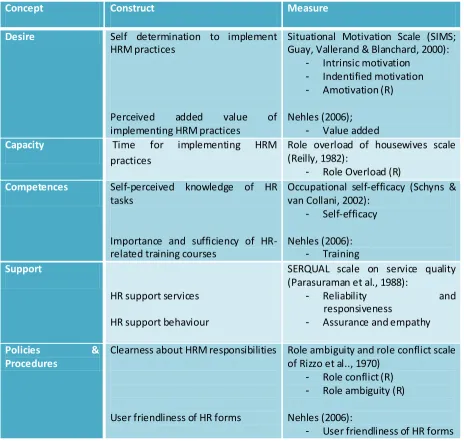
In order to measure the limitations that line managers can experience in their work, Nehles (2006) developed a questionnaire to examine how the limitations desire, capacity, competence, support and policies & procedures are perceived by line managers. The data referring to line managers’ limitations were measured on a five-point Likert scale ranging from 1 (disagree) to 5 (agree). Below the operationalization by Nehles (2006) for the five concepts are described.
Desire
To measure line managers’ desire to implement HRM practices, the constructs “self-determination” and “added value” are used.
In devolution literature authors distinguish between personal motivation and institutional motivation of line managers to implement HRM. The self-determination theory (Deci & Ryan, 1985) also differentiates between personal and institutional incentives. According to this theory, different types of motivation underlie human behaviour listed on a continuum from high to low levels of self-determination: intrinsic motivation, extrinsic motivation and amotivation. An intrinsically motivated person is engaged in activities for his own sake, for the pleasure and satisfaction derived from performing them (Deci, 1971). Extrinsic motivation refers to behaviours where the goals of action extent beyond those inherent in the activity itself, for instance by rewards (external regulation) or goals as being chosen by oneself (identified regulation). The amotivated behaviours are the least self-determined; a person experiences no sense of purpose and no expectations of reward or possibility of chancing the course of events. The self-determination theory is measured by means of the Situational Motivation Scale (SIMS: Guay, Vallerand & Blanchard, 2000).
27 because it is expected that line managers are more willing to perform HR tasks when they see the added value in these activities. These items were developed based on a pilot case study where 30 first line managers were interviewed. The added value items were developed based on the received answers on the question: “Why do you perform HR activities?”
Capacity
To measure whether line managers experience problems in spending sufficient time on HRM implementation, the construct “role overload” was used.
A very important reason for line managers’ capacity problems in implementing HRM is managerial short-termism. “Line managers report frustration that they are not able to devote sufficient time to HR issues, because operational tasks tend to dominate” (Whittaker & Marchington, 2003, p. 250). The pressure of operational tasks and the increasing HR responsibilities put excessive demands on line managers’ time and energy and might result in role overload for line managers (McConville, 2006). Line managers’ role overload is measured with a scale developed by Reilly (1982) on the role overload of housewives. Role overload of housewives occurs when the sheer volume of behaviour demanded of the wife exceeds her available time and energy. Nehles (2006) argues that line managers face a similar kind of role overload as housewives, but with differe nt conflicting demands; operational tasks versus HRM responsibilities. The items on the housewife’ scale were translated into time demands for line managers. For example, the original item reads: “I just can’t find the energy in me to do all the things expected of me”. This items is translated in: “I just can’t the energy in me to perform all the HR activities expected of me”
Competences
To measure line managers perceived competences, the constructs “occupational self -efficacy” and “training” are used.
28 Furthermore, items on the importance and sufficiency of the training courses were added, which were developed based on a pilot case study. The importance and sufficiency of training is discussed to have an effect on line managers’ competences and therefore researchers advocate a need for their continual training (McGovern et al., 1997; Renwick, 2000).
Support
To measure how line managers perceive the support they receive from HRM, the constructs “HR support service” and “HR support behaviour” were used.
The support that line managers receive from HR professionals can be regarded as HRM services. These HRM services imply content related advice and coaching on how to perform HR activities. The quality of services can be defined as the customers overall perception of the service (Parasuraman, 1988). According to theory of Parasuraman et al. (1988) service quality exist of 5 dimensions: tangibles (physical facilities, equipment, and appearance of personnel), reliability ( ability to perform the promised service dependably and accurately), responsiveness (willingness to help customers and provide prompt service), assurance (knowledge and courtesy of employees and their ability to inspire trust and confidence) and empathy (caring, individualized attention for the customers).
These items are based on the SERVQUAL scale on service quality (Parasuraman et al., 1988). This scale originally consists of these of five items, but Nehles (2006) used four of these items: reliability, responsiveness, empathy and assurance. Tangibles was not used because it is not applicable to the services delivered by HR professionals but more to the services provided for products.
Factor analysis showed that reliability and responsiveness refer to the construct “HR support service”, whereas respectively empathy and assurance refer to the construct “HR support behaviour”.
Policies & Procedures
To measure how line managers perceive the policies & procedures available on (how to execute) their HR responsibilities, the constructs “perceived clearness about HRM responsibilities” and “user friendliness of HR forms” are used.
29 1970). The items on this scale were reformulated so that they address the HR role of line managers, for example; the expression “policy” is reformulated into “HR policy”.
In addition, based on a pilot case study, items were developed on the user friendliness of HRM forms. This refers to clearness about how line managers should implement HRM practices. These items were added because if line managers lack clear policies and procedures on how to implement HRM practices, they might execute HRM practices according to their own understanding which can lead to inadequate and conflicting working methods.
[image:29.596.66.530.263.704.2]Summary
Table 1: Operationalization of the independent variable
Concept Construct Measure
Desire Self determination to implement HRM practices
Perceived added value of implementing HRM practices
Situational Motivation Scale (SIMS; Guay, Vallerand & Blanchard, 2000):
- Intrinsic motivation - Indentified motivation - Amotivation (R)
Nehles (2006); - Value added
Capacity Time for implementing HRM practices
Role overload of housewives scale (Reilly, 1982):
- Role Overload (R)
Competences Self-perceived knowledge of HR tasks
Importance and sufficiency of HR-related training courses
Occupational self-efficacy (Schyns & van Collani, 2002):
- Self-efficacy
Nehles (2006): - Training
Support
HR support services
HR support behaviour
SERQUAL scale on service quality (Parasuraman et al., 1988):
- Reliability and
responsiveness
- Assurance and empathy
Policies & Procedures
Clearness about HRM responsibilities
User friendliness of HR forms
Role ambiguity and role conflict scale of Rizzo et al.., 1970)
- Role conflict (R) - Role ambiguity (R)
Nehles (2006):
30
3.1.2 Dependent variable- HRM implementation effectiveness
In order to measure HRM implementation effectiveness of line managers, Nehles (2006) developed a questionnaire to measure how subordinates judge the HR performance of their line managers. The dependent variable, HRM implementation effectiveness, is thus measured based on perceptions of employees about their satisfaction of the way line managers implement HRM practices. The data referring to line managers’ implementation effectiveness were measured on a five-point Likert scale ranging from 1 (dissatisfied) to 5 (satisfied).
HRM implementation effectiveness is operationalized by Nehles (2006) based on the following HRM
practices:
Personnel administration; Recruitment & selection; Career management; Evaluation & rewarding; People management.
The selection of HRM practices is based on Truss (2001) and the operationalization is based on a selection of a list of 25 selected HR activities used by line managers identified by the contact HR manager in the case company (Nehles, 2006). For each HRM practice the respondents were asked to rate the effectiveness of line managers on several activities.
3.1.3 Control variables
I included some control variables in the statistical analysis to reduce the possibility of incorrect results because of correlations between variables. First of all, demographic variables are taken into account: line managers’ age, experience, education and span of control. Older and more experienced line managers may implement HRM more successfully than younger colleagues, not because of higher motivation or better policies & procedures, but simply because they have done it more often. Higher educated line managers might be more capable of applying knowledge in executing HRM practices than lower educated line managers. The span of control for smaller or larger groups of subordinates might affect line managers’ HRM implementation effectiveness because it might be more difficult to be responsible for a large group of employees. Secondly, one contextual variable is taken into account: the organization. The two organizations examined are different per sector, size and production.
31
3.2
Reliability assessment
Reliability assessment refers to the homogeneity of the items in a construct or the extent to which item responses correlate with the total test score (Hinkin, 1995). The most commonly accepted measure is internal consistency reliability using Cronbach’s Alpha. The Cronbach’s Alpha gives an indication of the extent to which a number of items in a scale measure the same construct.
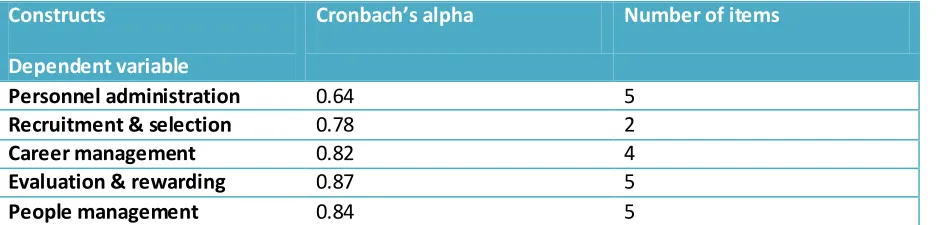
[image:31.596.65.532.300.487.2]A Cronbach’s Alpha of 0,70 or higher is considered acceptable. The constructs i n this research show good internal consistency. Except for the construct “personnel administration”; this construct is somewhat lower than the acceptable level of consistency. Nevertheless, “personnel administration” is kept as a construct in this research because it has theoretical value to form part of the dependent variable “HRM implementation effectiveness”.
Table 2: Cronbach’s alpha of constructs for the independent variable (line managers’ HR limitations)
Table 3: Cronbach’s alpha of constructs for the dependent variable (line managers’ implementation effec tiveness)
Constructs
Dependent variable
Cronbach’s alpha Number of items
Personnel administration 0.64 5
Recruitment & selection 0.78 2
Career management 0.82 4
Evaluation & rewarding 0.87 5
People management 0.84 5
3.3
Research population & data collection methods
Nehles (2007-2008) collected data in two case companies. The first company is a large international naval defence company that employs about 2000 employees in the Netherlands. The second case
Constructs
Independent variables
Cronbach’s alpha Number of items
Role overload 0.88 5
Self determination 0.79 9
Added Value 0.77 4
Self efficacy 0.80 5
Training 0.80 2
HR support services 0.76 3
HR support behaviour 0.80 4
Perceived clearness about HRM responsibilities
0.77 9
[image:31.596.67.535.536.649.2]32 study company is a medium sized construction company located in the North East of the Netherlands employing about 750 employees.
3.3.1 Independent variable: Line managers’ limitations in implementing HRM
For the independent variable, the research population is line managers at various levels in an organization, responsible for the supervision of a team of employees. The questionnaire was adapted to the company language and situation by the HR managers of the company. Nehles (2007-2008) developed an online survey to use in both case companies, but could only use this in the construction company. In the naval defence company employees have no access to the internet and therefore the questionnaire was sent to line managers’ home addresses by mail. The population consisted of 254 line managers: 149 from the naval defence company and 105 in the construction company. Nehles (2007-2008) used a four-phase administration process as suggested by Salant and Dilman (1994). This included sending a short advance notice mail to the whole population. Next, the actual survey or e-mail with the link to the online survey was send, together with a signed letter to the respondent or some information about the survey in the e-mail respectively. This was sent to the respondents a week after the short advance notice e-mail. After that, Nehles (2007-2008) send reminder e-mails one and three weeks after sending the survey, without distinguishing betwee n respondents and non-respondents, since the survey was anonymous.
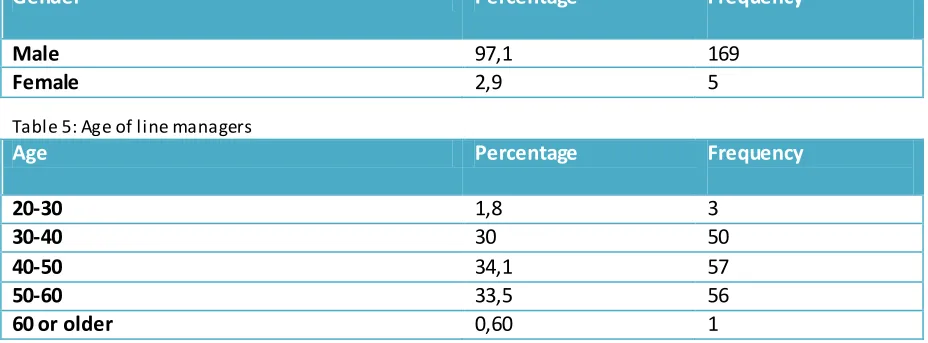
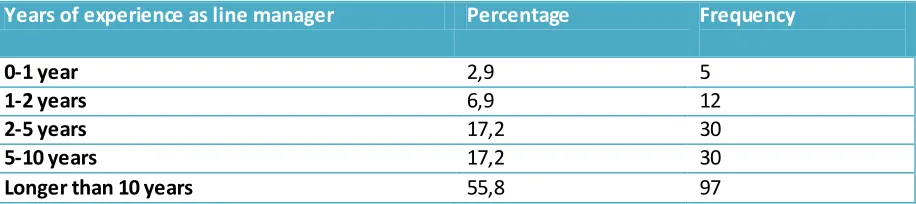
Line managers had three weeks to complete the survey which took about twenty minutes to fill in. 179 line managers participated in the research. After cleaning the responses, Nehles (2007-2008) ended up with a sample of 174 line managers: 108 in the naval defence company and 66 in the construction company. This represents a response rate of 69 percent. According to Babbie (2003) a response rate of 60 percent or more is considered good and a response rate of at least 70 percent is considered very good. Below are a few characteristics of the line managers sample:
Table 4: Gender of line managers
Gender Percentage Frequency
Male 97,1 169
[image:32.596.65.529.576.748.2]Female 2,9 5
Table 5: Age of line managers
Age Percentage Frequency
20-30 1,8 3
30-40 30 50
40-50 34,1 57
50-60 33,5 56
33 Table 6: Educational level of line managers
Education Percentage Frequency
Secondary 4,6 8
Vocational 19 33
[image:33.596.69.527.190.292.2]Tertiary 76,4 133
Table 7: Experience as line manager
Years of experience as line manager Percentage Frequency
0-1 year 2,9 5
1-2 years 6,9 12
2-5 years 17,2 30
5-10 years 17,2 30
Longer than 10 years 55,8 97
Table 8: Line managers’ span of control
Span of control Percentage Frequency
0 0,6 1
1 up to and including 5 17 29
6 up to and including 10 25,6 44
11 up to and including 15 12,8 22
16 up to and including 20 17 29
21 up to and including 25 7 12
26 or more 20 35
3.3.2 Dependent variable- HRM implementation effectiveness
For the dependent variable (the effectiveness of HRM implementation), the research population is the most important stakeholders of line managers: their subordinates. Subordinates are in the utmost position to judge line managers’ implementation effectiveness, since they experience the implementation of HRM practices by line managers on a day-to-day basis.
[image:33.596.66.530.319.450.2]34 had three weeks to fill in the questionnaire. During these three weeks, Nehles (2007-2008) send three reminder emails per e-mail as well as per mail. The response rate was 62 percent, which includes a sample of 72 employees.
For the naval defence company the procedure was different. For this company the questionnaire was sent as part of the yearly employee people survey to all employees of the company. The population consisted of 1907 employees. The questionnaire was sent by mail to the home address of the employees. The administration of the questionnaires for the naval defence company was performed by the Oakdale Group Consultancy. 993 employees participated in the sample. This represents a response rate of 52 percent.
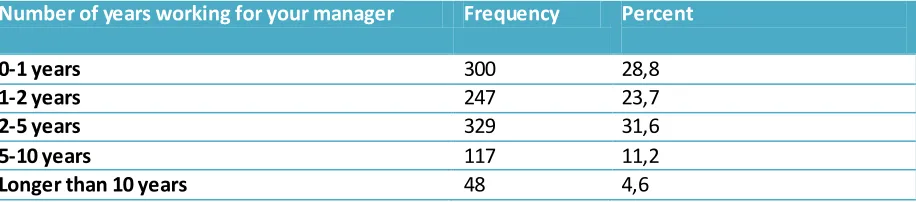
The sample of both companies together is 1065 employees. Below are a few characteristics of the
[image:34.596.66.539.316.416.2]subordinates sample:
Table 9: How long do you work for your company?
Number of years working for the company Frequency Percent
0-1 years 78 7,4
1-2 years 61 5,8
2-5 years 70 6,6
5-10 years 141 13,4
Longer than 10 years 702 66,7
Table 10: How long do you work for you current manager?
Number of years working for your manager Frequency Percent
0-1 years 300 28,8
1-2 years 247 23,7
2-5 years 329 31,6
5-10 years 117 11,2
Longer than 10 years 48 4,6
3.4
Preparation for data analysis
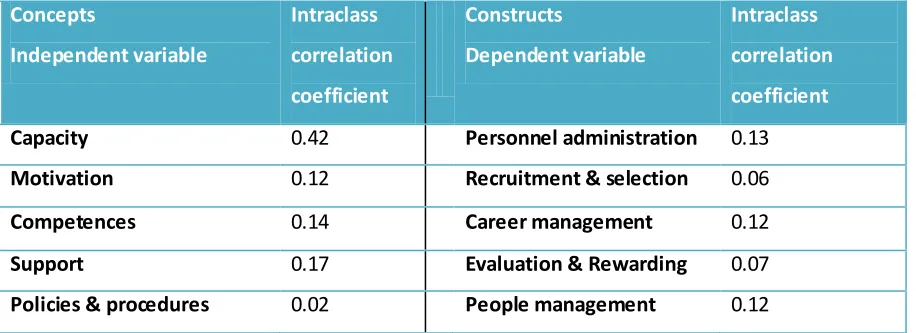
[image:34.596.72.530.443.544.2]35 questions/2 + 1) valid answers. After calculating the means, some constructs needed to be reverse coded, since some questions were asked negative instead of positive.
Next, I cleaned up the datasets; I kept only the means per construct. I merged the datasets for the two case companies and generated two datasets: one for the line managers sample and one for the employee sample.
In order to conduct analysis about the relationship between line managers’ limi tations and their effectiveness as perceived by employees, the dataset from line managers needed to be matched with the dataset of their subordinates. Unfortunately, it was not possible to match subordinates individually to their line managers, because of the quarantined anonymity of the line managers in the organizations. However, it was possible to determine which employee belongs to which line manager based on department numbers. But in most cases, a department consisted of multiple employees (average 9,8 per department). Sometimes, there were also multiple line managers per department (average 1,9 per department). Therefore, the datasets needed to be aggregated in order to calculate means of line managers and employees per department.
[image:35.596.66.524.579.746.2]However, in order to do this, the answers of line managers in a department and the answers of employees in a department should not vary too much from each other. The mean is not a reliable indicator when the variation in responses is high. To verify this, I calculated an intraclass correlation coefficient. This assesses the inter-rater reliability within and between groups (Bliese, 2000). It describes how strongly units in the sample resemble each other. There are different forms of intraclass correlation coefficients (ICC). I used a ICC(1) calculation which represents a form of proportional consistency. James (1982) interprets the ICC (1) as the degree of reliability associated with a single assessment of the group mean. He interprets the ICC (1) as an index of inter -rater reliability, which is why he recommends using it as a criterion for aggregating. The ICC’s (1) are as following:
Table 11: Intraclass correlation coefficients
Concepts
Independent variable
Intraclass correlation coefficient
Constructs
Dependent variable
Intraclass correlation coefficient
Capacity 0.42 Personnel administration 0.13
Motivation 0.12 Recruitment & selection 0.06
Competences 0.14 Career management 0.12
Support 0.17 Evaluation & Rewarding 0.07
36 Bliese (2000) advocates that ICC(1) values between 0,05 and 0,20 are common. Therefore, the values of the dependent variable show excellent inter-rater reliability for all of the construct. For the independent variables are also most of the construct coefficients are between these values, except for the concepts capacity and policies and procedures. Fortunately, most of the values demonstrate very good inter-rater reliability for the concepts and constructs.
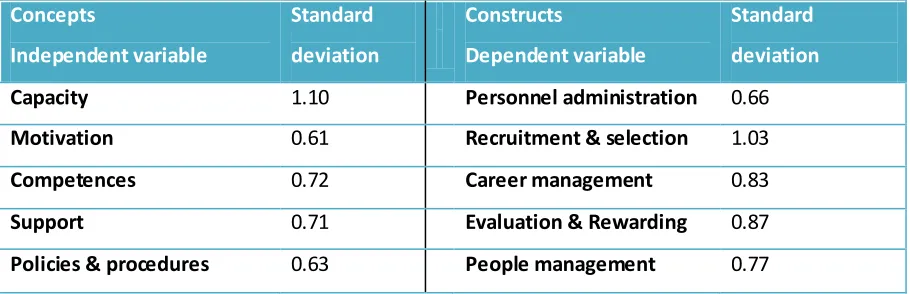
[image:36.596.66.521.398.545.2]Next to the ICC(1) calculations, standard deviations of the responses per department were calculated. A standard deviation is a measure of the variability or dispersion of a population. In other words: it is the average dispersion of the mean. A low standard deviation indicates that the responses tend to be very close to the same value (the mean), while a high standard deviation indicates that the responses are spread out over a large range of values (Moore & McCabe, 2006). A standard deviation lower than 0,8 is considered acceptable, based on a five point Likert scale. The standard deviation of in the responses of the line managers and employees per departments were in general low, in most cases lower than 0,8. This entails that employees and line managers gave similar responses per department, which produces a reliable mean. The average standard deviations for the departments are presented in table 12.
Table 12: Average standard deviations for the departments
Concepts
Independent variable
Standard deviation
Constructs
Dependent variable
Standard deviation
Capacity 1.10 Personnel administration 0.66
Motivation 0.61 Recruitment & sele