Abstract- Among available level set based methods in image segmentation, Fast Two Cycle (FTC) model is efficient and also the fastest one. But its efficiency is highly dependent to contour initialization. This paper tries to improve this method by using a kernel-based fuzzy c-means (KFCM) clustering algorithm. The proposed approach consists of two successive stages for image segmentation. Firstly, the KFCM is used to cluster the input image. Then ROI’s fuzzy membership matrix is used for next stage as an initial contour. Eventually, FTC model is utilized to segment the image by curve evolution based on level set. As a result, two benefits are provided for image segmentation in addition of advantages of FTC model. They are independency of curve initialization and reduction of user intervention. Experimental results show promising outputs in segmentation of different kinds of image including medical data imagery, natural scene and synthetic data.
Index Terms—Image Segmentation, Curve Evolution, Kernel-based Fuzzy C-Means Clustering, Geometric Active Contours, Level Set
I. INTRODUCTION
egmentation is a crucial step in image analysis and effect on the efficiency of image analysis extremely[1]. There are some factors that make segmentation complex such as noise, contrast variation, inhomogeneity of object boundary, motion blurring artifacts and so on [2] . These factors cause to develop a plenty of researches and several approaches in image segmentation. Moreover some tools are available for segmentation of different kind of image like medical images[3]. Nevertheless it has been remained a challenging area yet. There are a highly growing interest in this field as well[4].
Among available segmentation methods, Level set-based geometric active contour by using the theory of curve evolution shows promising results in complicated images like medical images[5]. Because it can capture the topology of shapes and are robust in noisy images. But this method [5, 6] has some drawbacks. Some researches proposed several level set-based methods to solve them. Consequently, seven different level-set algorithms were formed. Each method can solve a part of drawbacks but cause some other problems.
Manuscript received December 30, 2011; revised January 27, 2012. Maryam Rastgarpour is an instructor with the department of Computer Engineering, Saveh branch, Islamic Azad University, Saveh, Iran. (E-mail:[email protected]; [email protected]) Siavash Alipour is a M. SC. Student with the Department of Computer Engineering at Tarbiat Moallem University-Tehran, I. R. Iran.
(E-mail: [email protected])
Dr. Jamshid Shanbehzadeh is an associate professor with the Department of Computer Engineering at Tarbiat Moallem University-Tehran, I. R. Iran. (E-mail: [email protected] )
Table 1 presents problems of level set based methods and corresponding available method to solve it.
[image:1.595.307.549.412.596.2]Fast Two Cycle Algorithm with Smoothness Regularization which has been proposed by Shi and Karl [7], is the fastest method among level-set based ones while retaining significant accuracy[2]. So it can be called as the most efficient level-set based method which has ever been proposed. But its result is high dependent on curve initialization. In fact, initial curve doesn’t consider any topological constraints but should enclose the region of interest (ROI) and touch every object and background region. Figure 1 shows the dependency of FTC Model on curve initialization in different kinds of images including medial data (first row), real data (second row) and synthetic one (third row). From left to right, an improper curve initialization in the first column leads to wrong segmentation in second column. While a proper one in the third column results in accurate segmentation in forth column.
Figure 1 Dependency of Shi Model on curve initialization. From left to right columns – first and third: curve initialization in red; second and forth: results of segmentation in magenta and reference contours in white.
This paper tries to improve FTC model by focusing on initialization step and derives a benefit of Kernel Fuzzy C-Mean Clustering algorithm[8] to dominant the high dependency on curve initialization.
The rest of paper is organized as follows. Section II introduces KFCM clustering and FTC model. Section III proposed approach is described. Experimental results are presented in Section IV. Finally this paper concludes in section V.
S
Improved Fast Two Cycle by using KFCM
Clustering for Image Segmentation
Table 1 Problems of level set-based methods and corresponding proposed method to solve it
Problem Proposed method
Fails in Ambiguous and discrete edges Geodesic Active Contour [9] Noise sensitivity Active contours without edge [10] Depending on curve initialization Variational B-Spline Level set [11] Re-initialization of sign distance function Evolution without re-initialization [12]
Unsuccessful to find interior contour of an object Variational B-Spline Level set [11] and Region-Scalable Fitting Energy[13] Fails in inhomogeneous region Region-Scalable Fitting Energy[13], Localizing Region-Based Active Contours[14] Computational complexity Fast Two-Cycle Algorithm With Smoothness Regularization[7]
II. BACKGROUND
This paper uses KFCM clustering and FTC model for image segmentation. So some basic information about KFCM clustering method and FTC Model (an efficient kind of curve evolution algorithm based on level set for image segmentation) is explained in the following.
A. KFCM Clustering
A Kernel-Based Fuzzy C-Means clustering(KFCM) algorithm has been proposed by Zhang et al [15, 16] with strong noise robustness. In fact, it is obtained just by replacing a new kernel-based metric in the original Euclidean norm metric of FCM.
The KFCM partitions a dataset { } , where P the dimension, into c fuzzy subsets by minimizing the following objective function :
( ) ∑ ∑ ‖ ( ) ( )‖
(1)
where is the number of clusters and determined by a prior knowledge , i.e. c=4 for brain image; is the number of data points; is the fuzzy membership of in class ; is a
weighting exponent on each fuzzy membership and controls clustering fuzziness (usually ); is the set of cluster centers or prototypes ;and is an implicit nonlinear map. It’s better to mention that is a member of [0,1] and
must satisfy∑ and ∑ . In feature
space, a kernel can be a function which is called K, where ( ) 〈 ( ) ( ) 〉 and 〈 〉 is the inner product. So:
‖ ( ) ( )‖ ( ( ) ( )) ( ( ) ( )) ( ) ( ) ( ) ( ) ( ) ( ) ( ) ( ) ( ) ( ) ( )
(2)
There are some popular kernel functions in [17]. In this paper we use Gaussian Radial basis function (GRBF) kernel ( ) ( ‖ ‖ ) where is the width parameter, then:
( ) (3)
By substituting Eq. (2) and Eq. (3) in Eq. (1), we have:
( ) ∑ ∑ ( )
(4)
Similar to FCM, the optimization problem comes to minimize ( ) under the constraints of . Then:
( ( )) ( ) ∑ ( ( )) ( )
(5)
, and:
∑ ( ) ∑ ( )
(6)
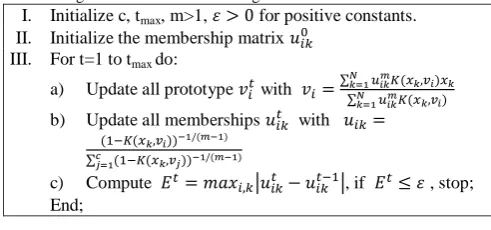
Summarization of KFCM algorithm is described in Table 2. In this algorithm, similarity measure in FCM, i.e. Euclidean norm metric, is replaced by a new kernel-induced metric (in this paper, Gaussian kernel) which makes the weighted sum of data points more robust. So this algorithm is a robust clustering approach if an appropriate value for sigma would be chosen. It’s obtained by trial-and-error technique or experience or prior knowledge which neither too large nor too small. We consider 150 for sigma like [15] does. As mentioned in [15], KFCM needs to be improved for image segmentation. This paper applies the power of curve evolution based on level set to increase the efficiency of segmentation by KFCM.
Table 2 Algorithm of KFCM clustering
I. Initialize c, tmax, m>1, for positive constants.
II. Initialize the membership matrix
III. For t=1 to tmax do:
a) Update all prototype with ∑∑ ( )
( )
b) Update all memberships with
( ( )) ( ) ∑ ( ( )) ( )
c) Compute | |, if , stop;
End;
B. Fast Two Cycle Model
Shi and Karl [14] approximates the level-set function in a narrow band using an integer valued array. They used a fast two-cycle (FTC) algorithm instead of solving Partial Differential Equations (PDEs) to speed up the computations. The basic idea is using of two cycle for curve evolution, one cycle for data-dependent term and another one for smoothness regularization. Implicit function is approximated by a piece wise constant function and defined by only four values for fast computation:
( ) {
(7)
Where
{
{ | ( ) } { | ( ) }
( ) { | ∑| |
}
[image:2.595.301.547.370.485.2]points D\Ω as the background region. The interior points are those grid points inside C but not in Lin and similarly, the
exterior points are those points outside C but not in Lout.
This function approximates the signed distance function locally.
Their algorithm can apply some evolution speeds that composed of a data-dependent term and a curve smoothness regularization term. So the general speed function F is .
In this paper we use speed function of CV model[9] for data-dependent speed, :
( ( ))( ( ) ) (
( ( )))( ( ) )
(8)
Where I is the intensity, is Heaviside function which is defined as ( ) {
,
∫ ( ( ( ))) ( )
∫ ( ( ( ))) , and
∫ ( ( )) ( )
∫ ( ( )) .
Then they just use the sign of evolution speed function F.
So, ̂ {
They use MBO algorithm [18, 19] for smoothing speed,
, which is derived Gaussian filtering:
̂ {
( )( )
( )( )
where is the convolution operation.
[image:3.595.298.556.195.709.2]This algorithm is fast enough to apply in real-time application. The cause is that the evolution steps use only integer operations in both cycles by two simple element switching mechanisms between two linked lists. They called these mechanisms, switch_in to move the boundary outward by one grid point at that location and similarly switch_out to move the boundary inward. The algorithms of Switching Mechanisms and FTC algorithm for image segmentation are represented in Table 3 and Table 4 respectively.
Table 3 Switch_in and Switch_out algorithms
Switch_in(x)
For a point
1. Delete x from Lout.
2. Add those N(x) which were exterior points to Lout.
3. Insert x to Lin.
Switch_out(x)
For a point
1. Delete x from Lin.
2. Add those N(x) which were interior points to Lin. 3. Insert x to Lout.
III. PRPOSED APPROACH
The efficiency of FTC model depends on curve initialization extremely. Because of curve evolves just in a narrow band
of initial curve. This paper uses the KFCM clustering to improve and automate image segmentation.
The proposed approach consists of two successive stages to integrate FTC model with KFCM clustering for image segmentation. Firstly, the KFCM is used to extract ROI’s fuzzy membership matrix. Secondly, zero level set is initialized using this matrix and curve would be evolved iteratively by FTC model to converge and segment the ROIs. It can be seen in Table 5 The algorithm of proposed method and in Figure 2 Framework of roposed approach.
Table 4 FTC Algorithm for image segmentation by curve evolution based on level set[14]
1. Initialize following values:
a) , ̂ and ̂ based on initial curve.
b) tmax ( predefined maximum iterations)
2. Cycle 1: data dependent evolution For i=1 to Nado
a) Compute Fdfor each point in Lout and Lin and store its sign in
̂, so:
̂ {
b) Outward evolution:
For each point x Lout , if ̂(x) > 0: switch_in(x).
c) Eliminate redundant points in Lin.
For each point x Lin, if ∀y N(x), φ (y) < 0:
i. Delete x from Lin
ii. Set φ (x) = −3.
d) Inward evolution. For each point x Lin, if ̂(x) < 0: switch_out(x)
e) Eliminate redundant points in Lout. For each point x Lout, if ∀y
N(x), φ (y) > 0,
i. Delete x from Lout
ii. Set φ (x) =3.
f) Check following stopping condition, if it is satisfied, go to 3;
otherwise continue this cycle.
I. The speed at all the neighboring grid points satisfies:
̂( ) {
II. T = tmax
End;
3. Cycle 2: smoothing via Gaussian filtering For i=1 to Nsdo
a) Compute the smoothing speed ̂ for each point in Lout and Lin. b) Outward evolution. For each point x Lout , if ̂ (x) > 0:
switch_in(x).
c) Eliminate redundant points in Lin. For each point x Lin, if ∀y
N(x), φ (y) < 0:
i. Delete x from Lin
ii. Set φ (x) = −3.
d) Inward evolution. For each point x Lin,) if ̂ (x) < 0:
switch_out(x).
e) Eliminate redundant points in Lout. For each point x Lout, if ∀y
N(x), φ (y) > :
i. Delete x from Lout
ii. Set φ (x) = 3.
End;
4. If stopping condition not satisfied in 2, go to 2.
Figure 2 Framework of roposed approach
IV. EXPERIMENTAL RESULT
To evaluate proposed approach, the authors use different kinds of images including medical data imagery, natural scene and synthetic data. They simulated the proposed
Input Image
Preproces sing
KFCM
clustering
Segmenta tion by FTC Model
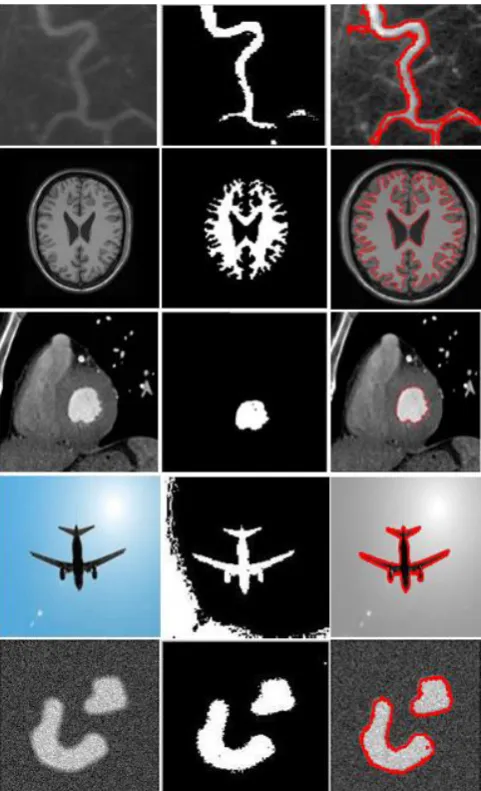
[image:3.595.68.268.582.710.2]approach in Matlab 2008. The information of input images in Figure 3 are as follows: Vessel image borrowed from [12]( first row); Brain image borrowed from [22](second row); Airplane image borrowed from [23](forth row); finally two object image borrowed from [2](last row).
Table 5 The algorithm of proposed method (KFCM+FTC)
1. Stage 1: the KFCM clustering
i. Set value of c, tmax (maximum iteration number), m=2, , .
ii. Continue from step 2 in Table 2 which consists of KFCM algorithm
iii. Extract ROI’s fuzzy membership matrix.
2. Stage 2: Curve evolution by Shi model
i. Initialize the zero level set using the output matrix of stage 1(part iii) with following function [20, 21] :
( ) {
ii. Continue from step 1 in Table 4 which consists of the algorithm of FTC Model
End;
In implementation of KFCM, the parameters m and are fixed for all input images while the number of clusters, parameter c, varies with respect to input image. It is determined based on prior knowledge of image. It was set value “3” for the images of vessel, bone, airplane and two objects; and value “4” for brain images in our simulation.
The algorithm of FTC model (Table 4) has four parameters, Na, Ns, Ng and . Na controls data-dependent speed and three other ones effects on smoothing regulation speed. Their experimental showed that their method is robust with respect to perturbation of these parameters [14]. So these parameters are generally chosen as follows: Na=30, Ns=3, Ng=3 and similar to those they applied. The max iteration, tmax, was considered 200 as well.
Figure 3 shows the simulation result of proposed approach. From left to right, first column is original image, second column is the result of KFCM clustering, and the last one is the result of integrating KFCM with FTC model (proposed approach). The second column shows that the KFCM clustering can’t operate well alone. Moreover FTC model is high dependent on initial curve as depicted on figure 1. The third column of figure 3 illustrates promising result of this integrating where ROIs boundaries, i.e. segmentation result is in red.
V. CONCLUSION
This paper derives the benefit of Curve evolution by FTC model and the KFCM clustering for image segmentation by integrating them. In fact, FTC model is so efficient in terms of computational complexity and accuracy among available image segmentation method based on curve evolution by level set. But it’s dependent on curve initialization extremely. This paper uses fuzzy membership matrix of KFCM for initial curve to solve this problem. Simulation result shows promising outputs for segmentation of different kinds of image including medical data imagery, natural scene and synthetic data.
Figure 3 Simulation result for different kinds of images, the columns from left to right: original image, result of KFCM, result of proposed approach in red.
REFERENCES
[1] R. C. Gonzalez and E. Richard, "Woods, digital image processing," ed: Prentice Hall Press, ISBN 0-201-18075-8, 2002.
[2] T. Dietenbeck, et al., "CREASEG: a free software for the evaluation of image segmentation algorithms based on level-set," in Image
Processing (ICIP), 17th IEEE Int. Conf. on Hong Kong, pp. 665-668,
2010.
[3] M. Rastgarpour and J. Shanbehzadeh, "Application of AI Techniques in Medical Image Segmentation and Novel Categorization of Available Methods and Tools," Lecture Notes in Engineering and Computer Science, vol. 2188, p.p. 519-523, 2011.
[4] M.Rastgarpour and J. Shanbehzadeh, "The Problems, Applications and Growing Interest in Automatic Segmentation of Medical Images from the year 2000 till now," in ICICA, Dubai, pp. 409-412, 2011.
[5] J. S. Suri, et al., "Shape recovery algorithms using level sets in 2-D/3-D medical imagery: A state-of-the-art review," Information Technology in
Biomedicine, IEEE Transactions on, vol. 6, pp. 8-28, 2002.
[6] V. Caselles, et al., "A geometric model for active contours in image processing," Numerische Mathematik, vol. 66, pp. 1-31, 1993. [7] R. Malladi, et al., "Shape modeling with front propagation: A level set
approach," Pattern Analysis and Machine Intelligence, IEEE
Transactions on, vol. 17, pp. 158-175, 1995.
[8] V. Caselles, et al., "Geodesic active contours," INTERNATIONAL
JOURNAL OF COMPUTER VISION, vol. 22, pp. 61-79, 1997.
[9] T. F. Chan and L. A. Vese, "Active contours without edges," Image
Processing, IEEE Transactions on, vol. 10, pp. 266-277, 2001.
[10] O. Bernard, et al., "Variational B-spline level-set: a linear filtering approach for fast deformable model evolution," Image Processing,
[image:4.595.44.293.135.279.2][11] C. Li, et al., "Level set evolution without re-initialization: a new variational formulation," in Computer Vision and Pattern Recognition
(CVPR) IEEE Computer Society Conference on, pp. 430-436 vol. 1,
2005.
[12] C. Li, et al., "Minimization of region-scalable fitting energy for image segmentation," Image Processing, IEEE Transactions on, vol. 17, pp. 1940-1949, 2008.
[13] S. Lankton and A. Tannenbaum, "Localizing region-based active contours," Image Processing, IEEE Transactions on, vol. 17, pp. 2029-2039, 2008.
[14] Y. Shi and W. C. Karl, "A real-time algorithm for the approximation of level-set-based curve evolution," Image Processing, IEEE
Transactions on, vol. 17, pp. 645-656, 2008.
[15] D. Q. Zhang and S. C. Chen, "A novel kernelized fuzzy c-means algorithm with application in medical image segmentation," Artificial Intelligence in Medicine, vol. 32, pp. 37-50, 2004.
[16] D. Q. Zhang, et al., "Kernel-based fuzzy clustering incorporating spatial constraints for image segmentation," in Proc. of the 2th Int.
Conf. on Mach. Lear. and Cyb., pp. 2189-2192 Vol. 4, 2003.
[17] K. R. Muller, et al., "An introduction to kernel-based learning algorithms," Neural Networks, IEEE Transactions on, vol. 12, pp. 181-201, 2001.
[18] B. Merriman, et al., Diffusion generated motion by mean curvature: Dept. of Mathematics, University of California, Los Angeles, 1992. [19] B. Merriman, et al., "Motion of multiple junctions: A level set
approach," Journal of computational physics, vol. 112, pp. 334-363, 1994.
[20] N. Ray and S. T. Acton, "Image segmentation by curve evolution with clustering," in Proc. of 34th Asilomar Conf.on Sig., Sys., and
Computers. Pacific, Grove, CA, USA, pp. 495-498 vol. 1, 2000.
[21] Y. Wu, et al., "Brain MRI segmentation using KFCM and Chan-Vese model," Transactions of Tianjin University, Springer, vol. 17, pp. 215-219, 2011.
[22] Available in Insight Segmentation and registration Toolkit (ITK), an open source and cross platform system: http://www.itk.org/

![Table 4 FTC Algorithm for image segmentation by curve evolution based on level set[14] 1](https://thumb-us.123doks.com/thumbv2/123dok_us/1284278.657117/3.595.298.556.195.709/table-algorithm-image-segmentation-curve-evolution-based-level.webp)