Systemic Classification and its Efficiency
C h r i s B r e w "
D e p a r t m e n t of Experimental P s y c h o l o g y a n d
H u m a n C o m m u n i c a t i o n Research Centre
This paper examines the problem of classifying linguistic objects on the basis of information
encoded in the system network formalism developed by Halliday. It is shown that this problem
is NP-hard, and a restriction to the formalism, which renders the classification problem soluble
in polynomial time, is suggested. An algorithm for the unrestricted classification problem,
which separates a potentially expensive second stage from a more tractable first stage, is then
presented.
1. Introduction
In this p a p e r we describe algorithms that enable the system n e t w o r k s of Systemic G r a m m a r (HaUiday 1976, 1975) to be exploited in applications, such as natural lan- guage u n d e r s t a n d i n g , that require incremental description refinement. We are attracted to the system n e t w o r k formalism on three main counts:
Potential Reversibility. System networks fit well with a m o d e l of linguistic b e h a v i o r as goal-directed action, since they e n c o d e grammatical information in the f o r m of sets of interconnected choices that a language user needs to make in order to p r o d u c e apposite a n d c o m m u n i c a t i v e utterances. It seems natural to exploit this information for c o m p r e h e n s i o n as well as generation.
Computational Convenience. System n e t w o r k s look simple, yet are expressive e n o u g h to allow the d e v e l o p m e n t of substantial grammars. If this a p p a r e n t simplicity is re- flected in the mathematical properties of the system n e t w o r k formalism then it m a y be possible to design cheap description refinement algorithms that use the networks. Wider Applications. If the n e t w o r k s turn out to be easy to process, they m a y have w i d e r applications in tasks requiring representation of nonlinguistic knowledge. We think that the tasks for which such n e t w o r k s are most likely to be a p p r o p r i a t e are those for which conventional taxonomic representations are nearly, but not quite, sufficient. O u r algorithms (presented in the final part of this paper) operate b y converting as m u c h as possible of the information contained in the networks to taxonomic form.
• University of Sussex, U.K., and 2 Buccleuch Place, Edinburgh, U.K., currently at Sharp Laboratories of Europe Ltd., Oxford, U.K. Supported by a studentship provided by the Science and Engineering Research Council's Information Technology Initiative. I am grateful to several colleagues for constructive discussions of this work, and particularly to Stephen Isard and Robert Dale, who were kind enough to provide detailed commentary on earlier drafts. I am also indebted to two anonymous referees for suggestions that substantially improved the paper. None of those mentioned are
Computational Linguistics Volume 17, Number 4
question
ANIMACY
PN
personal PERSON
demonstr
f
[image:2.468.51.387.74.400.2]PLACE I
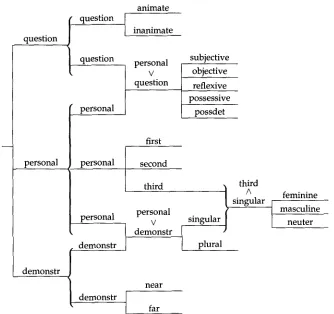
Figure 1
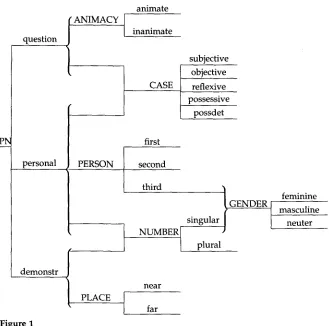
Winograd's pronoun network.
animate inanimate
CASE
first second
third
subjective objective reflexive possessive
possdet
singular NUMBER I plural
near far
I feminine GENDER masculine
neuter
In this paper we shall be presenting formal arguments about the capabilities of the system network formalism, working at a level of detail that would make the pre- sentation of large scale linguistic examples prohibitively tedious. Our main example will therefore be the network shown in Figure 1. This network provides information about the choices a speaker needs to make in order to correctly produce English pro- nouns. Similar networks can describe the choices that have to be made in order to generate other components of an utterance, such as sentences, verb phrases, or into- nation contours, but for present purposes pronouns will prove sufficient illustration. We have applied the ideas described in this paper to a parsing system that accepts the language generated by the grammar of a pre-existing (Houghton 1986; Houghton and Isard 1987) dialog generation system.
Chris Brew
Systemic Classification and its Efficiency
Realization Rules
question animate subjective
~ w h oquestion animate objective
~ w h o mquestion animate possessive
---* w h o s equestion inanimate
--* w h a tdemonstr singular near
--, t h i sdemonstr singular far
~ t h a tdemonstr plural near
--* t h e s edemonstr plural far
- * t h o s epersonal first singular subjective
--* I
personal first singular objective
--* m epersonal first singular reflexive
--* m y s e l fpersonal first singular possessive
---* m i n epersonal first singular possdet
--* m ypersonal second singular subjective
~ y o upersonal second singular objective
--* y o upersonal second singular reflexive
--* y o u r s e l fpersonal second singular possessive
--* y o u r spersonal second singular possdet
~ y o u rpersonal first plural subjective
~ w epersonal first plural objective
- * u spersonal first plural reflexive
--* o u r s e l v e spersonal first plural possessive
--* o u r spersonal first plural possdet
--. o u rpersonal second plural subjective
--* y o upersonal second plural objective
- * y o upersonal second plural reflexive
--* y o u r s e l v e spersonal second plural possessive
--+ y o u r spersonal second plural possdet
~ y o u rpersonal third singular subjective feminine
~ s h epersonal third singular subjective masculine
--* hepersonal third singular subjective neuter
--* itpersonal third singular objective feminine
--+ h e rpersonal third singular objective masculine
~ h i mpersonal third singular objective neuter
--* itpersonal third singular reflexive feminine
--* h e r s e l fpersonal third singular reflexive masculine
~ h i m s e l fpersonal third singular reflexive neuter
--* i t s e l fpersonal third singular possessive feminine
--* h e r spersonal third singular possessive masculine
--+
hispersonal third singular possessive neuter
--* itspersonal third singular possdet feminine
--* h e rpersonal third singular possdet masculine
~ hispersonal third singular possdet neuter
--+ itspersonal third plural subjective
--* t h e ypersonal third plural objective
--* t h e mpersonal third plural reflexive
--* t h e m s e l v e spersonal third plural possessive
~ t h e i r spersonal third plural possdet
--* t h e i rFigure 2
[image:3.468.68.375.46.652.2]Computational Linguistics Volume 17, Number 4
2. System Networks in NLP
2.1 Systemic Language Production
In many language-generation systems, such as those described by Davey (1978), Wino- grad (1972), Houghton (1986), Houghton and Isard (1987), and Mann and Matthiessen (1985), system networks are used to structure the decisions the system needs to make in the course of producing a syntactic constituent. Each network lays out a set of inter- connected options, but does not specify how the system chooses between the options in a particular situation.
In systemic grammar, language production involw,~s the task of traversing a net- work, gradually making choices that incrementally specify various aspects of the form of an utterance. As choices are made the system collects features that are eventually realized in an appropriate form. A brief example of how this process might be applied to Figure 1 is given below.
2.1.1
I~oughton's Dialog System.
The system on which our work is based (Houghton 1986; Houghton and Isard 1987) is an unusual synthesis of ideas from systemic gram- mar with a unification-based phrase structure grammar. It is at its most systemic in its approach to what (Halliday 1975, p. 5) refers to as functions in structure, but contains nothing directly corresponding to the macro-functions by which Halliday character- izes the functions of language. In other words, Houghton's system retains the role of systemic networks in codifying choice, but the architecture does not align with tripar- tite systemic distinction between textual, ideational, anti interpersonal macro-functions (Winograd 1983, p. 288).An interaction between two simulated agents is largely controlled by a representa- tional level of interaction frames, which lays out a space of possible moves that allow an agent to initiate conversations, request information from an interlocutor, signal as- sent, convey information, and so on. This work is in the tradition of Davey (1978) and Power (1979), emphasizing the gamelike structure of multi-agent dialog in pref- erence to the textual structure of extended monolog. In this context there seems to be little need for an explicit representation of the systemic macro-functions: Houghton's interaction frames suffice.
The interaction frames specify a repertoire of actions available to a simple planning mechanism that the agents use to carry out tasks specified by the system designer. The agents make no distinction between different types of action, and linguistic behavior only arises when it becomes necessary for an agent to enlist help to achieve its top- level goal. It is just as valid to find something out by looking as by asking, although interesting linguistic behavior will only occur in the latter case.
Houghton (1986) defines the interaction of Making Something Known as follows:
P a r t i c i p a n t s --- i n i t i a t o r < h a s _ t y p e A G E N T >
a d d r e s s e e < h a s _ t y p e A G E N T > p r o p < h a s _ t y p e F A C T >
E n d G o a l --- k n o w ( a d d r e s s e e , p r o p )
E f f e c t --- k n o w ( a d d r e s s e e ,
k n o w ( i n i t i a t o r , p r o p ) )
P r e c o n d i t i o n --- k n o w ( i n i t i a t o r ,
n o t ( k n o w ( a d d r e s s e e , p r o p ) ) )
R e s p o n s e --- a d d r e s s e e -> u p d a t e w o r l d v i e w
i n i t i a t o r -> c h e c k a c c e p t a n c e
Chris Brew Systemic Classification and its Efficiency
and comments that
The goal of this interaction is to get the addressee to know something. The immediate effect here is that they will at least know that you know it, and the precondition is that the initiator believes the addressee does not already know it. The response of an addressee is to attempt to integrate that information into its current beliefs. The initiator waits for uptake of the information, which is indicated by the addressee's reply. (Houghton 1986, p. 90).
In order to achieve the goal of informing someone that a door is locked, the speaker would instantiate i n i t i a t o r to point to herself, addressee to indicate her addressee and prop to stand for something like locked(door_a), setting up the environment within which linguistic decisions are to be made.
In principle an agent is free to draw on any available information in order to reach decisions about the choices offered within Houghton's systemic networks, and the outcome of these choices will affect the eventual form of the utterance. In practice the types of information available to the agent can be brought into a rough and ready correspondence with the types of information carried by Halliday's macro-functions. We present our view of the correspondence solely to provide orientation for readers already familiar with systemic grammar and the tri-partite systemic distinction first mentioned above.
Information about interpersonal factors is available from inspection of the state of the current dialog game. This allows the agent to keep' track of
why
it is trying to speak. At this level we are only interested in the type of dialog game, the speaker's role within that dialog, and the stage that has been reached within the execution of that game.Information about ideational factors comes primarily from the propositional content embedded within the instantiated interaction template. Reference to the propositional content ensures that the system knows
what
it is trying to express. The distribution of propositional content between elements of the eventual utterance is mediated by a simple (de)compositional semantics using a lambda calculus-like representation similar to that provided by Pereira and Shieber (1987). The propositional content that is assigned to a particular constituent is extensively used by the chooser functions that determine the choices made in the course of realizing that constituent, but it is not the sole determinant of the eventual form of the utterance.Computational Linguistics Volume 17, Number 4
a record of the preceding dialog m a i n t a i n e d b y the system. This is part of the task of deciding how to say w h a t it is that n e e d s to be said.
G i v e n the simplicity of the d o m a i n and the actors, the nature of the dialog, the absence of an explicitly r e p r e s e n t e d version of Halliday's tripartite distinction, a n d the central role of the planning system, the issue of h o w tlhe various c o m p o n e n t s interact loses m u c h of the i m p o r t a n c e it has in standard systemic grammar. While H o u g h t o n does p r o v i d e a m e c h a n i s m b y w h i c h m a k i n g a choice at a particular n o d e of a systemic n e t w o r k may, as a side effect, p r e - e m p t decisions that m i g h t otherwise n e e d to be m a d e later, the issue of parallel selection of features does not m a t t e r as m u c h as it w o u l d in a system w h e r e a u t o n o m o u s textual, ideational, a n d interpersonal c o m p o n e n t s w e r e acting in t a n d e m to constrain the f o r m of a text.
In s t a n d a r d systemic g r a m m a r s the connection b e t w e e n features and utterances is e n c o d e d in the f o r m of realization rules. In H o u g h t o n ' s system the realization rela- tions are specified indirectly b y m e a n s of an association b e t w e e n sets of features a n d the p r o d u c t i o n of a context-free p h r a s e structure grammar. G e n e r a t i o n begins w i t h a single n o d e that will e v e n t u a l l y span the w h o l e sentence, a n d proceeds b y recur- sively e x p a n d i n g that n o d e until a c o m p l e t e p h r a s e m a r k e r is p r o d u c e d . W h e n e v e r a n o d e n e e d s to be e x p a n d e d the system collects a set of features b y traversing one or m o r e systemic networks, then uses the features to select an a p p r o p r i a t e p r o d u c t i o n from the context-free part of the grammar. The recursive generation of constituents terminates w h e n it reaches a situation w h e r e all the current leaf n o d e s can be realized lexically. The p h r a s e structure c o m p o n e n t encodes the r a n g e of available constructions and mediates the distribution of semantic content to the leaves of the tree. For a m o r e detailed account of the generation process see the descriptions in H o u g h t o n (1986) and H o u g h t o n a n d Isard (1987).
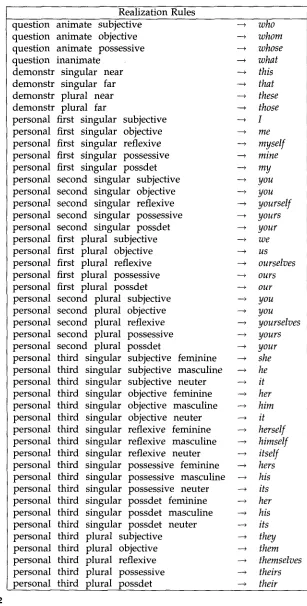
2.1.2 The Generation of Pronouns. H a v i n g sketched the reasons for w h i c h w e b e c a m e interested in the properties of systemic n e t w o r k s and their role in a grammar, w e n o w r e t u r n to the discussion of s y s t e m n e t w o r k s as formal objects in their o w n right, w h i c h is the main subject of this paper. Sample realization rules for English p r o n o u n s are p r o v i d e d in Figure 2. For p r o n o u n s , the realization relationship is particularly simple, since e v e r y distinct set of features that can be p r o d u c e d b y the n e t w o r k m a p s onto a single lexical item. T h r o u g h o u t the rest of the p a p e r w e shall be using the generation of p r o n o u n s as a place h o l d e r for the m o r e elaborate generation process outlined above. Let us consider two situations in w h i c h a hypothetical language-generation system m i g h t n e e d to generate a p r o n o u n , a n d trace the choices that n e e d to be made. In b o t h cases the system is a t t e m p t i n g to brief its client a b o u t a g o v e r n m e n t decision, b u t in the first situation it has just p r o d u c e d the sentence The government has decided to raise taxes, b u t in the second the c o r r e s p o n d i n g sentence was The government have decided to raise taxes. These sentences are b o t h grammatically acceptable in British English, b u t in one case the g o v e r n m e n t are seen as a collection of p e o p l e while in the other it is being treated as an entity in its o w n right. 1 In either case the system n o w w a n t s to tell the user that the g o v e r n m e n t i s / a r e unlikely to carry out i t s / t h e i r decision before the next election. 2
1 The sentence containing this footnote is deliberately infelicitous, illustrating the mistake that we wouldn't want the system to make.
2 Stephen Isard points out that the parallel sentences The government has fallen and The government have fallen describe very different situations; evidently it is an oversimplification to suppose that a
Chris Brew Systemic Classification and its Efficiency
The system's understanding of pronoun use is based on the network shown in Figure 1, which it will use in choosing an appropriate pronoun for each of these situations.
The traversal of the network starts at the left-hand side. The first choice that has to be made is the one between q u e s t i o n , p e r s o n a l and demonstr. In both cases we need a p e r s o n a l pronoun rather than a q u e s t i o n pronoun or a demonstr one. We are now faced with the need for decisions on CASE, PERSON and NUMBER. Let us stipulate that the government, however we describe it, is to be the subject of the sentence; the pronoun therefore receives the feature s u b j e c t i r e in both cases. The p r o n o u n also has to be t h i r d person, since neither the system nor its client is the subject of the planned sentence. H o w e v e r the choice of NUMBER depends on the choice that was made earlier in the discourse, so in the first case the system will need to choose s i n g u l a r and in the second it will need p l u r a l . If it chooses p l u r a l it has reached the edge of the network, and can use the collected feature set to access the appropriate pronoun, which is they.
However, if it chooses s i n g u l a r it still needs to decide whether the government requires a feminine, masculine or n e u t e r pronoun, since otherwise it cannot decide between she, he, and it. The system network formalizes the availability or otherwise of the GENDER choice by placing the corresponding system in a position that can only be reached if the pronoun being generated is both t h i r d and s i n g u l a r . Of course, a more elaborate process is involved in the generation of complex constituents, but the principle remains the same: networks are traversed, produce sets of features, and the features are used to guide the construction or selection of sub-constituents.
2.2 Systemic Language Analysis
By specifying the range of options available to the language user a system network defines a set of possible outcomes to the generation process, and hence also a space of possible structures corresponding to the various feature sets that can be obtained by traversing the network. It may be that the networks admit structures that are never in fact used by the system as a whole, but without knowledge of the details of the mecha- nism by which choices are made we cannot exploit any additional constraints imposed by the process of realization. In this paper we focus on the use of the networks as a knowledge source in their own right. Systemic networks form a terminological repre- sentation system in the sense of the term used in work on KL-ONE and its successors (Brachman and Schmolze 1985; Nebel 1990). We would like to understand the nature of the knowledge they express well enough to be able to use system networks as the basis of a general, and perhaps computationally convenient, terminological language for use in linguistic applications. Our approach is very close to that of Mellish (1988), as well as to a multitude of other formalisms involving partial descriptions, such as Shieber (1986).
Computational Linguistics Volume 17, Number 4
2.2.1 Systemic Classification. Following Mellish, we refer to the task of using system networks in comprehension as systemic classification. We conceive of this as an ac- tivity similar to the taxonomic classification carried out by biologists. By making use of the observable features of a specimen we attempt to pin down the point at which that specimen ought to be accommodated within the space of structural descriptions we have at our disposal. On the assumption that the slpeaker's linguistic options are correctly described by a particular collection of networks, a listener is entitled to make inferences from this assumption, and to use knowledge of the form of the system networks in the search for a plausible global hypothesis about the properties of the utterance that the speaker seems to have produced. Because the choices made by a speaker are interdependent, a plausible hypothesis about part of the description of an utterance may allow us to reconstruct part or all of the missing portion of the descrip- tion. The job of a scheme for systemic classification is to provide efficient and correct algorithms for the construction of consistent descriptions and the rejection of inconsis- tent hypotheses. Nebel (1990) discusses a slightly more general notion of classification, applicable to a knowledge representation language like NIKL (Kaczmarek, Bates, and Robins 1986), BACK (Von Luck et al. 1986) or LOOM (MacGregor and Bates 1987). The notions of subsumption that operate in such rich formalisms are more sophisti- cated, but the essential idea of classification, namely the organization of terms into a pre-computed subsumption hierarchy, remains the same. As in Mellish's work, the main goal is to gain efficiency by pre-computing some or all of the useful subsump- tion relationships that hold between descriptions. For the purposes of this paper the descriptions are feature-based systemic descriptions and the role of the pre-computed subsumption graphs described by Nebel is played by the specially designed encod- ings that ensure that subsumption information is readily available at run-time. There is of course a price to pay for this run-time efficiency, since we have to pre-process the networks in order to establish the encoding relations that will be of use at run-time.
For the purposes of analyzing an utterance, the most important property of the feature system induced by a system network is the following
Any system network defines a set of atomic labels that can be com- bined to form descriptions of linguistic objects. It also provides a com- plex of constraining principles that conspire to declare inconsistent certain combinations of features.
For example, the network in Figure 1 expresses the constraint that no pronoun can be specified as both feminine and masculine, and also the constraint that only third person singular pronouns can bear either of these features.
2.3 Prior Work on Systemic Language Analysis
Winograd (1983) and McCord (1977) have both provided techniques that re-express system networks and their associated realization rules as hand-crafted recognition programs.
In both cases this amounts to a proceduralization of the grammar, and runs the risk of making it even harder than necessary to debug a malfunctioning grammar. We prefer to adopt a more declarative approach, in which the grammar is represented in a form as close as possible to that with which linguists actually work.
Chris Brew Systemic Classification and its Efficiency
rather than comprehension, but since they aim for a declarative specification of the generation relationship between systemic grammars and the utterances they license, it might be possible to use their grammars in either direction. For Patten and Ritchie a systemic grammar is encoded as a set of rules for a production system, and the generation process involves the application of these rules.
Kasper (1987a, 1987b) has designed algorithms that involve the encoding of both system networks and the associated realization rules as constraints expressed within a feature logic involving disjunction. He then implements the key operation of unifica- tion by applying a general technique for unification of disjunctive feature descriptions (Kasper 1988). These techniques decompose the problem of disjunctive unification into three stages, only the last of which is exponentially hard. We are not attempting to match his general algorithms for disjunctive unification, but rather to design special purpose algorithms that are particularly suitable for use with system networks, and particularly for those networks that play a role in Houghton's system.
In practice the set of constraints that Kasper develops from his systemic grammar is too large to solve conveniently with the constraint-solving technology available to him, so he augments the constraint grammar with a small hand-crafted phrase structure component. The main motivation for this move is the search for efficiency rather than any particular wish to use a phrase structure grammar. Kasper's basic strategy remains that of building up a large set of constraints that can then be solved by general theorem-proving techniques.
Like Kasper, we use a chart parser, but in our case the phrase structure grammar is an essential component of the knowledge used by the system rather than a small ad- dition required for the sake of efficiency. This makes no difference from a formal point of view, but reflects our strategy of using appropriate special purpose mechanisms in preference to potentially costly general techniques. Although system networks, sys- temic realization rules, and context-free grammars can all be translated into formulae of Kasper's extended FUG, our approach has been to investigate ways in which the knowledge contained in these components can be exploited using simpler methods.
While Kasper's approach involves the translation of system networks into a more general constraint formalism, Mellish (1988) displays encodings that reduce the key operations of systemic classification to straightforward manipulations of PROLOG- like terms. Unfortunately, it turns'out that system networks sometimes need a rather opaque encoding, which would require costly re-translation if users needed to inspect the workings of an NLP system that used it. The general encoding is in principle capable of handling any system of constraints expressed in the propositional calculus, and makes no use of the particular structure of systemic descriptions.
Mellish's approach to the implementation of systemic classification is to construct structure preserving mappings from the space of systemic descriptions to an isomor- phic space in which classes of entities are represented by terms taken from the GAF lattice. 3 These terms act as partial descriptions of linguistic objects, and are combined using the operation of term unification. Unfortunately the only generally applica- ble mapping that Mellish is able to offer has unpleasant properties, producing large terms whose internal structure has little in common with the structure of relation- ships between the descriptive feature labels used in the network. 4 Although the terms produced by the brute force mapping are spectacularly large, our main objection to
3 For most purposes this lattice is the same as the recursively defined space of terms used by PROLOG, but for a technical introduction see (Reynolds 1970).
Computational Linguistics Volume 17, Number 4
this approach is the loss of transparency associated with the mapping. It doesn't seem likely that a linguist would feel comfortable with the output of the mapping, so a grammar development system would presumably have to include facilities for trans- lating the machine representation back into more readable form. Although the simpler mappings that Mellish has developed for more restricted forms of network do offer more perspicuity, we feel that even in those cases our representations are at least as accessible to the human user as Mellish's, which do not in any case generalize to the full system network formalism.
Our view of the nature of system networks is close to those of Mellish and Kasper, since we try to separate questions about the underlying meaning of the networks from decisions about the processes by which they can be exploited. We treat system net- works as alternative notations for sets of logical axioms constraining the co-occurrence of property symbols in descriptions. Nothing more elaborate than the propositional calculus is required. In principle one could apply standard theorem-proving techniques to these axioms, but in practice it is better to employ special purpose techniques that make more use of the structure inherent in the networks. The translation of system networks into logical axioms is very similar to the one described in Mellish (1988), but by adopting a slightly different labeling scheme we obtain a little extra clarity, which helps when we come to design algorithms that make use of the axioms produced. 2.3.1
Classification and Consistency Checking.
In order to carry out classification we need to answer the following questions1. When is an object an instance of a given description?
2. When may two given descriptions describe the same object?
3. Given two descriptions of the same object, how may the descriptions be combined to produce a more fully specified description?
and in order to answer the questions we need to understand the behavior of the key operations of subsumption checking and unification as they apply to the description space within which we are operating. Both these operations can effectively be treated as special cases of consistency checking.
This is the operation of checking a conjunction of positive and negative boolean attributes for consistency with the axioms derived from a network. This should succeed if the conjunctive description picks out a nonempty class of objects from those capable of being derived from the network, but to fail if there is no object which can meet the constraints imposed.
Unification.
For descriptions consisting of atomic symbols generated from a system network the operation of unification between two descriptions D1 and D2 consists of two stages.1. The formation of the conjunction D such that D contains the union of all the feature specifications given in D1 or D2.
2. The checking of this new description D for consistency with the constraints arising from the system network.
Chris Brew Systemic Classification and its Efficiency
Subsumption.
One description D1 subsumes another D2 if all possible objects correctly described by D2 are also correctly described by D1. If A subsumes B then B D A. If that is so then B A -~A is unsatisfiable. If A is an atomic symbol then B A -~A can be checked directly for consistency; otherwise -~A has to be expanded out, yielding(B A -~al) V (B A -~a2) V... (B A
-~an)
In order to prove that B D A we have to show that none of the alternatives given above can ever be satisfied. The subsumption check fails the moment any of the dis- junctive alternatives is found to be a description of a legal object. While the individual branches of this checking process can be carried out as efficiently (or inefficiently) as unification itself, the preliminary expansion to disjunctive normal form is potentially costly. This is doubly unfortunate since the expansion depends on the input expres- sions, and therefore cannot be carried out at compile time. This problem evaporates if we restrict ourselves to networks lacking
disjunctive
systems, 5 since Mellish's term- encoding techniques allow both subsumption and unification to be implemented using standard operations familiar in logic programming.Realization Rules and Disjunction.
Although the features mentioned in the system networks may in fact correspond to large disjunctions of different low-level features when the networks and the realization rules are compiled together into one large constraint system, we treat the realization rules by a different mechanism and can therefore continue to regard the features as atomic. Our primary concern is to ensure that the basic feature-matching operation carried out by our chart parser is efficient enough to be carried out many times in the course of analyzing utterances. The im- plicit disjunction between the different productions of Houghton's phrase structure grammar is handled by the usual techniques of chart parsing, which are described in, for example, section 3.6 of Winograd's textbook (Winograd 1983). Since these tech- niques are acceptably efficient, there is no pressing need to adopt Kasper's approach, within which the realization rules are conjunctive constraints, and the effect of includ- ing realizations is to change the representation of choice systems from disjunctions of atomic formulae into disjunctions of complex formulae. As before, our approach is to replace the general mechanism with a less powerful technique that is well attuned to the task in hand.2.4 Labeling System Networks
This section describes the process of translating system networks into logical axioms. As an intermediate stage we build a specially labeled version of the network with which we are working. In order to do this we need a more formal characterization of system networks than we have yet presented.
A system network is made up of possibly labeled lines tied together by systems. In the system networks described by Mellish some, but not necessarily all, of the lines are labeled with items chosen from a set of distinct atomic symbols. The example in Figure 1 shows such a labeling. In this scheme there is only one sort of label, no distinction being made between words that are usually thought of as feature names (such as NUMBER) and those that would more naturally be feature values (such as s i n g u l a r or plural). We would in any case like a labeling scheme that makes a clean distinction between feature names and feature values, and it turns out that
Computational Linguistics Volume 17, Number 4
demonstr
feminine masculine neuter Choice system
demonstr V personal personal
Disjunctive system
pn
pn
A n d ! y s t e m pn
singularthird } singularthirdA
[image:12.468.78.400.57.253.2]Conjunctive system
Figure 3
Types of system.
suitable slight modifications in Mellish's scheme greatly simplify the task of translating networks into equivalent sets of axioms. We start by introducing the new labeling scheme, and showing where it differs from Mellish's version.
The differences between the labeling schemes are small. Networks labeled in our style continue to represent the same information as would be contained in the same networks labeled by Mellish or Winograd. All that is gained is a measure of uniformity and clarity, which helps simplify the task of translating networks into logic.
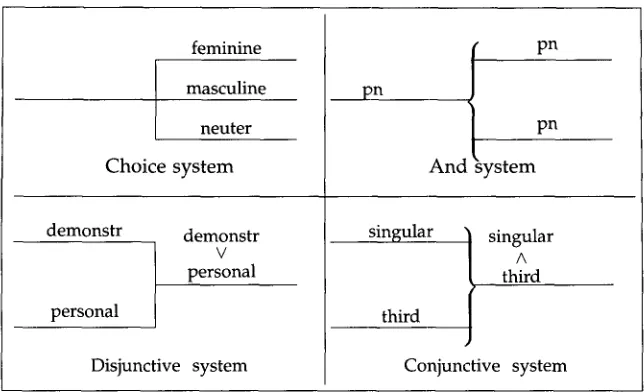
2.4.1 Types of System. There are four distinct types of system, each of which has one collection of lines as its right-hand side and another collection as its left-hand side. For a given system s these are notated as
RHS(s)
andLHS(s),
respectively.The choice system has one line on its left-hand side and a number of lines greater than one as its right-hand side. Informally it represents a choice of exactly one attribute from those given by the labels attached to the lines in the right-hand side.
The system at the top left of Figure 3 is a
choice
system in which the alternation between feminine, masculine, and neuter is expressed.The system at the top right of the figure represents a form of conjunction. Where the choice system contains a vertical line standing for disjunction, the and system represents conjunction with a left curly bracket (i.e. {). Again exactly one line must appear on the left-hand side of the system, and there should be a larger number of lines on the right-hand side. And systems mean that all the right-hand lines of the system will be tried whenever the left-hand line is reached. Since no choice is made, no feature is generated by traversing an
and
system.Chris Brew Systemic Classification and its Efficiency
traversed. For
disjunctive
systems w e can get t h r o u g h to the right-hand line if one or m o r e of the lines on the left-hand side are traversed. The system at the b o t t o m left of the figure is adisjunctive
system, and the one at the b o t t o m right is aconjunctive
system.2.4.2
Well-Formedness Requirements for System Networks.
This section sets out o u r definition of w h a t it m e a n s w h e n w e say that a system n e t w o r k is well formed. Given a system network, theprecedes
relation b e t w e e n lines is the smallest relation such that1. nl precedes n2 if
nl E
LHS(s),
n2 ERHS(s)
for some system s in the network.2. nl precedes n2 if for a n y line n3 in the n e t w o r k nl precedes n3 and n3 precedes n2.
If nl precedes n2 then nl is a predecessor of n2. In a well-formed system n e t w o r k no line m a y precede itself. Strictly speaking, this is a deviation from Systemic G r a m m a r as presented in H u d s o n (1971), which explicitly permits cyclic systems. For o u r p u r p o s e s cyclic networks are unsatisfactory, because useful cyclic paths in the n e t w o r k have to be traversed more than once. If n e t w o r k traversal is to terminate, the choices m a d e on the last traversal of such a p a t h have to differ from those m a d e on earlier traversals. The sets of features that could be generated b y a n e t w o r k w o u l d then d e p e n d not just u p o n the structure of the n e t w o r k b u t also on the w a y it was used b y a particular generation system. O u r techniques w o u l d have n o t h i n g to say a b o u t this situation, since w e are examining the n e t w o r k s in their o w n right, and do not have access to the criteria b y which the choices are made. We are therefore outlawing cyclic n e t w o r k s for the m o m e n t .
Assuming that the g r a p h f o r m e d b y the system n e t w o r k is acyclic implies that there must be at least one line that is not p r e c e d e d b y a n y other. If there is m o r e than one such line, then the n e t w o r k has multiple e n t r y points and no obvious intu- itive meaning. For the sake of definiteness w e decree that such n e t w o r k s will not be translated as such, b u t will instead be prefixed with a single
and
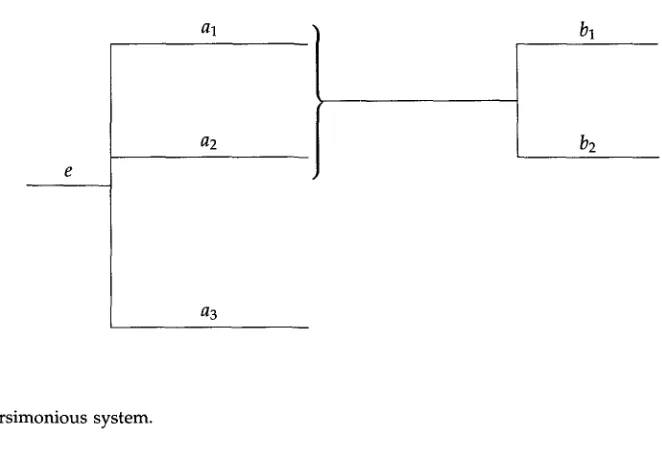
connective, w h o s e left-hand side contains a single n e w line, a n d w h o s e right-hand side comprises the set of lines that w o u l d otherwise have had no predecessor. There is n o w exactly one line with no predecessor, which can be referred to as the root. The root of Figure 4 is the line labeled with e. It is possible to d r a w networks in w h i c h certain regions of the n e t w o r k can n e v e r be reached. The simplest case of this involves distinct branches of a choice system feeding into aconjunctive
system, as s h o w n in Figure 4. H e r e the choice b e t w e e n bl and b2 will n e v e r be reached. At best this is a waste of space. We say that n e t w o r k s containing unreachable portions are u n p a r s i m o n i o u s , a n d declare t h e m to be ill formed. While it m a y not always be easy to see w h e t h e r a complicated n e t w o r k is parsimonious, the necessary w o r k can be carried out w h e n the n e t w o r k is defined, and n e e d not carry a run-time cost.Computational Linguistics Volume 17, Number 4
al
/
/
a3
bl
b2
Figure 4
An unparsimonious system.
from lines to n a m e s such that
a line receives a n a m e if a n d only if there is a choice s y s t e m to w h o s e right-hand side it is directly attached.
no t w o lines carry the same name.
In practice, system n e t w o r k s are labeled in w a y s that are v e r y nearly basic label- ings. The major difference is that some n o d e s attached to the left b u t not to the right of choice systems get given labels that c o r r e s p o n d a p p r o x i m a t e l y to feature names. Since these labels a d d n o t h i n g to the m e a n i n g of the n e t w o r k they can safely be ignored.
The restriction to n e t w o r k s w i t h o u t duplicated labels simplifies the discussion in the rest of the paper, b u t it is not hard to t r a n s f o r m n e t w o r k s with duplicated labels into ones in w h i c h all labels are distinct. The details of this transformation are not discussed here.
2.4.4 E x h a u s t i v e Labelings.. E v e r y exhaustive labeling builds on a basic labeling, a n d is a labeling in w h i c h e v e r y line in the n e t w o r k is labeled with some value. In contrast to the conventional systemic labelings, in w h i c h labels are constrained to be atomic names, exhaustive labelings assign b o o l e a n conjunctions and disjunctions of atomic n a m e s as labels for some lines. The full definition of an exhaustive labeling follows.
Let Y" be a 1-1 function from lines to n a m e s for these lines. ~- is an exhaustive labeling of a n e t w o r k if a n d only if the following conditions hold:
1. That part of Y that p r o v i d e s n a m e s for lines attached directly to the right of choice systems m u s t be a basic labeling.
[image:14.468.85.416.70.295.2]Chris Brew Systemic Classification and its Efficiency
question
personal
demonstr
question
question
personal
personal
personal demonstr
demonstr
animate inanimate
personal V question
first second
subjective objective reflexive possessive
possdet
third third
singular personal
V singular demonstr t plural
near far
feminine masculine
neuter
Figure 5
An exhaustively labeled network.
3. If Y assigns line names 11,12~...
Im
to the lines entering aconjunctive
system (where l I is the label for the line appearing at the top of the system and
lm
that at the bottom), then it must assign the labelll A 12/k... lm
to the line that leaves that system.4. If 3 v assigns line names 11~ 12~...
lm
to the lines entering adisjunctive
system (adopting the same ordering convention as above), then it must assign the label 11 V 12 V...
Im
to the line that leaves that system.The ordering convention we introduced above is a technical convenience rather than an essential part of the nature of an exhaustive labeling; all that matters is that appropriate expressions representing conjunctions and disjunctions are propagated to the right- hand lines of
conjunctive
anddisjunctive
systems. [image:15.468.58.392.87.401.2]Computational Linguistics Volume 17, Number 4
2.5 Translating the Labeled Networks
In this section we show how to convert an exhaustively labeled network into a set of axioms expressing the information from the network in the framework of propositional calculus. This work is closely related to a similar translation scheme given in Mellish (1988), but because our scheme works with slightly different labelings the results are a bit easier to understand.
The translation scheme in Mellish's paper can be applied to all four types of systems in an exhaustively labeled network, and the correct results will be produced, but it turns out that many of the systems in an exhaustively labeled network map into uninteresting tautologies.
Mellish proposed that a choice system such as the one for GENDER in Figure I should be translated as
AMO{femininG masculine, neuter} (1)
GENDER - feminine V masculine V neuter (2) where AMO stands for a complex formula meaning 'at most one of.' (Mellish actually presents these axioms in a predicate calculus notation, but we have suppressed this detail, which makes no difference.) In the example of a choice system given above the full expansion of the complex formula would be
-~(feminine A masculine)A
~(feminine A neuter) A -~(masculine A neuter) (3) In Figure 5 we have removed the GENDER label from the left-hand side of the choice system and replaced it with the appropriate complex label. When we employ Melish's scheme the translation becomes:
AMO{feminine, masculine, neuter} (4)
third A singular -- feminine V masculine V neuter (5) but the essential principle remains the same. Two intimately linked axioms arise from each choice system. Where necessary we shall refer to the axiom involving AMO as the exclusivity axiom and the other one as the accessibility axiom. It is easy to construct the exclusivity axiom given the corresponding accessibility axiom, but the converse is not true. We shall therefore be basing our implementation on the use of the accessibility axiom, with the exclusivity axiom understood to be implicitly present.
For and systems Mellish proposes a translation that is as if the label from the left of the and system had been written onto the lines to the direct right of the and system. In our scheme the label actually has been written there by the time the translation comes into operation, so there is no need to provide an independent translation for and systems. Instead the systems to the right of the and system will automatically receive translations reflecting the presence of the and system. This happens for the three and systems of Figure 5, with question, personal, and demonstr being propagated across the system in the appropriate way.
For disjunctive and conjunctive systems applying Mellish's translation would again yield a tautology. Where Mellish translates the disjunctive system of Figure 3 (which carries the feature name NUMBER on its right-hand branch) as
Chris Brew Systemic Classification and its Efficiency
applying Mellish's translation to our labeling scheme yields the tautologous
personal V demonstr =_ personal V demonstr (7) Intuitively it looks as if the real work that goes on in a system network happens in choice systems, and the other lines exist only in order to link together choice sys- tems in the appropriate ways. From any point of view except that of a mathematical troublemaker this was probably obvious from the outset.
The axioms derived from the pronoun network in Figure 5 are the following.
question =_ animate V inanimate
(8)
demonstr =_ near v far
question V personal =_ subj v obj V refl V possess V possdet
personal V demonstr =- singular V plural
personal ~ first V second V third
third A singular =_ feminine V masculine V neuter
(9) (10) (11) (12) (13) The algorithm for translating system networks into a more standard form is now complete, so we move on to consider the ways in which this information can be used. 2.6 Computational Tractability
In the next section we address the question of whether the labeling schemes developed so far can form the basis of efficient algorithms for carrying out the task of systemic classification.
We start by showing that system networks can be used to express NP-hard prob- lems. This is something of a disappointment, since the original goal of this work was to show that the network formalism could function as a low-power version of more general feature formalisms. The idea was that linguists who chose to express their grammars within the network formalism would be sacrificing a measure of notational convenience in order to gain a guarantee of acceptable computational behavior. Since we must currently assume that NP-hard problems are intractable, we are unable to provide the desired guarantee.
2.6.1 Systemic Classification is NP-Hard. In this section we show that the problem of systemic classification is at least as hard as problems known to be NP-hard. This is done by constructing a polynomial time mapping 11 from instances of the NP-hard problem called 3SAT to networks that can be tricked into solving this problem for us. This is a standard technique from complexity theory. For an introduction to similar linguistic applications of complexity theory see Barton, Berwick, and Ristad (1988).
Computational Linguistics Volume 17, Number 4
V
Y
-qy
X
b?_
I bl
a2
[image:18.468.101.283.58.268.2]I al
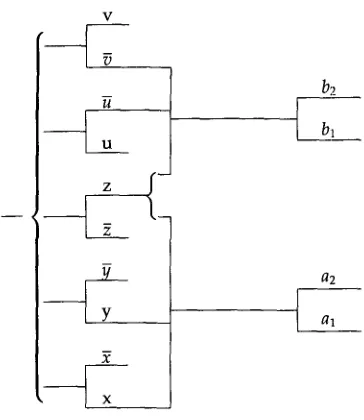
Figure 6
A network for 3SAT.
systemic classification is NP-complete as well as NP-hard. We think this upper bound on the complexity class to be of purely theoretical interest, since our parsers depend on efficient description-matching as a primitive, and an NP-hard problem is in our view already too expensive to be solved regularly in an efficient parsing system. We are aware that the complexity result only applies to the worst case, but in the absence of a satisfactory account of precisely what constraints a grammar writer has to observe to avoid the bad cases, we are uneasy about providing these grammar writers with a potentially explosive general mechanism. Our guess is that there is something about the h u m a n cognitive system that ensures that hard cases won't arise naturally, but it is dangerous to assume that they won't arise, not least because one possible way of us- ing the technology provided here is as a target representation for automatic grammar development environments that present the user with higher level primitives. What- ever modularity constraints may be observed by a human writer, it is unclear that similar constraints will automatically hold over the output of an automatic grammar transformer.
The 3SAT problem. 3SAT is the problem of determining the satisfiability of a boolean formula, stated in conjunctive normal form, in which exactly three variables occur in each clause of the conjunction. These variables may either be positive or negated, and may be repeated from clause to clause. It is known that 3SAT is just as hard as the problem of satisfiability for general boolean formulae (Barton, Berwick, and Ristad provide a demonstration of this fact on pp. 52-55 of Barton, Berwick, and Ristad [1988]). A sample input formula for 3SAT is
Chris Brew Systemic Classification and its Efficiency
and the problem is to find an assignment of t r u e and f a l s e to variables such that the whole expression comes out true.
A mapping from 3SAT instances to networks. We now construct the mapping II that takes a 3SAT instance and constructs a network that can be used to solve that instance. The following steps are necessary. Let the name of the 3SAT instance be E and its length NE.
Make a list of the variable names used in E, counting positive and negative occurrences of a variable as the same. This can certainly be done in time polynomial in NE using a standard sorting algorithm such as merge sort. Let the name of the list of variable names be V and its length Nv. Because the drawings are prone to get very intricate we use the example of the very simple expression
( x V y V z )
A (z V ~V~) (15)(which has already been illustrated in Figure 6 )
Construct a network consisting of a large and system feeding Nv parallel binary choice systems. Each choice system carries two labels, one
corresponding to a variable name in V and the other formed by negating the label on the other branch of the system. The choice of prefix should be such that all labels on the resulting network are unique. This part of the process is polynomial in the length of V.
For every clause in E, add a ternary disjunctive system linking the lines of the network having the labels corresponding to the three symbols of the clause. This part of the process involves scanning down the Nv systems of the network once for each clause of E, and is therefore also polynomial in NE.
Finally, binary choice systems are attached to the outputs of all the
disjunctive systems introduced in the last stage. These systems are labeled
with generated labels distinct from those already used in the network. This step is clearly also polynomial in NE, requiring the creation of a number of choice systems equal to the number of clauses in E.Computational Linguistics Volume 17, Number 4
that makes E come out true. This means that systemic classification cannot be solved in polynomial time unless 3SAT, and hence all of A/'7 v, can.
3. Algorithms for Consistency Checking
3.1 Isolating the Sources of Intractability
Given that there is no efficient way of applying all the constraints imposed by a system network, it would help if we could isolate the source or sources of the inefficiency. If this can be done, it might allow an algorithm for constraint application in which a cheap first stage does most of the work, calling on an expensive second stage only when it is needed. It turns out that the presence of
disjunctive
systems is the main cause of the inefficiency, so we now move to a method for the removal of these systems. The idea is that the nondisjunctive version of a disjunctive network expresses some, but not all, of the constraints present in the original network.We have two equivalent representations for the constraints induced by a system network, and shall feel free to switch between the view of networks as geometric objects and the view of axiom sets as constraints on the structure of linguistic entities. We shall refer to diagrams of networks in the hope that this will help the reader gain intuitions about what is going on. Readers who find the diagrams unhelpful should ignore them.
There is a simple transformation that maps networks involving disjunction into nearly equivalent versions not containing any
disjunctive
systems. Although this tem- porarily ignores some of the information implicit in the disjunctive network, every description the transformed network would reject as inconsistent is also rejected by the full network from which it is derived. The right-hand sides ofchoice
systems are left untouched by the transformation, so the exclusivity axioms of the original network continue to hold.System networks form directed acyclic graphs, so it is possible to use the prece- dence relationship defined above to form a topologically sorted list of the atomic labels in the network. Precedence is not a total ordering on the atomic labels, so some other criterion, such as lexicographic ordering, is needed to produce an unambiguously or- dered list. We call the position of a label in this list its depth. It does not matter what the extra criterion for ordering the depth list is, as long as it is consistently applied and no two labels have the same depth. By extension,
choice
systems also have a depth, defined to be the depth of the shallowest label in the right-hand side of the system. Atomic symbols in the sets of axioms derived from system networks inherit the depth of the corresponding labels in the network, and axioms inherit the depth of the correspondingchoice
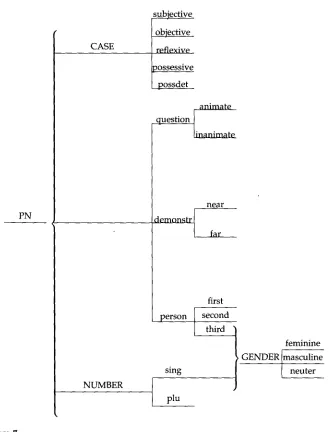
systems.The idea is that every fragment of the original network that flows out of the right of a
disjunctive
system is detached from that system and re-attached nearer the root of the network. This point is the point at which the various paths leading from the root to thedisjunctive
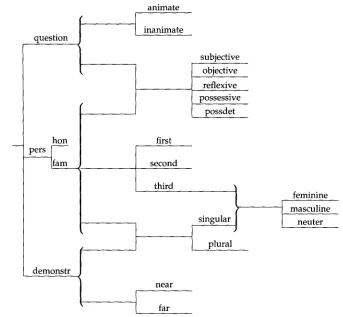
system most recently diverged. Although the formal details of how to do this in a general network are somewhat intricate, an illustration is provided in Figure 7. The two systems that have been moved are those that were originally fed by disjunctive systems in Figure 5, namely those which express choices for CASE and NUMBER. These have both been moved back from their original location and re-attached immediately to the right of the root of the network.Chris Brew Systemic Classification and its Efficiency
PN
CASE
subjective objective reflexive [P °;seSdie: e
animate question inanimate
near demonstr I
far
first person second
third
NUMBER
sing plu
feminine GENDER masculine
[image:21.468.55.386.54.486.2]neuter
Figure 7
A simplified network.
self).
Some of the constraints expressed in the original network are lost in the trans- formed version.3.2 Relaxing Sets of Axioms
Relaxation is the formal counterpart of the network rewriting described in the last section. For clarity, it is defined over sets of axioms rather than over networks, simply because it is far easier to achieve the necessary clarity w h e n working in the d o m a i n of propositional formulae.
Computational Linguistics Volume 17, Number 4
a2
bl
b2
Cl a2 V bl r
[image:22.468.53.372.63.402.2]1
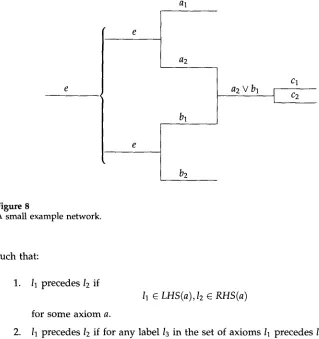
C2Figure 8
A small example network.
such that:
1. ll precedes 12 if
I1 E LHS(a), 12 E RHS(a)
for some axiom a.2. ll precedes 12 if for any label 13 in the set of axioms ll precedes 13 and 13 precedes 12.
The common predecessors of a set of symbols S are defined to be the members of that set
P(S)
that precede every member of S. Every fully elaborated description containing any member of S must also contain every member ofP(S).
The deepest common predecessors of S are those members ofP(S)
having no successor inP(S).
The transformed set of axioms is formed by replacing every axiom involving disjunction in the LHS with a rule made up of the same RHS and a new LHS consisting of the conjunction of a specially generated identifying feature with the deepest common predecessors of the elements of the old LHS. As an example we use the network given in Figure 8, which was used by MeUish to demonstrate the necessity for repeated variables in the terms representing systemic descriptions. It has been exhaustively labeled, showing the disjunction introduced by the presence of a disjunctive system feeding the rightmostchoice
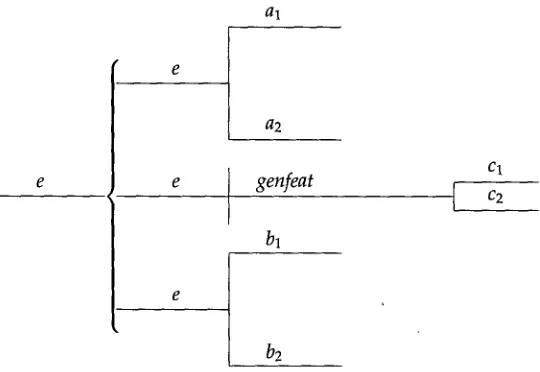
system. This network demonstrates that the consistency of descriptions is not always deriveable from information about the pairwise consistency of individual features. For example, while al is consistent with b2 and also with cl, it does not follow that the combined description al A b2 A Cl is also consistent.Chris Brew Systemic Classification and its Efficiency
al
a2
e
genfeat
bl
b2
Cl
[image:23.468.88.358.62.248.2]C2
Figure 9
A transformed version of the example.
A record is kept of the correspondences between the features introduced to stand for left-hand sides and the expansions for which they stand. This is used, if necessary, in a second stage of checking. In the example above we would have had to note that
genfeat ~ cl V
C 2and to retain this information for future checking. 3.3 Overview of the Checking Algorithm
Our consistency checking algorithm works by implementing a sort of parallel search, working back from the right of the network toward its root. The run-time behavior of the algorithm depends on the properties of the networks used. If the network involves disjunctive systems then true parallelism is required, with multiple processes constructing mutually inconsistent partial descriptions on the basis of the same seed description. Since parallel processes may need private copies of part or all of the target expression, this approach will involve us in potentially exponential amounts of work copying data structures.
If
disjunctive
systems are not present, cheaper approaches are possible, because we can organize matters so as to require no more than one copy of the target expres- sion. This allows us to demonstrate the tractability of consistency checking for system networks lacking disjunction, while the checking procedure for full system networks remains just as costly as we would expect given its equivalence to 3SAT.Computational Linguistics Volume 17, Number 4
Our algorithms decompose the problem of systemic classification into three stages: .
.
.
An off-line step in which a general system network is broken down into a relaxed version lacking disjunction ancl a set of constraints expressing the information missing from the relaxed version of the network. A first stage of checking in which the relaxed form of the network is applied to an input expression.
A second (optional) stage in which the information missing from the relaxed network is re-applied to the results of the first cheek.
In the compilation step the axioms from the original network are converted into an ordered list of relaxed axioms. These axioms contain special generated features that act as hooks for a group of aliasing rules that have the job of expressing the information present in the original axioms but absent from their relaxed counterparts.
The first stage of checking involves successive inspection of the relaxed axioms for applicability to the expression being checked. If the right-hand side of an axiom matches the expression then the left-hand side of the axiom is combined to form an extension of the expression. Because the compilation step has organized the axioms in order of depth this algorithm is able to make all legitimate deductions from the relaxed form of the network, and also to fail if the expression given is outlawed by this relaxed form.
In the second stage of checking we use the output of the first stage, attempting to discharge any generated features that have been introduced. In the worst case this will involve polynomial expense, since the problem is that of simultaneously satisfying a number of constraints each of which may individually be satisfiable in a number of different ways.
Although the difficulty of this constraint satisfaction task depends both on the structure of the network and on the details of the expression being checked, we can make a certain amount of progress with this task even in the compilation step. This is because the structure of the network may tell us that the constraint satisfaction problem can be decomposed into subtasks that will never interact whatever the nature of the input expression. By inspection of a system network we can derive a metric that indicates the possible computational cost of applying the information contained in that network, as well as an indication of how much of that information can be recovered without getting involved in the costly search processes that can be occasioned by the presence of disjunctive systems.
3.4 Representation
.This section deals with the way in which expressions and axioms are represented for use in the checking algorithm. As mentioned previously this presentation is somewhat abstract, and describes idealized data structures rather than their somewhat more intricate realizations.
For the network in Figure 8 the original set of axioms is
e ~ al V a2 (16)
e ~ bl V b2 (17)
Chris Brew Systemic Classification and its Efficiency
and the checking rules relevant to the first stage are
e ~ a l V a 2 (19)
e = bl V b2 (20)
e A genfeatl ~ cl V c2 (21)
3.4.1
Representation of
Expressions. All boolean expressions can be reduced to the form of a disjunction of conjunctions of (possibly negated) atomic symbols. The ex- pressions to be checked will consist either of simple conjunctions of unnegated atomic symbols, or, if we need to support subsumption checking, conjunctions of a single negated atomic symbol with a number of unnegated symbols. The algorithm will in fact handle any number of negated atomic symbols, but we do not make any use of this capability. An appropriate representation of such expressions is as a vector of slots capable of taking three values along each dimension. Each of the N slots corresponds to one and only one of the N atomic symbols in the set of axioms, and the order of the slots is the order of increasing depth given by the depth relationships in the network. We shall illustrate these vectors using strings of symbol specifications. Within such a string there are three possible types of symbol specification:• the presence of a positive specification for a symbol is represented using a boldface capital letter (A1)
• the presence of a negated specification for a symbol is represented with a boldface capital letter with a line above ( ~ )
• the absence of any specification for a symbol is represented using a lighter lower case font (al). Explicit representation of absent symbols means that every symbol in the repertoire must appear (in some form) in every vector.
For the example network in Figure 8 the correspondence between expressions and their representations is as follows.
al A b2 is represented by
and
is represented by
(C2~ C1~ B2, bl, a2, A1, e)
-~C 1
(C2~ C1} b2} bl, a2~ a~, e)
The elements of a symbol vector are implicitly conjoined, and there is no mechanism for expressing disjunction.