A Robust Distributed Power Control Algorithm
for Minimum Interference to Primary Users in
Underlay Cognitive Radio Networks
https://doi.org/10.3991/ijoe.v12i12.6443
Lingling Chen
1,2, Xiaohui Zhao
2, Shubei Sun
1, Yueliang Lu,
1Xiaoyue Gong
1and Xingquan Gao
11 Jilin Institution of Chemical Technology, Jilin, China 2 Jilin University, Jilin, China
Abstract—A robust distributed optimal power control
(RDPC) scheme under worst case condition is proposed to make primary users (PUs) receive minimum interference generated from all secondary users (SUs) in underlay cogni-tive radio networks (CRNs). The strategy considers the transmit power of each SU below the maximum allowable power of the devices and interference plus noise ratio (SINR) of each SU under the minimum threshold. Simula-tion illustrate thatthe RDPC can lead SUs to reduce the interference to PUs, and simultaneously the better meet quality of service (QoS) requirement of SUs in comparison with the distributed power control algorithm (DPC) and the traditional iterative water filling algorithm (IWFA) in time-varying channel environment.
Index Terms—cognitive radio networks, robust distributed
power control (RDPC), worst case condition
I. INTRODUCTION
Cognitive radio (CR) is one of the most promising technologies for future wireless communications [1-2] to resolve the limited radio spectrum resource shortage prob-lem [3]. In underlay cognitive radio networks (CRNs) [4], secondary users (SUs) can share the frequency spectrum with primary users (PUs) and ensure the PU of the quality of service, simultaneously. Therefore, the transmit power control of SU [5], which is one of the spectrum sharing core technologies , are attracted widespread attention by researchers.
Currently, the problem of power control to SU in CR systemhas been an area of active research [6]-[10]. The adaptive power control problems based on game theory overcome the near-far effect, which studied in [11]. In [12], standard distributed power control algorithm (SDPCA) and an improved distributed power control algorithm (IDPCA) are proposed based on convex optimi-zation theory in underlay cognitive radio networks (CRNs), which obtain the minimum the transmit power of SU. In [13], author consider a cognitive radio system the in fading wireless channels and propose an opportunistic power control strategy for cognitive users, which serves as an alternative way to protect the primary user's transmission and to realize spectrum sharing be-tween the primary user and the cognitive users. The power control scheme is proposed to maximizes the SNR in [14]. All these papers can not consider uncertainty of these parameters, which only consider perfect channel estima-tion in communicaestima-tion systems.
Based on the above discuss, we can consider uncertain-ty in real communication systems. In this paper, a robust distributed power control algorithm (RDPC) is proposed to minimum the interference power from SU-Tx to PU-Rx under the worst case condition, which is appropriate in real system. In order to guarantee communication quality of PUs and SUs, our proposed power control scheme not only considers that the transmit power of each SU should not exceed its maximum power, but also takes the mini-mum SINR at secondary receivers into account. Simula-tion results show that the RDPC under the worst case condition is superior to the distributed power control algo-rithm (DPC) [12] the traditional iterative water filling algorithm (IWFA) [15] in time-varying channel environ-ment.
II. SYSTEM MODEL
In this paper, a distributed spectrum sharing CRN is taken into consideration in underlay scenario, which con-sists of transmitter-receiver pairs of MSUs and KPUs. For each SU transmitter, the transmit power should not be more than the maximum allowable power of the de-vices. So the power should be under this restriction
m
max
0
<
p
m!
p
! "
m
{1,2, , }
!
M
(1)where
p
mdenotes the transmit power of the SU transmit-ter (SU-Tx) on linkm
.m max
p
represents the maximum value of transmission power provided by the SU-Tx.Meeting the transmission quality of PU, the QoS of each SU should also be protected. That is to say, the sig-nal-noise ratio (SINR) of each secondary receiver (SU-Rx) should not less than a threshold as follows
m
th m
!
"
!
(2)Where
!
m and!
mth (!
mth>
0
) are the real value andthe min-imum value of SINR at the SU-Rx on link
m
. The specific formula of!
mis as follows=
mm mm
m
G p
N
mm
G
denotes the direct channel gain from the active SU-Tx to the SU-Rx at linkm
.N
m is the sum of the interference powers and the background noise at the SU-Rx at linkm
. Its formula can be defined as follows{1,2, , }
jjm
M
m m mp
j m
N
G p
!
I
k
K
"
=
%
+
+
# $
!
(4)where
1 km
K
mp k
k
I G p
=
=
!
represents the suminterfer-ence powers from all PU-Txs to the excited SU-Rxs of link
m
,G
jm andkm
G
are the interference gains from the SU-Tx of linkj
to the SU-Rx of linkm
and from the PU-Tx of linkk
to the SU-Rx of linkm
respectively.p
j represents the transmit power of the SU-Tx on linkj
.p
k denotes the transmit power of the PU-Tx on linkk
.Our objective is to minimize the sum interference caused by all SU-Txs, and simultaneously satisfy the conditions (1) and (2). Thus the power optimization prob-lem can be expressed as
m 1
max
min
0 . .
=
! < " #
$ % # &
'
m M
mk m m
m th m
h p
p p
s t
(
(
(5)
where
h
mkis the channel gain between the SU-Tx of the linkm
and the PU-Rx of the linkk
.III. ROBUST PROBLEM FORMULATION
In practice, the channel gain and interference between SUs and PUs are uncertainties. In this section, according to the description method of additive uncertainty, we can get the description of uncertainty as follows
" =
{
h h
mk|
mk+ #
h
mk:|
#
h
mk|
$
!
mk mkh
}
(6){
g
mm|
g
mmg
mm:
g
mm!
m mmg
}
"=
+ #
#
$
(7)
2 2
{
jm jm jm: |
jm|
m}
j m
g g
g
g
r
!
" =
+ #
%
#
$
(8)
{
! !
m m!
m:||
" !
m m}
#
=
+
$
%
(9) where hmk,
g
mm,jm
g
,!
mare the nominal value of channel gains, and!
h
mk,!
g
mm,!
jm
g
,!
"
m are the errors of the corresponding estimation ,respectively.[0,1)
mk
!
"
denotes the upper bound of uncertainty,which describes the size of the uncertainty and represents the accuracy of parameter estimation. When the upper bound is zero
(
!
mk=
0)
, there is no uncertainty insys-tem. Obviously, the bigger
!
mk is, the more error is, theestimated channel gain is further away from the true val-ue. In the same way,
!
m,r
mand!
m are the upper bound of uncertainties of each parameter.In combination with (6)-(9), the minimum interference problem can be written as
1 max
min
. .
,
,
,
m
m
M mk m m
m th m
mk mm jm m
h p
p
p
s t
h
g
g
!
!
"
=
#
$
%%
&
'
%
( )
(*
(+
(,
%-.
(10)
The above optimization problem (10) is a SIP (semi-infinite programming) problem, which is difficult to solve under the infinite number of constraints. To solve this problem, we use the worst case method to convert the SIP into a deterministic optimization problem under the finite number of constraints. It can be described by the follow-ing equation
m 1
, max
min
min
max (
)
hik
mm
m jm m
M
mk m
m
m mm
g th
jm m m
g j m
m
h p
p g
g p
p
p
!
"
!
#$ =#%
#& #' (
)
*
+
*
+
,
*
*
-.
/
/
(11)
According to the Cauchy-Schwartz inequality, we have
, ,
2
max ( ) max [ ( ) ( )]
( )
jm m jm m m jm m jm jm j m m
g j m g j m
jm j m m j m m
j m j m
g p g g p
g p r p
! ! ! ! !
! " !
#$ #% #$ #%
& &
& &
+ = +' + +'
( + + +
)
)
)
)
(12)
min min ( ) (1 )
mm m mm mm m mm mm m mm m
g "#p g =g "#p g +$g = p g %!
(13) The above robust optimization problem (12) can be written as
m 1
max
min
. . (1 )
hik
m
M mk m m
m
th m mm m
m h p
p p
s t p g
I
!
"
#$ =
% & '
( ) *
' +
,
(14)
where 2 (1 )
m jm j m j m m j m j m
I g p r p
! "
# #
=
$
+$
+ + denotesThe above problem (13) can be transformed into the convex optimization problem as follows
m
1 max
min
. .
(1
)
log
log
hik
m
M mk m m
m
th
m mm m
m
h p
p
p
s t
p g
I
!
"
#$ =
%
&
'
(
)
*
'
+
,
(15)
IV. ROBUST DISTRBUTED POWER CONTROL
ALGORITHM
Considering the convexity of problem (13), the optimal solution can be obtained by Lagrange dual function as
max
({ },{ },{ }) (1 ) ( )
(1 ) [log(1 ) log(1 )]
m m m m mk mk m m m
m m
th m mm m
m m
m m
L p p h p p
p g I
! " # !
$ " %
= = & + & &
+ + & +
'
'
'
(16)
Where
"
m!
0
and"
m!
0
are Lagrange multipliers. The dual function of original problem is depicted asm
max ({ },{ }) min ({ },{ },{ })
min ( , , ) [ log(1 ) ] m
m
m m p m m m
th
m m m m m m
m m
D L p
L p p
! " ! "
! " " # !
=
=
%
+%
+ $(17)
Where single user optimization problem as
( , , ) [ (1 ) ]
(1 )
log(1 )
m m m m m mk m m
m mm m m
m
L p p h
p g I
! "
#
!
$
"
= % +
%
% +
(18)
And, in order to obtain the fixed
({ },{ })
!
m"
m , we need to solve the following dual problem
max ({ },{ })
. .
0,
0
m m
m m
D
s t
!
"
!
#
"
#
(19)According to the KKT conditon [16],the optimal trans-mit power can be obtained by the following equation
( , , ) 0
!
=
!
m m m m
m L p
p
" #
(20)And the optimal solution is
*
[
]
(1
)
(1
)
m m
m
m mk m mm m
I
p
h
g
!
"
#
$
+
=
%
+
%
%
(21)To obtain distributed solutions of (14), the dual problem can be solved by subgradient iteration algorithm to update the dual variables
m
1
[
(
max)]
+
=
+
!
+t t
m m
a p
mp
"
"
(22)1 [ log( 1 )]
1 (1m ) /
th
t t
m m
m mm m m
b
p g I
! " "
#
+ = + + +
+ $
(23)
Where
[ ]
X
+=
max[0, ],
X
a
!
0
andb
!
0.
V. SIMULATION RESULTS
In this section, we use several computer simulations to demonstrate the theoretical results of the previous sec-tions. We also compare the performance of robust uted power control (RDPC) algorithm with that of distrib-uted power control algorithm (DPC) [12] and the tradi-tional iterative water filling algorithm (IWFA) [15].
In underlay network, we assume there is one primary link and three cognitive links,
i e
. .
, M=1,N=3. The nomi-nal values ofg
mm,
g h
jm,
mk, and!
mare randomly cho-sen from the intervals [0,1],[0,0.01], [0,1], and [0,0.01]. The maximum transmission power of each SU is max 1m
p = mW, and the estimated interference from PU on
the SU’s link isImp=2!m. The threshold value of the minimum SINR on each SU-Rx is
!
mth=
[2,2,2]
TdB. Thefollowing set of uncertain parameters 15%
m
r = r = , !m=! =15% , !m=! =15% ,
15%
m
! =! = .
From Fig.1 (a), Fig.2 (a) and Fig.3 (a), we can clearly know that the transmit power of our proposed algorithm, DPC algorithm and IWFA are lower than the maximum allowable power of each secondary user’s transmitter. From Fig.1 (b), Fig.2 (b) and Fig.3 (b), the SINR of each SU is higher than the minimum SINR threshold value in three algorithms.
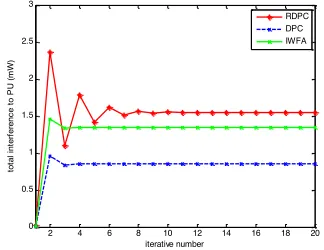
Fig.4 and shows the total power consumption of the RDPC and other two algorithms. It is clearly know that it needs more transmit power and more time to conquer the channel uncertainty effect in our proposed algorithm, and the DPC algorithm can achieve the smaller total power consumption than IWFA in perfect channel. Specifically, we clearly know that the convergence value of the energy consumption in the RDPC algorithm is roughly the same as that of IWFA in Fig.4, but larger than the DPC algo-rithm, which considered the interference gain uncertain-ty(
!
=15%). Furthermore, the interference power received at PU-Rx is the largest in the three algorithms under when the other gains are constant in Fig.5.However, it is necessary to consider the channel uncer-tainty or users’ mobility in real communication environ-ment. When the number of the user of increasing the number,i.e. , M=3,N=3,
!
=
60%
.The simulations are shown from Fig.6 to Fig.10.2 4 6 8 10 12 14 16 18 20 0
0.2 0.4 0.6 0.8 1
iterative number
trans
m
it pow
er
(m
W
)
(a)
SU1 SU2 SU3 Pmax
2 4 6 8 10 12 14 16 18 20 0
5 10 15
iterative number
SI
NR
of
eac
h S
U (
dB
)
(b)
SU1 SU2 SU3 SINRmin
Figure 1. RDPC algorithm
2 4 6 8 10 12 14 16 18 20 0
0.2 0.4 0.6 0.8 1
iterative number
trans
m
it pow
er
(m
W
)
(a)
SU1 SU2 SU3 Pmax
2 4 6 8 10 12 14 16 18 20 0
5 10 15
iterative number
SI
NR
of
eac
h S
U (
dB
)
(b)
SU1 SU2 SU3 SINRmin
Figure 2. DPC algorithm
2 4 6 8 10 12 14 16 18 20 0
0.2 0.4 0.6 0.8 1
iterative number
trans
m
it pow
er
(m
W
)
(a)
SU1 SU2 SU3 Pmax
2 4 6 8 10 12 14 16 18 20 0
5 10 15
iterative number
SI
NR
of
eac
h S
U (
dB
)
(b)
SU1 SU2 SU3 SINRmin
Figure 3. IWFA
2 4 6 8 10 12 14 16 18 20
0 0.5 1 1.5 2 2.5 3 3.5 4
iterative number
ener
gy
c
ons
um
pt
ion (
m
W
)
RDPC DPC IWFA
13.81414.2 1.751.8 1.85
Figure 4. Energy consumption of three algorithms
2 4 6 8 10 12 14 16 18 20 0
0.5 1 1.5 2 2.5 3
iterative number
tot
al
int
er
fer
enc
e t
o P
U (
m
W
)
RDPC DPC IWFA
2 4 6 8 10 12 14 16 18 20 0
0.2 0.4 0.6 0.8 1
iterative number
trans
m
it pow
er
(m
W
)
(a)
SU1 SU2 SU3 Pmax
2 4 6 8 10 12 14 16 18 20 0
5 10 15
iterative number
SI
NR
of
eac
h S
U (
dB
)
(b)
SU1 SU2 SU3 SINRmin
Figure 6. RDPC algorithm
2 4 6 8 10 12 14 16 18 20 0
0.2 0.4 0.6 0.8 1
iterative number
trans
m
it pow
er
(m
W
)
(a)
SU1 SU2 SU3 Pmax
2 4 6 8 10 12 14 16 18 20 0
5 10 15
iterative number
SI
NR
of
eac
h S
U (
dB
)
(b)
SU1 SU2 SU3 SINRmin
Figure 7. DPC algorithm
In Fig.7 and Fig.8, we can obviously observe that the transmit power and SINR of three SUs demonstrate the same result as Fig.2 and Fig.3 with changing the number of users.
The total interference of SUs to three PUs is shown in Fig.10, which illustrates our proposed algorithm can effectively reduce the interference to the PUs when the communication environment changes.
2 4 6 8 10 12 14 16 18 20 0
0.2 0.4 0.6 0.8 1
iterative number
trans
m
it pow
er
(m
W
)
(a)
SU1 SU2 SU3 Pmax
2 4 6 8 10 12 14 16 18 20 0
5 10 15
iterative number
SI
NR
of
eac
h S
U (
dB
)
(b)
SU1 SU2 SU3 SINRmin
Figure 8. IWFA
2 4 6 8 10 12 14 16 18 20 0
0.5 1 1.5 2 2.5 3
iterative number
ener
gy
c
ons
um
pt
ion (
m
W
)
RDPC DPC IWFA
15.615.81616.2 0.981 1.02 1.04 1.06 1.08
Figure 9. Energy consumption of three algorithms
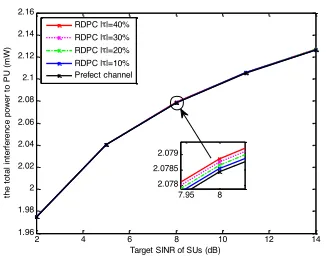
In the following simulations, we will show the impact of channel estimation error and background noise quanti-zation error to the communication status in Fig.11 to Fig.14.From Fig.11, Fig.12, Fig.13 and Fig.14, we can get the same conclusion that the total interference from SUs to PU monotonously increases with the minimum SINR threshold value!mth. Specifically, For a given uncertainty,
if !mth increases, each SU needs transmit more power to
meet the QoS requirements, Which also means that the transmit power of SU and the total interference to PU is positive correlation. From Fig.11, for a given!mth, if the
2 4 6 8 10 12 14 16 18 20 0
0.5 1 1.5 2 2.5 3
iterative number
tot
al
int
er
fer
enc
e t
o P
U (
m
W
)
RDPC-PU1 RDPC-PU2 RDPC-PU3 DPC-PU1 DPC-PU2 DPC-PU3 IWFA-PU1 IWFA-PU2 IWFA-PU3 11.611.81212.2
0.35 0.4 0.45
11.81212.2 1.181.2 1.22 1.24 1.26 1.28
15.615.81616.2 0.82 0.84 0.86 0.880.9 0.92
Figure 10. Total interference to PU of three algorithm
2 4 6 8 10 12 14 1.9
2 2.1 2.2 2.3 2.4 2.5 2.6 2.7
Target SINR of SUs (dB)
the t
ot
al
int
er
fer
enc
e pow
er
to P
U (
m
W
)
RDPC |!|=40% RDPC |!|=30% RDPC |!|=20% RDPC |!|=10% Prefect channel
Figure 11. Total interference to PU versus Total interference to PU versus !mthwith interference gain uncertainty!
2 4 6 8 10 12 14 1.95
2 2.05 2.1 2.15 2.2
Target SINR of SUs (dB)
tot
al
int
er
fer
enc
e pow
er
to P
U (
m
W
)
RDPC |!|=40% RDPC |!|=30% RDPC |!|=20% RDPC |!|=10% Prefect channel
Figure 12. Total interference to PU versus
m
th
! with direct channel gain
uncertainty!
2 4 6 8 10 12 14 1.96
1.98 2 2.02 2.04 2.06 2.08 2.1 2.12 2.14 2.16
Target SINR of SUs (dB)
the t
ot
al
int
er
fer
enc
e pow
er
to P
U (
m
W
)
RDPC |!|=40% RDPC |!|=30% RDPC |!|=20% RDPC |!|=10% Prefect channel
7.95 8 2.078 2.0785 2.079
Figure 13. Total interference to PU versus
m
th
! with background noise
uncertainty! !
2 4 6 8 10 12 14 1.95
2 2.05 2.1 2.15 2.2
Target SINR of SUs (dB)
the t
ot
al
int
er
fer
enc
e pow
er
to P
U (
m
W
)
RDPC |r|=40% RDPC |r|=30% RDPC |r|=20% RDPC |r|=10% Prefect channel
Figure 14. Total interference to PU versus m
th
! with channel gain uncer-tainty! !
Through the calculation of variances, we can clearly know the size of the influence of different parameters on the system from Table 1. Among them, we can see that the
!
deviates from the center value is the greatest with!
,r
and!
, which means the greatest effect in real commu-nication system.TABLE I.
INTERFERENCE TO PU WITH DIFFERENT PARAMETERS OF
UNCERTAINTIES
Param eter
Interference to PU (mW)
(
th =8)
m!
Vari-ance
0% 10% 20% 30% 40%
!
2.0784 2.2099 2.3325 2.4472 2.5546 2.8* 10-2!
2.0784 2.0979 2.1143 2.1283 2.1404 4.8* 10-4r
2.0784 2.0901 2.1010 2.1106 2.1184 2.0* 10-4!
2.0784 2.0785 2.0786 2.0787 2.0788 2.0* 10-8REFERENCES
[1] Liang Y C, Chen K C, Li G Y, et al. Cognitive radio networking and communications: An overview[J]. Vehicular Technology, IEEE Transactions on, 2011, 60(7): 3386-3407.
https://doi.org/10.1109/TVT.2011.2158673
[2] Lingling Chen, Xiaohui Zhao. An improved power control AFSA for minimum interference to primary users in cognitive radio net-works [J]. Wireless Personal Communications, 2016,87(1):293-311. https://doi.org/10.1007/s11277-015-3043-5
[3] Haykin S, Fuster J M. On cognitive dynamic systems: Cognitive neuroscience and engineering learning from each other[J]. Pro-ceedings of the IEEE, 2014, 102(4): 608-628.
https://doi.org/10.1109/JPROC.2014.2311211
[4] Monemi M, Rasti M, Hossain E. On Joint Power and Admission Control in Underlay Cellular Cognitive Radio Networks[J]. Wire-less Communications, IEEE Transactions on, 2015, 14(1): 265-278. https://doi.org/10.1109/TWC.2014.2340866
[5] Prasad B, Roy S D, Kundu S. Outage and SEP Performance of Secondary User in Spectrum Sharing with Imperfect Channel Es-timation[C]//Advances in Computing and Communications (ICACC), 2014 Fourth International Conference on. IEEE, 2014: 29-32.
[6] Xiao L, Chen T, Liu J, et al. Anti-jamming Transmission Stackel-berg Game with Observation Errors[J]. IEEE Communications Letters, 2015,19(6): 949-952. https://doi.org/10.1109/LCOMM. 2015.2418776
[7] Xiao Y, Bi G, Niyato D. A simple distributed power control algorithm for cognitive radio networks[J]. Wireless Communica-tions, IEEE Transactions on, 2011, 10(11): 3594-3600.
[8] [8] Ekin S, Abdallah M M, Qaraqe K, et al. Random subcarrier allocation in OFDM-based cognitive radio networks[J]. Signal Processing, IEEE Transactions on, 2012, 60(9): 4758-4774.
https://doi.org/10.1109/TSP.2012.2203126
[9] Wang Z, Jiang L, He C. A novel price-based power control algo-rithm in cognitive radio networks[J]. Communications Letters, IEEE, 2013, 17(1): 43-46. https://doi.org/10.1109/LCOMM.2012. 120612.121587
[10] Lingling Chen, Xiaohui Zhao. Power control algorithm for cogni-tive radio based on chaos particle swarm optimization [J]. Journal of Information and Computational Science,2014,11 (12): 4277-4287. https://doi.org/10.12733/jics20104257
[11] Yang G, Li B, Tan X, et al. Adaptive power control algorithm in cognitive radio based on game theory[J]. Communications, IET, 2015, 9(15): 1807-1811. https://doi.org/10.1049/iet-com.2014.1 109
[12] Lingling Chen, Xiaohui Zhao. Distributed Algorithm for Minimiz-ing Interference to Primary User in Cognitive Radio [J]. Journal of Computational Information and Systems,2015,11(12): 1799-1808. [13] Chen Y, Yu G, Zhang Z, et al. On cognitive radio networks with opportunistic power control strategies in fading channels[J]. Wire-less Communications, IEEE Transactions on, 2008, 7(7): 2752-2761. https://doi.org/10.1109/TWC.2008.070145
[14] Srinivasa S, Jafar S A. Soft sensing and optimal power control for cognitive radio[J]. Wireless Communications, IEEE Transactions on, 2010, 9(12): 3638-3649. https://doi.org/10.1109/TWC.2010. 100110.081079
[15] Parsaeefard S, Sharafat A R. Robust worst-case interference control in underlay cognitive radio networks[J]. Vehicular Tech-nology, IEEE Transactions on, 2012, 61(8): 3731-3745.
https://doi.org/10.1109/TVT.2012.2205719
[16] Luenberger D G, Ye Y. Linear and nonlinear programming[M]. Springer Science & Business Media, 2008.
AUTHORS
Lingling Chen received her Bachelor and PH.D de-grees both in Communication Engineering from Jilin University, China, in 2004 and 2015 respectively. Cur-rently, she is a associate professor of College of Infor-mation and Control Engineering, Jilin Institute of Chemi-cal Technology,simultaneously she is a post-doctor in
Computer science and technology from Jilin University. Her research interests are in nonlinear optimization, mo-bile computing and cognitive radio networks. (e-mail: [email protected]).
Xiaohui Zhao received his Bachelor and Master de-grees both in Electrical Engineering from Jilin University of Technology, China, in 1982 and 1986 respectively, and his PH.D degree in control theory from University de Technology de Compiegne, in 1993, France. Currently, he is a Professor of College of Communication Engineering, Jilin University. His research interests are signal pro-cessing, nonlinear optimization and wireless communica-tion. (e-mail: [email protected])
Shubei Sun, Yueliang Lu, Xiaoyue Gong will receive their Bachelor degrees in Electronic Information Engi-neering from Jilin Institute of Chemical Technology, Chi-na, in 2016. Currently, their are students of College of Information and Control Engineering, Jilin Institute of Chemical Technology. their research interests are in ro-bust optimization and cognitive radio networks. (e-mail: [email protected]; [email protected];1051825385 @ qq.com)
Xingquan Gao received his Master and PH.D degrees both in Control Engineering from Jilin University, China, in 2003 and 2006 respectively. Currently, he is a professor of College of Information and Control Engineering, Jilin Institute of Chemical Technology. His research interests are in nonlinear optimization, robust optimization and cognitive radio networks. E-mail: [email protected].