Wireless Sensor Network Coverage Optimization
Based on Fruit Fly Algorithm
https://doi.org/10.3991/ijoe.v14i06.8698
Ren Song!!", Zhichao Xu, Yang Liu
Jilin University of Finance and Economics, Jilin, China [email protected]
Abstract—To solve the defect of traditional node deployment strategy, the improved fruit fly algorithm was combined with wireless sensor network. The optimization of network coverage was implemented. Based on a new type of in-telligent algorithm, the change step of fruit fly optimization algorithm (CSFOA) was proposed. At the same time, the mathematical modeling of two network models was carried out respectively. The grid coverage model was used. The network coverage and redundancy were transformed into corresponding math-ematical variables by means of grid partition. Among them, the maximum ef-fective radius of sensor nodes was fixed in mobile node wireless sensor net-work. The location of nodes was randomly cast. The location of sensor nodes was placed in fixed position nodes. The effective radius of nodes can be changed dynamically. Finally, combined with the corresponding network mod-el, the improved algorithm was applied to wireless sensor network. The combi-nation of the optimal solution of the node position and the perceptual radius was found through the algorithm. The maximum network coverage was achieved. The two models were simulated and verified. The results showed that the im-proved algorithm was effective and superior to the coverage optimization of wireless sensor networks.
Keywords—wireless sensor networks; coverage optimization; sensor nodes
1
Introduction
technology and communication technology. They constitute the "sensory", "brain", and "nerve" of the information technology system.
As a new technology, wireless sensor network is widely used in military field, ag-ricultural production, ecological monitoring and disaster warning, infrastructure status detection, industrial field, intelligent transportation, medical system and smart home. However, because the working environment of WSN is so bad that most of them can't deploy sensor nodes in the field, they can only deploy nodes in large-scale random delivery mode, which causes many urgent problems. For example, the acquisition of wireless sensor networks, processing and transmission of high-quality signals and the construction of sensor node hardware platform need to be studied. One of the key problems of sensor networks is the deployment optimization of nodes. The improve-ment of network coverage, the reduction of network energy consumption and the simplification of network model are the basis of the development of wireless sensor technology.
2
Literature review
Cheng and others as stated in [1] designed a delay-aware data collection network structure for wireless sensor networks. In addition, Sun and others proposed as stated in [2] a cooperative communication for wireless ad hoc and sensor networks. Wireless sensor network is a distributed sensor wireless ad hoc network. The end of the WSN node can perceive and inspect the sensors of the external world.
Li and Lin as stated in [3] designed a smart home control system based on wireless sensor networks. Luo and others as stated in [4] applied the opportunistic routing algorithm for relay node se-lection in wireless sensor networks. Rezvani and others as stated in [5] studied the data aggregation technique for wireless sensor networks. Srbinovska and others, as stated in [6], proposed environmental parameters monitor-ing, which used wireless sensor networks. Shu and others as stated in [7] optimized the transmit power-time and bit energy efficiency based on cdma wireless sensor networks. Younis and others as stated in [8] discussed the node clustering in wireless sensor networks. Yao and others as stated in [9] proposed an energy-efficient and lifetime-balancing data collection protocol for wireless sensor networks. Zhao and others as stated in [10] designed a mobile data gathering with load balanced clustering and dual data uploading in wireless sensor networks.
By deploying sensors, the information in the monitoring area is collected in real time and processed with a processing unit. Then, these data are sent to the remote network control center. The location of the node can be fixed and removable, and the sensor nodes can be wired or wirelessly connected to the Internet. Wireless sensor networks (WSN) are composed of many sensor nodes deployed in the monitoring area. There are three main elements in the network: sensor, perceiving object and observer structure.
optimi-zation algorithm is designed based on the fruit fly algorithm. This method makes up for the shortcomings of current research on network coverage. It is noted that the new method is effective and superior to the coverage optimization of wireless sensor net-works.
3
Methodology
3.1 Wireless sensor network
Wireless sensor network is a distributed sensor wireless ad hoc network. The end of the WSN node can perceive and inspect the sensors of the external world. By de-ploying sensors, the information in the monitoring area is collected in real time and processed with a processing unit. Then, these data are sent to the remote network control center. The location of the node can be fixed and removable, and the sensor nodes can be wired or wirelessly connected to the Internet. Wireless sensor networks (WSN) are composed of a large number of sensor nodes deployed in the monitoring area. There are three main elements in the network: sensor, perceiving object and observer structure. By perceiving, collecting, and processing the information of the perceiving object, it is finally sent to the observer. The structure of the wireless sensor is shown in Figure 1.
Cloud
compution Integration node Internet or satellite Management node
Fig. 1. Structure diagram of wireless sensor network
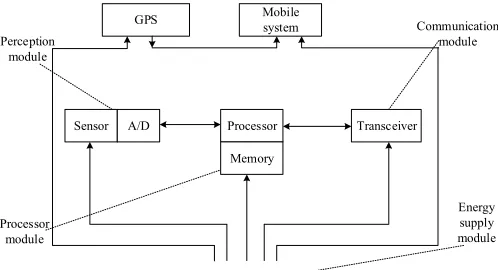
In different applications, the composition of the sensor nodes is different. Howev-er, they are usually made up of 4 parts: the perception module, the communication module, the processor module and the energy supply module. The structure of the node function of the wireless sensor network is shown in Figure 2.
GPS Mobile system
Sensor A/D Processor
Memory
Transceiver Perception
module
Processor module
Communication module
Energy supply module
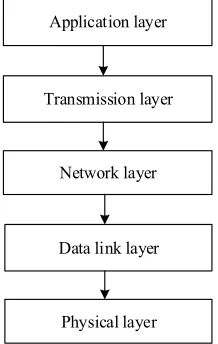
From the horizontal direction, each part is the management unit of the network. From the vertical direction, each part is composed of the communication protocol layer of the network. According to the difference of function, the communication protocol layer can be divided into five layers: physical layer, data link layer, network layer, transmission layer and application layer. The network management unit is di-vided into three aspects according to its function: energy management, mobility man-agement and task manman-agement. The network system structure of sensor communica-tion is shown in Figure 3.
Application layer
Transmission layer
Network layer
Data link layer
Physical layer
Fig. 3. The network system structure of sensor communication
Large scale: A large number of accurate data are collected in the monitoring target area, so the wireless sensor network will deploy sensor nodes on a large scale. The scale of WSN is reflected in two parts: one is the large target monitoring area of WSN; the other is the high density of sensor nodes in the target monitoring area. Wireless sensor networks (WSN) use a large number of sensor nodes to cooperate to improve the network communication and the quality of service.
Self-organization: In the use of wireless sensor networks, the location of the initial sensor nodes is generally not accurate. The structure between adjacent nodes is also uncertain. Therefore, the self-organizing ability of the sensor nodes is very important. It can automatically set and control the network. In addition, the cover void caused by the failure node needs to be remedied to increase the signal precision in the monitor-ing area. The topology of the network will also change. The self - organizmonitor-ing ability of the network ensures that the structure can cope with these changes.
Coverage performance: The coverage performance of wireless sensor networks is related to the distribution mode and number of sensor nodes and the energy consump-tion of the nodes. The implementaconsump-tion of target monitoring area coverage, the optimal node distribution mode selection, the optimal number of nodes and the reduction of node energy consumption are the key to the research of wireless sensor network cov-erage performance.
Connectivity performance: In wireless sensor networks, the working ability of a single node is very small, and the performance of the perception range and network communication is very poor. On the premise of satisfying perception and coverage, wireless sensor networks should also guarantee the connectivity of wireless sensor networks. Connectivity and coverage are the basis for the normal operation of wire-less sensor networks.
The life time of the network: The rated power of wireless sensor nodes is usually not high. The working environment of the node is usually very bad, and it is difficult to maintain the node. Therefore, the survival of a single node will affect the smooth operation of the entire network. By improving the energy utilization of each node, the whole network life time can be extended effectively.
Energy balance: Energy consumption is one of the most influential factors for the design and implementation of wireless sensor networks. The energy consumption of each node is different because of the different working modes of each node. Some nodes with higher frequency can be easily damaged, which makes the network cover-age and the quality of work rapidly decline. Therefore, it is a key problem to ensure the energy balance of each node.
Fault tolerance and adaptability: The working environment of wireless sensor net-works is generally very bad. It is often infeasible to maintain or replace a node. There-fore, the network needs strong fault tolerance and self-adaptability. It can automatical-ly manage and repair the network through automatic adjustment, and improve the quality of service of the network.
The complexity of the algorithm: The wireless sensor network node is a small em-bedded system module. The computing power and storage space are very limited. The complexity of the coverage control algorithm must be taken into account. Too com-plex algorithm will bring the network slow speed, storage space and other disad-vantages. Therefore, the complexity of the algorithm is also a key problem that must be considered when designing the network.
3.2 Fruit fly algorithm
Fruit fly optimization algorithm (FOA) is a new type of intelligent optimization al-gorithm researched and developed by Pan Wenchao in 2011. It has good global opti-mization performance and can solve many optiopti-mization problems. Fruit fly has senso-ry awareness superior to other organisms, especially visual and olfactosenso-ry. Depending on the sense of smell, fruit flies are well aware of various odorous molecules in the air and can even smell food tens of kilometers away. At the same time, with keen eye-sight, it gathers with other fruit flies. Fruit fly algorithm is to imitate the foraging process of fruit flies and put forward a new type of intelligent optimization algorithm.
The fruit fly algorithm is less computationally intensive, the running time is short, the algorithm complexity is low, and the optimization precision is high. However, the time of the fruit fly algorithm is short, the algorithm theory and method are not ma-ture, so the algorithm has a lot of defects. The stability of the fruit fly algorithm is not high, and it is very easy to fall into the local optimal. In the later period, the conver-gence precision is reduced and the converconver-gence speed is slowed down. These are the contents and improvements that need to be studied when using the fruit fly algorithm.
3.3 Change the Step of FOA
According to the introduction of the fruit fly algorithm in the last section, it can be seen that the fruit fly algorithm has many advantages over other swarm intelligence algorithms. However, the fruit fly algorithm also has a large defect. The fruit fly indi-vidual iterates from the same starting point each time in the fruit fly algorithm. Then, the search is carried out in the random direction, and the random number in the fixed interval
[
!
H
,
H
]
is searched. When H is large, the algorithm has strong global search ability and fast convergence speed, but the local search ability of the algorithm is low, and the convergence accuracy is not enough. On the contrary, if theH
is smaller, the local search ability is stronger. The global search capability is low. It leads to the slow convergence of the algorithm. Moreover, the algorithm is searched in the area, and the convergence result is easy to fall into the local optimal error solu-tion centralizasolu-tion. In view of the above limitasolu-tions, the change step of fruit fly opti-mization algorithm (CSFOA) proposed in this paper divides the search into several cycles. If 50 iterations are taken to a period ofT
, the step length in each cycle is changed in the form ofSin
(
x
)
, which is as follows:!"
!
#
$
>
%
+
&
=
'
=
&
(
&
+
=
L
H
L
L
H
i
L
H
Maxgen
i
T
i
H
rand
xis
X
X
i i i i i ))
)
)
1
)
(sin(
]
,1
[
)
,
mod(
)
1
()
2
(
_
(1)sev-eral cycles, which can increase the diversity of the search process. The algorithm can effectively jump out of local convergence and greatly reduce the possibility of local convergence. Then, CSFOA uses the
Sin
(
x
)
function within each cycle to make the step change in the unit cycleT
. WhenSin
(
x
)
is increasing monotonously, the step length exponentially increases. The algorithm has a strong global search ability and can achieve fast convergence. The convergence result is not easy to fall into the local optimal. At the same time, the increase of the step length can solve the possible local convergence problem ofSin
(
x
)
in the last monotone decreasing interval. In the)
(
x
Sin
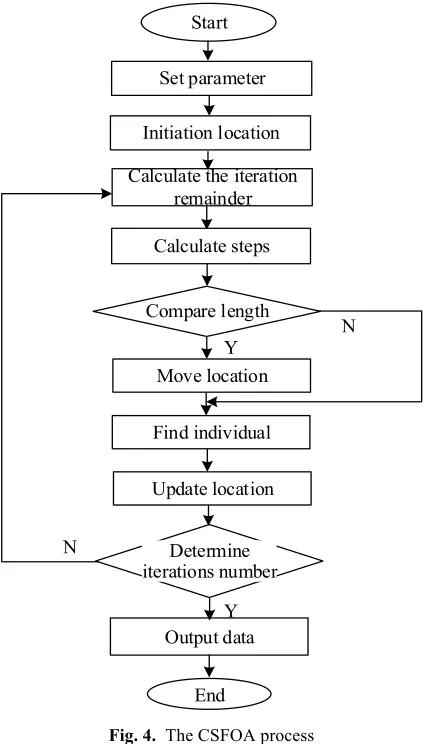
monotonically decreasing interval, the step length exponential type decreases, which enables the algorithm to complete a high precision search in a small range. The result has better convergence effect. The CSFOA process is shown in Figure 4.Set parameter
Calculate the iteration remainder
Compare length Start
End Y Move location Calculate steps
Output data Determine iterations number
Y N
N Initiation location
Find individual
Update location
4
Result Analysis and Discussion
4.1 Node model of wireless sensor network
The grid coverage model is used. In a two-dimensional region of
a
*
b
, the region is dispersed intoa
*
b
receiving point, and the location of each receiving point is expressed as(
a
i,
b
i)
.N
sensor nodes are randomly deployed in the target area, and the rated effective radius of the node is R. Each node sends its own position to theSink
node and completes the optimization operation by theSink
node. Each group of sensor nodes can be expressed as:)
,
,...,
,
(
w
1w
2w
iw
NW
=
(2)The distance between the node
w
i and the receiving point(
a
k,
b
k)
is expressed as:2 2
,k
(
i k)
(
i k)
i
x
a
y
b
d
=
!
+
!
(3)The probability of receiving point
(
a
k,
b
k)
to the nodew
i signal is expressed as:!"
!
#
$
>
%
=
R
d
R
d
P
k i k i k i , , ,0
1
(4)The probability that the receiver
(
a
k,
b
k)
can receive the number one sent by this group of nodes is expressed as:)
1
(
1
)
,
(
a
kb
kP
i,kP
=
"
!
"
(5)Finally, the signal coverage rate of the transmitter
W
to the region is expressed as:b
a
b
a
P
G
k kW
*
)
(
!
"
=
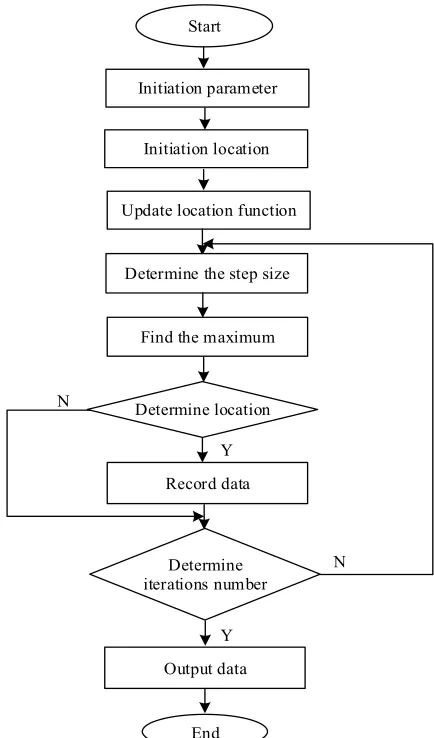
(6)swarm optimization (PSO), frog leaping algorithm (SFLA) and firefly algorithm (FA). However, these algorithms have some drawbacks in wireless sensor network coverage optimization. They are not well integrated with coverage optimization mod-els. For example, the structure of particle swarm optimization (PSO) is too complex, which results in too slow computing speed and too poor real-time performance. Frog jumping algorithm performance is poor. The final coverage is not satisfactory. It does not meet the user's service requirements. Some algorithms have many parameters, leading to the network model is too complicated. In response to these problems, CSFOA is used to avoid these drawbacks. It effectively solves the wireless sensor network coverage optimization problem of mobile nodes. The flow chart of the cover-age algorithm of the mobile node based on CSFOA is shown in Figure 5.
Initiation parameter
Update location function
Determine location Start
End Y Record data Determine the step size
Output data Find the maximum
Determine iterations number
Y
N N
Initiation location
In order to verify the superiority of CSFOA in the coverage optimization of wire-less sensor networks in mobile nodes, under the condition that the number of itera-tions is 200, the coverage area is
50
m
*
50
m
and the nominal effective radius of node is5
m
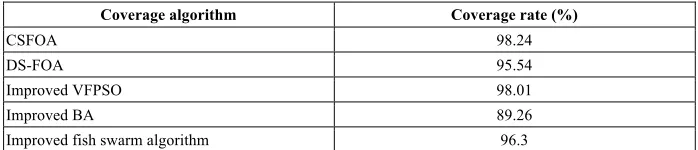
, five algorithms, namely, CSFOA, improved virtual force particle swarm optimization (VFPSO), improved bat algorithm (BA), improved chaos fish algorithm and DS-FOA, are used to simulate wireless sensor network coverage optimization. The average of the results of 50 experiments is taken as the final result. The final results are shown in Table 1 (set the theoretical coverage is 1).Table 1. Comparison of algorithm coverage Coverage algorithm Coverage rate (%)
CSFOA 98.24
DS-FOA 95.54
Improved VFPSO 98.01
Improved BA 89.26
Improved fish swarm algorithm 96.3
As can be seen from Table 1, under the same circumstances, compared with other improved algorithms, the CSFOA has the highest network coverage, and the theoreti-cal coverage is 98.24%. Compared with DS-FOA, improved VFPSO, improved BA and improved fish algorithm, the CSFOA algorithm increased by 2.7%, 0.23%, 8.98% and 1.94% respectively. Because CSFOA is closely integrated with the high perfor-mance of wireless sensor network model and algorithm, it has better effect on the coverage optimization of wireless sensor networks in mobile nodes.
Through the data display and analysis of simulation experiments, it can be seen that CSFOA has good performance (convergence accuracy and convergence speed) in the coverage optimization of wireless sensor networks for mobile nodes. Compared with other improved intelligent optimization algorithms, the proposed algorithm can better integrate the network model. It has better results and the process is more stable. The network coverage is higher. Therefore, it is more suitable for mobile node wire-less sensor network coverage optimization.
the current research, redundant nodes in the coverage model are eliminated by grid coverage and coverage radius nodes. However, the traditional algorithm has such problems as high complexity or low convergence accuracy. It cannot achieve ideal results in coverage optimization of wireless sensor networks with fixed location nodes. In view of the above problems, the CSFOA algorithm is used to solve the dy-namic radius planning of fixed position nodes, and the optimization of network cover-age is realized. The simulation experiment shows the superiority and effectiveness of the CSFOA algorithm in the wireless sensor network coverage optimization of fixed position nodes.
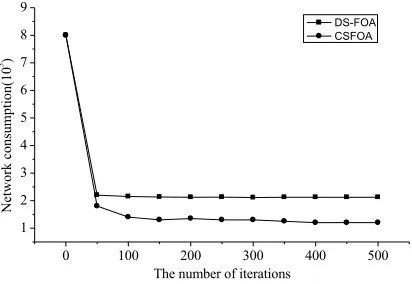
Figure 6 is a comparison of two improved Drosophila algorithms for DS-FOA and CSFOA in wireless sensor network coverage optimization at fixed location nodes. It can be seen that after 500 iterations, two algorithms achieve high accuracy, and two algorithms have fast convergence speed. Compared with DS-FOA, CSFOA can better combine the wireless sensor network model with fixed position nodes. It has better optimization performance. In the first 50 iterations, CSFOA can quickly achieve high precision convergence. In the 50500-iterative process, the algorithm can jump out of the local optimal by self-correction, and further improve the accuracy and achieve better results. After the 500 iterations, the result of CSFOA is much more accurate than that of DS-FOA. The two kinds of fruit fly algorithms are compared as shown in Figure 6.
0 100 200 300 400 500
1 2 3 4 5 6 7 8 9
Ne
tw
or
k c
on
su
m
pt
io
n(
10
5 )
The number of iterations
DS-FOA CSFOA
Fig. 6. Comparison of two kinds of fruit fly algorithms
5
Conclusions
Based on a new type of intelligent algorithm, the change step of fruit fly optimiza-tion algorithm (CSFOA) is proposed. At the same time, the mathematical modeling of two network models is carried out respectively. Finally, combined with the corre-sponding network model, the improved algorithm is applied to wireless sensor net-work. The results show that the improved algorithm is effective and superior to the coverage optimization of wireless sensor networks. The specific performance is as follows:
First, the improved fruit fly algorithm is combined with two coverage models of wireless sensor networks. Through the comparison test, it is proved that the solution of this paper is better than the previous solution.
Second, based on the foraging behavior of fruit flies, the fruit fly optimization al-gorithm was proposed. Fruit flies have a sensitive sense of smell and vision. It can quickly and accurately find the food location. Therefore, the FOA algorithm has the characteristics of less parameters, faster convergence rate and higher accuracy.
Third, the fruit fly optimization algorithm has many advantages, there are some obvious drawbacks. For example, the algorithm tends to fall into the local optimal convergence. The step size of the algorithm will have a great influence on the optimi-zation efficiency and the result.
Finally, based on the Drosophila algorithm, the change step of fruit fly optimiza-tion algorithm (CSFOA) is proposed. At the same time, CSFOA algorithm is applied to the coverage optimization problem of wireless sensor network. Through a series of simulation experiments, the effectiveness and superiority of CSFOA on the coverage optimization of wireless sensor networks is verified. The optimization of wireless sensor network coverage is realized.
6
Acknowledgement
This paper is supportted by Project of the Education Department of Jilin Province, "13th Five-Year" science and technology project "in finance and Economics Colleges Construction of cross platform integrated simulation training" (contract number: JJKH20170122KJ).
7
References
[1]Cheng, C. T., Chi, K. T., & Lau, F. C. M. A delay-aware data collection network structure for wireless sensor networks. IEEE Sensors Journal, 2017, vol. 11(3), pp. 699-710.
https://doi.org/10.1109/JSEN.2010.2063020
[3]Li, M., & Lin, H. J. Design and implementation of smart home control systems based on wireless sensor networks and power line communications. IEEE Transactions on Industrial Electronics, 2015, vol. 62(7), pp. 4430-4442. https://doi.org/10.1109/TIE.2014.2379586
[4]Luo, J., Hu, J., Wu, D., & Li, R. Opportunistic routing algorithm for relay node selection in wireless sensor networks. IEEE Transactions on Industrial Informatics, 2017, vol. 11(1), pp. 112-121. https://doi.org/10.1109/TII.2014.2374071
[5]Rezvani, M., Ignjatovic, A., Bertino, E., & Jha, S. Secure data aggregation technique for wireless sensor networks in the presence of collusion attacks. Dependable & Secure Com-puting IEEE Transactions on, 2015, vol. 12(1), pp. 98-110. https://doi.org/10.1109/TDSC. 2014.2316816
[6]Cheng, C. T., Chi, K. T., & Lau, F. C. M. A delay-aware data collection network structure for wireless sensor networks. IEEE Sensors Journal, 2017, vol. 11(3), pp. 699-710.
https://doi.org/10.1109/JSEN.2010.2063020
[7]Ruela, A. S., Cabral, R. D. S., Aquino, A. L. L., & Guimarães, F. G. Memetic and evolu-tionary design of wireless sensor networks based on complex network characteristics, 2017, vol. 1(2), pp. 33-53.
[8]Younis, O., Krunz, M., & Ramasubramanian, S. Node clustering in wireless sensor net-works: recent developments and deployment challenges. Network IEEE, 2015, vol. 20(3), pp. 20-25. https://doi.org/10.1109/MNET.2006.1637928
[9]Yao, Y., Cao, Q., & Vasilakos, A. V. Edal: an energy-efficient, delay-aware, and lifetime-balancing data collection protocol for wireless sensor networks. IEEE/ACM Transactions on Networking, 2015, vol. 23(3), pp. 810-823. https://doi.org/10.1109/TNET.2014.230659 2
[10]Climent, S., Sanchez, A., Blanc, S., Capella, J. V., & Ors, R. Wireless sensor network with energy harvesting: modeling and simulation based on a practical architecture using real ra-diation levels. Concurrency & Computation Practice & Experience, 2016, vol. 28(6), pp. 1812-1830. https://doi.org/10.1002/cpe.3151
8
Authors
Ren Song, Zhichao Xu, and Yang Liu are with Jilin University of Finance and Economics, Jilin, China.