EHPSO: An Enhanced Hybrid Particle Swarm
Optimization Algorithm for Internet of Things
https://doi.org/10.3991/ijoe.v14i06.8305
Dashe Li!!"#$Dapeng Cheng, Jihong Qin
Shandong Business and Technology University, Yantai, Shandong, China
Shue Liu
Binzhou Medical University, Yantai, Shandong, China
Pingping Liu
Yantai North Tea Promotion Center, Yantai, Shandong, China
Abstract—Internet of Things (IOT) has found broad applications and has drawn more and more attention from researchers. At the same time, IOT also presents many challenges, one of which is node localization, i.e. how to deter-mine the geographical position of each sensor node. Algorithms have been pro-posed to solve the problem. A popular algorithm is Particle Swarm Optimiza-tion (PSO) because it is simple to implement and needs relatively less computa-tion. However, PSO is easily trapped into local optima and gives premature re-sults. In order to improve the PSO algorithm, this paper proposes the EHPSO algorithm based on Novel Particle Swarm Optimization (NPSO) and Hybrid Particle Swarm Optimization (HPSO). The EHPSO algorithm applies the prin-ciple of best neighbor of each particle to the HPSO algorithm. Simulation re-sults indicate that EHPSO outperforms HPSO and NPSO in evaluating accurate node positions and improves convergence by avoiding being trapped into local optima.
Keywords—Internet of Things, particle swarm optimization, hybrid
1
Introducion
consisting of two phases is introduced in [1]. A novel localization method (NLM) utilizing the relative received signal strength of neighboring nodes to build the finger-print database was set forth in [2]. A matrix completion algorithm using a nonlinear conjugate gradient method was proposed in [3]. Centralized localization algorithms are suggested in [4,5]. Coordinate system stitching based distributed algorithms were depicted in [6]. Hybrid localization algorithms were discussed in [7]. An error propa-gation aware localization algorithm was described in [8]. A modified particle swarm optimization algorithm based on gravitational field interactions was proposed in [9]. A neural network approach was implemented in [10]. Algorithms based on PSO or variants were proposed in [11-13]. Combining the advantages of PSO and genetic algorithm (GA), an improved FPSO + FGA hybrid method was provided in [14]. An algorithm using information of the second global best and second personal best parti-cles to improve the search performance of the original PSO was proposed in [15]. A new hybridized version of Particle Swarm Optimization algorithm with variable neighborhood search was proposed to solve the constrained shortest path problem in [16]. The MGBPSO-GSA algorithm (combination of Mean Gbest Particle Swarm Optimization and Gravitational Search Algorithm was developed in [17].
In this paper, the Enhanced Hybrid Particle Swarm Optimization Algorithm for op-timal node locations in Internet of Things is proposed. The proposed EHPSO algo-rithm can determine accurate node positions and improve convergence by avoiding being trapped into local optima.
The remainder of the paper is organized as follows. Section 2 provides a general description of IoT node localization using standard PSO. An improved approach and its mathematical model are explained in Section 3. Section 3 also provides the pseudo code for the implementation of the improved approach. Simulations are carried out to compare the proposed approach of this paper with other algorithms in Section 4. Con-clusion is drawn in Section 5.
2
The Standard Particle Swarm Optimization
The Particle Swarm Algorithm, an evolutionary intelligence algorithm, was first proposed by Kennedy and Eberhart in 1995 . Comparing to other algorithms, it has many advantages. For instance, it is not easy to indulge in local optimum but is easy to implement, has high robustness and low requirement for computer hardware.
Considering an M-dimensional search space. N denotes the volume of the swarm population. The position of the i ! th particle is expressed as a vector !!! !!"! !!"! ! !!" ! ! ! !!! ! ! . The vector !!! !!"! !!"!! !!" ! ! ! !!! ! ! represents the velocity of the !th particle. Assume that !!"#$%! !!"! !!"! ! !!" ! ! !
!!! ! ! is the best position that the !th particle has been searched by now. The
opti-mum of !!!"#$% is defined as the best position of the whole swarm which is expressed as !!"#$!!!! !!"! !!"! ! !!" . The particles update their positions and velocities according to the following formulas
!!" !! ! ! !!" ! ! !!" ! ! !
where ! is the inertial weight, which is essential to the convergence and usually is chosen as 0.7;!!! and !! are termed as learning factors which determine the influence
of cognitive and social scaling coefficients and their recommended values are
!!! !!!!!!"!. !!! and !! are random numbers uniformly distributed in the interval
[0,1].
3
IoT Node Localization Based on NPSO
3.1 Problem Statement
The principals accomplishing IoT node localization utilize the a priori information of anchor nodes to determine the approximate or accurate coordinates of the target nodes. Assume that the coordinate of !"# anchor is !!!! !!!; the coordinate of the target
node to be determined is !!! !!, then the distance !! between the ith anchor node and
target node can be calculated as
!!! !!!! !! !!!!!!! (2)
Therefore, the coordinates of the target nodes can be calculated as follows:
!!! !!!! !! !!!!!!! !
!!! !!!! !! !!!!!!!
(3)
The aforementioned equations hardly give a unique answer. PSO is introduced to solve the problem. Suppose that !! is the value of !!, the fitness function of PSO can be described as follows:
! !!! !!! ! !!!!!!!
!!! (4)
where ! is the number of total anchor targets.
3.2 HPSO
!"#$%! !!" ! !!!!"#$%&! !!" ! !! ! !!!!!"#$%&! !!"
!"#$%! !!" ! !!!!"#$%&! !!" ! !! ! !!!!!"#$%&! !!" (5)
!"#$%!!!!"! ! !"#$%&!!!!"! !!"#$%&!!!!"! ! !"#$%&!!!!"!"#$%&!!!!"!! ! !"#$%&!!!!"!
!"#$%!!!!"! ! !"#$%&!"#$%!!!!!!!!"!"!!!"#$%&!!!!!!"#$%&!!!!"!"!! ! !"#$%&!!!!"! (6)
where !"#$% !!" ! !"#$%!!!!! are the child’s position and velocity
ly.!!"#$%& !!" ! !"#$%&!!!!! are the parent’s position and velocity respectively.
Whereas if children’s fitness function value is larger than parent’s, that is to say,
! !!"#$% ! !!!!"#!!"!, HPSO is no longer an efficient approach to solve the local
optimum in that circumstance. The following method is provided to solve the prob-lem.
3.3
Position Estimation Using PSOIn the standard PSO, the particle may be trapped into a local optimum solution and not easy for the particle to escape from it because it is only guided by its historical best solution and the global best solution. To solve this problem, an IoT-related HPSO is put forth based on NPSO proposed in [13].
According to the above discussion, the best positions of each particle and the best positions of whole swarms are critical for the particle’s movement in the search space. Especially, in some certain circumstance, the best neighbor or the neighbor’s neighbor may provide much better information.
Definition: the neighbors of the ith particle are identified by the mean Euclidean Metric between the ith particle and the rest of the particles. Assume that !!"!
!!!!! !! !!!!!!!! is the Euclidean Metric between the ith particle and the jth
parti-cle, then mdi can be calculated as follows,
!"!! !!" ! !!!
!!!
(7)
Thus, if !"!! !, we can define the jth particle as the neighbor particle. After the best neighbor !!"!"#$ has been chosen, the following formulas are utilized to guide the movement of each particle. If !!!!"!"#$! ! !!!!!, then
!!!"#!!!" !! ! ! ! !"#$%&'!!!" ! ! ! !!!!!!"#$%&!!!" ! ! ! !"#$%&!!!"!!!!! !
!!!!!!"#$%&!!!"!"#$!!!! ! !"#$%&!!!" ! !!
!!!"#!!!" ! ! ! ! !!"#$%&!!!" ! ! ! !!!"#!!!" ! ! ! !
(8)
!!" ! ! ! ! !!" ! ! !!" ! ! !
If !"
!! !!or the particle is trapped into a local optimum solution, we will!!"! ! !!!!!!"
!!! ! !
Otherwise,
!!" ! ! ! !!!!" ! ! !!!!!!!"!!!!!!"!!!! ! !!!!!!!" ! !!!" ! !
!!" ! ! ! !!!" ! ! !!"!!! !!
(9)
3.4 Pseudo-Code
Based on the aforementioned descriptions, the pseudo-code of the EHPSO algo-rithm are provided as follows:
(1) Initialization: A series of parameters should be initialized in advance, including a population of M particles with random position !! within the transmission range, the maximum iteration, random best position of the i!th particle !!!"#$% and the best posi-tion of the whole swarm !!"#$!!!.
(2) The initial velocity is set to zero; !!"#! !!"#! !!"#! !!"# are set to fixed values; (3) Set !!! !!!! !!! ! ! !"! and find !!;
(4) while f(pchild)<f(pparent) do
(5) Update the particle velocity by equations (6) (6) Update the particle position by equations (5) (7) while f(pchild)>f(pparent) do
(8) if !"!! ! do
(9) Update the particle velocity by equations (8) (10) Update the particle position by equations (1) (11) while !"!! ! and !!"!! ! do
(12) Update the particle velocity by equations (9) (13) Update the particle position by equations (1)
4
Simulation Results and Discussion
The IoT system with 15 target nodes and 5 anchor nodes is randomly deployed in a 20m!20m open area where the communication between nodes will not be disturbed by some other factors. The dimension of the EHPSO is fixed to be 50. When the pre-cision of the fitness function attains 10-6 or the maximum iteration number approach-es 100, the simulation will be terminated. According to [18], the cognitive parameters c1=c2 and inertia constant ! are set to be 1.494 and 0.6 respectively.
4.1 Localization Error
The aim to improve localization algorithms is to lower the localization error, which is one of the most important criterion to localization algorithm. By altering the loss index n, the amount of swarm N and the iteration number, some experiments are car-ried out to test the advantages of EHPSO over other localization algorithms.
As shown in Figure 1, with the value of pass loss index ! increasing, the localiza-tion error will vary correspondingly. In the rank of PSO, QJ-CMPSO and NPSO, the localization error value of PSO is the largest and EHPSO’s is lower than QJ-CMPSO’s at the same pass loss index.
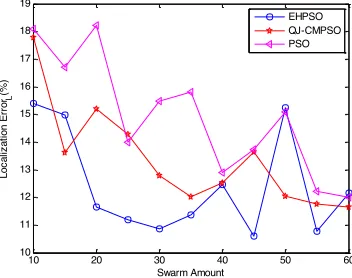
In Figure 2, it dedicates the relationship between swarm amount and localization error when the parameters are fixed as n=2.5 and N varying from 10 to 60. Comparing the three approaches, the localization error is shrinking with the development of swarm amount approximately. At the same swarm amount, the value of EHPSO’s localization error is the lowest and the value of PSO is the highest.
Fig. 1. Relationship between pass loss index and localization error
Fig. 2. Relationship between swarm amount and localization error
2 2.5 3 3.5 4 4.5 5
6 7 8 9 10 11 12 13 14 15
Pass Loss Indexn
Loc
al
iz
at
ion E
rrorL
(%)
EHPSO QJ-CMPSO PSO
10 20 30 40 50 60
10 11 12 13 14 15 16 17 18 19
Swarm Amount
Loc
al
iz
at
ion E
rror
L
(%)
4.2 Algorithm Convergence
The fitness function can be viewed as the localization absolute error of sensor nodes in an IoT system, whose convergence value can be used to assess the localiza-tion accuracy and algorithm convergence.
From Figure 5, it can be deduced that all the three algorithms PSO, QJ-CMPSO and EHPSO have convergence attribute, however EHPSO’s convergent velocity is fastest among the three algorithms, QJ-CMPSO is the second fast.
Fig. 3. Relationship between iteration times and fitness value
4.3 Localization Performance
Fig.4. Iteration process Fig.5. Localization performance
Figure 4 shows the process of approaching global extrema during iterating. The es-timated node positions approach the real positions gradually and the eses-timated errors become smaller with the iteration times increasing.
Figure 5 shows what is achieved after an one-time localization of 20 unknown nodes, where the parameters are set as n=2.5,N=40,Tmax=100. After 10 iterations, 16 active nodes are observed and the average error is 6.47%.
0 20 40 60 80 100
2 3 4 5 6 7 8 9 10 Iteration Times Fi tnes s V al ue( m ) EHPSO QJ-CMPSO PSO
0 10 20 30 40 50
0 5 10 15 20 25 30 35 40 45 50 Iteration Process Anchor Nodes Unknown Nodes Estimated Position
0 10 20 30 40 50
5
Conclusion
Based on RSSI, after defining the best neighbor, the EHPSO algorithm has been proposed to determine the localization of nodes of an IoT system quickly. The pseu-do-code of the EHPSO algorithm is provided and simulations have been carried out. The analysis of the simulation results leads us to the conclusion that EHPSO is a good alternative because it is simpler to implement than the PSO algorithm or the QJ-CMPSO algorithm. The EHPSO algorithm also outperforms the standard PSO algo-rithm and the QJ-CMPSO algoalgo-rithm in many aspects.
6
Acknowledgement
This work is partially supported by National Natural Science Foundation (No.61070175), Shandong Province Natural Science Foundation (ZR2013FL017, ZR2013FL018), and Project Development Plan of Science and Technology of Yantai (2015ZH062, 2015ZH062). The authors gratefully acknowledge the suggestions of the reviewers which have helped improve the presentation.
7
References:
[1]Zhikui Chen, Feng Xia, Tao Huang, Fanyu Bu, Haozhe Wang(2013). A localization
meth-od for the Internet of Things. The Journal of Supercomputing, 63: 657–674
https://doi.org/10.1007/s11227-011-0693-2
[2]Kai Lin, Min Chen, Jing Deng, Mohammad Mehedi Hassan , Giancarlo Fortino(2016).
Enhanced Fingerprinting and Trajectory Prediction for IOT Localization in Smart Build-ings. IEEE Transactions on Automation Science and Engineering, 13:1294-1307
https://doi.org/10.1109/TASE.2016.2543242
[3]Luong Nguyen, Sangtae Kim, Byonghyo Shim(2017). Localization in Internet of Things
network: Matrix completion approach. Information Theory and Applications Workshop, La Jolla, CA, USA.
[4]A. Pal(2010) . Localization Algorithms in Wireless Sensor Networks: Current Approaches
and Future Challenges. Network Protocols and Algorithms, 2:45-73. https://doi.org/
10.5296/npa.v2i1.279
[5] A.A. Kannan , Guoqiang Mao , B. Vucetic(2006).Simulated Annealing based Wireless
Sensor Network Localization. Journal of Computers, 2:15-22. https://doi.org/10.4304/
jcp.1.2.15-22
[6]D. Moore, J. Leonard, D. Rus. Robust distributed network localization with noisy range
measurements. In Proceedings of the Second ACM Conference on Embedded Networked Sensor Systems(2004), November 3-5 2004, Baltimore, MD, pp. 50-61.
https://doi.org/10.1145/1031495.1031502
[7]King-Yip Cheng, King-Shan Lui, Vincent Tam. Localization in Sensor Networks with
Limited Number of Anchors and Clustered Placemen. In Proceedings of Wireless Com-munications and Networking Conference(2007), March 11-15 2007, Hong Kong, China, pp. 4425–4429.
[8]N. A. Alsindi, K. Pahlavan, B. Alavi. An Error Propagation Aware Algorithm for Precise
Con-ference(2006),November 12-15 2006,Washington, DC, USA, pp. 1-7,
https://doi.org/10.1109/MILCOM.2006.302311
[9]M. Spichakova(2016). Modified particle swarm optimization algorithm based on
gravita-tional field interactions. Proceedings of the Estonian Academy of Sciences,65:15–27.
https://doi.org/10.3176/proc.2016.1.01
[10]Shiu Kumar, Ronesh Sharma(2016). Localization for Wireless Sensor Networks: A Neural
Network Approach. International Journal of Computer Networks & Communications,
8:61-71 https://doi.org/10.5121/ijcnc.2016.8105
[11] A. Gopakumar , Lillykutty Jacob. Localization in wireless sensor networks using particle
swarm optimization. IET International Conference on Wireless, Mobile and Multimedia Networks(2008), February 11-13 2008, Beijing,China,pp. 227-230
[12]Xinyi Hu, Shuo Shi, and Xuemai Gu(2012). An Improved Particle Swarm Optimization
Algorithm for Wireless Sensor Networks Localization. Journal of Experimental Biology,
1:1-4 https://doi.org/10.1109/WiCOM.2012.6478418
[13]Chun-Feng Wang, Kui Liu(2016). A Novel Particle Swarm Optimization Algorithm for
Global Optimization. Computational Intelligence and Neuroscience, 2016:1-10
https://doi.org/10.1155/2016/9482073
[14]F. Valdez, P. Melin, O. Castillo(2014). Modular Neural Networks architecture
optimiza-tion with a new nature inspired method using a fuzzy combinaoptimiza-tion of Particle Swarm Op-timization and Genetic Algorithms, Information Sciences, 270:143–153.
https://doi.org/10.1016/j.ins.2014.02.091
[15]Y.B. Shin , E. Kita(2014). Search performance improvement of particle swarm
optimiza-tion by second best particle informaoptimiza-tion. Applied Mathematics and Computaoptimiza-tion,246: 346–
354. https://doi.org/10.1016/j.amc.2014.08.013
[16]Y. Marinakis, A. Migdalas, A. Sifaleras(2017). A hybrid Particle Swarm Optimization –
Variable Neighborhood Search algorithm for Constrained Shortest Path problems.
Europe-an Journal of Operational Research,261:819-834 https://doi.org/10.1016/j.ejor.2017.03.031
[17]N. Singh, S. Singh, S B Singh(2017). A New Hybrid MGBPSO-GSA Variant for
Improv-ing Function Optimization Solution in Search Space. Evolutionary Bioinformatics,
13:1-13. https://doi.org/10.1177/1176934317699855
[18]R.C. Eberhart!Yuhui Shi. Tracking and optimizing dynamic systems with particle
swarms. Proceedings of the 2001 Congress on Evolutionary Computation(2001),May
27-30, Seoul, South Korea,pp. 94-100 https://doi.org/10.1109/CEC.2001.934376
8
Authors
Dashe Li, Dapeng Cheng, and Jihong Qin are with the College of Computer of
Science and Technology at
Shandong Business and Technology University,
Yantai, China.
Shue Liu is the researcher of Binzhou Medical University, Yantai, China.
Pingping Liu is with the Yantai North Tea Promotion Center, Yantai, Shandong,
China.