HyPERlEPTINEMIA AS A PROGNOSTIC FACTOR FOR
PREEClAMPSIA: A COHORT STUDy
Hugo Mendieta Zerón1, Verónica Jackeline García Solorio2, Pamela Montserrat Nava Díaz3,
Adriana Garduño Alanís3, Jonnathan Guadalupe Santillán Benítez4, Ma. Victoria Domínguez García4,
Carolina Escobar Briones5, Edgar Denova Gutiérrez6
Molecular Biology Laboratory, Medical Research Center (CiCMED), Autonomous University of the State of Mexico (UAEMex), Toluca, México1; Autonomous University of the State of Mexico, Toluca, Mexico2; Maternal-Perinatal
Hos-pital “Monica Pretelini”, Toluca, Mexico3; Medical Research Center, Autonomous University of the State of Mexico,
Toluca, Mexico4; Faculty of Medicine, National Autonomous University of Mexico5, National institute of Public Health
(iNSP), Cuernavaca, Morelos, Mexico6
Summary: introduction: Leptin is an adipokine which has a direct relationship to obesity. Our aim was to measure this hormone in pregnant women at three months intervals throughout their pregnancies to determine the serum value of those who developed preeclampsia.
Material and Methods: We followed 19 women (median age 24.8 ± 5.7 years) with pre-gestational Body Mass Index (BMI) less than 25 kg/m2, 21 (median age 26.1 ± 4.6 years) with BMi higher than 25 kg/m2 and 16 (median age 30.9 ± 5.8 years)
with Gestational Diabetes Mellitus (GDM) (median age 30.9 ± 5.8 years), recruited in the 1st trimester of pregnancy. Serum levels of leptin were measured with radioimmunoassay (RiA) technique.
Results: In the first trimester of pregnancy leptin levels showed statistically significant differences between normal weight and overweight-obese women (p < 0.001), diabetic women (p < 0.05) and the subgroup of preeclamptic women (p < 0.001). For those women with PGBMI ≥ 40 kg/m2 and leptin ≥ 40 ng/ml in the second trimester, the Odds Ratio (OR)
to develop preeclampsia was of 47.95% CI (4.1–527.2). Analyzing leptin values with ROC curves, the greatest area under the curve (AUC) was for leptin in the second trimester (0.773, CI: 0.634–0.911).
Conclusion: Women with morbid obesity (BMI ≥ 40 kg/m2) had significantly higher levels of serum leptin (p < 0.01) and
a value of 40 ng/ml of this hormone seems to be predictive of developing preeclampsia in this group of patients.
Key words: Body mass index (BMI); Gestational diabetes; Leptin; Obesity; Overweight; Pregnancy
introduction
Many pregnant women are obese (body mass index (BMi) > 30 kg/m2) and the prevalence of maternal obesity
is increasing (1). Obesity in pregnancy has been linked to several adverse pregnancy outcomes, including spontane-ous abortion, preeclampsia, gestational diabetes (GDM), fetal macrosomia, cesarean delivery, and wound compli-cations post-cesarean section. GDM is defined as varying degrees of carbohydrate intolerance with onset or first diag-nosis during pregnancy (2).
it is recognised that the initiation of dietary or pharma-cological therapy after 24 weeks gestation is likely too late to favorably impact fetal or maternal health. Consequently, some authors have proposed the term gestational prediabe-tes to identify women in early pregnancy (e.g., 12 weeks gestation) at risk for developing GDM using conventional glycemic testing (3).
it is worldwide accepted that preeclampsia is a multi-system disorder characterized by pregnancy-induced or
gestational hypertension and new-onset proteinuria during the second half of pregnancy and is a foremost cause of ma- ternal death (4). Therefore, the early identification of pa- tients with an increased risk for preeclampsia is one of the most important goals in obstetrics.
Recently, it has been suggested that impaired regula-tion of complex interacregula-tions among various adipokines plays an important role in the development of preeclamp-sia (5). For instance, elevated leptin levels may be in- volved in the pathogenesis of preeclampsia and be asso-ciated with the development of severe disease (6; 7). Besides, leptin gene and leptin receptor gene polymor-phisms have also been implicated in the development of preeclampsia (8–10).
The aim of this study was to measure the sensibil-ity and specificsensibil-ity of leptin serum levels in lean, over-weight-obese and diabetic pregnant women throughout their pregnancies to determine if this hormone could serve as an early prognostic marker for preeclampsia risk.
Materials and Methods
SettingThis was a cohort study conducted in the Maternal Per-inatal Hospital “Mónica Pretelini” (HMPMP) from January 1, 2009, to November 30, 2010.
Accepting an alpha risk of 0.05 and a beta risk of 0.2 in a bilateral contrast, 17 subjects per group were needed to detect a difference equal to or greater than 0.6. it was assumed a proportion of 0.035 positive cases (preeclamp-sia) in one of the groups. The estimation of loses was of 0.1 (11).
Preeclampsia was diagnosed and classified according to the criteria specified by the technical bulletin of the Amer-ican College of Obstetricians and Gynecologists (ACOG) and the National High Blood Pressure Education Program (NHBPEP) working Group Report on High Blood Pressure in Pregnancy (12).
Subjects
Women were recruited at their first visit at 10–12 weeks gestation. They were asked to attend after an overnight fast and were tested between 0700 and 0900 h. Three groups of pregnant women were formed: a) normal weight (pre-ges-tational (PG) BMi < 25 kg/m2), b) overweight-obese
(PGBMI ≥ 25 kg/m2) and c) hyperglycemic in the first
tri-mester of pregnancy confirmed as GDM in women previ-ously known to be normoglycemic.
Exclusion criteria were type 1 diabetes mellitus, chronic hypertension or twin pregnancy. Those women with incom-plete medical records or less than two nutritional visits dur-ing the pregnancy were considered lost to the study.
Measures in each trimester
Anthropometric assessment
Body weight was measured in an overnight fasting status without shoes in a minimal clothing state by the use of a dig-ital scale (Seca, Hamburg, Germany) to the nearest 0.1 kg. Height was measured using a non-stretched tape measure (Seca, Hamburg, Germany) to the nearest 0.1 cm. PGBMi was calculated as weight in kg divided by height in meters squared based on the prenatal chart or self-reported weight.
Blood pressure
Blood pressure (BP) was recorded using a standard sphygmomanometer (Riester Big Ben® Square, Germa-ny) and appropriately sized cuff, that was changed to an electronic monitor (Mercury, Mennem Medical) in case of preeclampsia.
Laboratory
Blood samples were collected to measure albumin (mg/dl), cholesterol (mg/dl), creatinine (mg/dl), glucose (mg/dl),
triglycerides (mg/dl), uric acid (mg/dl), liver enzymes (Dimension Rx L Max, Dade Behring), hemoglobin (g/dl) (Advia 120, Bayer Health) and general urine test according to standardized procedures recommended by the interna-tional Federation of Clinical Chemistry and Laboratory Medicine (iFCC).
Serum levels of leptin (Millipore/Linco., USA, Cat. HL-8IHK) and adiponectin (Millipore/Linco., USA, Cat. # HADP-61HK) were determined by means of a double anti-body radioimmunoassay (RiA) using materials and proto-cols suppliedby the provider. For leptin, the sensitivity of the assay was 0.437 ng/ml + 2 SD (100 μl sample size), with an intraassay coefficient of variation (CV) of 3.4% to 8.3% and an interassay CV of 3.6% to 6.2%. For adiponec-tin the sensitivity was of 1 ng/ml, with an intraassay CV of 1.78% to 3.59%, an interassay CV of 6.9% to 9.25%, and a recovery rate of 99% to 117% for adiponectin.
Gestational diabetes test
At the time of recruitment the medical staff used the fol-lowing risk factors to screen women for GDM: a first-de-gree relative with diabetes, a history of GDM or macro-somia, persistent glucosuria, a rapid or excessive weight gain during early pregnancy, a random plasma glucose ≥ 7 mmol/l. Women with one or more of these factors underwent the standard 100 g (Silanes Laboratory, Mexico) 3-h oral glucose tolerance test (OGTT) after an overnight fast. The diagnosis of GDM was made according to the National Diabetes Data Group (NDDG) (13).
Diet
All women were given individualized dietary advice from a qualified dietitian. Compliance with the dietary reg-imen was evaluated weekly during visits to the high-risk pregnancy clinic.
Statistical analysis
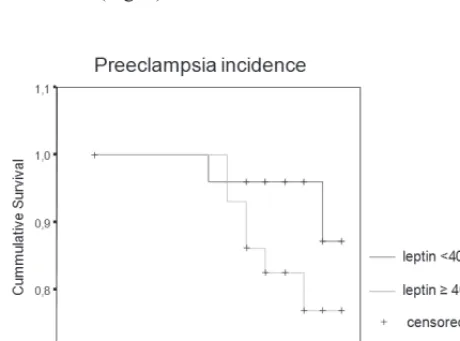
we used the SPSS version 16. Continuous variables were expressed in means ± standard deviation (SD). initial data were assessed through simple crosstabulations and by using χ2 test for categorical variables. Kruskal Wallis and Mann-whitney U tests were used as the variables were not normally distributed. Multivariable test were performed to evaluate the effect of covariates on leptin, systolic and diastolic BP. A Kaplan Meier curve was developed for censored cases of preeclampsia with leptin values above 40 ng/ml.
Receiver Operating Characteristic (ROC) curves were used with each variable and in the cases of preeclampsia. A p value ≤ 0.05 was considered statistically significant.
Ethics
results
Subjectswe followed 19 women of normal weight (median age 24.8 ± 5.7 years), 21 women who were overweight-obese (median age 26.1 ± 4.6 years) and 16 women with diabetes
mellitus (median age 30.9 ± 5.8 years). The mean weight gain was in the ranges described by the institute of Med-icine (IOM), 10.5 ± 1.7, 6.5 ± 3.4 and 11.4 ± 6.4 kg for these three groups. Table 1 shows the baseline demo-graphic, clinical and metabolic characteristics of the study population in pregnancy, stratified into the three gesta-tional groups.
measures
Measures with significant differences are synthesized in table 2. With the Kruskal Wallis test, we found signifi-cant statistical differences in the following variables: age, pre-gestational weight, height, PGBMi, weeks’ gestation,
systolic BP, diastolic BP, cholesterol (1st and 2nd trimes-ter), glucose (1st and 2nd trimestrimes-ter), leptin (1st and 2nd trimester), triglycerides (1st trimester) and baby weight. There were no significant differences among the groups with respect to parity.
Tab. 1: Sociodemographic and clinical characteristics
Normal BMi > 25 GDM
Cases1 19 33.9 21 37.5 16 28.5
Age (years)2,b* 24.8 5.7 26.1 4.6 30.9 5.8
Occupation1
Home 15 79 18 85.7 14 87.5
with job 4 21 2 9.5 2 12.5
Parity2
Pregnancies 1.7 0.8 2.6 1.3 2.7 1.5
Scholarity1
Primary School 0 0 6 28.5 5 31.2
High School 13 68.4 10 47.6 8 50.0
College 6 31.6 4 19.0 1 6.2
University 0 0 0 0 2 12.5
Clinical measures2
Pregestational weight (kg)a,b*** 52.5 6.1 75.1 12.7 84.1 13.9
PGBMi
(kg/m2)a,b*** 21.7 1.5 30.6 3.7 34.9 5.4
weeks of gestationb*** 39.3 0.7 38.4 1.9 37 2.9
Baby weight (kg)b*** 3091.5 222.4 2946.4 493.8 2658.5 549
Preeclampsia1 0 0 4 19 4 25
iUGR1 0 0 3 14.2 5 31.25
1 n and percentage; 2 mean ± Standard deviation; BMi: body mass index; iUGR: intrauterine growth restriction, PGBMi:
pregestational body mass index. a (between normal weight and overweight-obese women), b (between normal weight and
Comparing the results of women who were normal weight with women who were overweight-obese, the first group had lower levels of pre-gestational weight (p < 0.001), PGBMi (p < 0.001), diastolic BP (1st and 3rd trimester: p < 0.001, 2nd trimester: p < 0.01), systolic BP (1st and 3rd trimester: p < 0.001), glucose and triglycer-ides in the 1st trimester (p < 0.05) and leptin (1st trimester: p < 0.001, 2nd trimester: p < 0.05).
Comparing women of normal weight versus women with diabetes, the first group was younger (p < 0.001), reached more weeks of gestation and babys’ weight (p < 0.001) and showed lower levels in pre-gestational weight (p < 0.001), PGBMi (p < 0.001), cholesterol (2nd trimester), glucose (1st and 2nd trimester: p < 0.001, 3rd
trimester: p < 0.01), leptin (1st trimester) (p < 0.05) and triglycerides (1st trimester).
Between normal weight women and the subgroup of preeclamptic women, the second group was older (p < 0.001), reached less weeks’ gestation (p < 0.05), and had higher values in glucose (1st trimester: p < 0.001, 2nd trimester: p < 0.01), cholesterol (1st trimester: p < 0.001, 2nd trimester: p < 0.01), leptin (1st trimester: p < 0.001, 3rd trimester: p < 0.05), pre-gestational weight, PGBMi and triglycerides (1st trimester) (p < 0.001).
Comparing overweight-obese women with diabetic pregnant women, the first group was younger (p < 0.05), reached more weeks of gestation (p < 0.05) and babys’ weight (p < 0.01), had lower levels of PGBMi (p < 0.01),
Tab. 2: Variables with statistically significant differences by intergroup comparisons
Variable Trimester
First Second Third
Cholesterol
(mg/dl) c (152.6 ± 28.2vs 176.6 ± 23.2)* b (219.9 ± 31.4vs 183.8 ± 45.7)* c (219.9 ± 31.4 vs 196.8 ± 17.7)** Systolic blood pressure
(mm Hg) a (101.3 ± 8.1vs 111.3 ± 10.7)*** c (101.3 ± 8.1 vs 122.6 ± 11.7)***
c (109.7 ± 3.8
vs 128.7 ± 8.4)*** a (115.1 ± 3.1vs 128.2 ± 11.1)*** c (115.1 ± 3.1 vs 145 ± 8.1)*** Diastolic blood pressure
(mm Hg) a (66 ± 4.8vs 72.9 ± 5.8)*** c (66 ± 4.8 vs 81.2 ± 7.9)***
a (70 ± 3.3 vs 74 ± 6.7)** c (70 ± 3.3 vs 85.1 ± 13.9)***
a (76 ± 2.3 vs 85 ± 5.7)*** c (76 ± 2.3 vs 96 ± 3.7)*** Glucose
(mg/dl) a (82.1 ± 6.4vs 87.7 ± 7.2)* b (82.1 ± 6.4 vs 113.4 ± 31)*** c (82.1 ± 6.4 vs 99.1 ± 21)***
b (79.6 ± 6.3 vs 96.4 ± 13.7)*** c (79.6 ± 6.3 vs 90.1 ± 11.4)**
b (78.1 ± 6.6 vs 93.4 ± 15.8)**
Leptin
(ng/ml) a (29.6 ± 11vs 45.8 ± 13.1)*** b (29.6 ± 11 vs 40.3 ± 9.6)* c (29.6 ± 11 vs 46 ± 7)***
a (36.8 ± 13.9 vs 49.9 ± 15.1)* c (36.8 ± 13.9 vs 54.6 ± 5.6)**
c (38.8 ± 12 vs 55.4 ± 8.8)*
Triglycerides
(mg/dl) a (125.4 ± 27.6vs 165.5 ± 47.9)* b (125.4 ± 27.6 vs 170.8 ± 56.7)* c (125.4 ± 27.6 vs 172 ± 59.6)***
a (between normal weight and overweight-obese women), b (between normal weight and diabetic women), c (between normal weight and preeclamptic women).
diastolic and systolic BP (p < 0.001 the three evaluated periods) as well as glucose (1st trimester: p < 0.01, 2nd trimester: p < 0.05) and higher of leptin (2nd trimester) (p < 0.05).
Taking into account two conditionals, PGBMI ≥ 40 kg/m2
and leptin ≥ 40 ng/ml in the second trimester, the Odds Ratio (OR) to develop preeclampsia was of 47.95% CI (4.1–527.2), p = 0.0018. Following this, the power to dis-cern a difference was around 100% (proportion with the two conditionals = 80%, proportion two = 7.8%). Multi-variate tests showed a lack of effect of age, parity, PGBMi and pre-gestational weight on leptin, systolic and diastolic BP in the second trimester.
During the follow-up period, there were no cases of preeclampsia in the group of pregnant women with nor-mal PGBMi. in contrast, four patients in each of the other groups (overweight-obese and GDM) developed this com-plication. Kaplan Meier curve of censored cases of preec-lampsia with leptin values above 40 ng/ml illustrates this behaviour (Fig. 1).
with ROC curves, the greatest area under the curve (AUC) for a variable associated with preeclampsia was for final weight (0.826, CI: 0.714–938), followed by PGBMI (0.822, CI: 0.667–967) (Fig. 2). With a PGBMI value of 38.5 kg/m2, we had a sensitivity of 0.5 and a specificity
of 0.921. Analyzing leptin values with this test, the great-est AUC was for leptin in the second trimgreat-ester (0.773, CI: 0.634–0.911) followed by leptin in the first trimester (0.750, CI: 0.714–0.886) (Fig. 3).
After regrouping by PGBMi, those women with morbid obesity (PGBMI ≥ 40) had leptin value in the first trimester of 54 ± 9 ng/ml, while those with obesity (PGBMI ≥ 30) had 42 ± 13.2 ng/ml and those with overweight (25 ≤ PGBMI < 30) had 41 ± 14.3 ng/ml.
discussion
in our population, dietary patterns during pregnancy were similar to those previously reported for the Mexican population with substantial deficiencies in intakes of cere-als, legumes and vegetables (14).
Given the weight gain during pregnancy, this physi-ological moment can be seen as a forced stage of over-
Fig. 1: Kaplan Meier curve for time to preeclampsia based upon serum leptin levels
For leptin < 40 ng/ml: Mean Survival Time (MST): 40.63 weeks, Standard Error (SE): 0.28, 95% Confidence Inter-val (CI) (40.08–41.19). For leptin ≥ 40 ng/ml: MST: 39.98 weeks, SE: 0.38, 95% CI (39.24–40.72).
Fig. 2: Receiver Operating Characteristic (ROC) curves of final weight and pregestational body mass index
PGBMi: pre-gestational body mass index
Fig. 3: Receiver Operating Characteristic (ROC) curves of serum leptin levels
weight-obesity with all of the risks of this pathology. Rising levels of obesity strengthen the potentially clini-cal significance of our findings related to the increasing importance of first-trimester identification of women at the greatest risk for complications such as GDM or preec-lampsia. in our study, higher values of systolic BP at the time of recruitment and at the end of gestation were corre-lated with overweight-obese women compared to normal weight women.
in support of the notion of damage produced by obesity during gestation, was the finding that two women initially followed in the overweight-obese group developed GDM. Furthermore, of the women who developed preeclampsia, four were morbidly obese (PGBMI ≥ 40), three were obese (30 ≤ PGBMI < 40) and one was overweight (25 ≤ PGBMI < 30). Of the other women, there was only one who was morbidly obese who did not develop preeclampsia.
we also searched for possible differences in the weight of babies among the groups and found that this variable was higher in normal pregnancies than in GDM. This difference is attributed to the premature interruption of pregnancies in the last group due to preeclampsia. in fact, normal preg-nancies had a longer duration of gestation when compared to the GDM group. This behavior was similar when com-paring overweight-obese women versus the GDM group, with a longer duration of gestation and heavier babies in the former group when compared to the latter.
Similar to Ray et al. (3), we think that the actual rec-ommendation to screen for GDM conditions is too late for physicians to diagnose a critical metabolic problem for the mother and fetus, making it obligatory to consider new guidelines and terms. in our work, glucose in diabetic women was higher than in the other groups at the moment of admission to our study. Fortunately, we reached meta-bolic control after the follow-up with advice from the nutri-tionist. Among all of the women, there was a tendency for cholesterol, triglycerides and leptin to increase.
Due to the worldwide diversity in the results of ponectin and pregnancy (15–18), we measured this adi-pokine only to characterize those women with normal weight, and the mean values for the first, second, and third trimester were 14.3, 20.6 and 43 µg/ml, respectively.
Evidence shows that maternal leptin levels correlate with maternal weight, BMi, mid-arm circumference and skinfold thickness, but not with birth weight, placental weight or maternal height (19). Controversy exists in the literature, regarding maternal leptin levels in GDM. This discrepancy could be a result of the differences in the time of maternal blood sampling (20).
Some authors have published that leptin is not associat-ed with preeclampsia and that neither adiponectin nor lep-tin differ significantly between mild and severe cases (21; 22). On the contrary, previous studies have demonstrated that plasma leptin concentrations are increased significant-ly during the third trimester of preeclamptic pregnancies when compared to normal pregnancies (23). Even more, it
has been documented that plasma leptin levels are elevated before preeclampsia becomes clinically evident (24). Our results support this late notion as leptin levels in preeclamp-tic patients were significantly higher compared to controls in each trimester (46 ± 7, 54.6 ± 5.6, 55.4 ± 8.8 vs. 29.6 ± 11, 36.8 ± 13.9, 38.8 ± 12) ng/ml. Unlike weight gain, leptin in pregnancy had a better AUC for cases that developed preeclampsia. Specifically, a leptin level of 40.2 ng/ml in the first trimester had a sensitivity of 0.875 and a specificity of 0.311 for developing preeclampsia. in addition, seven of eight preeclampsia cases in our cohort study had leptin reports above this level. The fact that the concentrations of leptin increased in diabetic women, despite the metabolic control reached, suggest that this adipokine is not modifia-ble by insulin treatment but by BMi.
There is evidence to suggest that the placenta, rather than maternal adipose tissue, makes a substantial contribu-tion to the increase of maternal leptin concentracontribu-tions (25; 26). in fact, placental leptin expression has been shown to be up-regulated by different pregnancy hormones such as chorionic gonadotrophin and 17beta-estradiol and also by second messengers such as cyclic adenosine 5′-monophos-phate (27–29). Even more, the production of leptin from placental syncytiotrophoblasts increases with gestational age, leading to an increased leptin level in maternal circu-lation (25). Although this is a very important concept, we were not able to collect and weight the placentas as these tissues were used for other studies.
In the context of our population, the key finding of the current study is the demonstration that elevated serum levels of leptin in pregnant women in the first and second trimesters can be predictors for preeclampsia, suggesting that this hormone is an important factor contributing to this complication of pregnancy (30). Further studies are required to verify whether this hypothesis is true at an ear-ly stage of pregnancy (31). importantear-ly, this adipokine is not modified by insulin treatment as with adiponectin and maintains a direct relationship with visceral adiposity. This last point, “the obesity issue” (pre-gestational BMi, weight gain in pregnancy) (32), could explain at least in part the contradictory data concerning the pattern of adipocy-tokines’ secretion in normal and complicated pregnancies.
conclusion
Leptin values higher than 40 ng/ml in the first trimester was present in 87.5% of pregnant women with morbid obe-sity who developed preeclampsia. Therefore, this adipokine could be useful as a prognostic marker for preeclampsia.
Acknowledgements
This study was supported by the Autonomous Univer-sity of the State of Mexico (UAEMex), Grant: 2841/2009.
references
1. Tsoi E, Shaikh H, Robinson S, Teoh TG. Obesity in pregnancy: a major health-care issue. Postgrad Med J 2010; 86: 617–23.
2. Ostlund i, Hanson U, Bjorklund A, et al. Maternal and fetal outcomes if ges-tational impaired glucose tolerance is not treated. Diabetes Care 2003; 26: 2107–11.
3. Ray JG, Berger H, Lipscombe LL, Sermer M. Gestational prediabetes: a new term for early prevention? indian J Med Res 2010; 132: 251–5.
4. Kuc S, Wortelboer EJ, van Rijn BB, et al. Evaluation of 7 serum biomarkers and uterine artery Doppler ultrasound for first-trimester prediction of preeclampsia: a systematic review. Obstet Gynecol Surv 2011; 66: 225–39.
5. Bienertova-Vasku J, Dostalova Z, Kankova K, et al. is there any link between severe pre-eclampsia and defined polymorphisms in leptin and adiponectin genes? J Obstet Gynaecol Res 2008; 34: 858–64.
6. Ouyang Y, Chen H, Chen H. Reduced plasma adiponectin and elevated leptin in pre-eclampsia. Int J Gynaecol Obstet 2007; 98: 110–4.
7. Molvarec A, Szarka A, Walentin S, et al. Serum leptin levels in relation to cir-culating cytokines, chemokines, adhesion molecules and angiogenic factors in normal pregnancy and preeclampsia. Reprod Biol Endocrinol 2011; 9: 124. 8. Rigo J, Szendei G, Rosta K, et al. Leptin receptor gene polymorphisms in
severe-ly pre-eclamptic women. Gynecol Endocrinol 2006; 22: 521–5.
9. Nagy B, Varkonyi T, Molvarec A, et al. Leptin gene (TTTC)(n) microsatellite polymorphism in pre-eclampsia and HELLP syndrome. Clin Chem Lab Med 2009; 47: 1033–7.
10. Varkonyi T, Lazar L, Molvarec A, et al. Leptin receptor (LEPR) SNP polymor-phisms in HELLP syndrome patients determined by quantitative real-time PCR and melting curve analysis. BMC Med Genet 2010; 11: 25.
11. http://www.imim.es/ofertadeserveis/software-public/granmo/. 2011.
12. Report of the National High Blood Pressure Education Program working Group on High Blood Pressure in Pregnancy. Am J Obstet Gynecol 2000; 183: S1–S22.
13. Classification and diagnosis of diabetes mellitus and other categories of glucose intolerance. National Diabetes Data Group. Diabetes 1979; 28: 1039–57. 14. Balas-Nakash M, Rodríguez-Cano A, Muñoz-Manrique C, Vásquez-Peña P,
Per-ichart-Perera O. [Adherence to a medical nutrition therapy program in pregnant women with diabetes, measured by three methods, and its association with gly-cemic control]. Rev invest Clin 2010; 62: 235–43.
15. Nakatsukasa H, Masuyama H, Takamoto N, Hiramatsu Y. Circulating leptin and angiogenic factors in preeclampsia patients. Endocr J 2008; 55: 565–73.
16. Paradisi G, ianniello F, Tomei C, et al. Longitudinal changes of adiponectin, carbohydrate and lipid metabolism in pregnant women at high risk for gestational diabetes. Gynecol Endocrinol 2010; 26: 539–45.
17. Retnakaran R, Connelly PW, Maguire G, et al. Decreased high-molecular-weight adiponectin in gestational diabetes: implications for the pathophysiology of Type 2 diabetes. Diabet Med 2007; 24: 245–52.
18. Retnakaran R, Qi Y, Connelly PW, et al. Low adiponectin concentration during pregnancy predicts postpartum insulin resistance, beta cell dysfunction and fast-ing glycaemia. Diabetologia 2010; 53: 268–76.
19. Geary M, Pringle PJ, Persaud M, et al. Leptin concentrations in maternal serum and cord blood: relationship to maternal anthropometry and fetal growth. Br J Obstet Gynaecol 1999; 106: 1054–60.
20. Lepercq J, Cauzac M, Lahlou N, et al. Overexpression of placental leptin in diabetic pregnancy: a critical role for insulin. Diabetes 1998; 47: 847–50. 21. Dalamaga M, Srinivas SK, Elovitz MA, Chamberland J, Mantzoros CS. Serum
adiponectin and leptin in relation to risk for preeclampsia: results from a large case-control study. Metabolism 2011; 60: 1539–44.
22. Martínez-Abundis E, González-Ortiz M, Pascoe-González S. Serum leptin levels and the severity of preeclampsia. Arch Gynecol Obstet 2000; 264: 71–3. 23. Laivuori H, Gallaher MJ, Collura L, et al. Relationships between maternal plasma
leptin, placental leptin mRNA and protein in normal pregnancy, pre-eclampsia and intrauterine growth restriction without pre-eclampsia. Mol Hum Reprod 2006; 12: 551–6.
24. Chan TF, Su JH, Chung YF, et al. Elevated amniotic fluid leptin levels in pregnant women who are destined to develop preeclampsia. Acta Obstet Gynecol Scand 2006; 85: 171–4.
25. Highman TJ, Friedman JE, Huston LP, wong ww, Catalano PM. Longitudinal changes in maternal serum leptin concentrations, body composition, and resting metabolic rate in pregnancy. Am J Obstet Gynecol 1998; 178: 1010–5. 26. Briana DD, Malamitsi-Puchner A. Reviews: adipocytokines in normal and
com-plicated pregnancies. Reprod Sci 2009; 16: 921–37.
27. Ge YC, Li JN, Ni XT, et al. Cross talk between cAMP and p38 MAPK path-ways in the induction of leptin by hCG in human placental syncytiotrophoblasts. Reproduction 2011; 142: 369–75.
28. Maymo JL, Pérez PA, Dueñas JL, et al. Regulation of placental leptin expression by cyclic adenosine 5′-monophosphate involves cross talk between protein kinase A and mitogen-activated protein kinase signaling pathways. Endocrinology 2010; 151: 3738–51.
29. Sánchez-Jiménez F, Pérez-Pérez A, González-Yañes C, Varone CL, Sánchez-Mar-galet V. Sam68 mediates leptin-stimulated growth by modulating leptin receptor signaling in human trophoblastic JEG-3 cells. Hum Reprod 2011; 26: 2306–15. 30. Lu D, Yang X, wu Y, et al. Serum adiponectin, leptin and soluble leptin receptor
in pre-eclampsia. int J Gynaecol Obstet 2006; 95: 121–6.
31. Gao XL, Yang HX, Zhao Y. Variations of tumor necrosis factor-alpha, leptin and adiponectin in mid-trimester of gestational diabetes mellitus. Chin Med J (Engl) 2008; 121: 701–5.
32. Roberts JM, Bodnar LM, Patrick TE, Powers Rw. The Role of Obesity in Preec-lampsia. Pregnancy Hypertens 2011; 1: 6–16.
Received: 20/06/2012 Accepted in revised form: 29/12/2012
Corresponding author: