International Journal of Health Sciences Education
International Journal of Health Sciences Education
Volume 2 Issue 2 Article 3
2014
Wearable Technology In Obstetrical Emergency Simulation: A
Wearable Technology In Obstetrical Emergency Simulation: A
Pilot Study
Pilot Study
Jami Goodwin
Department of Obstetrics & Gynecology, East Tennessee State University
Rayan A. Elkattah
Department of Obstetrics & Gynecology, East Tennessee State University
Martin Olsen
Department of Obstetrics & Gynecology, East Tennessee State University
Follow this and additional works at: https://dc.etsu.edu/ijhse
Part of the Emergency Medicine Commons, Medical Education Commons, and the Obstetrics and Gynecology Commons
Recommended Citation Recommended Citation
Goodwin, Jami; Elkattah, Rayan A.; and Olsen, Martin (2014) "Wearable Technology In Obstetrical Emergency Simulation: A Pilot Study," International Journal of Health Sciences Education, 2(2). Available at: https://dc.etsu.edu/ijhse/vol2/iss2/3
Introduction
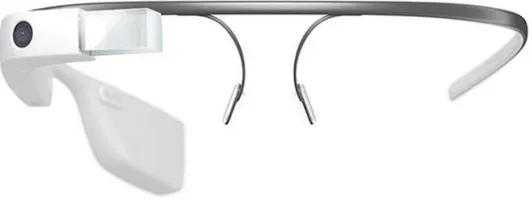
Due to the acuity of obstetrical emergencies at our institution, medical students only observe the acute care of patients in such scenarios. Google Glass (Figure 1) is a wearable computer with an optical head-mounted display. Features include its built-in microphone, bone conduction transducer, voice over Internet protocol, wireless connectivity, and its hands-free functionality. The low weight device fits over the eyeglasses of those participants who wear glasses. In an attempt to overcome the limited involvement medical students receive in obstetrical
emergencies, we developed a pilot study that examines the utility, effectiveness, and satisfaction that Google Glass provides in medical students’ education through remotely-conducted
simulation exercises covering two common obstetrical emergencies. East Tennessee State University (ETSU) institutional review board approval was obtained for this study. No external funding was used or solicited for this study.
Figure 1:
The Google Glass Device
Description of the Pilot Study
Thirteen ETSU medical students spread over two third-year clerkship rotations accepted the opportunity to participate in two obstetrical emergency simulation scenarios using Google Glass during their assigned obstetrics and gynecology (OBGYN) rotation. Two simulation scenarios were performed. Shoulder dystocia with its associated maneuvers including suprapubic pressure, McRobert’s, Rubin’s, or Wood’s maneuvers were part of the first simulation exercise. Vaginal breech delivery with its associated maneuvers including controlled delivery of the fetus, proper pelvic support, rotational and limb splinting maneuvers, and flexion of the fetal head were part of the second simulation exercise. As mock-trainees, the students wore Google Glass while
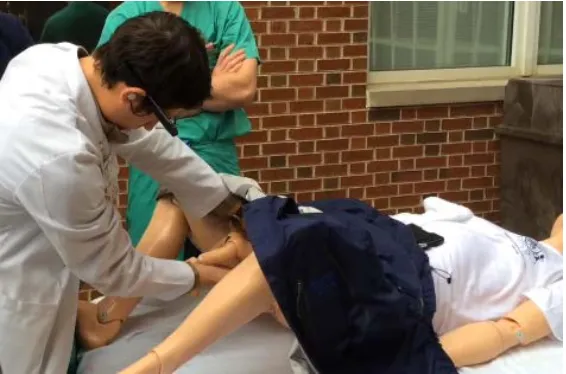
participating in these remotely-simulated and monitored emergencies (Figure 2). A team approach was used with the remote preceptor located in the medical simulation lab while the trainees were in a separate building or outdoor area. The remote OBGYN resident instructor monitored student activity on a laptop device through Google Glass transmitted video feed and provided verbal instructions and live feedback to the student wearing the device during the simulation. All simulation exercises were performed on Noelle™ – a full-body, high-fidelity obstetric simulator. Students were then asked to complete a 4-question survey grading the
1 Goodwin et al.: Wearable Technology in Obstetrical Emergency Simulation
effectiveness of the exercise (Table 1), including a section for any extra comments pertaining to the simulation with Google Glass.
Figure 2:
Live-feedback between mock-trainee and remote instructor (not shown) in a vaginal breech delivery simulation using the Google Glass device and a full-body surgical simulator.
Table 1
Q1-4: Questions on the post-simulation survey with respective results
Questions Answers
How valuable was this exercise for your education?
Extremely
valuable valuable Very Valuable Not that valuable Not valuable at all
7 5 1 0 0
Did you find Google Glass distracting to your activities?
Not distracting
at all
Not too
distracting Distracting distracting Very distracting Extremely
4 7 2 0 0
Was this exercise a successful test of Google Glass's potential in
improved emergency obstetric care by non-obstetricians?
Extremely
successful successful Successful Very successful Not that
Not successful at
all
5 3 5 0 0
How likely do you feel that Google Glass or a similar device will be incorporated into medical
care during your career?
Extremely
likely Very likely Likely Not very likely Not likely at all
All participants felt that the exercise with Goggle Glass was valuable, and 7 of 13 students (55%) reported it as being extremely valuable. None reported it as not being valuable. Two of 13
students (15%) reported that it caused some distraction, four (30%) reported that it was not too distracting, and the remaining 55% reported no distractions at all. All 13 students (100%) rated Google Glass as being more than “successful" in its potential to improve emergency obstetric care in non-obstetricians. None of the students reported it as having no potential. Seven of 13 students (55%) believed that Google Glass or a similar device is “extremely likely” to be incorporated into medicine. All (100%) predicted that it was “likely” or higher, that similar devices will be incorporated into medical care. None believed that such devices were unlikely to be used in the future of medicine. Additional comments included the following statements: “Outstanding learning opportunity”, “Great project, experience, concept, tool for learning.” Two students (15%) noted a few technical difficulties of using Google Glass as the connectivity between the mock-trainee and remote resident instructor was not always ideal but they reported that if these challenges were addressed, the device “would be awesome” and likely not hinder the educational experience in any way.
Review of Literature
In this pilot study, Google Glass was worn by the mock-trainee medical students. This allowed for “Eyes On” training and live-feedback from the remote OBGYN resident instructor. Wearable technology has been shown to have several benefits in medical education. Google Glass is a wearable computer with an optical head-mounted display. Several authors have described the uses of Google Glass in medical proofs-of-concept projects in several settings including the operating theater, ambulances, tele-consultations, advanced cardiac life support training, and medical education and medical simulation (Albrecht, et. al, 2014; Glenn, 2013; Ostrom, 2013). Vallurupalli et al. (2013) have also demonstrated the benefits of wearable technology in
improving training in a cardiology fellowship. However, literature regarding this wearable technology in the medical realm is quite limited (Albrecht, et. al, 2014; Vallurupalli et al., 2013), particularly in medical simulation. Simulation plays a major role in providing trainees with skill sets needed to perform procedures that are at times critical. Per Vallurupalli (2014) stressed that there is potential for trainees to benefit from live feedback and guidance while providing clinical care with Google Glass.
Application to Medical Education
Google Glass offers the addition of unique views for learner observation such as the “eyes of the patient” view when Google Glass is placed on the patient simulator and the “eyes of the student” view when it is placed on the learner. A future potential benefit from Google Glass is using its prism technology to present the learner with visual information during simulation activities. This may include but is not limited to diagrams, flowcharts, step-by-step instructions, images,
descriptions, and a multitude of other information. Medical student involvement in emergent clinical settings may be quite limited despite having the basic knowledge in managing patients in such settings. A study by Zhou et al. (2014) that evaluated medical students participating in cardiopulmonary resuscitation (CPR) in the emergency department setting showed that student-involved resuscitation teams were able to perform good CPR under medical staff supervision.
3 Goodwin et al.: Wearable Technology in Obstetrical Emergency Simulation
This suggests that medical students’ role in medical emergencies is possible with appropriate supervision.
Study Limitations and Conclusion
We have utilized Google Glass device in an attempt to simulate two common obstetrical emergencies and train medical students as a means to increase their knowledge in the actual management of patients in such emergencies. Our preliminary results in this pilot study are promising, however several limitations are present. The low number and non-randomization of participants may have over-exaggerated our results. Our preliminary results indicate student satisfaction with their exposure to this new wearable technology in obstetrical emergency simulation. Further studies are needed to validate the role of wearable technology in medical simulation and evaluate the effect such simulation has on actual obstetrical emergencies.
References
Albrecht, U. V., Von Jan, U., Kuebler, J., Zoeller, C., Lacher, M., Muensterer, O. J. . . .
Hagemeier, L. (2014). Google Glass for documentation of medical findings: Evaluation in forensic medicine. Journal of Medical Internet Research, 16, e53. doi:
10.2196/jmir.3225
Glenn, B. (2013, March 13). What can Google Glass do for medicine? Medical Economics.
Retrieved from:
http://medicaleconomics.modernmedicine.com/medical- economics/news/user-defined-tags/electronic-health-records/what-can-google-glass-do-medicine.
Ostrom, C. M. (2013, November 17). Harborview surgeon test-drives Google Glass in the operating room. The Seattle Times. Retrieved from:
http://seattletimes.com/html/localnews/2022282502_googleglasssurgeryxml.html.
Vallurupalli, S., Paydak, H., Agarwal, S. K., Agrawal, M., & Assad-Kottner, C. (2013). Wearable technology to improve education and patient outcomes in a cardiology fellowship program - a feasibility study. Health and Technology, 3, 267-270. doi:10.1007/s12553-013-0065-4
Zhou, X. L., Duan, X.W., Zhao, Y., Xu, P., Jiang, S., & Ni, S. Z. (2014) Medical students do not adversely affect the quality of cardiopulmonary resuscitation for ED patients. The
American Journal of Emergency Medicine, 32, 306–310. doi:10.1016/j.ajem.2013.12.007