Tuning of a Modified I-PD Controller for use with a highly
Oscillating Second-order-like Process
Galal Ali Hassaan
(Department of Mechanical Design & Production, Faculty of Engineering, Cairo University, Egypt Email: galalhassaan @ymail.com)
---
************************
---Abstract:
This paper presents a tuning approach for a modified I-PD controller to be used with a highly oscillating second-order-like process. The MATLAB program is used through its optimization toolbox to tune the controller subjected to three functional constraints. The functional constraints are selected to produce good performance of the control system regarding its transient characteristics. The tuning technique used is compared with another technique and the effectiveness of the controller is investigated through comparison with using the ITAE standard form technique, with the I-PD original controller and with a conventional PID controller.
Keywords — Modified I-PD controller, controller tuning, control system performance.
---
************************
---I. INTRODUCTION
This is one of the controllers investigated by the author to improve the performance of linear control systems and get red of the drawbacks of using the conventional PID controller.
Kondo and Ochi (2010) described a design method of an I-PD controller for a SISO plant. They presented examples to demonstrate the effectiveness and usefulness of their proposed method. The I-PD structure they used consisted of one integral block acting on the error signal and a loop comprising a PD-controller in its feedback [1]. Prasad, Varghese and Balakrishnan (2012) designed an I-PD controller to control a first order lag integrating plus time delayed (FOLIPD) plant. They compared their tuning technique with two other techniques including Ziegler-Nichols one [2]. Mechizuki and Ichihara (2013) in their paper about I-PD controller design when used with ball and plate system designed the controller using the
generalized Kalman-Yakubovich-Popov lemma for the ball and plate. The closed loop control system they proposed had an I-action acting on the main error of the control system, P+D actions and a low pass filter acting in the feedback path. They used the low pass filter to reduce the influence of the noise measurement from the camera [3]. Hassaan (2014) in his paper about tuning an I-PD controller used with a highly second order process tuned the controller using an ISE criterion and the MATLAB optimization toolbox. He could get rid of the kick associated with PID controller application and reduce the settling time to only 1.46 s [4].
International Journal of Computer Techniques -– Volume 6 Issue 1, Jan – Feb 2019
ISSN:2394-2231 http://www.ijctjournal.org Page 27
and PD-PI controllers for use with the nonlinear ball and beam system. He linearized the nonlinear model and tuned the controllers using the ITAE criterion [6]. Panjaitan, Kurnianto, Sanjaya and Turner (2017) applied an I-PD controller to control an islanded micro grid system. The results showed good reference tracking capabilities during set-pont and load changes compared with PID control [7]. Kaya (2018) applied the I-PD controller to improve the performance of unstable processes comparing with PID and I-PD design methods. He used the IST2E criterion to tune the control providing good control system performance [8].
II.PROCESS
The controlled process is second-order-like process having the transfer function, Gp(s):
Gp(s) = ωn2 / (s2 + 2ζωns + ωn2) (1)
Where:
ωn = process natural frequency = 10 rad/s
ζ = process damping ratio = 0.05
III. THE I-PD CONTROLLER
The structure of an I-PD controller for the control of a process was proposed to help in getting rid of the kick associated with using a PID controller and shown in Fig.1 [2] . The controller shown in Fig.1 has three parameters: the integral time constant τi ,
the proportional gain Kp and the derivative time
constant τd. This control was used by the author to
control a highly oscillating process having 85.45 % maximum overshoot and 8 s settling time.
C(s)
Fig.1 I-PD controlled process [2].
In a modified I-PD controller, the integral gain Ki and the derivative gain Kd are used instead
of the integral time constant τi and the derivative
time constant τd. The new block diagram of the
closed loop control system is shown in Fig.2
Fig.2 Modified I-PD controlled process.
In our present modification, the mathematical model of the modified I-PD controller relating its output U(s) to its two inputs E(s) and C(s) as clear from the controller block diagram in Fig.2 is given by:
U(s) = Kp{(Ki/s)E(s) – (1 + Kds)C(s) (2)
With E(s) = R(s) – C(s), Eq.2 becomes:
U(s) = (KpKi/s)R(s)–[(KpKi/s)+Kp(1+Kds)]C(s)
(3) The modified I-PD controller has three parameters:
- Proportional gains, Kp
- Integral gain, Ki
- Derivative gain, Kd
IV. CONTROL SYTEM TRANSFER
FUNCTION
As the process transfer function, Gp(s) is related
to the controller output U(s) and process output C(s) through:
Gp(s) = C(s) / U(s) (4)
The closed loop transfer function of the control system is obtained by combining Eqs.1, 3 and 4 and given by:
M(s) = b0 / (a0s3 + a1s2 + a2s + a3) (5)
Where:
b0 = ωn2 KpKi
a0 = 1
a1 = 2ζωn + ωn2 KpKd
a3 = ωn2 KpKi
V.CONTROLLER TUNING AND SYTEM
TIME RESPONSE
The controller parameters are tuned as follows:
- The control and optimization toolboxes of MATLAB are used to assign the three parameters of the controller [9].
- The integral of the square of time square multiplied by error (IST2E) suggested by Kaya [8] is chosen as an objective function for the optimization process.
- Three functional constraints are set for the closed-loop control system: maximum percentage overshoot, settling time and a stability constraint derived from the Routh-Hurwitz criterion for control system stability. - The step response of the closed-loop control
system is plotted using the command 'step' of MATLAB [10].
- The controller is tuned using the above approach for the second order-like process with ζ = 0.05 and equivalent natural frequency ωn = 10 rad/s.
- The time-based specifications of the closed- loop control system are extracted using the MATLAB command 'stepinfo' [11].
- The tuning parameters of the modified I-PD controller are:
Kp = 20.0659
Ki = 13.7404
Kd = 0.0299
- The unit step response of the control system incorporating the tuned modified I-PD controller is shown in Fig.3.
- The step time response of Fig.3 reveals the following time-based specifications of the closed control system incorporating the modified I-PD controller:
• Maximum percentage overshoot: 0.051 % • Settling time: 0.148 s • Steady state error: 0
- The modified I-PD controller could eliminate completely the kick associated with the classical PID controller.
Fig.3 Modified I-PD controlled second order process.
VI. COMPARIZON WITH MINIMUM
ITAE STANDARD FORMS TUNING
- The parameters of the modified I-PD controller is tuned using the minimum ITAE standard forms of Graham and Lathrop [12]. The resulting controller parameters are:
Kp = 20.0659
Ki = 15.2846
Kd = 0.0268
- The unit step time response of the closed loop control system incorporating the modified I-PD controller and the process with ζ = 0.05 and ωn = 10 rad/s is shown in
Fig.4 for both tuning techniques.
- The performance characteristics of the control system for both tuning techniques are as follows:
• The maximum percentage overshoot is
0.051 using the presented tuning technique compared with 1.975 % using the minimum ITAE standard forms of Graham and Lathrop.
International Journal of Computer Techniques -– Volume 6 Issue 1, Jan – Feb 2019
ISSN:2394-2231 http://www.ijctjournal.org Page 29
Fig.4 Comparison between two tuning techniques.
VII. COMPARIZON WITH PID AND I-PD
CONTROLLERS
- To investigate the effectiveness of the modified controller regarding kick elimination, it was compared with using a classical PID controller to control the second order process under study.
- The PID controller was tuned by the auther when used with underdamped second order processes and had the tuned parameters [13]:
Kp = 9.9981
Ki = 9.0021
Kd = 0.9892
- The Un-modified I-PD controller was tuned by the author and had the tuned controller parameters [14]:
Kp = 1.7523
Ki = 5.3314
Kd = 0.1113
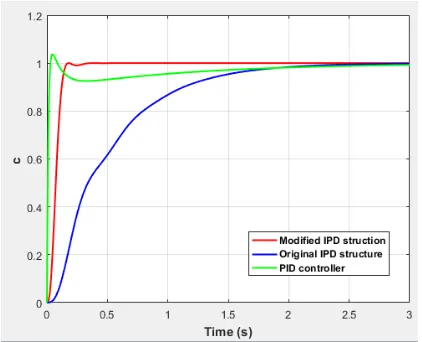
- The unit step response of the closed loop control system incorporating the three controllers used with the highly oscillating process is shown in Fig.5.
Fig.5 Comparison between three controllers.
- The time based characteristics of the control system using the three controllers are compared in Table 1.
TABLE 1
CHARACTERISTICS COMPARISON USING THREE CONTROLLERS
Controller I-PD Modified I-PD
PID
OSmax (%) 0 0.051 3.648
Ts (s) 1.898 0.148 1.897
VIII. CONCLUSIONS
- The I-PD controller was modified by replacing its time constants τi and τd parameters by Ki and Kd.
- It was used to suppress the high oscillations of a second-order-like process.
- It was tuned using the MATLAB optimization toolbox.
- Three constraint functions were used to provide good performance for the closed loop control system.
- The IST2E error criterion was used as an objective function for the constrained optimization problem of the controller tuning.
- The performance of the control system in terms of its unit step time response was compared with that using a classical PID controller and an un-modified I controller.
- The time response kick was authorized when using the PID controller.
- The time-based specifications of the control system were compared for the three controllers: I-PD, modified I-PD and PID controllers.
- The modified I-PD controller was superior compared with the un-modified I producing a very fast step time response with very low maximum percentage overshoot.
REFERENCES
[1] H. Kando and Y. Ochi, "I-PD controller design based on integral optimal servomechanisms", Journal of Control,
System Integration, vol.3, issue 6, pp.448-455, 2010
[2] S. Prasad, S. Varghese and P. Balakrishnan, "Optimization of I controller for a FOLIPD model using particle swarm intelligence International Journal of Computer Applications, vol.
26 2012.
[3] S. Mochizuki and H. Ichihara, "I-PD controller design based on generalized KYP lemma for ball and plate system",
Conference, Zurich, Switzerland, pp.2855-2860, July 17
[4] G. A. Hassaan, "Tuning of an I-PD controller used with a highly oscillating second order process", International Journal of Mechanical Engineering and Technology, vol.5, issue 5,
pp.115-[5] D. Puangdownreong, A. Nawikavatan and C. Thammarat Computer Sciences", vol.86, pp.83-86, 2016.
[6] D. Sain, "PID, I-PD and PD-PI controllers design for the ball and beam system: A comparative study", IJCTA, vol.9, issue 39
[7] S. Panjaitan, R. Kurnianto, B. Sanjaya and M. Turner design and analysis in an islanded micro grid system Journal on Smart and Intelligent Systems, vol.10, issue pages, 2017.
[8] I. Kaya, "Optimal analytical tuning of I-PD controllers for unstable time delay systems", 6th
International Conference on Control Engineering and Information Technologies, Istanbul, Turkey, pp.85 October 25-27, 2018.
[9] C. Lopez, "MATLAB optimization techniques", Springer, 2014. [10] L. Moysis and T. Azar, "Introduction to control system design using
MATLAB", International Journal of System Dynamics Applications, vol.6, issue 3, pp.130-170, 2017
[11] Mathworks, "stepinfo",
https://www.mathworks.com/help/control/ref/stepinfo.html
[12] D. Graham and R. Lathrop, "The synthesis of optimal response, criteria and standard forms", Transactions AIEE, vol.72, issue 5, pp.273 1953.
[13] G. A. Hassaan, "On simple tuning of PID controllers for underdamped second-order processes, International Journal of Mechanical and Production Engineering Design and Development, vol.4, issue 3, pp.61-68, 2014.
[14] G. A. Hassaan, "Tuning of an I-PD controller used with a highly oscillating second order process", International Journal of Mechanical Engineering and Technology, vol.5, issue 5,
pp.115-The performance of the control system in terms of its unit step time response was using a classical PID modified I-PD
The time response kick was authorized
based specifications of the control system were compared for the three PD and PID
PD controller was superior modified I-PD st step time response with very low maximum percentage
PD controller design based on integral-type ", Journal of Control, Measurement and
10.
Optimization of I-PD controller for a FOLIPD model using particle swarm intelligence", , vol.43, issue 9,
pp.23-controller design based on ", European Control July 17-19, 2013. PD controller used with a highly International Journal of Mechanical
-121, 2014. D. Puangdownreong, A. Nawikavatan and C. Thammarat, "Procedia
for the ball and beam 39, pp.9-14, 2016. S. Panjaitan, R. Kurnianto, B. Sanjaya and M. Turner, "I-PD control design and analysis in an islanded micro grid system", International , issue 4, Paper 9, 20
PD controllers for unstable International Conference on Control Engineering and Information Technologies, Istanbul, Turkey, pp.85-90,
C. Lopez, "MATLAB optimization techniques", Springer, 2014. L. Moysis and T. Azar, "Introduction to control system design using MATLAB", International Journal of System Dynamics Applications,
https://www.mathworks.com/help/control/ref/stepinfo.html , 2019. D. Graham and R. Lathrop, "The synthesis of optimal response, criteria
AIEE, vol.72, issue 5, pp.273-288 ,
G. A. Hassaan, "On simple tuning of PID controllers for underdamped order processes, International Journal of Mechanical and Production Engineering Design and Development, vol.4, issue 3,
PD controller used with a highly oscillating second order process", International Journal of Mechanical
-121, 2014.
BIOGRAPHY
Galal Ali Hassaan
• Emeritus Professor of System Dynamics
and Automatic Control.
• Has got his B.Sc. and M.Sc. from Cairo
University in 1970 and 1974.
• Has got his Ph.D. in 1979 from Bradford
University, UK under the supervision of Late Prof. John Parnaby.
• Now with the Faculty of Engineering, Cairo
University, EGYPT.
• Research on Automatic Control, Mechanical
Vibrations , Mechanism
Synthesis and History of Mechanical Engineering.
• Published 255 research papers in
international journals and
• Author of books on Experimental Systems
Control, Experimental Vibrations and Evolution of Mechanical Engineering.
• Chief Justice of the International Journal of Computer Techniques.
• Member of the Editorial Board of
International Journals including the International Journal of Computer Techniques.
• Reviewer in some international journals. • Scholars interested in the author
publications can visit:
http://scholar.cu.edu.eg/galal BIOGRAPHY
Emeritus Professor of System Dynamics
Has got his B.Sc. and M.Sc. from Cairo University in 1970 and 1974.
Has got his Ph.D. in 1979 from Bradford University, UK under the supervision of Late Prof. John Parnaby.
Now with the Faculty of Engineering, Cairo
Research on Automatic Control, Mechanical
Synthesis and History of Mechanical
research papers in international journals and conferences.
or of books on Experimental Systems Control, Experimental Vibrations and Evolution of Mechanical Engineering.
International Journal of
Member of the Editorial Board of some s including the rnational Journal of Computer
Reviewer in some international journals. Scholars interested in the author’s
International Journal of Computer Techniques -– Volume 6 Issue 1, Jan – Feb 2019