Image restoration of underwater images using
Energy Minimization Algorithm
Ms.B.Mahalekshmi PG Scholar
Computer Science and Engineering St. Xavier's Catholic College of Engineering
Ms.G.Johncy Assistant Professor Computer Science and Engineering St. Xavier’s Catholic College of Engineering
Abstract:
This paper focuses its attention towards underwater image processing in order to improve the image quality. As most of the images of offshore installations, drinking water reservoir etc. are captured and inspected manually by divers. And manual intervention in this regard is dangerous, costly, time-consuming and yet does not often enable a full assessment. Hence camera based inspection is used to capture the images under water. Using cameras underwater poses major technological challenges. The objects in the underwater images are faint, difficult to view and analyze because the images of such environment loses the details of the object. The underwater images usually suffer from non-uniform lighting, low contrast, skew, blurs and diminished colors. And hence in this research work, a novel method has been proposed for handling underwater image skewing and blurring in case of unidirectional cyclic waves and circular ripples to enhance the visibility of underwater images. The geometric distortion such as skew is caused by the time variant refraction over the dynamic fluids. And this distortion is associated with motion blur depending on the exposure time of camera. The proposed work develops a mathematical model for image restoration from these distortions with good accuracy.
Keywords—non-uniform lighting; blur; skew; cyclic waves; circular ripples; image restoration;
I. INTRODUCTION
A. Need for Underwater Imaging
Nowadays there is a large scope of research in the area of underwater image processing in order to explore, and investigate underwater activities of images. Yet, the captured underwater images lack in the quality and visibility. Hence, there is a necessity to improve the quality of underwater images and enhance its visibility. Underwater image processing finds its application in the areas such as the inspection of plants, seabed exploration, and search for wrecks up to the exploration of natural resources as e. g. manganese nodules. Due to the poor visibility conditions the environment of the world’s ocean is still not well explored. And a lot of underwater image enhancement techniques are available
nowadays, as the earth is an aquatic planet having 70% of its surface covered with water. And scientists show their keen interest in knowing what lies in underwater, and moreover, this field has made an importance to the use of underwater sequences to monitor marine species, underwater mountains & plants, to achieve this purpose it is absolutely necessary to use the clear and qualitative underwater images.
B. Problems associated with Underwater Images
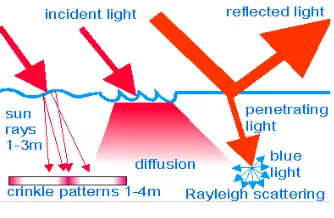
A lot of problems arises such as diffusion and crinkling of patterns because of light reflection. These are caused because of dust sprinkled in water. The reflected light is partly polarized horizontally and partly enters the water vertically. Due to vertical polarization the underwater object is less shining and observes deep colors.
Fig. 1.B.1 Effects of light on water surface
Fig. 1.B.2 Appearance of color in underwater
The blue color has shortest wavelength and hence travels the longest in the water that makes the underwater images having been dominated only by blue color because of this effect of blue color, the original color of any object under the water is affected. In addition to excessive amount of blue color, the blur images contain little brightness, little contrast and so on.
To summarize underwater images suffer from limited range, non uniform lighting, low contrast, diminished colors, blur etc. Moreover many parameters can modify the optical properties of the water and underwater images show large temporal and spatial variations. So, it is necessary to pre-process those images before using usual image pre-processing methods.
II. IMAGEACQUISITIONANDPREPROCESSING
A. Underwater Image Acquisition
Autonomous and remotely operated underwater vehicles are usually used to capture the data such as underwater mines, shipwrecks, coral reefs, pipelines and telecommunication cables from the underwater environment. These vehicles usually carry a visual system which captures various images of interested creatures and monitors environmental conditions. Unfortunately, due to the phenomena of optical attenuation and scattering in water, these captured images often have serious color distortion and poor visibility problems.
Fig 2.A.1 Natural light enters from air to an underwater scene point
B. Image Formation in Flowing Water
Let Ig(x) be the original image corresponding to the bottom planar scene of a waterpool which is imaged by a front-to-parallel camera. The proposed method uses applications with assumption of small water waves (low spatial frequency and small amplitude fluctuations). The wave gets attenuated as it progresses. With a limited field-of-view (FOV), the attenuation of water waves can be treated as negligible. Each video frame I (x, τ) is a distorted version of the original scene Ig(x) and the two images can be related by the equation
I (x, τ) = Ig(x + w(x, τ))
where w(x, τ) is the warping function acting on the pixel at location x at time τ. Let n be the refractive index of water, and let θi and θr be the angle of incidence and refraction, respectively, of the light ray reaching the camera from scene point B. Let us assume that water fluctuations with respect to the level h0 are small. In flowing water, the light ray which reaches the camera above the water surface will make a finite angle with the normal ˆn defined on the surface of the water at point O.
C. Underwater Image Preprocessing
It is composed of several successive independent processing steps which correct non uniform illumination (homorphic filtering), suppress noise (wavelet denoising), enhance edges (anisotropic filtering) and adjust colors (equalizing RGB channels to suppress predominant color). The algorithm is automatic and requires no parameter adjustment. The method was used as a preliminary step of edge detection. The robustness of the method was analyzed using gradient magnitude histograms.
D. Color Feature Extraction
A color image is a combination of some basic colors. In each individual pixel of a color image (termed ‘true color’) down into Red, Green and Blue values. We are going to get as a result, for the entire image is 3 matrices, each one representing color features. The three matrices are arranging in sequential order, next to each other creating a 3 dimensional m by n by 3 matrixes. (i) Three color planes namely Red, Green and Blue are separated. (ii) For each plane row mean and column mean of colors are calculated. (iii) The average of all row means and all columns means are calculated for each color plane. (iv)The features of all 3 planes are combined to form a feature vector.
III. LITERATURESURVEY
nonuniform color cast, blurring, and low-contrast that characterize underwater engineering and monitoring images. Importantly, UCIQE is a simple and fast solution for real-time underwater video processing. This approach[1] extracts the most relevant statistical features that are representative for underwater image degradations such as colour cast, blurring and noise caused by attenuation, floating particles and lighting. This approach uses the following methods (i) defogging based algorithms – to enhance visibility (ii). contrast stretching methods and the newest image fusion enhancement.
By adopting image blurriness with the image formation model (IFM) [2], there is a way to estimate the distance between scene points and the camera and thereby recover and enhance underwater images. This paper used image blurriness to estimate the depth map for underwater image enhancement. It is based on the observation that objects farther from the camera are more blurry for underwater images.
Blurring and low-contrast are the characteristics of underwater images, which are similar to haze images, is the main challenge in searching of fish from underwater images. To overcome the effects of blurring and low-contrast, apply the dark channel prior [3], which was proposed to remove haze from a single input image. Since the underwater images are similar with the haze images, this method mentioned can be also applied to underwater images. The dark channel prior is based on those most local patches in haze-free outdoor images containing some pixels, which have low intensities in at least one color channel. Using this prior with the haze-imaging model, a high quality haze-free image can be recovered. When the dark channel prior is applied to an underwater image, a clear image is generated.
Objects look very different in the underwater environment compared to their appearance in sunlight. High quality images with correct colouring simplify the detection of underwater objects and may allow the use of visual SLAM algorithms developed for land-based robots underwater. Hence, image processing is required to obtain images of high quality and correct colouring. Current algorithms focus on the colour reconstruction[4] of scenery at diving depth which has the advantage that a significant part of sunlight is still present and different colours can still be distinguished. At greater depth the filtering is much stronger such that this is no longer possible. In this study it is investigated whether machine learning can be used to transform image data. In order to obtain images under underwater lighting conditions in a controlled environment a special light source with a defined wavelength is used for illumination of test objects in a laboratory setup. The images are then fed through statistical learning algorithms with or without pre-filters. It is shown that k nearest neighbour and support vector machines are most suitable for the given task and yield excellent results.
IV. METHODOLOGY
The proposed work focuses on restoring a static planar scene degraded by skewing effect when imaged through a dynamic water surface. This gets essential because of geometric distortions due to unidirectional cyclic waves and
circular ripples in fluid flow. Although the camera and scene are stationary, light rays emanating from a scene undergo refraction at the fluid–air interface. This refraction effect is time varying for dynamic fluids and results in nonrigid distortions (skew) in the captured image. These distortions can be associated with motion blur depending on the exposure time of the camera. Hence a mathematical model for blur formation is devised and proposed a restoration scheme using a single degraded observation. And the proposed work also deals in evaluation of blur induced by circular ripples (though space variant) can be modeled as uniform in the polar domain and develop a method for deskewing.
A. Deblurring and Deskewing of Degraded Image
Estimate the latent image and the set of translational warps using maximum-a-posteriori (MAP) formulation, latent image, PSF from the given blurred observation using Bayes theorem.
(i) Likelihood
In the presence of noise, the blurred image is given by
g = ∑ tD(λ)(Hλl) + η
λ∈D
where η is modeled as a set of Gaussian random variables is commonly modeled as Gaussian with zero mean and standard deviation σ0.
(ii) Prior on PSF
The PSF for motion blur for camera shake and a sparsity constraint was enforced. The PSF in our scenario represents the set of in-plane translations that any particular pixel experiences due to refraction. The probability distribution of sparse images is heavy-tailed in nature and can be modeled by a Laplacian.
(iii) Prior on Latent Image
It is well-known that the gradients of natural images are usually sparse. However, employing a sparse prior will render the latent image estimation problem non-convex. To make our optimization step simpler, we use a Gaussian distribution for image gradients.
(iv) Energy Minimization
The latent image and the PSF can by estimated by using an energy minimization approach which minimizes the negative logarithm of the a posteriori probability.
Gener ate the likeliho
od of the
Estim ate prior on the
PSF
Estimate prior on latent image
Estimate latent image and PSF using Energy
minization Apply
• Prediction: The first step is prediction of the latent image estimate l in which the given blurred observation is subject to bilateral filtering, shock filtering and gradient magnitude thresholding. This step ensures that insignificant details and noise are eliminated. The output of this step is an estimate of the gradient of the latent image which is fed as input to the subsequent stages.
• PSF Estimation: In this step, we fix the latent image estimate (obtained from prediction) and minimize the energy function
• Latent Image Estimation: The latent image is estimated using conjugate-gradient approach. In this step, we fix the PSF obtained from the PSF estimation step and minimize the energy function.
B. Algorithm1- for Recovering a Planar Scene Distorted Input (a) Initial PSF estimate, (b) single motion blurred
image due to water waves Output : deskewed and deblurred image
1. Repeat
2. Obtain latent image estimate I from prediction step.
3. By using I and initial PSF, estimate PSF 4. By using the estimated PSF, estimate latent
image, I
5. Until maximum number of iterations is reached.
C. Algorithm 2 - for Recovering a Distorted Scene in the Presence of Circular Ripples
Input (a) Initial PSF estimate, (b) single motion blurred image due to circular ripples
Output : deskewed and deblurred image
1. Convert blurred observation into polar domain 2. Use algorithm 1 to obtain an estimate of the
original image f in the polar domain.
3.
Convert the restored image of polar domain back to rectangular coordinatesV. EXPERIMENTALSETUP
This work is verified with the dataset comprising of underwater video. And the implementation procedure includes the following modules:
i. Loading a Video
ii. Video to Frame Conversion
iii. Recovering from distortion of cyclic waves iv. Recovering from distortion of circular ripples v. Restore the frames
vi. Frames to Video conversion
i. Loading a Video
Using the open dialog box, the user can select a video file of .avi format.
ii. Video to Frame Conversion
To perform the deblur and deskew operation fastly, the video need to be transformed to frames. And hence read the .av file and get the video information and write it as an image.
iii. Recovering from Cyclic Waves
From the obtained frame, construct the latent image using the prediction step and the initialize the point spread function. And then using the estimated PSF further estimate the latent image. Repeat the process n number of times to restore the distorted image by cyclic waves.
iv. Recovering from Circular Ripples
With the initial estimated Point Spread Function and latent image of blurred and skewed image, convert blurred observation into polar domain. And then obtain an estimate of the original image f in the polar domain. Convert the restored image of polar domain back to rectangular coordinates. Store the frames.
v. Restore the frames
Now the frames are deblurred and deskewed. And these frames need to be reconstructed to view the restored video.
vi. Frames to video conversion
Collect all the frames that are restored from the previous step and then use the function to transform those frames to a video. And play the video file that has been restored from distortions.
VI. CONCLUSION
LIGHT SCATTERING AND COLOR CHANGE ARE TWO MAIN PROBLEMS IN UNDERWATER IMAGES. DUE TO LIGHT SCATTERING, INCIDENT LIGHT GETS REFLECTED AND DEFLECTED MULTIPLE TIMES BY PARTICLES PRESENT IN THE WATER.THIS DEGRADES THE VISIBILITY AND CONTRAST OF THE UNDERWATER IMAGE.DARK CHANNEL PRIOR IS METHOD USED FOR REMOVING THE HAZE PRESENT IN THE UNDERWATER IMAGE. IT IS BASED ON A KEY OBSERVATION - MOST LOCAL PATCHES IN HAZE-FREE UNDERWATER IMAGES CONTAIN SOME PIXELS WHICH HAVE VERY LOW INTENSITIES IN AT LEAST ONE COLOR CHANNEL.USING THIS PRIOR WITH THE HAZE IMAGING COLOR MODEL ESTIMATES THE THICKNESS OF THE HAZE AND RECOVER A HIGH QUALITY HAZE FREE IMAGE.THIS METHOD DOES NOT REQUIRE IMAGES WITH DIFFERENT EXPOSURE VALUES, AND IS ENTIRELY BASED ON THE ATTENUATION EXPERIENCED BY POINT ACROSS MULTIPLE FRAMES.
References
[1] R. Schettini and S. Corchs, “Underwater image processing: State of the art of restoration and image enhancement methods,” EURASIP J. Adv. Signal Process., vol. 2010, Jan. 2010, Art. ID 14.
[2] D. G. Turlaev and L. S. Dolin, “On observing underwater objects through a wavy water surface: A new algorithm for image correction and laboratory experiment,” Izvestiya, Atmosph. Ocean. Phys., vol. 49, no. 3, pp. 339–345, 2013.
[3] R. Shefer, M. Malhi, and A. Shenhar. (2001). Waves Distortion Correction Using Crosscorrelation. [Online]. Available: http://visl.technion.ac.il/projects/2000maor/
[4] H. Murase, “Surface shape reconstruction of a nonrigid transport object using refraction and motion,” IEEE Trans. Pattern Anal. Mach. Intell., vol. 14, no. 10, pp. 1045–1052, Oct. 1992.
[5] A. A. Efros, V. Isler, J. Shi, and M. Visontai, “Seeing through water,” in
Proc. Adv. Neural Inf. Process. Syst., 2004, pp. 393–400.
[6] Z. Wen, A. Lambert, D. Fraser, and H. Li, “Bispectral analysis and recovery of images distorted by a moving water surface,” Appl. Opt., vol. 49, no. 33, pp. 6376–6384, 2010.
[7] Z. Wen, D. Fraser, and A. Lambert, “Bicoherence: A new lucky region technique in anisoplanatic image restoration,” Appl. Opt., vol. 48, no. 32, pp. 6111–6119, 2009.
[8] Y. Tian and S. G. Narasimhan, “Seeing through water: Image restoration using model-based tracking,” in Proc. IEEE 12th Int. Conf. Comput. Vis., Sep./Oct. 2009, pp. 2303–2310.
[9] Y. Tian and S. G. Narasimhan, “A globally optimal data-driven approach for image distortion estimation,” in Proc. IEEE Conf. Comput. Vis. Pattern Recognit., Jun. 2010, pp. 1277–1284.
[10] Z. Hu and M.-H. Yang, “Fast non-uniform deblurring using constrained camera pose subspace,” in Proc. Brit. Mach. Vis. Conf., 2012, pp. 136-1–136-11.
[11] L. Xu and J. Jia, “Two-phase kernel estimation for robust motion deblurring,” in Proc. 11th Eur. Conf. Comput. Vis., 2010, pp. 157–170. [12] L. Xu, S. Zheng, and J. Jia, “Unnatural L0 sparse representation for
natural image deblurring,” in Proc. IEEE Conf. Comput. Vis. Pattern Recognit., Jun. 2013, pp. 1107–1114.
[13] M. Hirsch, C. J. Schuler, S. Harmeling, and B. Scholkopf, “Fast removal of non-uniform camera shake,” in Proc. IEEE Int. Conf. Comput. Vis., Nov. 2011, pp. 463–470.
[14] M. Hirsch, S. Sra, B. Scholkopf, and S. Harmeling, “Efficient filter flow for space-variant multiframe blind deconvolution,” in Proc. IEEE Conf. Comput. Vis. Pattern Recognit., Jun. 2010, pp. 607–614.
[15] O.Whyte, J. Sivic, A. Zisserman, and J. Ponce, “Non-uniform deblurring for shaken images,” Int. J. Comput. Vis., vol. 98, no. 2, pp. 168–186, 2012.
[16] A. Gupta, N. Joshi, C. L. Zitnick, M. Cohen, and B. Curless, “Single image deblurring using motion density functions,” in Proc. 11th Eur. Conf. Comput. Vis., 2010, pp. 171–184.
[17] A. Donate and E. Ribeiro, “Improved reconstruction of images distorted by water waves,” in Advances in Computer Graphics and Computer Vision. Berlin, Germany: Springer-Verlag, 2007, pp. 264–277. [18] O. Oreifej, G. Shu, T. Pace, and M. Shah, “A two-stage reconstruction