_____________________________________________________________________________________________________
*Corresponding author: Email: [email protected], [email protected];
Effect of Garlic Oil Supplementation on Intake,
Digestibility, Performance and Rumen Function of
Goats Fed Silage Based-diet
M. I. Okoruwa
1*and O. M. Edoror
11Department of Animal Science, Faculty of Agriculture, Ambrose Alli University, P.M.B. 14, Ekpoma, Nigeria.
Authors’ contributions
This work was carried out in collaboration between both authors. Author MIO designed the study, performed the statistical analysis, wrote the protocol and wrote the first draft of the manuscript. Author OME managed the analyses of the study and literature searches. Both authors read and approved the final manuscript.
Article Information
DOI: 10.9734/EJNFS/2019/v10i230102
Editor(s):
(1)Dr. R. C. Ranveer,Department of Meat, Poultry and Fish, PG Institute of Post – Harvest Management, Killa – Roha, BSKKV, Dapoli, India.
Reviewers:
(1) Yusuf Garba, Bayero University, Nigeria. (2)Anut Chantiratikul, Mahasarakham University, Thailand. Complete Peer review History:http://www.sdiarticle4.com/review-history/51342
Received 10 July 2019 Accepted 11 September 2019 Published 25 September 2019
ABSTRACT
This study was conducted to assess the effect of garlic oil supplementation on intake, digestibility, performance and rumen function of goats. Thirty goats with initial average body weight of 6 ± 0.99 kg were randomly divided into five treatments with six goats each in a completely randomized design. The diets contained a control group without garlic oil (CA1) and diets supplemented with
garlic oil at 20 g (GB2), 25 g (GC3), 30 g (GD4) and 35 g (GE5). Results showed that acid detergent
fibre and lignin (66.02 and 52.37%) digestibility, total volatile fatty acid with acetate (88.62 mM and 69.68mol/100mol), feed conversion ratio (9.47), ammonia nitrogen (12.39mg/dl), methane (21.96mol/mol) and protozoa (8.93 x 10⁸ cfµ/mol) of goats reared on CA1 were (P < 0.05) higher
than those on test diets (GB2, GC3, GD4 and GE5). Goats fed on GC3 and GD4 diets had higher (P
< 0.05) nutrients digestibility with rumen parameters, daily weight gain and intake compared with those on CA1, CB2 and GE5 diets. The ether extract intake (58.09%) and digestibility (64.03%) in
goats reared on GE5 were (P < 0.05) higher than those on other diets. Ash intake and digestibility,
Okoruwa and Edoror; EJNFS, 10(2): 104-115, 2019; Article no.EJNFS.2019.012
affected by treatment diets. In conclusion, the supplementation of garlic oil to treatment diets improved intake, digestibility, performance and rumen function of goats, indicating garlic oil as alternative additive to improve poor quality feeds.
Keywords: Garlic; goats; nutrient utilization; rumen indices; silage.
1. INTRODUCTION
The current estimated population of goats in Nigeria is about 72.5 million, from this estimate they contribute about 24% of the meat supply that increase productivity of animal’s protein in Nigeria [1]. Despite these highlighted potentials, goat feeding is still facing serious difficulties relating to quantitative and qualitative provision of nutrients in the tropics. Inadequate year-round feed resources are predominant factor contributing to this problem of feed shortage. This exacerbates by seasonal fluctuation that extends drought periods and brings about scarcity of forages and unbalance nutrient contents in ruminants [2]. Conventional feeds that could have been used to tackle this situation are scared and often unsatisfactory due to escalating prices of the feed ingredients resulting from competition between man and livestock. A practical way of addressing this problem of feeding goats in the dry season is by using conserved forages. Silage is important feeding strategy that can be made available at critical periods of the year for ruminants.
However, silage is valued as a sustainable means of providing feeds for ruminants during unfavorable weather condition [3]. Notwithstanding, there is a large amount of biomass of green maize fodder produced in post harvest that is not used in southern Nigeria. This can be used with cowpea post harvest leaves as green forage for silage in goat feeding. It is well documented [4] that silage cannot be used as the only source of feed for ruminants, but in combination with other feeds will enhance its utilization. Hence, the incorporation of feeds with cowpea in maize silage based diet can be a viable adoption of feeding strategy that could offer potential to improve performance in goat production. Though this has offered avenues to improve feeding value of roughages, numerous studies [5,6] had also pointed out that supplementation of essential plant oils as alternative to antibiotics due to their perceived antimicrobial, antifungal and antioxidant properties are important to attain optimum level of performance in goat productivity. Garlic oil is such essential plant oil that can be used to
modulate rumen microbial activities, reduce protein degradation and increase rumen by-pass protein. It can also exert their effects on digestibility and nitrogen metabolism through the inhibition of deamination and prevention of attachment and colonization of feed by proteolytic bacteria [7]. Thus, the objective of this study is to determine the effects of garlic oil supplementation on intake, digestibility, performance and rumen fermentation profiles in goats fed cowpea in maize silage based-diet.
2. MATERIALS AND METHODS
2.1 Study Area
The present study was carried out at the Teaching and Research Farm, Ambrose Alli University, Ekpoma, Nigeria. The area is located at longitude 6.09ºE and latitude 6.42ºN within the humid climate zone of southern Nigeria. The vegetation of this geographical zone represents an interface of between the tropical rainfall and derived savanna as reported by Ajala et al. [3].
2.2 Animals, Experimental Design and Treatment Diets
Thirty apparently healthy growing West African dwarf does of 6 – 7months old with an average live weight of 6 ± 0.99 kg were selected from the Small Ruminant Unit at the Teaching and Research farm. The goats were randomly distributed to five experimental diets with three replicates of two goats making a total of six goats per treatment in a completely randomized design. The animals were allocated to individual cleaned and disinfected pens that were provided with feed bunks and water troughs.
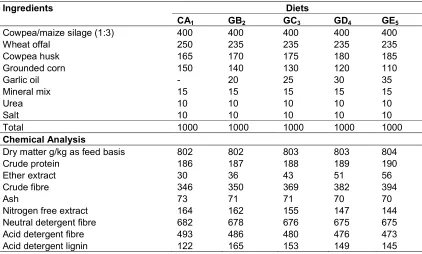
The diets were composed of 600 g/kgDM of concentrate and 400 g/kgDM of cowpea/maize silage in a ratio of 1:3 respectively (Table 1), which were formulated according to AFRC [8]. The treatment diets contained similar cowpea/maize silage (1:3) but the concentrate mixture comprised different proportion of feed ingredients and garlic oil. The compared treatment diets were; CA1 (without garlic oil that
Table 1. Ingredients and chemical composition (g/kg of DM) of experimental diets
Ingredients Diets
CA1 GB2 GC3 GD4 GE5
Cowpea/maize silage (1:3) 400 400 400 400 400
Wheat offal 250 235 235 235 235
Cowpea husk 165 170 175 180 185
Grounded corn 150 140 130 120 110
Garlic oil - 20 25 30 35
Mineral mix 15 15 15 15 15
Urea 10 10 10 10 10
Salt 10 10 10 10 10
Total 1000 1000 1000 1000 1000
Chemical Analysis
Dry matter g/kg as feed basis 802 802 803 803 804
Crude protein 186 187 188 189 190
Ether extract 30 36 43 51 56
Crude fibre 346 350 369 382 394
Ash 73 71 71 70 70
Nitrogen free extract 164 162 155 147 144
Neutral detergent fibre 682 678 676 675 675
Acid detergent fibre 493 486 480 476 473
Acid detergent lignin 122 165 153 149 145
GC3 (25 g of garlic oil), GD4 (30 g of garlic oil)
and GE5 (35 g of garlic oil). The garlic oil was
added to the concentrate mixture right before feeding. Cowpea/maize silage (1:3) mixture and concentrate were weighed separately on an electronic scale with a 1 g accuracy (Marte, LC 100, Sao Paulo, SP, Brazil), mixed and offered
ad-libitum twice daily as a total mixed ration.
Table 2. Composition (%) of fatty acids in garlic oil
Components Content in %
Saturated fatty acids
Lauric acid 49.32
Myristic acid 0.59
Stearic acid 0.75
Lignoceric acid 0.32
Unsaturated fatty acids
Oleic acid 3.1
Linoleic acid 20.42
Linolenic acid 3.76
Palmitoleic acid 1.48
Arachidonic acid 0.94
2.3 Feeding Management and Samples Collection
Experimental animals were housed in individual semi open pens and fed the experimental diets to meet daily feed requirement as per AFRC [8].
Okoruwa and Edoror; EJNFS, 10(2): 104-115, 2019; Article no.EJNFS.2019.012
inserted to a depth of approximately 110 – 130cm through the esophagus. The first portion (about 30ml) of the sample collected was directed to reduce saliva contamination. Rumen fluid samples were strained through four layers of cheese cloth and pH was determined immediately after collection using a digital pH meter (Eutech pH tester 30, thermo-fisher sci, Inc, USA). Thereafter, 20 ml of the rumen samples were stored in 40ml of 10% formal saline before direct microscopic counts of rumen protozoa, bacteria and fungi. Sub –samples of 10ml were also acidified with a 1 m sulfuric acid solution to measure ammonia nitrogen (NH3 – N)
and total volatile fatty acid (TVFA), while separate 10ml sub-samples were treated with 2 ml of 25% meta-phosphoric (prepared in 5N sulfuric acid) kept overnight at 4ºC and centrifuged at 584rpm for 15min to measure individual volatile fatty acids.
The methane (CH4) emission was estimated
according to the equation of Moss et al. [9]. CH4
(mol/mol of VFA) = 0.45 x C2 – 0.275 x C3 + 0.4 x
C4. Where C2, C3 and C4 are acetate, propionate
and butyrate respectively expressed as mol/100 ml of VFA.
Rumen study was preceded by a 14day metabolic trial to determine apparent nutrients digestibility. Goats were housed separately in individual metabolic cages designed for a complete separation of faeces and urine. The animals were acclimatized for 7days prior to the commencement of the 7days collection period. During the study, sub-samples of feeds and feed residues were collected, weighed and recorded daily before dried and stored for subsequent analysis. Faeces were quantitatively collected by hand immediately as or after an animal defecated during these periods. The faeces collected each day were thoroughly mixed and sub-samples of 5% aliquot were taken for dry matter determination and stored at -20ºC [4]. At the end of collection periods, faecal samples from each animal were separately bulked, mixed properly and about 10% of the sub-samples of feeds, feed residues and faeces were pooled, dried for 48hours at 60ºC in a forced air oven and grounded to pass through a 1mm screen in a wlley mill (Arthur H. Thomas Co. Philadelphia, PA) and stored in airtight containers for analysis.
Apparent digestibility of nutrients were calculated as intake minus faecal output divided by intake and converted to a percentage [4]. Note that;
nutrient intake = feed intake x nutrient in feed while nutrient output = faecal output x nutrient in faeces.
2.4 Chemical and Statistical Analyses
All stored sub-sample of diets, feed residues and faeces were analysed for proximate composition according to the procedures of AOAC [10], while neutral detergent fibre, acid detergent fibre and acid detergent lignin were determined as reported by Van Soest et al. [11]. Composition of fatty acids in garlic oil was analysed according to the report of Kirisci and Kamalak [6]. Rumen ammonia nitrogen concentration was determined as outlined in previous publication of Corredu et al. [12]. Rumen volatile fatty acid and its fractions were carried out according to the methods reported by Mor et al. [13], while rumen microbes were counted according to the report of Corredu et al. [14]. Data collected from the study were subjected to descriptive statistics and analysis of variance (ANOVA) using the general linear modeling procedure [15]. Significant treatment means were separated at 5% level of probability using Duncan’s multiple range test [16].
3. RESULTS
Chemical composition of treatment diets did not differ in dry matter and ash content (Table 1). The mean content of ether extract and crude fibre for diets were 43.2 g and 368.2 g respectively. Nitrogen free extract content was higher in the control diet than the test diets, while crude protein was higher in the test diets as compared with control diet. No much difference was detected in neutral detergent fibre and acid detergent fibre with lignin. Composition of fatty acids in garlic oil is provided in Table 2. Lauric and linoleic acids were higher in saturated and unsaturated fatty acids respectively in garlic oil.
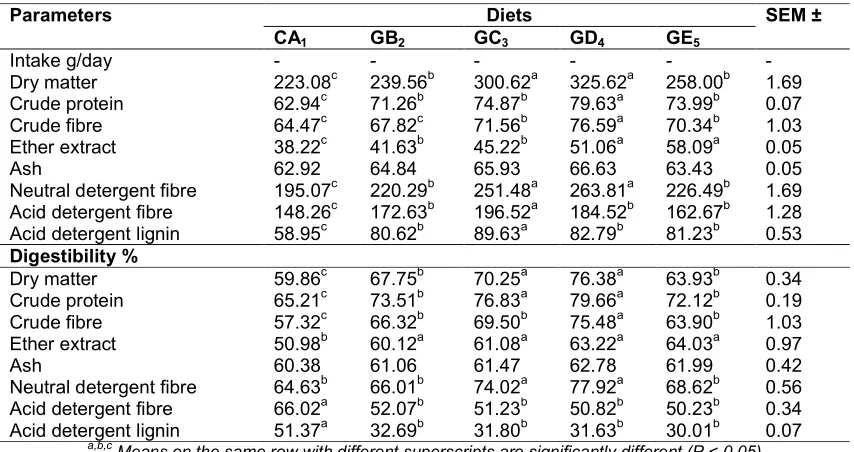
Intake and apparent nutrient digestibility results of the experimental animals are listed in Table 3. Dry matter intake (DMI) was significantly (P < 0.05) different among treatment diets. Supplementation at 25 and 30 g of garlic oil to diets showed greater DMI as compared with control diet that had low DMI. Neutral detergent fibre intake had similar results with DMI. Intakes of crude protein and crude fibre were greater (P < 0.05) for goats fed diet GD4 than those fed
diets GB2, GC3, GE5 and CA1. Ether extract
of garlic oil increased in the diets. Goats fed on GC3 diet consumed more acid detergent fibre
and lignin than those fed on other test diets and control group. However, no significant difference (P > 0.05) in ash intake was found among diets.
Apparent digestibility of nutrients were significantly (P < 0.05) influenced by garlic oil supplementation except digestibility of ash that was not affected (P > 0.05). Supplementation at 25 and 30 g of garlic oil demonstrated higher significant values (P < 0.05) in dry matter, crude protein and NDF digestibility than other garlic oil supplemented diets and control group. Furthermore, all supplemented garlic oil treatment groups showed higher significant (P < 0.05) increase in ether extract digestibility but lower in ADF and ADL digestibility. However, diet GD4 had higher positive effect (P < 0.05) in crude
fibre digestibility as compared with other treatment diets.
Data on growth parameters are presented in Table 4. Results in the study showed that GC3
and GC4 resulted in higher intake of diets,
followed by GE5 and GB2 then CA1. This
variation in intake of diets significantly (P < 0.05) affected weight gain of goats. Final body weight that ranged from 9.44 to 10.39 kg was significantly (P < 0.05) greater for goats fed GC3,
GD4 and GE5 diets than those fed on CA1 and
GB2 diets. Goats on GC3 and GD4 recorded
higher total, weekly and daily weight gains as compared with diets CA1, GB2 and GE5. Feed
conversion ratio that was apparently different (P< 0.05) in treatments favoured goats on diet GD4
than other diets. However, average initial body weight of goats in the dietary treatments did not vary significantly (P > 0.05).
Table 3. Intake and apparent digestibility of nutrients in goats fed garlic oil supplemented diets
Parameters Diets SEM ±
CA1 GB2 GC3 GD4 GE5
Intake g/day - - - -
Dry matter 223.08c 239.56b 300.62a 325.62a 258.00b 1.69
Crude protein 62.94c 71.26b 74.87b 79.63a 73.99b 0.07
Crude fibre 64.47c 67.82c 71.56b 76.59a 70.34b 1.03
Ether extract 38.22c 41.63b 45.22b 51.06a 58.09a 0.05
Ash 62.92 64.84 65.93 66.63 63.43 0.05
Neutral detergent fibre 195.07c 220.29b 251.48a 263.81a 226.49b 1.69
Acid detergent fibre 148.26c 172.63b 196.52a 184.52b 162.67b 1.28
Acid detergent lignin 58.95c 80.62b 89.63a 82.79b 81.23b 0.53
Digestibility %
Dry matter 59.86c 67.75b 70.25a 76.38a 63.93b 0.34
Crude protein 65.21c 73.51b 76.83a 79.66a 72.12b 0.19
Crude fibre 57.32c 66.32b 69.50b 75.48a 63.90b 1.03
Ether extract 50.98b 60.12a 61.08a 63.22a 64.03a 0.97
Ash 60.38 61.06 61.47 62.78 61.99 0.42
Neutral detergent fibre 64.63b 66.01b 74.02a 77.92a 68.62b 0.56
Acid detergent fibre 66.02a 52.07b 51.23b 50.82b 50.23b 0.34
Acid detergent lignin 51.37a 32.69b 31.80b 31.63b 30.01b 0.07
a,b,c
Means on the same row with different superscripts are significantly different (P < 0.05)
Table 4. Growth parameters of goats fed experimental diets
Parameters Diets SEM ±
CA1 GB2 GC3 GD4 GE5
Initial body weight (kg) 7.46 7.25 6.63 6.45 7.18 0.03
Final body weight (kg) 9.44b 9.78b 10.11a 10.39a 10.09a 0.07
Total weight gain (kg) 1.98a 2.53b 3.48a 3.94a 2.91b 0.05
Weekly weight gain (g) 165.00c 210.83b 290.00b 329.33a 242.50b 1.06
Daily weight gain (g) 23.57c 30.12b 41.43a 46.91a 34.64b 0.15
Daily feed intake (g) 223.08c 239.56b 300.62a 325.62a 258.58b 1.09
Feed conversion ratio 9.47a 7.95b 7.26b 6.94c 7.47b 0.04
a,b,c
Results on pH, total volatile fatty acid (VFA) concentration, molar proportion of individual VFA and acetate: propionate (C2:C3) ratio in the
rumen are shown in Table 5. The rumen pH did not differ significantly (P > 0.05) among the treatment diets. Total VFA concentrati decreased significantly (P < 0.05) in rumen of goats fed garlic oil supplemented diets as compared with control diet. However, molar proportion of C2 also decreased (P < 0.05) while
C3 and butyrate (C4) proportion increased (P <
0.05) as the inclusion of garlic oil increased in diets. Notwithstanding, the highest production of C3 and C4 were recorded in supplementation at
25g and 30 g of garlic oil than other garlic supplemented diets. This study did not also found significant (P >0.05) difference in iso
Table 5. Rumen fermentation profile of goats fed garlic oil supplemented diets
Items
CA
Rumen pH 6.32
Total VFA (mM) 88.62
Individual VFA (mol/100mol)
Acetate (C2) 68.68
Propionate (C3) 22.99
Butyrate (C4) 7.68
Iso-butyrate (C5) 2.01
Valerate (C6) 2.03
Iso-valerate (C7) 1.98
C2 : C3 2.96
a,b
Means on the same row with different superscripts are significantly different (P < 0.05)
Fig. 1. Rumen ammonia nitrogen (NH
0 2 4 6 8 10 12 14 CA1 GB2 A m m o n ia N it ro g e n c o n c e n tr a ti o n N H3 -N ) m g /d l
Okoruwa and Edoror; EJNFS, 10(2): 104-115, 2019; Article no.EJNFS.2019.012
total volatile fatty acid (VFA) concentration, molar proportion of individual VFA ) ratio in the rumen are shown in Table 5. The rumen pH did not differ significantly (P > 0.05) among the treatment diets. Total VFA concentration decreased significantly (P < 0.05) in rumen of goats fed garlic oil supplemented diets as compared with control diet. However, molar also decreased (P < 0.05) while ) proportion increased (P < f garlic oil increased in diets. Notwithstanding, the highest production of were recorded in supplementation at g of garlic oil than other garlic supplemented diets. This study did not also found significant (P >0.05) difference in
iso-butyrate (C5), valerate (C6), iso-valerate (C
C2 : C3 ratio as in rumen pH.
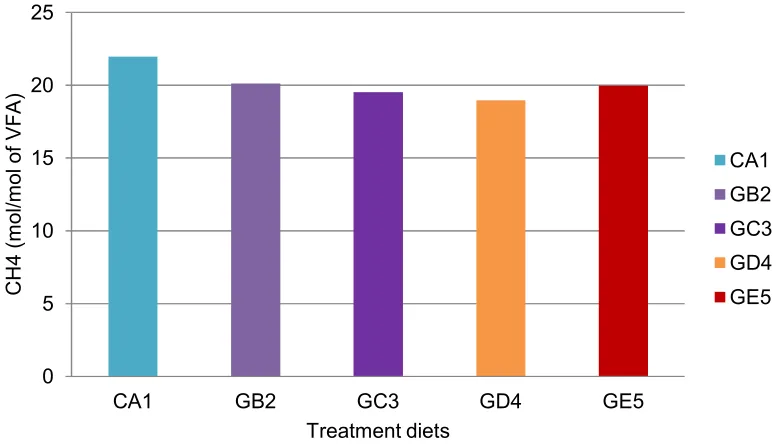
Presented in Figs. 1 and 2 are results of rumen ammonia nitrogen (NH3 – N) production and
methane (CH4) emission. The results showed
that inclusion of garlic oil to the treatment diets influenced NH3 – N and CH4 emission in the
study. Garlic oil supplemented diets depressed rumen NH3 – N concentration than
the control diet. Similarly, estimated CH production tended to be reduced in supplementation with garlic oil compared with control diet. Moreover, the reduction in NH3 – N and CH4 gas in supplemented
diets GC3 and GD4 were higher than GB
GE5.
Rumen fermentation profile of goats fed garlic oil supplemented diets
Diets
CA1 GB2 GC3 GD4 GE5
6.32 6.54 6.78 6.82 6.67
88.62a 85.74b 83.99b 83.49b 82.01b
68.68a 66.82b 66.73b 65.92b 66.74b
22.99b 24.52a 26.01a 26.06a 24.81a
7.68b 8.02a 8.06a 8.09a 8.04a
2.01 1.96 1.98 1.95 1.99
2.03 1.99 1.93 1.96 1.97
1.98 1.82 1.90 1.94 1.86
2.96 2.73 2.67 2.63 2.69
Means on the same row with different superscripts are significantly different (P < 0.05)
Fig. 1. Rumen ammonia nitrogen (NH3 – N) production
GB2 GC3 GD4 GE5
Treatment diets
115, 2019; Article no.EJNFS.2019.012
valerate (C7) and
1 and 2 are results of rumen N) production and ) emission. The results showed that inclusion of garlic oil to the treatment
emission in the study. Garlic oil supplemented diets
N concentration than imated CH4 gas
production tended to be reduced in
supplementation with garlic oil compared with control diet. Moreover, the reduction in
gas in supplemented were higher than GB2 and
Rumen fermentation profile of goats fed garlic oil supplemented diets
SEM ± 0.06 b 1.39 b 1.23 a 0.97 0.21 0.03 0.04 0.06 0.03
Means on the same row with different superscripts are significantly different (P < 0.05)
CA1
GB2
GC3
GD4
Fig. 2. Rumen estimated methane gas production
Table 6. Effect of garlic oil supplementation on rumen microbial population (x108cfµ/ml) of goats
Items Diets SEM ±
CA1 GB2 GC3 GD4 GE5
Total bacteria 10.09a 9.83b 9.36b 8.99c 8.97c 0.07
Fibrobactor succinogenes 7.96a 5.86b 5.23b 5.12b 5.03b 0.04
Ruminococcus albus 5.73b 6.42a 6.48a 6.52a 6.32a 0.08
Ruminococcus flavefaciens 5.02b 6.20a 6.50a 6.58a 6.40a 0.12
Ruminococcus fibrisolvens 7.32a 5.02b 4.92c 4.65c 4.45c 0.16
Total methanogenes 6.68a 5.64b 4.72c 4.51c 5.41b 0.09
Total protozoa 8.93a 6.95b 6.01b 5.87c 6.72b 0.05
Total fungi 4.86 4.79 4.72 4.70 4.68 0.03
a,b,c
Means on the same row with different superscripts are significantly different (P < 0.05)
Results of rumen microorganisms’ population as influenced by dietary treatments is shown in Table 6. It was found that total bacteria population was significantly different (P < 0.05) between the control and supplemented groups. The population was highest in CA1 and lowest in
GD4 and GE5. However, the control group also
tended to increase Fibrobactor succinogenes
population significantly (P < 0.05) as compared with garlic oil supplemented diets. All supplemented groups had shown higher population of Ruminococcus albus and
Ruminococcus flavefaciens than the control group except Butyrivibro fibrisolvens population that was lower (P < 0.05) as indicated in Table 5. In the study, total methonogenes and protozoa population tended to be increased and quantified significantly in control group than the test groups
while total fungi population was unaffected by garlic oil supplementation (P > 0.05).
4. DISCUSSION
Manipulation of rumen functions with feed additives has been recognized as an important strategy for improving feed efficiency and performance in goats. In the present study, dry matter of the diets (Table 1) were approximately high, hence they can be preserved over a long term for distance transportation. Variations in nutrient components of diets could be a reflection of different proportion of nutrients with garlic oil contents that were supplied by the feed ingredients. However, crude protein (CP) levels in these diets were higher than the range values (11.00 to 13.00% of CP required to supply
0 5 10 15 20 25
CA1 GB2 GC3 GD4 GE5
C
H
4
(
m
o
l/
m
o
l
o
f
V
F
A
)
Treatment diets
CA1
GB2
GC3
GD4
Okoruwa and Edoror; EJNFS, 10(2): 104-115, 2019; Article no.EJNFS.2019.012
adequate protein for maintenance and moderate growth in goats [17]. Fatty acids in garlic oil (Table 2) exhibit numerous biological functions which are beneficial for the state of animals’ health. It has medicinal, antimicrobial properties, antioxidant, antifungal and antiviral agents that speeds up digestion and improve immune system in livestock It has been reported in literature [6] that linolenic and lauric acids have antibacterial and antifungal functions as the key ingredients of many feed additives.
Increase in the DMI of the test diets might be attributed to specific gravity of particle size of feeds and garlic oil supplementation compared with the control diet. Feed intake has been reported by Rafiee-Yarandi et al. [18] to depend on large number of factors such as physical characteristics, palatability, distension stimulates stretch receptors in rumen wall, digesta flow rate and fibre digestion. In general, it was found that inclusion of garlic oil up to 30 g tended to increase nutrient intake than 35 g of garlic oil supplementation. This tendency to reduce nutrient intake at 35gof garlic oil has been shown to interact with dietary fibre in the rumen to depress fibre degradability [19]. However, garlic oil had no effect on ash intake. This result on ash is in consistent with previously
published reports where oil supplementation in goats’ diet has no effect on mineral intake [20].
Digestibility results were influenced by the action of garlic oil on diets. The progressive increase in the digestibility of DM, CP, crude fibre (CF) and neutral detergent fibre (NDF) up to 30 g (3%) of garlic oil supplementation in this study could possibly suggest that the rumen microbes had adapted to that levels of linolenic and lauric acids in garlic oil which resulted in reduction of protozoa, leading to a higher population of bacteria, hence increased digestibility of nutrients. This contradicts the reports of Candyrine et al. [20] that 4% linseed oil supplementation in diets of goats improved digestibility. This inconsistency could be due to the type of oil used in the different studies which are made up of different composition of fatty acids. Notwithstanding, the slight reduction in most digestibility of nutrients at 35 g (3.5%) garlic oil inclusion (Table 3) could probably explain the higher degree of linoleic acid of garlic oil in the rumen. Zhang et al. [21] stated that fatty acids with higher degree of unsaturated are toxic towards rumen microbes, thus reducing digestibility. Interestingly, garlic oil
supplementation did not affect digestibility of ash but acid detergent fibre (ADF) and acid detergent lignin (ADL) digestibility were decreased with increase in garlic oil inclusion. Higher content of most of saturated and unsaturated fatty acids in the garlic oil (Table 2) could have probably inhibit ADF and ADL degrading microbes from acting in the rumen .This is in agreement with Kongmun et al. [22] who reported that ash digestibility is not altered by garlic powder but ADF and ADL digestibility tend to decrease in swamp buffalo as result of higher lauric, palmitic and linoleic acids in diets fed garlic and coconut oils supplement. However, it is interesting to know that ether extract digestibility increased with garlic oil inclusion in the diets but the general low digestibility of nutrients recorded in the control diet could be attributed to the physical effective fibre and accumulation of high level of fermentation acid from silage which might have depressed the activity of cellulolytic and fibrolytic bacteria in the rumen.
Experimental diets did not adversely affect growth performance but enhance both feed intake and weight gain of goats (Table 4). The higher feed intake and better digestibility of nutrients in goats fed garlic oil supplemented diets explain the higher final body weight and better weight gain observed in the study. This observation indicates that goats on the test diets were better in terms of intake, efficiency of feed utilization and physiological state; hence they were more efficient in converting feed to weight gain. As pointed out in earlier reported literature [23] that garlic oil supplemented diets have higher energy density with antimicrobial action that improve energy intake at similar feed intake level, enteric health and proper maintenance of goats. Highest weight gain recorded in goats on 30g of garlic oil diet was in line with the previous study of Ahmed et al. [24] who reported significant increase in weight gain of growing buffalo calves when up to 2.5% natural juice containing garlic was added to diet.
As expected, feed conversion ratio (FCR) improved with garlic oil inclusion diets than the control diet. However, the positive response between weight gain and FCR obtained from the test diets as compared with control diet could probably be used to further attest the superiority of the test diets in terms of nutrient utilization for body weight gain.
(5.5 – 7.0), where microbial digestion of fibre and protein has been found to be optimal [22]. Volatile fatty acid (VFA) production has been reported to depend on nutrient digestibility, rate of absorption, rate of digesta passage from the rumen and the activity of microbial population in the rumen [25]. The reduction in VFA production in test diets might be ascribed to a depressive effect of garlic oil on the protein degradation which is in accordance with the reduction of the abundance of ammonia production observed in the garlic oil supplemented diets. However, part of VFA can be produced from hydrolysis of dietary protein to amino acids which are deaminated before conversion to VFA [26]. Hence a decrease of protein degradation could lead to a reduction of VFA originated from deamination of amino acids [27]. The higher total VFA and molar proportion of C2 acid observed in
the control diet suggest some extent of higher population of fibre degradation microbes that could be attributed to better digestion of fibre component of the diet as compared with the test diets. It was highlighted by Corredu et al. [14] that higher production of acetate and fibre degrading microbes in the rumen contribute to greater extent in the digestion of fibrous plant material, which could have compensated production of VFA. Garlic and its compounds (diallyl disulfide and allyl mercaptan) reduced C2
and methane proportions but increased C3 and
C4 proportion to some extent suggesting that
garlic compounds were responsible for most of these effects [22,28]. Thus this explains the higher available energy to support growth and possibly higher tendency to biosynthesize fats in goats on test diets.
Supplemented diets did not affect C2 to C3 ratio
suggesting that the levels of garlic oil supplementation in the study did not interfere with their function in the rumen. Notwithstanding, C2 – to – C3 ratio recorded in this study were
much greater than 2.5 value considered to be the threshold, below which milk fat depression occurs in ruminants [25].
The proportion of C5, C6 and C7 observed
suggests that diets containing garlic oil might result in increased outflow of metabolizable protein from the rumen to hind gut. This is in agreement with the literature reported by Eastridge et al. [29] that when concentration of C5 ,C6 and C7 are similar among diets, it means
similar degradation of protein occurs because of their branched chain VFA that are derived primarily from dietary protein [30].
The ammonia nitrogen reduction in rumen of goats on test diets (Fig. 1) could be related to the ability of garlic compounds to affect the growth of rumen proteolytic bacteria, either directly reducing the activities of the protease enzymes or indirectly by their ability to bind proteins as demonstrated in the effect of sainfoin hay with garlic on rumen ammonia production by Kirisci and Kamalak [6]. This decrease in NH3 – N
concentration could probably make protein in the test diets not to be easily degraded and probably became source of rumen-protected protein by supporting the synthesis of microbial protein in the rumen. Thus, this might enhance the metabolic protein supply of goats and high proportion of non NH3 – N which increased
outflow of metabolizable protein from the rumen. This observation is in accordance with the previous work of Wanapat et al. [31] that higher rumen escape of protein increases the supply of metabolizable protein to the lower intestine. Cardozo et al. [32] also reported that garlic oil in continuous culture reduced NH3 and increased
peptide and amino acid nitrogen concentration which suggested that deamination was inhibited and increased more rumen bypass of protein.
Garlic oil supplementation also represented a feasible strategy in estimating methane (CH4) emission in the rumen (Fig. 2). However, garlic oil inclusion diets were effective in reducing CH4
emission, probably because of garlic compounds concentration which were appropriate to affect inhibition of methanogenic archaea directly or indirectly by the reduction of fibre digestion in the rumen. This result was consistent with previous study of Kongmun et al. [22] that shown significant suppression of methane production in ruminants fed garlic powder supplementation.
Rumen microbial profile of goats fed diets of garlic oil supplementation is shown in Table 6. All supplemented diets showed reduction in total bacteria population than the control diet. There was substantial evidence that garlic oil inhibit metabolic activity of rumen bacteria by absorption onto the microbial cell wall [20]. The control group of experimental animals increased degradation of cellulose and protein by elevating the population of Fibrobacter succinogens and
Okoruwa and Edoror; EJNFS, 10(2): 104-115, 2019; Article no.EJNFS.2019.012
Ruminoccus flavefaciens have been noted to be involvedin fibre degradation [35] and could have contributed to some extent in fibre digestion of garlic oil supplemented diets. The higher C3 and
C4 proportion recorded in test diets (Table 3)
compared with control diet could probably be attributed to the higher population of R. albus
and R. flavefacien obtained in garlic oil supplemented diets. This agrees with the report in literature [21] that the introduction of essential oil in a diet of ruminants can inhibit or increase the growth and activity of some strain thus affecting the total population of bacteria in the rumen.
Methanogens which are responsible in utilizing hydrogen in the process of methanogenesis were higher in control diet. This could have diverted the use of available hydrogen for methane formation, which was a loss of energy from the diet [36] and decreased energy efficiency of goats, hence leading to the lower feed efficiency and slower growth rate in the goats (Table 4). The anti-methanogenic effect of garlic oil and its active components such as organosulfur
compounds are strong inhibitors of
methanogens, as a result, the synthesis of their unit was inhibited, and thereby affecting methanogen population of garlic oil supplemented diets. In the same vein, test diets tended to decrease total protozoa population while fungi population was unaffected. The decline in protozoa population could be due to reduction in the permeability properties of their cell membrane, competition among rumen micro-organism species and the bioactive components of garlic. Kongmun et al. [22] provide further support for this finding by demonstrating that essential oil of garlic contains high amount of esterified lauric and myristic acids that might be absorbed either onto rumen microbes or onto feed particles and interact with dietary fibre to act as an antibacterial agent and decrease protozoa population.
5. CONCLUSION AND RECOMMENDA-TION
Results of this study have shown that garlic oil supplementation had no effect on fungal population but rumen ammonia nitrogen, methane emission and total protozoa count were lower in garlic oil inclusion diets. Furthermore, the use of garlic oil as supplement in this present study improved intake, digestibility, growth and rumen fermentation. The improvement were more enhanced in supplementation of 25 g
(2.5%) and 30 g (3%) garlic oil than 0 g, 20 g and 35 g inclusion levels in the diets, hence 2.5 and 3% garlic oil supplementation were recommended.
The above advantage of garlic oil
supplementation on intake, digestibility and growth with rumen fermentation would be an attractive option for farmers to produce quality products from goats to meet the increasing demand for ruminant products in many of the tropical countries.
ETHICAL APPROVAL
As per international standard written ethical permission has been collected and preserved by the author(s).
COMPETING INTERESTS
Authors have declared that no competing interests exist.
REFERENCES
1. Ajala MK, Lamidi OS, Otani SM. Petri-ruban small ruminant production in Northern Guinea savanna, Nigeria. Asian Journal of Animal and Veterinary Advances. 2008;3(3):138-146.
2. Salem HB. Nutritional management to improve shee pand goat performances in semi arid regions. Revista Brasileira de Zootecnia. 2010;39:337–347.
3. Ajayi FT, Ogunleke F, Adeina A, Durotoye ES. Performance, haematology and serum biochemistry of West African dwarf goats fed ensiled mixtures of elephant grass (Pennisetum purpureum) with lime bean, African yam and pigeon pea. Journal of Natural Science. 2012;46:694–702. 4. Khaing KT, Loh TC, Ghizan S, Halim RA,
Samsudin AA. Feed intake, growth performance and digestibility in goats fed whole corn plant silage and Napier grass. Malaysian Journal of Animal Science. 2015;18(1):87–98.
5. Cowan MM. Plant products as
antimicrobial agents. Clinical Microbiology Review. 1999;12:564–582.
Available:https://cmr.asm.org/content/cmr/ 12/4/564/.full.pdf
production. Livestock Research for Rural Development. 2019;31(4):1–5.
7. Molero R, Ibara M, Calsamiglia S, Ferret A, Losa R. Effects of specific blend of essential oil compounds on voluntary on dry matter crude protein degradability in heifers fed diets with different forage to concentrate ratios. Animal Feed Science and Technology. 2004;114:91–104. 8. AFRC. Agricultural and Food Research
Council, energy and protein rewiurement of ruminants. CAB International, Wallingford. 1995;159.
9. Moss AR, Jouany JP, Newbold J. Methane production by ruminants: its contribution to global warming. Ann. Zootech. 2000;49: 231–253.
10. AOAC. Official Methods of Analysis 15th Edition. Association of official analytical chemist, Washington, DC. 1990;2044. 11. Van Soest PJ, Robertson JB, Lewis BA.
Methods for dietary fibre, neutral detergent fibre and non-starch polysaccharides in relation to animal nutrition. Journal of Dairy Science. 1991;74:3583–3597.
12. Corredu F, Nudda A, Battacome G, Boe R, Francesconi AHD, Pulna G. Effects of grape seed supplementation, alone or association with linseed in ruminal metabolism in Sards dairy sheep. Animal Feed Science Technology. 2015;199:61– 72.
13. Mor P, Bals B, Kumar S, Tyagi N, Reen JK, Tyagi B, Choudhury PK, Pyagi AK. Influence of replacing concentrate mixture with AFEX pellets on rumen fermentation, blood profile and acetamide content in the rumen of crossbred (Alpine x Beetle) female goats. Small Ruminant Research.
2019;170:109–115.
14. Corredu F, Fancello F, Chessa L, Afzori AS, Pulina G, Nudda A. Effects of supplementation with exhausted myrtle berries on rumen function of dairy sheep. Small Ruminant Research. 2019;170:51– 61.
15. SAS. Statistical analysis system. User’s Guide Version 9.0 SAS Instsitute, Inc. Cary North Carolina USA; 2004.
16. Duncan DG. Multiple range and multiple F-tests, Biometrics. 1955;11:1–42 .
17. National Research Council. Nutrient requirements of goats: Angora dairy and meat in temperate and tropical countries. National Academics Press, Washington, D.C. USA. ISBN13: 97803031851. 1981; 91.
18. Rafiee-Yarandi H, Alikhani M, Ghorbani GR, Heydani M, Rezamand P. Dietary protein level and corn processing method: Intake, digestibility and feeding behaviour of lactating dairy cows. Livestock Science. 2019;221:19–27.
19. Dohme F, Machmuler A, Wasserfallen A, Kreuzer M. Ruminal methanogenesis as influenced by individual fatty acids supplemented to complete ruminant diets. Lett. Appli. Microbiol. 2001;32:47–51. 20. Candyrine SCL, Jahromi MF, Ebrahimi M,
Chen WL, Rezaei S, Goh YM, Abdullah N, Liang JB. Oil supplementation improved growth and diet digestibility in goats and sheep fed fattening diet. Asian – Australasian Journal of Animal Sciences. 2019;32(4):533–530.
21. Zhang CM, Guo YQ, Yuan ZP. Effect of octadeca carbon fatty acids on microbial fermentation, methanogenesis and microbial flora in-vitro. Animal Feed Science Technology. 2008;146:259-269. 22. Kongmun P, Wanapat M, Pakdee P,
Navanukraw, Yu Z. Manipulation of rumen fermentation and ecology of swamp buffalo by coconut oil and garlic powder supplementation. Livestock Science. 2011; 135:84–92.
23. Shokrollahi B, Hesami SM, Baneh H. The effect of garlic extract on growth, haematology and cell-mediated immune response of new born goat kids. Journal of Agriculture and Rural Development in the Tropics and Subtropics. 2016;117(2):225– 232.
24. Ahmed AA, Bassuomy NI, Awod ES, Aiad AM, Mohammed SA. Adding natural juice of vegetables and fruitage to ruminant diets (B) nutrients utilization microbial safety and immunity, effect of diets supplemented lemon, onion and garlic juice fed to growing buffalo calves. World Journal of Agricultural Science. 2009;5(4): 456–465.
25. Yang L, Guang-Ning Z, Hong-Jian X, Shwang Z, Xiu-Jing D, Cong L, Xing-Yi Z, Hong-Bo Z, Yong-Gen Z. Effects of replacing alfalfa hay with Moringa oleifera leaves and peduncles on intake, digestibility and rumen fermentation in dairy cows. Livestock Science. 2019;220: 211–216.
Okoruwa and Edoror; EJNFS, 10(2): 104-115, 2019; Article no.EJNFS.2019.012
ruminant digestion and metabolism, 2nd edition. CABI Publishing: 2005;157–175. 27. Pastra AK, Saxena J. Exploitation of
dietary tannins to improve rumen metabolism and ruminant nutrition. Journ. Sci. Food Agric. 2011;91:24–37.
28. Busquet M, Calsamiglia S, Ferret A, Carro MD, Kamel C. Effect of garlic oil and four of its compounds or rumen microbial fermentation. Journal of Dairy Science.
2005;88:4393–4404.
29. Eastridge ML, Bucci PB, Ribeiro CVDM. Feeding equivalent concentrations of forage neutral detergent fiber from alfalfa hay, grass hay, wheat straw, and whole cottonseed in corn silage based diets to lactating cows. Anim Feed Sci Technol.
2009;150:86–94.
30. Berthiaume R, Benchaar C, Chaves AV, Tremblay GF, Castonguay Y, Bertrand A, Bélanger G, Michaud R, Lafrenière C, McAllister T, Brito AF. Effects of nonstructural carbohydrate concentration in alfalfa on fermentation and microbial protein synthesis in continuous culture. Journal of Dairy Science. 2010;93:693– 700.
31. Wanapat M, Khejorsart P, Pakdee P, Wanapat S. Effect of supplementation of garlic powder on rumen ecology and digestibility of nutrients in ruminants. Journ. Sci. Food Agric. 2008;88:3497– 3503.
32. Cardozo PW, Calsamiglia S, Ferret A, Kamel C. Effects of natural plant extracts on ruminal protein degradation and fermentation profiles in continuous culture. Journal of Animal Science. 2004;82:3230– 3236.
33. Wang JP, Yoo JS, Jang HD, Lee JH, Cho JH, Kim IH. Effect of dietary fermented garlic by Weissella korrensis powder on growth performance, blood characteristics and immune response of growing pigs challenged with Escherichia coli
lipopolysaccharide. Journal of Animal Science. 2011;89(7):2123–2131.
34. Patra AK, Yu Z. Essentials oil modify rumen bacterial compositions in-vitro as revealed by micro array analysis. Journal of Animal Science, 91(E-suppl.2/J) Journal of Dairy Science.2013;96(E–suppl.1):713. Available:https://www6.inra.frlproductionsa nimales/content/download/6913/93095/ver sionII /file/prod_anim_27_4_06.pdf 35. Candyrine SCL, Liang JB, Goh YM. In-vitro
rumen fermentation characteristics of goats and sheep supplemented with polyunsaturated fatty acids. Anim. Prod Sci. 2016;57:1607–1612.
36. Nkrumah JD, Okine EK, Mathison GW. Relationships of feedlot feed efficiency, performance and feeding behaviour with metabolic rate, methane production and energy partitioning in beef cattle. Journal of Animal Science. 2006;84:145–153.
© 2019 Okoruwa and Edoror; This is an Open Access article distributed under the terms of the Creative Commons Attribution License (http://creativecommons.org/licenses/by/4.0), which permits unrestricted use, distribution, and reproduction in any medium, provided the original work is properly cited.
Peer-review history: