Original Article
Obsessive Compulsive Disorder Is More Flyer in New
Generation
Nimra Siddiqui*, Syedd Anamta Knawal, Syeda Zarfshan Fatima & Kainat ghaffor
Jinnah University for women, Karachi, Pakistan. Corresponding Author: [email protected]
Abstract
Obsessions are thought, images and impulses that occur repeatedly. Persons having obsessive compulsive disorder do not want to have these thoughts because these thoughts disturbing them. Ordinarily, individuals having obsessive compulsive disorder recognized that these thoughts are senseless. The common symptoms of OCD is avoid contamination such as washing hand excessively, cleaning household, etc. Now a days, the use of modern technology such as online video games, selfies and social media is increased. The over use of this technology can lead to obsessive compulsive disorder in young generations. In OCD there is Serotonin deficiency in synapse this low levels of serotonin can cause OCD symptoms. Antidepressants (SSRI’s) is used to treat OCD because it increased the serotonin level in synapse The drugs include: Clomipramine (Anafranil), Fluoxetine (Prozac), Fluvoxamine, Sertraline (Zoloft) and Paroxetine (Paxil, Pexeva).The psychological treatment of OCD is very effective when it takes the form of cognitive-behavioral therapy (CBT) and lot of research is required for the same before it affects large population of the world and will be on the top of the list of Global Burden of Diseases.
Keywords
Obsessive compulsive disorder, young generation, contamination, selfies, smart phone, Online video games.
Introduction
The principal aim of this study were to examine the prevalence rate, clinical characteristic and related factors of obsessive compulsive disorder. Obsessions are thought, images and impulses that occur repeatedly. Persons with obsessive compulsive disorder do not want to have these thoughts because these thoughts disturbing them. Ordinarily, individuals having obsessive compulsive disorder recognized that these thoughts are senseless. Obsession are typically accompanied by intense and uncomfortable feelings such as doubt, fear etc. (Clark, et al., 2014). Compulsion is the subsequent part of obsessive compulsive disorder. These are repetitive thoughts or behavior that the person uses with the impulsion of
cognitive-behavioral therapy (CBT) or behavior therapy these treatment are closely linked to learning and cognitive-behavioral theories of the maintenance of OCD (Meyer v., 1966).Certain psychiatric medications can control the obsessions and compulsions of OCD. Antidepressants (SSRI’s) approved by the Food and Drug Administration is used to treat OCD include: Clomipramine (Anafranil), Fluoxetine (Prozac), Fluvoxamine, Sertraline (Zoloft) and Paroxetine (Paxil, Pexeva) (MFMER 1998-2017).
In this modern world technology is a big part of our society and our foreseeable future. The use of modern technology such as online video games and social media is increased over the last decade (Cheng & Li, 2014; Kuss & Griffiths, Karila & Billieux, 2014; Mazzoni & Lannone, 2014; Ryan, Chester, Reece & Xenos, 2014; Young, 2015). These technology has been associated with many positive attributes such as cognitive skill development, social interaction, entertainment and many more but the excessive use of this technology lead to addiction and this addiction further lead to ADHD, mood swings and obsessive compulsive disorder. Researchers demonstrated that both women and men use different online activities men’s are more addicted to online video gaming whereas women’s are more addicted to social media, texting, and online shopping (Andreassen C. S., et al., 2016).The another obsession is Smartphone. Ahonen (2011) research by Nokia Company that the average person look at their phone about 150 times a day. A survey studied show that 45% of British adults indicated they feel worried when they cannot access their email and social sites even many of them check there Smartphone in every 1 hour (Rosen, L. D., et al., 2013). OCD is the most common disorder, its affect
over 2% population about more than in 50 people in the world. The more people suffer from obsessive compulsive disorder than from depression and bipolar (Obsessive-CompulsiveDisorder-2012). According to one of such study which was held in Pakistan in 2012 on fisherman community, it was found that 3% population was suffering from OCD among them 56% were females and 50% young generation under the age of 25. The most recurring symptoms were found to be dirt, contamination, checking fear of losing things and religious thoughts. According to the author Pakistan need more intuitions into the presence of this disorder and more research work are needed to determine the consequences of this disorder (Gadit, A. A, 2012).
Common Obsession in OCD
(Clark, D. A., & Radomsky, A. S. 2014).
Contamination such as body fluid (examples: urine, feces), germs/disease (example: HIV, herpes), environmental contamination, house hold chemicals (example cleaner solvents), dirt, etc.
Losing control such as Fear of acting on an impulse to harm others or oneself, Fear of violet or horrific images in one’s mind, Fear of blurting out obscenities or insults and Fear of stealing things
Harm: Fear of being responsible for something terrible happening (example Fire burglary); Fear of harming other because of not being careful enough (example: dropping something on the ground that might cause someone to slip and hurt him/herself.)
aggressive sexual behavior towards other.
Obsession related to perfectionism such as Concern about evenness or exactness, Concern with a need to know or remember, Fear of losing or forgetting important information when throwing something out, Fear of losing thing.
Other such as Excessive concern about right or wrong thing morality, Concern with a getting physical illness or diseases (not by contamination e.g. Cancer).
Common Compulsion in OCD
(Wilhelm, S., & Steketee, G. S., 2006).
Cleaning and Washing such as Hand washing, showering, bathing, tooth brushing, excessively and doing other thing to prevent contamination.
Checking such as Checking that you did/will not harm other or yourself, checking that you did not make a mistake, checking some parts of your physical condition or body, checking that nothing terrible happened.
Repeating such as Rewriting or Rereading, Repeating routine activities (examples: going in or out doors, getting up or down of the chair), Repeating body movement (example: touching and blinking), Repeating activities in multiple times.
Mental Compulsion such as Mental review of event to prevent harm, Praying to prevent from harm, Counting while performing a task to end on a ‘good’, ‘right’ or ‘safe’ number, Undoing or cancelling (example: replacing a bad word with a good word to cancel it out).
Other Compulsion such as putting things in order or arranging things until right it ‘feel right’, Telling asking or confessing to get reassurance, Avoiding situation that trigger obsession.
Methodology
The study was conducted among the people(n=150) of all age groups belonging to various categories of our society including students , housewife, working men and women, there was no exclusion criteria, the questionnaire can be filled by anyone. The study is based on general OCD symptoms open ended questionnaire and general interviews which are taken at different places of metropolitan city of Pakistan i.e. Karachi. People were asked about general OCD symptoms including fear of losing thing, checking of social accounts or smart phone, washing and cleaning practice, playing video games and maximum number of selfies taking at a time.
Results
After careful evolution we interpreted that 62 % females are affected by this disorder whereas 38 % male have obsessive compulsive disorder. The 20 -30 age group is mostly affected i.e. 64.20% whereas under 20 is affected 23 % and above 30 age group is less affected i.e. 12.80% as shown in figure # 1 and 2.
According to the survey result this show that 49% of the population in the metropolitan city is aware of this disorder while the rest of the 51% people were unaware of this disorder and they think that it is normal thing which they do regularly that is shown in figure # 3
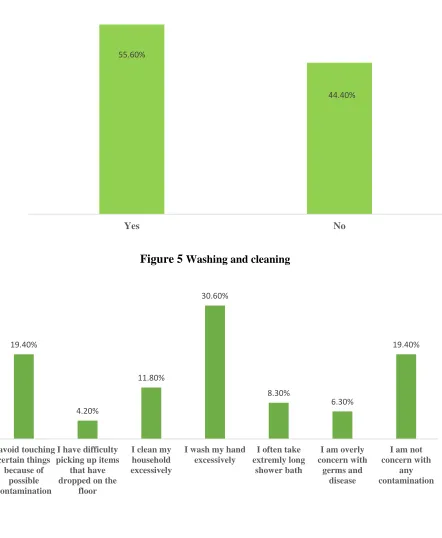
The current study shows that washing and cleaning practices are observed in the population that 30.60% peoples Consider them helpless to overcome their impulses to wash out their hand over and over again because every time after washing out their hand they again become phobic about contamination and they again wash their hands.19.40% Individuals avoid to touching thing because of contamination , while 4.20% individuals face difficulty in picking up items that have dropped On the floor because of contamination or germs, whereas 11.80% peoples clean their home a lot because of their Skeptical behavior about Cleanness and contamination mostly above 30 women’s are obsessive of cleaning their household excessively ,While 6.30% individuals Think overly about contamination and also become phobic. Whereas 19.40% are not conscious about any contamination and germ this is consider as they are not obsessive that is shown in the figure # 5.
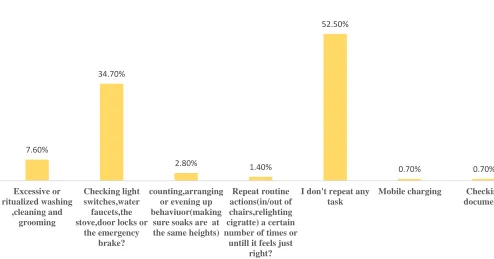
The result show it clearly that 7.60% individuals does excessive cleaning or washing of their house or even clean them self-many time it is one of most common type of OCD in which individuals do such type of acts , where 34.70% individuals repeatedly check switches ,water faucets. Some of these individuals may be OCD patient about which they actually unaware of this disorder, where 2.80% of individuals Count or arranging thing repeatedly but there is a less chance of OCD and we don’t easily consider it OCD because It may be their conscious that they may not be Shameful in their social circle about these embarrassed thing but we can't neglect it as OCD so we also should Have to do proper OCD test, where 1.40% of individuals Repeat their routine work but it is rare case and if seen so don’t take it too easily , where 52.50% of peoples not repeat their
task which is an good condition that show clearly that they are non OCD and non-phobic patient ,whereas 0.70% excessively charge Their mobile which also an disadvantage of mobile which make people to conscious about charging and make them obsessive , while 0.70% of individuals check their important documents which is another Sign of perfectionism but also may be OCD condition that is shown in the figure # 6.
The graph (figure # 7) result show that 24% people do not avoid throwing things away because they are afraid that they may be need them later but 35% people a bit avoid throwing things away because they are afraid that they may be need them later, 22% people averagely avoid throwing things away because they are afraid that they may be need them later, 11% people mostly or amassment avoid throwing things away because they are afraid that they may be need them later , 8% people maximal avoid throwing things away because they are afraid that they may be need them later.
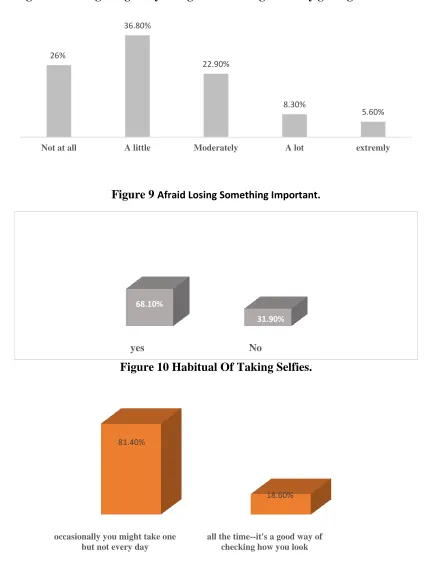
The graph (figure # 8) result show that 26.40% people do not frequently get nasty thoughts and have difficulty in getting rid of them 36.80% people a bit frequently get nasty thoughts and have difficulty in getting rid of them 22.90% people averagely frequently get nasty thoughts and have difficulty in getting rid of them 8.30% people mostly or amassment frequently get nasty thoughts and have difficulty in getting rid of them 5.60% people maximal frequently get nasty thoughts and have difficulty in getting rid of them.
because they forgot something important as shown in figure # 9.
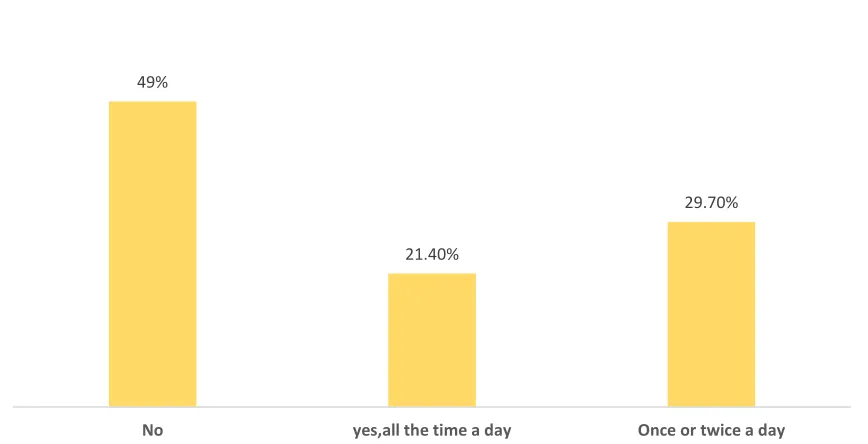
The (figure # 10) shows that 81.40% take selfies occasionally while 18.6% take selfies all the times a day and these people become obsessive. The figure #11 shows that 21.40% people say that his/her partner or parents complained that they spend more time on using phone while talking to them this obsession is very common in female.49% people say that there partner or parents do not complained that they are spend too much time on cell phone whereas remaining 29.70% people say that there partner or parents say once or twice a day this shows that these people are obsessive in using cell phone.
The question which is asked to the people of Karachi that what the first thing is they do when they wake up? 53.10% people say that
they reach their phone next to their bed and check Facebook and twitter these indicate that they are obsessive to social media while 17.90% people say that they stumble into the shower and other 29 % people say that that again go back to sleep as shown in figure #12.
People were asked about did they play video game and if yes then how much time they play video game? 63.60% people say that they play video game where as 36.40 % people say that they have no interest in video games mostly male are obsessive of playing video games Most of the people 22.40% say that they only play video game in free time while 22.20 % people say that they play video game 1-2 hours whereas 33.30 % people say that they play video game all the time of the day they are very addicted to video game according research these people are obsessive of playing video game due to loneliness as shown in (figure #13)
Figure 1 shows Gender.
female 62% male
Figure 2 indicates Age wise OCD patients.
Figure 3 showing Knowledge about Obsessive Compulsive Disorder.
23%
64.20%
12.80%
Below 20 20-30 Above 30
49%
51%
Figure 4 showing individual concern with contamination or getting a Serious illness (AIDS)
Figure 5 Washing and cleaning 55.60%
44.40%
Yes No
19.40%
4.20%
11.80%
30.60%
8.30%
6.30%
19.40%
I avoid touching certain things
because of possible contamination
I have difficulty picking up items
that have dropped on the
floor
I clean my household excessively
I wash my hand excessively
I often take extremly long
shower bath
I am overly concern with
germs and disease
I am not concern with
Figure 6 showing Repeat certain act over and over again
Figure 7 Avoid throwing things away to save it for future use. 7.60%
34.70%
2.80% 1.40%
52.50%
0.70% 0.70%
Excessive or ritualized washing
,cleaning and grooming
Checking light switches,water faucets,the stove,door locks or
the emergency brake?
counting,arranging or evening up behaviuor(making
sure soaks are at the same heights)
Repeat routine actions(in/out of chairs,relighting cigratte) a certain number of times or
untill it feels just right?
I don't repeat any task
Mobile charging Checking documents
24%
35% 22%
11%
8% Not at all
A little
Moderately
A lot
Figure 8 shows getting nasty thoughts and facing difficulty getting rid of them.
Figure 9 Afraid Losing Something Important.
Figure 10 Habitual Of Taking Selfies.
26%
36.80%
22.90%
8.30%
5.60%
Not at all A little Moderately A lot extremly
yes No
68.10%
31.90%
occasionally you might take one but not every day
all the time--it's a good way of checking how you look
81.40%
Figure 11 Spending More Time Using Mobile Phone.
Figure 12 First Thing Individual Does When She/he Wakes Up.
49%
21.40%
29.70%
No yes,all the time a day Once or twice a day
53.10%
17.90%
29%
reach for your phone next to your bed to check facebook and twitter
Figure 13 shows Time Spend by an individual in Playing Video Games.
Discussion
A survey result which was conducted in the city of Karachi in which many people participated according to the result almost both gender are affected by this disorder but females are highly affected 20-30 age group is highly obsessive. whereas above 30 age is less affected approximately half population of the Karachi city are unaware of this disorder and people think that it is the normal thing which they do their routine activities the most common symptom of obsessive compulsive disorder is contamination that 55.60% people say that they are very conscious about contamination people were asked about what they do to avoid contamination people were said that they wash their hand excessively because they think that their hand are not wash completely or its hand are not free from germs so they wash their hand again and again Hence it is a kind of anxiety. The women’s above 30 age and married said that they wash their household excessively some people said that they avoid picking thing from the ground due to contamination. Repetition is the common symptom of compulsion people were asked
about this symptoms most of the Individuals repeatedly check switches, water faucets because they are afraid that something bad is happen if they don’t check switches ,locks, etc. these individuals may be OCD patient about which they are actually unaware of this disorder, whereas individuals who Count or arranging thing repeatedly but there is a less chance of OCD and we don’t easily consider it OCD because It may be their conscious that they may not be Shameful in their social circle about these embarrassed thing but we can't neglect it as OCD so we also should have to do proper OCD test. In this current study shows that smart phone is the major factor of causing obsessive compulsive disorder. People spent too much time to using cell phone such as 21.40% people said that his/her partner or parents complained that they spend more time on using phone while talking to them this obsession is very common in female.49% people said that there partner or parents do not complained that they are spend too much time on cell phone whereas remaining 29.70% people said that there partner or parents say once or twice a day this shows that these people are obsessive
63.60% 36.40%
22.20%
33.30% 22.40%
of using cell phone. The 84% people say that they take selfies occasionally. These indicated that are not obsessive compulsive disorder but all the time a day taking selfies indicate obsessive compulsive disorder. According to American psychiatric association especially in young girls selfies causes obsessive compulsive disorder .The majority of people said that they are using cell phone when they wake up and check Facebook, twitter and other social sites and these technologies take our new generation towards obsessive compulsive disorder.
Conclusion
We have concluded that OCD is the most prevailing disorder .The young generation is highly obsessive to the latest technologies such as smart phone, selfies, online video games, Facebook, Twitter, etc. The people are unaware of this disorder and they think that these are normal thing. We have to educate young generation that selfies capturing, spending too much time of playing video games, social media is not the normal practice and they should use latest technologies in limited time. We should organize seminar to aware the people about this disorder and its treatment. The lot of research is required for the same before it affects large population of the world and will be on the top of the list of Global Burden of Diseases.
References
Andreassen, C. S., Billieux, J., Griffiths, M. D., Kuss, D. J., Demetrovics, Z., Mazzoni, E., & Pallesen, S. (2016). The relationship between addictive use of social media and video games and symptoms of psychiatric disorders: A large-scale cross-sectional study. Psychology of Addictive Behaviors, 30(2), 252.
Clark, D. A., & Radomsky, A. S. (2014). Introduction: A global perspective on unwanted intrusive thoughts. Journal of Obsessive-Compulsive and Related Disorders, 3(3), 265-268.
Gadit, A. A. (2012). Obsessive-compulsive disorder (OCD): is this disorder under-recognized? JPMA. The Journal of the Pakistan Medical Association, 62(9), 974-975.
Guenther, P. M., Casavale, K. O., Reedy, J., Kirkpatrick, S. I., Hiza, H. A., Kuczynski, K. J., ... & Krebs-Smith, S. M. (2013). Update of the healthy eating index: HEI-2010. Journal of the Academy of Nutrition and Dietetics, 113(4), 569-580.
Meyer, V. (1966). Modification of expectations in cases with obsessional rituals. Behaviour research and therapy, 4(1), 273-280.
“ObsessiveCompulsiveDisorder”.WebM D.com. Feb. 20, 2012. <http://www.webmd.com/anxiety
panic/guide/obsessive-compulsive-disorder>.
Radomsky, A. S., Alcolado, G. M., Abramowitz, J. S., Alonso, P., Belloch, A., Bouvard, M., & Garcia-Soriano, G. (2013). Journal of Obsessive-Compulsive and Related Disorders.
Rosen, L. D., Whaling, K., Rab, S., Carrier, L. M., & Cheever, N. A. (2013). Is Facebook creating “iDisorders”? The link between clinical symptoms of psychiatric disorders and technology use, attitudes and anxiety. Computers in Human Behavior, 29(3), 1243-1254. What causes OCD? OCD –UK,
https://www.ocduk.org/what-causes-ocd. Wilhelm, S., & Steketee, G. S. (2006).