Research Journal
Volume 12, No. 3, September 2018, pages 114–125
DOI: 10.12913/22998624/92177 Research Article
NUMERICAL MODELED STATIC STRESS-DEFORMED STATE OF PARALLEL
PIPES IN DEFORMABLE ENVIRONMENT
Ismoil Ibrohimovich Safarov1
1 Tashkent Chemical Technology Institute, Mirzo-Ulugbek district, KaraSu-6, house-12, flat-64, 100050
Tashkent, Uzbekistan, e-mail: [email protected]
ABSTRACT
The paper considers the static pressure of the environment on the parallel pipe. The environment is elastic, homogeneous bodies. To determine the ambient pressure, the
finite element method (FEM) is used. An algorithm (MAS) was developed and a com
-puter program was compiled. Based on the compiled program (C++), numerical re
-sults are obtained. The numerical re-sults obtained for two to five parallel pipes are compared with known theoretical and experimental results.
Keywords: pipe, finite element method, static pressure, environment, possible dis -placements, calculation area.
INTRODUCTION
At present, and in the coming decades, ensur -ing the operational reliability of the linear part of multi-thread underground pipelines is and will continue to be a complex scientific and en -gineering problem. In the modern design, vari-ous software packages of automated design are widely used, allowing to carry out the engineer -ing analysis of computer models without resort -ing to real experiments. The most common and efficient calculation method is the finite element method (FEM). When determining the pres -sure of the soil on the pipes, it is necessary to take into account such factors as: the number of threads, the topography of the embankment, the conditions of supporting the pipes and other fac-tors encountered in design practice. Accounting for other factors in analytical solutions is either extremely complex; or in general is impossible because of the difficulties that arise in this case of a mathematical nature. Various factors encoun-tered in project practice can be accounted for us-ing numerical methods. Recently, when solvus-ing various kinds of applied problems, the finite ele -ment method (FEM) is widely used. A number
of works are known in which domestic [1, 2, 3, 4] and foreign authors [5, 6] successfully apply FEM to determine the soil pressure on a single laid extended pipe, under various conditions of its support, taking into account the heterogeneity of the soil composing the body mounds of con-stant height (flat deformation).
STATEMENT OF THE PROBLEM BY THE
FINITE ELEMENT METHOD
The most common method for calculating complex structures is the finite element method (FEM). Its peculiarity consists in the fact that a design representing a continuous medium is re-placed by its analog, composed both of cubes and of a finite number of element blocks, the behavior of each of which can be determined in advance. The interaction of the elements makes it possible to present an overall picture of the deformation of the system. In Figure 1. The cylindrical bodies in the deformed space are depicted. The stiffness characteristics of each of these elements is deter-mined in advance. The stress-strain state of such a complex structure can be determined with the help of FEM. The advantage of the method in its
universality: the possibility of using elements of different types, the arbitrariness of the region un -der consi-deration, simple methods for construct-ing elements of high accuracy. In the variant of the method considered below, the method of dis -placements, when joining elements, the require -ment of satisfying natural boundary conditions is not necessary. This most famous version of the FEM uses the formulation of the principle of pos -sible displacements:
δА = δА1 + δА2 = 0
In matrix form for a three-dimensional body, it can be represented as follows:
∫∫∫{σ}T{δε}dxdydz = ∫∫∫{q}Tdxdydz + ∫∫{p}T{δu}dS
The same state can have the form:
∫∫∫{σ}T{δε}dxdydz = ∫∫∫{δu}Tdxdydz + ∫∫{p}T{δu}dS
Vectors of volume forces, surface forces and mixing of points of the body are as follows:
{q}={x, y, z}T, {p}={p
x py pz}T, {u}={u1 v1 w1}T (1)
The equilibrium conditions (1) do not de -pend on which material properties and are valid for both linear and nonlinear systems. For a lin -early elastic body having initial deformations, the physical relationships take the form:
{σ}=[D]{ε}-[D]{ε0} (2)
where [D] - is the matrix of elastic constants, {e0} is the vector of initial deformations. Moves are given in the form of polynomi -als in powers of х, у, z:
{u}=[А]{α} (3)
where [A] is the matrix depending on the coor -dinates of the element, {α} - is the vec -tor of the coefficients of the polynomial expansion of the displacement functions. The number of coefficients corresponds to the number of degrees of freedom of the element, and the coefficients them -selves are associated with nodal displace -ments. If we denote the vector of node nodal displacements through {un}, then the displacement field is divided by the dependence:
{u}=[ϕ]{un} (4)
We use the relations between deformations and displacements, then we get:
{ε}=[В]{un} (5)
The matrix [B], which connects deformations with nodal displacements, is important in the fur -ther calculation (Figure 1). The stress vector is defined by equations (2), and taking into account (5) it will look like:
{σ}=[D][В]{un}-[D]{ε0} (6)
Let us consider separately the left and right sides of the equilibrium condition (1). After sub -stituting the deformation vector into the left side of the equation (1), it will be expressed in terms of nodal displacements and some integral indi-cated by the symbol [К]:
∫∫∫{δε}т[D]{ε}dxdydz = δ{un}т ∫∫∫[B]Т[D][В]dxdydz{u
n} = δ{un}т[К]{un}
Here [K] is a matrix containing the basic information on the behavior of a small region of a deformed system. It is called the element stiffness matrix and is the main characteristic of the system in the FEM.
On the right-hand side of equation (1), the integrals over the volume and over the surface can be represented as follows:
∫∫∫([δε]Т[D]{ε
0}+{δu}Т{q})dxdydz+∫∫{u}Т{р}dS=δ{un}Т∫∫∫[В]Т[D]{ε0}dxdydz+δ{un}Т∫∫∫[ϕ]Т{q}dxdydz+δ{un}Т∫∫[ϕ]Т{p}dS
These relations determine the vector (P) of external forces, reduced to the nodes of external forces. Thus, considering the matrix [ф] connecting the displacements at any point of the element with nodal displacements and the matrix [B] corresponding to the relations between the deformations and displacements of the nodes of the element according to the formula (6), the stiffness matrix [K] and the vector of external nodal forces (F):
[К]=∫∫∫[В]Т[D][B] dxdydz
{F}=∫∫∫[B]T[D]{ε
0} dxdydz+∫∫∫[ϕ]T{q} dxdydz+∫∫[ϕ]{p}dS
For each element, the equilibrium conditions take the form:
METHODOLOGY FOR CALCULATING THE
STATIC PRESSURE OF SOIL ON PIPES
As a computational model, by analogy with [7, 8], a weighty elastic medium (Figure 1) is used that contains holes and other inclusions sup-ported by circular cylinders and other inclusions (foundation, heterogeneity of the ground, etc.). For pipes according to [9], we assume that the cylinder is welded to the medium (there is no slip -page of the soil along the surface of the pipe). On the external contour of the medium, the boundary conditions have the following form [9] (Figure 1): • on vertical boundaries, shear stresses and
horizontal displacements are either zero or these boundaries are free;
• on the lower horizontal boundary adjacent to the base of the embankment there are no ver -tical and horizontal movements;
• the upper surface is either free from external influences, or loaded with a surface load. The dimensions of the chosen area for the cal-culation should be optimal, because this affects the time spent on the calculation of the FEC and, consequently, the efficiency of the program based on it. If the soil is an isotropic material or the system of the pipe-soil in question has an axis of symmetry (both in geometry and in material), it is possible to reduce the design area by taking only a symmetrical half of it. The breakdown of the cho -sen calculation area is carried out in the form of tetrahedral finite elements. In this case, the center mesh should thicken as it approaches the pipes; it is around the pipes that the greatest
concentra-tion of soil pressure occurs. To estimate the con-vergence of the resulting approximate solution corresponding to this breakdown, it is necessary to make a finer division of the computational do -main into an exact solution. Then a comparison of the solutions corresponding to both breakdowns should be made. If they differ from each other by an amount greater than the predetermined accu-racy of the computations, it is necessary to make an even smaller third partition of the domain and the corresponding solution compare with the so -lution for the second breakdown, etc. It should be noted that with a dense arrangement of pipes in the places of their contact, “singular points” arise, in a small neighborhood of which it is im -possible to achieve the necessary accuracy of cal-culations for any smallest breakdown (elasticity theory is inapplicable at these points). The same points arise in the places where the pipes rest on a flat base. When determining the soil pressure on rigid round pipes, such as ferroconcrete pipes in particular [10, 11], this difficulty is easily over -come by the following method: with the help of FEM, the vertical and horizontal soil pressure at all points of the pipe, except for the special one, is determined; a concentrated force is applied at a particular point, directed vertically at the point of support of the pipes or horizontally at their point of contact, equal in magnitude to the area of the diagram of the vertical and horizontal pressure of the soil acting on the pipes, respectively.
triangular finite element, we apply a downward concentrated force equal in weight to the part of the soil bounded by this element divided by the number of nodes. The surface load is distribut-ed along the nodes of the upper boundary in the form of concentrated forces. If it is necessary to obtain the influence matrices (Green’s function), then it is necessary to calculate the unit concen-trated force, applying it consistently at each node of the upper boundary. Modeling of materials of soil, pipes and other inclusions is carried out with the help of the corresponding values of elastic constants (E, ν) and specific gravity. This makes it possible to take into account the conditions of supporting the pipes, the heterogeneity and ver-bosity of the soil of the embankment and the base, and the multitude of laying.
PARAMETRIC ANALYSIS OF
STRESS-STRAIN STATE OF REINFORCED
CONCRETE UNDERGROUND ROUND
TUBES
Using the program MSK-1, the influence of the following factors on the pressure distribution of the soil of the embankment around the round reinforced concrete underground pipes was inves -tigated: the number of threads, the distance be -tween the pipes, the location of the pipe (extreme, middle), the Poisson coefficient of the embank -ment soil, the type of pipe support, the change of the relief of the embankment along the pipes, length of pipes.
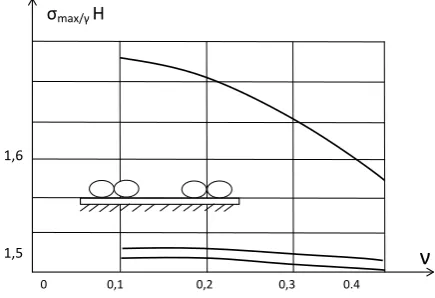
The influence of the number of threads. In Fig. 2, 3, 4 shows the dependence of the maxi
-mum soil pressure on the pipes on the number of threads and the Poisson’s ratio of the soil. At the same time, the support was firmly supported on a flat solid base. From Figure 2, 3, 4 it fol -lows that the value of σmax for pipes laid in sev-eral strings is 10-30% less than the corresponding value for a single laid pipe, which is determined by SNiP2.05.03.-84. In this case, the maximum soil pressure depends on location of the pipe, i. on an average pipe it is 15-25% less than on an extreme one.).
The fact that the outer tube is unloaded is less due to the fact that only one nearby middle pipe exerts a significant influence on its unloading, and the other is the outer tube, first, far from it (1.0D), and secondly, between the two outer tubes lies the middle tube, which is a kind of “screen”, reduc -ing the mutual unload-ing effect of the two out -er tubes. Th-erefore, in particular, the maximum pressure of the soil on the edge pipe is practically independent of the number of threads (in Figure 4, the value of σmax for pipes of two yarn stacking and the outer tubes of multi-threading is shown in one curve. two pipes are located on both sides of it, and not one, as in the case of an extreme tube.
From Figures 3 and 4 it follows that for a num -ber of threads greater than three, the value of σmax on the middle tubes is practically independent of the number of threads. with the concept of a “pe -riod” of pipes and explained in [12]. Figure 2 It is clear that as the Poisson’s ratio rises (y = 0.1 ... 0.4), the maximum ground pressure on the middle tube decreases, and with a decrease in the number of threads this decrease is stronger and amounts to, for example, 7% for three-laying pipes and 1
ν
σmax/γ H
1,6
1,5
0 0,1 0,2 0,3 0.4
Fig. 2. Graph of the dependence of the maximum soil pressure on the pipes () on the number of threads and the Poisson’s ratio (ν) ( D = 4 м, Н = 12 м ,d = 0, γ =
16.7 kg/m3)
ν
σmax/γ H1,6
1,5
0 0,1 0,2 0,3 0.4
Fig. 3. Graphs of the dependence of the maximum
soil pressure on the five-laying pipes (σmax) on the
position of the pipe and Poisson’s ratio (v) (D = 3 м,
This is explained by the fact that the greater the value of the coefficient ν, the greater the distribu -tion capacity of the ground environment.
Consequently, we can assume that for a num -ber of threads four or more, the value of σmax on the average is practically independent of the coef-ficient ν. An explanation of this phenomenon is given in [12, 13].
As can be seen from Figure 3, as the coef -ficient ν increases, the difference in the values of σmax for pipelines with different number of threads decreases.
Thus, the maximum ground pressure on the pipes of multi-thread stacking is less than the sin -gle one. At the same time, the maximum ground pressure on the outer tubes is greater than the av-erage pressure. The pressure of σmax on the edge pipe is practically independent of the number of threads. The maximum soil pressure decreases with increasing number of threads and with a number of threads greater than three, this de-crease becomes insignificant.
Hence it follows that the difference between the maximum soil pressure on the outer and mid -dle pipes of multiline stacking (n ≥ 3) is practical -ly independent of the number of threads and for densely laid pipes is 15-20%. In addition, with an increase in the Poisson’s ratio of soil, the value of σmax on the edge pipe is reduced. With the number of threads n > 4, the value of σmax on the middle tube is practically not from the coefficient ν.
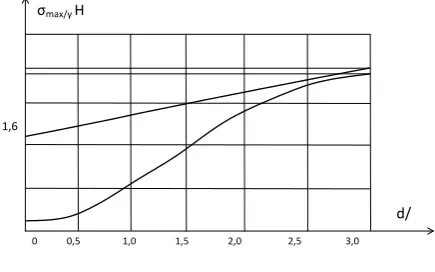
Effect of the distance between the pipes. The results of the analysis of the maximum ground pressure on two and three-stranded laying pipes (a) between them are shown in Figure 5.
The graphs in Figure 5 show that as the dis -tance between the pipes increases, the value of σmax increases. At 0 ≤ d/D ≤ 0.5, the increase in σmax is insignificant (3%), and at 0.5 < d/D ≤ 2.0 a significant increase in the maximum ground pres -sure is observed, decaying at d/D > 2. At d/D ≥ 3, the maximum ground pressure per pipe laid in several strands corresponds to the maximum pressure per single laid pipe and coincides with the value determined by SNiP 2.05.03-84 (90).
Thus, the mutual influence of multifilament stacking pipes takes place at a distance between us d < 3D and leads to a decrease in the maximum ground pressure on them compared to a single stacked pipe. The pressure of σmax on the middle and outer tube reaches a minimum value when the d = 0 pipes are laid closely and are respectively 0.74 and 0.85 of the maximum pressure on a single stacked pipe.
On the basis of the obtained dependences of the magnitude of the distance between the pipes, the following formulas are derived for determin -ing the soil pressure coefficients for pipes of mul -tiline stacking: for 0 < d/D ≤ 2.5.
KC
M = 0.1 (d/D) + 0.75;
KK
M = 0.01 (d/D)2 + 0.02 (d/D) + 0.9
(7)
where: КCМ and КKМ - are the coefficients that take into account the reduction of the maximum soil pressure, respectively, on the edge and middle multiline stack as compared to a single stacked pipe.
Analysis of the influence of the distance be -tween the pipes on the horizontal pressure of the
1,8
1,6
1,4
0 1 2 3 4 5 H
γ σmax/
n
CНиП 2.05.03-84
Fig. 4. Dependence of the maximum pressure of
rocks on the workings (σmax) on the number of threads
(n) (D = 3 м, Н = 8 м, d = 0, γ = 16.7 kg/m3, ν = 0.3;
- single output;
- extreme development of multiline stacking; - average production of multiline stacking
d/ D
σmax/γ H
1,6
1,4
0 0,5 1,0 1,5 2,0 2,5 3,0
Fig. 5. Graphs of the dependence of the maximum
soil pressure (vmax) on the pipes from the distance in
the light (d) between the filaments. (Н = 8 м, γ = 16.7
soil (σs) at the horizontal diameter was carried out by double-laying pipes, the theoretical and experimental studies carried out have shown that the quantity σs does not depend on the number of threads. In this case, it is necessary to distinguish the horizontal pressure of the soil on the pipe from the side of the adjacent pipe (σs) and from the opposite (pipe-free side) (σs).
From Figure 6 that the horizontal pressure σr for d/D > 3 is a constant value and coincides with the corresponding σ = 0. At 0 ≤ d/D ≤ 2, it increases intensively and at d/D = 0 tends to infin -ity. This is due to the appearance of a “singular” point, in which the theory of elasticity is not ap -plicable. The sharp increase in d with decreasing distance d is explained by the convergence of the two stress concentrates, which are the pipes.
The influence of the Poisson’s ratio on the horizontal pressure of the soil is shown in Fig -ure 7. It follows from the graphs that the values of σs and σr increase with increasing coefficient ν, and the horizontal pressure on the side of the adjacent tube increases more intensively, i.e increases the coefficient σs by a factor 2.8, and σr in 2.3 times.
d
ν
σr10-1MПа0,5
0,4
0 1,0 2,0 3,0 4,0 5,0
Fig. 6. Graphs of the dependence of the maximum
ground pressure (νmax) on the pipes from the distance
in the light (d) between the strands (Н = 6 м ,D = 2 м
γ = 16.7 kg/m3, ν = 0.3)
0,1 0,2 0,3 0,4
σr10-1МПа
0,4
0,3
Fig. 7. Dependence of the horizontal pressure (σг) on Poisson’s ratio (ν)(D = 2 м, d = 2m, H = 6 m, γ = 16.7
kg/m3, n = 2)
0.39 0.17
0.28 0.47 0.72 1.01
1.27
1.49 1.18 1.36 .15
0.8
0.32 .16 0.6
0.17 0.28 0.47 0.72
1.01 1.27 1.49
1.18
1.36 .15
0.8
0.32 0.39 .16 0.6 1.18
Fig. 8. Diagrams of radial ground pressure on pipes of two-thread styling
2m 1m 2m
0.17 0.28 0.47 0.72
1.01 1.27
1.49 1.18 1.36 .1 5 0.8
0.32 0.39 .16 0.6
0.28 0.47 0.72
1.01 1.27
1.49 1.18 1.36 .1 5 0.8
0.32 0.39 .16 0.6
0.17
2m 2m 2m
0.17 0.28 0.47 0.72
1.01 1.27 1.49
1.18 1.36 .1 5 0.8
0.32 0.39 .16 0.6
0.28 0.47 0.72
1.01 1.27 1.49
1.18 1.36 .1 5 0.8
0.32 0.39 .16 0.6
0.17
Stress state of the soil around the pipes For a more complete analysis of the soil pres -sure on the pipes of multi-stranding, the diagrams of radial (σr) and tangential (σs) ground pressures are considered for various parameters of laying multi-thread pipes on a flat solid base.
In Figure 8-10 shows the diagrams (σr) for pipes laid in one and two strands at a distance of d of 0, 0.5D, 1.0D, 2.0D, 3.0D. All the diagrams of the same sign correspond to the compression pressure. It is seen from the diagrams that for d < 3.0D they are asymmetric, and for d = 3, D are symmetric. The presence of the asymmetry of the diagram a is due to the mutual influence of the multiline stacking tubes on the pressure distribu -tion of the soil around each pipe. With an increase in distance 6. this effect gradually weakens and does not affect when d ≤ 3.0D, i.е. in this case the tube of multi-strand folding of the diagram σs is practically symmetrical. Therefore, in the design of pipes, the deviation of the ordinate σmax from the vertical diameter can be ignored for d > 2.0D. The ordinate of the maximum radial pressure de -viates from the pipe lock in the opposite direction to the location of the adjacent pipe. The analysis shows that this effect is manifested especially in multiline stacking at d < 2.0D. This is due to the fact that on one side of the end pipe is located next to it a pipe that unloads the first. The op -posite side is free and there is no unloading effect from this side the outer tube receives.
Due to this “unbalanced unloading” of the outer tube, the value of σmax is shifted. In Figure 11 is a graph of the dependence of the deviation of the ordinate σmax (angle β) on the parameter d. This biconvex curve whose ordinates decrease with increasing d. At 0 < d < 0.5D and d > 2.0D, the angle β varies insignificantly (actually from 15° to 14°30' and from 2° to 0°). The main change in angle β occurs at 0.5 < d < 2, D. The maximal value of the ordinate σmax reaches at d = 0 (tubes laid close), minimal (00) at d < 3.0D, when each pipe works as a single stacked one.
The analysis in Figures 8-10 shows that the diagrams of σmax on the half of the pipe opposite the location of the adjacent pipe (in the Figure the left half of the diagrams to the ordinate σmax) in all cases the effect of two pipes at d/D < 3.0 on the pressure distribution of the soil around of them is local and extends to a section up to 15°< and < 180° (in the figure, the right half of the diagrams)
In Figures 8, 12, 13 shows the diagrams of the radial pressure of the soil σr on a single laid pipe and on pipes laid closely in two, three, four and five threads. In all cases, the pressure diagrams on the outer tubes are asymmetric, and the average tubes (for n > 3) are explained by symmetrical unloading by two adjacent pipes.
2m 2m
0.17 0.28 0.47 0.72
1.01 1.27 1.49
1.18 1.36
.1 5 0.8
0.32 0.39 .16 0.6
0.28 0.47 0.72 1.01
1.27 1.49 1.18
1.36 .1 5 0.8
0.32 0.39 .16 0.6
0.17
4m
2m 2m
0.17 0.28 0.47 0.72 1.01
1.27 1.49 1.18
1.36 .1 5 0.8
0.32 0.39 .16 0.6
0.28 0.47 0.72 1.01
1.27 1.49 1.18
1.36 .1 5 0.8
0.32 0.39 .16 0.6
0.17
6m
Fig. 10. Diagrams of radial soil pressure on pipes of a two-wire styling
Fig. 11. Change of parameter β from d/D
0.28 0.47 0.72 1.01
1.27 1.49 1.18
1.36 .1 5 0.8
0.32 0.39 .16 0.6
1.18 1.18
1.26 .1 4 0.7
0.22 0.29 1.26 .1 4 0.7
Fig. 12. Diagrams of radial soil pressure on
n=4
0.28 0.47 0.72
1.01 1.27 1.49 1.18
0.17
1.18 1.18 1.18 1.36
.1 5 0.8
0.32 0.39 .16 0.6 1.26
.1 4 0.7 0.5 0.22
0.29 1.26
.1 4 0.7 0.5 0.22
0.29 1.26
.1 4 0.7 0.5 0.22
0.29 n=5 0.2 8 0.4 7 0.7 2 1.0 1 1.2 7 1.4 9 1.1 8 0.1 7 1.1 8 1.36 .1
5 0.8 0.3 2 0.3 9 .16 0.6 1.1 8 1.1 8 1.1 8 1.2
6 .1 4 0.7 0.5 0.22
0.2 9
1.2 6 .14 0.7
0.5 0.22 0.2 9
1.2 6 .1
4 0.7 0.5 0.22 0.2 9
1.2 6 .14 0.7
0.5 0.22 0.2 9
Fig. 13. Diagrams of radial ground pressure on a five-pipe stacking
1,0
0,9 0,8 0,7 0,6
0,5
0,4
0,1 0,2 0,1
0,2 0,3
0,3 0,4 0,5 0,6
0,7 0,8 0,9
1,0 1,4 1, 0 0, 9 0,8 0,7 0,6 0, 5 0,4 0, 3 0, 2 0,1 1, 0 0,9 0,8 0,7 0,6 0,5 0,4
0,1 0,2 0,1
0,2 0,3
0,3 0,4 0,5 0,6
0,7 0,8 0,9
1,0 1,1 1, 2 1, 3 1,5 1,1 1,2 1,3
в) n=3
1,0 0,9 0,8
0,7
0,6
0,5
0,4 0,1 0,2 0,1
0,2 0,3
0,3 0,4 0,5 0,6 0,7 0,8
0,9 1,0
1,1 1,2 1,3 1,5 1,1 1,2 1,3 1,5 1,1 1,2 1,3 1,5
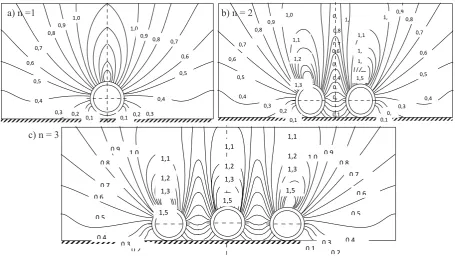
Fig. 14. Diagrams of radial soil pressure σr on a single (a), gutter (b) and three-stranded pipe (D = 4 m, H = 8 m,
ν = 0,3,d = 1 m, γ = 16,7 kH/m3)
a) n =1 b) n = 2
c) n = 3
The upper part of the diagrams of the multi-line stacking is slightly flattened in comparison with the diagram for a single laid pipe (Figure 8). This oblateness is greater for medium pipes than for extreme tubes, which indicates a more uni -form distribution of pressures, their greater load.
It follows from Figure 13, b (n = 5), the dia -grams for the central and neighboring middle tubes practically coincide. The diagrams for the medium pipes for n = 4 (Figure 13, a) and for n = 5 are also small from each other. Thus, when determining the pressure of the soil on the pipes of pipes of four-stranding. The concept of “pipe period” was also introduced there. It means a minimum number of pipes, in which the addition of another pipe from the edge practically has no effect on the stress-strain state of the soil around the central pipe.
Consequently, the value of the period for the sleeves is four. Analogously, the value of the pe -riod (T) of the pipes laid at some distance from each other was analyzed. The results of this anal -ysis are presented in Table 1.
From Table 1 it can be seen that the value of T decreases with increasing distance between the pipes. This is due to a decrease in the mutual influence of the pipes as the distance between them increases.
In order to present the general picture of the distribution of the radial pressure of the embank -ment on the pipes in Figure 13 shows the lines of equal radial pressures for pipes laid in one, two and three threads respectively. Symmetrical arrangement lrr. is typical for a single laid pipe (Figure 13). In addition, lr.d. are also symmetric
for central tubes for odd multicultural packing in the vicinity of 1.5D from the center of the pipe in both directions (for example, for n = 3 Figure 12).
For the outermost tubes, asymmetry and dis -placement of the vertices are observed. in the op-posite direction from the adjacent pipes (Figure 12). In addition, σr at n = 2 and n = 3 have less ordinates and are more flattened than for a single laid pipe (n = 1).
This flattening indicates a more uniform ground pressure on multi-threaded pipes compared to a single-laid σr for double-laying pipes and the three-threaded outer tubes are almost identical.
Figure 15 shows the diagrams of m for a sin -gle pipe and double-laying pipes with a distance in the light d = 0 ... 3. It is characteristic that on the half of the pipe free from the influence of the adjacent one (in the figure, the left half) τ does not depend on the parameter d and the diagram τ is the same as for the single pipe. The ordinates of the right half of the diagram τ for 0 < d < 3.0D are smaller than the left one due to the unloading effect of the neighboring pipe. For d > 3.0D, the effect is no longer affected and the diagram τ is similar to the diagram for a single pipe.
The maximum of the tangential pressures for any half of the diagram is achieved at θ = 60° from the vertical axis in both directions. The larg -est value of τmax in all cases for the outer tubes occurs on the left-hand half of the tube (free from the influence of the neighboring pipe) and ex -ceeds the small tangent pressures on the right half of the tube by a factor of 2.2 d = 0; by 1.55 times at d = 0.5D and by 1.1 times at d = 1.0D.
Table 1. Dependence of the pipe period on the distance in the light between them
D/D 0 … 0.5 0.5 1.0…2.0 2.0
T 4 3 2 1
2м
0, 2 0,3 2 0,4 2 0,4 1 0,4 5 0,3 5
0,1
9 0,2
0,1 9
0,3 0 0,4 0 0,4 6 0,4 5 0,3 6
а)
2м 0,
2 0,3 2 0,4 2 0,4 1 0,4 5 0,3 5
0,1 9 б)
2м 0,1
9 0,2
0,1 9
0,3 0 0,4 0 0,4 6 0,4 5 0,3 5
Fig. 15. Diagrams of radial soil pressure on pipes of a two-thread styling
d
σmax/γH
1,8
1,6
1,0 2,0 3,0 4,0
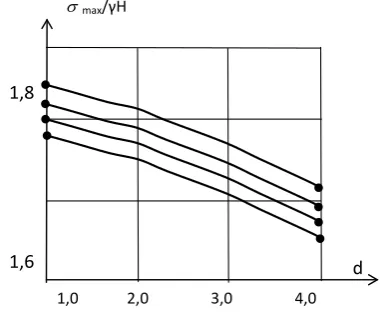
Fig. 16. Graphs of the dependence of the maximum
ground pressure (νmax) on the pipes from the distance
in the light (d) between the strands (Н = 6 м , D = 2
Influence of the type of support of pipes In Figure 11 are graphs of the dependence of the value of σmax on the support of pipes and the Pausson coefficient ν. In the calculation, the fol -lowing conditions for supporting the pipes were used at the suggestion of the hydropower plant: • base with angle of capture 2α0 = 90°; base
with an angle of coverage 2α0 =120°;
• a foundation with an angle of coverage 2α0 = 120°, while the height of the foundation from the ground to the bottom point of the pipe was assumed to be 0.2D. In addition, support was considered on a flat base.
As can be seen from Figure 16, the largest val -ue of σmax corresponds to support on the founda-tion, and the smallest on the base with a coverage angle of 2α0 = 120°. For example, at ν = 0.1, the value of σmax for pipes supporting the foundation is larger than the corresponding values for pipes that support a flat solid base by 3%. solid base with an angle of coverage 2α0 = 90° by 6%, the base with an angle of coverage 2α0 = 120° by 8%. This phe -nomenon is explained by the fact that the larger the I pipe protrudes above the surface of the base (together with the foundation), the more the pres -sure of the soil acting on this pipe is concentrated. We also note that, regardless of the type of sup -port, the quantity σmax decreases with increasing coefficient ν. With an increase in the coefficient ν by a factor of 4, σmax decreases depending on the type of support of the pipe in 1.17 - 1.21 times. Given the slight change in σmax, depending on the method of support (2-8%) in designing pipes based on a solid base, this factor can be ignored.
In Table 2 shows the dependence of the coef -ficient of maximum vertical soil pressure (Кmax = σzzmax/γhmax; hmax - maximum embankment height) on reinforced concrete pipes from the number of
threads and the profile of the embankment. The pipes are supported by a reinforced concrete foundation with an angle of coverage up to 120°. The wall thickness of the pipes is 0.1D
The distance in the light between the pipes is 0.5D. Pipes are made of concrete of class B 25; ν = 0.15; E = 30000MPa; soil of the mound with elastic constants ν = 0.3; E = 30MPa.
In the first row of Table 2 shows the results for long pipes laid over a bulk of constant height (flat deformation). In the second row of Table. 6.2 shows the results for long pipes laid under the mound with the applied length of pipes laid under the mound with a variable longitudinal profile in the form of a triangle with an angle slope β = up to 30°.
From Table 2 it follows that the coefficient Kmax decreases with the number of threads. And this fact is true both for a flat problem (the first line) and for a volume one (second line).
For example, the value of Kmax for an aver-age three-threaded pipe (n = 3) is 35% smaller than the corresponding value for a single pipe (n = 1) in the case of a flat problem ((β = 0°), and by 37%, in the case of spatial problem (30°) .
To analyze the influence of the longitudinal relief of the embankment on the soil pressure on the pipes and compare the results of the planar and spatial problems, the maximum height of the embankment (β = 30°) was assumed equal to the height of the mound of constant height (β = 0°). From Table 2 that the values in the first line dif -fer from the corresponding values of the second row by an average of 30%. From this it follows that taking into account the variable length of the embankment height along the length of the pipe reduces the estimated ground pressure as com-pared with the calculation performed on the flat-deformed scheme. This effect was obtained for the first time.
In this case, as follows from Table 1 this ef -fect is slightly less pronounced for a single pipe (29%) and slightly stronger for two-thread (32%) and three-thread (30%) stacking pipes.
Influence of length of pipes. In Table 3 shows the dependence of the coefficient Kmax for rein-forced concrete pipes of two-strand packing from their length l (β° = 0).
From Table 3 it follows that with a decrease in pipe length the coefficient Kmax kills. In this case, when the length l = 10.0D, its effect on Kmax is insignificant. Thus, the length l = 10.0D is that boundary of applicability of the plane the-ory of elasticity (plane deformation) for extended Table 2. Dependence of the coefficient Kmax on the
number of threads and the angle of the longitudinal
profile of the mound
n 1 2 3
β 1.75 1.36 1.13
β = 30° 1.24 0.92 0.79
Table 3. Dependence of the coefficient Kmax on the length of the pipes l
u0 4.0 6.0 10.0 15.0
pipelines at a constant height of the embankment. In the work [1] the concept of the “core”, which in our case is equal to 10.0 D , is derived, and is the boundary between the “short” and “length” pipes, i.e. at l = 10.0 D, the plane-deformed scheme gives an overestimate of the Kmax coef-ficient even at a constant height of the embank -ment. This overestimate is 38% at l = 6.00 and 55% at l = 4.00.
Thus, taking into account the length of the pipes reduces the design ground pressure in com-parison with the calculation using a flat-deformed scheme, if l = 10.0D.
CONCLUSIONS
1. The maximum static pressure of the soil (σmax) per pipe is somewhat less than that of a single pipe, an average of 10% for the outer pipe and 20% for the middle pipe. In this case, the quantity c σmax increases with increasing pa -rameter d, having a minimum at d = 0 (tubes stacked closely) and a maximum at d = 3.0, which coincides with the corresponding value for a single tube.
2. The pressure σmax decreases with increasing Poisson’s ratio ν of the soil. The greatest value of σmax corresponds to supporting on the foun-dation, the smallest - to a profiled base with a large angle of coverage. Pressure σmax on the outer tube and on the middle pipe is practical-ly independent of the number of threads. 3. The horizontal static pressure (σs) of the soil
located between the pipes decreases with in -creasing parameter d, reaching a minimum at d = 3.0D, equal to the corresponding value for a single pipe. The horizontal pressure of the soil (σr) on the outermost pipe from the op -posite side of the adjacent pipe is equal to the horizontal pressure on a single pipe and does not depend on the parameter d. With a pipe spacing of 0.5D < d < 3.0D, the value of σr 28% more than σs. The values of σr and σs increase directly in proportion to the height of the embankment and decrease with decreasing Poisson’s ratio of the soil.
4. Diagrams of the radial and tangential static pressure of the soil for the outer tubes of mul-tiline stacking (n > 3) and double-laying pipes practically coincide. The diagrams of the ra-dial soil pressure are asymmetric for the outer tubes, are practically symmetrical for the
mid-dle ones. The angle of this deviation depends on the parameter d and at 0 ≤ d ≤ 3,0D varies respectively from 15° to 0°.
5. The values of the maximum radial and horizon -tal pressure of the soil on a single pipe, obtained in accordance with the SNiP and the FEM for an extended embankment, having a constant height (flat deformation) are in good agree -ment. This gives grounds for using FEM to cal -culate multicell pipes in the design practice. 6. The account of the variable along the length
of the pipe of the height of the embankment reduces the design ground pressure as com-pared with the calculation performed on the flat-deformed scheme. This effect is more pro -nounced for multi-threaded pipes and weaker for a single pipe.
7. Allowance for the length of the pipes reduces the estimated ground pressure as compared with the calculation using a flat-deformed scheme, if their length is l < 10.0D.
REFERENCES
1. Avliyakulov N.N., Safarov I.I. Modern problems
of statics and dynamics of underground pipelines.
-Tashkent. Publishing: science and technology. 2007, 306 p.
2. Agapkin VM, Borisov SN, Krivoshein BL Refer
-ence Guide for the calculation of pipelines. – Mos
-cow. Publishing: Nedra. 1987, 190 p.
3. Ainbinder AB, Kamershtein AG Calculation of trunk pipelines for strength and stability- Moscow. Publishing: Nedra. 1982, 343 p.
4. Aleshin V. V. [and others] Numerical analysis of
the strength of underground pipelines. Moscow: Publishing: URSS, 2003, 320 p.
5. Borodavkin P.P., Sinyukov A.M. Strength of the main pipelines. -Moscow. Publishing: Nedra, 1984, 245 p.
6. Erzhanov NS, Aitaliev JM, Masanov Zh.K. Seis
-mic stress of underground structures in an
aniso-tropic massif. - Alma-Ata. Publishing: Science. 1980, 211р.
7. Kamershtein, AG, Rozhdestvenskiy VV, Ruchim
-sky MN Calculation of Pipelines for Strength: A
Reference Book. Moscow: Publishing house Gos
-toptekhizdat, 1963, 424 p.
8. Zenkevich O. Finite Element Method in Engineer
-ing. Moscow: Mir, 1975.
9. Samarsky A.A. Mathematical modeling: ideas,
methods, examples / . – Moscow. Publishing: Fiz
-matlit, 2005, 316 p.
-mentals of numerical simulation of main pipelines.
Moscow. Publishing: KomKniga, 2005, 496 p.
11. Borodavkin P.P., Sinyukov A.M. Strength of the
main pipelines. Moscow. Publishing: Nedra, 1984, 245 p.
12. Vinogradov SV Calculation of underground pipe
-lines for external loads. Moscow. Publishing: Stroiizdat, 1980, 135 p.
13. Aleshin V. V. [and others] Numerical analysis of the strength of underground pipelines. Moscow. Publishing: URSS, 2003, 320 p.
14. Safarov I.I. Auliyakulov N.N. Methods of increas
-ing the seismic resistance of underground plastic
pipelines // Uzbek Journal of Oil and Gas, 2005, No. 4, 42-44.
15. Seleznev V. Ye., Aleshin V. V., Klishin GS Meth
-ods and technologies of numerical simulation gas
pipeline systems. Moscow: Publishing House of the URSS, 2002, 448 p.
16. Seleznev, V. Ye., Aleshin V. V., Pryalov SN Math
-ematical modeling of the main pipeline systems.
Additional chapters. Moscow. Publishing: MAKS
Press, 2009, 356 p.
17. Chichelov VA [et al.] Calculations of the stress-strain state of pipelines operated under difficult
conditions in a nonlinear setting. Moscow. Publish
-ing: Gazprom, 2006, 80 р.
18. Shammazov A. M. [and others] Development of a
method for calculating the stress-strain state of gas
pipelines laid in complex engineering-geological conditions // Oil and gas. 2004. No. 2, 119-128.
19. Safarov I.I., Teshaev M.Kh., Boltayev Z.I. Propa
-gation of linear waves in extended lamellar bodies. LAP, Lambert Academic Publishing (Germany). 2016, 315 p.
20. Safarov I.I, Teshaev M.H, Boltaev Z.I. Wave pro
-cesses in mechanical waveguide. LAP LAMBERT Academic publishing (Germany). 2012, 217 p. 21. Bozorov M.B, Safarov I.I, Shokin Y.I. Numerical
simulation of vibrations, dissipative homogeneous
and heterogeneous mechanical systems. Moscow. Science. 1966, 188 p.