9
Rapid Capture: Reading through a Closed
Book
Priyansh Soni
CSE Department, PEC University of Technology, Chandigarh, India
ABSTRACT
Book scanning is the process of converting physical books and magazines into digital media such as images, electronic text or electronic books by using an image scanner but the task is so tedious and time consuming and full of errors that human proofreaders usually check the output for errors. Imagine if scanning a book was as simple as ripping a CD. No unbinding, no page turning, no adjusting, just insert any book and get a digital copy. Ancient books that shouldn’t be handled by human hands can be unlocked without any disruption. And if the process becomes speedy enough, digitizing a book could become a lot less labour intensive. Some high-end scanning systems employ vacuum and air and static charges to turn pages while imaging is performed automatically, usually from a high resolution camera located over an adjustable v-shaped cradle. Images are then shuttled from the imaging device into various editing suites which can further process the images for an archival-quality file. But the current systems still are unable to read through a closed book with an adequate precision. Is it possible to create a revolution using new tools along with advances in computational imaging to get at pictures of things we could never see with optical technologies? Can we judge a book through its cover?
Keywords: Scanning, Digitizing, Resolution, Optical Technologies.
INTRODUCTION
Ultrafast imaging has been a key enabler to many novel imaging modalities, including looking behind corners and imaging behind scattering layers. With picoseconds time resolution and unconventional sensing geometries, ultrafast imaging can fundamentally impact sensing capabilities in industrial and biomedical applications. Spatial resolution, spectral contrast and occlusion are three major bottlenecks for non-invasive inspection of complex samples with current imaging technologies. In order to go through a closed book we basically need four things. First we need to have a radiation that goes through the paper. So, the paper has to be slightly transparent in this frequency range. Second, we need to have a time resolution to distinguish between different pages. Third, we need to have the spectral information of different inks in order to verify that the ink is visible in the range of frequencies. Fourth is the ability to recognize the characters themselves. This involves the use of natural language processing. This finding could lead to office machines that can scan reams of paper at once, or help researchers scan ancient books that are too fragile to open. It could also perhaps help spies read mail without opening envelopes.
PRIMITIVE TECHNIQUES
A. Destructive Scanning Methods: -
For book scanning on a low budget, the least expensive method to scan a book or magazine is to cut off the binding. This converts the book or magazine into a sheaf of loose papers, which can then be loaded into a standard automatic document feeder (ADF) and scanned using inexpensive and common scanning technology. While this is not a desirable solution for very old and uncommon books, it is a useful tool for book and magazine scanning where the book is not an expensive collector's item and replacement of the scanned content is easy. It involves two major steps. First being either unbinding or cutting according to the book structure and scanner hardware requirements. Second and main process is the scanning with the help of digital camera.
B. Non-Destructive Scanning Methods: -
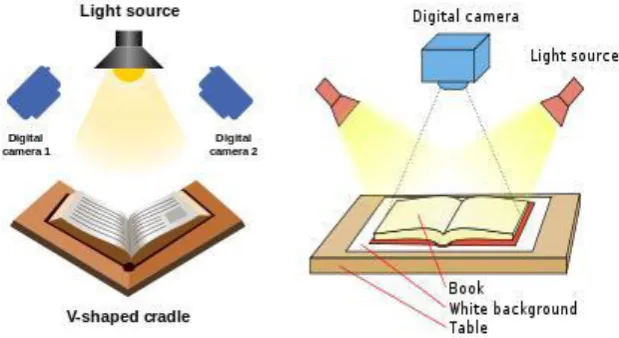
10 short period of time. Some high-end scanning systems employ vacuum and air and static charges to turn pages while imaging is performed automatically, usually from a high resolution camera located over an adjustable v-shaped cradle. Images are then shuttled from the imaging device into various editing suites which can further process the images for either an archival-quality file such as TIFF, or a web-friendly output such as JPEG or PDF.
Figure 1: (a) V-shaped book scanner (b) Manual Book Scanner
COMPONENTS
A. Terahertz Frequency Radiation Camera: -
The use of terahertz radiation—the band of electromagnetic radiation between microwaves and infrared light can be incorporated to distinguish between ink and blank paper, and gauge distance between individual pages. Terahertz waves or THz waves are electromagnetic waves similar to light that have frequency range of 100 GHz to 10 THz. These frequencies are located in between the far infrared and microwaves and more accessible as compared to infrared rays which provide higher frequency but lack accessibility. To peer through stacks of paper, the system relies on terahertz radiation. Because terahertz radiation reacts differently to different chemicals, the scientists can use it to tell the difference between blank pages and the words written or printed on them. Terahertz imaging systems emit short bursts of radiation that can penetrate a variety of materials. Substances such as water, plastics, gases and bio fuels absorb specific terahertz frequencies, which makes it easy to identify them. In fact, NASA used the technique to inspect foam insulation structures on its shuttle fleet, and it’s the same technology used in full body scanners at the airport.
Figure 2: Measurement geometry and sample schematics.
B. An Intelligent Algorithm: -
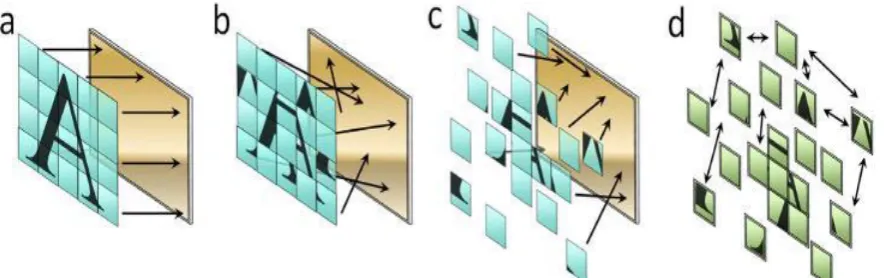
11 images from individual sheets in a stack of papers. In case of ancient books, another key ingredient is important: a method for interpreting distorted or incomplete images as individual letters.
C. Sensors and Detectors: -
One of the major concerns during the detection of signals reflected back after striking the book is whether it is a true signal or not. While most of the radiation is either absorbed or reflected by the book, some of it bounces around between pages before returning to the sensor, producing a spurious signal. The sensor’s electronics also produce a background hum. One of the tasks of the algorithm is to filter out all this noise. The information about the pages distance helps. The difference in refractive index - the degree to which they bend light - between the air and the paper means that the boundary between the two will reflect terahertz radiation back to a detector. The system should exploit the fact that trapped between the pages of a book are tiny air pockets only about a few micrometers deep. It allows the algorithm to hone in on just the terahertz signals whose arrival times suggest that they are true reflections. Then, it relies on two different measures of the reflections energy and assumptions about both the energy profiles of true reflections and the statistics of noise to extract information about the chemical properties of the reflecting surfaces. So, a standard terahertz camera emits ultra short bursts of radiation, and the camera’s built-in sensor detects their reflections. From the reflections time of arrival, the algorithm can gauge the distance to the individual pages of the book. Thus the sensors and detectors mainly have the function to detect whether the reflected signal actually provides the data of the true signals so that the algorithm can extract useful contents from it.
Figure 3: Scene points to sensor pixels mapping in different imaging modalities. Mapping of Letter A by a letter interpretation algorithm.
WORKING
Although it is clear from the components what the device is capable of doing. It is important to illustrate the working and specificities of the device while scanning. Terahertz source produces flashes of radiation that are reflected back by each of the air layers between the pages of a book, in the end, the reflected rays are recorded with a special camera. The data from the camera are analyzed by a computer system, and build a finite sequence of symbols on the pages using the difference in time between the moment of emission of the pulse and time of registration of the reflected signal. Received data passes through processing with several special algorithms that make the image of each character as clear as possible, in addition, additional steps of post-processing help to recover the original shape even from very much distorted characters. An addition of a filtering mechanism ensures the reduction in noise.
RECENT ADVANCEMENTS
Recently, a group of researchers from MIT and Georgia Tech have built a device that can see through paper and distinguish ink from blank paper to determine what is written on the sheets. The prototype successfully identified letters printed on the top nine sheets of a stack of paper, and eventually the researchers hope to develop a system that can read closed books that have actual covers.
12
Multiple algorithms work in conjunction to create a legible image of the print. The first set, developed by MIT, produce the raw imaged based on the signals picked up by the device's sensor. An additional algorithm developed by Georgia Tech takes the often blurry and incomplete raw images and identifies the individual letters.
Although most of the light waves are either absorbed by ink or paper, or bounced right back to the sensor, some of the radiation bounces back and forth between pages before making its way back to the detector. This interference prevents the current device from counting beyond 20 individual sheets, and it can only read the print on the top nine.
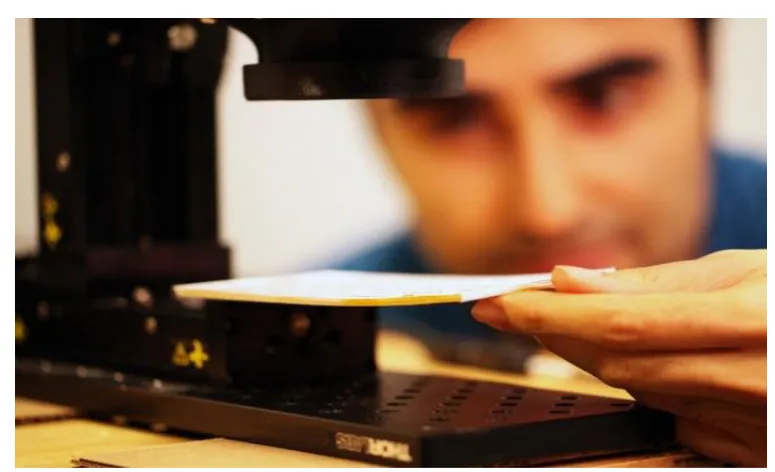
Figure 4: Barmak Hesmat, one of the developers with the prototype.
BENEFITS
A. Scanning Fragile Historical Documents:- Ancient books that shouldn’t be handled by human hands can be unlocked without disruption. And if the process becomes speedy enough, digitizing a book could become a lot less labour intensive. The system could be a fantastic tool for museums or other facilities who want to explore and catalogue historical documents, without actually having to touch or open them, and risk damage.
B. Digitization of Libraries: - All the major libraries of the world have long been engaged in translation of books to digital format so that it becomes more accessible to the general public. Some libraries use automated systems for scanning while some others digitize their books the “old way” using the most conventional scanners. In any case, it requires careful handling with books, and the process is time-consuming because of the need to turn the pages, besides, there are ancient specimens that are in very poor condition for which the slightest manipulation can be fatal. With the introduction of a special kind of scanner, capable of scanning a closed book, they do not even have to move.
C. Industrial Applications: - Other potential industrial applications may include analyzing any materials organized in thin layers, such as layers of paint or coatings on machine parts or pharmaceuticals. Also, scanning through large amounts of documents without having to mechanically separate the pages, which could be useful for banks and other corporate associations. The time-gated spectral content extraction can enable inspection and, more specifically, content extraction from very thin layers much deeper than what was possible before. This has applications in the inspection of samples with cultural value as well as industrial coatings and any properly layered structure. The methodology developed in this paper can also be adapted to other forms of topographic imaging.
LIMITATIONS AND CHALLENGES
13 B. Lack of Precision: - The use of terahertz frequency is encouraged due to its better reactivity with chemicals and because it contains all available wavelengths but it is discouraged due to lack of preciseness and penetration power. The prototype built is only able to penetrate through nine pages of a stack of pages.
C. Impact on Health: - Although the technique boasts of a breakthrough in the imaging technology but due to the use of terahertz radiation it involves utmost care. Radiation, although in harmless form does impact the human health and precautionary preventive measures are encouraged and must be incorporated.
FUTURE PROSPECTS
According to scientists at MIT who developed the prototype, at the moment, the algorithm can correctly deduce the distance from the camera to the top twenty pages in a stack, but past a depth of nine pages, the energy of the reflected signal is so low that the differences between frequency signatures are swamped by noise. Terahertz imaging is still a relatively young technology and researchers are constantly working to improve both the accuracy of detectors and the power of the radiation sources, so deeper penetration should be possible.
Also the device requires the paper used to have some degree of transparency. This displays the need for improvement in hardware i.e. the detectors and emitters need a certain degree of refinement in order to penetrate to higher levels without any disturbance and noise produced like internal reflection and paper quality.
In order to accomplish the main objective of actually reading through a book, there is an inevitable need to improve the penetration depth of the scanner, increasing the resolution of the camera and increase the power source of terahertz radiation.
The use of femto-photography can be incorporated to measure the time gap or time resolution between two consecutive pages of the book thus reducing the need of complex computations.
CONCLUSION
I would like to conclude that the proposed technique is much faster and efficient as compared to current conventional mechanisms. The result is a set of images that are much higher resolution and easier to read than similar images taken using X-rays or ultrasounds. While there is scope of improvement, this work is one of the first to use these new tools along with advances in computational imaging to get at pictures of things we could never see with optical technologies. Now we can judge a book through its cover.
REFERENCES
[1]. https://en.wikipedia.org/wiki/Book_scanning [2]. https://en.wikipedia.org/wiki/Femto-photography
[3]. Jansen, C. et al. Terahertz imaging: applications and perspectives. Appl. Opt. 49. [4]. http://www.nature.com/articles/srep20217
[5]. http://www.nature.com/articles/ncomms12665
[6]. Wietzker, S. et al. Terahertz imaging: a new non-destructive technique for the quality control of plastic weld joints. J. Eur. Opt. Soc. Rapid Publ. 2.
[7]. Stoik, C. D., Bohn, M. J. & Blackshire, J. L. Non-destructive evaluation of aircraft composites using transmissive terahertz time domain spectroscopy.
[8]. http://gizmodo.com/mit-invented-a-camera-that-can-read-closed-books-1786522492
[9]. http://www.telegraph.co.uk/news/2016/09/21/mit-researcher-develops-a-machine-that-can-read-a-closed-book/ [10]. http://in.pcmag.com/robotics-automation/107745/news/mit-imaging-tech-can-read-closed-book
[11]. http://thenextweb.com/science/2016/09/12/mit-researchers-can-scan-a-book-through-its-cover/#gref [12]. https://science.slashdot.org/story/16/09/12/2356233/mit-invented-a-camera-that-can-read-closed-books [13]. http://www.livescience.com/56054-new-tech-could-read-closed-books.html
[14]. http://blogs.discovermagazine.com/d-brief/2016/09/09/how-to-read-a-closed-book/ [15]. http://newatlas.com/terahertz-radiation-books/45348/
[16]. http://cameraculture.media.mit.edu/can-computers-read-through-closed-books/ [17]. https://www.engadget.com/2016/09/12/mit-reads-closed-books-with-radiation/ [18]. http://world.true-news.info/video-created-a-device-that-can-scan-a-closed-book/ [19]. https://www.library.cornell.edu/preservation/tutorial/technical/technicalB-02.html [20]. http://dl.acm.org/citation.cfm?id=2975165