(Tehran Polytechnic)
Vol. 46 - No. 1 - Spring 2014, pp. 57- 64 )AIJ-MISC)
٭Corresponding Author, Email: [email protected]
(𝒏, 𝟏, 𝟏, 𝜶)
-Center Problem
P. Kavand
1, A. Mohades
2*, and M. Eskandari
31- PhD. Student of Computer Science, Department of Mathematics and Computer Science, Amirkabir University of Technology, Tehran, Iran.
2- Associate Professor, Department of Mathematics and Computer Science, Amirkabir University of Technology, Tehran, Iran, 3- Assistant Professor, Department of Mathematics, Alzahra University, Tehran, Iran.
ABSTRACT
Given a set
𝑆
of
𝑛
points in the plane and a constant
𝛼
,
(𝑛, 1, 1, 𝛼)
-center problem is to find two closed
disks which each covers the whole
𝑆
, the diameter of the bigger one is minimized, and the distance of the
two centers is at least
𝛼
. Constrained
(𝑛, 1, 1, 𝛼)
-center problem is the
(𝑛, 1, 1, 𝛼)
-center problem in which
the centers are forced to lie on a given line
𝐿
. In this paper, we first introduce
(𝑛, 1, 1, 𝛼)
-center problem and
its constrained version. Then, we present an
𝑂(𝑛 log 𝑛)
algorithm for solving the
(𝑛, 1, 1, 𝛼)
-center problem.
Finally, we propose a linear time algorithm for its constrained version.
KEYWORDS
1.INTRODUCTION
Facility location problems concern the choice of the location of one or multiple facilities, in a given geographical space and subject to some constraints, to optimally fulfill predetermined objectives. Facility location problems are usually categorized based on some characteristics such as: number of facilities (single/ multiple), objective function (single/ multiple), solution space (discrete/ network/ continuous), number of commodities (single/ multiple), capacity limitation (yes/no), shape of facility (point/ extensive), and demand (discrete/ continuous). However, it should be noted that these characteristics are not restricted to the above mentioned ones. In the literature, many concepts, tools and techniques of artificial intelligence such as fuzzy logic can be used for the implementation of numerous models in operations research. So, some of the works in the area of facility location have used fuzzy theory to fuzzify the parameters of the model or have dealt with the facility location problem as a fuzzy multiple attribute decision making problem [1].
An important problem in facility location is 𝑘-center problem. Let 𝑆 be a set of 𝑛 points in the plane, the Euclidean 𝑘-center problem in ℝ𝑑, is to find 𝑘 congruent closed balls of minimum radius whose union covers 𝑆.
The 𝑘-center problem has been known to be NP-complete
when parameter 𝑘 is a part of the input [2]. Agarwal and
Procopiuc showed that 𝑘-center problem in ℝ𝑑 can be
solved in 𝑛𝑂(𝑘1−1 𝑑
⁄ )
time [3].
The smallest enclosing circle problem in the Euclidean plane (Euclidean 1-center problem) is a special case of the planar 𝑘-center problem in the Euclidean space. In 1857 the 1-center problem was presented, for the first time, by Sylvester [4] and finally N. Megiddo presented a linear time algorithm for solving this problem in 1983 [5]. He also presented a linear time algorithm for finding the center of the smallest enclosing circle on a given line.
The other special case of the 𝑘-center problem is the 2-center problem which has many applications in transportation [6]. Hershberger and Suri [7] solved the decision version of 2-center problem in 𝑂(𝑛2log 𝑛) time. Agarwal and Sharir [8] obtained an 𝑂(𝑛2𝑙𝑜𝑔3𝑛) time algorithm for solving the 2-center problem in the plane, using the parametric searching paradigm of Megiddo [9]. Eppstein presented a randomized algorithm whose expected running time is 𝑂(𝑛2𝑙𝑜𝑔2𝑛 log log 𝑛) [10], and Jaromczyk and Kowaluk proposed a deterministic
algorithm whose running time is 𝑂(𝑛2log 𝑛) [11]. Sharir
[12] gave a near-linear algorithm for the 2-center problem
in the plane with 𝑂(𝑛𝑙𝑜𝑔9𝑛) running time. Then,
Eppstein [13] improved the previous bounds and gave a randomized algorithm for solving this problem with
𝑂(𝑛𝑙𝑜𝑔2𝑛) expected time. Finally, Chan [14] presented a
deterministic algorithm whose running time is
𝑂(𝑛𝑙𝑜𝑔2𝑛𝑙𝑜𝑔2log 𝑛).
A variant of the 2-center problem which is known as alpha-connected two-center problem was considered in [15]. Let 𝑆 be a set of 𝑛 points in the plane and 𝛼 be a constant. The alpha-connected two-center problem is to find two congruent closed disks, whose radii is as small as possible, their union covers 𝑆, and the distance of the two centers is at most 2(1 − 𝛼)𝑟 in which 𝑟 is the optimal
radius. An 𝑂(𝑛2𝑙𝑜𝑔2𝑛) expected-time algorithm was
presented for solving this problem in [15].
This paper considers the (𝑛, 1, 1, 𝛼)-center problem and its constrained version. Given a set 𝑆 of 𝑛 points in the plane and a constant 𝛼, the (𝑛, 1, 1, 𝛼)-center problem is to find two closed disks each of which covers the whole
𝑆, the diameter of the bigger one is minimized, and the distance of the two centers is at least 𝛼. The constrained
(𝑛, 1, 1, 𝛼)-center problem is the (𝑛, 1, 1, 𝛼)-center problem in which the centers are forced to lie on a given line 𝐿. This paper presents an 𝑂(𝑛 log 𝑛) time algorithm for solving the (𝑛, 1, 1, 𝛼)-center problem, and a linear time algorithm for its constrained version using the farthest point Voronoi diagram.
An important application of this problem appears in "Urban Design". Assume that we want to locate some facility centers in an area. The goal is designing an efficient arrangement of such facility centers such that the maximum distance between the customers and their nearest facility center of each type is minimized. In addition, the distance between each two facility centers is an admissible distance. For example, it is not smaller than a predefined distance, due to the density of the facility centers that causes to have a crowded region. In this study we want to locate two facility centers of two different types in a city or along a street of a city (in the case of the constrained version) such that the maximum distance between the customers and each facility center is minimized. Meanwhile, the distance between these two facilities should not be less than the predefined distance 𝛼.
This paper is organized as follows. Section 2 contains some definitions and notations. Section 3 considers the
(𝑛, 1, 1, 𝛼)-center decision problem. In Section 4 we
present an 𝑂(𝑛 log 𝑛) algorithm for solving the
2.DEFINITIONS AND NOTATIONS
Let 𝑆 = {𝑠1, 𝑠2, … , 𝑠𝑛} be a set of 𝑛 points and 𝐿 be a line in the plane. The Euclidean distance between two points 𝑠𝑖 and 𝑠𝑗 in the plane is represented by 𝑑(𝑠𝑖, 𝑠𝑗).
We also denote the Euclidean distance between the point
𝑠𝑖 and the line 𝐿 in the plane by 𝑑(𝑠𝑖, 𝐿).
Let 𝑝 be a point in the plane and 𝑟 be a positive real
number, the circle and the closed disk each centered at 𝑝
with radius 𝑟 are represented by 𝐶(𝑝, 𝑟) and 𝐷(𝑝, 𝑟), respectively.
Let 𝑆 = {𝑠1, 𝑠2, … , 𝑠𝑛} be a set of 𝑛 demand points in the plane, 𝛼 be a constant, and 𝑃 = {𝑎1, 𝑎2, … , 𝑎𝑝} and
𝑄 = {𝑏1, 𝑏2, … , 𝑏𝑞} be two sets containing𝑝 and 𝑞 facility centers of two different types 𝑎 and 𝑏, respectively. The
(𝑛, 𝑝, 𝑞, 𝛼)-center problem is to locate these 𝑝 + 𝑞 faciliy centers in the plane such that:
𝑚𝑖𝑛 𝑚𝑎𝑥 (𝑚𝑎𝑥
1≤𝑖≤𝑛1≤𝑗≤𝑝𝑚𝑖𝑛𝑑(𝑠𝑖, 𝑎𝑗) , 𝑚𝑎𝑥1≤𝑖≤𝑛1≤𝑗≤𝑞𝑚𝑖𝑛𝑑(𝑠𝑖, 𝑏𝑗))
𝑠. 𝑡. 𝑑(𝑎𝑖, 𝑏𝑗) ≥ 𝛼∀𝑖, 𝑗; 1 ≤ 𝑖 ≤ 𝑝, 1 ≤ 𝑗 ≤ 𝑞.
(1)
The (𝑛, 1, 1, 𝛼)-center problem is a special case of the
(𝑛, 𝑝, 𝑞, 𝛼)-center problem. In other words, for a given set
S of n points and a constant 𝛼, the (𝑛, 1, 1, 𝛼)-center problem is to find two closed disks each of which covers
the whole 𝑆, the diameter of the bigger one is minimized,
and the distance of the two centers is at least 𝛼.
3.(𝒏, 𝟏, 𝟏, 𝜶)-CENTER DECISION PROBLEM
In this section, we first present the definition of a geometric object which is called center hull, also known as the circular hull [15, 16]. Then, we propose a trivial
𝑂(𝑛 log 𝑛) algorithm for solving the (𝑛, 1, 1, 𝛼)-center decision problem using the center hull.
Given a set 𝑆 of 𝑛 points in the plane, a constant 𝛼, and a positive real number 𝑟. The (𝑛, 1, 1, 𝛼)-center
decision problem is to decide whether 𝑆 can be covered by
two congruent closed disks of radius 𝑟, such that each of
them covers the whole 𝑆 and the distance of the two centers is at least 𝛼.
Definition 3- 1- [16] The center hull of 𝑆 with radius
𝑟, denoted by CENH(𝑆, 𝑟), is the locus of points which are the centers of circles of radius 𝑟 that cover 𝑆, that is,
CENH(𝑆, 𝑟) = {𝑝 | 𝐶(𝑝, 𝑟)covers𝑆}
In other words, the center hull of 𝑆 with radius 𝑟, is the intersection of all the disks centered at the points of 𝑆 with radius 𝑟, i.e., CENH(𝑆, 𝑟) = ⋂𝑠∈𝑆𝐷(𝑠, 𝑟) [15].
Lemma 3- 2- Let 𝑆 = {𝑠1, 𝑠2, … , 𝑠𝑛} be a set of 𝑛
points, 𝐹𝑃𝑉𝐷(𝑆) be the farthest-point Voronoi diagram of
𝑆, and 𝑉(𝑠𝑖) be the Voronoi region associated with an element 𝑠𝑖. Within each Voronoi region, say 𝑉(𝑠𝑖),
𝜕CENH(𝑆, 𝑟) is a subarc of a circle of radius 𝑟 centered at
𝑠𝑖 [16].
Lemma 3- 3- 𝜕CENH(𝑆, 𝑟) is a circular list of subarcs of circles of radius 𝑟each centered at the associated farthest-neighbor in 𝑆 [16].
Proposition 3- 4- The (𝑛, 1, 1, 𝛼)-center decision problem can be solved in 𝑂(𝑛 log 𝑛) time.
Proof. The solution of the decision problem is positive if and only if the diameter of the CENH(𝑆, 𝑟) is greater than or equal to 𝛼. Since the farthest point Voronoi diagram and the center hull can be constructed in
𝑂(𝑛 log 𝑛) time [16], and the diameter of the center hull
can be computed in 𝑂(𝑛) time [17], the decision problem
can be solved in 𝑂(𝑛 log 𝑛) time.
4.(𝒏, 𝟏, 𝟏, 𝜶)-CENTER PROBLEM
Let 𝑆 be a set of 𝑛 points in the plane and 𝛼 be a constant. We wish to find two closed disks each of which covers the whole 𝑆, the diameter of the bigger one is minimized, and the distance of the two centers is at least
𝛼.
In this section, we propose an 𝑂(𝑛 log 𝑛) time
algorithm for solving the (𝑛, 1, 1, 𝛼)-center problem.
Lemma 4- 1- If 𝑟 and 𝑟′ are the optimal radii of the
(𝑛, 1, 1, 𝛼)-center problem, then 𝑟 = 𝑟′.
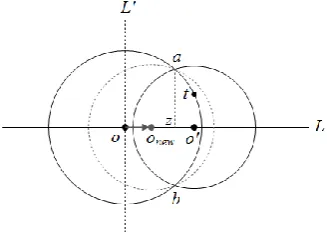
Proof. Let 𝐷(𝑜, 𝑟) and 𝐷(𝑜′, 𝑟′) be the optimal disks of the (𝑛, 1, 1, 𝛼)-center problem. Assume without loss of generality that the line 𝐿 passing through 𝑜 and 𝑜′ is horizontal and 𝑜′ is on the right side of 𝑜. Let 𝑎 and 𝑏 be the upper and lower intersection points of 𝐶(𝑜, 𝑟) and
𝐶(𝑜′, 𝑟′), respectively, and 𝜌 and 𝜌′ be the subarcs of the circles 𝐶(𝑜, 𝑟) and 𝐶(𝑜′, 𝑟′) constructing the boundary of the intersection region of 𝐷(𝑜, 𝑟) and 𝐷(𝑜′, 𝑟′), respectively. Suppose that 𝑟 > 𝑟′. For 𝑟′> 𝑟, we can do in a similar way. Since 𝑆 has located in the intersection area of 𝐷(𝑜, 𝑟) and 𝐷(𝑜′, 𝑟′), by moving 𝑜 on 𝐿 towards
𝑜′, 𝐷(𝑜
𝑛𝑒𝑤, 𝑟𝑛𝑒𝑤) in which 𝑜𝑛𝑒𝑤 is the new position of 𝑜 and 𝑟𝑛𝑒𝑤 = 𝑑(𝑜𝑛𝑒𝑤, 𝑎), still covers 𝑆. To prove our claim, it is sufficient to show that any point 𝑡 which lies on 𝜌 is covered by 𝐷(𝑜𝑛𝑒𝑤, 𝑟𝑛𝑒𝑤). Since 𝑑(𝑎, 𝐿) ≥ 𝑑(𝑡, 𝐿), the area of triangle ∆𝑜𝑎𝑜𝑛𝑒𝑤 is greater than or equal to the area of the triangle ∆𝑜𝑡𝑜𝑛𝑒𝑤. By using the Heron's formula for calculating the area of a triangle, we can have
On the other hand, 𝑟𝑛𝑒𝑤 < 𝑟: Suppose that the vertical line passing through 𝑎 intersects 𝐿 in a point 𝑧. We have:
𝑟2= 𝑑2(𝑜, 𝑧) + 𝑑2(𝑎, 𝑧),
𝑟𝑛𝑒𝑤2 = 𝑑2(𝑜𝑛𝑒𝑤, 𝑧) + 𝑑2(𝑎, 𝑧).
(2)
Since 𝑑(𝑜, 𝑧) > 𝑑(𝑜𝑛𝑒𝑤, 𝑧), 𝑟 > 𝑟𝑛𝑒𝑤.Therefore, by moving 𝑜 on 𝐿towards𝑜′, 𝐷(𝑜𝑛𝑒𝑤, 𝑟𝑛𝑒𝑤) still covers 𝑆 and
𝑟𝑛𝑒𝑤 < 𝑟. Thus, if 𝑑(𝑜, 𝑜′) > 𝛼, we can move 𝑜 on 𝐿 towards 𝑜′ such that 𝑑(𝑜𝑛𝑒𝑤, 𝑜′) is still more than or equal to 𝛼 and also the solution becomes better which is a contradiction with the optimality, so 𝑑(𝑜, 𝑜′) = 𝛼. In this case,𝑜′ can also be moved on 𝐿 in a direction that its distance from 𝑜 increases. Let 𝑞 be a point of 𝑆 farthest from 𝑜𝑛𝑒𝑤′ (the new position of 𝑜′). It is obvious that
𝐷(𝑜𝑛𝑒𝑤′ , 𝑟𝑛𝑒𝑤′ ) covers 𝑆 and 𝑟𝑛𝑒𝑤′ ≥ 𝑟′. Thus, according to what is said, 𝑜 and 𝑜′ can be moved on 𝐿 such that
𝑑(𝑜𝑛𝑒𝑤, 𝑜𝑛𝑒𝑤′ ) ≥ 𝛼, 𝑟𝑛𝑒𝑤 < 𝑟 and 𝑟𝑛𝑒𝑤′ ≤ 𝑟𝑛𝑒𝑤. This means that 𝑟 and 𝑟′ cannot be the optimal radii which is a contradiction (See Fig. 1). □
Fig. 1.The left disk is 𝑫(𝒐, 𝒓), the right disk is 𝑫(𝒐′, 𝒓′), and 𝒓 > 𝒓′
Lemma 4- 2- If 𝐷(𝑜, 𝑟) and 𝐷(𝑜′, 𝑟′) are the optimal disks of the (𝑛, 1, 1, 𝛼)-center problem, then 𝑑(𝑜, 𝑜′) = 𝛼.
Proof. Assume without loss of generality that the line
𝐿 passing through 𝑜 and 𝑜′ is horizontal and 𝑜′ lies on the right side of 𝑜. Let 𝑎 be the upper intersection point of
𝐶(𝑜, 𝑟) and 𝐶(𝑜′, 𝑟′). It follows from Lemma 4-1 that
𝑟 = 𝑟′. Suppose that 𝑑(𝑜, 𝑜′) > 𝛼, hence 𝑜 can be moved on 𝐿 towards 𝑜′ such that 𝑑(𝑜, 𝑜′) ≥ 𝛼. It can be proved in a similar way that is said in the previous Lemma that
𝐷(𝑜𝑛𝑒𝑤, 𝑟𝑛𝑒𝑤), in which 𝑜𝑛𝑒𝑤 is the new position of 𝑜 and
𝑟𝑛𝑒𝑤 = 𝑑(𝑜𝑛𝑒𝑤, 𝑎), covers 𝑆 and 𝑟𝑛𝑒𝑤 < 𝑟, so 𝑟′= 𝑟 >
𝑟𝑛𝑒𝑤. It follows from Lemma 4-1 that 𝑟′ and 𝑟𝑛𝑒𝑤 can not
be the optimal radii and they can be improved. Thus,𝑜 and
𝑜′ cannot also be the optimal centers which is a
contradiction with the first hypothesis (See Fig. 2). □
Lemma 4- 3- Let 𝐷 = 𝑎𝑎′ be the diameter of the
CENH(𝑆, 𝑟). Only one of the following two cases can happen,
(i) Both 𝑎 and 𝑎′ are the vertices of the CENH(𝑆, 𝑟).
(ii) 𝑎 is a vertex and 𝑎′ is a point on an arc 𝐴′ of the
CENH(𝑆, 𝑟) which is the intersection point of 𝐴′ and the line passing through 𝑎 and 𝑐′ (the associated center of 𝐴′), and also 𝑑(𝑐′, 𝑎′) ≤ 𝑑(𝑎, 𝑎′).
An example is illustrated in Fig. 3 for the case (ii).
Fig. 2.The left disk is 𝑫(𝒐, 𝒓), the right disk is 𝑫(𝒐′, 𝒓′), 𝒓 = 𝒓′, and 𝒅(𝒐, 𝒐′) > 𝜶.
Proof. At least one of 𝑎 and 𝑎′ must be a vertex of the center hull, since otherwise we can move 𝑎 or 𝑎′ to be a vertex, and so the length of 𝑎𝑎′ will increase. For instance, in Fig. 4, by moving 𝑎 and 𝑎′ on 𝐴 and 𝐴′, respectively, with the same speed and in two different directions, clockwise and counterclockwise, 𝑑(𝑎, 𝑎′) will
increase. Thus, 𝑎𝑎′cannot be the diameter of the
CENH(𝑆, 𝑟). On the other hand, if 𝑎 is a vertex and 𝑎′ is a point on an arc 𝐴′of the center hull, 𝑎′ must be the intersection point of 𝐴′ and the line passing through 𝑎 and
𝑐′ (the associated center of 𝐴′) and also 𝑑(𝑐′, 𝑎′) ≤
𝑑(𝑎, 𝑎′), since otherwise we can move 𝑎′ on 𝐴′ in a direction such that the length of 𝑎𝑎′ increases. For instance, in Fig. 5, by moving 𝑎′ on 𝐴′ the distance between 𝑎 and 𝑎′ will increase. As a result,𝑎𝑎′ cannot be the diameter of the CENH(𝑆, 𝑟). Other cases are similar to Fig. 4 and Fig. 5.
Fig. 3.The farthest point Voronoi diagram and the associated center hull of the point set 𝑺 = {𝒄, 𝒄′, 𝒅, 𝒅′, 𝒆} with some
radius 𝒓. 𝒂′is the intersection point of 𝑨′ and the line passing through 𝒂 and 𝒄′ (the associated center of 𝑨′). 𝒂𝒂′is
a candidate for the diameter of the CENH(𝑺, 𝒓). In Fig. 4 and Fig. 5, let 𝑜 be the midpoint of the line segment 𝑎𝑎′, 𝑐 and 𝑐′ be the associated centers of the arcs
𝐴 and 𝐴′, respectively, 𝐿 be the line passing through 𝑐 and
Fig. 4.The center hull of the point set 𝑺 = {𝒄, 𝒄′, 𝒅, 𝒅′} with a radius
𝒓. 𝒂 = 𝒃and 𝒂′= 𝒃′. The dotted circle 𝑪(𝒐, 𝒕) in which
𝒕 = 𝒅(𝒐, 𝒂) = 𝒅(𝒐, 𝒂′), is inner tangent to both 𝑪(𝒄, 𝒓) and
𝑪(𝒄′, 𝒓) at the points 𝒂 and 𝒂′, respectively.
Lemma 4- 4- Let 𝑓(𝑟), as a function of the radius 𝑟, bethe diameter of the CENH(𝑆, 𝑟). 𝑟∗is the optimal radius of the (𝑛, 1, 1, 𝛼)-center problem if and only if 𝑓(𝑟∗) = 𝛼.
Proof. Assume for a contradiction that 𝑓(𝑟∗) > 𝛼. There exists a real number 𝜀 > 0 such that the diameter of the CENH(𝑆, 𝑟∗− 𝜀) is greater than or equal to 𝛼. This means that𝑟∗ is not the optimal radius which is a contradiction.
Conversely, suppose for a contradiction that 𝑓(𝑟∗) =
𝛼, 𝑟0 be the optimal radius, and 𝑟0≠ 𝑟∗. Thus, 𝑟0< 𝑟∗.
Since 𝑓 is a strictly monotone increasing
function, 𝑓(𝑟0) < 𝑓(𝑟∗) = 𝛼. Therefore, 𝑟0 is not feasible which is a contradiction. □
Fig. 5.The center hull of the point set 𝑺 = {𝒄, 𝒄′, 𝒅, 𝒅′} with some radius 𝒓.𝒂is a vertex of the CENH(𝑺, 𝒓), 𝒂′ is a point on the arc 𝑨′ which is the intersection point of 𝑨′ and the line passing through 𝒂 and 𝒄′, and 𝒅(𝒔𝒌, 𝒂′) > 𝒅(𝒂, 𝒂′).The
dotted circle 𝑪(𝒂, 𝒅(𝒂, 𝒂′)) is inner tangent to the circle
𝑪(𝒔𝒌, 𝒓) at the point 𝒂′.
A critical radius is a radius in which the center hull undergoes a combinatorial change. That is, by increasing the radius by 𝜀 > 0, an arc is added to the center hull. If we gradually increase the radius, a critical radius will occur while the center hull intersects with a vertex of the farthest point Voronoi diagram [15].Since the farthest
point Voronoi diagram of a set of 𝑛 points has 𝑂(𝑛) vertices [18], the number of critical radii is 𝑂(𝑛).The critical radius corresponding to eachVoronoi vertex can be determined by computing the distance between the vertex and its associated farthest neighbor in 𝑆, so each critical radius can be determined in constant time. As a result, all critical radii can be determined in linear time.
Theorem 4- 5-The (𝑛, 1, 1, 𝛼)-center problem can be solved in 𝑂(𝑛 log 𝑛) time.
Proof. Let 𝑟1, 𝑟2, … , 𝑟𝑘 be the sequence of critical radii in increasing order, and 𝑑1, 𝑑2, … , 𝑑𝑘 be its associated diameters sequence. Since the diameter function of the center hull is a strictly monotone increasing function in radius, this sequence is also in increasing order. Let
𝐷(𝑜, 𝑟∗) and 𝐷(𝑜′, 𝑟∗) be the optimal disks. By applying the binary search on 𝑟1, 𝑟2, … , 𝑟𝑘, one of the following two cases will happen,
(i) The radius 𝑟𝑡 will be found such that 𝑑𝑡= 𝛼, and so𝑟𝑡= 𝑟∗.
(ii) An interval (𝑟𝑡−1, 𝑟𝑡) will be found such that
𝑟𝑡−1< 𝑟∗< 𝑟𝑡, and 𝑑𝑡−1< 𝛼 < 𝑑𝑡 (it is possible to 𝑟𝑡 be infinity).
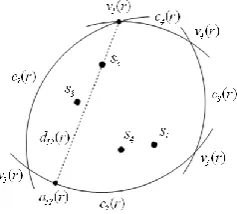
Fig. 6.The center hull of 𝑺 = {𝒔𝟏, 𝒔𝟐, 𝒔𝟑, 𝒔𝟒} with a radius 𝒓. For the antipodal pair 𝐯𝟏(𝒓)and 𝐜𝟐(𝒓), 𝒂𝟏𝟐(𝒓) is the point on the arc
𝒄𝟐(𝒓) farthest from 𝒗𝟏(𝒓), and 𝒅𝟏𝟐(𝒓) = 𝒅(𝒗𝟏(𝒓), 𝒂𝟏𝟐(𝒓)). Since the diameter of the center hull of a set of 𝑛
points can be determined in 𝑂(𝑛) time, this procedure can
be done in 𝑂(𝑛 log 𝑛) time. From Lemma 4- 4, if the case
(i) occurs, there is nothing more to do. In case (ii), by changing the radius in the interval (𝑟𝑡−1, 𝑟𝑡), the center hull will not undergo any combinatorial change, so the number of arcs and vertices remains unchanged in this interval. Let 𝑚 be the number of the vertices of the center
hull in this interval. Obviously, 𝑚 ∈ 𝑂(𝑛). Let
to be a point on the arc 𝑐𝑗(𝑟), farthest from 𝑣𝑖(𝑟), and
𝑑𝑖𝑗(𝑟) to be the distance between 𝑣𝑖(𝑟) and 𝑎𝑖𝑗(𝑟) (See Fig. 6). For any antipodal pair of vertices, 𝑣𝑖(𝑟) and 𝑣𝑗(𝑟),
we define 𝑑𝑖𝑗′(𝑟) to be the distance between 𝑣𝑖(𝑟) and
𝑣𝑗(𝑟). The number of antipodal pairs is 𝑂(𝑛). On the other hand 𝑑𝑖𝑗(𝑟) and 𝑑𝑖𝑗′(𝑟) each can be computed in
constant time. So, all 𝑑𝑖𝑗(𝑟)s and 𝑑𝑖𝑗′(𝑟)s can be
computed in 𝑂(𝑛) time. It is sufficient to find the smallest radius 𝑟 in the interval (𝑟𝑡−1, 𝑟𝑡) such that 𝑑𝑖𝑗(𝑟) = 𝛼or
𝑑𝑖𝑗′(𝑟) = 𝛼, for some 𝑖 and 𝑗. The equations 𝑑𝑖𝑗(𝑟) =
𝛼and 𝑑𝑖𝑗′(𝑟) = 𝛼 can be solved in constant time for each 𝑖 and 𝑗, so all these equations can be solved in 𝑂(𝑛) time and also finding the smallest radius in the solution set can
be done in 𝑂(𝑛) time. This smallest radius is the optimal
radius and the endpoints of its associated diameter are the optimal positions for the centers. Thus, the (𝑛, 1, 1, 𝛼) -center problem can be solved in 𝑂(𝑛 log 𝑛) time. □
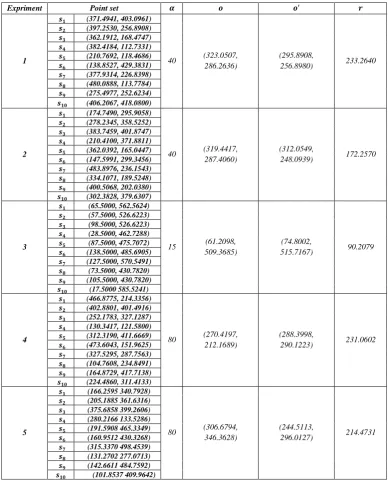
We have implemented our algorithm for the
(𝑛, 1, 1, 𝛼)-center problem. Five experimental results are shown in Table. 1. Let 𝑆 = {𝑠1, 𝑠2, … , 𝑠10} be a set of ten points in the plane, 𝑜 and 𝑜′ be the optimal centers, and 𝑟 be the optimal radius for the (𝑛, 1, 1, 𝛼)-center problem for 𝑆.
5.CONSTRAINED(𝒏, 𝟏, 𝟏, 𝜶)-CENTER PROBLEM
Let 𝑆 be a set of 𝑛 points in the plane, 𝛼 be a constant and 𝐿 be a line, the constrained (𝑛, 1, 1, 𝛼)-center problem is the (𝑛, 1, 1, 𝛼)-center problem in which the centers are forced to lie on 𝐿.In this section, we first propose an
𝑂(𝑛 log 𝑛) time algorithm for solving the constrained
(𝑛, 1, 1, 𝛼)-center problem, then we improve the time to
𝑂(𝑛).
Lemma 5- 1- If 𝑟 and 𝑟′ are the optimal radii of the constrained (𝑛, 1, 1, 𝛼)-center problem, then 𝑟 = 𝑟′.
Proof. The proof is similar to Lemma 4-1. □
Lemma 5- 2- If 𝐷(𝑜, 𝑟) and 𝐷(𝑜′, 𝑟′) are the optimal disks of the constrained (𝑛, 1, 1, 𝛼)-center problem, then
𝑑(𝑜, 𝑜′) = 𝛼.
Proof. The proof is similar to Lemma 4-2. □
From now on, assume without loss of generality that 𝐿
is the 𝑥-axis.
Observation 5- 3- Let 𝑆 be a set of points in the plane, and 𝑜𝐿 and 𝑜𝑅 be two points on 𝐿 such that 𝑜𝐿lies on the left side of 𝑜𝑅. For any point in the plane such as 𝑝, let
𝐹𝑆(𝑝) be the point in 𝑆 farthest from 𝑝. It can easily be
seen that if 𝑑(𝑜𝑅, 𝐹𝑆(𝑜𝑅)) > 𝑑(𝑜𝐿, 𝐹𝑆(𝑜𝐿)), by moving 𝑜𝐿 and 𝑜𝑅 to the right on 𝐿 such that their distance remains
unchanged, again 𝑑(𝑜𝑅, 𝐹𝑆(𝑜𝑅)) > 𝑑(𝑜𝐿, 𝐹𝑆(𝑜𝐿)). It can
also be shown that if 𝑑(𝑜𝐿, 𝐹𝑆(𝑜𝐿)) > 𝑑(𝑜𝑅, 𝐹𝑆(𝑜𝑅)), by
moving 𝑜𝐿 and 𝑜𝑅 to the left on 𝐿 such that their distance remainsunchanged, again 𝑑(𝑜𝐿, 𝐹𝑆(𝑜𝐿)) > 𝑑(𝑜𝑅, 𝐹𝑆(𝑜𝑅)).
Theorem 5- 4- The constrained (𝑛, 1, 1, 𝛼)-center problem can be solved in 𝑂(𝑛) time.
Proof. Let 𝐷(𝑜, 𝑟) and 𝐷(𝑜′, 𝑟′) be the optimal disks
of the constrained (𝑛, 1, 1, 𝛼)-center problem. From
Lemmas 5-1 and 5-2, 𝑟 = 𝑟′and 𝑑(𝑜, 𝑜′) = 𝛼. On the other hand, From the Observation 5-3, there exists just one pair of points, say 𝑜𝐿 and 𝑜𝑅, on 𝐿 such that 𝑑(𝑜𝐿, 𝑜𝑅) = 𝛼 and 𝑑(𝑜𝐿, 𝐹𝑆(𝑜𝐿)) = 𝑑(𝑜𝑅, 𝐹𝑆(𝑜𝑅)), which are the optimal
centers of the constrained (𝑛, 1, 1, 𝛼)-center problem. Let
𝑡1, 𝑡2, … , 𝑡𝑚 be the increasing sequence of the intersection points of 𝐿 and the farthest point Voronoi diagram of 𝑆.
This sequence can be determinedin 𝑂(𝑛 log 𝑛). Thus,𝐿 =
(−∞, 𝑡1] ∪ (𝑡1, 𝑡2] ∪ … ∪ (𝑡𝑚−1, 𝑡𝑚] ∪ (𝑡𝑚, +∞). There are 𝑂(𝑛) pairs of these intervals such that one of them contains 𝑜 and the other one contains 𝑜′. It is sufficient to compute the solution of the constrained (𝑛, 1, 1, 𝛼)-center problem for each pair of the farthest neighbors corresponding to these pairs of the intervals. Notice that these two intervals, and so these two points can be the
same. This takes 𝑂(𝑛) time. The solution with the
smallest radius is the optimal radius. Now, we want to improve the time to 𝑂(𝑛).
Let 𝐷(𝑜, 𝑟) and 𝐷(𝑜′, 𝑟) be the optimal disks of the
constrained (𝑛, 1, 1, 𝛼)-center problem. We can write
𝑜′= 𝑜 + 𝑣⃗, in which 𝑣⃗ is a vector of length 𝛼 in the direction of 𝐿. The constrained (𝑛, 1, 1, 𝛼)-center problem can be modeled as follows:
min 𝑟
Subject to:
𝑑(𝑜, 𝑠) ≤ 𝑟 ∀𝑠 ∈ 𝑆 𝑑(𝑜′, 𝑠) ≤ 𝑟 ∀𝑠 ∈ 𝑆
𝑜, 𝑜′∈ 𝐿
(3)
On the other hand, for any 𝑠 ∈ 𝑆, we have:
𝑑(𝑜′, 𝑠) = 𝑑(𝑜 + 𝑣̅, 𝑠) = 𝑑(𝑜, 𝑠 − 𝑣⃗).
(4)
Therefore, the constrained (𝑛, 1, 1, 𝛼)-center problem can be written as follows:
TABLE 1.EXPERIMENTAL RESULT. LET 𝑺 = {𝒔𝟏, 𝒔𝟐, … , 𝒔𝟏𝟎} BE A SET OF TEN POINTS IN THE PLANE, 𝒐 AND 𝒐′ BE THE OPTIMAL CENTERS, AND𝒓 BE THE OPTIMAL RADIUS FOR THE (𝒏, 𝟏, 𝟏, 𝜶)-CENTER PROBLEM FOR 𝑺.
Expriment Point set 𝜶 𝒐 𝒐′ 𝒓
1
𝒔𝟏 (371.4941, 403.0961)
40 (323.0507,
286.2636)
(295.8908,
256.8980) 233.2640
𝒔𝟐 (397.2530, 256.8908)
𝒔𝟑 (362.1912, 168.4747)
𝒔𝟒 (382.4184, 112.7331)
𝒔𝟓 (210.7692, 118.4686)
𝒔𝟔 (138.8527, 429.3831)
𝒔𝟕 (377.9314, 226.8398)
𝒔𝟖 (480.0888, 113.7784)
𝒔𝟗 (275.4977, 252.6234)
𝒔𝟏𝟎 (406.2067, 418.0800)
2
𝒔𝟏 (174.7490, 295.9058)
40 (319.4417,
287.4060)
(312.0549,
248.0939) 172.2570
𝒔𝟐 (278.2345, 358.5252)
𝒔𝟑 (383.7459, 401.8747)
𝒔𝟒 (210.4100, 371.8811)
𝒔𝟓 (362.0392, 165.0447)
𝒔𝟔 (147.5991, 299.3456)
𝒔𝟕 (483.8976, 236.1543)
𝒔𝟖 (334.1071, 189.5248)
𝒔𝟗 (400.5068, 202.0380)
𝒔𝟏𝟎 (302.3828, 379.6307)
3
𝒔𝟏 (65.5000, 562.5624)
15 (61.2098,
509.3685)
(74.8002,
515.7167) 90.2079
𝒔𝟐 (57.5000, 526.6223)
𝒔𝟑 (98.5000, 526.6223)
𝒔𝟒 (28.5000, 462.7288)
𝒔𝟓 (87.5000, 475.7072)
𝒔𝟔 (138.5000, 485.6905)
𝒔𝟕 (127.5000, 570.5491)
𝒔𝟖 (73.5000, 430.7820)
𝒔𝟗 (105.5000, 430.7820)
𝒔𝟏𝟎 (17.5000 585.5241)
4
𝒔𝟏 (466.8775, 214.3356)
80 (270.4197,
212.1689)
(288.3998,
290.1223) 231.0602
𝒔𝟐 (402.8801, 401.4916)
𝒔𝟑 (252.1783, 327.1287)
𝒔𝟒 (130.3417, 121.5800)
𝒔𝟓 (312.3190, 411.6669)
𝒔𝟔 (473.6043, 151.9625)
𝒔𝟕 (327.5295, 287.7563)
𝒔𝟖 (104.7608, 234.8491)
𝒔𝟗 (164.8729, 417.7138)
𝒔𝟏𝟎 (224.4860, 311.4133)
5
𝒔𝟏 (166.2595 340.7928)
80 (306.6794,
346.3628)
(244.5113,
296.0127) 214.4731
𝒔𝟐 (205.1885 361.6316)
𝒔𝟑 (375.6858 399.2606)
𝒔𝟒 (280.2166 133.5286)
𝒔𝟓 (191.5908 465.3349)
𝒔𝟔 (160.9512 430.3268)
𝒔𝟕 (315.3370 498.4539)
𝒔𝟖 (131.2702 277.0713)
𝒔𝟗 (142.6611 484.7592)
𝒔𝟏𝟎 (101.8537 409.9642)
Subject to:
𝑑(𝑜, 𝑠) ≤ 𝑟 ∀𝑠 ∈ 𝑆 𝑑(𝑜, 𝑠 − 𝑣⃗) ≤ 𝑟 ∀𝑠 ∈ 𝑆 𝑜 ∈ 𝐿
(5)
Obviously, this problem is equivalent to the smallest enclosing circle of the point set 𝑆 ∪ {𝑠 − 𝑣⃗|𝑠 ∈ 𝑆} with this constraint that the center is forced to lie on 𝐿. In 1983, N. Megiddo presented a linear time algorithm for finding the center of the smallest enclosing circle on a given line [5]. Hence, the constrained (𝑛, 1, 1, 𝛼)-center problem for
a set of 𝑛 points in the plane can be solved in 𝑂(𝑛) (See
Algorithm 1). □
Algorithm 1: A linear time algorithm for the constrained
(𝑛, 1, 1, 𝛼)-center problem.
Input: A set 𝑆 of 𝑛 points in the plane, a constant 𝛼, and a line 𝐿.
Output: Two congruent disks centered at 𝑜 and 𝑜′ with the smallest radius such that their intersection covers 𝑆, 𝑜 and 𝑜′ locate on 𝐿, and 𝑑(𝑜, 𝑜′) ≤ 𝛼.
𝑆′← {𝑠 − 𝑣⃗| 𝑠𝜖𝑆}.
Find the smallest enclosing circle of 𝑆 ∪ 𝑆′.
𝑜 ← the center of this circle.
𝑜′← 𝑜 + 𝑣⃗
return𝑜 and 𝑜′
end
6.CONCLUSION
In this study, we introduced (𝑛, 1, 1, 𝛼)-center
problem, and also a version of this problem which is
called constrained (𝑛, 1, 1, 𝛼)-center problem. We
presented an 𝑂(𝑛 log 𝑛) algorithm for finding two closed
disks each of which covers the whole 𝑆, the diameter of the bigger one is minimized, and the distance of the two centers is at least 𝛼.We also gave an 𝑂(𝑛) algorithm for solving this problem, provided the centers lie on a given line.
REFERENCES
[1] Rezaei, M., and FazelZarandi, M.H., “Facility
location via fuzzy modeling and simulation,” Applied soft computing, Vol. 11, pp. 5330– 5340, 2011.
[2] Megiddo, N., and Supowit, K., “On the complexity
of some common geometric location problems,” SIAM J. Comput., Vol. 13, pp. 1182– 1196, 1984.
[3] Agarwal, P. K., and Procopiuc, C. M., “Exact and
approximation algorithms for clustering,”
Algorithmica, Vol. 33, pp. 201.226, 2002.
[4] Sylvester, J. J., “A question in the geometry of situation,” Quart. J. Math., pp. 79, 1857.
[5] Megiddo, N., “Linear time algorithms for linear
programming in ℝ3,” Society for Industrial and Applied Mathematics, Vol. 12, No. 4. November 1983.
[6] Drezner, Z., “The planar center and
two-median problems,” Transportation Science, Vol. 18, pp. 351- 361, 1984.
[7] Hershberger, J., and Suri, S., “Finding tailored
partitions,” J. Algorithms, Vol.12, pp. 431– 463, 1991.
[8] Agarwal, P. K., and Sharir, M., “Planar geometric
location problems,” Algorithmica, Vol.11, pp. 185– 195, 1994.
[9] Megiddo, N., “Applying parallel computation
algorithms in the design of serial algorithms,” J. ACM, Vol.30, pp. 852– 865, 1983.
[10] Eppstein, D., “Dynamic three-dimensional linear
programming,” ORSA J. Computing, Vol.4, pp. 360– 368, 1992.
[11] Jaromczyk, J., and Kowaluk, M., “An efficient
algorithm for the euclidean two-center problem,” Proc. 10th ACM Sympos. Comput. Geom, pp. 303– 311, 1994.
[12] Sharir, M., “A near linear algorithm for the planar
2-center problem,” Discrete Comput. Geom., Vol.18, pp. 125– 134, 1997.
[13] Eppstein, D., “Faster construction of planar two-centers,” Proc. 8th ACM-SIAM Sympos. Discrete Algorithms, pp. 131– 138, 1997.
[14] Chan, T. M., “More planar two-center algorithms,”
Comput. Geom. Theory Appl., Vol.13, pp. 189– 198, 1999.
[15] Huang, P. H., Tsai, Y. T., and Tang, C. Y., “A near-quadratic algorithm for the alpha-connected two-center problem,” Journal Of Information Science and Engineering, Vol. 22, pp. 1317- 1324, 2006.
[16] Huang, P. H., Tsai, Y. T., and Tang, C. Y., “A fast
algorithm for the alpha-connected two-center decision problem,” Information Processing Letters, Vol. 85, pp. 205- 210, 2003.
[17] Rao, A. S., Goldberg, K., “Manipulating algebraic
parts in the plane,” Technical Report RUU-CS-93-43, 1993.
[18] Preparata, F. P., and Shamos, M. I.,