in the population sciences published by the Max Planck Institute for Demographic Research Konrad-Zuse Str. 1, D-18057 Rostock · GERMANY www.demographic-research.org
DEMOGRAPHIC RESEARCH
VOLUME 8, ARTICLE 9, PAGES 261-278
PUBLISHED 7 MAY 2003
www.demographic-research.org/Volumes/Vol8/9/
DOI: 10.4054/DemRes.2003.8.9
Research Article
Does biological relatedness affect
survival?
David Bishai, El Daw Suliman,
Heena Brahmbhatt, Fred Wabwire-Mangen,
Godfrey Kigozi, Nelson Sewankambo,
David Serwadda, Maria Wawer,
Ron Gray
1 Introduction 262
2 Background 262
3 A sociobiological perspective 263
4 Methods 264
4.1 Data 264
4.2 Sampling frame for Maternal Infant Supplementary
Study (MISS)
265
4.3 Analytic Sample 265
5 Assessing biological relatedness 266
5.1 Statistical analysis 266
5.2 Controlling for the endogeneity of biological relatedness
267
6 Results 268
7 Discussion 269
8 Conclusion 270
9 Acknowledgements 270
Notes 277
Research Article
Does biological relatedness affect survival?
David Bishai1
El Daw Suliman3
Heena Brahmbhatt3
Fred Wabwire-Mangen4 Godfrey Kigozi5
Nelson Sewankambo6
David Serwadda7
Maria Wawer9
Ron Gray8
ABSTRACT
Objective: We studied child survival in Rakai, Uganda where many children are fostered out or orphaned.
Methods: Biological relatedness is measured as the average of the Wright’s coefficients between each household member and the child. Instrumental variables for fostering include proportion of adult males in household, age and gender of household head. Control variables include socioeconomic status (SES), religion, polygyny, household size, child age, child birth size, and child HIV status.
Results: Presence of both parents in the household increased the odds of survival by 28%. After controlling for the endogeneity of child placement decisions in a multivariate model we found that lower biological relatedness of a child was associated with statistically significant reductions in child survival. The effects of biological relatedness on child survival tend to be stronger for both HIV- and HIV+ children of HIV+ mothers.
1;3,8,9
Johns Hopkins University 615 N.Wolfe St. Baltimore, MD 21205. Corresponding author: David Bishai. Email: [email protected]
4,5,6,7
Conclusions: Reductions in the numbers of close relatives caring for children of HIV+ mothers reduce child survival.
1. Introduction
There are now an estimated 11 million AIDS orphans living in sub Saharan Africa (UNAIDS 2002). (The conventional definition of “orphan” in most studies is a child below the age of 15 who has lost one or both parents.) Consideration of the impact of orphanhood typically emphasizes the orphan’s loss of the dead parent’s productive capacity (Over, Ellis, Huber, and Solon 1992) and the need to provide orphans financial security despite the loss of a parent. However there is a growing realization that the prevalent African tradition of child fostering might be sufficient to offset the financial predicament of orphanhood (Foster, Shakespeare, Chinemana, Jackson, Gregson, Marange, and Mashumba 1995; Kamali, Seeley, Nunn, Kengeya-Kayondo, Ruberantwari, and Mulder 1996; Urassa, Boerma, Ng'weshemi, Isingo, Schapink, and Kumogola 1997). Earlier observations on the wide prevalence of child fostering in West Africa (Bledsoe and Brandon 1987; Isiugo-Abanihe 1985) were reinforced by data showing that 14% of Northwestern Tanzanian households (Urassa et al. 1997)and 19% of Southern Ugandan households fostered orphan children (Nalugoda, Wawer, Konde-Lula, Menon, Gray, Serwadda, Sewankambo, and Li 1997). The extended family has been a traditional source of financial security and could be a very successful coping strategy. Yet financial security and caring by foster families may not be able to replace lost parents.
The objective of this paper is to develop a measure of the biological relatedness to household members and to ask whether biological relatedness affects the survival of children. We will show that biological relatedness can be measured, and that it has independent effects on child survival. We suggest that biological relatedness could be a useful proxy measure of the caregiver concern that may be lost as a consequence of adult mortality.
2. Background
"It is unwise in any economic model to assume a relationship between biological parenthood and economic responsibility for bringing up children. ... costs are widely shared, and few Africans feel significantly less responsible for the schooling costs of their nephews and nieces than for those of their own children."
Optimists who say that no assistance is needed, point to data showing no significant difference in mortality between orphans and non-orphans (Urassa et al. 1997) and minor differences in schooling rates. Nalugoda et al. (1997) found in Rakai that 56% of orphans and 64% of non-orphans were enrolled in school. Ainsworth and Rwegarulira (1992) found that in Kagera roughly 65% of teenage orphans were enrolled in school and 75% of corresponding non-orphans.
In contrast to these optimistic views, Sengendi and Nambi (1997) noted severe psychological effects related to bereavement in both orphaned children and their foster parents in Rakai. In focus groups conducted in Uganda, Ntozi and Mukiza-Gapere (1995) uncovered widespread reports of orphans being dispossessed and stigmatized for fear of AIDS. Lack of money affected 58% of Ugandan orphans (Ntozi 1997). The Kagera data show that mother’s deaths (but not father’s deaths) are followed by child stunting (Ainsworth and Semali 1998). This would indicate that while widowed and foster families are able to buffer the child’s health from the devastating loss of a father’s resources and protection, they cannot insulate the child from the loss of a mother. Ntozi (1997) concludes that,
“…the extended family has tried its best to cope with the orphan problem without much external assistance. It is therefore recommended that the family’s weak financial capacity to cope with the orphan problem should be countered by external assistance from government and international and local AIDS groups.”
3. A sociobiological perspective
kin and which increase the reproduction of whatever genes are held in common among kin. This has been stated as Hamilton’s Rule:
"The social behavior of a species evolves in such a way that in each distinct behavior-evoking situation the individual will seem to value his neighbors' fitness against his own according to the coefficients of relationship appropriate to that situation." (Hamilton 1964)
The coefficient of relationship (ω) is derived with reference to Mendelian inheritance. For example, ω is ½ for parents, ¼ for grandparents etc. In its simplest form Hamilton’s rule can be expressed as: ωb-c>0 where b is the fitness benefit to the beneficiary and c is the fitness cost to the altruist. The case where ω=1 suggests a case where the giver and receiver are the same organism. Here, Hamilton’s rule reduces to the basic principle of rational choice theory: the benefit of any action must exceed its cost.
One reaction to the proposition that Hamilton’s rule might apply to human behavior would be to reject it a priori by appealing to the countless cases of altruism among unrelated persons and the superb outcomes realized by adopted children around the world. However Hamilton’s rule should not be interpreted as a natural law that can never be violated. Instead, Hamilton’s rule refers to an equilibrium that the forces of natural selection would bring about if left unchallenged. A priori, Hamilton’s rule may or may not be a central tendency for humans at present. The best test of whether Hamilton’s rule applies to humans would use data on intrahousehold transfers describing their fitness benefit and fitness cost. Such a study would leave open the question of how important these statistical effects are for child survival. In this paper we will look at the reduced form of the impact of biological relatedness on child survival. If biological relatedness turns out to be important for survival, subsequent studies would be warranted to establish a detailed causal pathway. In this paper we simply ask whether household relatedness coefficients are correlated to child survival.
4. Methods
4.1. Data
villages (Nalugoda et al. 1997). Latest estimates suggest that approximately 29,000 children in the district have lost at least one parent; 4500-5000 of these have lost both parents (Nalugoda et al. 1997).
The Rakai Project has been studying the population of Rakai District and its epidemiological experience since 1988 (Gray, Wawer, Serwadda, Sewankambo, Li, Wabwire-Mangen, Paxton, Kiwanuka, Kigozi, Konde-Lule, Quinn, Gaydos, and McNairn 1998). Among other activities this project has followed the populations of 56 communities located on secondary roads between 1994 and 2001. The original purpose of the population cohort was to evaluate the impact of preventive interventions against sexually transmitted diseases (STDs) and AIDS by a community randomized clinical trial . This paper uses data from the Maternal Infant Supplementary Study (MISS) cohort which was comprised of pregnant mothers and their children identified during the STD trial (1994-1999).
4.2. Sampling Frame For Maternal Infant Supplementary Study (MISS)
A baseline cohort composed of 6216 women aged 15-59 entered surveillance in 1994. Women in this cohort who became pregnant while under surveillance between 1994 and 1999 were prospectively enrolled. Participation exceeded 90% of all who were approached. The women were given an extensive pre-partum physical exam, lab tests, and interviews. Mothers and surviving newborns were visited postpartum and both were examined. Data collection included prenatal STDs and HIV, pregnancy outcomes including anthropometry, prenatal and neonatal demise and subsequent determination of child HIV infection and long-term survival. As of late 2000, child vital status had been determined for 3635 children based on census and follow up data collected from 1998 to 2000. Tests for HIV used two enzyme immunoassays with Western blot confirmation of discordant assays. Infant HIV infection was diagnosed by RNA RT-PCR (Roche Amplicor 1.5).
4.3. Analytic Sample
for complete data on a number of sociodemographic factors and HIV status further reduced the eligible sample to 2208 children.
5. Assessing Biological Relatedness
In a context with prevalent fostering of children and frequent adult migration, orphanhood is the most stressful of several ways in which children’s kinship ties to household members are diluted. In order to assess all processes diluting child’s kinship we sought to parameterize the biological relatedness of children to other household members.
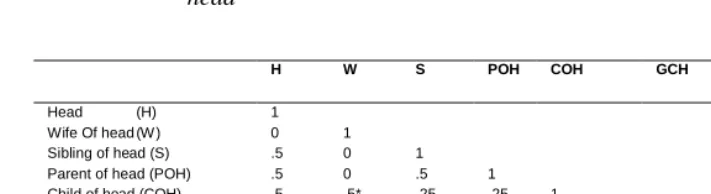
During the annual census conducted by the Rakai Project a household roster is completed including “relationship to household head” for every household member. We used the algorithm depicted in Table 1 to assign a coefficient of biological relatedness between each household member and the child of interest based on that child’s own relationship to household head, and the relationship of each household member to the household head. In addition one of the investigators (ES) visually inspected the data for all cases where a child’s relationship to household head was “other” or “grandchild” (Note 1).
We calculated the unweighted sum of all of biological relatedness (Wright’s) coefficients × 100 and divided it by the number of non-self household members to form an index of biological relatedness (IBR). Had we not adjusted by household size, the sum of Wright’s coefficients would have been itself reflective of household size rather than kinship. The natural interpretation of IBR is the percentage match of the propositus’s genes to a simple random sample of the gene pool of all other household members. Such an index would be 100% for each member of a household made up of clones (or of 2 identical twins), 50% for each sibling in a household of only full siblings and 0% for an adopted unrelated child in any household.
5.1. Statistical Analysis
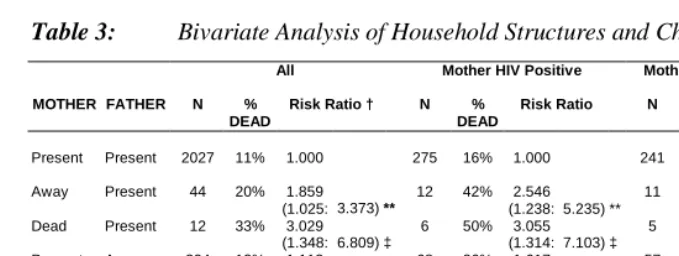
As a simple means of assessing the relationship of household structure to child survival we used 2 by 2 tables to calculate the unadjusted odds ratios of survival for children with various combinations of parental absenteeism and parental demise. We stratified the analysis by maternal HIV status in order to isolate effects that may differ for children of infected and uninfected mothers.
included in the models included mother’s age (categorical: 15-19 or >30yrs; reference group was 20-30,), mother’s education (any versus none), low socioeconomic status ( owning less than the median number of assets) , religion (Muslim versus non-Muslim), and and infant chest circumference (low versus normal, >30cms), which is a proxy measure of low birth weight (WHO 1993). These multivariate models were adjusted to control for endogenous child placement decisions as discussed below.
5.2. Controlling for the Endogeneity of Biological Relatedness
Intuition and economic theory suggest that the biological relatedness of a child could be heavily influenced by household choices related to fostering, the survival of other household members, and economic resources. There might be reverse causation in which a child’s survival propensity affects the household structure for that child. For instance, a child’s endowment of poor health might influence decisions to foster out that child or decisions to have extended family move in or out. In order to account for the potential endogeneity of IBR we instrument it using as instruments: proportion of adult males in household, age of household head, and gender of household head. These instruments are assumed to affect child survival only through their effect on the biological relatedness of the child to other household members. Objections that these instrumental variables have their own “independent” effects on survival might be launched on the grounds that households with older heads and more male members may have a lower preference for child well-being than a younger and more female dominated household. However, biologists explain a lower male preference for the survival of offspring on the basis of lower male certainty of paternity and a perception of potentially lower biological relatedness by males. Such a putative “independent” effect of maleness on preferences would actually be mediated by biological relatedness after all. Another criticism may be that the instrumental variables are predictive of unmeasured components of SES and hence may directly influence child survival. Later we offer empirical evidence that independent effects of household structure via SES are not occurring. Ultimately an analysis based on instrumental variables requires cautious interpretation and an evaluation of the plausibility of the identifying assumptions. The required assumption here is that child frailty causes few if any Ugandan households to make significant shifts in the age and sex of the household head or the proportion of male household members.
biological relatedness markers on survival were not significantlyaffected by alternative SES constructs based on principal components analysis following Filmer and Pritchett (Filmer and Pritchett 2001).
We use a full information maximum likelihood (FIML) approach. The FIML system is composed of a probit equation predicting the probability of child death as a function of covariates including the index of biological relatedness. The other equation in the FIML system is the maximum likelihood equivalent of an ordinary least squares equation predicting the index of biological relatedness from the same covariates and, in addition, the three instruments: proportion of adult males in household, age of household head, and gender of household head. Hausman tests are used to test the hypothesis that the biological relatedness is endogenously tied to child survival.
6. Results
Table 2 shows the means, proportions and standard deviations of the variables used for the analysis. One can gain a preliminary impression that children who died had a higher percentage of mothers who were absent or deceased and a lower index of biological relatedness.
Table 3 confirms the general impressions gleaned in Table 2—indicating that the risk ratio of child death is statistically significantly lower for children with both parents present. The effects of parental presence on survival is stronger among HIV positive mothers.
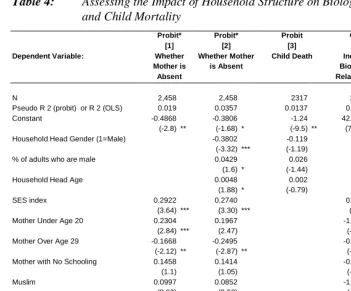
mother and decreases for mothers who are HIV positive. Relatedness appears to be increased in polygynous households even though the algorithm which computed biological relatedness coded as zero the Wright’s coefficient of head’s co-wives. The potentially higher number of half-siblings (with Wright’s coefficients of 0.25) that children have in polygynous households may be sufficient to raise the IBR.
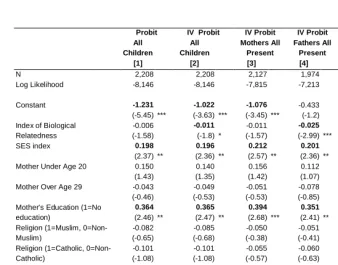
In Table 5 we present probit and instrumental variables (IV) probit estimates of the odds ratios of survival based on the instrumented IBR. The elasticity of the relationship between IBR and the probability of child death based on column 1 was calculated as -0.424 (95% CI: -0.953: 0.105). In concrete terms this means that a 50% increase in the IBR (equivalent to replacing 1 stepparent with 1 biological parent of a two parent-one child family) would lower the probability of child death by 21% (= 0.5 x –0.42). A 5% increase in IBR would lower the probability of death by 2.1%. More familiar factors associated with higher odds of child death in the full sample included low SES, no maternal education, and inadequate birthweight. In stratified analyses it appeared that the effects of IBR were similar in “mothers present” households (column [3]) where none of the variation in IBR could be due to absent mothers. The P-value for IBR in column [3] is P=0.12. The coefficient on IBR is larger in “fathers present” households where reductions in biological relatedness are more likely to reflect the absence of mothers. This asymmetry is consistent with the common sense notion that not all reductions in biological relatedness are the same—mothers are likely to count more.
The Hausman test statistics at the bottom of Table 5 are all negative. While it is impossible to directly interpret these results using a chi-squared distribution, one author suggests interpreting below zero Hausman tests results as zero and to thus accept the null (Greene 2000) . In this case the null hypothesis is that the index of biological relatedness is exogenous to child survival.
7. Discussion
Past studies of the effects of household structure have verified the commonsense notion that children’s welfare depends on who is present and absent from the household (Sear, Steele, McGregor, and Mace 2002). Rather than continuing to study household structure in terms of who is present/absent, this study operationalizes household structure as a single continuous variable reflecting biological relatedness.
Because of this, the sample we studied is relatively enriched with nuclear household structures and is not representative of all of households in the rural district under study. Another potential limitation of our approach is the possibility that household informants feel so attached to their foster children that they report them on the roster as simply children of the head. All of the interviewers were trained to emphasize to informants that the rosters required biological relationships to household head. If foster children were reported as biologically related this would be a conservative error—biasing the effects of biological relatedness towards zero. A further limitation is that children with reduced biological relatedness (e.g. due to parental demise) are among the most difficult to follow up. This leads to a degree of sample selection bias in our estimates. Intuitively, we believe that survival outcomes are likely to be worse for children in the households where parental demise or departure uprooted the entire household. Thus the sample selection bias is also likely to bias our estimates towards zero.
Despite these limitations, we do find that the impact of biological relatedness on child survival is statistically significant, even adjusting for the endogeneity of child placement. The effects of biological relatedness are not negligible, although the direct effects of HIV on survival overwhelm other determinants.
8. Conclusion
Our results indicate that households coping with HIV face something more than a cash shortage. They face a shortage of related adults. Children who lose close proximity to kin require special attention, not only financially but also in the form of advocacy, quality time, and mentoring.
Reduced biological relatedness is caused partly by adult death and partly by decisions on child placement. Children of HIV infected parents are more likely to have reduced biological relatedness to adults in their household, even before the death of their mothers. Reduced biological relatedness is associated with reduced child survival.
9. Acknowledgements
Table 1: Coefficients of biological relationship as a function of relationship to head
H W S POH COH GCH GNH N A
Head (H) 1
Wife Of head (W ) 0 1
Sibling of head (S) .5 0 1
Parent of head (POH) .5 0 .5 1
Child of head (COH) .5 .5* .25 .25 1
Grandchild of head (GCH) .25 .25* .12 .12 .5 or .25‡ 1 Grandniece of head (GNH) .12 .12* .12†‡ .06 .06 .12 1 Niece/neph of head (N) .25 .25* .25†‡ .25 .12 .25 .5‡ 1
Adopted child of head (A) 0 0 0 0 0 0 0 0 1
Notes
. *Possibly 0 if head is polygynous.
†Possibly 0 if child through spouse’s lineage.
Table 2: Distribution of children under 5 years of age by own characteristics and Mother’s characteristics
Characteristics of Mothers and Children
Living Children Dead Children
Number Nonmissing Mean SD Number Nonmissing Mean SD
or % or %
Asset Ownership (SES)
Low Asset Ownership 2146 55% 315 63%
Other than Low Asset Ownership 2146 45% 315 37%
Mother's Education
Mothers with no education 2146 10% 315 16%
Mothers with any education 2146 90% 325 84%
Mother's Age
<20 2132 16% 313 19%
age ≥20 and age <30 2132 61% 313 59%
30+ 2132 23% 313 22%
Age of Head of Household 2141 34.69 2.69 315 35.74 14.40
Sex of Head of Household
% where head is male 2141 87% 315 85%
% where head is female 2141 13% 315 15%
Household # of Males 2146 2.79 .48 315 2.98 1.83
HIV Status
HIV Positive Mother 2090 15% 309 27%
HIV Negative Mother 2090 85% 309 63%
LBW
Chest <30 cm 2104 8% 264 13%
Chest ≥30 cm 2104 92% 264 87%
Polygyny
Polygyny (>=2 wives) 1470 20% 199 21%
Monogamous 1470 80% 199 79%
Religion
Muslim 2146 16% 315 15%
Catholic 2146 62% 315 59%
Protestant or Pentecostal 2146 21% 315 24%
Orphanhood/Absent Mother
Mother Dead 2146 1% 315 2%
Mother not in HH 2146 3% 315 5%
Mother Alive and Present 2146 96% 315 83%
Table 3: Bivariate Analysis of Household Structures and Child Survival
All Mother HIV Positive Mother HIV Positive Child HIV
Negative
MOTHER FATHER N %
DEAD
Risk Ratio † N %
DEAD
Risk Ratio N %
DEAD
Risk Ratio
Present Present 2027 11% 1.000 275 16% 1.000 241 14% 1.000 Away Present 44 20% 1.859 12 42% 2.546 11 36% 2.655 (1.025: 3.373) ** (1.238: 5.235) ** (1.142: 6.173) ‡
Dead Present 12 33% 3.029 6 50% 3.055 5 40% 2.921
(1.348: 6.809) ‡ (1.314: 7.103) ‡ (0.954: 8.947) ‡
Present Away 204 12% 1.113 68 26% 1.617 57 18% 1.281
(0.756: 1.641) (1.003: 2.609) * (0.672: 2.444)
Present Dead 46 15% 1.383 20 35% 2.138 20 35% 2.556
(0.692: 2.767) (1.112: 4.115) ** (1.300: 5.026)
Away Away 47 19% 1.741 8 63% 3.819 3 33% 2.434 **
(0.955: 3.173) * (2.097: 6.957) ‡ (0.476: 12.442) ‡
Notes
Table 4: Assessing the Impact of Household Structure on Biological Relatedness and Child Mortality
Probit* Probit* Probit OLS OLS
[1] [2] [3] [4] [5]
Dependent Variable: Whether
Mother is Absent
Whether Mother is Absent
Child Death Index of Biological Relatedness
Index of Biological Relatedness
N 2,458 2,458 2317 2,450 2,446 Pseudo R 2 (probit) or R 2 (OLS) 0.019 0.0357 0.0137 0.0095 0.2662 Constant -0.4868 -0.3806 -1.24 42.0067 45.6953 (-2.8) ** (-1.68) * (-9.5) ** (70.82) *** (46.90) *** Household Head Gender (1=Male) -0.3802 -0.119 4.9907
(-3.32) *** (-1.19) (7.43) ***
% of adults who are male 0.0429 0.026 -2.4010
(1.6) * (-1.44) (-10.33) ***
Household Head Age 0.0048 0.002 -0.0751
(1.88) * (-0.79) (-3.8) **
SES index 0.2922 0.2740 0.3418 0.2861
(3.64) *** (3.30) *** (0.76) (0.8)
Mother Under Age 20 0.2304 0.1967 -1.3064 0.0408
(2.84) *** (2.47) (-2.22) ** (0.09) ***
Mother Over Age 29 -0.1668 -0.2495 -0.7009 1.8210
(-2.12) ** (-2.87) ** (-1.48) (3.33) ***
Mother with No Schooling 0.1458 0.1414 -0.2532 -0.3856
(1.1) (1.05) (-0.43) (-0.7)
Muslim 0.0997 0.0852 -1.1786 -0.4424
(0.62) (0.53) (-1.61) (-0.66)
Catholic 0.0785 0.0504 -0.6942 -0.2542
(.57) (.37) (-1.29) (-.49)
Polygyny (1=Polgynous, 0=No) 0.1408 0.1130 0.1626 0.9186
(1.59) (1.3) (.29) (1.78)
Low Birthweight (1=Chest<30 cm) -0.1301 -0.1267 0.4601 0.3303
(-1.14) (-1.1) (0.58) (0.55)
Mother's HIV status (1=HIV+, 0=HIV-) 0.2947 0.2347 -1.4272 -0.8839
(3.11) *** (2.5) (-2.45) *** (-1.82) *
Notes
*p<0.10 **p<0.05 ***p<0.01
Table 5: Probit Regression of the Probability of Child Death
Probit IV Probit IV Probit IV Probit IV Probit
All
Children
All Children
Mothers All Present
Fathers All Present
Both Mothers and Fathers Present
[1] [2] [3] [4] [5]
N 2,208 2,208 2,127 1,974 1,936
Log Likelihood -8,146 -8,146 -7,815 -7,213 -7,071
Constant -1.231 -1.022 -1.076 -0.433 -0.592
(-5.45) *** (-3.63) *** (-3.45) *** (-1.2) (-1.71) * Index of Biological
Relatedness
-0.006 (-1.58)
-0.011
(-1.8) *
-0.011 (-1.57)
-0.025
(-2.99) ***
-0.022
(-2.7) ***
SES index 0.198 0.196 0.212 0.201 0.217
(2.37) ** (2.36) ** (2.57) ** (2.36) ** (2.51) **
Mother Under Age 20 0.150 0.140 0.156 0.112 0.123
(1.43) (1.35) (1.42) (1.07) (1.12)
Mother Over Age 29 -0.043 -0.049 -0.051 -0.078 -0.086
(-0.46) (-0.53) (-0.53) (-0.85) (-0.91)
Mother's Education (1=No education)
0.364
(2.46) **
0.365
(2.47) **
0.394
(2.68) ***
0.351
(2.41) **
0.376
(2.57) ** Religion (1=Muslim,
0=Non-Muslim) -0.082 (-0.65) -0.085 (-0.68) -0.050 (-0.38) -0.051 (-0.41) -0.042 (-0.33) Religion (1=Catholic,
0=Non-Catholic) -0.101 (-1.08) -0.101 (-1.08) -0.055 (-0.57) -0.060 (-0.63) -0.032 (-0.34) Low Birthweight (1=Chest<30
cm)
0.208
(1.79) *
0.211
(1.82) **
0.230
(1.95) **
0.241
(1.93) **
0.253 (1.97)
Child is Male -0.049 -0.052 -0.045 -0.039 -0.024
(-0.76) (-0.78) (-0.65) (-0.53) (-0.33)
Child HIV Infected 1.310 1.296 1.181 0.949 0.903
(7.19) *** (7.12) *** (5.86) *** (3.9) *** (3.62) **
Hausman Statistic (-0.56) (-0.01) (-0.43) (-0.19) Notes
Z-statistics in parentheses are adjusted for clustering using robust standard errors
Notes
1. In cases where the child was the grandchild of the head, children of the head could possibly be aunts, uncles or parents of the child. Visual inspection of the ages and relationships of the adults could determine these relationships in the majority ofcases.
References
Ainsworth, M and D Filmer. 2002. "Poverty, AIDS and Children's Schooling: A Targeting Dilemma." World Bank Policy Research Working Paper 2885.
Ainsworth, Martha and Innocent Semali. 1998. "The Impact of Adult Deaths on the Nutritional Status of Children." in Workshop on the Consequences of Maternal Morbidity and Mortality. Committee on Population, National Research Council.
Bledsoe, Caroline and Anastasia Brandon. 1987. "Child Fostering and Child Mortality in sub-Saharan Africa: Some Preliminary Questions and Answers." Pp. 287-302 in Mortality and Society in Sub-Saharan Africa, edited by É. van de Walle, G. Pison, and M. Sala-Diakanda. New York: Oxford Press.
Case, Anne, Christina Paxson, and Joseph Albleidinger. 2002. "Orphans in Africa." NBER Working Paper Series Working Paper 9213.
Filmer, Deon and Lant Pritchett. 2001. "Estimating Wealth Effects without Expenditure Data--or Tears: An Application to Educational Enrollments in States of India." Demography 38:115-132.
Foster, G., R. Shakespeare, F Chinemana, H. Jackson, S. Gregson, C Marange, and S. Mashumba. 1995. "Orphan Prevalence and Extended Family Care in a Peri-Urban Community in Zimbabwe." AIDS Care 7:3-17.
Gray, R. H., M. J. Wawer, D. Serwadda, N. Sewankambo, C. Li, F. Wabwire-Mangen, L. Paxton, N. Kiwanuka, G. Kigozi, J. Konde-Lule, T. C. Quinn, C. A. Gaydos, and D. McNairn. 1998. "Population-based study of fertility in women with HIV-1 infection in Uganda." Lancet 35HIV-1:98-HIV-103.
Greene, William. 2000. Econometric Analysis. New York: MacMillan.
Isiugo-Abanihe, Uche. 1985. "Child fosterage in West Africa." Population and Development Review 11.
Kamali, A. , J.A. Seeley, J.F. Nunn, A Kengeya-Kayondo, A. Ruberantwari, and D.W. Mulder. 1996. "The Orphan Problem: Experience of a sub-Saharan Africa rural population in the AIDS epidemic." AIDS care 8:509-515.
Mukiza-Gapere, Jackson and James P.M. Ntozi. 1995. "Impact of AIDS on the Family and Mortality in Uganda." Health Transition Review 5:191-200.
Nalugoda, Fred, Maria J. Wawer, Joseph K. Konde-Lula, Rekha Menon, Ronald H. Gray, David Serwadda, Nelson K. Sewankambo, and Chuanjun Li. 1997. "HIV Infection in Rural Households, Rakai District, Uganda." Health Transition Review 7:127-140.
Ntozi, James P.M. 1997. "Effects of AIDS on Children: The Problem of Orphans in Uganda." Health Transition Review 7:23-40.
Over, Mead, Randall P. Ellis, Joyce H. Huber, and Orville Solon. 1992. "The Consequences of Adult Ill Health." Pp. 161-199 in The Health of Adults in the Developing World, edited by R. G. A. Feachem, T. Kjellstrom, C. J. L. Murray, M. Over, and M. Phillips. Washington, DC: World Bank.
Sear, R., F. Steele, I. A. McGregor, and R. Mace. 2002. "The effects of kin on child mortality in rural Gambia." Demography 39:43-63.
Shea, John. 1996. "Instrument Relevance in Multivariate Linear Models: A Simple Measure." National Bureau of Economic Research, New York.
UNAIDS. 2002. AIDS Epidemic Update: December 2002. Geneva: UNAIDS.
Urassa, Mark, J.Ties Boerma, Japheth Z.L. Ng'weshemi, Raphael Isingo, Dick Schapink, and Yusufu Kumogola. 1997. "Orphanhood, Child Fostering and the AIDS Epidemic in Rural Tanzania." Health Transition Review 7:141-153.
Wawer, M. J., D. Serwadda, S. D. Musgrave, J. K. Konde-Lule, M. Musagara, and N. K. Sewankambo. 1991. "Dynamics of spread of HIV-I infection in a rural district of Uganda." BMJ 303:1303-6.