DEMOGRAPHIC RESEARCH
VOLUME 32, ARTICLE 31, PAGES 859
−
872
PUBLISHED 7 MAY 2015
http://www.demographic-research.org/Volumes/Vol32/31/ DOI: 10.4054/DemRes.2015.32.31
Descriptive Finding
Post-divorce family trajectories of men and
women in Flanders
Sofie Vanassche
Martine Corijn
Koen Matthijs
©2015 Sofie Vanassche, Martine Corijn & Koen Matthijs.
This open-access work is published under the terms of the Creative Commons Attribution NonCommercial License 2.0 Germany, which permits use, reproduction & distribution in any medium for non-commercial purposes, provided the original author(s) and source are given credit.
1 Introduction 860
2 Data and methods 861
2.1 Data 861
2.2 Method 861
3 Results 863
3.1 A typology of partner trajectories following divorce 863 3.2 A typology of parenthood trajectories following divorce 866
4 Conclusion 869
Post-divorce family trajectories of men and women in Flanders
Sofie Vanassche1
Martine Corijn2
Koen Matthijs3
Abstract
BACKGROUND
Most studies investigating family life after a separation or divorce focus on single or competing events or transitions. Despite the growing popularity of the life-course perspective, few studies have given an overview of the sequence and timing of various post-divorce partner and parenthood trajectories.
OBJECTIVE
In this study we apply the technique of sequence analysis to describe the complete post-divorce partner and parenthood trajectory of post-divorced men and women in the first seven years following residential separation from their spouses.
METHODS
We use data from Divorce in Flanders, based upon a representative sample of first marriages drawn from the National Register. Our research sample consists of 1,530 men and 1,762 women who had been divorced for at least seven years at the time of interview. Ward’s method is used as a clustering method.
RESULTS
A large proportion of divorced men and women remain single or outside a union, and make no partner or parenthood transition at all. However, we identified eight patterns of post-divorce partner trajectory and eight patterns of post-divorce parenthood trajectory. These trajectories differ from each other in the occurrence, the order, and the timing of specific partner and parenthood transitions.
1
PhD, post-doctoral researcher FWO Flanders at the Centre for Sociological Research (Family and Population Studies), KU Leuven, Belgium. E-Mail: [email protected] (corresponding author).
2 PhD, researcher at the Centre for Sociological Research (Family and Population Studies), KU Leuven,
Belgium. E-Mail: [email protected].
3 PhD, professor at the Centre for Sociological Research (Family and Population Studies), KU Leuven,
CONCLUSIONS
Our results do not suggest complete de-standardization of the post-divorce family trajectories of men and women, but do suggest a substantial heterogeneity in post-divorce family life. This heterogeneity is often ignored or hidden by focusing on single events or family transitions.
1. Introduction
Events, transitions, and trajectories are important concepts in the sociology of the life course (Green 2010). Key questions arising from this perspective concern the timing and sequencing of events or transitions and the duration in between those events or transitions. In the present paper we explore the possibilities of sequence analysis to describe family trajectories of men and women following divorce in Flanders. Most studies that investigate family life after a separation or divorce are limited to single or competing events: second unions (e.g., Beaujouan 2012), remarriage versus new cohabitation (e.g., Wu and Schimmele 2005), or having a child within a new union (e.g. Jefferies, Berrington, and Diamond 2000). These studies give important insight into the determinants and timing of these events, but they do not provide an overview of the sequence and timing of various events and the temporal dynamics of family structures after a separation or divorce.
2. Data and methods
2.1 Data
We use the data from the Divorce in Flanders (DiF) project (Mortelmans et al. 2011), in which a disproportional sample of one third of intact (n = 2502) and two thirds of dissolved (n = 6004) first marriages contracted between 1971 and 2008 was drawn from the Belgian National Register. These reference marriages were confined to marriages between partners of a different sex and with Belgian nationality, from birth on. Moreover, neither partner could be divorced more than once.
The two (ex-)partners from each reference marriage were invited to participate. At the end of the fieldwork (September 2010) 4,659 ex-partners from dissolved reference marriages were interviewed (response rate = 43%), including 1,134 marriages of which both ex-partners participated in the study. By means of Computer Assisted Personal Interviewing, the complete partner and fertility trajectory was assessed. Restriction of the DiF-sample to men and women who had been separated for at least seven years at the time of interview resulted in a research sample of 1,530 men and 1,762 women.
2.2 Method
We use sequence analysis to construct two typologies of post-divorce family trajectory. All analyses and graphics are obtained using TraMineR (Gabadinho et al. 2011a). The trajectories are divided into time units and a specific status is assigned to each time unit. The goal is to identify clusters of similar trajectories in term of the type, duration, and sequence of the different statuses.
Both typologies are based on the transitions that occur following the date of residential separation from the spouse, and not the official divorce date. Several months or even years might pass between the residential separation and the legal divorce (Bastaits et al. 2011). Within that period, separated men and women may already have established new partnerships or new unions, or may even have produced children.
For the partner trajectory we distinguish four statuses:without partner (SINGLE), with a non-residential partner (LAT), in an unmarried cohabitation (LIV) and remarried (MAR). Only partnerships that lasted for at least three months were taken into account. As relationships may also be dissolved, we make a distinction according to the order of the partner (1st, 2nd, etc.). This enables us to distinguish consecutive relationships, also when there is no period of singlehood in between. We do not make this distinction for the remarried status, as people who divorced more than once were not included in the DiF-sample.
For the parenthood trajectory we distinguish five statuses: not in an (unmarried or married) union (SINGLE), union with partner without residential children of that partner and without common children with that partner (UNION), union with partner with residential children of that partner but without common children with that partner (UNION & STEPCHILD), union with partner without residential children of that partner but with common child(ren) with that partner (UNION & CHILD), and union with partner with residential children of that partner and with common child(ren) with that partner (UNION & STEPCHILD & CHILD).
For both trajectories, Ward’s method was used as a clustering method to aggregate the individual sequences into a reduced number of meaningful groups based upon a so-called distance matrix (Gabadinho et al. 2011b). Distance matrices contain the distances between all pairs of sequences in the data set. It is important to note that the choice of a specific metric and cost-specification (and the resulting distance matrix) influences the results that are obtained.
We use the Average Silhouette Width or ASW value to measure the quality of the cluster solution (Studer 2012). This measure (range 0-1) gives a good indication of the coherence of the assignation of the sequences to the different clusters, or the degree to which the clusters are distinct from one another. An ASW value of more than 0.50 points towards a good cluster solution (Studer 2012).
distance and accepts no insertions or deletions but only substitutions. All substitution costs were set to 1 (Gabadinho et al. 2011b). HAM is a position-wise measure and implies smaller distances in the case of similar timing. By contrast, LCS is based on the longest shared order of identical statuses between two sequences, without the condition of contiguous statuses (Elzinga 2007). Like OM, LCS focuses on similar state successions, without strict time alignment. Both alternative solutions were very similar to the solution obtained by OM with transition-rate specific substitution costs, but only the latter distinguished clearly the unstable post-separation partner trajectory.
The presented results for the parenthood trajectories are based upon the solution using the metric of the LCS. The cluster solution with eight parenthood trajectories has an ASW value of 0.64, which indicates a clear distinction between the different clusters. The main difference from the two alternative solutions (HAM and OM with transition-rate specific substitution costs) is the clear distinction of a cluster combining post-divorce step-parenthood and childbearing.
As the two typologies in the present study are based upon different sequence metrics, our results demonstrate the importance of testing different metrics and cost specifications, as they influence the results that are obtained. For substantive reasons, the two respective distance metrics are more appropriate to capture relevant variation in the two types of trajectory.
3. Results
3.1 A typology of partner trajectories following divorce
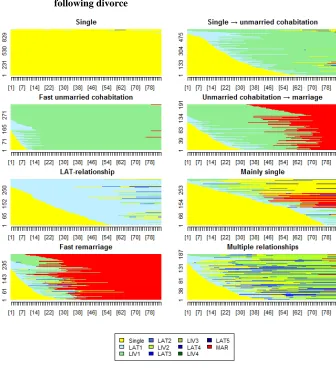
Figure 1: Sequence index plots of partner trajectories in the first seven years following divorce
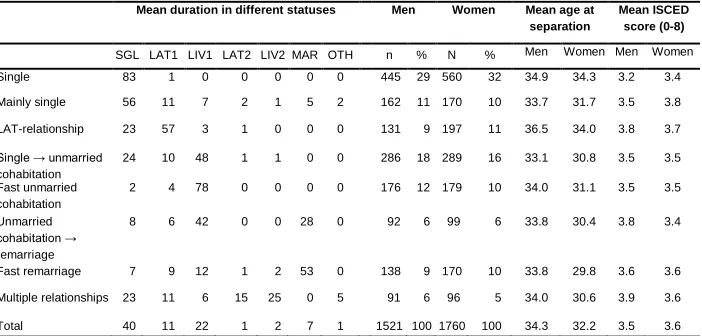
Table 1:
Mean duration in different statuses and frequency distribution
of partner trajectories in the first seven years following
divorce, by sex
Mean duration in different statuses Men Women Mean age at separation
Mean ISCED score (0-8)
SGL LAT1 LIV1 LAT2 LIV2 MAR OTH n % N % Men Women Men Women Single 83 1 0 0 0 0 0 445 29 560 32 34.9 34.3 3.2 3.4
Mainly single 56 11 7 2 1 5 2 162 11 170 10 33.7 31.7 3.5 3.8
LAT-relationship 23 57 3 1 0 0 0 131 9 197 11 36.5 34.0 3.8 3.7
Single → unmarried cohabitation
24 10 48 1 1 0 0 286 18 289 16 33.1 30.8 3.5 3.5
Fast unmarried cohabitation
2 4 78 0 0 0 0 176 12 179 10 34.0 31.1 3.5 3.5
Unmarried cohabitation → remarriage
8 6 42 0 0 28 0 92 6 99 6 33.8 30.4 3.8 3.4
Fast remarriage 7 9 12 1 2 53 0 138 9 170 10 33.8 29.8 3.6 3.6
Multiple relationships 23 11 6 15 25 0 5 91 6 96 5 34.0 30.6 3.9 3.6
Total 40 11 22 1 2 7 1 1521 100 1760 100 34.3 32.2 3.5 3.6
Note: SGL = Single, LAT1/LAT2 = LAT-relationship with, respectively, first and second partner, LIV1/LIV2 = Unmarried cohabitation with, respectively, first and second partner, MAR = Remarried, OTH: LAT- or unmarried cohabitation with third, fourth, or fifth partner.
The first trajectory is that of men and women who remain Single during the first seven years following divorce. This is the largest cluster in size. There is also a smaller cluster, Mainly single, in which divorcees are single for approximately five of the seven years. The cluster LAT-relationship contains divorcees who started a new relationship without cohabiting or remarrying. On average, this group had a non-residential partner for 4.5 years. All other clusters contain divorcees who started a new union. The first group, Fast unmarried cohabitation, (almost) immediately starts cohabiting, and lives with that new partner for 6.5 years on average. By contrast, in the group Single →
unmarried cohabitation, divorcees first live for approximately two years without a partner before starting to cohabit. Next, there are two clusters in which remarriage occurs, distinguished by the timing of the remarriage. In the cluster Unmarried cohabitation → remarriage, divorcees first live together unmarried for 3.5 years on average before getting married. The second group, Fast remarriage, remarries after about one year of unmarried cohabitation and is larger than the previous group. Finally, there is a small group of divorcees who cumulate consecutive partnerships in the seven years following divorce. This cluster is labeled Multiple relationships.
terms of the ISCED 2011-score, range 0 to 8 (F=3.2, df=7, p=0.0026). Men and women in the cluster LAT-relationship were on average older at the time of divorce and have a higher educational level compared to men and women in most other clusters. Men in the cluster Single are on average lower educated than those in other clusters, while women in this cluster are on average older than those in the other clusters.
3.2 A typology of parenthood trajectories following divorce
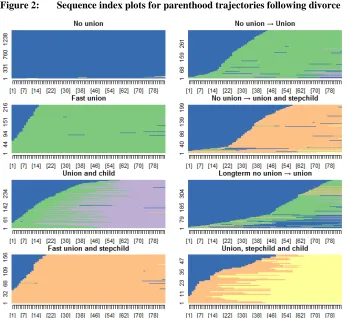
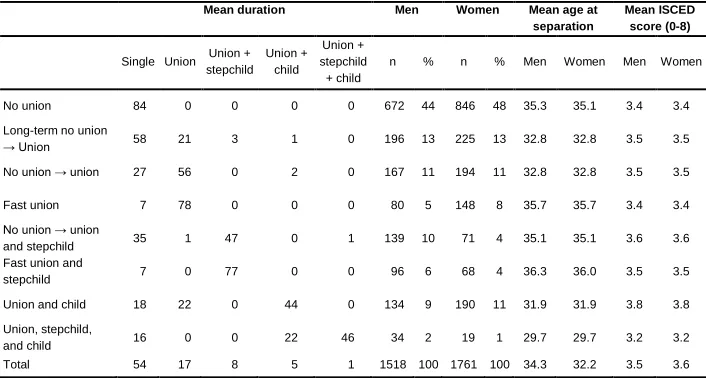
Next, we discuss the results for the parenthood trajectories of men and women following divorce. Figure 2 presents the sequence index plots for the different clusters. Table 2 reports the mean duration within the different statuses for each cluster and the frequency distribution of those trajectories for men and women separately.
The cluster No union contains divorcees who do not start a new union within the first seven years following divorce. The next three clusters contain divorcees who start a new union with a partner who does not have residential children from a previous union, and with whom they do not have a common child within that period. These three clusters are distinguished from one another by the duration of the singlehood period preceding the new union: Long-term no union → union (on average 5 years single), No union → union (on average 2 years single), and Fast union (on average 0.5 years single). The next two clusters contain divorcees who start a new union with a partner who brings in residential children. Within the cluster Fast union and stepchild, this happens on average within the first half year following the separation. Within the cluster No union → union and stepchild, men and women are on average single for three years after separation. Within the final two clusters, divorcees have a common child within their new union. In the cluster Union and child, the partner has no residential children from a previous relationship, in contrast with those in the cluster
Figure 2: Sequence index plots for parenthood trajectories following divorce
Table 2: Mean duration in different statuses and frequency distribution of parenthood trajectories in the first seven years following divorce, by sex
Mean duration Men Women Mean age at separation
Mean ISCED score (0-8)
Single Union Union + stepchild Union + child Union + stepchild + child
n % n % Men Women Men Women
No union 84 0 0 0 0 672 44 846 48 35.3 35.1 3.4 3.4
Long-term no union
→ Union 58 21 3 1 0 196 13 225 13 32.8 32.8 3.5 3.5
No union → union 27 56 0 2 0 167 11 194 11 32.8 32.8 3.5 3.5
Fast union 7 78 0 0 0 80 5 148 8 35.7 35.7 3.4 3.4
No union → union
and stepchild 35 1 47 0 1 139 10 71 4 35.1 35.1 3.6 3.6 Fast union and
stepchild 7 0 77 0 0 96 6 68 4 36.3 36.0 3.5 3.5
Union and child 18 22 0 44 0 134 9 190 11 31.9 31.9 3.8 3.8
Union, stepchild,
and child 16 0 0 22 46 34 2 19 1 29.7 29.7 3.2 3.2
Total 54 17 8 5 1 1518 100 1761 100 34.3 32.2 3.5 3.6
In contrast to the partner trajectories, there are clear differences in the male and female distribution of the trajectories (Chi-Square = 67.3, df = 7, p <0.001). There are twice as many men than women in the clusters No union →union and stepchild, Fast union and stepchild, and Union, stepchild, and child. Women more often have no new union within the first seven years following divorce, and if they do their partner has residential children less often.
4. Conclusion
In this paper we described the post-divorce family trajectories of men and women in terms of repartnering, union formation and remarriage, childbearing, and the transition to step-parenthood in Flanders. By looking at these transitions as a sequence of events instead of single, independent events, we gain insight into the order and timing of the partner and parenthood trajectories following divorce.
A first general conclusion concerns the prevalence of specific family transitions following divorce. Almost one in three men and women remain single during the first seven years following the residential separation with their spouse. The majority of men and women, however, repartner quite fast. Most of them have a quite stable post-divorce family life, and experience no additional relationship dissolution. Although we might underestimate the proportion of unstable (post-divorce) family trajectories due to the exclusion of second divorces from the SiV-sample, this underestimation is quite limited as the large majority of second divorces take place after age 50 (Corijn 2013). Two other reasons why unstable post-divorce trajectories might be underestimated are that only relationships that lasted for at least three months were reported in the dataset and that divorcees with unstable trajectories may participate less in surveys.
The second general conclusion is that there are important variations in the family trajectories of divorced men and women in Flanders. The obtained typologies nicely illustrate the heterogeneity in terms of the nature and timing of post-divorce partnerships (cohabiting or not, married or not), the birth of children within these new unions, and the parenthood status of the new partner. Within both typologies, none of the trajectories involving at least one transition can be identified as ‘the standard trajectory’, illustrating the outcome of the de-standardization of post-divorce family life during the last decades (Shanahan 2000). Nevertheless, despite this heterogeneity in trajectories, both cluster solutions have an ASW-value of 0.46 and 0.64, respectively, clearly identifying eight types of trajectory. This prevents the interpretation of complete de-standardization of the life course, and rather suggests the emergence of a limited number of alternative trajectories. It is also possible that post-divorce partner trajectories may once more become more standardized in the future. The men and women in the present study divorced in a period in which post-divorce unmarried cohabitation was gradually replacing remarriage as the standard living arrangement for higher order unions in Flanders (Pasteels, Lodewijckx, and Mortelmans 2013). At the end of this transition period, post-divorce partner trajectories may become more similar than during the transition period. For example, there might be a further decrease in the size of the clusters Unmarried cohabitation → remarriage and Fast remarriage, and an increase in the size of the clusters Fast unmarried cohabitation and Single →
figures indicate that single parents increasingly meet potential partners who also have children from a previous relationship, and that unions are frequently dissolved before men and women have realized their fertility aspirations. We might expect that these two trends will lead to a growing proportion of men and women in post-divorce family trajectories that involve at least one parenthood transition, or the two consecutive transitions of becoming a step-parent and experiencing an (additional or first) birth within a relatively short period of time.
References
Abbott, A. and Forrest, J. (1986). Optimal matching methods for historical sequences.
Journal of Interdisciplinary History 16: 471−494. doi:10.2307/204500.
Bastaits, K., Van Peer, C., Alofs, E., Pasteels, I., and Mortelmans, D. (2011). Hoe verloopt een echtscheiding in Vlaanderen? In: Mortelmans, D., Pasteels, I., Bracke, B., Matthijs, K., Van Bavel, J., and Van Peer, C. (eds.). Scheiding in Vlaanderen. Leuven: Acco: 85−112.
Beaujouan, E. (2012). Repartnering in France: The role of gender, age and past fertility.
Advances in Life Course Research 17: 69−80. doi:10.1016/j.alcr.2012.03.001. Buber, I. and Prskawetz, A. (2000). Fertility in second unions in Austria: Findings from
the Austrian FFS. Demographic Research 3(2). doi:10.4054/DemRes.2000.3.2. Corijn, M. (2013). Veranderingen in de burgerlijke staat doorheen de levensloop. In:
Corijn, M. and Van Peer, C. (eds.). Gezinstransities in Vlaanderen. Brussels: Studiedienst van de Vlaamse Regering, SVR-studie: 21−36.
Elzinga, C.H. (2007). Sequence analysis: Metric representations of categorical time series. Amsterdam: Vrije Universiteit Amsterdam, Dept of Social Science Research Methods.
Gabadinho, A., Ritschard, G., Studer, M., and Müller, N. (2011a). Mining sequence data in R with the TraMineR package: A user's guide (for version 1.8). Geneva: University of Geneva, Department of Econometrics and Laboratory of Demography.
Gabadinho, A., Ritschard, G., Müller, N., and Studer, M. (2011b). Analyzing and Visualizing State Sequences in R with TraMineR. Journal of Statistical Software
40(4): 1−37.
Green, L. (2010). Understanding the life course. Sociological and psychological perspectives. Cambridge: Polity Press.
Jefferies, J., Berrington, A., and Diamond, I. (2000). Childbearing following marital dissolution in Britain. European Journal of Population 16(3): 193−210. doi:10.1023/A:1026529300659.
Pasteels, I., Corijn, M., and Mortelmans, D. (2012). Een nieuwe partner na een echtscheiding? Opleidingsverschillen bij mannen en vrouwen in Vlaanderen.
Tijdschrift voor Sociologie 33(3-4): 331−352.
Pasteels, I., Lodewijckx, E., and Mortelmans, D. (2013). Gezinstransities in de levensloop van mannen en vrouwen. In: Corijn, M. and Van Peer, C. (eds.).
Gezinstransities in Vlaanderen. Brussels: Studiedienst van de Vlaamse Regering: 37−72.
Shanahan, M.J. (2000). Pathways to adulthood: Variability and mechanisms in life course perspective. Annual Review of Sociology 26: 667−692. doi:10.1146/ann urev.soc.26.1.667.
Studer, M. (2012). Etude des inégalitées de genre en début de carrière académique à l'aide de méthodes innovatrices d'analyse de données séquentielles, Chapitre: Le manuel de la librairie WeightedCluster: Un guide pratique pour la création de typologies de trajectoires en sciences sociales avec R [PhD thesis]. Geneva: University of Geneva, Faculty of Social and Economic Sciences.