in the population sciences published by the Max Planck Institute for Demographic Research Konrad-Zuse Str. 1, D-18057 Rostock · GERMANY www.demographic-research.org
DEMOGRAPHIC RESEARCH
VOLUME 19, ARTICLE 28, PAGES 1105-1144
PUBLISHED 01 JULY 2008
http://www.demographic-research.org/Volumes/Vol19/28/ DOI: 10.4054/DemRes.2008.19.28
Research Article
Sweden:
Combining childbearing and gender equality
Livia Sz. Oláh
Eva M. Bernhardt
This publication is part of Special Collection 7: Childbearing Trends and Policies in Europe (http://www.demographic-research.org/special/7/)
© 2008 Oláh & Bernhardt.
1 Introduction 1106
2 Fertility trends 1107
3 Proximate determinants of fertility 1114
3.1 Partnership trends 1114
3.2 Birth control and abortion 1117
3.3 Ideational changes 1120
3.3.1 Family ideals 1120
3.3.2 Norms and attitudes 1121
3.4 Changes in social conditions 1122
3.4.1 Ethnic composition 1122
3.4.2 Education 1123
3.4.3 Economic development 1127
4 Public policies modifying fertility and family behavior 1132
4.1 Parental leave 1133
4.2 Public childcare 1135
4.3 Housing 1136
5 Concluding remarks 1136
6 Acknowledgments 1137
Sweden:
Combining childbearing and gender equality
Livia Sz. Oláh1
Eva M. Bernhardt2
Abstract
Sweden is the forerunner of the Second Demographic Transition. Fertility trends have fluctuated greatly since the 1960s, and the 1990s showed both European-highest and lowest-ever-in-Sweden levels, while the cohort pattern has been relatively stable. Period fluctuations have been accompanied by a postponement of entering committed partnerships and parenthood as well as an increasing instability of family relationships. The awareness and the availability of effective contraceptives have been extensive since the mid-1970s, the year the liberal abortion law was introduced.
Post-modern values are dominant in this highly secularized society, but ideal family size is among the highest in the European Union, and childlessness has remained at a relatively low level. Ethnic diversification has increased over time, with about one-fifth of the population having a ‘foreign background’ in the early 2000s. The level of female labor-force participation is the highest in Europe (although mothers of pre-schoolers often work part-time), and young women are just as highly educated as men. Family policies, based on the principle of equality across social groups and gender, seem to play an important role in keeping fertility relatively high. In combination with other factors, family policies also play a role in the fluctuations of fertility rates, as eligibility to parental-leave and benefits as well as the availability of public childcare are linked to parents’ labor-force attachment.
1. Introduction
Sweden is well-known as the forerunner of the so-called Second Demographic Transition characterized by the dramatic transformation of family patterns towards less committed and more fragile couple relationships, by the later and less likely transition to parenthood, and by the sharp reduction of higher-order births currently taking place in Europe and European-origin populations (Lesthaeghe 1995). It may seem contradictory that Sweden, as a ‘pioneer’ of the Second Demographic Transition, commonly associated with low fertility, also exhibits one of the highest fertility levels in Europe, with a completed fertility close to replacement. This is an issue that has puzzled many researchers and continues to do so. In this chapter, we aim to shed some light on some of the crucial features of Sweden’s demographic and socio-economic landscape, hopefully increasing our understanding of this apparent paradox.
Sweden is the largest country in Scandinavia, both in terms of land area and population size – currently about 9.1 million. Period fertility has strongly fluctuated below the replacement level since the late 1960s along with a relatively stable cohort
pattern of about two children per woman for women born in the 20th century. High rates
of non-marital cohabitation, extramarital childbearing, and partnership break-up have accompanied this trend. The infant mortality rate is low and average life expectancy is high, even by international comparison, with 82.8 years for women and 78.4 years for men in 2005. Up to the 1930s, the country saw negative net migration, but following the Second World War Sweden became a land of immigration. In 1960, 4% of the population (ca. 300 000 people) was foreign-born, but this share increased to 12 % (over one million people) by the early 2000s. Including individuals born in Sweden with both parents born abroad, the proportion of those with a foreign background equals 16 % of the population in 2005 (SCB 2004a, 2006a). Because of immigration, the population growth rate has remained positive, unlike the growth rate in some other European countries. However, Sweden is among the five countries with the highest percentage of elderly aged 65+ in the population, displaying one of the highest dependency ratios in Europe (Council of Europe 2005). Thus, population aging, which is the result of long-term below replacement fertility and low mortality, is a major concern of policy makers owing to the challenges it imposes on the welfare state.
the early 1970s, and female employment rates in Sweden have been among the highest in Europe ever since, with nearly one-third of mothers of pre-school-aged children working part time (SCB 2003a). The vast majority employed in the public sector are women, which at least partly explains why the occupational structure in Sweden has remained markedly gender-segregated. Yet, gender equality is promoted also by family policies as seen in the parental-leave system introduced in the mid-1970s. These policies, with further reforms since, enhance fathers’ involvement in active parenting and the provision of subsidized, high-quality public childcare enable women and men to combine employment and parenthood. In fact, it has been argued that Swedish fertility, relatively high compared to most other European countries at least, is due to the construction of Swedish family policy (Bernhardt 1992) and the ‘woman-friendly Swedish political culture’ (Hoem 2005, p. 568).
In this chapter we analyze recent childbearing trends in Sweden. First, we discuss
the development of fertility in the 20th century with an emphasis on the final decades,
focusing thereafter on the most important proximate determinants of fertility. Next, ideational changes are highlighted, followed by a discussion of changes in social conditions and on public policies that modify family behavior. Concluding remarks on fertility development and its explanations round up the chapter.
2. Fertility trends
After a nearly continuous decline over the first four decades of the 20th century
Fertility continued to rise with the period TFR reaching 1.77 (101 000 children born) in 2005 (SCB 2002a, 2004b, 2006b).
Figure 1: Period and cohort total fertility rates, Sweden, 1900-2005, cohorts
born 1870-1970
1.0 1.5 2.0 2.5 3.0 3.5 4.0 4.5
1900 1915 1930 1945 1960 1975 1990 2005
Calendar year
period TFR cohort TFR
1870 cohort
1905 cohort
1935 cohort
1970 cohort
Source: SCB 2002a, 2006b, Council of Europe 2005.
Note: The time lag between the period TFR and cohort TFR is 30 years.
While the period TFR has remained below the replacement level since the late 1960s (except 1990), most cohorts born in the 20th century have displayed a fertility
level of around two children per woman. Completed cohort fertility also showed more moderate fluctuations than did period fertility trends (see Figure 1). Women born in 1904-1905 had the lowest fertility, with 1.8 children on average, while the cohorts born in the first half of the 1930s saw the highest fertility (nearly 2.2). For younger cohorts, especially those born in the 1970s or later, fertility is expected to remain below two children per woman (SCB 2002a).
partly related to the deferment of parenthood. Delaying the first birth increases the risk of childlessness and, given the biological limits, it reduces the span available for reproduction and thereby the number of children born to the women involved. Within a period of 35 years the age of entry into parenthood increased by five years, from a mean age of 24 and 26.6 for first-time mothers and fathers, respectively, in 1970 to 29 and 31.5 years in 2005 (SCB 2002b, 2006a) (see Figure 2). Looking at cohorts born 30 years earlier, we can link the start of the postponement of parenthood to those born in the mid-1940s. For the 1960 cohorts, there is no noticeable difference in the mean age at first childbearing by cohort and period. While we do not have data for cohorts after 1960, there is no reason to assume any changes in this pattern.
Figure 2: Mean age at first birth for mothers and fathers, Sweden,
1970-2005, and for selected cohorts born 1940-1960
20 22 24 26 28 30 32 34
1970 1975 1980 1985 1990 1995 2000 2005
Calendar year
Period mother Period father Cohort mother Cohort father
The increase in the mean age of first childbearing over time is the result of the strong variations in younger women’s first-birth fertility and a smooth but nearly constant increase in first childbearing among women aged 30 and above. From the mid-1960s to the mid-1980s, the propensity to have a first child declined among women below 30 years of age, it increased thereafter until the early 1990s, when it declined again but stabilized in 1998, and it increased slightly after 2000. For women in their 30s, the propensity of first birth rose from the early 1980s, followed by a decline in the 1990s, only to climb again since 1998 (Andersson 2004a). First-birth rates among women in their 40s increased over time, even in the 1990s. Men’s first childbearing patterns are very similar to those of women, but men are on average two years older than women when they have a first child (SCB 2002a).
Strong period fluctuations characterized the higher-order birth rates as well. Second-birth fertility fell in the late 1960s but became rather stable thereafter. It increased sharply as birth intervals shortened related to changes in the parental-leave program in the 1980s. Currently, almost half of all second births occur before the first child turns 2.5 years of age. The propensity of second birth declined between 1992 and 1997, but rose again thereafter (SCB 2002a, Andersson 2004a). The two-child norm is well established in Sweden. Among those who become parents before age 35, about 80% also have a second child. At the same time, only 20% of all births are of third or higher order (SCB 2002a). Between the mid-1960s and 1977, third- and fourth-birth rates decreased, then the trend reversed. The increase was interrupted in the early 1990s, followed by a decline that stabilized and slightly reversed after 1997 (Andersson 2004a).
As mentioned, the strong fluctuations of period fertility rates were accompanied by a rather smooth pattern of increasing postponement of childbearing over time. In the 1960s and 1970s, fertility was highest at ages around the mid-20s (25-26 years), shifting gradually to the late 20s from the mid-1980s (Figure 3). In 2005, the highest fertility displayed was at the age of 30. Similarly, since the 1990s next highest fertility has been seen for the ages of late 20s and early 30s, instead of the early 20s, as was
previously the case. At the beginning of the 21st century, women aged 29-31 have the
Figure 3: Age-specific fertility rates for women aged 15-49 years, selected years 1965-2005
0 20 40 60 80 100 120 140 160 180
15 20 25 30 35 40 45
Age
F
e
rt
ili
ty
r
a
te
(
p
e
r
1
0
0
0
w
o
m
e
n
)
1965 1975 1985 1995 2005
Source: SCB 2006c.
Figure 4: Accumulated fertility up to certain ages for female birth cohorts 1925-1965
0.0 0.5 1.0 1.5 2.0 2.5
1925 1930 1935 1940 1945 1950 1955 1960 1965 Birth cohort
20 25 30 35 40 45
Source: SCB 1999. Note: Up to and including age.
1950s. Nevertheless, the share of families with more than two children has been quite stable – around 30% across the cohorts displayed here (SCB 2006c). This, in combination with the high proportion of two-child families and a moderate level of childlessness, can explain the rather stable pattern of cohort fertility in Sweden.
Figure 5: Cohort parity distribution, women born in 1925-1960
0 5 10 15 20 25 30 35 40 45 50
1925 1929 1933 1937 1941 1945 1949 1953 1957 Birth cohort P ro p o rt io n o f w o m e n ( % ) b y t h e n u m b e r o f c h ild re n b o rn childless 1 child 2 children 3 children 4+ children
Source: SCB 2006c
3. Proximate determinants of fertility
3.1 Partnership trends
Fertility development has been closely related to changes in partnership trends. With the exception of a small increase in 1974 when both divorce and marriage procedures were simplified and apart from a ‘marriage-boom’ in 1989 when, related to changes in the widows-pension rules, the number of marriages nearly trebled compared to the 1970s and 1980s (Hoem 1991), the propensity to marry decreased steadily in Sweden from the late 1960s. At the same time, the prevalence of non-marital cohabitation increased rapidly, first among divorced women, then also among the never-married. Of the co-residential partnerships of Swedish women and men aged 25-34, 85% are cohabiting unions, according to data from the Eurobarometer Surveys of 2000 and 2001 (Kiernan 2004). In fact, at the beginning of the 21st century, only a small fraction of
first partnerships starts as marriage (Andersson 1998, Bernhardt 2002). This may also be linked to the concept of gender equality, as own earnings and thereby financial independence have increasingly enabled women in Sweden to postpone marriage without giving up the advantages of a co-residential relationship.
In the mid-1970s, childbearing began to precede marriage, as having children in
cohabiting relationships had become accepted3 (Thomson 2005). Since then, the mean
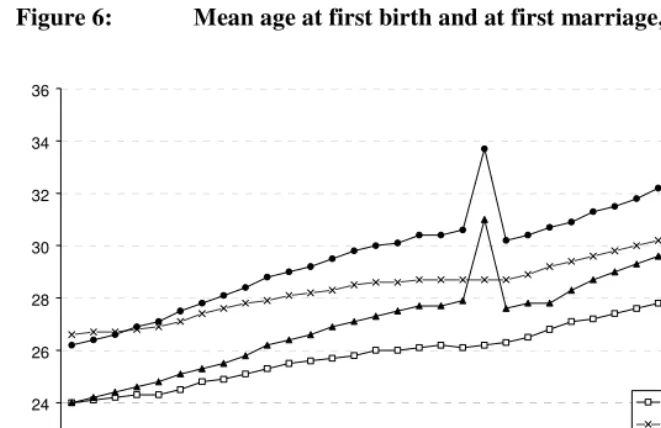
age at first birth has been below that of first marriage; both events being increasingly delayed (see Figure 6). The proportion of extramarital births in Sweden has been among the highest in Europe for decades, yet the share of births to single mothers4 has
remained at around 10 per cent except for the mid-1990s (SCB diff. yrs., 2005a, 2006c). Couples often marry after the first or second birth. Today, nearly 60% of all children and two-thirds of all first children are born in non-marital cohabiting relationships in Sweden (Figure 7). Birth intensities are usually higher, however, for married women than they are for cohabiting women at least up to parity 3 (see Berinde 1999; Santow and Bracher 2001; Oláh 2003, forthcoming).
3 Children born within and outside marriage have the same rights in Sweden since the late 1960s (Kiernan 2004).
Figure 6: Mean age at first birth and at first marriage, 1970-2005
20 22 24 26 28 30 32 34 36
1970 1975 1980 1985 1990 1995 2000 2005
Calendar year
Mother 1st birth Father 1st birth Woman 1st marriage Man 1st marriage
Source: SCB 1999, 2002a, 2006b.
Divorce rates have increased in parallel with decreasing marriage rates. Due to the liberalization of the divorce law (i.e., no-fault divorce, no waiting time for couples without children and merely 6 months for those with children), the divorce risk rose to around twice its previous level in 1974, mostly due to an increasing propensity among childless women to divorce. Then and in the following year, the number of divorces exceeded 25 000 compared to a maximum of 16 000 a year previously, resulting in a total divorce rate of 0.5 (50 of 100) (Council of Europe 2005; SCB 2007a). From the 1980s, especially the late 1980s, the divorce propensity increased again, but this time mainly for mothers. The increase leveled off at the beginning of the 21st century
independence and empowered them to leave an unsatisfactory relationship even if they have children.
Figure 7: Proportions of extra-marital births in 1900-2005, and of births to
single mothers (%), 1995-2005
0 10 20 30 40 50 60
1900 1915 1930 1945 1960 1975 1990 2005
Calendar year all non-marital
single mother
Source: SCB diff. yrs., 2005a, 2006c, 1996-2001, 2001-2003, 2004-2005.
Note: Own calculations regarding the proportion of births to single mothers, based on data from SCB 1996-2001, 2001-2003, 2004-2005.
shortened, which can suppress the number of children eventually born. Nevertheless, the number of higher-order relationships formed in the reproductive years increased (Bernhardt and Goldscheider 2002), and possibly childbearing in such unions did so, too. It has been shown, e.g., that Swedish women whose first and second children were born in different relationships had a higher third-birth intensity than those who had two children with the same partner (Hoem and Hoem 1989). In 2001, about 6% of two-child parents had their children with different partners compared to nearly one-fifth of those with three children (SCB 2002b). Stepfamily fertility is, however, a complex phenomenon (see e.g., Vikat et al. 1999) and to estimate its contribution to the total fertility of the country is beyond the scope of this paper.
3.2 Birth control and abortion
Pregnancy interruption was a crime prior to 1975, but the Abortion Law of 1938 did allow some exceptions: abortions due to medical, humanitarian, and eugenic indications. In 1946, a socio-medical indication was added, which made abortion an option for women with many children who lived in difficult economic circumstances. Since relatively young, healthy women with no or only few children were denied the procedure, the number of illegal abortions remained high well into the 1960s. A more liberal interpretation of the old abortion law then became normal practice, which resulted in a gradual disappearance of illegal abortions. In the mid-1970s, a new abortion law was enacted, which stipulated legal abortion on demand up to the 12th week of pregnancy. The new law was combined with a regulation providing free contraceptive advice and subsidized contraceptives. The main aim of the new policy was to prevent unwanted pregnancies and to make all children born, wanted children. This has been an important prerequisite for the combination of work and family, which has been the dominating pattern for several generations of Swedish women.
traditional methods might be the fact that abortion on demand has been available (as a backup for contraceptive failure) since the mid-1970s (and was, in fact, quite easily available even before that, with the old abortion law). This may also explain the relatively infrequent use of sterilization in Sweden. A new law introduced in 1976 has permitted the sterilization of men and women above age 25. An estimated 10% of middle-aged couples have relied on this method of birth control at the end of their reproductive period. In 75 % of the cases, it is the woman who is sterilized. Swedish couples prefer to rely on safe but reversible methods, giving them a ‘second chance’ to have children with new partners after the break-up of earlier relationships.
A recent study on the changing seasonality of births in Sweden (Cassel 2002)
suggests that births increasingly are consciously planned, as the last decade of the 20th
century exhibits a complete break in the seasonality pattern. Given frequent sexual activity during holiday periods, more children used to be born in early spring and fewer in the autumn before modern contraceptives and abortion were readily available. Under the new pattern, more children are born in the summer as conceptions are planned more consciously.
The first infant conceived using IVF (in vitro fertilization) in Sweden was born in 1982. In the early 21st century, the annual number of such deliveries had grown to about
1500, representing a little less than 2% of all deliveries. The use of the technique follows the maternal education level (Socialstyrelsen 2006a). Part of this may be due to differences in the maternal age distribution between women of different educational levels: Women with higher education postpone their pregnancies longer than those with lower education and with increasing age, the risk for infertility increases and so does the risk of IVF.
Figure 8: Number of induced abortions per 1000 women in different age groups, 1975-2005 0 5 10 15 20 25 30 35 40
1975 1980 1985 1990 1995 2000 2005
Calendar year N u m b e r o f a b o rt io n s (p e r 1 0 0 0 w o m e n a t th e a g e i n f o c u s ) 15-44 < 20 20-24
Source: Socialstyrelsen 2000, 2006b.
3.3 Ideational changes
3.3.1 Family ideals
Swedes attach a high importance to the family. Yet, the country has a weak family system, where the individual takes priority over the family group, and young people leave the parental home at a relatively early age; in most cases to live independently before forming co-residential unions of their own (Bernhardt et al. 2005a). In his study of family ties in Western Europe, Reher (1998) describes the Swedes as committed to ‘individualism and residential autonomy’. Thus, it may seem surprising that according to the European Values Study, including 32 European countries (Halman 2001), Swedes are somewhat more likely than the ‘average European’ to say that the family is very important in their life. Children are considered important but not necessary for a fulfilling life, in line with the post-modern values dominant in Sweden, which are also reflected in the higher than average proportions who say that friends and leisure are very important in their life. Further evidence of post-modern values is found in the high tolerance towards childlessness and alternative family forms other than marriage with joint children.
It is noteworthy that, in a country characterized by a high prevalence of unmarried cohabitation, as much as 80% of the population disagree with the statement that marriage is an outdated institution. Swedes also tend to think that both husband and wife should contribute to the household income (higher than average) and that paid work is important for women’s independence. Fewer than average think that home and children are more important to women than paid work. The European Values Study thus gives a clear picture of a society where egalitarian families are a prominent part of the overall value structure. It is also well known that Sweden is a highly secular country, and this is reflected in the responses to the question of how important God is in one’s life. Sweden (and Denmark) score the lowest of all of the 32 countries included in the study. Swedish survey data for young adults show that the relatively few (about 14%) who consider religion important in their lives score significantly higher on familism than those who consider religion unimportant (unpublished results).
3.3.2 Norms and attitudes
Studies on the impact of culture and norms on individual childbearing behavior are so far relatively rare in Sweden, despite strong theoretical underpinnings. An exception is Bernhardt and Goldscheider (2006), who analyzed Swedish survey data (Family and
Working Life in the 21st century) on attitudes toward parenthood among young adults
aged 22-30 in 1999, some of whom became parents over the following four years. While both men and women perceive more benefits to parenthood than costs, men are more likely to perceive both the negative consequences of parenthood, such as loss of personal freedom, economic problems and less time for friends, and they are more likely than women to expect positive consequences, such as an improvement in their relationship with their partner and a life with more meaning. However, men with more egalitarian attitudes perceive fewer costs and more egalitarian women perceive fewer benefits than those with more traditional attitudes. The analysis of the transition to parenthood indicates that, even when controlling for an assessment of the costs and benefits of children, men with more traditional attitudes were more likely to become fathers at an early age. In contrast, there were no gender differentials in the effect of the costs and benefits, each of which strongly affected the transition to parenthood, but, of course, in opposite directions.
Bernhardt and Goldscheider (2007) have analyzed three different aspects of socially constructed gender expectations among young adults in Sweden. Namely these are the preferred balance between work and family when the couple has pre-school children, views on whether parents should share equally the responsibility for child care tasks, and attitudes to gender equality in the workplace and in the society at large. Men and women did not seem to differ in their views on shared parenting, i.e., concerning parental responsibilities in everyday life, norms about how the practical tasks with regard to childcare should be shared. In contrast, young women are much more in favor of gender equality in work life, economic autonomy, and an egalitarian work-family balance. This gender differential may be due to different notions about the division of
housework, with men being less enthusiastic about housework than about childcare5.
Another study, using the same data set, focused on the relationship between attitudes, evaluations, and intentions on the transition to marriage or separation among cohabiting young adults, in the Swedish context of considerable social acceptance of unmarried cohabitation even among parents (Moors and Bernhardt 2006). Which ideational factors influence their propensity either to formalize their relationship by getting married or to split up? A two-wave panel study including 705 never-married
respondents cohabiting at the time of the first survey in 1999 shows that ideational factors influence subsequent behavior, even when different sets of control variables were included in the model. In the four-year period following the first survey, there were 113 separations and 168 marriages, while 414 respondents were still cohabiting with the same partner four years after the initial survey.
As was hypothesized, familistic attitudes were found to influence subsequent transitions among cohabiting couples, making marriage more likely and decreasing the likelihood of separation. Work-related values of success, by contrast, increased the likelihood of both transitions, indicating that ‘career-orientation’ either leads to a more stable form of living arrangement, i.e., marriage, or, if the relationship is not satisfactory, to a break-up. Respondents who were highly satisfied with their current relationship were more likely to marry and less likely to separate, while those who felt that being single again would improve their well-being, behaved in the opposite way, confirming the authors’ hypotheses and corresponding with earlier findings. Intentions to marry and childbearing plans (among the childless) also influenced behavior among cohabiting couples, making them more likely to marry and less apt to separate. Intentions only partly mediate the effect of attitudes and effects appear to be stronger for female respondents.
3.4 Changes in social conditions
3.4.1 Ethnic composition
The increasing prevalence of new family ideals, norms, and attitudes has been accompanied by changes in different aspects of social conditions, among other things, by changes in the ethnic composition of the population. While previously a relatively homogeneous society, immigration has become an important component of population growth in Sweden in the second half of the 20th century. In the 1960s, labor-force
immigration dominated, mostly from other Nordic countries, but also from Southern Europe. From the mid-1970s, the main reason for immigration has been family reunification, as well as asylum. In the 1990s, a large number of refugees came from the Balkans. Yet, the proportion of immigrants of non-European origin has been constantly increasing. Currently more than every fifth person in the Swedish population has a ‘foreign background’, i.e., they are foreign-born or born in Sweden to foreign-born parents, including the 6% of the population with one parent born abroad (SCB 2004a).
to family and work, young adults living in Sweden with at least one parent born in Poland or Turkey were compared to native Swedes (i.e., those with two Swedish-born parents) of the same age (Bernhardt et al. 2005b). Young women and men of Turkish origin displayed a more distinct family pattern than the other groups as they were much more likely to live in the parental home while unmarried, much less likely to cohabit, and much more likely to be married, although they held more favorable attitudes towards cohabitation than their behavior would suggest. Also, they were less supportive to inter-partnering and fewer considered an egalitarian work-family balance as ideal, where women and men share support and care giving responsibilities for young children (60% versus 75% among the native Swedes and those of Polish origin). Women were more egalitarian in all ethnic groups than men, but the difference was largest in the group of Turkish origin. Not surprisingly, educational attainment and exposure to Swedish society (in terms of neighborhood composition) were found to be important determinants of family attitudes and behavior of young adults of both ethnic origins studied, with implications for prospective changes in both behavior and attitudes, approaching those of the native population (for further details on this issue, see Bernhardt et al. 2007).
The fertility of immigrants has not been studied much in Sweden, but the few important exceptions (Andersson 2004b; Andersson and Scott 2005) show that period fertility trends of Swedish-born and immigrant women have been quite similar for several decades, and during the 1990s, birth-intensities for parities 1-4 decreased for these groups alike. Labor-market status was found to be important for the timing of first birth of both native and foreign-born women in the 1980s and 1990s, as low income reduced the propensity to become a mother while high income increased it, as did a good local business climate. Being enrolled in education greatly suppressed fertility across all groups. Contrary to public belief, immigrant women who received social assistance (i.e., welfare benefits) had a 30-60% lower risk to have a first child than Swedish-born women, except for those born in Finland, Germany, and Thailand, all of whom are most likely to live with a Swedish man (Andersson and Scott 2005).
3.4.2 Education
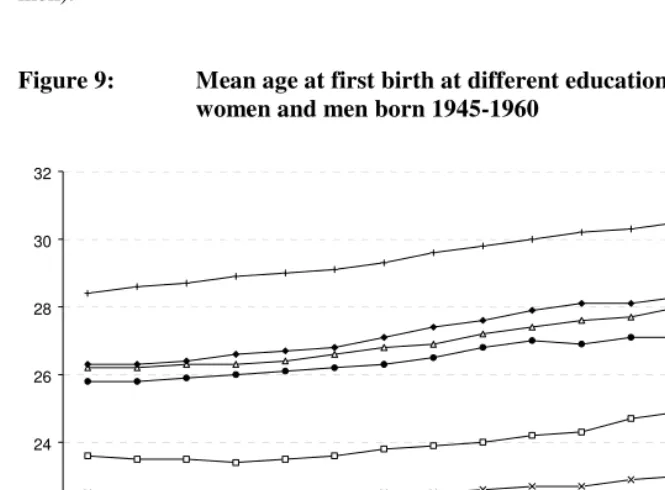
education diminished across cohorts, from about one-third of the 1945 cohort to 12% among women and 18% among men born in 1960. These changes in educational levels also had implications for fertility, related especially to the postponement of parenthood. While the deferment of first birth is noticeable for all educational levels across the 1945-1960 cohorts (Figure 9), it is greater at the highest than at the lowest educational level (2.2 years versus 0.9 years, respectively for women, and 2.0 versus 1.4 years for men).
Figure 9: Mean age at first birth at different educational levels for Swedish
women and men born 1945-1960
20 22 24 26 28 30 32
1945 1946 1947 1948 1949 1950 1951 1952 1953 1954 1955 1956 1957 1958 1959 1960 Birth cohort
w.primary w.second. w.tertiary m.primary m.second. m.tertiary
Source: SCB 2002a.
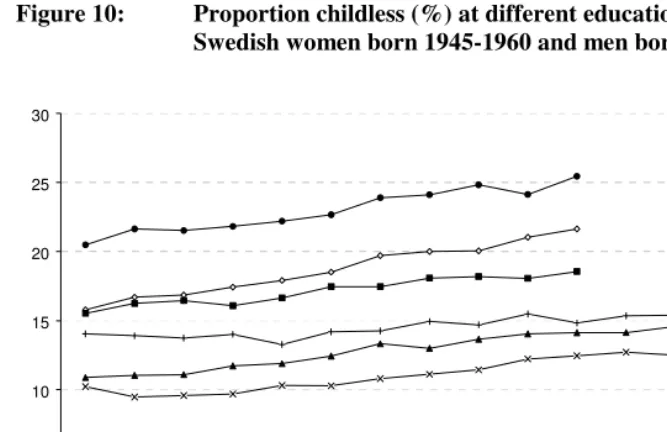
across cohorts (Figure 11), even though the propensity to have a child is at least as high for the highly educated women as for those with less schooling. The more educated become mothers at a higher age and therefore have a shorter reproductive span and thus fewer children than the least educated (SCB 2002a).
Figure 10: Proportion childless (%) at different educational levels for
Swedish women born 1945-1960 and men born 1945-1955
0 5 10 15 20 25 30
1945 1947 1949 1951 1953 1955 1957 1959 Birth cohort
w.primary w.second. w.tertiary m.primary m.second. m.tertiary
Figure 11: Average family size (number of children) among parents at different educational levels, Swedish women born 1945-1960 and men born 1945-1955
2.0 2.1 2.2 2.3 2.4 2.5 2.6
1945 1947 1949 1951 1953 1955 1957 1959 Birth cohort
w.primary w.second. w.tertiary m.primary m.second. m.tertiary
Source: SCB 2002a.
policies than the level of education alone, as it reflects the structure of the educational system inclusive of its gender aspects as well as a person’s preferences regarding occupation and family life.
3.4.3 Economic development
Female labor-force participation had already been substantial before women’s educational attainment approached that of men. Since the 1970s, female employment rates in Sweden have been among the highest in the developed world, nearly catching up with those of men (Figure 12). The high level of female employment was seen as a main reason for the fertility decline between the mid-1960s and the mid-1980s, although changes in attitudes as well as the availability of increasingly effective contraceptives (e.g., the pill, IUD), which allowed women to take control over their childbearing, were probably just as important for fertility trends (SCB 2002a). In the second half of the 1980s, increasing female labor-market participation was accompanied by a substantial increase in fertility, followed by a dramatic decline of both birth rates and employment rates in the 1990s. The pattern of pro-cyclical fertility was shown to be generated by childbearing behavior that was strongly attached to
income development at the micro-level6, given the income-related parental-leave
benefits parents of young children receive in Sweden (for details, see the next section) (Andersson 2000). This was also shown at the macro-level given the positive association of first-birth rates and municipal employment levels (see Hoem 2000). The positive effect of income on the propensity to give birth was found to be strongest for young childless women. The effect was positive but less intense for first birth among women in their thirties, and even more moderate for second birth. Also, among men higher income was found to be positively associated to the propensity to have the first child. For those below age 30, the effect of income was smaller for men than for women, unlike in the ages of thirties and forties (RFV 2001). As for third-birth rates, it was shown that women with a high income had a higher propensity, while the pattern was U-shaped among men, i.e., both for those with high and those with low income had higher third-birth rates than other men (RFV 2003).
Figure 12: Labor-force participation rates for Swedish women and men, 1963-2004
50 55 60 65 70 75 80 85 90 95
1963 1968 1973 1978 1983 1988 1993 1998 2003 Calendar year
Men Women
Source: OECD 2006.
Note: Total labour-force (% of population from 15-64 years).
Sweden was hit by severe economic crisis, we find the greatest increase in the proportion of those studying among women at ages mid- and late 20s, followed by the early thirties (Figure 15). The growth in the proportion enrolled in education has been more moderate among men (i.e., about half that of women) for these age groups (SCB 2007b).
Figure 13: Unemployment rates for Swedish women and men, 1963-2004
0 2 4 6 8 10 12
1963 1968 1973 1978 1983 1988 1993 1998 2003 Calendar year
Men Women
Source: OECD 2006.
Figure 14: Age of labor-market establishment among Swedish women and men, 1987-2004
0 5 10 15 20 25 30 35
1987 1989 1991 1993 1995 1997 1999 2001 2003 Calendar year
Men Women
Source: SCB 2002c, 2006d.
which became increasingly difficult to obtain for young people in the 1990s. Thus, the compositional changes (i.e., the doubling of the proportion enrolled in education, a substantial increase of the fraction of young people with temporary employment contracts, and the smaller share of those with a permanent position and a good income) can explain at least part of the decline in first and second-birth rates in the 1990s.
Figure 15: Proportion of Swedish women and men (%) enrolled in higher
education at different age groups, 1993-2004
0 5 10 15 20 25 30 35
1993 1994 1995 1996 1997 1998 1999 2000 2001 2002 2003 2004 Calendar year P ro p o rt io n ( p e rc e n t) e n ro lle d i n h ig h e r e d u c a ti o n b y a g e g ro u p w. 20-24 w. 25-29 w. 30-34 m. 20-24 m. 25-29 m. 30-34
Source: SCB 2007b (own calculations).
Note: Data on enrolment by age are available only for the years displayed here.
received unemployment benefits in either of the two preceding years, compared to those in continuous employment (Hank 2001). The explanation of unemployment having a positive effect on childbearing may be linked to the Swedish parental-leave program, according to the authors of these studies. This is due to the fact that parental benefits may be higher than unemployment benefits, facilitating the decision to have a first child especially when one’s prospects for employment are not really bright. Mothers can take advantage of the so-called speed-premium, which again would ensure as high a level of benefits as after the previous birth if the next child is born within 30 months (see details in the next section).
To claim a straightforward positive association between unemployment and fertility would be premature, however. Monthly time series of conceptions and abortions for the period 1987-2000 show that the rising unemployment rate in the early 1990s was followed almost immediately by a decrease in conceptions (Cassel 2005). With a delay of about one and a half years, abortions started to increase. Thus, both conceptions and abortions followed the unemployment trend, and they worked together to decrease the annual number of births. Out of the total decline in births from September 1991 to March 1997, 23% were due to a fall in conceptions given widely practiced efficient contraception, and 5% were due to a rise in the abortion risk. Hence, there is no doubt that economic development has become an important determinant of fertility in Sweden, not unrelated to changes in public policies.
4. Public policies modifying fertility and family behavior
It is not the stated goal of Swedish family policy to encourage childbearing or to keep the fertility rate at a certain level. It is, however, the stated goal of Swedish gender equality policy to enable both women and men to combine jobs with parenthood. For example, the Equal Opportunities Act of 1992 states that it is each employer’s obligation to make it easier for both male and female employees to combine work and parenthood. In fact, family policies and gender equality policies in Sweden are not two separate entities, but are closely interwoven and constructed to mutually support each other. It has been argued that gender-equal family policy in Sweden has been successful, i.e., in promoting a gender-equal society, in keeping the relatively high birth rate, and in providing support for families and children (Bernhardt 2005; Hoem 2005).
couples. As for transfers regarding children, there is no distinction based on whether they were born within marriage or not. The main principle of social security in Sweden is that every adult is responsible for her or his maintenance through own earnings, unless being incapable of work because of sickness, disability or old age in which case she/he is eligible for special social provisions (sickness benefits, pension). There is no spousal alimony at divorce as both women and men are expected to be in paid work, which is promoted also by individual taxation introduced in 1971 (Oláh 1998). Yet, gender equality applies not only to labor-force participation but also to family responsibilities, with family policies facilitating the combination of employment and childrearing for both women and men.
4.1 Parental leave
The most important component of Sweden’s family policy is the highly flexible parental-leave program introduced in 1974. Sweden was the first country in the world to acknowledge fathers as caring parents on a par with mothers. Parents who were in paid work for at least six months in the year prior to a birth were provided with a six-month leave, with 90% income replacement to be shared between themselves. Those with shorter or no previous employment have received a flat-rate benefit, which is currently 180 SEK per day (Försäkringskassan 2006a; JÄMO 2006). The parental benefit is taxable and paid by National Social Insurance, not by the parent’s employer. Job security and pension entitlement is attached to the leave, which can be used on a daily or nearly hourly basis up to the eighth birthday of a child.
of people in their 20s enrolled in education as well as difficulties to find a stable job, especially at ages below 30.
Since 1995, one month of the parental-leave has been reserved for the father and another month for the mother in order to promote a more gender-equal uptake of the leave. At the same time, the benefit level has been reduced to 80% of the previous income except for the last three months, and to 75% in 1996-1997. It may not be a pure coincidence that the two years following the further reduction of the benefit level also displayed the lowest TFR ever recorded in Sweden (1.5 in both 1998 and 1999), especially in combination with the economic hardships that families experienced due to the economic recession (Hoem 2000; Hoem 2005). The benefit level was increased again to 80% in1998 (Sundström and Duvander 2002) and has not changed since. From 2002, the leave includes 16 months in total, of which 2 months are reserved for each parent, the rest to be divided as the parents wish.
As part of the leave has been reserved for fathers since the mid-1990s, the proportion of men taking leave has increased, but the average length of leave they take shortened at least partly due to the reduction of the benefit level (RFV 2002). Highly educated fathers, those with a higher income and/or with a highly-educated partner are more likely to take parental leave than other fathers, while men with a weak labor-force attachment and foreign-born fathers are much less likely to do so. At present, nearly half of the users of the parental-leave are fathers, but their uptake is about one-fifth of all leave days a year (Försäkringskassan 2006b). Father’s uptake of parental-leave seems to be of importance to keep fertility relatively close to the replacement level in Sweden, as it has been shown to increase the propensity to have a second and/or third child (Oláh 2003; Duvander and Andersson 2006).
4.2 Public childcare
The combination of employment and parenthood, and thus gender equality, is also promoted by the extensive provision of high-quality public childcare in Sweden. This is also considered as a guarantee of equality regarding the provision of care and education as well as the redistribution of resources between children across social classes and ethnic origin. Public childcare is provided mainly by the municipalities, financed by government subsidies and to a minor extent by parents’ fees. The latter is linked to family income and the number of hours a child spends in the daycare center; but has a ceiling (the so-called maxtaxa, introduced in 2002). In the 1970s and 1980s, the state and the municipalities each covered about 45% of the costs, but the proportion of parents’ contribution rose to 17% by the late 1990s (Bergqvist and Nyberg 2002).
Public childcare is available for parents of pre-school aged children, the former who study or who are gainfully employed for at least 20 hours a week. Since 2002, even children of unemployed parents and those on parental-leave are guaranteed three hours a day at the daycare center (Bernhardt 2005). Today, nearly all children of full-time working parents have a place in public childcare, with only small differences across educational levels and socio-economic statuses. The proportion of children aged 0-6 years enrolled in public daycare centers increased from 2% in 1966 to 53% in 1996, while the share of children in public family daycare increased from 1 to 17%. The share
of childcare provided by the private market7 increased to nearly 15% by the late 1990s
(Björnberg 2002), as non-municipal childcare centers have become eligible for public subsidies since 1991.
The childcare system has usually been seen as a key factor for Sweden’s relatively high fertility rates, but the impact of regional variations in the quantity, quality, and price of daycare on continued childbearing was found to be limited, at least in the late 1990s (Andersson et al. 2004). According to the authors of the study, this suggests that the overall coverage of childcare is currently sufficiently high in Sweden for fertility decisions to be made independently of specific characteristics of childcare in the local area.
4.3 Housing
While not directly related to family policy, housing availability is another issue of importance for childbearing. In a survey on Swedish women and men aged 30-45, good housing was considered as the third most important economic factor that affected the respondents’ childbearing decisions (Löfström 2003). This finding is related to the growing influx of young people to the large cities in the 1990s, when housing construction remained relatively limited resulting in dramatically increasing housing costs. Birth rates have remained relatively low in the large cities, as the number of childless people is high and those having their first child in a large city municipality seem to be less likely to have further children (SCB 2005b) – both of these are likely to be linked, among other things, to housing availability. However, the issue has hardly been studied. As an exception, a preliminary analysis of data from a recent Swedish survey on housing and childbearing indicates that the housing shortage contributed to the fertility decline of the 1990s (Ström 2006).
5. Concluding remarks
Sweden has been seen as the ‘model country’ of the Second Demographic Transition, given the substantial changes in family patterns, both for partnerships and childbearing, as early as in the late 1960s-early 1970s. The strong period fluctuations in fertility in the final decades of the 20th century have been accompanied by quite a stable cohort
Female labor-force participation rates in Sweden have been among the highest in Europe. This also was considered as a main reason of the fertility decline between the mid-1960s and early 1980s, along with the increasing dominance of post-modern values and the availability of effective modern contraceptives and abortion on demand in case of contraceptive failure, allowing women to control their childbearing. The second half of the 1980s and the 1990s showed a pattern of pro-cyclical fertility as childbearing became strongly related to income development at both micro and macro levels. This pattern equally applied to native Swedes and the increasing fraction of immigrants in the Swedish population.
Swedish family policy, based on the principle of equality across social classes and gender, is shown to have strengthened both the delay of entry into parenthood and the pattern of pro-cyclical fertility. Eligibility to parental leave and the availability of public childcare have been linked to the (prospective) parents’ labor-force attachment, with the level of earnings determining the parental benefit. These policy measures by themselves provided incentives for women’s gainful employment, while the parental leave program also promoted men’s active involvement in parenting, especially since the mid-1990s. The result is a society where egalitarian family ideals are more prominent than in most other European countries, and also nearly equally supported by women and by men (even if studies on the actual sharing of housework and childcare still show a noticeable gap between ideals and reality). Thus, combining childbearing and gender equality may be a way to keep fertility from dropping to the very low and/or lowest-low levels seen in many European countries, all of which had had higher fertility than Sweden until about 20 years ago. This is a strategy that seems to work, at least for Sweden.
6. Acknowledgments
We are grateful for the financial support in the form of a post-doctoral research fellowship from FAS (Swedish Council for Working Life and Social Research) for Livia Oláh. We are also grateful for grant 2002-0117 (Family and Working Life in the
References
Andersson, G. (1998). “Trends in marriage formation in Sweden 1971-1993.” European Journal
of Population, 14, 2: 157-178.
Andersson, G. (1999). “Childbearing trends in Sweden 1961-1997.” European Journal of
Population, 15, 1: 1-24.
Andersson, G. (2000). “The impact of labour-force participation on childbearing behaviour: Pro-cyclical fertility in Sweden during the 1980s and the 1990s.” European Journal of
Population, 16, 4: 293-333.
Andersson, G. (2004a). “Demographic trends in Sweden: An update of childbearing and nuptiality up to 2002.” Demographic Research, Vol. 11, article 4,
http://www.demographic-research.org/Volumes/Vol11/4/.
Andersson, G. (2004b). “Childbearing after migration: Fertility patterns of foreign-born women in Sweden.” International Migration Review, 38, 2: 747-775.
Andersson, G., Duvander, A-Z., Hank, K. (2004). “Do child-care characteristics influence continued child bearing in Sweden? An investigation of the quantity, quality, and price dimension.” Journal of European Social Policy, 14, 4: 407-418.
Andersson, G., Scott, K. (2005). “Labour-market status and first-time parenthood: The experience of immigrant women in Sweden, 1981-97.” Population Studies, 59, 1: 21-38.
Andersson, G., Duvander, A-Z., Hoem, J. M. (2006). “Social differentials in speed-premium effects in childbearing in Sweden.” Demographic Research, Vol. 14, article 4,
http://www.demographic-research.org/Volumes/Vol14/4/.
Bergqvist, C., Nyberg, A. (2002). Welfare state restructuring and child care in Sweden. In: Michel, S., Mahon, R. (eds.) Child Care Policy at the Crossroads: Gender and Welfare
State Restructuring. New York, London: Routledge 287-307.
Berinde, D. (1999). “Pathways to a third child in Sweden.” European Journal of Population, 15,
4: 349-378.
Bernhardt, E. (1992). Working parents in Sweden: An example for Europe? In: Human Resources
in Europe at the Dawn of the 21st Century. Luxembourg: Eurostat: 235-254.
Bernhardt, E. (2002). “Cohabitation and marriage among young adults in Sweden: Attitudes, expectations and plans.” Scandinavian Population Studies, 13, 157-170.
Bernhardt, E. (2005). “Politiche familiari e pari opportunità in Svezia” (Family policies and equal opportunities in Sweden). La Rivista delle Politiche Sociali (Italian Journal of Social
Policy),nr 4, 239-256.
Bernhardt, E., Goldscheider, F. (2002). “Children and union formation in Sweden.” European
Sociological Review, 18, 3: 289-299.
Bernhardt, E., Goldscheider, F. (2006). “Gender equality, parenthood attitudes, and first births in Sweden.” In: Vienna Yearbook of Population Research 2006, Vienna: Austrian Academy
of Sciences: 19-39. http://www.oeaw.ac.at/vid/publications/p_yearbook_2006.shtml. Bernhardt, E., Goldscheider, F. (2007). Gender and work-family balance. In: Bernhardt, E. et al.
(eds.) Immigration, Gender and Family Transitions to Adulthood in Sweden. Lanham,
Md.: University Press of America: 95-114.
Bernhardt, E., Goldscheider, F., Goldscheider, C., Bjerén, G. (2005b). Entering Adulthood in Sweden: Gender, Family, and Immigrant Origins. Stockholm: Center for Gender Studies, Stockholm University.
Bernhardt, E., Goldscheider, C., Goldscheider, F., Bjerén, G. (2007). Immigration, Gender and
Family Transitions to Adulthood in Sweden. Lanham, Md: University Press of America.
Billari, F., Borgoni, R. (2005). “Assessing the use of sample selection models in the estimation of fertility postponement effects.” Statistical Methods and Applications, 14, 3: 389-402.
Björnberg, U. (2002). “Ideology and choice between work and care: Swedish family policy for working parents.” Critical Social Policy, 22, 1: 33-52.
Bracher, M., Santow, G. (1998). “Economic independence and union formation in Sweden.”
Population Studies, 52, 3: 275-294.
Bygren, M., Duvander, A-Z., Hultin, M. (2005). Elements of uncertainty in life courses: Transitions to adulthood in Sweden. In: Blossfeld, H-P. et al. (eds.) Globalization,
Uncertainty and Youth in Society. London: Routledge: 135-158.
Cassel, P.-G. (2002). Changing seasonality of births in Sweden 1900-1999. Scandinavian
Population Studies, 13, 97-109.
Cassel, P.-G. (2005). Conceptions and abortions as indicators of reproductive change. Paper presented at the Nordic Demographic Symposium, Aalborg, Denmark, April 2005. Council of Europe. (2005). Recent Demographic Developments in Europe 2004. Strasbourg:
Council of Europe Publishing.
Darroch, J.E., Frost, J.J., Singh, S. (2001). Teenage sexual and reproductive behavior in developed countries: Can more progress be made? Occasional Report No. 3. New York: The Alan Guttmacher Institute. Retrieved January 8, 2007 from http://www.guttmacher .org/.
Duvander, A-Z., Andersson, G. (2006). “Gender equality and fertility in Sweden: A study on the impact of the father’s uptake of parental leave on continued childbearing.” Marriage and
Family Review, 39, 1/2: 121-142.
Försäkringskassan (The National Social Insurance Board) (2006a). Föräldrapenning (Parental benefit). Retrieved August 24, 2006 from http://statistik.forsakringskassan.se/ portal/page?_pageid=47,38904&_dad=portal&_schema=PORTAL.
Försäkringskassan (The National Social Insurance Board) (2006b). Socialförsäkringsboken 2006. Årets tema del: På vuxenlivets tröskel (Social insurance in Sweden 2006. On the threshold to the adult life). Retrieved December 29, 2006 from http://forsakringskassan.se/filer/publikationer/pdf/sfb06.pdf.
Goldstein, J., Lutz, W., Testa, M.R. (2003). “The emergence of sub-replacement family size ideals in Europe.” European Demographic Research Papers 2, Vienna Institute of
Demography.
Halman, L. (2001). The European Values Study: A Third Wave. Source Book of the 1999/2000
European Values Survey. Tilburg: Tilburg University Press.
Hank, K. (2001). “Changes in Swedish women’s individual activity status and the subsequent risk of giving birth in the 1980s and 1990s: An extension of studies by Gunnar Andersson and Britta Hoem.” Demographic Research, Vol. 4, article 4,
http://www.demographic-research.org/Volumes/Vol4/4/.
Hoem, B. (2000). “Entry into motherhood: The influence of economic factors on the rise and fall in fertility, 1986-1997.” Demographic Research, Vol. 2, article 4, http://www.
Hoem, B., Hoem, J.M. (1989). “The impact of women’s employment on second and third births in modern Sweden.” Population Studies, 43, 1: 47-67.
Hoem, B., Hoem, J.M. (1996). “Sweden’s family policies and roller-coaster fertility.” Jinko
Mondai Kenkyu (Journal of Population Problems), 52, 1-22.
Hoem, J.M. (1990). “Social policy and recent fertility change in Sweden.” Population and
Development Review, 16, 4: 735-748.
Hoem, J.M. (1991). “To marry, just in case…: The Swedish widow’s-pension reform and the peak in marriages in December 1989.” Acta Sociologica, 34, 2: 127-135.
Hoem, J.M. (2005). “Why does Sweden have such high fertility?” Demographic Research, Vol.
13, article 22, http://www.demographic-research.org/Volumes/Vol13/22/.
Hoem, J.M., Neyer, G., Andersson, A. (2006a). “Education and childlessness. The relationship between educational field, educational level, and childlessness among Swedish women born in 1955-1959.” Demographic Research, Vol. 14, article 15, http://www.
demographic-research.org/Volumes/Vol14/15/.
Hoem, J.M., Neyer, G., Andersson, A. (2006b). “Educational attainment and ultimate fertility among Swedish women born in 1955-1959.” Demographic Research, Vol. 14, article 16,
http://www.demographic-research.org/Volumes/Vol14/16/.
JÄMO (Equal Opportunities Ombudsman) 2006. Parenthood & Parental Insurance – The Current Situation in Sweden. Available at http://www.jamombud.se/inenglish/docs/ TheEqualOpportunitiesOmbudsmanParenthoodParentalInsurance20065D1.pdf.
Kiernan, K. (2004). “Unmarried cohabitation and parenthood in Britain and Europe.” Law &
Policy, 26, 1: 33-55.
Lesthaeghe, R. (1995). The Second Demographic Transition in Western Countries: An Interpretation. In Mason, K. O., Jensen, A.-M. (eds.): Gender and Family Change in
Industrialized Countries. Oxford: Oxford University Press.
Löfström, Å. (2003). Att lillan kom till jorden…Barnafödande och konjunktur under det sena 1900-talet.(Childbearing and business cycles in the late 1900s) Umeå Economic Studies
No. 603. Umeå: Umeå University.
Moors, G., Bernhardt, E. (2006). Splitting up or getting married? The effects of attitudes, evaluations and intentions on transitions among cohabiting couples in Sweden. Unpublished manuscript.
OECD (2006). OECD Employment and Labour Market Statistics, Population and Labour Force Statistics, Vol 2006 release 01- online database. Retrieved August 15, 2006 from http://oecd-stats.ingenta.com/OECD/eng/TableViewer/wdsview/dispviewp.asp.
Oláh, L.Sz. (1998). ” ‘Sweden, the Middle Way’: A Feminist Approach.” The European Journal
of Women’s Studies, 5, 1: 47-67.
Oláh, L.Sz. (2001). ”Gender and family stability: Dissolution of the first parental union in Sweden and Hungary.” Demographic Research, Vol. 4, article 2, http://www.
demographic-research.org/Volumes/Vol4/2/.
Oláh, L. Sz. (2003). “Gendering fertility: Second births in Sweden and Hungary.” Population
Research and Policy Review, 22, 2: 171-200.
Oláh, L. Sz. (forthcoming). “First childbearing at higher ages in Sweden and Hungary, from the mid-1970s to the early 1990s: A gender approach.” Scandinavian Population Studies,
Vol. 14.
Regeringskansliet (Government Chancellery) (2001). Barnafödandet i fokus. Från
population policy to a child-friendly society. Ds 2001:57) Stockholm: Regeringskansliet. Socialdepartementet (Dept. of Social Affairs).
Reher, D. S. (1998). “Family ties in Western Europe: Persistent contrasts.” Population and
Development Review, 24, 2: 203-234.
RFV (The National Social Insurance Board) (2001). När har vi råd att skaffa barn? RFV Analyserar 2001:8 (When can we afford to have a child?). Stockholm: Riksförsäkringsverket (RFV).
RFV (The National Social Insurance Board) (2002). Spelade pappamånaden någon roll? Pappornas uttag av föräldrapenning. RFV Analyserar 2002:14. (Has the daddy month mattered? Fathers’ uptake of parental-leave) Stockholm: Riksförsäkringsverket (RFV). RFV (The National Social Insurance Board) (2003). När har vi råd att skaffa fler barn? En studie
om hur inkomst påverkar fortsatt barnafödande. RFV Analyserar 2003:8 (When can we afford to have more children? A study on the effect of income on continued childbearing). Stockholm: Riksförsäkringsverket (RFV).
Santow, G., Bracher, M. (2001). “Deferment of the first birth and fluctuating fertility in Sweden.”
European Journal of Population, 17, 4: 343-363.
SCB (Statistics Sweden) (1995). Kvinnors och mäns liv. Del 3. Barnafödande. Demografi med barn och familj 1995: 2.3 (The lives of women and men. Part 3. Childbearing. Demographic Reports 1995: 2.3). Örebro: SCB.
SCB (Statistics Sweden) (1999). Befolkningsutvecklingen under 250 år. Historisk statistik för Sverige. Demografiska rapporter 1999:2 (Population development in Sweden in a 250-year perspective Demographic Reports 1999:2). Örebro: SCB.
SCB (Statistics Sweden) (2001). Arbetsmarknadsstatus och fruktsamhet. Påverkar anknytningen till arbetsmarknaden kvinnors och mäns barnafödande? Demografiska rapporter 2001:2 (Employment status and reproductive behavior. Does the connection to the labor market affect women’s and men’s fertility? Demographic Reports 2001:2). Örebro: SCB. SCB (Statistics Sweden) (2002a). Hur många barn får jag när jag blir stor? Barnafödande ur ett
livsperspektiv. Demografiska rapporter 2002:5 (How many children will I have? Fertility in a life-perspective. Demographic Reports 2002:5). Örebro: SCB.
SCB (Statistics Sweden) (2002b). Mammor och pappor. Om kvinnors och mäns föräldraskap 2001. Demografiska rapporter 2002:7 (Mothers and fathers. On being a parent 2001. Demographic Reports 2002:7). Örebro: SCB.
SCB (Statistics Sweden) (2002c). Arbetskraftsprognos 2002. Information om utbildning och arbetsmarknad 2002:1 (Labor Force 2002. Information on the education and labor Market 2002:1). Stockholm: SCB.
SCB (Statistics Sweden) (2003a). Barn och deras familjer 2001. Demografiska rapporter 2003:1.2. (Children and their families 2001. Demographic Reports 2003:1.2). Örebro: SCB.
SCB (Statistics Sweden) (2003b). Arbetslöshet och barnafödande. Demografiska rapporter 2003:6. (Unemployment and childbearing. Demographic Reports 2003:6). Örebro: SCB. SCB (Statistics Sweden) (2004a). Efterkrigstidens invandring och utvandring. Demografiska
rapporter 2004:5 (Immigration and emigration in the postwar period. Demographic Reports 2004:5). Örebro: SCB.
SCB (Statistics Sweden) (2004c). Befolkningens utbildning 2004. Statistiska meddelanden UF 37 SM 0501 (Educational attainment of the population 2004. Statistical messages UF 37 SM 0501). Retrieved March 27, 2006 from http://www.scb.se
SCB (Statistics Sweden) (2005a). Statistisk Årsbok för Sverige 2006. (Statistical Yearbook of Sweden 2006) Stockholm: SCB.
SCB (Statistics Sweden) (2005b). Bostaden, storstaden och barnfamiljen. Demografiska rapporter 2005:1 (Metropolitan area, housing and families with children. Demographic reports 2005:1). Örebro: SCB.
SCB (Statistics Sweden) (2006a). Folkmängd i hela riket, länen och kommunerna 31 december 2005. Statistiska meddelanden BE 12 SM 0601 (Population in the whole country, counties and municipalities on Dec. 31, 2005. Statistical messages BE 12 SM 0601). Retrieved March 15, 2006 from http://www.scb.se
SCB (Statistics Sweden) (2006b). Befolkningsstatistik i sammandrag 1960-2005 (Population statistics, a summary, 1960-2005) Retrieved March 15, 2006 from http://www.scb.se SCB (Statistics Sweden) (2006c). Frutsamhetsregistret (Fertility register) Retrieved July 10,
2006.
SCB (Statistics Sweden) (2006d). Arbetskraftsundersökningar. (Labor Force Surveys). Retrieved August 15, 2006 from http://www.scb.se
SCB (Statistics Sweden) (2007a) Befolkningsutveckling; födda, döda, in- och utvandring, gifta, skilda 1749-2005 (Population development; births, deaths, in- and out-migration, marriages, divorces 1749-2005). Table retrieved January 2, 2007 from http://www.scb.se/templates/tableOrChart____26046.asp
SCB (Statistics Sweden) (2007b) Statistikdatabasen (Statistical database). Retrieved January 3, 2007 from http://www.scb.se
SCB (Statistics Sweden) (1996-2001) Befolkningsstatistik. Del 4. Födda och döda, civilståndsändringar m.m. (Population statistics. Part 4. Birth, deaths, changes in civil status, etc.for the years 1995-2000, respectively). Örebro: SCB.
SCB (Statistics Sweden) (2001-2003) Befolkningsstatistik. Del 4. Födda och döda, civilståndsändringar m.m. (Population statistics. Part 4. Birth, deaths, changes in civil status, etc.). Retrieved January 3, 2007 for the years in question from http://www.scb.se/ Templates/PlanerPublicerat/Default.aspx?amne=BE&type=PUB.
SCB (Statistics Sweden) (2004-2005) Tabeller över Sveriges befolkning. (Tables on the population of Sweden). Retrieved January 3, 2007 for the years in question from http://www.scb.se/
Templates/PlanerPublicerat/Default.aspx?amne=BE&type=PUB.
SCB (Statistics Sweden) (diff. yrs.) Statistisk Årsbok för Sverige (Statistical Yearbook for Sweden), Stockholm: Norstedt & Söner. (The yearbooks for the following years are referred to here: 1914, 1929, 1922, 1924, 1928, 1933, 1936, 1940, 1943, 1945, 1952, 1956, 1960, 1962, 1964).
Socialstyrelsen (Swedish National Board of Health and Welfare) (2000). Statistik – Hälsa och sjukdomar. Aborter 1998. (Statistics – health and diseases. Abortions 1998). Stockholm: Socialstyrelsen, Epidemiologiskt Centrum (Center for Epidemiology). Retrieved December 29, 2006 from http://www.socialstyrelsen.se.
Socialstyrelsen, Epidemiologiskt Centrum (Center for Epidemiology). Retrieved August 15, 2006 from http://www.socialstyrelsen.se
Socialstyrelsen (Swedish National Board of Health and Welfare) (2006a). Childbirth after IVF treatment in Sweden 1982-2001. Stockholm: Socialstyrelsen, Epidemiologiskt Centrum (Center for Epidemiology). Retrieved August 15, 2006 from http://www. socialstyrelsen.se
Socialstyrelsen (Swedish National Board of Health and Welfare) (2006b). Statistik – Hälsa och sjukdomar. Aborter 2005. (Statistics – health and diseases. Abortions 2005) Stockholm: Socialstyrelsen, Epidemiologiskt Centrum (Center for Epidemiology). Retrieved December 29, 2006 from http://www.socialstyrelsen.se.
Ström, S. (2006). Housing, work and children - project information retrieved August 24, 2006 from http://www.framtidsstudier.se/eng/redirect.asp?p=1816&intLevel1Clicked=1587. Sundström, M., Duvander, A-Z. (2002). “Gender division of childcare and the sharing of parental
leave among new parents in Sweden.” European Sociological Review, 18, 4: 433-447. Thomson, E. (2005). Partnership and parenthood: Connections between cohabitation, marriage
and childbearing. In: Booth, A., Crouter, N. (eds.). The New Population Problem: Why
Families in Developed Countries are Shrinking and What It Means. Mahwah, NJ:
Lawrence Erlbaum Associates.