RESEARCH ARTICLE
Development and evaluation of the reliability of Persian version
of double dichotic digit test in girls aged 7 to 11 years
Batool Shahmir1, Fahimeh Hajiabolhassan1*, Ghassem Mohammadkhani1, Ali Akbar Tahaei2, Shohreh Jalaie3
1
- Department of Audiology, School of Rehabilitation, Tehran University of Medical Sciences, Tehran, Iran
2
- Department of Audiology, School of Rehabilitation Sciences, Iran University of Medical Sciences, Tehran, Iran
3- Biostatistics, School of Rehabilitation, Tehran University of Medical Sciences, Tehran, Iran
Received: 26 Jan 2015, Revised: 4 May 2015, Accepted: 12 May 2015, Published: 22 Jun 2015
Abstract
Background and Aim: The double dichotic
digit test (DDT) is a simple test for assessing and screening auditory processing system. The purpose of this study was to develope a double DDT, in Persian language and find its basic norm values in girls aged 7 to 11 years.
Methods: The Persian version of double DDT
is composed of 3 different 25 numerical lists. Numbers in each list were recorded dichotically. The present cross‐sectional study was per-formed on 200 girls aged 7 to 11 years. Test-retest reliability was assessed in 30 of the study subjects.
Results: The mean scores of the right and left ears in the free recall condition increased from 92.33 and 86 percent in 7 year olds to 99.75 and 98.16 percent in 11 year olds and in the directed condition from 95 and 88.80 percent in 7 year olds to 100 and 98.41 percent in 11 year olds. In the free recall condition the right ear advantage value decreased from 6.33 percent in 7 year olds to 1.58 percent in 11 year olds, respectively and in directed recall condition, decreased from 6.91 percent in 7 year olds to 1.59 percent in 11 year
olds. The test has as high consistency reliability (p>0.05).
Conclusion: According to results of the present
study, the Persian version of the double DDT has suitable reliability for assessing the central auditory processing system in 7 to 11 year old girls.
Keywords: Double dichotic digit test; ear
advantage; central auditory processing; children
Introduction
Dichotic term refers to different stimuli presented to both ears, simultaneously. Usually the person will be asked to repeat one or both materials that were heard. Dichotic processing concept first was introduced by Broadbent (1954) [1]. Normal hearing, subjects have a better response to materials presented to their right ear than those presented to their left ear. This phenomenon which first was proposed by Kimura (1961), is called the right ear Advantage (REA) [2]. In most dichotic tests, the gradual maturation of auditory system improves the scores in both ears, but the extent of this score improvement in the left ear was more than the right ear, as a result right ear advantage is reduced progressively with age. The minimum difference between right and left ears is observed in the age range of 11 to 12 [3]. The *
recognition of dichotic speech is used to study brain hemisphere superiority in language and auditory processing abilities in children and adults [4]. Central auditory processing disorders (CAPD) which are generally defined as defects in the processing of sound patterns are not explainable with hearing loss environment. Children with CAPD have normal hearing threshold and intelligence, but they have pro-blem in understanding of speech and language in difficult listening task. The prevalence of CAPD, according to Musiek study, is about 3 to 7 percent of the population, and it occurs among boys two times more than girls [5].
Dichotic digit test (DDT) which is constructed to assess central auditory processing system is among binaural hearing tests [6,7]. This test is
sensitive to central auditory system
abnormalities [7], brainstem disorders, cortical and sub-cortical abnormalities [7] as well as inter hemispheric disorders. It is a quick and easy test, with high sensitivity and specificity [6,7]. DDT is not affected by mild to moderate high-frequency loss [3] and it is designed as a series of closed answers applicable to a wide age range since subjects are familiar with provided numbers [7], DDT is used to help the poor performance of the auditory cortex, the auditory nervous system maturity assessment in children and adolescents as well as to determine the dominant hemisphere for language. DDT defined by three parameters: right ear score, left ear score and ear advantage [7]. These tests are available in English in three single, double and triple forms. Usually, dichotic speech among normal people shows right ear score over the left ear, and right ear advantage which indicates the dominance of the left hemisphere for speech and language perception [3]. Studies showed that the right ear advantage (REA) to test dichotic digit is often 15 percent in 7 year olds and 2 percent in 11 year olds [7]. Mukari et al. conducted a study aimed at the development and standardization of single and double dichotic digit test (DDT) on 120 children who speak Malay with normal hearing which revealed DDT is appropriate to check auditory
processing system in children [3]. Also Rajabpour et al. conducted a study to construct and evaluate the reliability of the Persian version of single DDT on 126 students with normal hearing and concluded that single DDT have appropriate reliability and is suitable to assess the combination of binaural in children [6]. Among other studies about constructing and appraising of DDT, the Jutras et al. study is noticeable [7].
Since the children's hearing system is maturing, the normal rates obtained for the right ear, left ear, ear advantage (EA) will be different at different ages [1]. As a result, for monitoring the child performance and detection of auditory system anomaly, values of double DDT for different ages is required. Considering the lack of comprehensive study about the amount of double DDT among girls, this study is carried out with the aim of constructing a test and determining elementary normality and test-retest reliability of double DDT in order to confirm its advantage of working with children from an early age.
Methods
both channel. The resulting wave was recorded by wave format. In this study, three different lists were prepared, each contains 25 pairs of double digits. In each digit pairs, 4 digits were not the same. To ensure stimulus starting time equality, careful assessment was performed. Each list consists of 5 pairs of double digits for practice and 20 pairs for the test. Each pair of digits on a separate channel was recorded on a CD. First, a calibration tone with frequency of 1000 Hz, intensity equal to the mean intensity for the numbers, and duration of 30 seconds was recorded on CD at the beginning [3].
Subjects were selected by convenient non-random sampling method, to provide the inclusion criteria. This sample is included 200 girl students aged 7-11 years old (7-year-old age group: 30 children, 8 year old age group: 40 children, 9-year-old age group: 70 children, 10-year-old age group: 30 children and 11-10-year-old age group: 30 children). The sample size was obtained based on the first test error p=0.05. Also statistical indicators extracted from Mukari et al. [3] were 200.
The subjects was evaluated in terms of lack of the middle ear infection, audiological and otologic disorders, epilepsy, migraine and other central nervous system diseases, rubella, meas-les, low birth weight, history of high bilirubin, problems of hearing in family, lack of brain damage, anesthesia, lack of disorder in orientation and speech recognition in presence of noise, lack of utilizing effective drugs on central nervous system 48 hours before test, lack of disorder in speech through asking from parents and a central auditory processing questionnaire. Also, all participants had the advantage of word recognition score equal to or greater than 90% for each ear. All of them were native speakers of Persian whom were educated in Persian, and were right handed. Before starting the experiment, signed written consent forms were obtained from subjects. Otoscopy examination was carried out to assess the state of the canal and tympanic membrane, tympanometry was performed in both ears by Zodiac 901 (Madsen, Denmark), pure-tone audiometry was conducted at frequencies from
250 to 8000 Hz in both ears by the double-channel AC40 (Interacoustic, Denmark) to evaluate hearing. These thresholds were more than 15 dB at frequencies from 250 to 8000 Hz in both ears. Tympanogram type An and the ear volume of 0.3 to 1.6 mmho for children was considered normal. The assessment of handed-ness was done through Edinburgh test and those with a strong right handedness (9≤) were selected.
The test was administered in an acoustic room in Tehran University of Medical Sciences, School of Rehabilitation. After preparing examined child, a headphone was put on the child ear and digits were presented by two channel audiometer equipped with broadcasting set by CD at the most comfortable level (MCL), in child’s both ear, simultaneously.
At the beginning of each session the device was calibrated and to ensure the leading signal integrity, channel balance, and volume settings, the sound was heard through the headphone. According to Mukari et al. the evaluation of the hemisphere dominance and test impact was conducted in three phases: 1. During free recall children were asked to repeat all the numbers at the same order that were heard. At this stage, repeating the presented numbers does not matter. 2. Children were asked to repeat the numbers that are presented to the right ear. 3. Children were asked to repeat the numbers that are presented to the left ear. Children were asked to guess the number when they are not sure. By using training items before the main test, subject’s understanding of the test, is confirmed. Scores of right ear, left ear and the difference between the two (Ear Advantage) in double digit test in each stages of free and directed recall was obtained, and changes in the scores between the ages of 7 to 11 was investigated.
score was calculated for each listening situation. EA obtained by right ear score minus left ear score, Positive EA represents a right ear advan-tage and negative EA represents a left ear advantage. For extracting results and data analysis SPSS 17 was used. To analyze the results, after collecting the data, in order to organize and summarize the obtained data descriptive statistical methods was used, indices of central tendency (mean and standard devi-ation), and scattering parameters (ranges) ) were calculated, and areas to ensure the normal val-ues of each age group were determined. For analysis operation after ensuring the normal distribution of the data by Kolmogorov-Smirnov test, the reliability was assessed using paired t-test, ICC, and correlation coefficients. The data were compared using paired t-test. Kruskal-Wallis test was used to compare rates between different ages.
Results
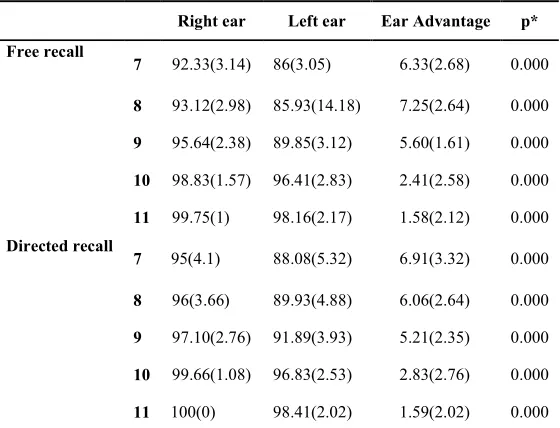
The average percentage of correct answers for each ear, standard deviation, average differences between the ears and comparing of right and left ear are summarized in Table 1. Generally, in
double dichotic digit, the average scores of the right and left ear increase with age. These improved advantages in the left ear are faster than right ear. There are significant effects of age on right ear and left ear in three hearing condition for all age groups (p<0.05). in double DDT. There is a significant difference between right and left ear’s scores in all age groups in both free and directed recall (p<0.05). Signi-ficant difference between the ears, approves the ear advantage in this test. Double DDT shows significant right ear advantage between age groups. In free recall, there are significant differences in all age groups, which the highest difference was observed in the 8 year olds age group (7.25%), the right ear advantage in guided response can be seen as free recall. In general, a right ear advantage decreases with the increase of age from 7 to 11 while the range is from 6.33 to 1.58 percent in free recall and 6.91 percent to 1.59 percent in directed recall. There is significant age effect for ear advantage in each three hearing conditions in all age groups (p<0.05).
The reliability of the test was assessed on 30 subjects using a paired t-test, 2-4 weeks after the Table 1. Mean percent correct recognition scores and standard deviations for the right and left ears,
and the mean ear advantage of the age groups in free and directed recall conditions
Right ear Left ear Ear Advantage p*
Free recall
7 92.33(3.14) 86(3.05) 6.33(2.68) 0.000
8 93.12(2.98) 85.93(14.18) 7.25(2.64) 0.000
9 95.64(2.38) 89.85(3.12) 5.60(1.61) 0.000
10 98.83(1.57) 96.41(2.83) 2.41(2.58) 0.000
11 99.75(1) 98.16(2.17) 1.58(2.12) 0.000
Directed recall
7 95(4.1) 88.08(5.32) 6.91(3.32) 0.000
8 96(3.66) 89.93(4.88) 6.06(2.64) 0.000
9 97.10(2.76) 91.89(3.93) 5.21(2.35) 0.000
10 99.66(1.08) 96.83(2.53) 2.83(2.76) 0.000
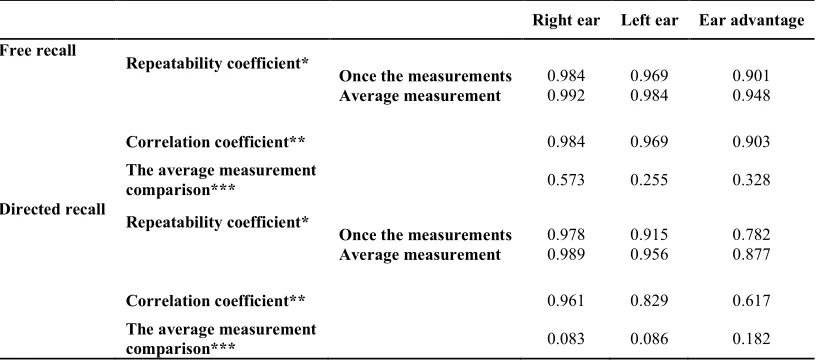
initial test was conducted, intraclass correlation (ICC) and Spearman and Pearson tests. Paired t-test value for the right ear, left ear and the ear advantage in a free recall, was 0.573, 0.225, and 0.325 respectively and also paired t-test value for the right ear, left ear, and ear advantage in a directed recall was 0.083, 0.086, and 0.182, respectively (p<0.05). Table 2, summarizes the results of the paired t-test, ICC, and Pearson-Spearman to calculate the average rates of double DDT in the first test and 2-4 weeks after the test.
In general, test-retest reliability is seen for double dichotic test, in which there are no significant differences between each score of the right ear, left ear and ear advantage in both hearing conditions (free recall and directed recall) in any of the age groups (p>0.05).
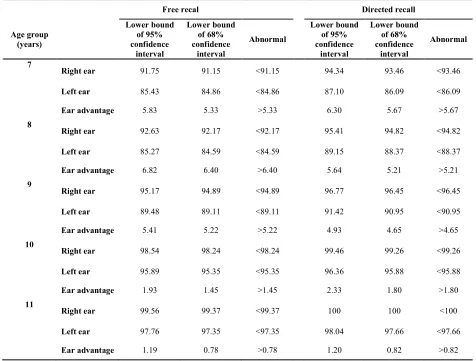
The range of standard values for the percentage of correct answers in double DDT, standard deviation from the mean (lower bound confi-dence interval 95%) and 2 standard deviations from the mean (lower bound confidence interval 68%) are shown in Table 3. For the right-ear and left-ear scores, normal was defined as scores that were greater than 1 SD below the mean. Scores that fell below the -2 SD were considered abnormal.
Discussion
The purpose of this study is to determine the preliminary normal value of the double DDT, and its reliability between test-retest. In double DDT the advantages of the right and left ear are small. The right ear score from 92.33% in 7 year olds increases to 99.57% in 11 year olds and the left ear score from 86% in 7 year olds increases to 98.16% in 11 year olds. This increase of advantages in right and left ears in double DDT in the free recall test, specially in the left ear, by aging are significant due to maturity and growth of transmission system between the hemis-pheres. Studies of Rajabpoor et al. to find nor-mal data on 7-8 year old boys using single DDT, revealed that by increasing of age from 7 years to 8 years, the mean score of right and left ear, in free recall and directed recall increases in single DDT and score of ear advantage in this test decreases with age, which is in accordance with this study [6]. Also a study carried out by Mukari and et al. in Malaysia using DDT on 120 normal children between the ages of 6-11 years old who was divided to 6 separate groups with 1 year interval (6 years to 6 years and 11 months). The results showed that in double DDT, the scores of right and left ear signi-ficantly increase with age, so that the mean Table 2. Test-retest reliability of double dichotic digit test for the 30 subject
Right ear Left ear Ear advantage
Free recall
Repeatability coefficient*
Once the measurements 0.984 0.969 0.901
Average measurement 0.992 0.984 0.948
Correlation coefficient** 0.984 0.969 0.903
The average measurement
comparison*** 0.573 0.255 0.328
Directed recall
Repeatability coefficient*
Once the measurements 0.978 0.915 0.782
Average measurement 0.989 0.956 0.877
Correlation coefficient** 0.961 0.829 0.617
The average measurement
comparison*** 0.083 0.086 0.182
* Intraclass Correlation
** Spearman test and Pearson (the score of the right ear, left ear, and ear advantage at free recall test using Pearson and directed recall were calculated using Spearman's test.)
score of the right ear from 80% in 6 years increase to 95% in 11 years and the mean score for the left ear from 70 percent for 6 year olds increases to 90 percent in 11 years, which confirms the results of this study [3]. The results of another study like Strouse et al. [8] also corresponds to the results of this study. On the other hand, the right ear advantage in the study of Mukari et al. [3] on double DDT of 13-15 percent in 6 years reduced to 4-5 percent in 11 years. Findings of this study shows that the amount of right ear advantage in double DDT in both free recall and directed recall are reduced by age (except for 8 year olds group who showed an increase in comparison with 7 year
olds) therefore the present like previous studies suggests the processing of linguistic stimuli in double DDT in the left hemisphere. In general, in double DDT in 7-11 year olds had the highest change in growth of corpus callosum and maturity between hemispheres. Westerhausen et al. showed that the right ear advantage and the size of the corpus callosum have inverse relation. The right ear advantage of children is reduced by growth of corpus callosum [9]. Also, bamiou et al. evaluates the effects of aging on mature routes between the hemispheres convention and corpus callosum convention by magnetic resonance imaging (MRI). The results of this study showed corpus callosum Table 3. Minimum values of the normal percent correct recognition scores for double dichotic digit test
with one and two standard deviation of the mean (n=200)
Free recal Directed recall
Age group (years)
Lower bound of 95% confidence
interval
Lower bound of 68% confidence
interval
Abnormal
Lower bound of 95% confidence
interval
Lower bound of 68% confidence
interval
Abnormal
7
Right ear 91.75 91.15 <91.15 94.34 93.46 <93.46
Left ear 85.43 84.86 <84.86 87.10 86.09 <86.09
Ear advantage 5.83 5.33 >5.33 6.30 5.67 >5.67
8
Right ear 92.63 92.17 <92.17 95.41 94.82 <94.82
Left ear 85.27 84.59 <84.59 89.15 88.37 <88.37
Ear advantage 6.82 6.40 >6.40 5.64 5.21 >5.21
9
Right ear 95.17 94.89 <94.89 96.77 96.45 <96.45
Left ear 89.48 89.11 <89.11 91.42 90.95 <90.95
Ear advantage 5.41 5.22 >5.22 4.93 4.65 >4.65
10
Right ear 98.54 98.24 <98.24 99.46 99.26 <99.26
Left ear 95.89 95.35 <95.35 96.36 95.88 <95.88
Ear advantage 1.93 1.45 >1.45 2.33 1.80 >1.80
11
Right ear 99.56 99.37 <99.37 100 100 <100
Left ear 97.76 97.35 <97.35 98.04 97.66 <97.66
convention between the ages of 7 to 11 has maximum growth rate which confirm the findings of this study [10].
Table 2 shows double DDT in this study indicates high reliability in each test-retest scores, 2-4 weeks after the initial test which corresponds to Mukari et al. [3], Rajabpour et al. [6], Strouse et al. [8]. Based on these studies double DDT has high reliability to assess the central auditory system in 7 to 11 year old girls.
Conclusion
According to the Persian version of double DDT has suitable reliability for central auditory processing system in 7 to 11 year old girls. Because of the simplicity of the test, ease of performance, being non-invasive and its low cost for evaluation of central auditory system, this test has clinical application in this age group.
Acknowledgements
The present paper is emerged from B. Shahmir dissertation. The research has been supported by Tehran University of Medical Sciences grant no. 27798-32-04-93. We would like to thank Mrs. Abotalebi, the principle of Nedaye Islam School for referring the children to this center.
REFERENCES
1. Shinn JB, Baran JA, Moncrieff DW, Musiek FE. Differential attention effects on dichotic listening. J Am Acad Audiol. 2005;16(4):205-18.
2. Marculino CF, Rabelo CM, Schochat E. Gaps-in-noise test: gap detection thresholds in 9-year-old normal-hearing children. J Soc Bras Fonoaudiol. 2011;23(4):364-7.
3. Mukari SZ, Keith RW, Tharpe AM, Johnson CD. Development and standardization of single and double dichotic digit tests in the Malay language. Int J Audiol. 2006;45(6):344-52.
4. Findlen UM, Roup CM. Dichotic speech recognition using CVC word and nonsense CVC syllable stimuli. J Am Acad Audiol. 2011;22(1):13-22.
5. Elliott EM, Bhagat SP, Lynn SD. Can children with (central) auditory processing disorders ignore irrelevant sounds? Res Dev Disabil. 2007;28(5):506-17.
6. Rajabpur E, Hajiablohasan F, Tahai SA , Jalaie S. Development of the Persian single dichotic digit test and its reliability in 7-9 year old male students. Audiol. 2013;23(5):68-77. Persian.
7. Jutras B, Mayer D, Joannette E, Carrier ME, Chénard G. Assessing the development of binaural integration ability with the French dichotic digit test: Ecoute Dichotique de Chiffres. Am J Audiol. 2012;21(1):51-9. 8. Carter AS, Wilson RH. The effect of filtering and
inter-digit interval on the recognition of dichotic inter-digits. J Rehabil Res Dev. 2000;37(5):599-606.
9. Westerhausen R, Moosmann M, Alho K, Medvedev S, Hämäläinen H, Hugdahl K. Top-down and bottom-up interaction: manipulating the dichotic listening ear advantage. Brain Res. 2009;1250:183-9.