RESEARCH ARTICLE
The effects of the acceptance and commitment therapy on the
experiential avoidance and intolerance of uncertainty of
mothers with hearing-impaired children
Karim Gharashi1, Naeimeh Moheb1*, Reza Abdi2
1- Department of Psychology, Faculty of Humanities and Educational Sciences, Tabriz Branch, Islamic Azad University, Tabriz, Iran 2- Department of Psychology, Azarbaijan Shahid Madani University, Tabriz, Iran
Received: 14 May 2019, Revised: 24 Jun 2019, Accepted: 7 Jul 2019, Published: 15 Oct 2019
Abstract
Background and Aim: Children's hearing loss affects not only their speech and language dev-elopment but also their mothers’ mental health. This study aimed to determine the effect of acc-eptance and commitment therapy (ACT) on the intolerance of uncertainty and experiential avoi-dance of mothers with hearing-impaired or deaf children.
Methods: This is a quasi-experimental study with the pretest-posttest design with a control group. The study population comprised all mot-hers of hearing-impaired or deaf children (2−6 years old) in Tabriz City, Iran. Using a purpo-sive sampling method, 32 mothers of hearing-impaired or deaf children were selected and then randomly assigned to control and experimental groups (each group, 16 subjects). The experim-ental group was treated with ACT in 8 sessions of 1.5 hours long in two weeks. The study data were collected by the Acceptance and Action Questionnaire-II (AAQ-II) and Intolerance of Uncertainty Scale (IUS).
Results: The results showed that ACT signi-ficantly increased scores on the AAQ-II and IUS in the experimental group compared to the
control group (p < 0.001).
Conclusion: ACT might be an efficient way to decrease intolerance of uncertainty and avoid-ance of experience in the mothers of hearing-impaired and deaf children. Also, therapists can use this approach for improving the intolerance of uncertainty and experiential avoidance in mothers of hearing-impaired or deaf children in rehabilitation centers.
Keywords: Hearing impairment; experiential avoidance; intolerance of uncertainty;
acceptance and commitment therapy
Citation: Gharashi K, Moheb N, Abdi R. The effects of the acceptance and commitment therapy on the experiential avoidance and intolerance of uncertainty of mothers with hearing-impaired children. Aud Vestib Res. 2019;28(4):256-264.
Introduction
Hearing impairment or hearing loss is an ina-bility leading to reduced hearing in human that may occur due to genetic, environmental, orga-nic factors, or diseases. This inability has diffe-rent impacts on the speech development of chil-dren based on the level of hearing impairment, age, and type of hearing loss [1]. Hearing imp-airment is one of the most prevalent sensori-neural defects in humans so that on average, 5
* Corresponding author: Department of Psychology,
out of 1000 children are born with severe to profound hearing loss [2]. Deaf children lose the golden time for language learning and face some problems and difficulties in language dev-elopment [3]. Furthermore, the complexity of children’s disability and its untreatable nature result in psychological problems in mothers, and these problems remain even several years after the children’s hearing loss and deafness diag-nosis [4]. Therefore, parents who are unhappy with their hearing-impaired children, tolerate stress, and experience emotional and psycholo-gical problems [5]. Parents, particularly mot-hers, play a vital role in raising and supporting their children in the rehabilitation process of the hearing problem [6]. Moreover, such problems may cause marital conflicts, family problems, and mental diseases such as anxiety in parents [7].
One of the main traits of anxiety is avoidance or escaping from situations and drivers, leading to stress. Avoidance is defined as an experience of negative and extreme evaluation of feelings, thoughts, and then intentional attempt to control or escape from such feelings [8]. Moreover, experiential avoidance does have a positive and significant relation with generalized anxiety dis-order, negative emotions, self-destruction, beha-vioral disorder, and anxiety. Hence, avoidance should be controlled and dealt with [9,10]. In addition, intolerance of uncertainty is one of the anxiety-associated traits identified as a cogni-tive, emotional, and behavioral reaction toward uncertainty, which makes bias in data proce-ssing, increases negative evaluation and reduces the ability to cope with the worrying situation [11]. Those patients who have uncertainty prob-lem consider this issue as annoying and cannot tolerate the doubt and hesitation. Because of avoiding unexpected negative events, these peo-ple increase their doubts and hesitations [12]. In this case, uncertainty intolerance is significantly related to anxiety arousal, depression, and con-cern [13-15].
Although there is not any study about the effect of treatment on the experiential avoidance and uncertainty intolerance among mothers of hearing-impaired and deaf children, the existing
This study was conducted to determine the effect of ACT-based therapy on experiential avoidance and uncertainty intolerance in mot-hers of hearing-impaired or deaf children due to following reasons: 1) the importance of expe-riential avoidance, uncertainty intolerance, and various mental disorders, in particular, emo-tional disorders and effect of these mental dis-orders on reduction of quality of life [30], 2) parents of disabled children may show some behaviors such as non-acceptance of problems, low emotional support, experiential avoidance and uncertainty due to concern for the future of their children, and 3) usefulness of ACT imple-mentation in mothers of hearing-impaired chil-dren and reducing experiential avoidance and uncertainty intolerance in these mothers.
Methods
This study was a quasi-experimental research with pretest-posttest design and a control group. The study population comprised all mothers of 2−6 years old children with hearing loss or deaf referring to a rehabilitation center for chil-dren with hearing disorders affiliated to Tabriz Welfare Organization in 2018. After taking the permission of the rehabilitation center's manag-ement, mothers of 32 children (out of 120 chil-dren) referring to the rehabilitation center were selected using a purposive sampling method and considering the inclusion criterion. The selected subjects were randomly assigned to the experi-mental and control groups (n = 16). The inclu-sion criterion included having a hearing-imp-aired or deaf child, 2−6 years old experience of hearing loss above 70 dB in family, being 20−40 years old, passing secondary school, giv-ing informed consent to participate in the res-earch, presence of both parents (mother and fat-her) of the child in the family. The exclusion criteria were absence in intervention sessions or suffering from any specific disease or disability. It should be noted that mothers of children with hearing loss above 70 dB were selected pur-posefully due to effects of severe hearing loss on the speech and language development of children. After selecting the samples, the res-earcher introduced himself to the respondents
and explained the research objectives and met-hod, ensuring them about the confidentiality of their information. The researcher obtained the written consent from the respondents and asked them to read the questions of Acceptance and Action Questionnaire-second version (AAQ-II) and Intolerance Uncertainty Scale and select the suitable options.
Acceptance and Action Questionnaire-II This questionnaire measures acceptance, experi-ential avoidance, and psychological inflexibility and the last version of this instrument consists of 10 items rated based on the 7-point Likert-type scale; this version was developed by Bond et al. in 2011 [31]. The total score ranges from 10 to 70; the higher score indicates a stronger tendency toward experiential avoidance. Psy-chometric adequacy of the Persian version of this questionnaire was assessed and confirmed by Abbassi et al. [32]. They examined the con-vergent validity of the questionnaire and rep-orted its correlation with the second version of Beck depression inventory [33] and Beck anxiety inventory [34] as 0.59 and 0.44, respec-tively in a sample of 192 students of Tehran Universities and Medical sciences University of Tehran.. In the above study, the scores of expe-riential avoidance of psychometric sample (25 female patients and 25 healthy patients) were compared to examine the differential validity of the questionnaire.
Uncertainty Intolerance Scale
reported as 0.94 and 0.74, respectively after five weeks. The correlation coefficients of this scale were obtained as 0.6, 0.55, and 0.59 in corr-elation with concern questionnaire, Beck anxi-ety inventory, and Beck depression inventory, respectively (all were significant) [36].
To conduct therapy and intervention, the pro-tocol of ACT-based therapy sessions of Hayes et al. [37] and Kowalkowski [38] was used. This protocol expands the psychological flexibility of individuals when facing inefficient thoughts and beliefs by employing a metaphor. In this pro-tocol, the therapist emphasizes the experiential avoidance and intolerance of uncertainty caused by the presence of a hearing-impaired child to encourage mothers to do their homework. The protocol was implemented for the experimental group in eight 90-min sessions during four weeks, two sessions per week. The control gro-up did not receive this therapy. After the end of the sessions, the posttest was implemented for both groups. ACT-based sessions can be sum-marized as follows:
The first session: pretest implementation and familiarity of mothers with the therapist and each other, description of group rules, explana-tion of therapy approach, and setting homework, including listing 5 important problems of mot-hers of hearing-impaired children.
The second session: checking homework of the previous session, evaluating problems of mot-hers of hearing-impaired children in the view-point of the individual, assigning homework of preparing a list of advantages and disadvantages and methods to control problems.
The third session: checking the homework of the previous session, specifying the ineffec-tiveness of negative events’ control using meta-phors and teaching tendency toward negative emotions and experiences, assigning homework of recording the cases in which mothers of hearing-impaired children stopped inefficient control methods successfully.
The fourth session: checking the homework of the previous session, teaching participants to separate evaluations from personal experiences, and taking the situation of observing the thou-ghts without judgment, assigning homework of
listing the cases in which mothers of hearing-impaired children have observed successfully without evaluating experiences and emotions. The fifth session: checking the homework of the previous session, connecting with the present moment, considering self as the board (meta-phor of chessboard), and teaching mindfulness techniques, assigning homework of recording cases in which, mothers of hearing-impaired children can observe thoughts using mindful-ness techniques.
The sixth session: checking the homework of the previous session, identifying life values of mothers of hearing-impaired children, and asse-ssing values based on their importance, ass-igning homework of preparing a list of barriers to values achievement.
The seventh session: checking the homework of the previous session, providing practical solu-tions for barriers by using metaphors and plan-ning for commitment to values, assigplan-ning home-work of reporting steps to follow values and thinking about sessions’ achievements.
The eighth session: concluding the reviewed concepts in sessions and asking participants to explain their achievements and their plans for life then conducting the posttest.
After data collecting and end of therapy ses-sions, data analysis was done using descriptive statistics and ANCOVA in SPSS 19.
Center of the Islamic Azad University of Tabriz.
Results
The age range of the experimental group was 22−37 years with a mean (SD) age of 29 (4.47) years. The age range of the control group was 26−36 years with a mean (SD) age of 30 (3.01) years. All of the mothers were housewives. In the experimental group, 25% of mothers had a middle school degree, 50% had a diploma, 6.2 % had an academic degree, and 18.8% BA degree. In the control group, 18.8% had a middle school degree, 43.8% had a diploma degree, 12.4% had an academic degree, and 25.0% had a BA degree.
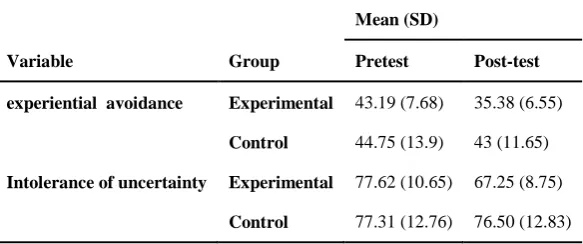
Table 1 presents the mean (SD) pretest and posttest scores of the experiential avoidance and intolerance of uncertainty in the experimental and control groups. Accordingly, mean scores of experiential avoidance and uncertainty into-lerance in the experimental group reduced after the intervention. In this case, the mean (SD) score of experiential avoidance of the experi-mental group reduced from 43.19 (7.68) to 35 (6.55) in the posttest (p < 0.001). In addition, mean (SD) scores of uncertainty intolerance of the experimental group reduced from 77 (10.65) to 67 (8.75) in the posttest (p < 0.001); while there was not any significant change in the mean scores of experiential avoidance and intolerance of uncertainty in the control group. ANCOVA test results showed that the group effect was significant at a confidence interval of 99 % (F1, 32 = 120.26, p = 0.001). It means that
there was a significant difference between the experiential avoidance levels of the control and experimental groups after adjusting pretest sco-res. On the other hand, the adjusted mean (SD) score, i.e. 36.05 (0.40) implied that experiential avoidance level in the experimental group was significantly lower than mean (SD) score of the control group 42.32 )0.40). Therefore, the obta-ined findings indicated significant effect of ACT on reducing experiential avoidance symp-toms in mothers of hearing-impaired children. In addition, ANCOVA results of intolerance of uncertainty indicated significant group effect at the confidence interval of 99% (F1, 32 = 71.38,
p = 0.001). It means that there was a significant difference between uncertainty intolerance lev-els of control and experimental groups after adjusting pretest scores. Moreover, the adjusted mean (SD) score implied that uncertainty into-lerance level in the experimental group 67.11 )0.79) was significantly lower than mean (SD) score of the control group 76.64 )0.79). There-fore, the obtained findings indicated significant effect of ACT on reducing uncertainty intole-rance symptoms in mothers of hearing-impaired children.
Discussion
This study aimed at examining the effect of acceptance and commitment therapy (ACT) on the symptoms of experiential avoidance and uncertainty intolerance in mothers of hearing-impaired or deaf children in Tabriz City, Iran. Research findings indicated that ACT had a
Table 1. Mean )standard deviation( of experiential avoidance and intolerance of uncertainty in the pretest and post-test stages in both the experimental and control groups
Mean (SD)
Variable Group Pretest Post-test
experiential avoidance Experimental 43.19 (7.68) 35.38 (6.55)
Control 44.75 (13.9) 43 (11.65)
Intolerance of uncertainty Experimental 77.62 (10.65) 67.25 (8.75)
significant effect on reducing symptoms of exp-eriential avoidance in mothers of hearing-imp-aired or deaf children. Our results were con-sistent with the studies conducted by Jones et al. [18], Gold et al. [19], and Shiralinia et al. [20] who confirmed the effect of ACT-based on the promotion of psychological flexibility of mot-hers with Autism spectrum disorder. Also, our findings are in line with the results of Pak et al. who found reduction in experiential avoi-dance in patients with multiple sclerosis [21], Mesbah et al. who found increase in resiliency of mothers of mentally retarded children [22], Hughes et al. who found positive effect on red-ucing chronic pain [23] and post-trauma stress disorder (PTSC), social anxiety disorder, dep-ression and experiential avoidance, and finally Kashdan et al. [30]. As a result, ACT helps indi-viduals to acquire skills, to cope with value-based activities, and to move toward valuable objectives. Therefore, moving toward values and precious goals not only makes individuals embrace problems but also helps them improve their psychological flexibility by accepting rea-lity [26]. Moreover, these mothers evaluate life events negatively because of their children’s problem as well as their experience of anxiety and experiential avoidance. In addition, these mothers may experience other psychological problems owing to non-acceptance of problem, avoidance behavior and lack of interventions [8]. Experiential avoidance is a problem, which destroys the quality of life [30] and is signi-ficantly associated with generalized anxiety dis-order, negative emotions, self-destruction, and behavioral disorder; hence, this problem should be solved [9,10].
It can be explained the main point of ACT is active and informed acceptance of unpleasant experiences of life without trying to change life conditions or tolerate undesired situations. In this protocol, mothers of hearing-impaired and deaf children learn how face their emotions, memories, feelings and thoughts actively and eagerly. Under such circumstances and under the support of group, mothers learn flexibility. In other words, as this therapy tends to increase psychological flexibility of individuals, they can
free themselves from unpleasant experiences because increased attention and knowledge about thoughts and emotions and practical tendencies is a positive aspect of acceptance and commitment, which leads to adaptive and positive psychological moods and increases social support and adaptation with hearing-impaired and deaf child.
A wealth of evidence confirms the relationship between experiential avoidance and emotional disorder, intolerance of uncertainty, intolerance of discomfort, cognitive and emotional repre-ssion, and mindfulness [26]. Therefore, ACT can play a vital role in reducing some problems considering the relationship between experien-tial avoidance and various mental disorders that diminishes the quality of life [27]. Parents of disabled children may show some behaviors such as denial of problems, low emotional sup-port, experiential avoidance, and uncertainty intolerance because of the unknown future of their children. On the other hand, acceptance is the opposite of experiential avoidance; accep-tance contributes to reducing problems occurr-ing in experiential avoidance. Therefore, accep-tance is a value-based choice without any force [31].
presence of a hearing-impaired or deaf child in family leads to uncertainty about a child’s fut-ure, ACT helps mothers of such children to accept their unpleasant feelings, emotions, and improve their positive emotions by recogni-zing their own circumstances. Therefore, one major goal of this therapy is to increase psycho-logical flexibility of individuals and to reduce their uncertainty by teaching them to accept the conditions instead of avoiding and denying the truth using acceptance and mindfulness processes besides commitment and behavior-changing processes [29].
Due to specific conditions of this study, the study population had some limitations, so cau-tion should be taken in generalizing the study results. Research constraints included sampling method and a few samples due to limited access to all mothers of hearing-impaired and deaf children in Tabriz. Considering the significant effect of ACT on the reduction of symptoms of experiential avoidance and intolerance of uncer-tainty, this therapy is recommended to be used for larger samples and fathers of hearing-imp-aired or deaf children, too. It is also suggested to examine the effect of this therapy in children older than six years, at school age, and other family members.
Conclusion
The obtained results indicated that ACT could reduce symptoms of experiential avoidance and intolerance of uncertainty in mothers of hearing-impaired children. Increased acceptance capa-city and psychological flexibility of mothers of hearing-impaired or deaf children would change the attitude of mothers toward disability of their children. Attitude change along with acceptance, not only provides mental comfort for mothers but also prepares the condition for implementing supporting rehabilitation pro-grams for their children. Therefore, as one of the cognitive-behavioral third-wave generation therapies, ACT plays a vital role in treating exp-eriential avoidance and intolerance of uncer-tainty in parents of hearing-impaired children. It is recommended that ACT be used in rehabilitation centers, particularly in centers for
children with hearing disorders.
Acknowledgement
This study was extracted from PhD dissertation submitted to Islamic Azad University of Tabriz by Karim Gharashi. The authors appreciate mot-hers of hearing-impaired and deaf children who participated in this research.
Conflict of interest
The authors declared no conflicts of interest.
References
1. Kirk S, Gallagher J, MR Coleman. Educating excep-tional children. 14ed en. Stamford, USA Publisher:
Cen-gage Learning; 2014.
2. World Health Organization. Newborn and infant hearing screening: Current issues and guiding principles for action. 2009. Available from: www.who.int/ blindness/publications/Newborn and Infant Hearing Screening Report.pdf.
3. Schorr EA, Roth FP, Fox NA. A comparison of the speech and language skills of children with cochlear implants and children with normal hearing. Commun Disord Q. 2008;29(4):195-210. doi:
10.1177/1525740108321217
4. Pipp-Siegel S, Sedey AL, Yoshinaga-Itano C. Predictors of parental stress in mothers of young children with hearing loss. J Deaf Stud Deaf Educ. 2002;7(1):1-17. doi: 10.1093/deafed/7.1.1
5. Gharashi K, Sarandi P, Farid A. [The comparison of stress and marital satisfaction status of parents of hearing-impaired and normal children]. Audiol. 2013; 22(1):18-24. Persian.
6. Gharashi K, Moheb M. The effect of cognitive-beha-vioral therapy on reducing the anxiety and depression of children with hearing loss . Aud Vestib Res. 2018; 27(1):31-7.
7. McConnell D, Savage A. Stress and resilience among families caring for children with intellectual disability: expanding the research agenda. Curr Dev Disord Rep. 2015;2(2):100-9. doi: 10.1007/s40474-015-0040-z
8. Clark DA, Taylor S. The transdiagnostic perspective on cognitive-behavioral therapy for anxiety and depression: New Wine for Old Wineskins? J Cogn Psychother. 2009;23(1):60-6. doi: 10.1891/0889-8391.23.1.60
9. Lee JK, Orsillo SM, Roemer L, Allen LB. Distress and avoidance in generalized anxiety disorder: exploring the relationships with intolerance of uncertainty and worry. Cogn Behav Ther. 2010;39(2):126-36. doi:
10.1080/16506070902966918
10. Bardeen JR, Tull MT, Stevens EN, Gratz KL. Exploring the relationship between positive and negative emotional avoidance and anxiety symptom severity: the moderating role of attentional control. J Behav Ther Exp Psychiatry. 2014;45(3):415-20. doi:
10.1016/j.jbtep.2014.04.006
2004;28(6):835-42. doi: 10.1007/s10608-004-0669-0
12. Mansouri A, Korozhde N. [The effectiveness of the acceptance and commitment therapy on the intolerance of uncertainty, worry and insomnia in mothers of children with autism spectrum disorder]. Journal of Research in Behavioural Sciences. 2017;15(3):347-53. Persian.
13. Dugas MJ, Gagnon F, Ladouceur R, Freeston MH. Generalized anxiety disorder: a preliminary test of a conceptual model. Behav Res Ther. 1998;36(2):215-26. 14. Arfaei A, Besharat gharamlaki R, Gholizadeh H,
Hekmati E. [Intolerance of uncertainty: comparision between individuals with Major depressed disorder with obsessive-compulsive disorder]. J Tabriz Univ Med Sci. 2011; 33(5): 17-22. Persian.
15. van der Heiden C, Melchior K, Muris P, Bouwmeester S, Bos AE, van der Molen HT. A hierarchical model for the relationships between general and specific vulnerability factors and symptom levels of generalized anxiety disorder. J Anxiety Disord. 2010;24(2):284-9. doi: 10.1016/j.janxdis.2009.12.005
16. Biglan A, Hayes SC, Pistorello J. Acceptance and commitment: implications for prevention science. Prev Sci. 2008;9(3):139-52. doi: 10.1007/s11121-008-0099-4
17. Bloy S, Oliver JE, Morris E. Using acceptance and commitment therapy with people with psychosis: A case study. Clin Case Stud. 2011;10(5):347-59. doi:
10.1177/1534650111420863
18. Jones L, Gold E, Totsika V, Hastings RP, Jones M, Griffiths A, et al. A mindfulness parent well-being course: evaluation of outcomes for parents of children with autism and related disabilities recruited through special schools. Eur J Spec Needs Educ. 2018;33(1):16-30. doi: 10.1080/08856257.2017.1297571
19. Gould ER., Tarbox J, Coyne L. Evaluating the effects of acceptance and commitment training on the overt behavior of parents of children with autism. Journal of Contextual Behavioral Science. 2017. doi:
10.1016/j.jcbs.2017.06.003
20. Shiralinia K, Abdollahi Mousavi H, Khojastemehr R. [The effectiveness of of group acceptance and com-mitment therapy (act)-based training on parenting stress and psychological flexibility in mothers of children with autism spectrum disorder]. Psychology of Exceptional Individuals. 2017;28(7):21-44. Persian. doi: 10.22054 / jpe.2018.26885.1695
21. Pak R, Abdi R, Chalbianloo G. [Effectiveness of acceptance and commitment therapy (ACT) on disease acceptance and experiential avoidance in patients with multiple sclerosis (MS)]. Contemporary Psychology. 2017;12(1):63-72. Persian.
22. Mesbah I, Hojatkhah SM, Golmohammadian M. [Effectiveness of group therapy based on acceptance and commitment on resilience mothers of children with mental retardation]. Psychology of Exceptional Individuals. 2018;8(29):85-109. Persian. doi: 10.22054 / jpe.2018.24311.1613
23. Hughes LS, Clark J, Colclough JA, Dale E, McMillan D. Acceptance and commitment therapy (ACT) for chronic pain: a systematic review and meta-analyses. Clin J Pain. 2017;33(6):552-568. doi:
10.1097/AJP.0000000000000425
24. Murrell AR, Scherbarth AJ. State of the research and
literature address: ACT with children, adolescents and parents. Int J Behav Consult Ther. 2006;2(4):531-43. 25. Ost LG. Efficacy of the third wave of behavioral
therapies: a systematic review and meta-analysis. Behav Res Ther. 2008;46(3):296-321. doi:
10.1016/j.brat.2007.12.005
26. Hayes SC, Strosahl KD, Wilson KG. Acceptance and commitment therapy: the process and practice of mindful change. 2nd en. New York: Guilford Press;
2012.
27. Hayes SC. Acceptance and commitment therapy and the new behavior therapies: mindfulness, acceptance and relationship. In: Hayes SC, Follette VM, Linehan MM, editors. Mindfulness and acceptance: expanding the cognitive-behavioural tradition. 1st ed. New York: The
Guilford Press; 2011. p. 1-29.
28. Villatte M, Villatte JL, Hayes SC. Mastering the clinical conversation. Language as intervention. 1st ed. New
York: Guilford Press; 2016.
29. Hayes SC, Levin ME, Plumb-Vilardaga J, Villatte JL, Pistorello J. Acceptance and commitment therapy and contextual behavioral science: examining the progress of a distinctive model of behavioral and cognitive therapy. Behav Ther. 2013;44(2):180-98. doi:
10.1016/j.beth.2009.08.002
30. Kashdan TB, Morina N, Priebe S. Post-traumatic stress disorder, social anxiety disorder, and depression in survivors of the Kosovo War: experiential avoidance as a contributor to distress and quality of life. J Anxiety Disord. 2009;23(2):185-96. doi:
10.1016/j.janxdis.2008.06.006
31. Bond FW, Hayes SC, Baer RA, Carpenter KM, Guenole N, Orcutt HK. et al. Preliminary psychometric properties of the acceptance and action questionnaire-II: a revised measure of psychological inflexibility and experiential avoidance. Behav Ther. 2011;42(4):676-88. doi: 10.1016/j.beth.2011.03.007
32. Abbasi E, Fata L, Moloudi R, Zarabi H. [Psychometric properties of persian version of acceptance and action questionnaire-II]. Journal of psychological models and methods. 2013;3(10):65-80. Persian.
33. Beck AT, Steer RA, Brown GK. Beck Depression Inventory manual. 2nd ed. San Antonio, TX: Psycho-logical Corporation. 1996.
34. Beck AT, Clark DA. Anxiety and depression: An infor-mation processing perspective. Anxiety Research. 1998; 1(1):23-36. doi: 10.1080/10615808808248218
35. Freeston MH, Rheauma J, Litarte H, Dugas MJ, Ladouceur R. Why do people worry? Pers Individ Dif. 1994;17(6):791-802. doi: 10.1016/0191-8869(94)90048-5
36. Buhr K, Dugas MJ. The role of fear of anxiety and intolerance of uncertainty in worry: an experimental manipulation. Behav Res Ther. 2009;47(3):215-23. doi:
10.1016/j.brat.2008.12.004
37. Hayes SC, Wilson KG, Gifford EV, Follette VM, Strosahl K. Experimental avoidance and behavioral disorders: a functional dimensional approach to diag-nosis and treatment. J Consult Clin Psychol. 1996; 64(6):1152-68.
[Dissertation]. Ypsilanti (MI): Eastern Michigan Univer-sity; 2012. 512.
39. Avdagic E, Morrissey SA, Boschen MJ. A randomized controlled trial of acceptance and commitment therapy and cognitive-behaviour therapy for generalised anxiety disorder. Behav Change 2014;31(2):110-30. doi:
10.1017/bec.2014.5
40. .Behrouz B. [The effectiveness of group-based accep-tance and commitment therapy on post-traumatic stress disorder, coping styles, and self-efficacy in girls with abnormal grief]. J Clin Psychol. 2016;7(4):81-91.
Persian.
41. Narimani M, Alamdari E, Abolghasem A. [The study of the efficiency of acceptance and commitment-based therapy on the quality of infertile women’s life]. Family Counseling and Psychotherapy. 2014;4(3):387-405. Persian.
42. Gharashi K, Moheb N, Abdi A. Effects of acceptance and commitment therapy on decreasing anxiety and depression symptoms in mothers of hearing-impaired or deaf children. Aud Vestib Res. 2019;28(2):116-23. doi: