RESEARCH ARTICLE
Auditory recognition of Persian digits in presence of
speech-spectrum noise and multi-talker babble: a validation study
Amin Ebrahimi, Mohammad Ebrahim Mahdavi*, Hamid Jalilvand
Department of Audiology, School of Rehabilitation, Shahid Beheshti University of Medical Sciences, Tehran, Iran
Received: 25 Sep 2019, Revised: 30 Oct 2019, Accepted: 9 Nov 2019, Published: 15 Jan 2020
Abstract
Background and Aim: Digits are suitable speech materials for evaluating recognition of speech-in-noise in clients with the wide range of language abilities. Farsi Auditory Recognition of Digit-in-Noise (FARDIN) test has been deve-loped and validated in learning-disabled child-ren showing dichotic listening deficit. This stu-dy was conducted for further validation of FARDIN and to survey the effects of noise type on the recognition performance in individuals with sensory-neural hearing impairment.
Methods: Persian monosyllabic digits 1−10 were extracted from the audio file of FARDIN test. Ten lists were compiled using a random order of the triplets. The first five lists were mixed with multi-talker babble noise (MTBN) and the second five lists with speech-spectrum noise (SSN). Signal- to- noise ratio (SNR) var-ied from +5 to −15 in 5 dB steps. 20 normal hearing and 19 hearing-impaired individuals participated in the current study.
Results: Both types of noise could differentiate the hearing loss from normal hearing. Hearing-impaired group showed weaker performance for digit recognition in MTBN and SSN and needed 4−5.6 dB higher SNR (50%), compared to the normal hearing group. MTBN was more
challenging for normal hearing than SSN.
Conclusion: Farsi Auditory Recognition of Digit-in-Noise is a validated test for estimating SNR (50%)in clients with hearing loss. It seems SSN is more appropriate for using as a back-ground noise for testing the performance of aud-itory recognition of digit-in-noise.
Keywords: Auditory recognition; hearing loss; speech perception in noise; digit recognition in noise
Citation: Ebrahimi A, Mahdavi ME, Jalilvand
H. Auditory recognition of Persian digits in presence of speech-spectrum noise and multi-talker babble: a validation study. Aud Vestib Res. 2020;29(1):39-47.
Introduction
There are many studies that confirm noisy envi-ronments are challenging for patients with hear-ing loss. People with hearhear-ing loss usually comp-lain that they hear the speech but cannot under-stand it properly and interfering noise or speech exacerbates their problem [1-4]. Speech recog-nition in quiet is routinely performed for pati-ents and can provide valuable results. However, its results cannot predict the patient's perfor-mance in everyday communication situations unless the recognition score in quiet is poor [5
-9].
Audiometry using speech stimuli, as its name implies, uses speech to evaluate the auditory * Corresponding author: Department of Audiology,
40 Auditory recognition of digit-in-noise
Aud Vestib Res (2020);29(1):39-47. http://avr.tums.ac.ir
system. Speech audiometry assesses two com-ponents: sensitivity to speech and clarity of the heard speech. Hearing loss is partly related to the ability to be heard (auditory sensitivity) and partly to the distortion component (speech clarity). The part related to auditory sensitivity is determined by assessing speech recognition in quiet [3-5] that are rated by speech recognition score (SRS) or word recognition score (WRS). In this test, the correct percentage of words recognized by a person at a sound intensity level (dB SL) is calculated relative to the speech recognition threshold (SRT). The speech recog-nition test in quiet aims to assess how one's speech is understood in a quiet environment while the speech intensity is high enough for the person to earn the highest score. The highest score a person gets in this test is called PBMAX.
Various materials such as nonsense sentences and syllables are used to evaluate the ability to recognize speech in quiet, but the most common materials are monosyllabic words [4].
Speech recognition testing in quiet is performed in many clinics every day. A review of studies in this area shows that 91% of audiologists do this test every day, and 92% of them use testing of suprathreshold monosyllabic word recog-nition in quiet. One of the limitations of speech recognition test in quiet (at a single level of presentation) is its failure to reflect one's per-formance in the real world. Moreover, most hearing-impaired patients do not complain of not understanding words in a quiet environment [5]. Carhart and Tillman (1970) for the first time suggested that in addition to the usual audio-metric tests and speech recognition in quiet, the ability to recognize speech in competitive noise also needs to be assessed, and by describing a hearing loss as signal-to-noise ratio (SNR), an estimate of the patient communication disability is obtained [6].
The second part of hearing loss (distortion com-ponent) refers to impaired speech recognition ability, especially in the presence of noise, and is determined by the correct percentage of speech recognition in noise [3-5]. Recently, another form of SNR has been used, and it is called signal-to-noise ratio for 50% correct
memory load. Digits are familiar and simple speech materials that can be used to evaluate a wide range of patients with language abilities and especially in cochlear-implanted children and bilinguals that language vocabulary is a concern. Using the conventional audiometric test, Ramikssoon et al. attempted to determine SRT in non-native English speakers using disy-llabic digits instead of words. They found that disyllabic digits could determine SRT in non-native English speakers more accurately than disyllabic words [11].
Although broadband noise (BBN) has been used for speech-in-noise tests in the past [12-15]. The frequencies located lower and higher than the frequency band of the target speech are found to be ineffective on masking, and a tendency to use narrow-band noise was observed in the litera-ture. Researchers have recently used multi-talker babble noise (MTBN), speech-spectrum noise (SSN) and speech-weighted noise (SWN) [10-18]. Therefore, studies should be conducted on the recognition of Persian digits [17] in the presence of different noises previously evalu-ated in children with learning disabilities. This study was conducted with two purposes. First, we wanted to know whether the recognition of digits in the presence of different noises can differentiate between people with hearing loss and those with normal hearing (validation) sec-ondly, whether digit recognition is affected by noise type, and which noise is more appropriate for evaluating Persian digits recognition in noise.
Methods
This research is a descriptive-analytical study based on observation. The study subjects inclu-ded 20 people with normal hearing with mean age of 23.4 years (NH group) and 19 sensory-neural hearing loss (HL group) participants with mean age of 50.7 years referred to the audiology clinic of Amir A’alam Hospital affiliated to Tehran University of Medical Sciences (TUMS) in Iran. They were selected using convenience sampling method, which is a non-random sam-pling technique. All subjects were right-handed and the test was performed on their right ear.
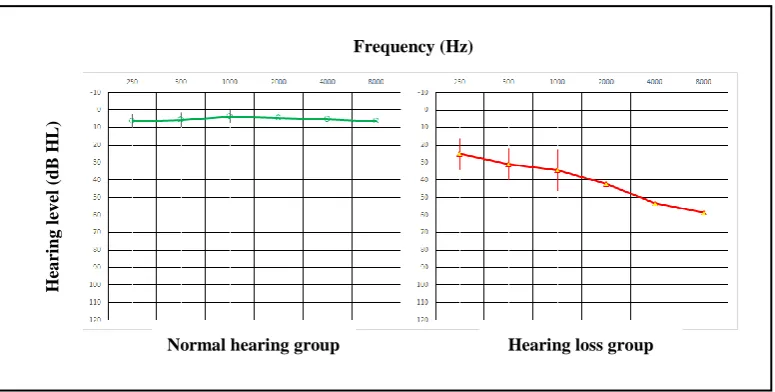
Also, all obtained WRS test scores ≥ 90% and had a healthy status of the tympanic membrane and middle ear based on tympanometry test results. Their maximum gap between air- and bone-conduction thresholds for each frequency was 10 dB, and they had no history of any neurological diseases. For people with normal hearing, the age ranged between 19 and 25 years, and their hearing threshold of 250 to 8000 Hz frequencies was ≤ 20 dB HL. For HL group, the age range was 20-65 years and the threshold of 500, 1000, and 2000 Hz frequencies were in the range of mild to moderate. Their pattern of hearing loss was symmetric such that the diffe-rence in hearing thresholds at frequencies of 500, 1000, 2000, and 4000 Hz in the left and right ears were ≤ 10 dB (Fig. 1).
42 Auditory recognition of digit-in-noise
Aud Vestib Res (2020);29(1):39-47. http://avr.tums.ac.ir
The data were entered into SPSS 23, and the mean and standard deviation of the correct rec-ognition performance of each group were calcu-lated for each digit and also for all digits. The non-parametric Mann-Whitney test was used to compare the mean recognition performance of each group, and the level of significance was set at p = 0.05. The SNR (50%) and the slope of 20%-80% were calculated on the
third-degree polynomial psychometric function fitted to measured data.
Results
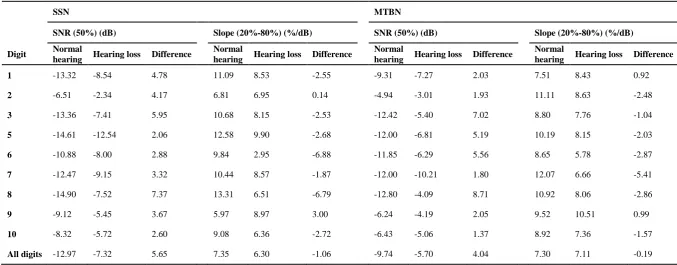
Table 1 shows the SNR (50%) and the slope of section 20%−80% on the psychometric function for different digits, the mean function of all dig-its, as well as the difference in these charac-teristics between NH and HL groups. As it can be seen, the HL group, compared to the NH group, required a higher SNR of 2−7 dB to obtain a 50% recognition score for each digit in the presence of SSN. This difference for MTBN varied from 1−8 dB. These values for the mean function of all digits for SSN and MTBN noise are 5.65 dB and 4.04 dB, respectively.
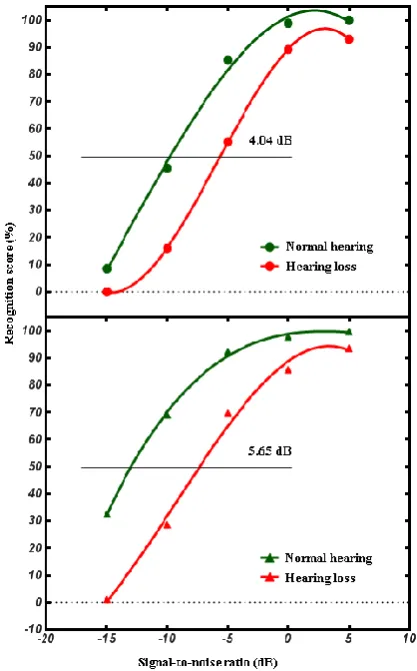
Fig. 3 shows the psychometric function of the mean recognition of all Persian monosyllabic digit 1−10 in MTBN noise and SSN, in the two groups. As it can be seen from the values in Table 1, the slope of the psychometric function of all digits in the section of 20%−80% in the NH group for MTBN and SSN is 7.30 and 7.11 %/dB and in HL group is 7.35 and 6.30 %/dB respectively. The slope becomes slightly slower in HL group for SSN than MTBN while, it is similar for the both noise in NH group with a liberal bias for SSN.
Fig. 4 illustrates the psychometric function of Fig. 2. Electrical spectrum of the
multi-talker babble noise (red) and speech-spectrum noise (blue) based on dB relative to
full scale (dB FS).
Fig. 1. Mean and standard deviation of test ear (right ear) AC hearing thresholds in sensory-neural hearing loss (right panel) and normal hearing (left panel) groups.
H
ea
rin
g
lev
el
(dB
H
L)
Table 1. SNR (50%) and slope of 20%-80% on the psychometric function of monosyllabic Persian digits 1-10 and mean function of all digits in presence of multi-talker babble noise and speech-spectrum noise in the both groups
SSN MTBN
SNR (50%) (dB) Slope (20%-80%) (%/dB) SNR (50%) (dB) Slope (20%-80%) (%/dB)
Digit Normal
hearing Hearing loss Difference
Normal
hearing Hearing loss Difference
Normal
hearing Hearing loss Difference
Normal
hearing Hearing loss Difference
1 -13.32 -8.54 4.78 11.09 8.53 -2.55 -9.31 -7.27 2.03 7.51 8.43 0.92
2 -6.51 -2.34 4.17 6.81 6.95 0.14 -4.94 -3.01 1.93 11.11 8.63 -2.48
3 -13.36 -7.41 5.95 10.68 8.15 -2.53 -12.42 -5.40 7.02 8.80 7.76 -1.04
5 -14.61 -12.54 2.06 12.58 9.90 -2.68 -12.00 -6.81 5.19 10.19 8.15 -2.03
6 -10.88 -8.00 2.88 9.84 2.95 -6.88 -11.85 -6.29 5.56 8.65 5.78 -2.87
7 -12.47 -9.15 3.32 10.44 8.57 -1.87 -12.00 -10.21 1.80 12.07 6.66 -5.41
8 -14.90 -7.52 7.37 13.31 6.51 -6.79 -12.80 -4.09 8.71 10.92 8.06 -2.86
9 -9.12 -5.45 3.67 5.97 8.97 3.00 -6.24 -4.19 2.05 9.52 10.51 0.99
10 -8.32 -5.72 2.60 9.08 6.36 -2.72 -6.43 -5.06 1.37 8.92 7.36 -1.57
All digits -12.97 -7.32 5.65 7.35 6.30 -1.06 -9.74 -5.70 4.04 7.30 7.11 -0.19
44 Auditory recognition of digit-in-noise
Aud Vestib Res (2020);29(1):39-47. http://avr.tums.ac.ir
the mean recognition of all Persian monosylla-bic digits from 1 to 10 in the presence of MTBN and SSN categorized by study groups. Based on this comparison, it is more challenging for NH group to recognize digits in the presence of MTBN than SSN. In other words, on average, NH group needed 3.2 dB higher SNR to recognize digits in the presence of MTBN compared to SSN. This finding is also true for people with hearing loss, who needed a higher SNR of 1.6 dB for digit recognition in the presence of MTBN. This finding suggests that MTBN creates a greater challenge for the NH group.
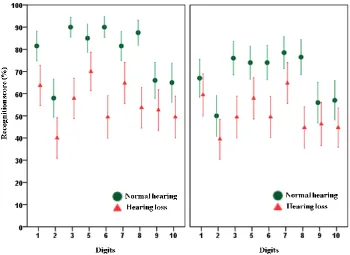
Fig. 5 shows the mean correct recognition with a 95% confidence interval for different digits in
the NH and HL groups in the presence of MTBN and SSN. Mean correct recognition score in the presence of SSN in the HL group was significantly weaker than that of the NH group (p < 0.05 for digits 1, 2, 5, 7, 9, 10, and p < 0.001 for digits 3, 6, and 8). However, the mean correct recognition of digits 1, 2, 9, and 10 in the presence of MTBN did not show a significant difference between NH and HL groups. This difference was significant in the other digits (p < 0.05 for digits 5 and 7 and p < 0.001 for digits 3, 6, and 8). The mean ± SD of recognition score for all digits in the presence of SSN for the HL group (55.7% ± 38) was significantly weaker than that of the NH group (78.3% ± 27) (p < 0.001). In the presence of MTBN, the mean ± SD recognition score of the HL group (50.7% ± 40) was also significantly weaker than that of the NH group (67.7% ± 37) (p < 0.05).
Discussion
The present study showed that HL group required an average SNR (50%) of 5.65 dB and 4.04 dB for all digits in the presence of SSN and MTBN, respectively, to have hearing perfor-mance equal to NH group. This difference in SNR (50%) between the two study groups confirms the complaint of hearing-impaired people of not understanding speech in the pre-sence of noise. The current result is in line with many other studies [2,3,18]. The comparison of the psychometric function of two noises showed that a slope of 20%−80% for SSN in the HL group for all digits (except 2 and 9), and their overall mean function was slower compared to the NH group. This finding was also true for MTBN except that the slope reduction was not observed for digits 1 and 9. Digit recognition in the presence of MTBN for both groups was more difficult than that in the presence of SSN. In other words, NH group needed 3.2 dB higher SNR, and HL group needed 1.6 dB higher SNR to recognize digits in the presence of MTBN compared to SSN.
The six-talker babble used in this study was taken from Heidari et al., and the level of noise intensity was similar to that of the study. As a Fig. 3. Psychometric function of mean
recognition score for all Persian monosyllabic digits 1-10 divided in multi-talker babble noise
result, our results in the NH group for MTBN (−9.7 dB for mean function) were very similar to the Heidari et al. study (−9.5 and −9.6 dB
using Spearman-Karber method and Probit regression respectively) [10].
McArdle et al. investigated the effect of various
Fig. 5. Mean (confidence: 95%) recognition score for all Persian monosyllabic digits 1−10 in presence of multi-talker babble noise (right) and speech-spectrum noise (left) in both groups.
Fig. 4. Psychometric function of mean recognition score for all Persian monosyllabic digits 1-10 in presence of multi-talker babble noise and speech-spectrum noise divided in normal (right) and hearing
46 Auditory recognition of digit-in-noise
Aud Vestib Res (2020);29(1):39-47. http://avr.tums.ac.ir
speech materials, including digits, monosyllabic words, and sentences presented in MTBN. They found that NH listeners and HL group needed less SNR to recognize digits than word and sen-tence stimuli. This finding was attributed to factors such as differences in linguistic com-plexity of different spoken materials, closed-set response for digits and semantic and calibration issues. They also found out that all the test mat-erials could differentiate between the recogni-tion results of individuals with NH and HL. McArdle et al. reported an 8 dB difference between their normal and hearing loss groups for digits recognition [5]. In our study, this diff-erence was 4 dB.
Wilson et al. investigated the difference bet-ween MTBN and SSN as a background noise for the word-in-noise testing. They found that people with NH perform slightly better in the presence of MTBN than in SSN noise. This difference was related to the amplitude modu-lation of MTBN noise, which resulted in a slight improvement in their performance. Both types of noise could make a difference in the perfor-mance of HL and NH groups. Eventually, MTBN noise appeared to be better noise only because of its face validity in mimicking every-day listening conditions. However, the results of hearing-impaired subjects were the same for both types of noise [18].
In the present study, MTBN was more challen-ging for normal group than SSN, so the mean recognition for some digits (1, 2, 9 and 10) in MTBN did not show a significant difference between the two study groups, while the mean recognition of the hearing-impaired group in the presence of SSN was significantly weaker than the normal group for all digits (Fig. 5). There-fore, the present study suggests that SSN noise is more effective background noise to differen-tiate between HL and NH.
Conclusion
FARDIN test has an acceptable validity for ass-essing speech-in-noise recognition ability of patients with sensory-neural hearing loss. Com-pared to multi-talker babble noise, it seems speech-spectrum noise to be more appropriate
for Persian digit recognition testing in noise by yielding a greater difference between the performance of the normal hearing and hearing loss groups.
Acknowledgments
This article has been extracted from A. Ebrahimi MSc. thesis on Audiology submitted to Shahid Beheshti University of Medical Scie-nces with Ethical Code No. IR.SBMU. RETECH.REC.1398.342.
Conflict of interest
The authors declare that they have no conflict of interest.
References
1. Wilson RH, Abrams HB, Pillion AL. A word-recognition task in multitalker babble using a descen-ding presentation mode from 24 dB to 0 dB signal to babble. J Rehabil Res Dev. 2003;40(4):321-7. doi:
10.1682/jrrd.2003.07.0321
2. Wilson RH, Burks CA, Weakley DG. A comparison of word-recognition abilities assessed with digit pairs and digit triplets in multitalker babble. J Rehabil Res Dev. 2005;42(4):499-510. doi: 10.1682/jrrd.2004.10.0134
3. Wilson RH, Weakley DG. The use of digit triplets to evaluate word-recognition abilities in multitalker babble. Semin Hear. 2004;25(1):93-111.
4. McArdle R, Hanth-Chisolm T. Speech audiometry. In: Katz J, Chasin M, English K, Hood LJ, Tillery KL, editors. Handbook of clinical Audiology. 7th ed. New York: Wolters Kluwer; 2015. p. 61-76.
5. McArdle RA, Wilson RH, Burks CA. Speech recog-nition in multitalker babble using digits, words, and sentences. J Am Acad Audiol. 2005;16(9):726-39. doi:
10.3766/jaaa.16.9.9
6. Carhart R, Tillman TW. Interaction of competing speech signals with hearing losses. Arch Otolaryngol. 1970;91 (3):273-9. doi: 10.1001/archotol.1970.00770040379010
7. Plomp R, Duquesnoy AJ. A model for the speech-reception threshold in noise without and with a hearing aid. Scand Audiol Suppl. 1982;15:95-111.
8. Martin FN, Champlin CA, Chambers JA. Seventh sur-vey of audiometric practices in the United States. J Am Acad Audiol. 1998;9(2):95-104.
9. Mueller HG. Speech audiometry and hearing aid fittings: going steady or casual acquaintances? Hear J. 2001; 54(10):19-29. doi: 10.1097/01.HJ.0000294535.51460.0c
10. Heidari M, Mahdavi ME, Heidari F, Akbarzadeh Baghban A. Auditory recognition of Persian digits in multi-talker babble noise: a preliminary study. Aud Vestib Res. 2015;24(3):134-40.
11. Ramkissoon I, Proctor A, Lansing CR, Bilger RC. Digit speech recognition thresholds (SRT) for non-native speakers of English. Am J Audiol. 2002;11(1):23-8. doi:
10.1044/1059-0889(2002/005)
word recognition as a function of meaningfulness, abstractness and phonetic structure. J Verbal Learning Verbal Behav. 1967;6(1):101-4. doi:
10.1016/S0022-5371(67)80057-4
13. Spreen O, Borkowski JG, Gordon AM. Effects of abstractness, meaningfulness, and phonetic structure on auditory recognition of nouns. J Speech Lang Hear Res. 1966;9(4):619-25. doi: 10.1044/jshr.0904.619
14. Jones D, Spreen O. The effects of meaningfulness and abstractness of word recognition in educable retarded children. Am J Ment Defic. 1967;71(6):987-9.
15. Mefferd RB Jr, Lester JW, Wieland BA, Falconer GA, Pokorny AD. Influence of distraction on the reproduction of spoken words by schizophrenics. J Nerv Ment Dis. 1969;149(6):504-9. doi: 10.1097/00005053-196912000-00006
16. Wilson RH, Cates WB. A comparison of two word-recognition tasks in multitalker babble: Speech Recog-nition in Noise Test (SPRINT) and Words-in-Noise Test (WIN). J Am Acad Audiol. 2008;19(7):548-56. doi:
10.3766/jaaa.19.7.4
17. Mahdavi ME, Pourbakht A, Parand A, Jalaie S, Rezaeian M, Moradiju E. Auditory recognition of words and digits in multitalker babble in learning-disabled children with dichotic listening deficit. Iran Red Crescent Med J. 2017;19(4):e42817. doi:
10.5812/ircmj.42817.