Available online at www.JGTPS.com
Research Article
ISSN
:2230-7346
Journal of Global Trends in Pharmaceutical Sciences
Vol.3, Issue 3, pp -747-754, July–September 2012
RP-HPLC METHOD FOR SIMULTANEOUS ESTIMATION OF
METFORMIN AND VILDAGLIPTIN IN BULK AND ITS TABLET
FORMULATION
B. Mohammed Ishaq1, Dr. K. Vanitha Prakash2*, Dr. G. Krishna Mohan3
1Department of Pharmaceutical Analysis, Annamacharya College of Pharmacy,
Rajampet, Kadapa Dist, A.P. India
2Department of Pharmaceutical Analysis, SSJ College of Pharmacy, Gandipet,
Hyderabad, A.P. India.
3Director, Centre for Pharmaceutical Sciences, IST, JNTU Hyderabad, A.P. India.
* Corresponding Author E-mail: [email protected]
ABSTRACT
A simple, rapid, sensitive and robust reversed phase-HPLC method was developed and validated to measure simultaneously the amount of Metformin and Vildagliptin at single wavelength (258 nm) in order to assess quantification in its tablet formulation and its subsequent stability studies. An isocratic elution of filtered sample was performed on Water’s C18 column with buffered mobile phase (0.1 M Dipotassium Phosphate buffer (pH 7) and acetonitrile in the ratio of 70:30 v/v) with PDA detection at 258 nm. The linearity for concentrations between 1000 and 3000 μg/ml for metformin and 100 and 300 μg/ml for vildagliptin were established. Intra and inter-day precision were less than 2%. The limits of detection (LOD) and quantification were 1.1 and 3.6 ng/ml for metformin and 0.3 and 0.8 ng/ml for vildagliptin. The determination of the two active ingredients was not interfered by the excipients of the products. This method was satisfactorily applied to the analysis of the tablet formulations and proved to be specific and accurate for the quality control of the cited drugs in tablet dosage form.
INTRODUCTION:
Metformin hydrochloride (MET), N,N ‐
dimethyl imido di carbonimidic diamide (Figure 1), is a biguanide hypoglycemic drug that is regarded as the main drug in mixed therapies of oral hypoglycemics. Literature survey reveals that some methods have been reported for determination of MET in mixtures including LC/MS/MS [1] and HPLC [2-5].
Figure 1: Structure of Metformin
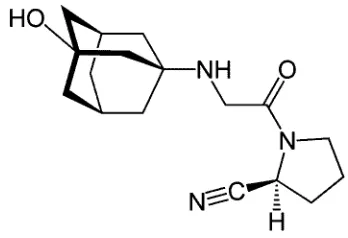
Vildagliptin (VLG), S‐1‐ [N‐ (3 ‐ hydroxyl
‐ 1 ‐ adamantyl) glycyl] pyrrolidine ‐ 2 ‐
carbonitrile (Figure 2), is an oral hypoglycemic drug of the dipeptidylpeptidase‐4 (DPP‐4) inhibitor class [6]. DPP‐4 inhibitors represent a new therapeutic approach to the treatment of type 2 diabetes [7]. Literature survey reveals that only one spectrophotometric
method [8] and one chromatographic method was reported for the determination of VDG in the presence of its synthetic intermediate [9].
Figure 2: Structure of Vildagliptin
Due to the lack of reported LC methods describing determination of the mixtures under investigation, it was deemed useful to develop simple, sensitive and selective LC method that could be useful for the simultaneous determination of MET and VLG. The proposed method was designed to be suitable for the quality assessment of these mixtures in a tablet dosage form.
EXPERIMENTAL WORK: INSTRUMENTATION:
The HPLC system was an LC Waters (Waters, Milford, MA, USA) consisting of quaternary gradient system (600 Controller), in line degasser (Waters, model AF), photodiode array detector (Water, 2998 model) and auto sampler (Waters, model 717 plus). Data was processed using Empower Pro software (Waters, Milford, MA, USA). Chromatographic separation assay was performed with a Water’s C-18 analytical column (150 mm × 4.6 mm inner diameter, 5 μm particle size, Waters,
mobile phase was pumped at a flow rate of 1 mL min−1. The detection wavelength was 258 nm.
Chemicals:
All reagents and solvents were of analytical and HPLC grade and included dipotassium phosphate buffer (K2HPO4), acetonitrile
Standards and considered as external standards. Combination tablets of MET and VLG were purchased from local market. Double distilled water was used during the entire HPLC procedure. Standard stock solutions of each drug (1 mg/mL) were prepared by dissolving 100 mg of the drug in mobile phase in a 100 mL volumetric flask and then completed to volume with the same. Then required concentrations were prepared by serial dilutions with mobile phase of these stock solutions.
Chromatographic conditions:
Chromatographic separation was achieved on Water’s C-18 column (150 mm × 4.6 mm inner diameter, 5 μm particle size, Waters, Dublin, Ireland). Isocratic elution using a mobile phase consisting of 0.1 M Dipotassium Phosphate buffer (pH 7) and acetonitrile in the ratio of 70:30 v/v with UV detection at 258 nm was performed. The buffer solution was filtered through 0.45 μm membrane filter and degassed for 30 min in an ultrasonic bath prior to use. The mobile phase was pumped through the column at a flow rate of 1 mL/min. Analyses were performed at 45°C and the injection volume was 10μL.
Samples preparation:
Twenty tablets were weighed. An accurately weighed amount of the finely powdered Galvusmet (Novartis) tablets equivalent to 2000 mg of MET and 200 mg of VLG was made up to 100 mL with mobile phase. The solution was filtered followed by serial dilution to the required concentrations for each experiment.
Linearity and repeatability
Accurately measured aliquots of working standard solutions equivalent to 1.0 ‐ 4.0 mg/ml MET and 100.0 ‐ 300.0 μg/ml VLG were separately transferred into two series of 10 mL volumetric flasks and then completed to volume with mobile phase. A volume of 10 μL of each solution was injected into the chromatograph. A calibration curve for each drug was obtained by plotting area under the peak (AUP) against concentration (C). The repeatability of the method was assessed by analyzing a mixture containing 200 μg/mL of VLG and 2000 μg/mL of MET.
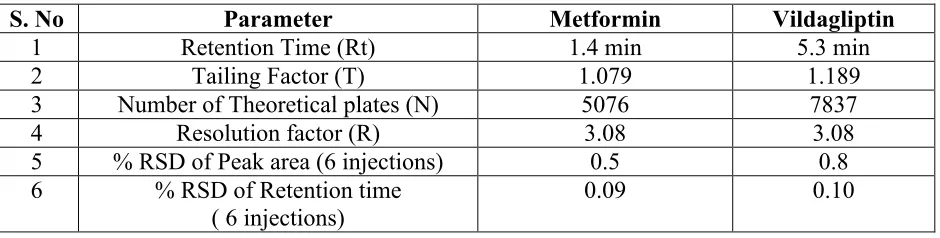
Table 1:System suitability test for the proposed LC method for the simultaneous determination of metformin and vildagliptin tablet dosage form.
S. No Parameter Metformin Vildagliptin
1 Retention Time (Rt) 1.4 min 5.3 min
2 Tailing Factor (T) 1.079 1.189
3 Number of Theoretical plates (N) 5076 7837
4 Resolution factor (R) 3.08 3.08
5 % RSD of Peak area (6 injections) 0.5 0.8
6 % RSD of Retention time ( 6 injections)
RESULTS AND DISCUSSION:
The combinations of MET and VLG is new to the market. No previous method was reported for the LC determination of MET and VLG in its tablet dosage form. Thus, the aim of this work was to develop a simple, accurate and reproducible LC method that could be applied to the simultaneous determination of MET and VLG in pharmaceutical preparations of these drugs.
Method development:
During the optimization cycle, several chromatographic conditions were attempted using an Inertsil C8 column (250 mm x 4.6 mm, 5 μm). Recently, cyano columns have been used for the separation and quantitation of drugs. Various mobile phase compositions containing different ratios of organic and aqueous phases were tried in an isocratic mode.
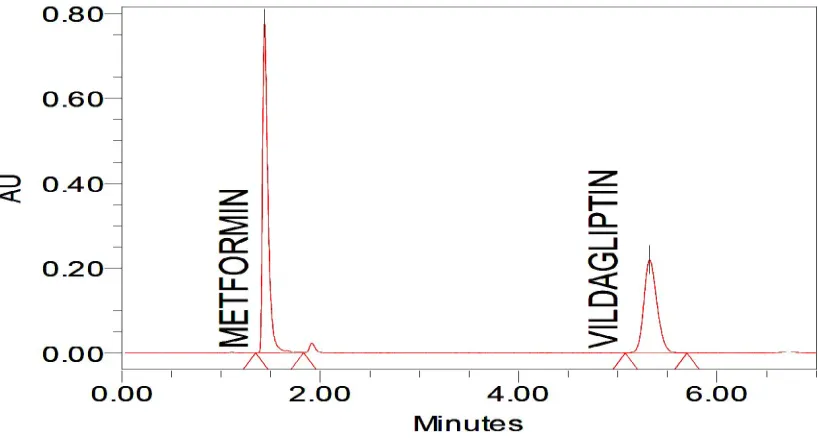
It was found that 50% of organic modifier was needed to elute all peaks within 8 min. Acetonitrile was found optimum for the elution. Besides, different buffers at different pH values were attempted along with acetonitrile. Therefore, a mobile phase consisting of 0.1 M Dipotassium Phosphate buffer (pH 7) and acetonitrile in the ratio of 70:30 v/v and pumped at a flow rate of 1.0 mL/min, with Waters C18 column, in an isocratic mode, gave good separation of the two drugs. Due to the poorly absorbing chromophores in the two drugs examined, detection was carried out at 258 nm to obtain sufficient peak intensity for these drugs. The retention times were 1.4 and 5.3 min for MET and VLG respectively; as presented in Figure 2 and 3.
Fig no 3: A typical LC chromatogram of 10 μL injector of standard sample solution containing metformin hydrochloride (2000 μg/mL) and vildagliptin (200 μg/mL).
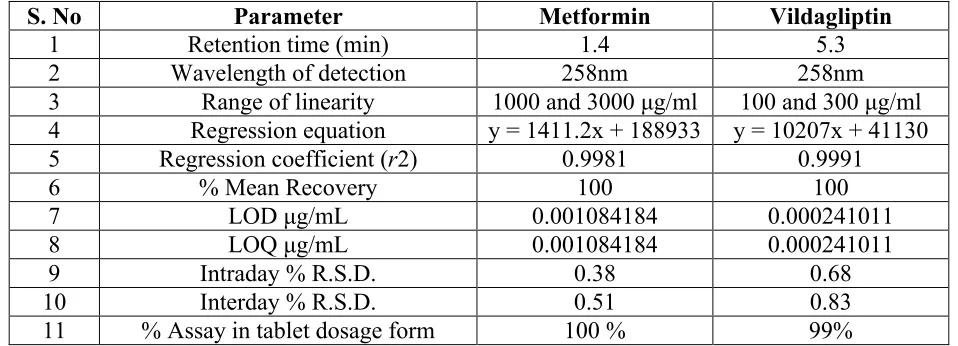
Table 2: Summary of results obtained by LC method for the determination of
metformin and vildagliptin
S. No Parameter Metformin Vildagliptin
1 Retention time (min) 1.4 5.3
2 Wavelength of detection 258nm 258nm
3 Range of linearity 1000 and 3000 μg/ml 100 and 300 μg/ml 4 Regression equation y = 1411.2x + 188933 y = 10207x + 41130 5 Regression coefficient (r2) 0.9981 0.9991
6 % Mean Recovery 100 100
7 LOD μg/mL 0.001084184 0.000241011
8 LOQ μg/mL 0.001084184 0.000241011
9 Intraday % R.S.D. 0.38 0.68
10 Interday % R.S.D. 0.51 0.83
11 % Assay in tablet dosage form 100 % 99%
System suitability tests:
In the proposed LC method, system suitability tests are used to verify that resolution and reproducibility were adequate for analysis performed. Different parameters affecting the chromatographic separation were studied.
METHOD VALIDATION: Linearity:
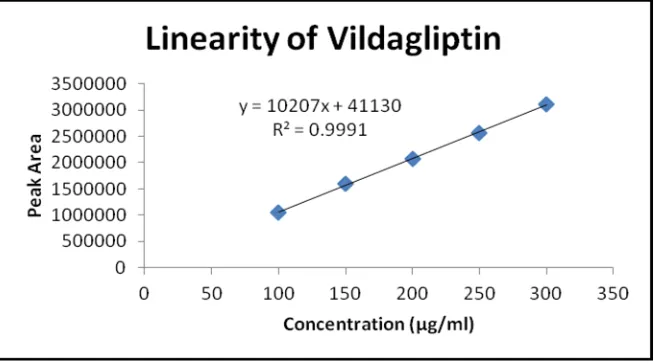
Linearity was studied for MET and VLG. A linear relationship between area under the peak (AUP) and component concentration (C) was obtained. The regression equations were also computed.
The linearity of the calibration curves were validated by the high value of correlation coefficients. The analytical data of the calibration curves including standard deviations for the slope and intercept are summarized in Table 2.
Fig no 4: Linearity of Metformin
Fig no 5: Linearity of Metformin
Accuracy:
Accuracy of the results was calculated by % recovery of three different concentrated samples of MET and VLG in its tablet dosage form by standard addition technique for Galvusmet tablets. The results obtained including the mean of the recovery and relative standard deviation are displayed in Table 2.
Precision:
The repeatability of the method was assessed by analyzing 2000 μg/mL of MET and 200 μg/mL of VLG, (n = 6). The values of the precision (%R.S.D.) of repeatability, inter‐day and intra‐day precision (using three different concentrations in triplicates for three days) are displayed in Table 1‐2.
Specificity:
Specificity is the ability of the analytical method to measure the analyte response in the presence of interferences. In the present work, specificity was checked by analyzing MET and VLG. Good resolution and absence of interference between drugs being analyzed are shown in Figure 2. Besides, the chromatograms of the pharmaceutical formulation samples were checked for the appearance of any extra peaks. No chromatographic interference from any of the excipients was found at the retention times of the examined drugs (Figure 2). In addition, the chromatograms of the drugs in the sample solutions were found identical to the chromatograms received by the standard solutions at the wavelengths applied (Figure 2 & 3). Moreover, good results
were obtained for the determination of the cited drugs in the two dosage forms, Table 2. These results confirm the absence of interference from other materials in the pharmaceutical formulations and therefore confirm the specificity of the two proposed methods.
Limit of detection and limit of quantification:
Limit of detection (LOD) which represents the concentration of analyte at S/N ratio of 3 and limit of quantification (LOQ) at which S/N is 10 were determined experimentally for the proposed methods and results are given in Table 3.
CONCLUSION:
A single LC method can be applied to the simultaneous determination of MET and VLG in their tablet dosage form. The proposed LC method has the advantages of simplicity, precision, accuracy and convenience for the separation and quantization of MET and VLG. The method can be applied for the determination of the cited drugs in tablets without interference from the tablets’ inactive ingredients. The method was validated showing satisfactory data for all the method validation parameters tested. Thus, the developed method can be conveniently used by quality control laboratories.
ACKNOWLEDGEMENT:
REFERENCES:
1. Mohammad Abdul-Azim et al., Development and validation of a reversed – phase column liquid chromatographic method for simultaneous determination of two novel giptins in their binary mixtures with metformin, European Journal of Chemistry. 2012; Vol 3, No 2.
2. Nahed M El-Enany et al., Development and validation of a repharsed phase- HPLC method for simultaneous determination of rosiglitazone and glimepiride in combined dosage forms and human plasma Chemistry Central Journal2012,6:9
3. M. Saeed Arayne et. al., Simultaneous Determination of Metformin, Cimetidine, Famotidine, and Ranitidine in Human Serum and Dosage Formulations Using HPLC with UV Detection, Journal of Chromatographic Science, Vol. 48, October 2010
4. El-Bagary RI, Elkady EF, Ayoub BM Liquid chromatographic determination of sitagliptin either alone or in ternary mixture with metformin and sitagliptin degradation product. Talanta 2011 Jul 15;85(1):673-80. Epub 2011 Apr 27.
5. Abdul‐ Azim Mohammad, Development and validation of a reversed‐phase column liquid chromatographic method for simultaneous determination of two novel gliptins in their binary mixtures with Metformin, European
Journal of Chemistry 3 (2) (2012) 152‐155.
6. Singh SK, Manne N, Pal M. Synthesis of (S)-1-(2-chloroacetyl) pyrrolidine-2-carbonitrile: a key intermediate for dipeptidyl peptidase IV inhibitors. Beilstein J Org Chem. 2008; 4:20. Epub 2008 Jun 12.
7. Ramakrishna Nirogi et. al., Sensitive liquid chromatography tandem mass spectrometry method for the quantification of sitagliptin, a DPP-4 inhibitor, in human plasma using liquid–liquid extraction.
Biomedical Chromatography
Volume 22, Issue 2, pages 214– 222, February 2008
8. El-Bagary R I, Elkady E F, Ayoub B M; Spectroflourometric and Spectrophotometric Methods for the Determination of Sitagliptin in Binary Mixture with Metformin and Ternary Mixture with Metformin and Sitagliptin Alkaline Degradation Product. International journal of Biomedical science. International Journal of Biomedical Science. 2011; 7(1):62-69.