
Download complete issue: Vol. 1, No. 2 (PDF)
7
0
0
Full text
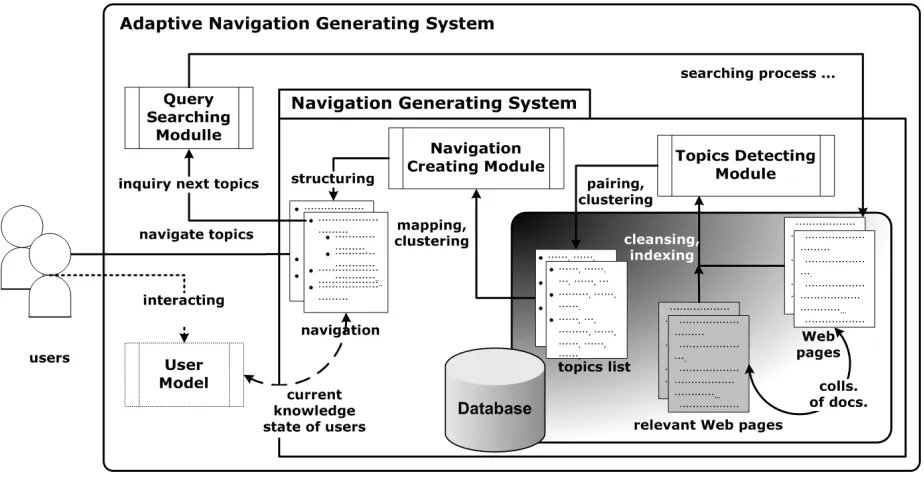
(2) 38. INTERNETWORKING INDONESIA JOURNAL. PURWITASARI ET AL.. Fig. 1. Framework of adaptive content-based navigation generating system.. adaptive navigation support [1] such as curriculum sequencing. The goal is to provide a user with “optimal path” through the materials that is the most suitable individually planned sequence of topics for learning. This becomes very important due to its ability to guide users through the volume of available resources. Sequencing could be implemented in the form of list of some recommended links as a suggested learning path. We design generating system which produces appropriate learning path with current interest of users. A document of Web page is representation form of at least an identified topic in learning path. On account of users want to browse more of a topic, system translates users' clicked action into inquiry using feature terms within the Web page as search keywords of selected topic. Our scoring schema exploits information of contents and hyperlinks in Web pages [2]. Many research efforts, which influence our framework to generate content-based navigation, have been engaged to bring structured representation to a large collection of documents in the Web. To fulfill the function there are two main approaches: (i) organize documents in a domain of subjects [3] [4] [5] [6] and (ii) provide scenarios of topics for learning particular subjects [7] [8]. We do thorough study literature to propose a framework that makes the best use of both models [9]. Then prototype implementation of the framework shows system uniqueness compare to works of previously mentioned researches. With data mining techniques on topic identification [3], we adapt the techniques and then employ similarity function for merging topics to other tasks like structuring and representing document into topics within content-based navigation. Documents may have membership in several domains of subjects. Though fuzzy clustering might be more suitable in partition collection of. subjects-overlapped documents [4], we show even agglomerative clustering can be applied. We consent in exploiting information of hyperlinks as well [5] [6] to generate navigation of learning path because documents in the materials collection are Web pages. Evaluations are done to verify validity of selected methods in the framework [10]. Some evaluations concerns about preparing Web contents that should be sufficient for a collection thus the system could suitably generate navigation. Another evaluation is related to comparing results of some distance measures for partitioning criteria on agglomerative clustering. Other evaluation observes generating navigation from contents of some documents that close to user's current interest of topic. The documents are retrieved with our scoring model [2]. After observing number of evaluations, the proposed framework is implemented [11]. However it is still a model system which generates a content-based navigation. An adaptive effect to generate and re-generate navigation that supports statement to produce appropriate learning path with current interest of users is emphasized in current work.. III. CONT ENT -BASED NAVIGAT ION GENERAT ING SYST EM Given a collection of documents, system outlines learning topics then provides learning scenarios to offer guidance for users. Initially it extracts topics which are frequently discussed in the collection with data mining techniques (Topics Detecting Module, Fig.1), then clusters extracted topics in order to hierarchically produce a sequence list of topics (Navigation Creating Module, Fig.1). ISSN: 1942-9703 / © 2009 IIJ.
(3) Vol.1/No.2 (2009). INTERNETWORKING INDONESIA JOURNAL. A. Overview Basic cognitive process of topic identification is that there exist sets of common words (frequent itemsets) for each topic. Frequent itemsets are mapped into hypergraph with vertices represent words and edges represent strength relation between words (Topics Detecting Module, Fig.1). To extract topics means to partition hypergraph into sub-graphs. Then extracted topics will be restructured to produce a hierarchical list of topics-subtopics using agglomerative clustering with some adjustments. This hierarchical list is supposed to give an implicit path as kind of learning direction for users (Navigation Creating Module, Fig.1). When users click in one topic, system makes an inquiry using feature terms within Web page as search keywords of selected topic. Inquiry results retrieved with our scoring scheme [2] become new resources to produce next sequence of topics (Query Searching Module, Fig.1). This module becomes addendum of adaptive effect in adaptive content-based navigation generating system. B. Topics Detecting Module If important terms (frequent itemsets) in the collection are mapped into graph of word vertices, sub graphs indicate implicit topics. Hypergraph is a graph in which its edge can connect more than two vertices. This module partitions hypergraph to single out hyperedges for identifying mostly discussed topics. shmetis library in hMetis tool is executed to do hypergraph partitioning[12]. Based on defined writing rule by shmetis for input-output files, we provide ways of encoding frequent 2-itemsets of hypergraph into input file and decoding output file into list of unnamed topics consisting common words of each topic. Topics Detecting Module begins with preprocessing collection [13] which includes indexing, removing stop words, stemming, and TF-IDF (term frequency - inverse document frequency) weighting in order to retrieve candidates of frequent itemsets. Data mining lists frequent itemsets that satisfying some minimum values of support and confidence filters. We introduce usage of other filters to set apart significant frequent 2-itemsets. First is indispensable feature value of TF-IDF term weight (Eq.1), and second is our own weighting schema of term entropy (Eq.2).. ωd ,t =. tf d ,t N ⋅ log ≥ δ w ...............................................(1) max tf d ,t nt i. Let the collection D of N Web pages, |D| = N, shows n t as number of documents containing term t. Then a weight ωd,t is assigned for each term t in a document d that depends on the number of term occurrences in the document, tfd,t, normalized by frequency value of the highest term occurrences. Term weight ωd,t is attenuated with an effect of idft = log N/n t if the term occurs too often in the collection. For TF-IDF filter we do not consider values of term weight ωd,t less than δw.. 39. T ABLE I A CONTINGENCY TABLE TO HELP DETERMINING IMP ORTANCE STATE OF TERMS IN A DOCUMENT. from set S lt from set S gt. belongs to CD a c. belongs to CNOT_D b d. | S lt | = a + b | S gt | = c + d. Entropy value measures uncertainty state. We consider entropy value of a term reflects effectiveness of the term in identifying certain document to others. This reasoning is derived from selection of most useful attribute to test at each node in decision tree algorithm [14]. For term entropy calculation we assume that there are only two classes as target classification: (i) whether the term is one of important terms in currently observed document or (ii) in the contrary that the term is important for any other documents except the currently observed one. Attribute for classification of a term belongs to (i) or (ii) is test condition whether frequency of the term in currently observed document (term frequency) will be less or more than average value of term frequency from all documents in the collection. In a collection D, for a document d let term t is classified into two classes: (i) important terms of document d, Cd, or (ii) important terms in other documents, Cnot_d. The state whether tfd,t value is less or greater than average number of term occurrences t in any document within collection avg(tfd,t)d∈{1…} becomes attribute for classifying. For each calculation of term entropy value ent d,t in document d, we assume that there are only two classes as target classification. Term entropy value ent d,t is defined as:. ent d ,t = ∑. | Sn | ent _ pd ,t ( S x ) ≥δ e ..................................... (2) N. with S x can be set of documents where term occurrences tfd,t in current document d is less, S lt, or greater, S gt, than average number avg(tfd,t); S x ∈{S lt, S gt}, and D = {S lt,∩S gt} (Table 1 depicts contingency table to help determining importance state of terms in a document). For entropy filter we do not consider values of term entropy less than δe . Given a set S x , containing only positive and negative documents of 2 class problem Cd and Cnot_d, entropy of set S x relative to this simple, binary classification is defined as:. ent _ pd ,t ( S x ) = −( p p log 2 p p + pn log 2 pn ). ................. (3). where p p is proportion of documents with term t belongs to Cd in S x and p n is proportion of documents belongs to C not_d. We list frequent itemsets that satisfy data mining filters, which are minimum support (Eq.4) and minimum confidence (Eq.5) [15]. Support s value shows a percent value of n documents that must contain terms ti and tj, pair of common words occurs together in. ISSN: 1942-9703 / © 2009 IIJ.
(4) INTERNETWORKING INDONESIA JOURNAL. 40. PURWITASARI ET AL.. multiple documents. The support filter will ignore any 2-itemsets of words that occur in few documents to ensure the ones that often occur are worthy of attention.. tpca or tpcb could become topics cluster as a result of merge topics. This modification handles issue of articles that very likely have blended topics.. s i , j = p(t i , t j ) ≥ δ s ....................................................................(4). sim(d i , tpct ) =. While confidence c, also called as mutual information, measures dependence or correlation between occurences of terms ti and tj. The confidence filter makes further analysis to find whether the presence of a 2-itemsets that often occurs (read: sufficient to the support filter) is strongly significant to become a potential frequent itemsets.. ci , j = log 2. p (t i , t j ) p (t i ) × p (t j ). ≥ δ c ..............................................(5). Note, p(x) is defined as a probability function of x, i.e. p(t) = n t/N, while p(x, y) is a joint probability function of x and y. C. Navigation Creating Module To know relations between topics-subtopics, agglomerative clustering is used to organize topics in nested groups of merged topics [3]. Clustering initialization uses extracted topics from hypergraph partitioning as cluster seeds. In the first iteration a cluster contains single topic but for the next a cluster could contain more than one merged topics. Merging some topics in a cluster could result well comprehensive topic or not is an appraising question. Thus we judge within distances on members in the same cluster should be minimized while between distances on different clusters be maximized. The smaller value variance ratio of between and within distance shows, the better clustering results are. If certain iteration has large value of variance ratio though it inclines smaller at previous iterations, then clustering will cut-off tree of topics-subtopics. Our assumptions during clustering process are that each document can only belong to exactly one cluster of topics and any cluster without document members will be removed. We use extracted topics as cluster seeds in initialization. Because of the assumptions there is possibility that some initial clusters do not have any document members and will be left out during tree construction. Our proximity matrix P is a matrix whose ijth entry denotes the similarity between topics in i th and jth clusters. Before merging topic a, tpca, and topic b, tpcb, we recalculate similarity between any document d to soon-to-be-merged topics based on their common words (sim(d, tpca), and sim(d, tpcb)). It means that there are words that not only frequently found in documents close to tpca but also exist in documents of tpcb. The similarity of document-to-topic is derived from TFIDF formula in term weighting process (Eq.6) [3]. Accumulation of document similarities value with every topics pair is applied in a mutual information style to update proximity matrix of topic clusters in each iteration time clustering. Eq.7 defines simab as similarity of topic a, tpca, and topic b, tpcb [3]. In the first iteration, tpca and tpcb contain single topic which is cluster seed taken from the extracted topics by Topics Detecting Module. For next iterations. ∑ k∈t. tf ik × (log(. ∑. j∈t. (log(. N 2 )) × nk. N 2 )) nk. ∑. j∈t. (tf ij ) 2 (log(. N 2 )) nk. .......................................................................................................... (6). simab =. ∑. i∈docs. ∑. sim(d i , tpca ) × sim(d i , tpcb ) N. j∈docs. sim(d j , tpca ) N. ×. ∑. k∈docs. sim(d k , tpcb ) N. .......................................................................................................... (7) Distances between two clusters of topics signify overlapping domain of subjects. Similarity function which is used to define likeness of document and cluster also works for calculating distances between clusters [3]. Our implementation demonstrates that similarity function of document and cluster is not only for merging topics [9] [11]. Aforesaid design for cutting-off topics-subtopics tree utilizes similarity function to work out on variance ratio value. In the end cluster of single topic or merged topics will have a document representation. For that purpose, this module searches the representation from list of documents similar to clusters of topics. The list is a descended order by depth-first traversing. Similarity function is used to measure likeness level similarity between document and cluster of topics based on common words which exist within. We compute similarity of each traversed document ignoring any document which has already become representation of other clusters. Similarity between document and sub clusters of currently visited cluster is also checked, because it is possible that the document is more suitable as representation of one of its sub cluster. In order to get orders of traversal topics in the list, we consider implicit links information of Web pages. PageRank [16] is selected to do link analysis for acquiring importance weight of each document representation.. IV. A DAPT IVE CONT ENT -BASED NAVIGAT ION GENERAT ING SYST EM Content-based navigation generating system changes point focus of learning path if current knowledge state of users is shifting. Query Searching Module will pin-point some documents from the collection where their contents relevant with information in user model (see Fig.1). Then the system. ISSN: 1942-9703 / © 2009 IIJ.
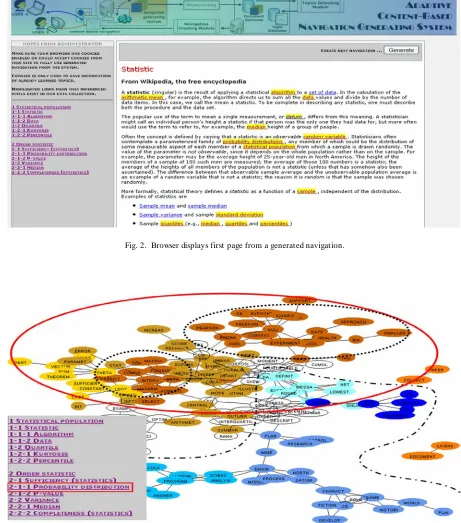
(5) INTERNETWORKING INDONESIA JOURNAL. Vol.1/No.2 (2009). 41. Fig. 2. Browser displays first page from a generated navigation.. Fig. 3. Map of topics from a generated navigation on a Web-based Application.. adaptively re-generates a new navigation to learn those documents.. A. Query Searching Module We use PageRank [16] to pick out most linked-by Web pages which their contents are more suitable with selected topic.. Generated navigation is derived from mapping of clustered topics where each single topic might be term phrases. Since position of combined terms might lead to different meaning, to find suitable contents we need to exploit schema of term weighting that considers position of terms [17]. Our searching process applies combined ranking factors of link analysis, PageRank Scoring, and content analysis that still retaining spatial information (position of terms) of search keywords,. ISSN: 1942-9703 / © 2009 IIJ.
(6) INTERNETWORKING INDONESIA JOURNAL. 42. Fourier Domain Scoring [2]. Searching results act as dummy collection replacing the original one in which the system will produce the next suitable navigation for more focused collection to learn further. Adaptive content-based navigation generating system uses Vector Space Model (VSM) or TF-IDF weighting, Fourier Domain Scoring (FDS) and PageRanks Score (PRS) in a combination to get similarity score of a document with selected material. The selected one is a Web page where user clicks [Generate] button (see Fig.2). System concerns term weight values of important terms that exist in document and query Web pages to get VSM score. System will calculate FDS score if and only if title of selected material consists more than single term. Finally multiplication between those three kinds of scores, if FDS score exists, defines final similarity between Web pages of document and query. B. System Implementation on Web-based Application As experiments to test functionality of each module, adaptive content-based navigation generating system is implemented. Small collection of documents contains English Wikipedia articles without images 1 is prepared. Collection of Web pages is prepared beforehand such as do html scraping based on XML files as patterns to extract only learning contents from raw Web pages. For this time being it is easier to observe adaptive effect with small experimental collection (±30 docs). The adaptive is concerned with topics mapping to recognize domain of subjects and then topics spotting of user interests to provide scenarios for learning subjects. We use libraries of Oracle Text 2 in indexing terms and Porter Stemmer algorithm in stemming processes. List of stop words contains words provided by Oracle Text, HTML tags and some common words in Wikipedia articles. Browser display Web page in Fig.2 for users. Highlighted links indicate that their being referenced Web pages are documents in the collection. System deals with contents of those pages in consecutive way of routine processes from aforementioned modules to derive map of topics for generating navigation. First generated navigation is illustrated in Fig.3 where it also shows graph of words 3, though to create illustration graph is not part of navigation generating system. Note that the graph describes map of topics in experimental collection of Wikipedia articles. The navigation has two sections as shown with a two-divided area in map op topics by dashed line. Each divided area in the graph contains several groups of gradational vertices. Nodes with the same gradation color are common words of single topic or sub section in generated navigation. Let say user clicks one topic of first generated navigation in 1. crawled from main page of category Statistic http://en.wikipedia.org/wiki/Statistic 2 Oracle T ext in Oracle Database http://www.oracle.com/technology/products/text 3 hypergraph is written with Dot Language and viewed at ZGRViewer http://zvtm.sourceforge.net/zgrviewer.html. PURWITASARI ET AL.. Fig.3 (see rectangle area of a sub section in the navigation). Selected topic has words in dotted ellipses within its coverage concept of subjects. Query Searching Module recognizes that searching results of documents have subjects relate to selected topic as illustrated with ellipse area of solid line. For second generated navigation in this case, the system will produce a structure from pin-points topics within solid line ellipse, and not from a whole map of topics. It is said that the system adaptively changes point focus of learning path for users based on their current interest. Fig.2 illustrates Statistic course in a sample of web-based learning. It is suggested that user learns topics about [Statistic Population] then followed by [Order Statistic] from the course. If user clicks link of [Probability Distribution], the system analyzes topic mapping in Fig.3 and generates new learning path focused on topics in ellipse area with solid line. The second generated path does not concern with all topics in the mapping.. V. CONCLUSIONS AND FUT URE W ORKS In previous works we do study literatures and propose a framework of navigation generating system, evaluate selected methods in the frameworks to confirm their validities, then implement the framework with still one left aspect to produce appropriate learning path for users: adaptive effect. This work brings to completion of proposed framework for generating navigation solely based on contents in the collection of documents. With addition of adaptive effect, the system could generate navigation as guidance for users without neglecting their context of interests on certain learning subjects. Adaptive content-based navigation generating system has produced a structural list of topics, not only hierarchical list in the different level but also reading sequence in the same level. Instead following links within Web pages of learning materials and then reading them in a hypertextual manner, users could follow path in our generated navigation and stay away of any hypertext disorientation. System implementation on this paper utilizes the term of adaptive from user model with information on the selected topic. As a note, it is believed that the collection of learning materials consists of topics and relation between topics decided by frequency of words in documents within the collection. Information of selected topics by user should be recorded to reflect user preferences of learning topics. Preference of a user is not adequately reflected yet in this paper. More elaborate studies are needed to represent user model. Information about previously visited links, time to access in each link or others could become reference for modeling users. Next, we would like the system also considers those aspects. The framework that has been discussed so far involves analyzing hidden topics that we believe will affect the optimal path of navigation support system to the user. It also will affect the reaction of the user to the system about learning process. Though evaluating the framework about functionality has been. ISSN: 1942-9703 / © 2009 IIJ.
(7) INTERNETWORKING INDONESIA JOURNAL. Vol.1/No.2 (2009). done, more quantitative evaluations of the effectiveness of the system are also expected. The effectiveness should face the question of how to directly evaluate user reaction to navigation generating system. Our next work will also consider this unanswered question. [17] L. A. Park, K. Ramamohanarao, and M. Palaniswami, “ Fourier Domain Scoring: A Novel Document Ranking Method,” IEEE T rans. on Knowledge and Data Engineering, vol. 16, no. 5, pp. 529–539, May 2004.. REFERENCES [1] P. Brusilovsky and E. Millan, “ T he Adaptive Web: Methods and Strategies of Web Personalization”, ser. Lecture Notes in Computer Science. Springer Berlin / Heidelberg, 2007, vol. 4321, ch. User Models for Adaptive Hypermedia and Adaptive Educational Systems, pp. 3–53. [2] D. Purwitasari, Y. Okazaki, and K. Watanabe, “ A Study on Web Resources’ Navigation for e-Learning: Usage of Fourier Domain Scoring on Web Pages Ranking Method,” in ICICIC ’07: Proc. of the Second Intl. Conf. on Innovative Computing, Information and Control, 2007. [3] C. Clifton, R. Cooley, and J. Rennie, “ T opCat: Data Mining for T opic Identification in a T ext Corpus,” IEEE T rans. on Knowledge and Data Engineering, vol. 16, no. 8, pp. 949–964, 2004. [4] M. E. S. Mendes, W. Jarrett, O. Prnjat, and L. Sacks, “ Flexible Searching and Browsing for T elecoms Learning Material,” in IST ’2003: Proc. of the 2003 Intl. Symp. on T elecomm., 2003. [5] M. Halkidi, B. Nguyen, I. Varlamis, and M. Vazirgiannis, “ T HESUS: Organizing Web Document Collections based on Link Semantics,” T he VLDB Journal, vol. 12, no. 4, pp. 320–332, 2003. [6] J. Zhu, J. Hong, and J. G. Hughes, “ PageCluster: Mining Conceptual Link Hierarchies from Web Log Files for Adaptive Web site Navigation,” ACM T rans. Interet T echnol., vol. 4, no. 2, pp. 185–208, 2004. [7] A. D. Wissner-Gross, “ Preparation of T opical Reading Lists from the Link Structure of Wikipedia,” in ICALT ’06: Proc. of the Sixth IEEE Intl. Conf. on Advanced Learning T echnologies, 2006, pp. 825–829. [8] S. Reinhold, “ WikiT rails: Augmenting Wiki Structure for Collaborative, Interdisciplinary Learning,” in WikiSym ’06: Proc. of the 2006 Intl. Symp. on Wikis, 2006, pp. 47–58. [9] D. Purwitasari, Y. Okazaki, and K. Watanabe, “ Content-based Navigation in Web-based Learning Applications,” in ICCE ’08: Proc. of the 16th Intl. Conf. on Computers in Education, 2008, pp. 557–564. [10] D. Purwitasari, Y. Okazaki, and K. Watanabe, “A Study on Adaptive Content-based Navigation Generating System for Web-based Learning,” in SIG-ALST ’53: Proc. of the 53 Conf. on Special Interest Group - Adv. Learning Science and T ech., T he Japanese Society for Artificial Intelligence. IEEE Education Japan Chap., 2008, pp. 31–36. [11] D. Purwitasari, Y. Okazaki, and K. Watanabe, “Data Mining for Navigation Generating System with Unorganized Web Resources,” in KES ’08: Proc. of the 12th Intl. Conf. on Knowledge-Based Intelligent Information and Engineering Systems, 2008, pp. 598–605. [12] G. Karypis, “ Multilevel Hypergraph Partitioning,” Comput. Sci. and Eng. Dept., Univ. Minnesota, Minneapolis, T ech. Rep. 02-25, 2002. [13] R. B. Yates and B. Ribeiro-Neto, Modern Information Retrieval. Addison-Wesley, 1999. [14] J. R. Quinlan, “ Induction of Decision T rees,” Machine Learning, vol. 1, pp. 81–106, 1986. [15] R. Agrawal, T . Imieli´nski, and A. Swami, “ Mining Association Rules between Sets of Items in Large Databases,” ACM SIGMOD, vol. 22, no. 2, pp. 207–216, 1993. [16] L. Page, S. Brin, R. Motwani, and T . Winograd, “ T he PageRank Citation Ranking: Bringing Order to the Web,” Stanford Digital Library T echnologies Project, T ech. Rep., 1998.. 43. .. ISSN: 1942-9703 / © 2009 IIJ.
(8)
Figure
Related documents
T3 showed a significant negative correlation with waist circumference in patients with hypothyroidism and met- abolic syndrome
transfer function of filter circuit and then apply sensitivity analysis as given in equation.
Moreover, the measurement data obtained while driving in urban traffic allowed plotting the characteristics of the time density for each of the tested two-wheeled
Charaka Samhita english translation; Sharira sthana, chapter 7, verse no.5, Chaukhambha Sanskrit series office, Varanasi, 1996. Shrikantha Murthy;
Conclusion: Immunization with SRBC suspension induced relative hypoxia, elevated reactive oxygen species (ROS), and oxidative stress in the lymphocytes as indicated by the increase
The current established methods for smoking cessation include wide range of side effects (Table No. 2), but as a comparison sublingual or buccal thin films are a better
Survivors of torture and/or war report experiencing informational barriers to navigating educa- tional pathways, accessing professional supports, evaluating credentials,
Determination of Minimum Inhibitory Concentration The antimicrobial potential of titled compounds thiazolidin-4-one was performed against Gram-negative.. bacterium:
