Applying Moodle Cloud Services in Iraqi Universities:
Mobile Applications Course
Ahmed Dheyaa Basha
Computer Science & Information Technology, University of Sumer, ALQul,aa, Iraq
Abstract
Interactive applications for Moodle cloud in education sector became one of the directions of information technology development in 2016-2018 especially with portable devices (mobile devices). Iraqi universities struggled to apply Moodle cloud services via mobile applications to advance productivity with professors and students, to improve overall quality of higher education. In this paper live (API) tools of social media in Facebook used as a port through Moodle cloud services, Google disk and set of mobile applications’ features are used tofacilitating all academic activities in course by Moodle cloud. The paper included proposed framework of Moodle cloud as a one of educational content management systems with the help of mobile applications that building in frames of course in University of Sumer as a one of Iraqi universities.Keywords
Moodle cloud, Mobile application course, Social media, live (API), LMS1. Introduction
Interactive applications for Moodle cloud in education sector became one of the directions of information technology development especially with portable devices (mobile devices).One of important the features of mobile application in learning are courses with the Moodle cloud services as an application of interactive methods with all the classes synchronous and non-synchronous [9-7]. All higher education universities involved high attention to the development and improve of interactive methods and teaching environment like Moodle cloud environment with suitable devices to learn persons [5-1]. Newly, the rising of Moodle cloud, as a gate to online knowledge-sharing community in universities, formed by interpersonal interaction anytime and anywhere [11-8]. Moodle cloud known as a free and open-source, it serves and meet different needs in public or private websites via use different portable devices (such as mobile devices) and
numerous applications in situations officially or
non-officially with availability of the Internet [15-13]. For instance, academic sites (to upload documents, assignment, registration, notifications and navigation) and social media sites (like Facebook) for multi-purpose (video live (API) used as a video conference, chatting and Correspondence)
* Corresponding author:
[email protected] (Ahmed Dheyaa Basha) Published online at http://journal.sapub.org/jwnc
Copyright©2018The Author(s).PublishedbyScientific&AcademicPublishing This work is licensed under the Creative Commons Attribution International License (CC BY). http://creativecommons.org/licenses/by/4.0/
[4-6-10]. Moreover, and according to many reports from “Mobile World Congress” 2016, 2017 [7] focused on the directions toward mobile devices as a high demand in scope of mobile learning in universities. Urgent demand for mobile learning is increasing, currently, new technologies still alone and not improves the experience of mobile learners in higher education. Learning content in universities must be adapted to achieve personal needs of those learners within their modern current context [10-3]. However, this study struggled to apply Moodle cloud services through mobile devices to present high quality of educational content in Iraqi higher education, especially with live (API) tools of social media in Facebook that used as a package available in Moodle cloud services.
2. Active Moodle Cloud in System of
Mobile Learning Management
students. Thus, creation active Moodle cloud in system of mobile learning management to the learning content reduces time and efforts and leads to integration services cloud of learning contents through Moodle cloud and available facilitates publishing and learning management especially courses content for student to develop; save of the documents; upload different software; replay comments and watching video for professor synchronous and non-synchronous for example by live (API) in Facebook across social media which already linked with Moodle cloud site to be used through mobile devices and its applications to serve learning contents [4-9-12].
3. Moodle Cloud Services and
Technology’s Applications
New Learning Management system (LMS) include system of mobile learning management is high-level to conduction and manage of the studying course in universities [7]. In this respect, contents published comply with a standard of Moodle cloud in terms of interactivity; visual elements like graphics; animation, video etc. in addition the, the openness number of subscribers to content in Moodle cloud it belongs to community that open exchange of opinions regarding the course and create control to process educational contents [10-2]. For the time being, there exist some options of (LMS) acquisition by the institutions included:
1. LMS are developed and improved by the institutions themselves;
2. LMS is used as a platform via Commercial sector to publish on the server of the institution;
3. LMS is spread by sharing software as a service on cloud services.
However, development Learning Management System (LMS) by institution is very difficult and need long-term of initialization and process [3]. For instance, many (LMS)-platforms used server of the institution via popular open source software. These (LMS)-platforms applicable, analysis, develops and editing include:
1. LMS-platforms eFront (www.). 2. LMS –platform Moodle.
3. LMS-platform Black board Learn.
In this respect, many LMS starting by numbers of developers regarding cloud and became popular in the world based on learning management through different software for instance:
1. Docebo (www.docebo.com). 2. Litmos (www.litmos.com). 3. Torch (torchlms.com).
Consequently, the author chose LMS Moodle cloud as a platform for University of Sumer. This choice was chosen for multi reasons: easy and friendly interface, diversity of management elements, popular LMS-platforms in term of
connectivity with social media like Facebook, and open source product etc., [9-11]. Moreover, Moodle cloud subscription free for students and teachers. In addition, support cloud services for mobile learning that use multi- applications developed by Google disk, Microsoft, YouTube etc. These features that provide different variety of possibilities to work with learning content including interactive access, online course, preview and editing and different services that organization or university access to them. To create documents or folder via course, the professor provide students password and email to login through Moodle cloud web site (https://sumer.moodlecloud.com/) with opportunity of collaborative and chatting or send assignment anytime and anywhere or discussion directly through live (API) in Facebook across set of social media that connectivity with Moodle cloud and Internet availability. In addition, using various applications package like Microsoft office and video that download from or to Moodle cloud by portable devices to be use and available for students and professor during the educational course freely. As a result, of LMS Moodle cloud services it was possible to solve several following tasks:
1- Creation educational groups of students and professors;
2- University ease establishes the calendar with academic tasks and possibility of automatic notification to students or themselves about the tasks and its completion;
3- Discussion of specific applications via lectures with follow much software through the course;
4- Collaborative and editing documents between members of the groups and professors;
5- Display multi learning materials to publishing via course with potential and opportunity for update or delete and explore;
6- Exchange the tasks and reports in case of the absence some student for a reasonable excuse, easy of services accessible anytime and anywhere by mobile devices; 7- Control and monitoring several educational tasks of
course completion during the semester.
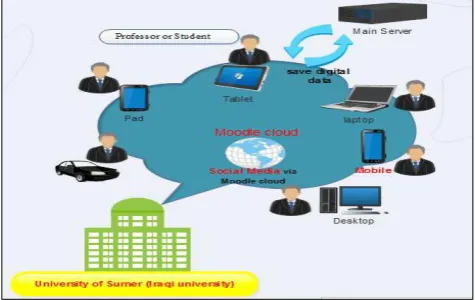
A number of Figures below shows interactive methods of learning management available with LMS Moodle cloud on different applications and services by multi portable devices through university site. However, Mobile learning in university on the basis of Moodle cloud services making educational content active, accessible; improve quality of education and minimize costs and time to professors and
students. Figure 1 shows framework about interactive
persons with social media via Moodle cloud.
Figure 2 showsof Facebook's platform as a social media
that used live (API) tools in course through Moodle cloud by mobile devices.
Figure 2. Shows Facebook as a social media used in course through Moodle cloud
Figure 3 below shows personal video live API in course for teacher to discuss material via Moodle cloud as video conference with students.
Figure 3. Shows video live API in course via Moodle cloud as video conference
Figure 4 below shows video live (API) during the course via Moodle cloud by using portable devices (mobile) and chatting students with teacher by using live streaming with the help of mobile applications.
Figure 4. Shows video live (API) during the course via Moodle cloud by using portable devices (mobile)
Figure 5 below explains login teacher with web site of university and guide students to registration in course.
Figure 5. Shows login teacher with web site of university
Figure 6 below explains how the teacher list of material of course for students to follow instruction and discussion through Moodle cloud with each other or with teacher by mobile.
Figure 6. Shows list of course for students
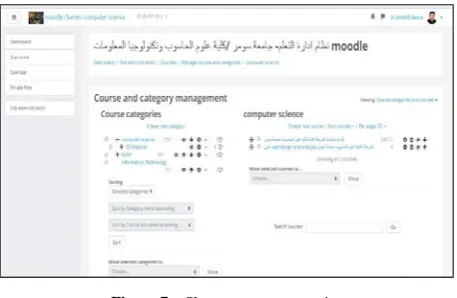
Figure 7. Shows course categories
In addition, Figure 8 below show set of activities during time table with the help of the calendar as services through Moodle cloud in university.
Figure 8. Shows activities with Calendar
Figure 9 below shows set of activity with resources that available in Moodle cloud services that help teachers in their course.
Figure 9. Shows activity with resource available with Moodle cloud services
4. Conclusions
The paper describes framework and a new way in educational content included Moodle cloud services and how link with social media (Facebook) to form educational content in Iraqi universities (university of Sumer). LMS –platform Moodle cloud used to edited and store learning
content. Consist of different environments to publish content. Moreover, the content becomes active and changes in information resources that shown automatically and easily in the LMS include Moodle cloud as a virtual environment synchronous and non-synchronous. Thus, more importantly and biggest part are activities related to professors and their students that conducted in mobile applications with the outcomes of these activities very easy to the course students on active links in LMS platform via Moodle cloud.
ACKNOWLEDGEMENTS
I would think University of Sumer to support my work especially faculty of Computer of Sciences & Information Technology and their staff.
REFERENCES
[1] T. Makarchuk, "Mobile Learning on the Basis of the Cloud Services," International Association for Development of the Information Society, 2017.
[2] M. Despotović-Zrakić, K. Simić, A. Labus, A. Milić, and B. Jovanić, "Scaffolding environment for e-learning through cloud computing," Journal of Educational Technology & Society, vol. 16, 2013.
[3] S. Balina, D. Baumgarte, and E. Salna, "Cloud based cross-system integration for small and medium-sized enterprises," Procedia Computer Science, vol. 104, pp. 127-132, 2017.
[4] H. Ogata, Y. Taniguchi, D. Suehiro, A. Shimada, M. Oi, F. Okubo, et al., "M2B System: A Digital Learning Platform for Traditional Classrooms in University," Practitioner Track Proceedings, 2017.
[5] D. Cvetkovic, M. Mijatovic, M. Mijatovic, and B. Medic, "Web service model for distance learning using cloud computing technologies," in Information and Communication Technology, Electronics and Microelectronics (MIPRO), 2017 40th International Convention on, 2017, pp. 865-869.
[6] Y. Chao-Tung, W.-T. Yeh, and S. Wen-Chung, "Implementation and Evaluation of an e-Learning Architecture on Cloud Environments," International Journal of Information and Education Technology, vol. 7, p. 623, 2017.
[7] V. Kumar and D. Sharma, "Cloud computing as a catalyst in STEM education," International Journal of Information and Communication Technology Education (IJICTE), vol. 13, pp. 38-51, 2017.
[8] A. Soceanu, M. Vasylenko, and A. Gradinaru, "Improving Cybersecurity Skills Using Network Security Virtual Labs."
[10] D. Patel and H. I. Patel, "Blended Learning in Higher Education using MOODLE Open Source Learning Management Tool," International Journal, vol. 8, 2017.
[11] S. A. El-Seoud, E. A. AboGamie, and M. Salama, "Integrated Education Management System via Cloud Computing," International Journal of Interactive Mobile Technologies (iJIM), vol. 11, pp. 24-33, 2017.
[12] S. Downes, "Applications, Algorithms and Data: Open Educational Resources and the Next Generation of Virtual Learning," 2017.
[13] Z. Liang, K. Morimura, and Y. A. Hernandez, "W-02 Empowering Globalization of Engineering Education with
Open-source e-Learning Platform and Cloud Computing Technology," in JSEE Annual Conference International Session Proceedings 2017 JSEE Annual Conference, 2017, pp. 19-24.
[14] A. D. Basha, I. N. Umar, and M. Abbas, "Mobile applications as cloud computing: implementation and challenge," International Journal of Information and Electronics Engineering, vol. 4, p. 36, 2014.