Policy sector perspectives on geoengineering
risk and governance
Drs. Shuchi Talati
1,2
and Paul Higgins
1
1American Meteorological Society Policy Program 2 Union of Concerned Scientists
Corresponding author: [email protected]
Keywords: climate change, geoengineering, climate policy, risk
Executive Summary: Response options for dealing with climate change could reduce societal risks or create new sources of risk. The risks associated with geoengineering and the potential to manage them through governance have received relatively little attention from the policy community, particularly in comparison to mitigation (efforts to reduce greenhouse gas emissions) and adaptation (efforts to build capacity to cope with impacts). This survey-based study of environmental policy professionals aims to better understand perceptions of risk and governance needs associated with a range of geoengineering approaches. Survey participants perceive solar radiation management (SRM) approaches as having higher risk and requiring more significant governance than carbon dioxide removal (CDR) approaches. These perceptions of risk and governance are largely independent of political affiliation, level of expertise in the topic, and experience working in the public sector. This potentially implies consistent views throughout the environmental policy community. Many respondents also expressed concern that research efforts could make geoengineering seem less risky and thereby make irresponsible implementation more likely (i.e., normalization). This creates a barrier for research at any scale, including computational modeling. Barriers to governance at the peer-review and institutional levels are low compared to national or international scales. Governance through peer-review and within institutions may be sufficient to enable meaningful advances in research even if governance efforts at larger scales lag. Respondents indicate that incentives for research or deployment can be as important as restrictions depending on the specific geoengineering approach, indicating that governance for geoengineering likely cannot be a one size fits all approach.
I. Introduction and research objectives
Geoengineering, also known as climate engineering or climate intervention, is a climate change risk management strategy. Defined by the American
Meteorological Society (AMS) as “deliberately
manipulating physical, chemical, or biological aspects of the Earth system,” the term encompasses
a diverse range of short- and long-term approaches with varying risks, impacts, and costs (AMS 2013). The approach could be used either as a complement or an alternative to other forms of climate change risk management such as mitigation (efforts to reduce human-caused emissions of greenhouse
gases) and adaptation (efforts to increase society’s
ability to respond to the impacts of climate change).
With the ongoing emission of greenhouse gases and the committed warming influence due to past emissions, the National Academies state that the
“likelihood of eventually considering last-ditch efforts to address damage from climate change [i.e., through geoengineering] grows with every year of
keep warming below 1.5 degrees (UNFCCC 2015). Neither goal, however, can be achieved through existing international commitments (Schiermeier 2015). Many suggest that current levels of carbon in the atmosphere alone are already sufficient to surpass the 2-degree goal in a matter of a few decades, even if emissions fell to zero immediately (Pearce 2016). Thus, to meet the 1.5-degree temperature aspirations of the Paris Agreement, use of some geoengineering technologies would almost certainly be necessary (Schiermeier 2015; Pearce 2016). Even if these goals are achieved, the societal consequences of warming 1.5 or 2 degrees could prove unacceptably high. Perhaps in recognition of this, the United States Global Research Program (USGCRP) called for research into geoengineering for the first time in its January 2017 report to Congress (USGCRP 2017).
Geoengineering is controversial, but also broad, encompassing a wide range of technologies. There are many different types of geoengineering that can create new risks, but the types of risk vary among differing approaches. Governance is one means of reducing, eliminating, or managing those risks. Geoengineering has been absent from governance dialogues surrounding climate change on most scales, from local to international levels. However, as interest in geoengineering increases, discussion of governance structures for both research and implementation are ripe for thoughtful and informed consideration. Governance of geoengineering can be defined broadly and can exist on multiple scales to either restrict or promote projects. It encompasses a wide range of actions from regulation to other "softer" approaches, such as distribution of research funds or creation of monitoring and
oversight practices. Oversight could, for example, reduce the risk of unilateral deployment,
“irresponsible” research efforts, unregulated private sector action, irreversible impacts from implementation, and insufficient consideration of the spatial heterogeneity of impacts. There is also currently little engagement of the general public for actions that decision-makers may deem necessary but that could cause widespread global changes.
Some literature exists on the potential role of geoengineering governance or how regulation could occur, but there has been little engagement of the larger environmental policy community. The most
prominent and central literature surrounding this issue include many of the same experts (Bipartisan Policy Center 2011; Solar Radiation Management Governance Initiative 2011; Royal Society 2009). In addition, major publications on geoengineering, such as those from the National Academies of Science (NAS), often focus on technology development and implementation and have comparatively limited discussion of governance issues (NRC 2015). Valuable social science literature exists that does engage the general public in a range of countries. In Australia, research finds that the public has an overall negative view of geoengineering (Wright et. al 2014). Focusing on research specifically, a Japanese study analyzing opinions of the lay public found that focus groups were ambivalent around geoengineering experimentation (Asayama et. al 2015). Similarly, an Oxford University study suggested that public acceptance of research is variable, and dependent on a number of criteria (Bellamy et. al 2017). A broad May 2018 Pew Research Center Poll also asked a question on the
public’s opinion on the effectiveness of solar
geoengineering to reduce climate change, finding that perception divided along political lines (Funk et.
al 2018). A recent paper by Burns et. al. in Earth’s
Future argues that social science needs to play an even larger role moving forward in solar geoengineering. They specifically state that the research scope surrounding geoengineering should
be expanded “to understand attitudes and
perceptions among communities of experts…such as
policymakers, political scientists, advocacy groups,
and climate and environmental scientists” (Burns et.
al 2016). They argue early social science research could mitigate future risks through understanding
these groups’ perceptions and making more informed decisions (Burns et. al 2016). Though their recommendations were specifically for solar geoengineering, they are applicable to the field as a whole. In this vein, a researcher interviewed fifteen scientists that advise the European Commission on climate change on their geoengineering views, finding that they have concerns with the underlying science, morality, and governance (Himmelsbach 2017). They did however support research.
public sector, and private companies to better understand perceptions of risk and governance needs associated with a range of types of geoengineering. This was done through a survey with a goal of characterizing views on the risks of and governance needs for different geoengineering projects that span a range of scales.
i. Research objectives
Through this survey, we seek to characterize the range of views held within the environmental policy community with respect to:
• How perceptions of risk and governance need vary based on the type of geoengineering
• How perceived risk of geoengineering and the need for governance can vary for different project sizes and approaches
• How preferences in scope and type of governance vary among participants for different geoengineering approaches, particularly throughout the transition from research to deployment
• How perceptions of risk, need for governance, and the appropriate scale of governance vary based on political affiliation, work experience, and expertise.
• How perceptions of the risks of climate change influence perceptions of risk of and governance need for geoengineering
This project seeks to characterize: 1) the range of opinions within the policy community of the risks of geoengineering and the need for governance of geoengineering research and implementation, and 2) understand governance approaches that may help to facilitate consideration of geoengineering options as part of comprehensive climate change risk management.
II. Background
i. Types of geoengineering
A wide array of approaches can be considered
“geoengineering”. There are two broad categories:
carbon dioxide removal (CDR), also known as negative emissions, and solar radiation management (SRM), also known as solar geoengineering. Within each category, there are a range of options that have different impacts, costs, and risks. Carbon dioxide removal is defined as intentional removal of carbon dioxide from the air or atmosphere through means of technology or large-scale changes in natural
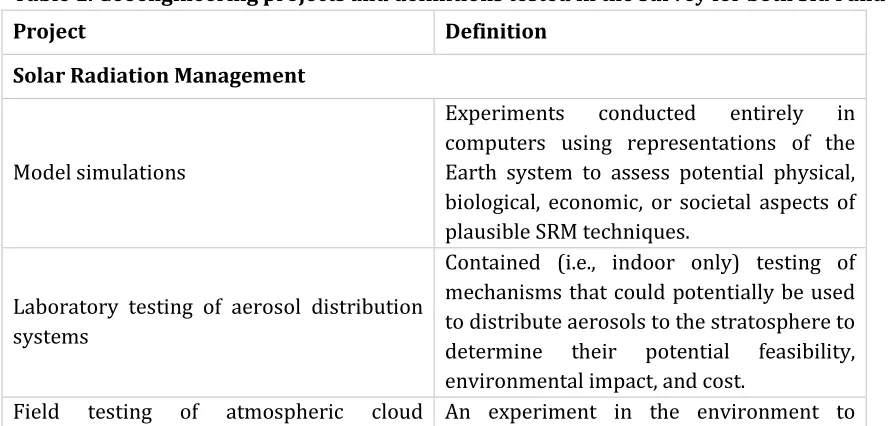
systems. Plausible methods of doing so can include enhanced weathering, land use management practices, or direct air capture (Table 1) (NRC 2015). For the methods that store carbon, the storage techniques are the same as those used for carbon capture and sequestration (CCS) from power plants, which seeks to prevent carbon dioxide from being released to the atmosphere and subsequently stores the carbon dioxide in some way. The effectiveness of these techniques varies by type and have been discussed at length in the literature. For example, direct air capture, also known as chemical air capture, has the potential to be very effective if it can be done on the scales necessary, though currently with very high associated costs. Scientists remain uncertain on whether bioenergy CDR pathways can achieve the ability to effectively produce negative emissions, research around which is ongoing (Vaughn and Gough 2016). Conversely, ocean fertilization likely could not be deployed at the scales necessary for meaningful temperature reduction (NRC 2015).
Solar radiation management is defined as
“intentional efforts to increase the amount of
sunlight that is scattered or reflected back to space, thereby reducing the amount of sunlight absorbed
by Earth” (AMS, 2013). Plausible methods for doing
so include cloud brightening, stratospheric aerosol injections, or increasing surface reflectivity (Table 1) (NRC 2015). There are numerous approaches for each type of geoengineering that vary by scale, size, and cost. Efforts to explore the potential of geoengineering can also fall at different points along the spectrum from research to deployment. Effectiveness of these techniques vary as well. Stratospheric aerosols can be highly effective with low associated costs, whereas large scale albedo modification would likely not be effective for the scales that are necessary.
ii. Potential risks of geoengineering
Different geoengineering approaches of both types have wide variation in their potential effectiveness to reduce impacts from greenhouse gas emissions and create new risks. An overview of potential risks is discussed here, but is not all encompassing. As
stated by AMS, SRM “would likely reduce Earth’s
precipitation patterns. As with inadvertent human-induced climate change, the consequences of reflecting sunlight would almost certainly not be the same for all nations and people, thus raising legal, ethical, diplomatic, and national security concerns”
(AMS 2013). Some geoengineering techniques also have the potential for unilateral deployment, the effects of which would not be contained to the country that deployed them. SRM is also unable to alleviate all impacts from increasing emissions, such as ocean acidification and the physiological effects of carbon dioxide on biological systems. Carbon dioxide removal projects have the potential to lower atmospheric concentrations, but also the potential to alter land use patterns, nutrient cycles, disrupt ecosystems, and impact biological systems and the goods and services they provide.
It is also possible that the exploration of geoengineering approaches can itself create risk. The idea of geoengineering could potentially distract from efforts to mitigate and adapt to climate change. Resources to develop geoengineering would possibly be drawn from these or other efforts, known as the moral hazard argument against geoengineering. The counter is also true, however, that limiting research around geoengineering technologies poses a risk to future generations if other forms of risk management are insufficient, a precautionary principle argument in favor of pursuing research. Investments in geoengineering could also be complimentary with other forms of risk management, could prove useful for addressing factors that alter climate, or could lead to ancillary benefits unrelated to climate stabilization.
iii. Governance of geoengineering
As the risks associated with human-caused climate change increase, the potential for interest in geoengineering as one component of climate change risk management appears likely to increase as well. Due to the uncertainties and potential risks of geoengineering approaches, comprehensive assessment of geoengineering as a risk management strategy requires the assessment of: 1) its potential to reduce the risks of climate change, 2) its potential to create additional risks, and 3) the potential to minimize and manage those additional risks (i.e., through the establishment of safeguards, oversight, and other forms of governance). Governance in the context of this survey can exist on multiple levels to
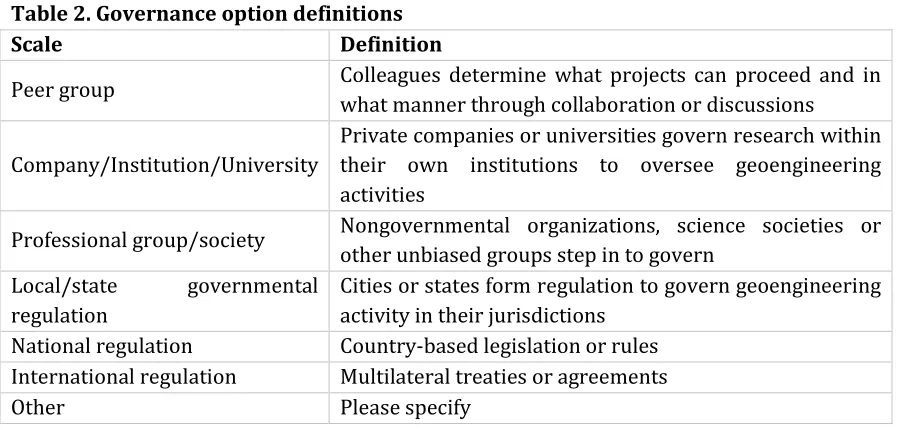
either restrict or promote research or deployment, or both. It encompasses a wide range of actions from regulation to other less direct approaches, such as distribution of research funds, providing incentives, or monitoring and overseeing practices. Table 2 lists different forms of governance asked about within the survey and discussed in this study. These were developed with the help of the report put forth by the Solar Radiation Management Governance Initiative in 2011 (SRMGI 2011).
III. Methods and tools i. Survey design
The survey includes a background section on geoengineering and five sections with questions. The background section was designed to enable participation by non-experts and to provide a minimum level of information to all participants. It ensured that no prior knowledge on the topic was needed, thereby enabling wider participation in the survey. The five sections of questions assess
respondents’: 1) perception of climate change risk,
2) perception of geoengineering risk, 3) perception of governance need for geoengineering, 4) level of technical expertise, and 5) background characteristics (i.e., political affiliation). Further detail is as follows:
i.i Climate change
To place participants’ responses to geoengineering
risk in context, survey questions attempted to identify perceived risk of climate change and need for climate change risk management. The section contained three questions: 1) What do you view as the most likely emissions trajectory for greenhouse gases from the options below? (Business as usual, low mitigation, moderate mitigation, high mitigation), 2) What percent of your average electricity bill would you be willing to pay as a carbon tax to encourage emission reductions? (your answer can be over 100%), and 3) Please indicate your level of agreement with the following statement: The United States is effectively managing the risks of climate change. (Strongly agree, somewhat agree, neither agree nor disagree, somewhat disagree, strongly disagree, the risks do not need to be managed). These questions were
designed to learn about respondents’ views on
Willingness to pay to address the risk of climate impacts is a narrow proxy that is influenced by many factors in the survey, including bias from wording choice, but is still a useful measurement that allows
for a quantification of the respondents’ attitudes.
i.ii Background information
The background information provided general knowledge on geoengineering and governance to enable an environmental policy professional not versed in geoengineering to be able to take the survey. The bulk of this section was based on the AMS policy statement on geoengineering as well as NRC reports on the topic released in 2015 (NRC 2015). Framing of the information presented is a key issue. This section likely shaped how some respondents reacted to different geoengineering approaches, however it was phrased to be consistent with these major sources on geoengineering. We did not discuss known risks, developmental states, or uncertainty so as to not affect perceptions of the different approaches to an unfamiliar respondent. The full background information is available in the supplementary information.
i.iii Geoengineering
These questions were designed to reveal how the survey taker perceives the risk and governance need for each of five approaches that span the stages from research on to full deployment of different types of geoengineering. Risk was assessed on a scale from 0-5, with 0 being extremely little to no risk of consequences and 5 being virtually certain of extremely serious negative consequences. Governance need was then assessed on a scale from 0-5, with 0 being not important at all and 5 being vital. These were then followed by a broader question on the scale of governance respondents
deemed the most appropriate. The questions’
instructions were as follows, with the survey presentation shown in Figure 1: Q1- What is your perception of risk for each project on a scale from
0-5? We define “risk perception” as your sense of the
likelihood of negative consequences to society and the environment from a particular geoengineering project, Q2- How important, in your opinion, are governance issues for each project on a scale of 0-5? And Q3- What scale of governance, if any, do you think is most necessary?
Definitions of projects as well as governance scales were displayed as users hovered over each label. A link to a separate page with definitions was also made available. There was no way to track which participants viewed this information, a limitation of understanding the framing effects, though it was assumed that most participants saw the definitions as they hovered over each project. Survey questions explored different scales of projects to understand at what point within the research to deployment timeline governance becomes a larger factor. It was also a method to gain a better understanding about how much variance in risk and governance perception there is for different approaches within geoengineering.
i.iv Expertise levels
We asked questions to determine participants’ level
of expertise with geoengineering to determine whether and how it influences perceptions of risk and governance need. Participants could self-identify their level of expertise from among four categories: expert, knowledgeable, somewhat familiar, and not at all familiar. Participants were also asked questions that would enable them to demonstrate their level of expertise. These questions included whether they had published on geoengineering or climate change. Respondents were also asked to rank the relative costs of implementing stratospheric aerosols, ocean fertilization, and air capture to lower global temperature by .5 degrees Celsius. This provided an
independent check of participants’ familiarity with
the subject because the relative costs are widely agreed upon among experts. No information on cost was provided in the background information of the survey.
i.v Participants’ background questions
We included questions about participants’ education
ii. Tool and distribution pathways
We used an anonymous web-based survey (A copy of which is provided in Appendix A) to determine how experts and environmental policy professionals from different sectors perceive risk and subsequent governance needs for different types and scales of geoengineering projects. A link to the survey was provided through email. To ensure anonymity of participants, the survey was conducted using Qualtrics, providing the same web link to all potential respondents. We distributed the survey as widely as possible, including our existing contacts, known policy professionals, and to organizations spanning the political spectrum from liberal to conservative.
iii. Statistical analysis
We characterized the results of the survey both qualitatively and using a range of statistical tests for different components of the survey. This included two sample t-tests with a significance level of .01 to test for a range of differences between multiple sets of independent groups. This includes differences in geoengineering opinions, namely risk and governance by project, as well as difference in opinions on climate change. We assessed the influence of party affiliation, expertise, and public sector experience on perceived risks and governance needs for geoengineering. In addition, Spearman rank correlation analyses were conducted for each project within SRM and CDR between risk and governance to understand if they are statistically significantly correlated. Further correlation analysis was conducted for risk and governance within different independent groups.
iv. Bias and demographics
There is likely a large sampling bias for the survey participants. Given the distribution methods, a bias for higher education level was seen. In addition, the fact that all respondents are those that choose to work in the environment, climate and/or energy fields likely had an impact on results. There is also a possible bias based on those that chose to take the survey. Some who received it may not have wanted to take it based on their views on geoengineering. Some who received the survey may also not have
wanted to take the survey because they don’t believe
climate change poses any risks that require management.
IV. Results
i. Overall results
Over a four-month period, 91 anonymous respondents completed the survey. The following sections both quantitatively and qualitatively describe the range of responses for individual sections of the survey.
i.i Climate change
Roughly 10% thought no levels of mitigation would occur, 36% that low levels of mitigation were likely, 43% thought moderate levels of mitigation were most likely, and 10% that high levels of mitigation
would occur. Respondents’ willingness to address
the risk of climate change impacts, as measured by a voluntary contribution of a percentage of their electricity bill, varied from 0%-1000%, with an average of 64% and a median of 25%. 25% of respondents somewhat disagreed that the United States is effectively managing the risks of climate change, and 59% strongly disagreed.
i.ii Geoengineering
The highest average risk and governance rankings were for stratospheric aerosol deployment, followed closely by large-scale albedo modification, shown in Figure 2. Lowest average risk and governance rankings were for model simulations and lab testing of aerosol distribution systems. Within SRM, risk perception and governance need increased sharply as soon as efforts moved beyond computer simulations and the laboratory. Within CDR, risk and governance values remained relatively more consistent across projects but were highest for small scale experimentation of ocean fertilization and enhanced weathering deployment. Respondents viewed ocean manipulation to be risky, supported
by their verbal comments. One respondent stated, “I
worry more about ocean experimentation because the high seas are much less governed, and more poorly understood than land and atmospheric
processes.” Another simply stated, “NO to ocean fertilization!!!” Some respondents seemed to have a
less clear understanding of enhanced weathering
deployment based on higher numbers of “I don’t know” responses to the risk ranking, which may have led to its higher average risk perception.
rankings for all projects. This held true no matter the scale of the project. The extent to which governance rankings were higher than risk rankings differed slightly amongst projects but was largest between values for field testing of cloud brightening and large-scale afforestation. For both these projects, average governance values were approximately 1.4 higher than risk.
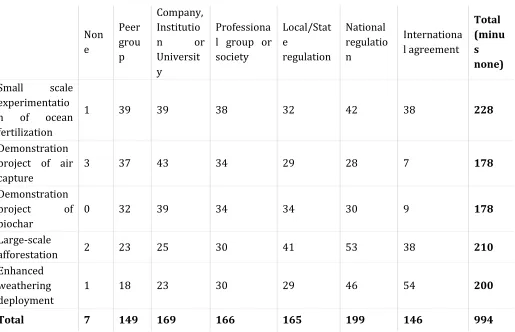
Though not statistically significant, the results in Tables 3 and 4 provide valuable qualitative insight into how respondents view governance. The final row of governance options in Tables 3 and 4 represent the total values for regulating any project for that governance option. The final column represents the total points of regulation per project, or how many respondents chose to regulate an individual project at any level. The governance options were not mutually exclusive. Many respondents preferred oversight or regulation at more than one scale for any sized project. 48% of survey participants preferred multiple points of governance for model simulations, and 65% of participants favored multiple points of governance for enhanced weather deployment and small experimentation of ocean fertilization. In first looking at SRM, field testing of cloud brightening, stratospheric aerosol injections and large-scale albedo modification have a much higher number of total points of regulation (233, 235, and 224 respectively) versus model simulations or lab testing of aerosol distribution systems (148 and 181 respectively). Large-scale albedo modification had similarly high numbers to stratospheric aerosols for larger scale governance versus state level governance, even though decisions on such projects would likely take place on a smaller geographical scale. In looking at CDR, small scale experimentation of ocean fertilization had the highest total points of regulation, followed closely by large scale afforestation and enhanced weathering deployment. Ocean fertilization had a relatively even distribution across different scales of governance. The expressed need for governance was high for large scale afforestation. Verbal comments suggested that incentives were needed to encourage such efforts,
such as “Afforestation in my view doesn't require
oversight the way other interventions do. However, governance intervention may be required to make it happen on a scale large enough to make a
difference.” Respondents viewed direct air capture
and biochar demonstration projects as mostly not needing national or international involvement, with state and local regulation the most frequently identified need. For CDR overall, national regulation was the most frequently identified need versus international. The point within the research to deployment timeline at which respondents viewed governance to be necessary within these projects was less clear. In comparing the two types of geoengineering, more participants saw a need for international regulation for SRM.
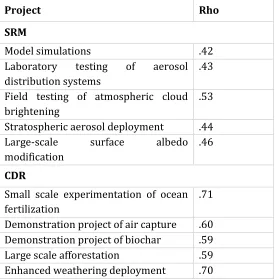
The Spearman rank correlation between risk and governance for each project under each geoengineering type revealed significant correlation for all projects, with higher levels of risk perception corresponding to higher values of governance need (Table 5). Overall, risk perception and governance need were more strongly correlated for CDR projects than for SRM (i.e. Rho values were larger) suggesting sample asymmetry could be a factor where there is a larger range of risk seen in the projects in SRM versus the projects in CDR.
ii. Group-based results
We grouped analysis in three ways based on 1) expertise, 2) views on climate change, and 3) background characteristics. We looked at how group membership related to risk and governance as well as in some cases, how they related to each other. Of those that chose to identify politically, 27% identified as conservative or moderate and 73% liberal or very liberal. We grouped conservatives with moderates due to the low number of conservative responses, a flawed solution. In terms of expertise, roughly 48% of respondents self-identified as familiar with geoengineering. Roughly 52% self-identified as only somewhat or not at all familiar. 72% of the sample has experience working in the public sector on a national scale, whereas 43% identified as currently working in the public sector, followed by 21% in the private sector, 10% in the non-profit sector, and the remainder in academia.
66% on average. Between different expertise levels or different levels public sector experience, there were no statistically significant differences for these values. In looking at views on optimism for future emissions mitigation, those with national public sector experience were more likely to predict high to moderate emissions mitigation versus those without (60% versus 40%, respectively). Expertise or political leanings had little discernible difference. Views on the effectiveness of current climate change risk management were mixed among all groups, with no discernible differences within the political spectrum, expertise level, or national public sector experience.
ii.ii Group-based perceptions on geoengineering T-test analyses included the following sets of groups with the corresponding group sizes. Note that the total number may not always add to the total number of respondents (91) due to the fact that some respondents did not answer all questions or did not fall into these groups.:
• Conservative/moderate respondents (30) versus liberal/very liberal respondents (61)
• Those with national public sector experience (62) versus those without (25)
• Those more familiar with geoengineering (42) versus those less familiar (49)
• Those with a higher willingness to pay to avoid risk from climate change versus those with less
• Those who are optimistic about future mitigation (48) versus those who are not (43)
• Those who view current governance around climate to be effective (14) versus those who do not (76).
In this analysis, we compared risk values within each set of groups and subsequently governance need values within each set of groups. Using a two-tailed t distribution, we found that no sets of background groups were significantly different from one another for both risk perception and governance need rankings. While family wise error is a limitation of these tests, we used a high significance level with the error rate at approximately 6% for the number of tests we conducted. Some groups had a smaller sample size, such as total number of conservatives and moderates, thus more respondents in those categories could increase statistical power and reveal that differences were significant. In analyzing governance, the two differing groups on climate governance (those who
think current governance is effective versus those who do not) did have some differences in governance for a few projects but were not statistically significant. They did not differ for risk perception. In trying to relate perceptions of climate risk to perceptions of geoengineering risk, we compared the top and bottom quartiles of willingness to pay to avoid climate risk. We found that risk perception of geoengineering did not significantly differ, however those with a lower willingness to pay saw a higher need for governance for CDR projects.
An additional way we looked at groups was to see if the correlation between risk and governance for each project differed for each set of groups. A Spearman rank analysis found that risk perception and governance need were significantly correlated for all groups (all P-values < .05)). Correlation between risk perception and governance need was consistent among groups.
V. Discussion
Results from this survey reveal similarities and differences in the risk perception of geoengineering and related governance within the environmental policy community. Overall, results of the survey found higher risk perception for SRM versus CDR, likely due to the nature of many of the projects and the high leverage of SRM projects on the earth system. The larger range of risk seen in the projects in SRM indicates that small-scale research may still be viewed as less risky, but respondents are much more wary about deployment. Within SRM, verbal comments suggested that respondents are not viewing smaller projects in isolation, but as incremental steps that, once taken, may increase the chances of high-risk deployment. Many felt that even small-scale research may also result in a normalization of geoengineering and less action on mitigation. Examples of such comments include
“Model simulations and lab tests are given a non
-zero rating as they may spur deployment activities,” and “Even simulations carry a core risk of
discouraging reductions in fossil fuel use by allowing a potential escape that cannot be realized in
practice.” These thoughts are further exemplified by
simulations and lab testing) are still perceived as having high governance need.
For both types of geoengineering, the fact that governance need was consistently higher suggests there is a perceived need for governance irrespective of perceived risk. The extent to which governance rankings were higher than risk rankings differed slightly amongst projects but was largest between values for field testing of cloud brightening and large-scale afforestation, indicating respondents interpreted these to have low risk but still required larger oversight or incentives.
In looking at research to deployment, higher points of regulation for larger scale projects within SRM provide a clear point at which respondents view more governance to be necessary. CDR results suggest that the point within the research to deployment timeline at which respondents viewed governance to be necessary is less clear, likely due to the lower risk of deployment for many of these projects as compared to SRM. Results also suggest that less international cooperation might be required for CDR, with an exception for ocean fertilization. Respondents remain uncertain about the scale for governance for such an endeavor.
Risk perception of geoengineering did not significantly differ with a willingness to pay, however those that had a lower willingness to pay for climate risks saw a higher need for governance for CDR projects. This could potentially imply that those with a perception of lower climate risk view some climate change risk management strategies as being somewhat more dangerous. This also suggests that the relative risk perception is a key metric. Relative risk refers to the difference between perceived risk of geoengineering in isolation versus when compared to the risks of climate change. If one views the risks associated with climate change as
being extremely high, then one’s perception of the
risk of geoengineering may be diminished. One could also say that as the benefits of geoengineering increase (due to avoided climate change), then the perceived risks of geoengineering may decrease. Larger risks associated with climate change imply greater benefits from geoengineering. In addition, the correlation values between risk and need for governance further suggest that the perceptions of relative risks of projects is different within each type
of geoengineering. The higher correlation of risk and governance need among CDR projects could imply that respondents view the relative risk of these methods to be lower than SRM with governance mechanisms in place. It should also be noted that there are many different types of risk. One can be more or less risk averse to changes in the climate system, to policy interventions, or to research. Time can also influence risk (e.g., with discounting of future risk relative to near term risk). We do not differentiate among these different types of risk, therefore this approach explores what might be considered an aggregation of all these types of risk. Risk perception here cannot be fully parsed among the different types of risk.
Environmental policy professionals generally found that some sort of governance is necessary for both research and deployment, though with varying scale and type. Some respondents suggested in verbal comments that peer groups are undervalued as a governance mechanism and could serve as critical evaluators. Governance discussions could thus start at smaller scales, with institutions, universities, or science societies leading the way as national and international actors are not doing so. This, however, could have a potential selection problem, as peer groups working in this field are more likely to have already decided that geoengineering research is acceptable. Respondents also felt that for-profit actors may require additional oversight or should not be involved in governance of higher risk geoengineering technologies at all. This implies that respondents thought that a profit motive requires more oversight than academic pursuits or those to advance the public interest.
within groups, but that the variation is similar for all groups. Respondents in all of these groups additionally felt that the risk of geoengineering increases without public and stakeholder engagement.
Political affiliation did influence the willingness to pay to address risks of climate change. Conversely, there was less influence from political affiliations on geoengineering risk perception and governance need, indicating a possibility that geoengineering has not yet gotten enough publicity to be politicized along the traditional right-left spectrum (Mahajan 2018). Another possibility is that geoengineering has aspects that cut across political views. However, to be in favor of geoengineering implies an acceptance of the risks posed by climate change and that they must be curbed. A recent noteworthy example of these cross-spectrum views is that of Congressman Lamar Smith, Chairman of the House Science Committee, who has a well-documented history of climate skepticism and denialism (Hiltzik 2017). However, at a House joint subcommittee hearing in November 2017, Representative Smith stated
“Geoengineering’s potential is worth exploring.
Generally, we know that the technologies associated with geoengineering could have positive effects on
the Earth’s atmosphere. These innovations could help reduce global temperatures or pull excess
greenhouse gases out of the atmosphere.” (House
Committee on Science, Space, & Technology 2017) This statement indicates an acceptance of the risks posed by climate change and a preference for geoengineering as a risk management strategy.
The conservative and moderate responses in the survey may not be fully representative due to the low number of these responses. The low level of conservative responses may either indicate that the field generally has a lower number of conservatives working on the issue, that fewer conservatives were willing to participate in the study, or that we were less successful in getting the link to the survey to conservatives. In addition, there is a possibility that moderates either have liberal leanings or were misidentified, as it is a subjective classification.
“Republican” may also not be synonymous to “conservative” to respondents. The topic remains
controversial amongst liberals as well, shown by varying risk perceptions and verbal comments against geoengineering deployment. However, the
lower levels assigned to the risk and governance of smaller scale research implies that responsible research seems to be less controversial throughout the entire sample.
The current state of politics in the United States brings a new level of complication to the issue. Withdrawing from the Paris Agreement may diminish the impetus for policymakers to limit global temperature warming to 1.5 degrees Celsius. However, one could also make the argument that researchers, private institutions, and foreign governments may have increased motivation to research geoengineering as they strive to meet the 1.5-degree goal without the participation of the United States (or conclude that larger amounts of warming will occur and thereby increase the potential need for geoengineering). Achieving an international agreement around geoengineering would be challenging with the current stance of the U.S. government surrounding climate change.
It should be noted that this sample may contain respondents that were more likely to conduct or value research. As discussed in the methods, distribution avenues led to a bias for higher education levels. There is also a possible bias based on those that chose to take the survey – those that chose not to take the survey may have done so due to their views on either climate change or geoengineering.
As discussions of governance remain mostly isolated to academic discussions, research and deployment of technologies continue to progress. In June 2017, the first commercial direct air capture plant opened in Switzerland was opened by Climeworks, a spinoff company from ETH Zurich (Marshall 2017-a; Climeworks 2017). Though small, it represents the implementation of technological advancements with or without regulations and oversight, and it only plans to grow (Magill 2017). 96% of respondents thought some form governance would be necessary for such an air capture demonstration project where there is currently none. In March 2017, a Harvard University program announced its intention for small scale experimentation of stratospheric aerosols (Marshall 2017-b). They too found that governance for experiments is not enough, and they
are creating a “bootstrap process” for governance of
board (Keith and Wagner 2017). As research progresses, however, a more formalized approach will potentially be necessary. Larger, more inclusive discussions surrounding geoengineering governance and increasing public engagement are vital to managing the risks of both research and deployment of these evolving technologies. The domestic
environmental policy community seems ready and eager to participate in these discussions.
References
American Meteorological Society. 2013. “Geoengineering the Climate System.” Accessed July 2016.
https://www.ametsoc.org/ams/index.cfm/abo ut-ams/ams-statements/statements-of-the- ams-in-force/geoengineering-the-climate-system/.
Anderson, Kevin. 2015. “Talks in the city of light generate more heat.” Nature, December 21, 2015 April
2017. http://www.nature.com/news/talks-in-the-city-of-light-generate-more-heat-1.19074. Asayama, Shinichiro, Sugiyama, Masahiroand Atsushi Isii.
2017. “Ambivalent climate of opinions:
Tensions and dilemmas in understanding
geoengineering experimentation.” Geoforum
80: 82-92.
https://doi.org/10.1016/j.geoforum.2017.01.0 12.
Bellamy, Rob, Lezaun, Javier., and James Palmer. 2017.
“Public perceptions of geoengineering research
governance: An experimental deliberative
approach.” Global Environmental Change 45:
194-202.
https://doi.org/10.1016/j.gloenvcha.2017.06. 004.
Bipartisan Policy Center. 2011. “Task force on climate remediation research.” Accessed July 2016.
https://bipartisanpolicy.org/wp-content/uploads/sites/default/files/BPC%20C limate%20Remediation%20Final%20Report.p df.
Bracmort, Kelsi and Richard Lattanzio. 2013.
“Geoengineering: Governance and Policy.”
Congressional Research Service, November 26, 2013.http://www.fas.org/sgp/crs/misc/R413 71.pdf.
Conference of Parties to the Convention on Biological
Diversity. 2016. “Climate-Related
Geoengineering.” Accessed September 2017.
https://www.cbd.int/doc/meetings/cop/cop-13/in-session/cop-13-wg-02-crp-03-en.pdf.
Dilling, Lisa and Rachel Hauser. 2013. “Governing
geoengineering research: why, when and
how?” Climatic Change 121(3): 553-565. https://doi.org/10.1007/s10584-013-0835-z. Fuss, S., Jones, C. D., Kraxner, F., Peters, G. P., Smith, P.,
Tavoni, M., van Vuuren, D. P., Canadell, J. G.,
priorities for negative emissions.”
Environmental Research Letters 11 (11).
https://doi.org/10.1088/1748-9326/11/11/115007.
Harrison, Daniel P. 2017. “Global Negative Emissions Capacity of Ocean Macronutrient Fertilization.”
Environmental Research Letters 12 (3). https://doi.org/10.1088/1748-9326/aa5ef5.
Hiltzik, Michael. 2017. “Congress' top climate change
denier continues his attack on states probing
Exxon Mobil.” Los Angeles Times, March 3,
2017.
http://www.latimes.com/business/hiltzik/la-fi-hiltzik-lamar-smith-20170303-story.html. Himmelsbach, Raffael. 2017. “How scientists advising the
European Commission on research priorities
view climate engineering proposals”. Science
and Public Policy 45 (1): 124-133. https://doi.org/10.1093/scipol/scx053.
Hogue, Cheryl. 2010. “Countries Agree To Ban
Geoengineering.” American Chemical Society,
November 8, 2010.
https://cen.acs.org/articles/88/i45/Countries-Agree-Ban-Geoengineering.html.
House Committee on Science, Space, and Technology.
2017. “Statement from Chairman Lamar Smith
(R-Texas) on Geoengineering: Innovation,
Research, and Technology.” Accessed
November 2017.
https://science.house.gov/sites/republicans.sc ience.house.gov/files/documents/HHRG-115-SY18-WState-S000583-20171108_0.pdf
Keith, David and Gernot Wagner. 2017. “Fear of solar
geoengineering is healthy – but don't distort
our research.” The Guardian, March 29, 2017.
https://www.theguardian.com/environment/ 2017/mar/29/criticism-harvard-solar-geoengineering-research-distorted.
Lukacs, Martin. 2017. “Trump presidency 'opens door' to
planet-hacking geoengineer experiments.” The
Guardian, March 27, 2017.
https://www.theguardian.com/environment/t rue-north/2017/mar/27/trump-presidency- opens-door-to-planet-hacking-geoengineer-experiments.
Magill, B. 2017. “World’s First Commercial CO2 Capture
Plant Goes Live.” Climate Central, May 31,
http://www.climatecentral.org/news/first-commercial-co2-capture-plant-live-21494.
Mahajan, Aseem, Tingley, Dustin, and Gernot Wagner.
2018. “Fast, cheap, and imperfect? US public opinion about solar geoengineering.”
Environmental Politics.
https://doi.org/10.1080/09644016.2018.1479 101.
Marshall, Christa. 2017 (a). “In Switzerland, a giant new
machine is sucking carbon directly from the
air.” E&E News, June 1, 2017.
http://www.sciencemag.org/news/2017/06/s witzerland-giant-new-machine-sucking-carbon-directly-air.
Marshall, Christa. 2017 (b). “Harvard researchers to launch geoengineering experiment.” E&E
News, March 24, 2017.
https://www.eenews.net/greenwire/2017/03 /24/stories/1060052052.
National Research Council. 2015. “Climate Intervention: Carbon Dioxide Removal and Reliable
Sequestration.”
https://www.nap.edu/catalog/18805/climate- intervention-carbon-dioxide-removal-and-reliable-sequestration.
National Research Council. 2015. “Climate Intervention:
Reflecting Sunlight to Cool Earth.”
https://www.nap.edu/catalog/18988/climate-intervention-reflecting-sunlight-to-cool-earth.
Parker, Andy And Oliver Geden. 2016. “No fudging on geoengineering.” Nature Geoscience, 9: 859 -860. https://doi.org/10.1038/ngeo2851. Pearce, Fred. 2016. “What Would a Global Warming
Increase of 1.5 Degrees Be Like?” Yale
Environment 360, June 16, 2016.
https://e360.yale.edu/features/what_would_a _global_warming_increase_15_degree_be_like.
Pew Research Center. 2018. “Majorities See Government
Efforts to Protect the Environment as
Insufficient.” May 9, 2018.
http://assets.pewresearch.org/wp-content/uploads/sites/14/2018/05/1115291 2/Embargoed-Report-energy-climate-5-9-18.pdf
Quaas, Martin F., Quaas, Johannes., Rickels, Wilfied, and Olivier Boucher. 2017. “Are there reasons
against open-ended research into solar
radiation management? A model of
intergenerational decision-making under
uncertainty.” Journal of Environmental
Economics and Management, 84: 1-17. https://doi.org/10.1016/j.jeem.2017.02.002. Shiermeier, Quirin. 2016. “Climate scientists focus on 1.5
degrees after Paris deal.” Nature, April 15,
2016. http://www.nature.com/news/climate- scientists-focus-on-1-5-degrees-after-paris-deal-1.19758.
Solar Radiation Management Governance Initiative. 2011.
“Solar Radiation Management: the governance
of research.” February 2016.
http://www.srmgi.org/files/2016/02/SRMGI. pdf.
The Royal Society. 2009. “Geoengineering the Climate: Science, Governance, and Uncertainty.”
https://royalsociety.org/~/media/Royal_Socie ty_Content/policy/publications/2009/8693.pd f.
United Nations Framework Convention on Climate
Change. 2015. “Paris Agreement.”Accessed July
2017,
http://unfccc.int/files/essential_background/c onvention/application/pdf/english_paris_agre ement.pdf.
U.S. Global Change Research Program. 2017. “The
National Global Change Research Plan
2012-2021: A Triennial Update.”
https://downloads.globalchange.gov/strategic-plan/2016/usgcrp-strategic-plan-2016.pdf.
Vaughn, Naomi and Clair Gough. 2016. “Expert
assessment concludes negative emissions
scenarios may not deliver.” Environmental
Research Letters 11 (9).
http://iopscience.iop.org/article/10.1088/174 8-9326/11/9/095003/meta
Victor, David. 2008. “On the Regulation of Geoengineering.” Oxford Review of Economic
Policy 24 (2): 322-336.
https://doi.org/10.1093/oxrep/grn018. Wright, Malcolm, Teagle, Damon. A. H., and Pamela
Feetham. 2014. “A quantitative evaluation of the public response to climate engineering.”
Nature Climate Change 4: 106-110.
https://doi.org/10.1038/nclimate2087.
climate and energy policies. From 2016-2017, Dr. Talati was the postdoctoral fellow in science policy with the American Meteorological Society's Policy Program and has worked at the White House Office of Science and Technology Policy during the Obama Administration. She received a Ph.D. in 2016 from Carnegie Mellon University in Engineering and Public Policy, a master’s in climate science and policy from Columbia University and a bachelor’s in environmental engineering from Northwestern University.
Paul Higgins, Ph.D. Dr. Paul Higgins is the Director of the American Meteorological Society’s Policy Program.
He studies climate change and its causes, consequences, and potential solutions. His research examines the two-way interaction between the atmosphere and the land-surface to help quantify responses and feedbacks to climate change. His policy analysis helps characterize climate risks and identify potential risk management strategies. He works with decision-makers to develop new policy options that can overcome contentious political obstacles. Dr. Higgins also works to inform policy makers, members of the media, and the general public about climate science and climate policy. In 2011, he was named a Google Science Communication Fellow in recognition for these efforts. From 2005-2006 Paul worked on climate policy in the United States Senate. From 2003-2005 he was a National Science Foundation postdoctoral fellow at the University of California. He received Ph.D. and M.S. degrees from Stanford University and a B.S. from The University of Michigan.
Acknowledgements
This work was supported, in part, by grants from the National Aeronautics and Space Administration (grant #NNX16AO53G) and the National Oceanic and Atmospheric Administration (grant #NA15NOS4690029). The authors would also like to thank the American Center for Physics Protection of Human Subjects Committee for their IRB exemption review. All opinions, findings, conclusions, and recommendations expressed in this paper are those of the authors alone and do not reflect the views of any U.S. Government agencies.
Tables and Figures
Table 1. Geoengineering projects and definitions tested in the survey for both SRM and CDR
Project Definition
Solar Radiation Management
Model simulations
Experiments conducted entirely in computers using representations of the Earth system to assess potential physical, biological, economic, or societal aspects of plausible SRM techniques.
Laboratory testing of aerosol distribution systems
Contained (i.e., indoor only) testing of mechanisms that could potentially be used to distribute aerosols to the stratosphere to determine their potential feasibility, environmental impact, and cost.
brightening determine potential feasibility and impact of increasing the albedo of clouds.
Stratospheric aerosol deployment
Deployment of aerosols into the stratosphere with the intent to reduce global average surface temperature by 1-2 degrees Celsius.
Large-scale surface albedo modification
Increasing land surface brightness in both urban and unpopulated areas in one or more countries through white roofs (painting structures white), crop reflectivity (planting more crops that reflect more sunlight), or covering deserts with reflective materials.
Carbon Dioxide Removal
Small scale experimentation of ocean fertilization
An experiment conducted in the ocean over a small area (approximately 25 square miles) to test the feasibility and effectiveness (i.e., carbon uptake and storage), and environmental impacts of distributing iron and other nutrients in the ocean.
Demonstration project of air capture
A facility utilizing an industrial process of capturing carbon dioxide from the ambient air that can then be used or geologically stored.
Demonstration project of biochar
A working project to convert waste biomass to charcoal that is subsequently used (burned for energy) or stored in soils.
Large scale afforestation
Massive increase in planting of trees on a global scale utilizing sequestration of carbon dioxide through ecosystem management
Enhanced weathering deployment
Table 2. Governance option definitions
Scale Definition
Peer group Colleagues determine what projects can proceed and in what manner through collaboration or discussions
Company/Institution/University
Private companies or universities govern research within their own institutions to oversee geoengineering activities
Professional group/society Nongovernmental organizations, science societies or other unbiased groups step in to govern
Local/state governmental regulation
Cities or states form regulation to govern geoengineering activity in their jurisdictions
National regulation Country-based legislation or rules International regulation Multilateral treaties or agreements
Other Please specify
Table 3. Number of respondents per governance scale options for SRM projects
Question None Peer group
Company, Institution or
University
Professional group or society
Local/State regulation
National regulation
International agreement
Total (minus none) Model
Simulations 23 51 35 40 3 9 10 148
Laboratory testing of aerosol distribution systems
7 47 56 41 12 16 9 181
Field testing of
atmospheric cloud brightening
0 33 39 39 38 52 32 233
Stratospheri c aerosol deployment
0 21 24 28 27 51 84 235
Large-scale surface albedo modification
0 21 24 26 28 54 71 224
Table 4. Number of respondents per governance scale options for CDR projects
Non e
Peer grou p
Company, Institutio
n or
Universit y
Professiona l group or society
Local/Stat e
regulation
National regulatio n
Internationa l agreement
Total (minu s none)
Small scale experimentatio n of ocean fertilization
1 39 39 38 32 42 38 228
Demonstration project of air capture
3 37 43 34 29 28 7 178
Demonstration project of biochar
0 32 39 34 34 30 9 178
Large-scale
afforestation 2 23 25 30 41 53 38 210
Enhanced weathering deployment
1 18 23 30 29 46 54 200
Table 5. Spearman rank correlation Rho values between rank of risk perception and governance need. Rho values (P < .05) are presented for correlation between risk and governance for the corresponding project.
Project Rho
SRM
Model simulations .42
Laboratory testing of aerosol distribution systems
.43
Field testing of atmospheric cloud brightening
.53
Stratospheric aerosol deployment .44 Large-scale surface albedo modification
.46
CDR
Small scale experimentation of ocean fertilization
.71
Demonstration project of air capture .60 Demonstration project of biochar .59
Large scale afforestation .59
Figure 2. Mean values for risk perception and governance need rankings for each project for (a) solar radiation management and (b) carbon dioxide removal. Risk perception rankings are on a scale from 0-5 with 0 meaning extremely little to no risk of negative consequences 5 meaning virtually certain of extremely serious negative consequences. Governance need rankings are also on a scale from 0-5, with 0 meaning not important at all and 5 meaning vital.
0.51
0.86
2.31
4.03
3.82
1.37
1.82
3.67
4.70 4.59
M O D E L
S I M U L A T I O N S L A B T E S T I N G O F A E R O S O L D I S T R I B U T I O N
F I E L D T E S T I N G O F C L O U D B R I G H T E N I N G
S T R A T O S P H E R I C A E R O S O L D E P L O Y M E N T
L A R G E - S C A L E S U R F A C E A L B E D O
M O D I F I C A T I O N
(A) MEAN VALUES FOR SRM PROJECTS
Risk Perception Governance Need
2.12
1.29 1.48 1.74
2.94
3.10
2.10 2.32
3.14
3.90