Dr. B. Madhavi Latha MetHoDoLogY
Hain’s test- a rapid aid for identification and sensitivity testing
of multidrug resistant and extended drug resistant tuberculosis
Madhavi Latha B1* and Anil K Bilolikar1
1Department of Microbiology, Krishna Institute of Medical Sciences, Minister Road, Secunderabad-500003, A.P, India
*corresponding author: Dr. B. Madhavi Latha, MD, Assistant Clinical Microbiologist, Department of Microbiology, KIMS Foundation and Research Centre, Minister Road, Secunderabad - 500003, AP, India. Email: [email protected]
Received 12 August 2012; Revised 15 September 2013; Accepted 22 September 2013
citation: Madhavi Latha B, Anil K Bilolikar (2013) Hain’s test- a rapid aid for identification and sensitivity testing of multidrug resistant and extended drug resistant tuberculosis. J Med Sci Res 1(3): 145–149.
copyright: © 2013 KIMS Foundation and Research Centre. All Rights Reserved.
Introduction
For the last 5000 years Tuberculosis (TB) is a well understood bacterial disease but is still infecting nearly 1/3rd of world’s population. Mycobacterium tuberculosis is a slow growing pathogen & TB remains the single infectious diseases causing the highest mortality in humans, leading to five deaths every minute. According to recent World Health Organization (WHO) reports, TB in India accounts to 1/5th of global incidence with 2 deaths every 3 minutes [1, 2, 3]. Drug resistance TB is growing immortal & is a devasting problem in India accounting to 1/4th of the global burden of MDR-TB. XDR-TB, unresponsive to any current TB drugs is also detected in India [3, 4]. Conventional methods like smear microscopy, culture, serology and even PCR do not fully satisfy the criteria for a good TB diagnosis. Alarming increases in MDR-TB, the emergence of XDR-TB, potential institutional transmission and rapid mortality of MDR-TB & XDR-TB patient with HIV coinfection, have necessitated the urgent need for rapid diagnosis & identification of MDR-TB for appropriate treatment of patient and preventing the spread of disease [3, 4].
Hain’s test (Geno Type MTBDRplus) is a molecular genetics assay for rapid identification of the M. tuberculosis Complex & its resistance to Rifampicin and Isoniazid from clinical samples & culture positive samples [5].
Intended use
test for the identification of the M. tuberculosis
Complex & its resistance to Rifampicin (RMP) and Isoniazid (INH) from pulmonary smear positive or negative clinical samples & culture positive samples. The following species are included in the tuberculosis causing M. tuberculosis complex: M. tuberculosis, M. africanaum, M. bovis subsp bovis, M. bovis subsp caprae, , M. bovis BCG, M. microti, M. canettii & M. pinnipedii. The identification of RMP resistance is enabled by the detection of the most significant mutations of the rpoB gene (coding for the β Sub unit of the RNA polymerase). For detection of INH resistance, the katG gene (coding for the catalase peroxidase) and the promoter region of
the inh A gene (coding for the NADH enoyl ACP reductase) are examined. This test is indicated as aid for the diagnosis & intended for the use in the medical facilities and medical laboratories [5].
Principles of the procedure
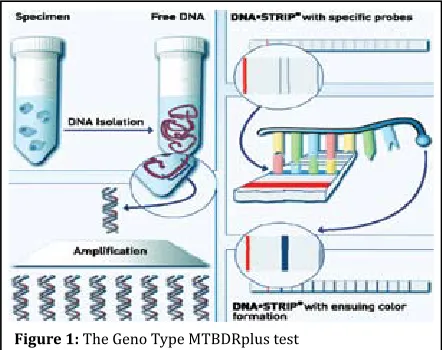
The Geno Type MTBDRplus test is based on the DNA Strip technology. The whole procedure is divided into 3 steps [5] Figure 1
complementary DNA strands is ensured by stringent conditions which result from the combination of the buffer composition & a certain temperature. Thus the probes reliably discriminate several sequence variations in the genes examined. The streptavidin- conjugated alkaline phosphatase binds to the amplicons biotin via the streptavidin moiety. Finally, the alkaline phosphatase transforms an added substrate into a dye which becomes visible on the membrane strips as a colored precipitate. A template ensures the easy & fast interpretation of the banding pattern obtained.
Indications
1. Screening MDR TB patients
2. Treatment failure & relapse patients
3. With unknown medical history, originating from high prevalence areas of MDR TB
4. Close contacts to persons infected with MDR TB.
5. High prevalence TB countries with high burden MDR TB
6. Countries with high usage of 1st line anti- TB drugs
Specimen requirements
1. Pulmonary smear positive or negative patient specimens such as sputum (induction or expectorated), bronchial material (bronchoal-veolar lavage) or aspirates (pleural aspirates) 2. Cultivated samples (solid/ liquid medium)
Storage and transport
1. All specimens should be collected in a sterile container and stored at a temperature of 2-8 oC [6, 7].
2. The transport of specimens at room temperature has to be carried out as soon as possible and should be done within 1-2 days [6, 7].
3. Specimens used for decontamination should not be older than 4 days.
4. After decontamination & subsequent resuspen-sion of the bacteria pellet with phosphate buffer, the samples can be stored at -20 oC or -80 oC for a maximum of 5 days until DNA extraction is performed.
Figure 1: The Geno Type MTBDRplus test
1. DNA extraction from the clinical specimens (pulmonary, decontaminated) or the cultured material (solid/liquid medium)
2. A multiplex amplification with biotinylated primers
3. A reverse hybridization.
Procedure
1. Clinical specimens should be processed using the NALC/ NaOH method [6], and the cell pellet should be resuspended in a maximum of 1 to 1.5 ml phosphate buffer.
2. DNA extraction is done from the decontaminated clinical specimens or the cultured material (solid/liquid medium) using Genolyse Kit [ Figure 2].
3. A multiplex amplification with biotinylated primers using a thermal cycler.
4. A reverse hybridization using Twincubator [Figure 3].
5. After the final step of hydridization, the reaction is stopped by rinsing twice with distilled water. 6. Using tweezers, the strips are removed from the
tray and dried between 2 layers of absorbent papers.
evaluation and interpretation of results 1. The dried strips are pasted on the evaluation
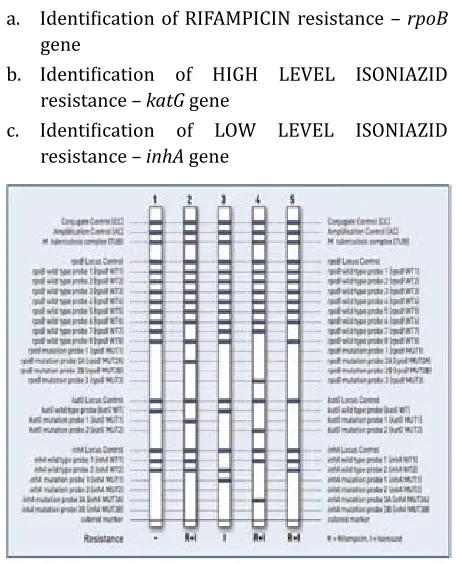
sheet which is provided with the kit in the designated fields by aligning the bands AC and CC with the respective lines on the sheet. 2. Each strip has a total of 27 reaction zones [Figure
4].
GenoType® MTBDRplus strip is used for
For the Detection of Multi-Drug Resistance (MDR TB) by [Figure 4].
a. Identification of RIFAMPICIN resistance – rpoB
gene
b. Identification of HIGH LEVEL ISONIAZID resistance – katG gene
c. Identification of LOW LEVEL ISONIAZID resistance – inhA gene
Figure 4: 27 reaction zones
Genotype® MTBDRslstrip is used for:
For the Detection of Extreme Drug Resistance (XDR TB) by resistance to Second Line drugs [Figure 5]. a. Identification of Aminoglycosides resistance -
rrs gene
b. Identification of fluroquinolones resistance –
gyrA gene
c. Identification of Ethambutol resistance – EMB
gene
Figure 2: Genolyse Kit
Quality control
In order to validate the correct performance of the test & the proper functioning of the kit constituents, each strip includes 5 control zones
1. A conjugate control zone (CC) to check the binding of the conjugate on the strip and a correct chromogenic reaction.
2. An Amplification Control zone (AC) to check for a successful amplification reaction.
3. Three Locus control zones (rpoB, katG and inhA) checking the optimal sensitivity of the reaction for each of the tested gene loci.
A contamination control sample containing water instead of DNA should be part of east test run; the respective test strip should show the bands CC and AC only.
Advantages
1. Highly efficient diagnostic procedure- simultaneous detection of MTB & sensitivity 2. Results within few hours (8- 12 hrs)
3. Internal controls ensure valid results
4. Suitable for screening of MDRTB, identification of MTB complex& detection of monoresistance. 5. Flexible, low implementation & service costs 6. Further XDR TB Diagnosis possible with
Genotype MTBDRsl. 7. Procedure user friendly.
8. Combines Maximum sensitivity with high specificity
Limitations
1. It is only a qualitative test. The intensities of bands on the strips do not give information about the number of cells in the positive sample. 2. As with any DNA detection method, the test
system detects DNA from viable and
non-Figure 5: Detection of Extreme Drug Resistance
viable bacteria. Therefore it cannot be used for monitoring the progression or success of treatment of patients with anti tuberculous drug therapy.
3. As with any DNA based assay, this test only screens the nucleic acid sequence and not the amino acid sequence. Therefore, it is possible that mutations in the probe region that do not cause amino acid exchange(silent mutations) will still produce the absence of one of the wild type bands.
4. It detects those resistances that have their origins in the rpoB, katG and inh A regions. Resistances originating from mutations of other genes or gene regions as well as other RMP and INH resistance mechanisms will not be detected by this test.
5. The presence of multiple bacterial species in the sample to be analyzed might hamper the interpretation of the test.
6. The effect of other variables such as co-infections is not yet evaluated.
7. The members of the M.tuberculosis complex cannot be differentiated
8. Due to high variability of bacterial genome. It is possible that certain sub types may not be detected leading to false negatives.
conclusion
With the emergence and spread of multidrug resistant tuberculosis (MDR TB) and extended drug resistant tuberculosis (XDR TB), tuberculosis has become a major medical public health problem threatening global health. MDR TB is a challenge to TB control due to its complex diagnosis and obstacles in treatment. As long as MDR-TB is not verified, use of inadequate and hence ineffective antibiotics may lead to further spread of resistant bacteria and amplification of resistance. Therefore a rapid diagnosis and identification of MDR TB is a prerequisite for appropriate treatment. HAIN GenoType® assay is a rapid test for detection of MDR and XDR as per WHO guidelines, validated for Indian strains by ICMR with an internal QC on every strip validating the test result.
references
1. Dakshina Bisht. Can newer diagnostic microbiological assays guide early Tuberculosis Management? Indian J Tuberc 2011, 58:51-53.
3. Isaakidis P, Cox HS, Varghese B, Montaldo C, Da Silva E. Ambulatory multi-drug resistant tuberculosis treatment outcomes in a cohort of HIV-infected patients in a slum setting in Mumbai, India. PLoS One. 2011, 6:e28066. doi: 10.1371/journal.pone.0028066.
4. Jain AK, Dhammi IK, Modi P, Kumar J, Sreenivasan R. Tuberculosis spine: Therapeutically refractory disease. Indian J Orthop. 2012, 46:171-8. doi: 10.4103/0019-5413.93685.
5. Geno Type MTBDRplus VER 2.0. Insructions for Use, IFU-304A-01:1-11
6. Kent PT, Kubica GP. Public health mycobacteriology: a guide for the level III laboratory. U.S. Department of Health and Human Services, Centres for Disease Control and Prevention, Atlanta, USA 1985.
7. Isenberg HD. Clinical microbiology procedures handbook. American Society for Microbiology, Washington, D.C., USA 1992.