w w w . a a s s j o u r n a l . c o m ISSN (Online): 2322 – 4479
Original Article
Received: 30/04/2013 Accepted: 18/06/2013
Effects of Eight Weeks of Circuit Resistance Training
on Pulmonary Function of Inactive Women
1
Maryam Khosravi
,
2Seyed Morteza Tayebi,
3Nasrin Ghorban-Nezhad
1- Shomal Academy of Physical Fitness Assessment (SAPFA), Shomal Marásh Sport Complex, Shomal University, Amol, Mazandaran, Iran.
2- Faculty of Physical Education and Sport Science, Allameh Tabataba’i University, Tehran, Iran.
3- Faculty of Physical Education and Sport Science, Islamic Azad University–Rasht Branch, Rasht, Guilan, Iran.
ABSTRACT
Effects of endurance training on respiratory system is approved somehow, but few and contradictory evidence exist concerning resistance training (RT), so the purpose of this research was therefore to study the effects of eight weeks of circuit RT (CRT) on pulmonary function of inactive women. Nineteen volunteer healthy inactive women were randomly divided into 2 groups: without training as the control (C) and CRT. A spirometry test was taken 24 h before and after the training course. The training period (8 weeks, 3 sessions/week) for CRT involved two circuits/session, 40-60s for each exercise with 60-80% of one the repetition maximum (1RM), and 1 and 3 min active rest between exercises and circuits, respectively. ANCOVA test showed that CRT increased significantly (p<0.05) maximum voluntary ventilation (MVV), peak expiratory flows (PEF), forced expiratory flows 25%-75% (FEF 25%-75%), and forced expiratory volume in one second (FEV1); but, vital capacity (VC), forced vital capacity (FVC), and FEV1/FVC ratio didn’t change significantly. The results may suggest that the CRT can improve some pulmonary function factors of healthy young inactive women besides other benefits of this type of training for women.
Key Words:Circuit Resistance Training, VC, FVC, MVV, PEF, FEV1, FEF 25%-75%.
Corresponding Author: Maryam Khosravi
E-mail1:[email protected]
INTRODUCTION
Sedentary lifestyle is associated with less efficient pulmonary function (1), and so ability of respiratory system and pulmonary function has a direct relationship with general health (2). Furthermore, regular physical activity is of much importance for young people’s general health (3, 4). Since cardiorespiratory endurance is a key component of physical fitness and regular physical activity can lead to physical fitness
improvement, it can enhance
cardiorespiratory endurance (5). It is well documented that the most effective factor in cardiorespiratory fitness is physical activity level (6-8). Exercise training improves endurance and strength of athletes’ respiratory muscles; it also causes a reduction in resistance of respiratory canals and increases lung elasticity and alveolar expansion, as studies have supported the expansion of pulmonary volumes and capacities (9). Accordingly, selection of appropriate type of exercise training may be an important factor in preventing or decreasing respiratory diseases and increasing the efficacy of this system.
Although some evidence has reported that the pulmonary system is unaffected by physical activity (10, 11). It is mainly recommended in various studies that endurance training (ET) is appropriate for improvement of pulmonary function (12), whereas some believe that fatigue of respiratory muscles has no influence on submaximal exercise functions. Others have found that body endurance is increased with respiratory trainings (13). On the other hand, RT has been found to have positive impacts on inspiratory and expiratory muscles, both in healthy people and individuals with chronic obstructive pulmonary disease (COPD) (12, 14-16). Few studies have been conducted on healthy individuals regarding the effect of inspiratory muscle training (IMT) (15) and concurrent respiratory
muscle training (CRMT) (14) on pulmonary function and contradictory results have been reported in the studies which do exist.
In addition, because of religious behaviors of Iranian women, they have poor situations for active lifestyle. It can put them at risky situation of health, even though they are healthy. In the light of few studies on the effect of RT (17) but not on healthy subjects specially healthy inactive women, as well as contradictory results of these evidence, we purposed to examine the effects of CRT on VC, FVC, MVV, PEF, FEV1, and FEF 25%-75% of healthy inactive women.
MATERIAL and METHODS
Subjects. The present study was
approved by the Research Ethics Committee of the School of Medical Sciences of Tarbiat Modares University (Iran), and conducted in accordance with policy statement of the Declaration of Iranian Ministry of Health. Written informed consent was obtained from 19 young healthy women. All subjects were asked to complete a medical examination as well as a medical questionnaire to ensure that they were not taking any regular medications; free of cardiac, respiratory, allergic, eye, and ear surgery; respiratory epidemic infections, uncontrolled blood pressure, thorax surgery history in three weeks before beginning trainings, history of pulmonary embolism, active hemoptysis, unstable angina, and myocardial infarction. The volunteers were assigned randomly to 2 groups including a control group (n=9) without training (C) and circuit RT (CRT) group (n=10).
Research Design. Participants were taken to the gym two times before the beginning of training period. In the first session, their 1RM was determined for each of 8 exercises. In the next session, a spirometry test was performed on each participants (spirometer: Spiro lab, SN: A23-050-7460, Mir Co, Italia) for VC, FVC, FEF
25%-75%, FEV1, FEV1/FVC ratio, PEF, and MVV measurements. The training sessions started in 24 h after the spirometry test for a period of 8 weeks with 3 sessions per week on Saturday, Monday, and Wednesday.
Exercise Training Procedure. The
subjects were instructed to follow a normal lifestyle, maintain daily habits, and avoid any regular medications. Each session
contained 10 min of warm-up and cool down. CRT training included two circuits/session, 60s (about 12 repeats) for each exercise with 60-65% 1RM, and 1 and 3 min active rest between exercises, and circuits, respectively during the first 4 weeks; and four circuits/session, 40s (about 8 repeats) for each exercise with 65-80% 1RM and same rest periods during the second 4 weeks (Table 1).
Table 1.Summary of Resistance Training Procedures
Rest(min) between
circuits
Rest(min) between exercises
Frequency of exercises (second/replicat
e) Volume
(circuits/session) Intensity
(1RM) Period
(weeks)
3 1
60 / 12 2
60-65% 1st four
3 1
40 / 8 4
65-80% 2nd four
Statistics. ANCOVA was used to
determine the effects of the mentioned training at a significance level of p = 0.05. Important ANCOVA assumptions, including linear relationship of dependent variable and covariate, normal distribution, and equality of error variances were examined with Pearson’s correlation test, one-sample
Kolmogorov-Smirnov test, and Levene test, respectively.
RESULTS
General data of the subjects including age, height, and weight are summarized in Table 2.
Table 2.Descriptive statistics of subjects (Mean ± SE) Factors
Groups (Year)Age Height(m) Weight(kg)
RT 26.4 ± 1.22 163.2 ± 1.46 59.3 ± 2.39
C 26.55 ± 0.94 161.88 ± 1.09 64.11 ± 2.94
RT:resistance training.C:control without training.
Assumptions of linear relationships and normal distribution were met in all variables. In ANCOVA results, the adjusted mean of dependent variables (post-test in this study) are presented with omission of covariate (pre-test in this study) effects.
VC, FVC, and FEV1/FVC. There was
no significant difference between groups in terms of VC, FVC, and FEV1/FVC [(F = .001, p = .98), (F = 2.522, p = .132) and (F = 1.426, p = .25), respectively] (table 3).
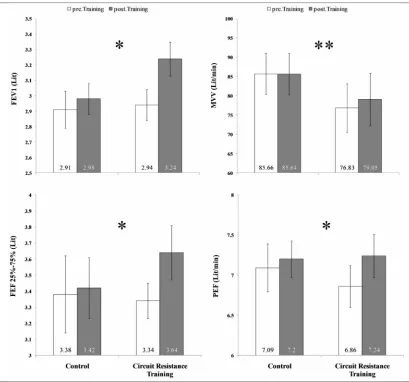
FEV1. The main effect of “Group” for FEV1 was significant (F = 6.619, p = .02). Mean plus-minus standard error of mean (M ± SE) of CRT (3.23 ± .06) was significantly greater than C (3.00 ± .06) (Fig. 2).
MVV. Differences between group for MVV were significant (F = 13.707, p = .002). M ± SE of CRT (83.46 ± .49) was significantly greater than C (80.75 ± .52) (Fig. 2).
FEF 25%-75%. Differences between group for FEF 25%-75% were significant (F = 7.673, p = .014). M ± SE of CRT (3.66 ± .06) was significantly greater than C (3.4 ± .06) (Fig. 2).
PEF. The main effect of “Group” for PEF was also significant (F = 4.35, p = .049). M ± SE of CRT (7.5 ± .07) was significantly greater than C (7.1 ± .08) (Fig. 2).
Table 3.Post-test adjusted Mean of pulmonary function parameter (Mean ± SE) Factors
Groups (Lit)VC FVC(Lit) FEV1/FVC(Ratio)
RT 3.066 ± 0.05 3.79 ± 0.07 85.49 ± 0.5
C 3.068 ± 0.05 3.62 ± 0.07 84.33 ± 0.48
VC: Vital Capacity. FVC: Forced Vital Capacity. FEV1/FVC: Forced Expiratory Volume in one second (FEV1) to Forced Vital Capacity (FVC) ratio. RT: resistance training.C:control without training.
DISCUSSION
In this study, VC (equal to sum of expiratory reserve volume, inspiratory reserve volume, and flowing volume), FVC (i.e. maximum amount of air exited from lung with a deep expiration after a deep inspiration), and FEV1/FVC (i.e. the percentage of FVC which exits the lung during first second of a deep expiration) of CRT weren’t different from C, but FEV1 (volume in 1st second is volume of air that
exits the lung in 1st second of a deep and potent expiration), MVV (total volume of air replaced with inspiration and expiration in maximum depth and speed), FEF 25%-75%, and PEF (maximum volume of air flow during a deep expiration maneuver) of CRT were significantly greater than C.
Nourry et al (2005) reported a significant increase in FVC, PEF, and FEV1 of healthy prepubescent children after 8 weeks of high-intensity interval running training (18). Farid et al (2005) found significant elevation in FVC, MVV, PEF, FEF 25-75%, and FEV1, but FEV1/FVC showed no significant change after eight weeks of aerobic exercise (asthmatic patients, 3sessions/week, 20min/session, 15min warm up and tensile exercise before main exercise/session) (19). Tartibian, Maleki, and Abbasi. (2010) found a significant rise in VC, FVC, MVV, FEF
25-75%, and FEV1 after wrestling training (12 weeks, 3times/week, 90–120 min/day to 70– 85% of HRmax in the first 6 weeks, and to
85–95% of HRmax in the second 6 weeks)
(20). Chenget al (2003) showed that active persons had a higher FEV1 than others (21). Besides, Wright et al (2003) after a hypertrophic maximal strength training [12 weeks (2 weeks of muscle habituation training, 5 weeks of hypertrophic training I, 5 weeks of hypertrophic training II with intensified eccentric work), initially twice, then 3 times a week, 60-120 min] in patients with chronic obstructive pulmonary disease (COPD) observed that FEV1 is elevated (5.3%) significantly compared to the baseline (12). Galvan and Cataneo (2007) believe that MVV can indicate the function of only respiratory muscles and therefore, the values of MVV increase on account of improved strength of inspiratory muscles (22). But we know that MVV is maximum voluntary ventilation and not only respiratory muscles but also expiratory muscles are involved in voluntary ventilation with strength; so depending on the capacity that inspiratory and expiratory muscles have to generate force, strength of these muscles is improved due to 8 weeks of CRT.
Figure 1. Pulmonary function differences in control and circuit resistance training groups.
FEV1:Forced Expiratory Volume in one second.MVV:Maximum Voluntary Ventilation. FEF25%-75%: Forced Expiratory Flows.PEF: Peak Expiratory Flows.*: significantly different from Control group (p < 0.05).**:significantly different from Control group (p < 0.01).
Nourry et al (2005) (18), based on literature, interpreted that the improvement in expiratory flow parameters including PEF, FEF 25%-75%, FEV1, and FEV1/FVC could be illustrated by one or both causes: an increase in contractility (23) or strength (24, 25) of the expiratory muscle, or alterations in the lung compliance and the balance in airways resistance (24, 26), as described in introduction. Tartibian et al (2010) concluded that these variables were influenced by exercise training because in inactive control group they showed a
significant decrease following 12 weeks of detraining (20). Besides, development of strength is related to increase in synthesis of the contractile proteins (actin and myosin) due to long-term training programs. Various studies suggest that the capacity of respiratory muscles can be elevated through appropriate stimuli that enlarge their workload and therefore the training of respiratory muscles through multiple types of exercise training purposes to expedite these kinds of cellular changes in the activated muscles (22).
Multiple aspects may support improvement of the pulmonary function. We know that muscular imbalances-associated with inactivity causes a restriction in the thorax (12), and so exercise training maybe could have a compensatory effect on this situation; furthermore, reinforcement of the auxiliary respiratory muscle is another effect of regular exercise training (27). It has been shown in previous studies on asthmatic patients that physical exercise can increase the residual air flow and decrease the ventilation with reinforcement of bronchi expansion during an exercise. This makes an asthmatic patient save air flow during exercise (19, 28).
In addition, improved pulmonary function following exercise training could be due to decreased airway resistance, increased airway caliber, and strengthened respiratory muscles as well as lung and thorax elasticity (9, 20). On the other hand, hormonal effects, compromised roles of
adrenaline (29, 30) and cortisol (31) also appear to be feasible. A decreased lung retractability and induced vasodilatation of pulmonary vessels is reported due to an increased activation of adrenaline system during exercise training that vasodilatation of pulmonary vessels cause a decreased airway resistance and an enhanced FEV1 and FVC through increasing the airflow (29, 30). Serum cortisol has also been reported to have a connection to bronchodilatation and lung surfactant generation (31).
CONCLUSION
The present study showed that a period of CRT causes a clear increase in FEV1, MVV, FEF 25%-75%, and PEF. So results of our study may suggest that the CRT can improve some pulmonary function factors of healthy young inactive women beside of other benefits of this type of training for women.
REFFRENCES
1. Singh VP, Jani H, John V, Singh P, Joseley T. Effects of upper body resistance training on pulmonary functions in sedentary male smokers. Lung India : official organ of Indian Chest Society. 2011;28(3):169-73. Epub 2011/09/03.
2. WHO. Promoting Physical Activity in Schools: An Important Element of a Health-Promoting School. WHO Information Series on School Health, Document Twelve. WHO; 2007 [cited 2010 6 September]; Available from:http://whqlibdoc.who.int/publications/2007/9789241595995_eng.pdf.
3. Boreham C, Riddoch C. The physical activity, fitness and health of children. Journal of Sports Sciences. 2001;19(12):915 - 29.
4. Boreham CAG, Riddoch CJ. Physical activity and health through the lifespan. In: McKenna J, Riddoch CJ, editors. Perspectives in Health and Exercise. London: Palgrave Macmillan; 2003. p. 11-24.
5. Caspersen CJ, Powell KE, Christenson GM. Physical activity, exercise, and physical fitness: definitions and distinctions for health-related research. Public health reports. 1985;100(2):126-31. 6. McCord P, Nichols J, Patterson P. The effect of low impact dance training on aerobic capacity,
submaximal heart rates and body composition of college-aged females. Anglais. 1989;29(2):184-8. 7. Maaroos J, Land A. Anthropometric indices and physical fitness in university undergraduates with
different physical activity. Anglais. 2001;59(2):157-63.
8. Williams CL, Hayman LL, Daniels SR, Robinson TN, Steinberger J, Paridon S, et al. Cardiovascular Health in Childhood: A Statement for Health Professionals From the Committee on Atherosclerosis, Hypertension, and Obesity in the Young (AHOY) of the Council on Cardiovascular Disease in the Young, American Heart Association. Circulation. 2002;106(1):143-60.
9. Leith DE, Bradley M. Ventilatory muscle strength and endurance training. Journal of Applied Physiology. 1976;41(4):508-16.
10.Hagberg JM, Yerg JE, Seals DR. Pulmonary function in young and older athletes and untrained men. Journal of Applied Physiology. 1988;65(1):101-5.
11.Womack CJ, Harris DL, Katzel LI, Hagberg JM, Bleecker ER, Goldberg AP. Weight Loss, Not Aerobic Exercise, Improves Pulmonary Function in Older Obese Men. The Journals of Gerontology Series A: Biological Sciences and Medical Sciences. 2000;55(8):M453-M7.
12.Wright P, Heck H, Langenkamp H. Effects of a resistance training on pulmonary function and performance measurements in patients with chronic obstructive pulmonary disease. European Journal of Sport Science. 2003;3(3):1-10.
13.Pringle EM, Latin RW, Berg K. The relationship between 10 km running performance and pulmonary function. Journal of Exercise Physiology. 2005;8(5):22-8.
14.Wells GD, Plyley M, Thomas S, Goodman L, Duffin J. Effects of concurrent inspiratory and expiratory muscle training on respiratory and exercise performance in competitive swimmers. European Journal of Applied Physiology. 2005;94(5):527-40.
15.Enright SJ, Unnithan VB, Heward C, Withnall L, Davies DH. Effect of High-Intensity Inspiratory Muscle Training on Lung Volumes, Diaphragm Thickness, and Exercise Capacity in Subjects Who Are Healthy. Physical Therapy. 2006;86(3):345-54.
16.Spruit MA, Gosselink R, Troosters T, De Paepe K, Decramer M. Resistance versus endurance training in patients with COPD and peripheral muscle weakness. European Respiratory Journal. 2002;19(6):1072-8.
17.Shaw I, Shaw BS, Brown GA. afterConcurrent training and pulmonary function in smokers. International journal of sports medicine. 2011;32(10):776-80.
18.Nourry C, Deruelle F, Guinhouya C, Baquet G, Fabre C, Bart F, et al. High-intensity intermittent running training improves pulmonary function and alters exercise breathing pattern in children. European Journal of Applied Physiology. 2005;94(4):415-23.
19.Farid R, Azad FJ, Atri AE, Rahimi MB, Khaledan A, Talaei-Khoei M, et al. Effect of Aerobic Exercise Training on Pulmonary Function and Tolerance of Activity in Asthmatic Patients. Iranian Journal of Allergy, Asthma and Immunology. 2005;4(3):133-8.
20.Tartibian B, Maleki BH, Abbasi A. The effects of omega-3 supplementation on pulmonary function of young wrestlers during intensive training. Journal of science and medicine in sport / Sports Medicine Australia. 2010;13(2):281-6.
21.Cheng YJ, Macera CA, Addy CL, Sy FS, Wieland D, Blair SN. Effects of physical activity on exercise tests and respiratory function. British Journal of Sports Medicine. 2003;37(6):521-8.
22.Galvan CCR, Cataneo AnJM. Effect of respiratory muscle training on pulmonary function in preoperative preparation of tobacco smokers. Acta Cirurgica Brasileira. 2007;22:98-104.
23.Farrell PA. Maximal expiratory flow-volume relationships before and after eight weeks of endurance training. The Journal of sports medicine and physical fitness. 1981;21(2):145-9.
24.Clanton TL, Dixon GF, Drake J, Gadek JE. Effects of swim training on lung volumes and inspiratory muscle conditioning. Journal of Applied Physiology. 1987;62(1):39.
25.EngströM I, Eriksson BO, Karluerg P, Saltin B, Thoren C. PRELIMINARY REPORT ON THE DEVELOPMENT OF LUNG VOLUMES IN YOUNG GIRL SWIMMERS. Acta Pædiatrica. 1971;60:73-6.
26.Courteix D, Obert P, Lecoq A-M, Guenon P, Koch G. Effect of intensive swimming training on lung volumes, airway resistances and on the maximal expiratory flow-volume relationship in prepubertal girls. European Journal of Applied Physiology and Occupational Physiology. 1997;76(3):264-9. 27.Boeckh-Behrens WU, Buskies W, Loges D, Winsen L. Gesundheitsorientiertes Fitnesstraining:
Wehdemeier und Pusch; 2002.
28.Patessio A, Donner CF. Selection criteria for exercise training in patients with COPD. Zeitschrift für Kardiologie. 1994;83(3):155-8.
29.Forte VA, Leith DE, Muza SR, Fulco CS, Cymerman A. Ventilatory capacities at sea level and high altitude. Anglais. 1997;68(6):488-93.
30.Gautier H, Peslin R, Grassino A, Milic-Emili J, Hannhart B, Powell E, et al. Mechanical properties of the lungs during acclimatization to altitude. Journal of Applied Physiology. 1982;52(6):1407-15. 31.Landstra AM, Postma DS, Boezen HM, Van Aalderen WMC. Role of Serum Cortisol Levels in
Children with Asthma. Am J Respir Crit Care Med. 2002;165(5):708-12.