6824
VALIDATION OF GALLIC ACID BY USING HPTLC AND HPLC TECHNIQUES FOR STANDARDIZATION OF AMLA RAS AND EXPLORATION AS
PHYTOSOMES
Dhanashri M. Bachhav*, Dr. R.S. Bhambar, Dr. D.L. Attarde
M.G.V’s Pharmacy College, Adgaon Naka, Panchavati, Nashik- 422003
*Corresponding author E-mail:[email protected]
ARTICLE INFO ABSTRACT
Key Words
Gallicacid HPLC Phytosomes
HPTLC
Validation of standard gallic acid is done by HPTLC and HPLC method with gallic acid, marketed formulation (3 different batches) of amla ras and prepared phytosomes. Amla ras was spray dried and powdered. Linearity, precision, accuracy, robustness, ruggedness, % recovery for the formulated amla ras performed. Phytosomes prepared by Indena’s patented processes. Before preparing phytosomes gallic acid and lecithin was characterized by M.P., FTIR, UV and TLC. Prepared phytosomes evaluated by FT-IR, SEM (scanning Electron Microscopy), X- Ray Diffraction, Particle size, DSC (Differential Scanning Calorimetry). As per two modern Analytical techniques HPTLC and HPLC percentages of gallic acid found to be in Formulation 1, 2 & 3 comparing of standard with same of formulation, 0.853% ,0.618% ; 0.824%,0.72%; 0.76%,0.68% w/v respectively. Gallic acid and phytosomes were characterized for their standard before the phytosome preparation. Validation of 2 analytical methods was done with standard gallic acid and its marketed preparation and found that, technique could be applied to estimation of gallic acid in amla ras. By using standard gallic acid and lecithin, phytosomes were prepared and they are evaluated for and also its M.P. is compared with gallic acid shape and nature.
INTRODUCTION
Tannins:
Tannins are plant extract having astringent properties. Tannins are complex organic, non- nitrogenous plant products which generally have astringent properties [1]. Seguin in 1796 used the term ‘Tannin’ firstly to designate substances. Tannins have the capacity to bind with tissue protein and
precipitate them [2].
Gallic acid [8]: Gallic acid is a trihydroxybenzoic acid, a type of phenolic acid, a type of organic acid, also known as
3, 4, 5-trihydroxybenzoic acid, found in gallnuts, sumac, witch hazel, tea leaves, oak
bark, and other plants[2]. It is used as a standard for determining the phenol content of various analysts by the Folin- Ciocalteau assay; results are reported in Gallic acid equivalents. Gallic acid can also be used as a starting material in the synthesis of the psychedelic alkaloid mescaline. Gallic acid seems to have anti-fungal and anti-viral properties. Gallic acid used as a antioxidant , also protect cells against cancer cell. It shows cytotoxicity against cancer cell and with that it not harms to healthy cells. It
Journal of Global Trends in Pharmaceutical Sciences
6825 shows astringent properties in internal
haemorrhage also used in diabetes, albuminuria. Used externally to treat psoriasis and external haemorrhoids. It is a weak carbonic anhydrase inhibitor. In basic research, Gallic acid extracted from grape seeds has been shown to inhibit the formation of amyloid fibrils, one of the potential causes of Alzheimer's disease and Parkinson's disease. One study indicated that Gallic acid has this effect on amyloid protein formation by modifying the properties of alpha-synuclein, a protein associated with the onset of neurodegenerative diseases. Gallic acid is classified as mutagen and teratogen.
HPTLC: The system consists of, a solvent reservoir and combining system, a high pressure pump, a sample inlet pump, a column, a detector and the recording unit. HPLC offers the benefits of speed, resolution and sensitivity useful for separating high molecular weight.
Lecithin [5]
Lecithin is a generic term to designate any group of yellow-brownish fatty substances occurring in animal and plant tissues, which are amphiphilic,they attract both water and fatty substances, and are used for smoothing food textures, dissolving powders, homogenizing liquid mixtures, and repelling sticking materials.
Phytosomes: In phytosomes, phyto means plant and some means cell like. Phytosomes
are cell like structure [3]. Phytosomes are the advanced formulation containing herbal extract surrounded with lipid[4]. Indena develops a patented technology, which includes standardized plant extract or the water soluble phytoconstituents to make lipid compatible molecular complex, as it increases absorption and bioavailability [6]. Phosphatidylcholine is a bifunctional compound. Lecithin is yellow brown fatty substance present in plant tissue as well as in animal[7].Methods utilize for their characterization are Melting point determination, Thin Layer Chromatography
(TLC),Infra Red Spectroscopy, , differential scanning calorimetry, (DSC), X-Ray Diffraction Analysis, Scanning Electron Microscopy (SEM). They are amphiphilic means attract to both water and fat. Standardization of gallic acid is done by using different 3 batches of amla ras. Amla ras is spray dried to get the powder form of Ras. The effectiveness of any herbal medication is dependent on the delivery of effective level of the therapeutically active compound. But a severe limitation exists in their bioavailability when administered orally or by topical applications. Phytosomes are recently introduced herbal formulations that are better absorbed and as a result produced better bioavailability and actions than the conventional phyto molecules or botanical extracts. Phytosome is a patented technology developed by a leading manufacturer of drugs and nutraceuticals, to incorporate standardized plant extracts or water soluble phytoconstituents into phospholipids to produce lipid compatible molecular complexes, called as phytosomes and so vastly improve their absorption and bioavailability.
Spray drying involves: Atomization, Air Disperser: the Drying chamber.
MATERIAL AND METHOD: Validation of gallicacid by HPTLC. Method: For stationary phase TLC Silica Gel G F254 used. Plates were cut at 10x10cm and 10x20cm. Mobile Phase used is Toluene: Ethyl Acetate: Formic Acid: Methanol (3:3:0.8:0.2). Chamber saturation for 20 min.
Preparation of Standard Stock Solutions: Weighed accurately 10 mg of Gallic acid, dissolved in 10 ml methanol.Pipette out 1ml of solution from stock in 10 ml volumetric flask and makeup to the 10 ml, stored in refrigerator at cold temperature to avoid degradation.
6826 Mobile Phase: Different solvent systems
were tried but the most suitable solvent system was Toluene: Ethyl acetate: Formic acid: Methanol (3: 3: 0.8: 0.2).The scanning wavelength was observed at 254nm showed good response for Gallic acid.
Preconditioning of Chamber: To achieve saturation, at least half of the area of the inside wall of the chamber was lined with filter paper. Sufficient quantity of mobile phase poured in chamber about 20ml with the side filter paper stand for 20 min at least at room temperature.
Development of Chromatogram: plates marked at 70mm below upper side kept vertically in the mobile phase and allowed to run to specified distance. After specified run plate was removed, marked at mobile phase front, dried the plate.
Chromatographic evaluation and estimation: Plate is scan under camag scanner, the % of gallic acid present in concentrations is calculated.
Validation by HPLC Instrument information:
Standard Preparation of stock For the stock preparation 0.01 gm of drug is dissolved in 10 ml of solvent. The solvent is an mobile phase which is a methanol:water (80:20) at 276nm.
Quantitative estimation of Gallic acid in Amla Ras
Selection of marketed formulation and batches: 3 batches of Marketed formulation of AmlaRas is spray dried and weighed and spray dryied.
Stock preparation of AmlaRas powder- prepared same as standard gallic acid stock was prepared.
Characterization of Standard Gallic acid
Melting point- Melting point of Gallic acid
is taken
UV Visible Spectrophotometer: Procedure- Baseline for 100 ppm gallic acid stock solution is taken with methanol and then sample of gallic acid is run with methanol for the max is taken in 400nm to 200nm.
Fourier Transform Infrared
Spectroscopy: Triturate gallic acid with KBR and taking the IR spectra of all the compounds.
TLC- Thin layer chromatography is being carried out for the standard Gallic acid, phytosomes and marketed formulation of amla ras after spray drying using mobile phase Toluene : ethyl acetate : formic acid : methanol ( 3:3:0.8:0.2) run at 10cm. Chamber saturated at 20 min. 5% feCl3 in methanol is used as spraying reagent.
Characterization of Lecithin: FT-IR- Procedure:- Triturate Lecithin with KBR and IR is taken Visualization: -UV 254 nm, 370 nm, 378nm
Procedure for the formulation of phytosomes: Phytosomes were formulated by Indena’s patented processe
Complex of standard gallic acid and lecithin (1:1) taken to 20 ml of dichloromethane refluxed at temperature not more than 40o C for 2 hrs Resultant evaporated . Then 10 ml of n- hexane added with continuous stirring. Phospholipid complex was precipitated. It is filter and then precipitate was dried under vaccumto remove traces ofsolvent. Resultant complex pack in amber colourd glass bottle flushed with nitrogen and then stored at room temperature
6827
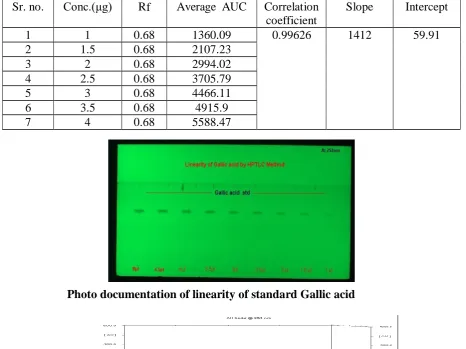
Table 1: Linearity
Sr. no. Conc.(μg) Rf Average AUC Correlation coefficient
Slope Intercept
1 1 0.68 1360.09 0.99626 1412 59.91
2 1.5 0.68 2107.23
3 2 0.68 2994.02
4 2.5 0.68 3705.79
5 3 0.68 4466.11
6 3.5 0.68 4915.9
7 4 0.68 5588.47
Photo documentation of linearity of standard Gallic acid
3D spectra of standard Gallic acid
Table 2: Precision
Sr. no. Conc.(μg) Rf Average AUC SD
1 3 0.66 4028.17
130.26
2 3 0.66 4345.87
3 3 0.66 4404.09
4 3 0.66 4302.99
5 3 0.66 4277.1
6828
Photodocumentation of precision
Sr. no.
Conc.
(μg)
Intraday Interday
Mean SD RSD %RSD Mean SD RSD %RSD
1 3 4474.00
80.26 0.0183 1.83%
4319.20
62.51 0.0144 1.44%
2 3 4469.24 4455.74
3 3 4344.32 4334.89
4 3 4287.61 4288.60
5 3 4304.67 4294.65
6 3 4372.90 4373.21
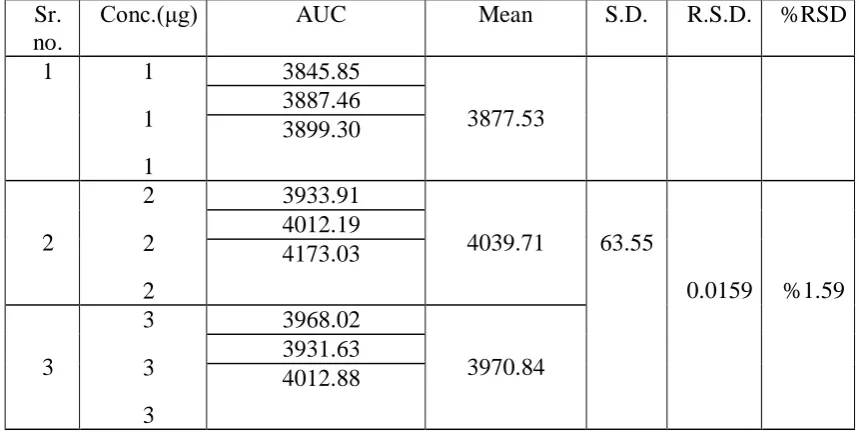
Table 4: Accuracy
Sr. no.
Conc.(μg) AUC Mean S.D. R.S.D. %RSD
1 1
1
1
3845.85
3877.53 3887.46
3899.30
2
2
2
2
3933.91
4039.71 63.55
0.0159 %1.59 4012.19
4173.03
3
3
3
3
3968.02
3970.84 3931.63
4012.88
Table 5: Limit of detection and limit of quantitation
Sr. no. Limit of Detection Limit of Quantitation
1
6829
Table 6: Condition in robustness
Sr.no. mobile phase Toluene Ethyl acetate Formic acid Methanol
1 taken as 8.5 8.5 2.2 0.6
2 Changes did as 8 9 2.2 0.6
Table 7: Robustness
Sr.no. Conc.(μg) Rf Average AUC SD RSD %RSD
1 3 0.7 4034.03
79.08 0.0196 1.96
2 3 0.7 3969.96
3 3 0.7 4002.84
4 3 0.7 4169.33
5 3 0.7 4052.31
6 3 0.7 3959.90
Table 8: Ruggedness
Sr. no. Conc. (μg)
Rf Average
AUC
SD RSD %RSD
1 3 0.66 4389.55 67.29 0.0153 1.53
2 3 0.66 4464.96
3 3 0.66 4372.58
4 3 0.66 4289.50
5 3 0.66 4312.62
6 3 0.66 4410.81
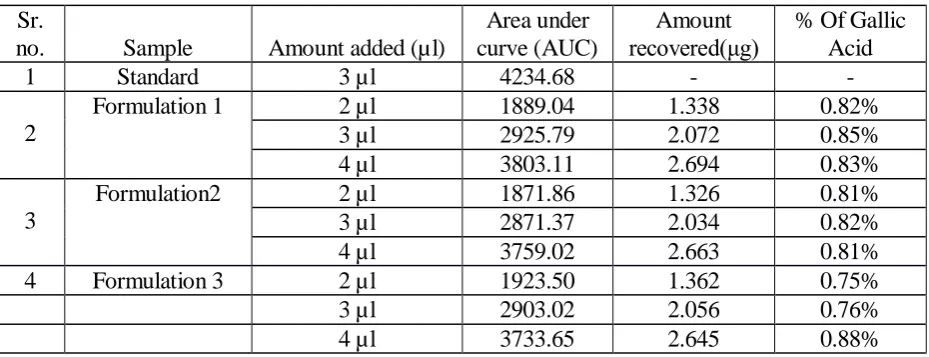
Table 9: Quantitative estimation of Gallic acid in AmlaRas
Sr.
no. Sample Amount added (µl)
Area under curve (AUC)
Amount recovered(μg)
% Of Gallic Acid
1 Standard 3 µl 4234.68 - -
2
Formulation 1 2 µl 1889.04 1.338 0.82%
3 µl 2925.79 2.072 0.85%
4 µl 3803.11 2.694 0.83%
3
Formulation2 2 µl 1871.86 1.326 0.81%
3 µl 2871.37 2.034 0.82%
4 µl 3759.02 2.663 0.81%
4 Formulation 3 2 µl 1923.50 1.362 0.75%
3 µl 2903.02 2.056 0.76%
6830
Spectra of standard Gallic acid & Spectra of marketed formulation Of Amla Ras containing Gallic acid
Sr.no. Sample Amount added(μg) Area under
curve (AUC) Mean % recovery
1
Std+Formulation1
3+2
5440.7
5440.53 70.08%
5449.4 5461.5
2
Std+Formulation2
3+2.6
6133.0
6131.7 91.69%
6143.6 6118.5
3 Std+Formulation3 3+3.1 6768.4 6832 113.59%
6883.2 6844.4
Photodocumentation of % Recovery & 3D spectra of % Recovery
Sr.No. Concentration Area Correlation coefficient Slope
1 20 1031098
0.998 84762
2 40 2792870
3 60 4512941
4 80 5990677
5 100 7908394
6831
Table no. 13:- Robustness of HPLC of standard Gallic acid
Sr. No. concentration Area Mean SD %SD
1 60 4495294
4505184 8586.12 0.19
2 60 4510731
3 60 4509527
Table no14. Limit of Detection and Limit Of Quantitation
Sr.no. Limit of Detection Limit Of Quantitation
1
2 LOD = 14.84 LOQ = 44.97
Table no 15:- % Assay of HPLC of standard Gallic acid and Formulation
Sr. no. Concentration Area of Standard Area of Sample % Assay
1 20ppm
1031098
621638 60%
2 20ppm 622073 60.4%
3 20ppm 640140 62.10%
Table no16: % Recovery for Gallic acid
Sr. No. % composition Area of standard Area of Sample % Recovery
1 50% Recovery 4512941 3681063 81.57
2 100% Recovery 5990677 5274281 88.04
3 150% Recovery 7908394 6554378 82.88
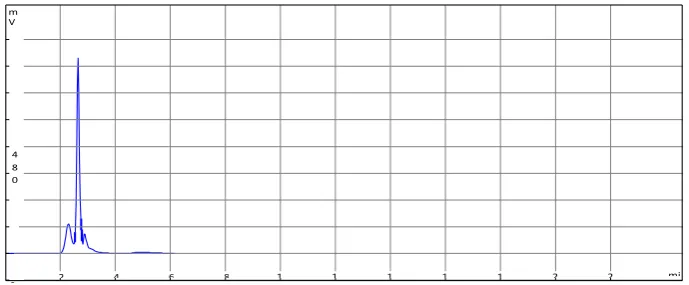
Spectra of Formulation-1for % Recovery
m V
4 8 0
4 2 0
3 6 0
3
2 4 6 8 1
0 12 14 16 18 20 22
mi n
-60
2 .6
2
6832
Spectra of Formulation-2- for % Recovery
Spectra of Formulation-3 for % Recovery
Spectra of IR for standard Gallic acid
Wave number (cm-1
) Bond
1539 -C-C- strech
1620 -C=C- aromatic ring
1712.85 -C=O- carboxylic grp.
2337.8 -C=C- Alkynes
3730.45 -O-H phenols
m V 7 2 0 6 4 0 5 6 0 4 8 0 4 0 0 3 2 0 2 4 0 1 6 0 8 0 0 -8 0
2 4 6 8 1
0 1 2 1 4 1 6 1 8 2 0 2 2 m in 2 .6 2 7 ' m V 90 0 80 0 70 0 60 0 50 0 40 0 30 0 20 0
2 4 6 8 1
6833
Spectra of UV of Standard Gallic acid
Spectra of IR of Lecithin
Wavenumber(cm-1)
Bond
1462.09 -C-H- alkanes
1743.71 .>C=O carboxylic acids
2341.66 C=C alkynes
3726.6 -N-H- amines
Interpretation of IR
6834
Conditions for TLC: Stationary phase: Silica gel G for TLC
Mobile phase: Toluene: Ethyl acetate: formic acid: methanol (3:3:0.8:0.2) Spraying Reagent- 5% Ferric Chloride
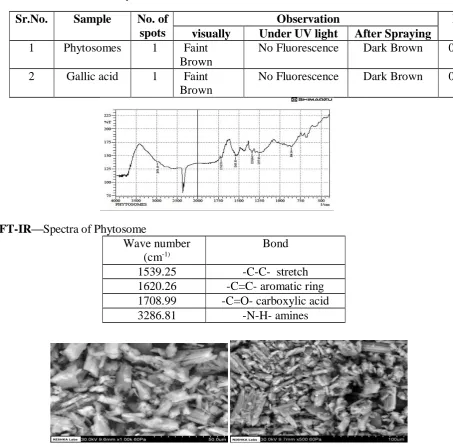
Table no. 17:- For TLC of Phytosome and Gallic acid
Sr.No. Sample No. of
spots
Observation Rf
visually Under UV light After Spraying
1 Phytosomes 1 Faint
Brown
No Fluorescence Dark Brown 0.62
2 Gallic acid 1 Faint
Brown
No Fluorescence Dark Brown 0.66
FT-IR—Spectra of Phytosome
Wave number (cm-1)
Bond
1539.25 -C-C- stretch
1620.26 -C=C- aromatic ring 1708.99 -C=O- carboxylic acid
3286.81 -N-H- amines
SEM of the Phytosomes
6835
Spectra-2 and 3: for Particle Size
X-Ray Diffraction [9]
DSC for Gallic acid
6836
CONCLUSION:
Validation of Gallic acid has been done by using HPTLC and HPLC. This analytical characterization mainly focuses on qualitative studies. TLC of standard gallic acid, spray dried powder of Amla ras and phytosomes carried out and after spraying with same reagent it shows the dark brownish colour of gallic acid. The result showed that the calibration curve was linear in rang 1-5μg/μl. The correlation coefficient was found to be 0.99626 which is indicated good linearity. The SD, RSD and %RSD for precision and accuracy is calculated. Recovery studies of marketed formulation of Amla ras were performed at 80%, 100% and 120% and recovery showed 70.08%, 91.69% and 113.59%. All validation parameters such as precision, accuracy, LOD, LOQ, ruggedness, and robustness can be performed. The present study is to present the technical information to perform reliable and reproducible HPTLC to establish the identity, purity, and quality of formulated Amla ras. Also the Validation of gallic acid is performed by using HPLC technique, with the Amla ras formulation and its phytosome formulation. Linerity of gallic acid gives an slope 84762 and regression is 0.998. The limit of % SD should be less than 2% and obtained is 0.76%. The all parameter such as robustness, LOD and LOQ is performed. Validation method is precise. Assay gives for Formulation-1, 0.618% ; for Formulation-2, 0.72% and for Formulation-3, 0.68%. The% Recovery of marketed formulation of Amla ras were performed at 50%, 100% and 150% and recovery showed 81.57%, 88.04% and 82.88%. As per two modern analytical technique HPTLC and HPLC % of Gallic acid found to 2 techniques could be applied to estimation of gallic acid in Amla ras. Characterization of gallic acid and lecithin did for the purpose of formulation of it as phytosomes. As the phytosomes are prepared from standard
gallic acid and lecithin, a phospholipid. Phytosomes are compared with gallic acid and lecithin by taking their IR. The Phytosomes are evaluated by SEM, Particle size, X-Ray Diffraction. SEM- Scanning Electron Microscopy gives the shapes of the phytosomes, as they are cylindrical in shapes. Particle size is in d.nm. also the % intensity is also given. The XRD shows that, it is in crystalline in nature. After doing DSC of standard Gallic acid and Phytosomes there is a slight change in M.P. The standard gallic gives M.P. at 2560
c and the phytosomes gives 2430
c.
Acknowledgement:-I am very thankful to
Dr. Sachin Hire, my husband for his support. Also thanking you mam Dr. D.L. Attarde (MGV’s Pharmacy college) for her valuable guidance.
REFERENCES:
1. The Ayurvedic Pharmacopoeia of India. Part 1, Vol 4. Govt. of India, Ministry of Health & Family Welfare, Dept. of Indian Systems of Medicines & Homeopathy, New Delhi, India, 2004, pg.no.5,6.
2. Khare CP. Encyclopedia of Indian Medicinal Plants, Springer Link, Germany, 2004; pg.no.313-314
3. SuryawanshiJAS,“Phytosome: An
emerging trend in herbal drug treatment”, Journal of Medical Genetics and Genomics 2011; 3(6),pg.no. 109-11
4. Mohd AA, Aniket Kumari A, Kumari P, Saurabh S, Khurana L, Commercially bio available proprietary technologies and their marketed products. Elsevier- Drug Discovery Today 2013,pg.no. 105
6837 Division of MERCK and CO., Inc,
white house station, NJ, 1996, pg.no. 747, 939
6. Bhattacharya S.Phytosomes: Emerging Strategy in Delivery of Herbal Drugs and Nutraceuticals. Pharma Times 2009; pg.no.41
7. Bhattacharya S, Ghosh A. Phytosomes: the Emerging Technology for Enhancement of Bioavailability of Botanicals and Nutraceuticals. The Internet Journal of Aesthetic and Antiaging Medici 2009; 2 Suppl 1,pg.no 2-4.
8. S.J. Carter,Cooper and Gunn’s, tutorial pharmacy, CBS Publishers and Distributors. 6th edition, 1986, pg.no.174-176.
9. C.K. Kokate, A.P.Purohit, S.B. Gokhale, Pharmacognosy,vol I nd II, NiraliPrakashan, 47th edition, July 1999, pg.no.9.10
10.Vinod D. Rangari, Pharmacognosy and Phytochemistry, , Carrier
Publication, Volume 2,
2ndedition,December 2009, pg.no. 240-241
11.Leon Lachman,Herberta A. Lieberman, Joseph L. Kanig, The Theory and Practice of Industrial Pharmacy, , 3rd edition, by Varghese Publishing House, 1976, pg.no. 179-180