Assessing Self-Employment on Empowering Women in Southern Ethiopia
1 Firew Arega, 2 Dr. Naveen Kolloju
1Research scholar, Department of Civics and Ethical Studies, School of Social Sciences and Humanities, Arba Minch
University, Ethiopia..
2Assistant Professor, Department of Civics and Ethical Studies, School of Social Sciences and Humanities, Arba
Minch University, Ethiopia.
Email – 1[email protected] , 2[email protected]
Keywords: Microfinance; Financial Inclusion; Financial Exclusion
1. INTRODUCTION:
Empowerment of women is one of the important issues of contemporary development policies in many developing countries. It has also become central to the debates all over the world on how to empower women in order to improve their quality and dignity of lives (Nosheen, 2009; pp. 216-229). In a general conception, enhancing women’s status and their empowerment levels can play a significant role in the success of many development programs that bring positive social changes. Empowerment of women, therefore in recent times, has been one of the central issues in the project of development and is important for the all-round development and harmonious growth of any nation. It would be possible only when women are considered as equal partners in progress along with men. However, the ground reality shows that women in much of the developing world lack support for fundamental functions of a human life. They are less well-nourished than men, less healthy, more vulnerable to physical violence and sexual abuse (Nussbaum, 2000). It is therefore, in order to accelerate growth, prosperity, justice and equality, it is necessary to create opportunities for socio-economic development of womenfolk in all over the world. The empowerment of the less privileged, including women, therefore becomes a national priority for political parties and governments in the developing world today.
2. REVIEW OF LITERATURE:
There are different ways to understand empowerment: Mehra, (1997) defines “empowerment is a process, which
includes the expansion of choices for women and an increase in women’s ability to exercise choice”. She is of the view that empowerment makes it possible for women to expand their preferences and which also enhances their capacity to act according to these preferences. For instance, women’s access to economic opportunities through the creation of various self-employment activities expands their preferences. Health services and education improve women’s capabilities to take advantage on those preferences (pp.138-149). In a similar vein, Mayoux (2000) also defines empowerment is a process of change in power relations that is both multidimensional and interlinked. Empowerment, particularly women empowerment, is the processes by which women take control and ownership of their lives through expansion of their
Abstract: Throughout the world, deeply entrenched barriers exclude women from meaningful participation in
economic, social and political activities. In recent times, the governments in many developing countries including Ethiopia have come up with various developmental policies and programs in order to promote
women’s advancement in different spheres. Currently, women in the study area are participating in different self-employment activities. However, various constraints in socio-economic and political fronts are severely affecting their active participation in these activities and thus it instigated to conduct the study. The study primarily attempted to assess various self-employment activities on empowerment of women in socio-economic and political spheres in Basketo Special Woreda, Southern Ethiopia. Particularly, with specific objectives, it examined the self-employment activities on social empowerment of women, analyzed the role of microfinance
institutions (MFIs) vis-à-vis promotion of self-employment activities of women. It alsoexamined the role of the
government and its intervention through various policies and programs in bringing women empowerment and identified the constraints of women’s participation in self-employment activities. Descriptive and explanatory research design was employed. The study revealed that there was inaccessibility of multi loan chances with the microfinance institutions (MFIs) vis-à-vis promotion of self-employment activities for women. The study found that the government was striving for the better empowerment of women but has numerous drawbacks. The findings also revealed that women self-employment activities are becoming an important area of emphasis in the study area, primarily for its great potentials as a source of income generation. However, there are a number of economic, social and institutional constraints.
transform those choices into desired actions and outcomes. Empowerment of women is about expanding women’s assets and capabilities to participate in, negotiate with, influence, control and hold accountable the institutions that affect their lives (Yesuf, 2014; p.69).
In order to create more gender equality and alleviate poverty among women in both urban and rural settings, scholars and field practitioners have recognized the importance of empowering women. Expanding women’s economic opportunities is critical for meeting the obligations laid out in major human rights conventions and for enhancing countries’ development prospects and eliminating poverty. Realizing the potential of all people can contribute to productivity and a more resilient society. In this regard, empowerment of women through creation of various self-employment activities received significant attention across the globe (Jemi Klugman Fellow and Sarah Twigg, 2015; p.38).
As it mentioned, since empowerment of women through creation of self-employment activities is one of the key strategies, there is a need to understand what self -employment is. Self-employment can include several types of work and is defined as working for oneself, as opposed to working for another person or organization. The self-employed people are often described as consultants, small business owners and also who are running different self-employment activities (Cal J. Halverson,2016). Self-employment is sometimes equated with entrepreneurship, but this can be misleading. It is understood that “entrepreneurship” conjures the image of a risk-taker setting up a business with the intent of making it grow and prosper. In developing countries, however, the goal of much self-employment is far more modest: to earn money for a time—preferably, a short time-before transitioning to a more remunerative activity (Fields, 2014).
Self-employment is also ‘starting and running a successful business or social enterprise’. Many famous companies began this way as visionary men and women patented an invention, created a company or registered a brand. Although an excellent business idea plays a key role in the ultimate success of a business, the application of the idea will ultimately decide its fate (Laing, 2011).With reference to female self-employment, it is especially encouraged because higher incomes for women empower them, improve the health of their families, and alleviate poverty in society at large. In this context, development institutions have been urged to increase female participation in various self-employment activities. However, knowledge about the gains and costs to women who earn a living in self-employment activities is sparse (Heemskerk, 2003). Especially, a detailed research on this area is still unexplored in many developing countries in general and Ethiopia in particular.
2.1. Microfinance and Women’s Empowerment:
The concept of microfinance has become a significant aspect of development phenomenon in the international arena over the last three decades. The primary aim of the microfinance intervention is to provide tiny loans for the unbanked poor households, particularly women. It is believed that this approach has helped the poor and unemployed, and provided them with adequate amount of credit that is restricted in the formal banking system. George (2008) defines microfinance as “a provision of thrift, credit and other financial services (loans) and products of very small amount to the poor in rural, semi-urban and urban areas for enabling them to raise their income levels, improve living standards and empower them in different spheres”. Microfinance initiatives, it is believed, have a great bearing on achieving the goal of women’s empowerment by promoting their saving habits, and extending bank loans to them to start various income-generating activities (Campbell, 2010).
2.2. Women and Self-Employment:
According to Harper (1996), women empowerment differs from one country to another and between different income groups within each country. However, women’s economic, social and political position is generally worse in poor countries as compared to the rich. Women empowerment is giving the ability to generate choices and exercise bargaining power, developing a sense of self-worth, a belief in one’s ability to secure desired changes and the right to control one’s life (Narayan, 2002). As stated by Narayan (2002), in most poor countries, men’s domination on women is strongest within the household. Access to credit and participation in income-generating activities is assumed to strengthen women’s bargaining position within the household thereby allowing them to influence a greater number of strategic decisions (p.323). Ethiopia is also one of the poor countries where women have a low standard of living. This study looks into self-employment activities as contributing to women’s knowledge and self-confidence by widening their social networking.
They also give women the tools and skills they need to participate more effectively and successfully in politics and to informally influence decisions and policies that affect their lives.
In Ethiopia, women constitute about 50% of the population in which the majority of the unemployed segment of the female population are mostly affected by poverty. Since the majority of Ethiopian women live in areas where basic social services such as health, education and other infrastructures are non-existent, disease, malnutrition, and illiteracy is seriously affecting their and the life of their children (Tesfay, 2003).
Many people who are poor, unemployed, or socially marginal may pursue self-employment or informal sector activities because jobs are not available, not accessible, or not adequate in providing a living wage. For poor women, barriers such as the lack of child care and transportation, as well as little education and few job skills, further limit their employment opportunities (Hagen and Lurie,1993; and Miller, 1990). Despite the number of low-income people engaged in self-employment activities, numerous barriers exist to start and operate a viable business for people receiving public assistance. The primary obstacles are lack of business knowledge and skills, lack of access to capital and other resources and psychological barriers.
3. RESEARCH METHODOLOGY: 3.1. Description of the Study Area:
Basketo is an area found in South Western part of Ethiopia under the administration of South Nations Nationalities and Peoples Regional State (SNNPRS), 562 Kilometers from the capital, Addis Ababa and is located in 350 kilometers away from the regional city, Hawassa. It is one among 14 zonal and 4 special woreda arrangements in the region comprising 31 rural kebeles and 2 urban kebeles, which has totally 33 kebeles.
3.2. Sampling Technique and Sample Size Determination:
The researcher conducted investigation on self-employed women’s participation in various self-employment activities in the case of Basketo Special Woreda, Southern Ethiopia. For this study purposive sampling has been used. There are 31 rural kebeles and 2 urban kebeles, totally 33 kebeles existed in the Basketo Special Woreda. A total of 623 registered women data obtained from the Basketo Special Woreda Women and Children Affairs Office. Out of 623 registered women self-employers, a total of 244 sample women self-employers were selected as final sample size for this study. The below paragraph explains the sampling techniques and sample size determination. .
There are different possible ways of sample size determination with different approaches in determining error terms and precision levels. While calculating the published tables as a guide for sample size determination, Israel (1992) used a formula developed by (Yamane,1967) with the precision level of ±5, ±7 and ±10. As it mentioned, a total of 244 total sample women self-employers were selected. This obtained number of total sample size(n) from a given population size(N) through a basic formula provided by Yamane (1967) for 95% confidence level with degree of maximum variability 50% (p: 0.5) at uppermost pair 5%, middle one 7% and lower one of 10% level of significance and then, allocate total samples size for each study. To this study the researcher used to the upper most pair (5%).
n = = = 243.59~244
Where: 1=Constant
N= the total number of population=623 e=the error terms (0.5%)
n = Number of sample =244
4. DATA ANALYSIS AND DISCUSSION OF RESULTS:
Table 4.1. Activities of the Respondents’ engagement
Activities Frequency Percent
Petty trade (selling of edible oil, sugar and selling packaged gruel powder) 20 8.2 Production and construction (building materials, wood products, wood saving furnace) 4 1.6 Service (coffee and tea bending, beauty salon and food preparation) 49 20.1 Agriculture (cultivation of vegetables, crop production like maize, teff, cereals like
potatoes, spices i.e. gingers)
137 56.1
Urban agriculture (cultivation of cabbage, peppers, tomatoes and rearing poultry) 34 13.9
Total 244 100
Source: Field Survey, 2019
The government has five development categories for the urban dwellers in order to sustain their lives. It is clearly seen from the above table 4.1, of the 244 total respondents, majority of the respondents 137 about 56.1 percent are engaged in the agriculture activity particularly in the cultivation of vegetables, crop production like maize, teff, cereals like potatoes, spices (gingers) and on animal husbandry like poultry and cattle rendering. The participants of service activity like coffee and tea bending, beauty salon and food preparation accounts for 49 respondents 20.1 percent, while 34 respondents i.e. 13.9 percent are engaged in the urban agriculture activities in their small plots of lands they cultivate cabbage, peppers, tomatoes, and rearing poultry are done in small plots of land. The respondents who are participating in the petty trade which includes selling of edible oil, sugar and selling packaged gruel powder are 20 in number, which accounts 8.2 percent. The remaining 4 respondents, i.e. 1.6 percent are engaged in the production and construction activities particularly on wood saving furnace. This table confirms that the majority of respondents are participating in the agricultural activity. It also indicates that most of the women in rural areas are illiterate and in their cheap labor force. Thus, the participation of women in production and construction activities is less when compared to the other activities performed by them. This is because the production and construction activities are capital intensive and needs more skill and technology. Since majority of the respondents are illiterate that becomes a challenge to participate in these activities.
Figure 4.1. Numbers of self-employed group members in self-employment
Source: Field Survey, 2019
Table 4.2. The role of group leaders in self-employmentactivity
The Role of the group leader in the self-employment Activity Frequency Percent
Mobilizing group members 64 26.2
Adjusting the condition to women’s gain money 43 17.6
Managing overall resources of the group members 47 19.2
All of the above 90 37
Total 244 100
Source: Field Survey, 2019
From the above table no 4.2, it is understood that of the total 244 respondents, 90 participants i.e. 37 percent said that the group leaders play all the following mentioned roles: mobilizing group members, adjusting the condition to women’s gain money, and managing overall resources of the group members. 64 participants, which accounts 26.2 percent said that the group leaders play a key role in mobilizing the group members; 47 participants, i.e. 19.2 percent said their role is adjusting the condition to women’s gain money, while the remaining 43 respondents, i.e. 17.6 percent said group leaders manage overall resources of the group members. It confirms, economic advancement leads self-employed women both in social and political empowerment.
During field study, the researcher observed that the group leaders were actively participating to tackle the various constraints that they face from internal environment of group members and external environments. Even though, they have been confronting their own house hold and community burdens. The same is true for the most group members that they had been playing their role to reach their optimal goals. However, the obstacles regarding to women participation in various self-employment activities has not been solved. But the reduction and minimization of obstacles yet continued. Almost all group members are the member of the leading party because the group arrangement highly attached with political interventions of the government bodies to the sake of maximizing their party members. The long stayed groups those who were active since 2014/15 were participated during 2014/15 national election time with their members and elected their party behalf of their wish.
Table 4.3. Asset ownership rights before and after engaging self-employment activity
Asset ownership Rights
Before engaging in self-employment activity
After engaging in self-employment activity
Frequency Percent Frequency Percent
High 46 18.8 174 71.3
Medium 79 32.4 45 18.4
Poor 119 48.8 25 10.3
Total 244 100 244 100
Source: Field Survey, 2019
Regarding with the asset ownership rights before engaging in self-employment activity, the above table no.4.3 indicates that of the 244 respondents, 119 respondents’, which account for 48.8 percent, asset ownership rights were poor. 79 respondents i.e. 32.4 percent were practicing medium household asset ownership rights. The remaining 46 respondents that were 18.8 percent responded their household asset ownership right was high. It is understood that before participating in self-employment activities, majority of the self-employment respondents’ asset ownership rights were poor. It indicates that women have less authority on asset ownership rights because they have no chance of generating income rather than helping their husbands.
The researcher observed the status of employers during field study in various aspects. For instance, the self-employed women’s children wore the same school uniforms with others. And also self-self-employed women’s cultivated their own plot of lands for household consumption purpose individually. These indicate that progress of change shown on the life of women’s in the study area. This is because of the participation of women in economic activities that shown economic advancement on their family members.
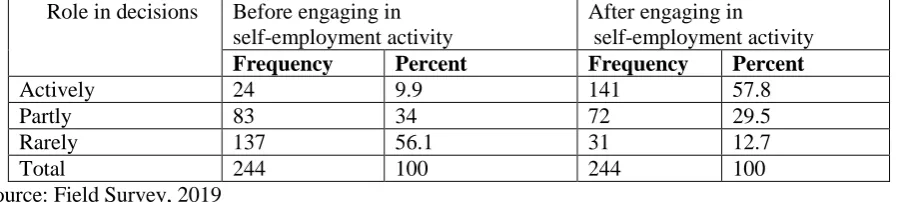
Table 4.4. Respondents’ participation in house hold decision making before and after engaging in self-employment activity
Role in decisions Before engaging in self-employment activity
After engaging in
self-employment activity
Frequency Percent Frequency Percent
Actively 24 9.9 141 57.8
Partly 83 34 72 29.5
Rarely 137 56.1 31 12.7
Regarding respondents’ participation in household decision making before engaging in self-employment activities, the above table no.4.4 is depicting respondents’ participation levels. It is evident from the table that from the total of 244 respondents, the majority 137 respondents, which accounts 56.1 percent were rarely participating in the decision making at the household level. 83 respondents with 34 percent were partly practicing in the decision-making; the remaining 24 respondents, which account 9.9 percent were actively participating in household decision making before engaging in self-employment.
This indicates that most of the women before engaging in self- employment activities were not participating actively in the decision-making at the household level. The same table no. 4.4 also represents the respondents’ participation in household decision making after engaging in self-employment activities. It is evident from the table that from the total of 244 respondents the majority 141 respondents, which account 57.8 percent are participating in decision making actively. Followed by 72 respondents with 29.5 percent are practicing partly, while the 31 respondents i.e. 12.7 percent rarely participating in household decision making after engaged in self-employment.
From the above analysis it is understood that women are actively participating in the household decision making after having their presence in various self-employment activities. It is clearly evident that the participation of women in the self-employment activities greatly enhances their decision making power. This economic change forward the way for the women for better interaction with their community and decision making.
Table 4.5 Source of start-up funding
Source Frequency Percent
Personal saving - -
Household - -
From money lenders 17 7
Microfinance institutions 126 51.6 Assistant from friends/relatives - -
In heritance - -
Assistant from NGO’s 101 41.4
Total 244 100
Source: Field Survey, 2019
The table above 4.5 shows that of the 244 total respondents, majority of the respondents 126 i.e. 51.6 percent of the self-employers use microfinance institutions as their main source of start-up funding. It is also evident that 101 respondents i.e. 41.4 percent use NGO’s as the main source of start-up funding in financing their self-employment activities. The remaining 17 respondents i.e. 7 percent self-employers use money lenders as their source of starting-up their activities to mobilize funds. However, it is found that no women self-employers use personal saving, household, lenders, friends/ relatives and inheritance as a source of financing their self-employment because there is a chance to borrowing money from micro finance and projects that help women in the area who are voluntary to participate in different self-employment activities in group or associations. These NGOs like, AGP in the area.
From the above bar chart no.4.2 it is understood that there are several hindrances that are being faced by the self-employers during money borrowing from microfinance institutions/MFIs. Of the total 244 respondents majority of 101 respondents i.e. 41.39 percent of them complained about high interest rates, too small loan size and the repayment policy. And 44 respondents i.e. 18.03 percent perceived problematic group dynamics. Next to those, 31 respondents i.e. 12.7 percent faced the repayment policy constraints. The remaining respondents 11 and 10 i.e. 4.5 percent and 4.09 percent perceived to small loan amount and the problems are unknown.
Table 4.6 Renovation of house
Renovation of house Frequency Percent Better before joining self-employment 86 35 Better after joining self-employment 158 65
Total 244 100
Source: Field Survey, 2019
The above table no 4.6, indicates that of the total 244 respondents, 158 participants i.e. 65 percent said that the renovation of house is better after the women joining self-employment activities while 86 participants, who account 35 percent said that the renovation of house was better before the women joining self-employment activity. The respondents explained that after joining self-employment activities, they have better income and their attitude to improving their house has increased. This confirms that the majority of the participants were economically advanced.
Table 4.7 Buying house hold materials
Buying household materials Frequency Percent Better before joining self-employment 53 22 Better after joining self-employment 191 78
Total 244 100
Source: Field Survey, 2019
From the table no 4.7 above, it explained that, out of the total 244 respondents, 191 participants i.e. 78 percent said that buying household materials are better after the women joining self-employment activities while 53 participants, who account 22 percent, said that buying of household materials were better before the women joining self-employment activities. The respondents explained that they are generating better income which helped them to buy materials like television, desks, tables and others after joining self-employment activities.
This further confirmed by the researcher during field observation, few women who are participating in self-employment activities in the study area particularly in Laska Simba, Laska Bakala and Sassa Makessa kebeles those accessed by electricity have bought televisions and other materials.
4.3 Constraints for women self-employer’s performance in the self-employment activities: Table 4.8 Economic constraints for the performance of women self-employers
No. Item Mean Standard
Deviation
Rank of of Severity
1 Economic Constraints
1.1 You are satisfied with the financial access provided by the micro finance institutions and other lending sources
2.8 1.21 4th
1.2 Access to market for your products and services 2.41 1.19 2nd
1.3 Access to information to exploit self-employment opportunities
2.65 1.31 3rd
1.4 There is stiff competitions in the market place in that you engaged the activity
2.95 1.63 5th
1.5 You have access to necessary inputs(raw materials) 2.21 1.36 1st
Source: Field Survey, 2019
suppliers of finance for women self-employers in self-employment activities. However, the table 4.19 shows that women self-employers in self-employment activities neither satisfied nor dissatisfied with the financial access given by microfinance institutions and other lending sources. It shows that a mean score of (2.8) with a standard deviation of (1.21). Therefore, the average score of the respondents with regard to the satisfaction levels by the access to various financial services is ‘undecided’ with little deviations among them.
Table 4.9 Social constraints that affect women self-employers
No. Item Mean Standard
Deviation
Rank of of Severity 1 Social Constraints
1.1 You have a better social acceptability 3.51 1.39 5th
1.2 You have no prejudice or class biases 2.47 1.32 3rd
1.3 The societies positive attitude towards your products/services
3.00 1.39 4th
1.4 You have a positive relationship with the workforce/ group members
3.60 1.31 6th
1.5 You were not affected by gender inequalities 2.40 1.34 1st
1.6 You have no cultural influences 2.43 1.28 2nd
Source: Field Survey, 2019
From the above table no. 4.9 it is understood that the mean scores (2.40) and standard deviation of (1.34) the women disagree that they have not affected by the gender inequalities. It indicates that the gender inequality is the first major constraint in social issues of the respondents. The majority of the respondents agree on the issue of gender inequalities. This constrains takes the lion share and which is severe problem in the study area. This indicates the actions taken by concerned bodies and the constraints of gender inequalities are mismatching. The second major constraint is cultural influence. The respondents disagree mean (2.43) and with a standard deviation of (1.28) for cultural influences. This shows that till now cultural domination is not totally removed. Respondents disagree on the issues no prejudice or class biases mean of (2.47) and standard deviation of (1.32). From this result the women in the study area have been facing prejudice or class biases. However, contrarily mean of (3.00) and standard deviation of (1.39) with regard to the attitude of the society towards their products/services, the respondents neither agree nor disagree on the idea that the attitude of the society is positive. The attitude of the societies on regard of women’s activities is the fourth major constraint. They do agree on the idea that they have a better social acceptance. The mean (3.51) and standard deviation (1.39) of the respondents show that women have better social acceptability. Besides, through the mean of (3.60) and standard deviation of (1.31), the respondents agree in relation to the attitude of other group members towards their self-employment activities. These self-employers have a positive relationship with their group members. In addition, the attitude of the group members towards the self-employment activities is the same.
Table. 4.10 Institutional Constraints that affect the performance of women Self-employers
No. Item Mean Standard
Deviation
Rank of Severity 1 Institutional Constraints
1.1 You have self-employment activity assistants and supporters from government bodies
2.33 1.28 2nd
1.2 You have a network with different administrative bodies
2.23 1.32 1st
1.3 You have not faced institutional and policy constraints
3.12 1.44 3rd
1.4 You were beneficiary of government
incentives (training, financial and raw materials)
3.40 1.39 4th
Source: Field Survey, 2019
constraints of assistants and supporters from government bodies. The mean of 2.33 and standard deviation of 1.28, the respondent women self-employers in self-employment activities have disagree on the assistants and supports from government bodies. With the means of 3.12 and standard deviations of 1.44, the respondents are undecided with the existence of institutional and policy constraints because most of the self-employed women got support from the government directly and indirectly. Due to this reason, they fear to explain the existing policy constraints freely. Similarly, the respondents neither agree nor disagree the means of 3.4 and standard deviations of 1.39 with regard to the beneficiary of government incentives.
As this study shows, most of the women self-employers in the study area are engaged in the agricultural activities. Self-employers are organized under groups and cooperatives. They use microfinance institutions as the main sources of funding. This shows that agricultural activity is the predominant activity in the rural areas. It is expanding at an alarming rate and opens an opportunity for rural women to generate income for their household. Besides this, the openings of microfinance institutions allow women to be organized under groups and cooperatives for the purpose of acquiring finance even without collaterals. Groups and cooperatives give these self-employers an opportunity of sharing skills, knowledge and experiences.
In addition, women in the rural area particularly self-employed women are moving forward in terms of sharing their ideas and information pertaining to various social and economic issues at the village level. They are becoming influential in aspects of decision making on women issues. Furthermore, they are becoming leading ones in kebele administrations like women association, league and women federation president positions. The constraints identified in this research shows that all concerned bodies are not doing what is expected of them. It is not from one organization, but the concerning bodies like Women and Children’s Affairs, Women League and Federations, Omo Micro Finance Institution, Agriculture and Natural Resource Development Office and others to have jointly work on the employment of women in the study area. All stakeholders have collective responsibility in bringing women self-employers in as active participant in their respective self-employment activities and for their betterments in economic, social and political spheres.
5. CONCLUSION:
There is an inaccessibility of multi loan chances as the role of microfinance institutions (MFIs) vis-à-vis promotion of self-employment activities for women. In addition, the loans are given for organized groups than individuals and this created another problem like burden for those members for repayment of loan in the case of dropout group members. The government is striving for the better empowerment of women but has numerous drawbacks. Such as deployment of women empowerment experts like others as health, agriculture and omo agents are absent at kebele level and the awareness creation for women is low in the area. Women self-employment activities are becoming an important area of emphasis in Basketo Special Woreda primarily for its great potentials as a source of income generation. However, there are a number of constraints that affect their performance. Even though social constraints are minimizing in the study area, institutional and economic challenges are still tremendous. This can be associated with the effects of globalization that may create intense competitions in the market and poor performances for those self-employed women that cannot easily cope up with changes. With poor human capital has the least chance to development. In this regard, training centers, disciplined and quality workforce can’t easily accessed for self-employment activities to be active in the study area. The production of trained workforce is very important than the production of goods and services. Whatever is produced in the economy to be competitive both in the domestic and international markets, depends on the quality of the productive workforce the country has. The empowerment of women is necessitated because of the fact that women are generally more vulnerable to poverty and it is a basic condition for development. It is also fundamental to bring about changes in areas such as finance, health and education in the family and the society at large. The delivery of self-employment activities is one of the best alternatives to the empowerment of women.
REFERENCES:
1. Bateman, Milford (2010) Why Does not Microfinance Work? The Destructive Rise of Local Neoliberalism. London: Zed Books.
2. Cal J. Halverson (2016). Work, Aging and Retirement, George Warren Brown School of social Work ,Washington University in St. Louis,313-324.
3. Campbell, Gregor (2010): Micro financing in the Developing World: How Small loans Empower Local Economies and Catalyse Neoliberalism's End Game. Third World Quarterly, 31(7), pp. 1081-1090.
5. Fields, G. S. (2014). Self-Employment and Poverty in Developing Countries. USA and IZA Germany: Corne II University.
6. Harper, Malcolm. (1996). Empowerment Through Enterprise. A training manual for non-government
organization Intermediate Technology . London: SAGE Publications Ltd.
7. Harper, Malcolm (2003). Microfinance: Evolution, Achievements and Challenges. New Delhi: Samskriti Publications.
8. Heemskerk, M. (2003). Self-Employment and Poverty Alleviation: Women’s Work Artisanal Gold Mines. In M. Heemskerk, Self-Employment and Poverty Alleviation: Women’s Work Artisanal Gold Mines (pp.145-156). USA: Human Organization.
9. Jemi Klugman Fellow and Sarah Twigg. (2015). Women and Public Policy Program. Consultant IFC Working Paper, 38.
10. Mayoux, L. (2000). Micro finance and the empowerment of women: A review of the key Issues. Geneva: Social Finance Working Paper:ILo.
11. Mayoux, L. (2001) ‘Microfinance Impacts in Enterprise’, Impact News, l (3), pp. 2-4.
12. Mehra, R. (1997): Women, Empowerment, and Economic Development. Annals of the American Academy of
Political and Social Sciece, pp.138-149.
13. Narayan, D. (2002). Empowerment and Poverty Reduction:A Source Book, The Bank for Reconstrucation and Development, 323.
14. Nosheen, I. (2009): The determinants of women empowerment in Southern Punjab(Pakistan). Anempirical Analysis. European Journal of Social Sciences, pp.216-229.
15. Nussbaum, M. C. (2000). Women and Human Development: The capacities Approach. New Delhi: Kali for Women.
16. Sen, Amartya (2000) Development as Freedom. New Delhi: Oxford University Press.
17. Tesfay, H. (2003). The impact of Microfinance on poor women: A case study of Dedebit Credit and Saving Institution (DECSI) in the Eastern Zone of Tigray, Ethopia .
18. Yamane, T. (1967). Statistics: An Introductory Analysis, 2nd Ed. New York: USARC.