Effect of self-reported home smoking
restriction on smoking initiation among
adolescents in Taiwan: a prospective
cohort study
Dih-Ling Luh,1,2Hsiu-Hsi Chen,3Amy Ming-Fang Yen,4Ting-Ting Wang,4 Sherry Yueh-Hsia Chiu,5Ching-Yuan Fann,6Sam Li-Sheng Chen4
To cite:Luh D-L, Chen H-H, Yen AM-F,et al. Effect of self-reported home smoking restriction on smoking initiation among adolescents in Taiwan: a prospective cohort study.BMJ Open 2015;5:e007025.
doi:10.1136/bmjopen-2014-007025
▸ Prepublication history for this paper is available online. To view these files please visit the journal online (http://dx.doi.org/10.1136/ bmjopen-2014-007025).
Received 29 October 2014 Revised 12 March 2015 Accepted 20 March 2015
For numbered affiliations see end of article.
Correspondence to Dih-Ling Luh; [email protected]
ABSTRACT
Objective:The aims of this study were to investigate the influence of home smoking restriction (HSR) and the modified effect of parental smoking on smoking initiation among adolescents.
Design:Prospective Cohort Study.
Setting:Junior high school in Keelung City, Taiwan. Participants:This study collected and evaluated primary data from the Adolescent Smoking and Other Health-Related Behaviour Survey conducted in Keelung City, which aimed to investigate smoking and health-related behaviours in junior high school students
(2008–2009). Data on students free of smoking in 2008
and following them until 2009 (n=901) to ascertain whether they had started smoking were analysed with logistic regression mode to examine the proposed postulates.
Main outcome measure:The outcome variable was smoking initiation, which was defined as smoking status (yes/no) in the 2009 follow-up questionnaire. The main independent variable was HSR obtained from an adolescent self-reported questionnaire. Information on parental smoking was measured by adolescents self-reporting the smoking behaviour of their father and mother.
Results:The rate of HSR was 29.79% among 7th grade adolescents. The effect of HSR on smoking initiation in adolescents was statistically significantly modified by paternal smoking (p=0.04) but not by maternal smoking (p=0.54). The effect of HSR on smoking initiation was small for fathers with the habit of smoking (OR=0.89, 95% CI (0.42 to 1.88)), but the corresponding effect size was 3.2-fold (OR=2.84, 95% CI 1.19 to 6.81) for fathers without the habit of smoking.
Conclusions:Paternal smoking behaviour may play an interactive role with HSR in preventing smoking initiation among Taiwanese adolescents.
INTRODUCTION
An important objective of health agencies worldwide is to protect children from passive smoking that results from family
members smoking in the home.1 Thus, the
promotion of home-based non-smoking
policies is the key to tobacco control pro-grammes because it not only reduces a child’s exposure to secondhand smoke but also increases smoking cessation rates.2
However, very few Asian countries have reported similar estimates. The National Health Interview Survey (NHIS) of over 20 000 Taiwanese in 2001 showed that the prevalence of exposure to environmental tobacco smoke at home (excluding smokers but including occasional exposure) in adoles-cents aged between 12 and 17 years was 43% and 42.4% for boys and girls, respectively, and that the prevalence of exposure to envir-onmental tobacco smoke at home was higher in adolescents than in adults.3
The prevalence of smoke-free homes varies but has been increasing over time in coun-tries worldwide.2 The prevalence of a strict ban on smoking in the home has increased from 58.1% in 1995 to 83.8% in 2007 in the
Strengths and limitations of this study
▪ The effect of home smoking restriction (HSR) on
adolescent smoking initiation was modified by paternal smoking but not maternal smoking using in a prospective cohort study. If parental behaviour is inconsistent with the regulation, its control will be ineffective.
▪ If parental behaviour is inconsistent with the
reg-ulations, this control will be ineffective.
▪ In addition to the small sample size that may
affect the failure to control for other confounding or to identify other effect modifiers, since the samples were derived from a local city in Taiwan, the results may not be generalised to the whole adolescent population in Taiwan.
▪ The measurement of HSR and parental smoking
were self-reported by the adolescents in the questionnaire.
on September 22, 2020 by guest. Protected by copyright.
USA.4 Home smoking restriction (HSR) among US households with children and smokers approximately increased fourfold from 14.1% in 1992/1993 to 50% in 2006/2007.5 In Finland, 58% of 12–18-year-old adoles-cents reported a stark ban non-smoking in their homes.6 Several cross-sectional studies found that HSR may reduce teenage smoking,7 the likelihood of trying tobacco,8 9and becoming an ever smoker.10 Conversely, a partial ban or the lack of a ban increased the likeli-hood of being a daily smoker among 12-18-year-olds.6
More often than not, parents in most families play a major role in decision-making for their household and set behavioural examples. In Taiwan, Wenet al11 showed that parental influence was more important than peer influence using a cross-sectional representative sample of 44 976 high school students in 1995. Nonetheless, results regarding the effects of parental smoking on HSR and child smoking were discordant. Some research-ers have found that HSR reduces the risk of children becoming smokers, even after controlling for parental smoking status.6 8 12Some studies found that adolescent smoking was inversely related to the presence of a restrictive household policy, but the association was atte-nuated when parental smoking was considered in the model.13 Proescholdbell’s study showed that although restrictive home smoking policies were associated with a lower likelihood of trying smoking for both middle and high school students, the relation was restricted to homes with non-smoking parents for high school stu-dents.8A prospective cohort study, using environmental tobacco smoke exposure at home but not HSR as an indicator, found that higher exposure to secondhand smoke at home predicted the smoking initiation of young Chinese children, independent of parental smoking status.14 However, the effect of HSR on smoking among adolescents has not yet been elucidated using a prospective cohort study.
Seventh graders were in the transforming period from primary school to junior middle school. They are sensi-tive to behaviour change and may try smoking to join in a new group and be identified by the others.15–17 It is therefore imperative to understand the effect of HSR on adolescent smoking behaviour.
Generally speaking, though most studies have shown an association between HSR and reduced adolescent smoking behaviours,18it is worthwhile to further investi-gate a novel postulate regarding the interaction between parental smoking and HSR in association with in a pro-spective cohort study. By collecting 1-year follow-up school-based data from Taiwanese adolescents, the pur-poses of this study were: (1) to describe the rate of HSR and who implemented HSR in the families of seventh graders; (2) to describe the relations between parental smoking and HSR among seventh graders; (3) to assess the effect of HSR on smoking initiation among seventh grade never smokers; and (4) to assess the modified effect of parental smoking on the relation between HSR and adolescent smoking initiation.
METHODS
Study design and participants
An adolescent cohort study entitled as ‘Adolescent smoking and related behaviour survey’was conducted by Keelung City Health Bureau and Chung-Shang Medical University in 2008 based on study participants enrolled from the first-year (seventh grade) students of junior high school. There are 18 junior high schools, 495 classes and 16 439 students in Keelung City. We used a simple random sampling method to choose 73 classes of seventh graders with 2446 students. Of 2446 students enrolled in 2008, 1723 responded to the questionnaire (a 70.44% response rate). To describe the rate of HSR in seventh grade students, we used the data of 1723 seventh grade students. Using the same procedures, a follow-up survey was conducted in October of 2009. Among the 1723 respondents in 2008, 1017 students provided informed consent and participated in the second questionnaire (the follow-up rate was 59.02%). To assess the effect of HSR on the initiation of smoking, we used the data of 1017 students in eighth grade. After excluding 57 ever smokers at baseline and 59 students who did not provide their smoking status, the remaining 901 without smoking in 2008 were followed in 2009 to ascertain the status of smoking.
The reasons for not participating included lack of par-ental or individual consent and absence from school on the day of the survey in 2008. Since we had no informa-tion on the smoking behaviour of their parents and other factors from the students who did not participate, we were unable to assess whether there were differences between those students who responded and those who did not.
In 2009, as H1N1 (Influenza A virus subtype H1N1) was rampant in Taiwan, there were more students who were absent from class due to the epidemic. The reasons for non-response included lack of consent from the parents and, to a large extent, absence from class due to sickness and, to a lesser extent, the refusal from students them-selves. However, there were no differences between the followed-up students (n=1017) and those lost-to-follow-up (n=706) with respect to most variables including smoking behaviour (χ2(df=1) =3.08, p=0.0795), sex (χ2(df=1)=0.0006,
p=0.9800), single family (χ2(df=1)=0.70, p=0.4034), highest
parental education (χ2(df=2)=3.57, p=0.1675), paternal
smoking (χ2(df=1)=0.02, p=0.8908), maternal smoking
(χ2(df=1)=2.17, p=0.1404), and intention to smoke in the
future (χ2(df=1)=0.13, p=0.7177). Only having a best friend
who smoked was significantly different between the two groups (χ2(df=1)=4.59, p=0.0322), with higher rates of
having a best friend that smoked (11.31%) among those who were lost to follow-up than those who were followed for the entire study (8.17%).
Data collection
This study utilised a self-administered questionnaire to collect data, which were taken by the students them-selves in the classroom. In 2008, the data collection
on September 22, 2020 by guest. Protected by copyright.
procedures included three steps. First, we contacted the school administrators and teachers. The second step was to obtain consent from the students and their parents. All students who provided parental and individual informed consent were included in the study. Finally, trained interviewers collected data from the classes after explaining the purpose of the study and reiterating the ethical issues associated with this research.
Measurement of variables
The independent variable was smoking initiation that was measured by asking students who had never smoked at 2008, of the question- “Have you ever smoked or made attempt to smoke cigarette”—and with a binary answer (yes/no) at the 2009 follow-up.
All independent variables were collected from the base-line questionnaire at the entry of study in 2008. The main independent variable, HSR, was based on students’ self-reported information on whether the definite inhibition of smoking at home or not was stipulated and implemen-ted. Parental smoking behaviour was also reported by stu-dents in a similar manner with the question “Did your father/mother smoke in the preceding year?”
Furthermore, we collected information about the person who made the decision about HSR in a multiple selection question. Then we organised the data into four categories as follows: father only, mother only, both father and mother and collective decision made by parents and other members (such as grandparents).
Additional explanatory variables included in the following regression model, which were also collected from the 2008 baseline questionnaire, included sex (boy/girl), highest parental education ( junior high school/senior high school/college or university), having a best friend who smoked (yes/no), and intention to smoke in the future (yes/no). The latter two variables were measured by asking the two questions: “Did your best friend have smoked?” and “Have you ever consid-ered making attempt at smoking?”
The contents validity of the questionnaire was based on the literature and was assessed by an expert commit-tee panel.
Statistical analysis
Frequency and percentage were used to describe the dis-tribution of HSR and smoking initiation stratified by par-ental smoking behaviour. We used χ2 tests to examine the differences between HSR and smoking initiation. We then applied a Breslow-Day homogeneity test to assess whether the relations between HSR and smoking initi-ation were modified by parental smoking behaviours. Finally, the logistic regression model was adopted to esti-mate the effect of HSR on smoking initiation and to assess the interaction between parental smoking and HSR behaviours in association with smoking initiation after adjusting for other extraneous variables.
In the multivariable logistic regression analysis, we used the missing indicator method to take missing
values into account to justify the comparison of different models, particularly when a multivariable regression model was conducted. The majority of variables with missing data are less than 5% except intention to smoke in the future (missing rate=6.1%). It would not affect the results if data analysis is performed with missing completely at random (MCAR) assumption.
A significance level of 5% was set for assessing statistical significance. All analyses were conducted using SAS V.9.2.
RESULTS
The rate of HSR and the frequencies of correlates associated with HSR
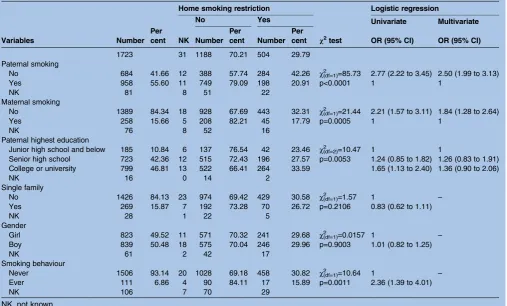
Among the 1723 seventh grade students, the rate of self-reported HSR was 29.8%. The distributions of the factors associated with HSR are specified in table 1. In the simple logistic regression model, paternal smoking, maternal smoking and highest level of parental educa-tion were significantly related to HSR. In the multivari-ate model, after adjusting for paternal smoking, maternal smoking and highest level of parental educa-tion, the rates of HSR among households with paternal and maternal smokers were 2.50 and 1.84 times higher than those without parental smoking, respectively.
The impact of HSR and PSB on smoking initiation
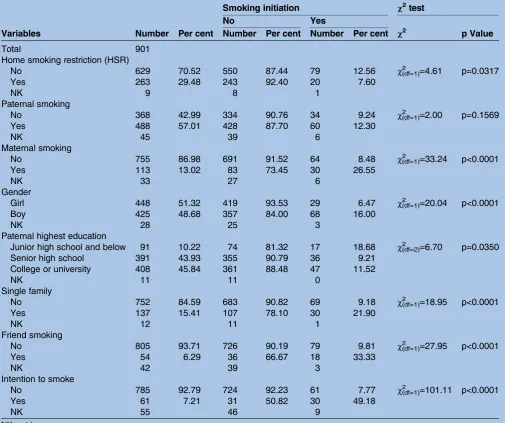
The relations between HSR or PSB and smoking initi-ation are shown in table 2. Of the 901 adolescents who were non-smokers at baseline (2008), frequencies (11.1%) who may start smoking during the first year of follow-up (during theseventh grade) were ascertained at the second survey in 2009.
Smoking initiation rates were 12.6% for non-HSR house-holds and 7.6% for HSR househouse-holds. Adolescents who lived in homes without HSR were 1.75 times (95% CI (1.04 to 2.92)) more likely to initiate smoking compared to those with HSR (χ2(df=1)=4.61, p=0.03).
Smoking-initiating rates were 26.55% for children of mothers who smoked and 8.48% for children of mothers who did not smoke. This difference was highly statistically significant (χ2(df=1)=33.24, p<0.001). Children of mothers who smoked
were four times (OR=3.98, 95% CI (2.44 to 6.51)) more likely to initiate smoking than children of mothers who did not smoke. In contrast, the father’s smoking behaviour was not associated with smoking initiation (χ2(df=1)=2.0,
p=0.16).
The proportion of households with an HSR (n=504) categorised by the decisionmaker was as follows: 11.90% father only, 27.78% mother only, 11.51% both father and mother, 39.09% collective decision including parents and 9.72% collective decision excluding parents. Among the 504 households, 272 never smoker house-holds were followed to analyse the relationships between the decisionmaker of the HSR and adolescent-smoking initiation. There was an insignificant relationship between the decision-maker of the HSR and smoking initiation (χ2(df=4)=0.69, p=0.9530).
on September 22, 2020 by guest. Protected by copyright.
The effect modification of PSB
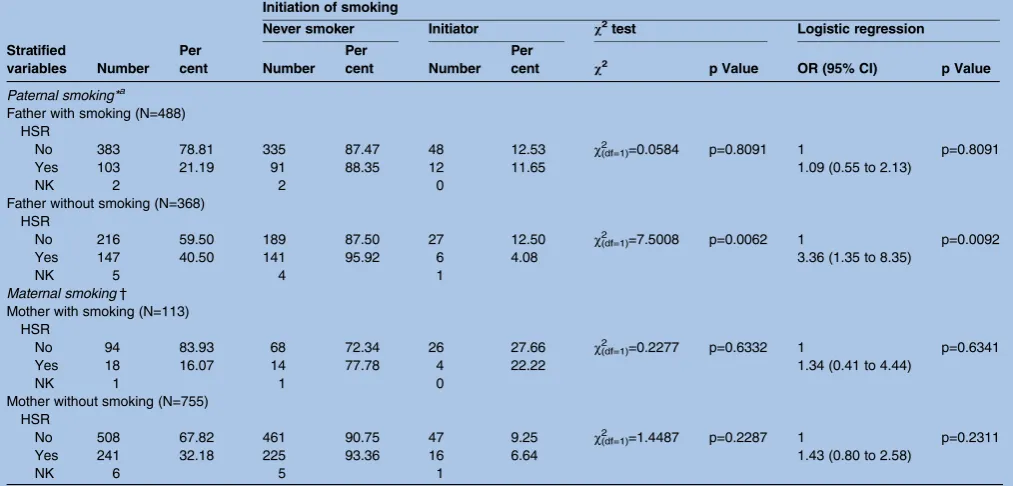
Whether PSB modified the effect of HSR on smoking initiation in adolescents is specified in table 3 by the stratification of PSB with the application of the Breslow-Day homogeneity test across the estimated ORs. The influence of HSR on smoking initiation was
modi-fied by the father’s smoking habits (χ2(df=1)=3.94,
p=0.05), but not by the mother’s smoking habits (χ2(df=1)=0.01, p=0.92).
The effect of HSR on smoking initiation among the stratum of parental smoking was small (OR=1.09, 95% CI (0.55 to 2.13),χ2(df=1)=0.06, p=0.81), but smoking
initi-ation was 3.36 times (95% CI 1.35 to 8.35) higher in adolescents who lived without HSR as compared to those who lived with HSR among that of fathers without smoking. This result shows that paternal smoking
modi-fied the effect of HSR on smoking initiation. This inter-action effect was also confirmed by the likelihood test (χ2=3.98, p=0.0460).
The relationship between smoking initiation and other extraneous variables is shown in table 3. Being male, having a parent who only completed junior high school, being from a single-parent family, having a best friend who smoked and having an intention to smoke in the future indicated a greater likelihood of smoking than being a girl, having a parent who completed college/university education, not being from a single-parent family, having a non-smoking best friend and having no intention of smoking in the future. These
variables were controlled in the following multivariable logistic regression models.
The results of the multiple logistic regressions
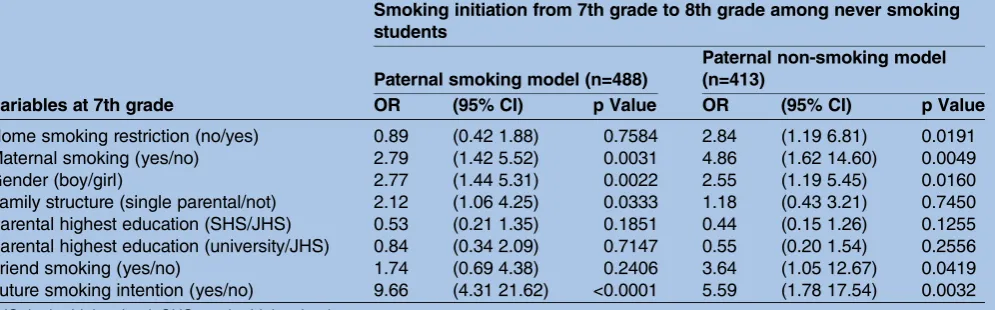
con-firmed such a significant interaction between paternal smoking and HSR (as shown by model 1 in table 4) after adjusting for other extraneous variables, but such an interaction was not observed for maternal smoking and HSR (as shown in model 2 of table 4). HSR was a statistically significant influence on smoking initiation among those whose fathers did not smoke (as shown in the paternal non-smoking model in table 5), but this effect was not present among those whose fathers smoke (as shown by the paternal smoking model in table 5), consistent with the results shown in table 3. Among those whose fathers did not smoke, adolescents in fam-ilies without HSR were more likely to begin smoking than those who lived in HSR families (OR=2.84, 95% CI 1.19 to 6.81).
DISCUSSION
On the basis of the junior high school longitudinal follow-up data, the overall proportion of HSR was 29.79% among seventh grade adolescents. Our results found that it may be the presence of smoking bans in homes with non-smoking fathers that has a protective effect on smoking initiation. We also confirmed a signifi -cant effect of smoking bans in homes on the initiation of smoking in adolescents after controlling for other
Table 1 Distribution and logistic regression results of parental smoking on home smoking restriction. (n=1723)
Variables Number
Per cent
Home smoking restriction
χ2
test
Logistic regression
No Yes Univariate Multivariate
NK Number Per
cent Number Per
cent OR (95% CI) OR (95% CI)
1723 31 1188 70.21 504 29.79
Paternal smoking
No 684 41.66 12 388 57.74 284 42.26 χ2
(df=1)=85.73 2.77 (2.22 to 3.45) 2.50 (1.99 to 3.13)
Yes 958 55.60 11 749 79.09 198 20.91 p<0.0001 1 1
NK 81 8 51 22
Maternal smoking
No 1389 84.34 18 928 67.69 443 32.31 χ2
(df=1)=21.44 2.21 (1.57 to 3.11) 1.84 (1.28 to 2.64)
Yes 258 15.66 5 208 82.21 45 17.79 p=0.0005 1 1
NK 76 8 52 16
Paternal highest education
Junior high school and below 185 10.84 6 137 76.54 42 23.46 χ2
(df=2)=10.47 1 1
Senior high school 723 42.36 12 515 72.43 196 27.57 p=0.0053 1.24 (0.85 to 1.82) 1.26 (0.83 to 1.91) College or university 799 46.81 13 522 66.41 264 33.59 1.65 (1.13 to 2.40) 1.36 (0.90 to 2.06)
NK 16 0 14 2
Single family
No 1426 84.13 23 974 69.42 429 30.58 χ2
(df=1)=1.57 1 –
Yes 269 15.87 7 192 73.28 70 26.72 p=0.2106 0.83 (0.62 to 1.11)
NK 28 1 22 5
Gender
Girl 823 49.52 11 571 70.32 241 29.68 χ2
(df=1)=0.0157 1 –
Boy 839 50.48 18 575 70.04 246 29.96 p=0.9003 1.01 (0.82 to 1.25)
NK 61 2 42 17
Smoking behaviour
Never 1506 93.14 20 1028 69.18 458 30.82 χ2
(df=1)=10.64 1 –
Ever 111 6.86 4 90 84.11 17 15.89 p=0.0011 2.36 (1.39 to 4.01)
NK 106 7 70 29
NK, not known.
on September 22, 2020 by guest. Protected by copyright.
possible causative factors in Taiwanese adolescents. The most novelfinding of our study is that the effect of HSR on the start of smoking is modified by parental smoking (eg, the interaction between parental smoking and HSR). Accordingly, by stratifying paternal smoking habits, the effect of HSR on the start of smoking was stat-istically significant in the absence of paternal smoking, but not in the presence of paternal smoking. However, this effect modification was not noted for maternal smoking.
In spite of several previous relevant studies, the effect of HSR on the initiation of smoking among adolescents has not yet been studied using longitudinal follow-up studies in Taiwan. Therefore, the first aim of this study was to determine the prevalence of HSR. Our study found that the rate of HSR was 29.79% (95% CI 27.59 to 31.99) among the families of seventh junior high school adolescents. In general, the total rate of smoke-free homes varies from country to country.
In addition to the disparity in the rate of HSR that varies from country to country, the effect of HSR on ado-lescent smoking has also been inconsistent among previ-ous studies. Many studies have shown that HSR affects adolescent smoking initiation,19daily smoking6or experi-mental smoking,6 8 9 even after adjusting for parental smoking. However, other studies have shown that HSR has no significant effects on current adolescent smoking behaviour after adjustment for parental smoking.8 9 13
From the perspective of social behaviour science, HSR affects adolescent smoking initiation in several ways. First, HSR builds a smoke-free supportive physical environment9 12 that provides a smoke-free subjective norm and attitude19 and exerts parental control over adolescents.20 Second, the adoption of HSR may have spillover effects, which are supported by the fact that forbidding smoking indoors is associated with having fewer peers who smoke. This spillover effect offers some preliminary ideas regarding why home indoor
Table 2 Distribution of main variables according to smoking initiation. (n=901)
Variables Number Per cent
Smoking initiation χ2test
No Yes
Number Per cent Number Per cent χ2 p Value
Total 901
Home smoking restriction (HSR)
No 629 70.52 550 87.44 79 12.56 χ2(df=1)=4.61 p=0.0317
Yes 263 29.48 243 92.40 20 7.60
NK 9 8 1
Paternal smoking
No 368 42.99 334 90.76 34 9.24 χ2(df=1)=2.00 p=0.1569
Yes 488 57.01 428 87.70 60 12.30
NK 45 39 6
Maternal smoking
No 755 86.98 691 91.52 64 8.48 χ2(df=1)=33.24 p<0.0001
Yes 113 13.02 83 73.45 30 26.55
NK 33 27 6
Gender
Girl 448 51.32 419 93.53 29 6.47 χ2(df=1)=20.04 p<0.0001
Boy 425 48.68 357 84.00 68 16.00
NK 28 25 3
Paternal highest education
Junior high school and below 91 10.22 74 81.32 17 18.68 χ2(df=2)=6.70 p=0.0350
Senior high school 391 43.93 355 90.79 36 9.21
College or university 408 45.84 361 88.48 47 11.52
NK 11 11 0
Single family
No 752 84.59 683 90.82 69 9.18 χ2
(df=1)=18.95 p<0.0001
Yes 137 15.41 107 78.10 30 21.90
NK 12 11 1
Friend smoking
No 805 93.71 726 90.19 79 9.81 χ2
(df=1)=27.95 p<0.0001
Yes 54 6.29 36 66.67 18 33.33
NK 42 39 3
Intention to smoke
No 785 92.79 724 92.23 61 7.77 χ2
(df=1)=101.11 p<0.0001
Yes 61 7.21 31 50.82 30 49.18
NK 55 46 9
NK, not known.
on September 22, 2020 by guest. Protected by copyright.
smoking restrictions reduce adolescent smoking.21 In general, HSR may represent a contextual factor of a family bond that precludes adolescents and family members from smoking. A previous study conducted on ninth grade students in Taiwan found that strong family relations could be a protective factor against sub-stance use (including smoking).22 HSR may also repre-sent one of the strategies for monitoring the health behaviour of adolescents to prevent them from develop-ing unhealthy behaviours.23 The strongest effect on youth smoking is parental smoking and the role of
home smoking bans seems to be modified by paternal smoking. This finding may account for the fact why some studies found an effect and others did not, as the interaction between parental smoking and HSR was not considered.
On the basis of thesefindings, it is necessary to identify significant correlates (including parental smoking and other significant factors) that account for the underlying contextual factors in relation to HSR strategies.
The effect of HSR on adolescent smoking initiation has been thought to be confounded by other factors.
Table 3 The effect of smoking ban at home and initiation of smoking among eighth grade students stratified by parental smoking behaviour. (N=901)
Stratified
variables Number Per cent
Initiation of smoking
Never smoker Initiator χ2test Logistic regression
Number Per
cent Number Per
cent χ2 p Value OR (95% CI) p Value
Paternal smoking*a
Father with smoking (N=488) HSR
No 383 78.81 335 87.47 48 12.53 χ2
(df=1)=0.0584 p=0.8091 1 p=0.8091
Yes 103 21.19 91 88.35 12 11.65 1.09 (0.55 to 2.13)
NK 2 2 0
Father without smoking (N=368) HSR
No 216 59.50 189 87.50 27 12.50 χ2(df=1)=7.5008 p=0.0062 1 p=0.0092
Yes 147 40.50 141 95.92 6 4.08 3.36 (1.35 to 8.35)
NK 5 4 1
Maternal smoking†
Mother with smoking (N=113) HSR
No 94 83.93 68 72.34 26 27.66 χ2
(df=1)=0.2277 p=0.6332 1 p=0.6341
Yes 18 16.07 14 77.78 4 22.22 1.34 (0.41 to 4.44)
NK 1 1 0
Mother without smoking (N=755) HSR
No 508 67.82 461 90.75 47 9.25 χ2
(df=1)=1.4487 p=0.2287 1 p=0.2311
Yes 241 32.18 225 93.36 16 6.64 1.43 (0.80 to 2.58)
NK 6 5 1
*Breslow-Day test for homogeneity of the ORs on paternal smoking,χ2(df=1)=3.9404, p=0.0471.
†Breslow-Day test for homogeneity of the ORs on maternal smoking,χ2(df=1)=0.0102, p=0.9195. HSR, home smoking restriction; NK, not known.
Table 4 The effect of home smoking restriction on smoking initiation among junior high school students in Taiwan—logistic regression analysis results (n=901)
Variables at 7th grade
Smoking initiation from 7th grade to 8th grade among never smoking students
Model 1 Model 2
Coefficient (SE) p Value Coefficient (SE) p Value
Home smoking restriction (no/yes) 1.06 (0.44) 0.0160 0.36 (0.31) 0.2507
Paternal smoking (yes/no) −0.40 (0.28) 0.1470 −0.13 (0.25) 0.6028
Maternal smoking (yes/no) 1.18 (0.29) <0.0001 1.24 (0.32) <0.0001
Gender (boy/girl) 1.02 (0.25) <0.0001 1.04 (0.25) <0.0001
Family structure (single parental/not) 0.56 (0.28) 0.0440 0.58 (0.28) 0.0376
Parental highest education (SHS/JHS) −0.66 (0.35) 0.0610 −0.63 (0.35) 0.0745
Parental highest education (university/JHS) −0.35 (0.35) 0.3090 −0.33 (0.35) 0.3392
Friend smoking (yes/no) 0.83 (0.37) 0.0240 0.84 (0.37) 0.0239
Future smoking intention (yes/no) 1.97 (0.32) <0.0001 1.94 (0.32) <0.0001
Interaction: paternal smoking×HSR 1.18 (0.58) 0.0410
Interaction: maternal smoking×HSR −0.46 (0.75) 0.5395
Model 1 was that added interaction term of paternal smoking and HSR. Model 2 was that added interaction term of paternal smoking and HSR.
HSR, home smoking restriction; JHS, junior high school; SHS, senior high school.
on September 22, 2020 by guest. Protected by copyright.
Though household smoking restrictions offer health benefits, they do not appear to be associated with ado-lescent smoking after accounting for other factors.13 Different reasons for HSR implementation may lead to different findings. For example, families reported that they would consider a total ban to protect children from secondhand smoke and to protect family members if they became sick.24
In our study, it is interesting to note that paternal, but not maternal, smoking modified the effect of HSR on smoking initiation. It is also important to note that most of the previous studies treated parental smoking as a single dichotomous variable (yes/no)25 or assigned smoking status to three categories (none, one, or two parents smoke),26 but few studies treated parental smoking behaviour as two independent variables, pater-nal smoking and materpater-nal smoking. This may partially account for why the relationships between parental smoking and adolescent smoking behaviour were incon-sistent.27The modified effect of paternal, but not mater-nal, smoking is supported by two postulates. First, the traditional patriarchal society allows paternal behaviour to have a greater influence on both the regulations at home and the effect of these regulations on adolescents. Second, regulations at home are often not concordant with paternal behaviour. In the case of paternal smoking and HSR, teaching by personal example has more power to change behaviours than verbal instructions. The latter two points make a large contribution to explaining why paternal smoking has the most influence on the initiation of smoking in adolescents.
According to the rates and ORs of paternal and mater-nal smoking behaviour on HSR, we found that the rate of HSR in the paternal smoking families was higher than that in maternal smoking families. Prior studies have shown similar results6 However, another study showed contradictory results.13 The explanations and mechanisms for this association require further investigation.
Regarding the factors associated with smoking initi-ation and paternal smoking, the influence of best friend smoking on the start of smoking differed according to paternal smoking habits. In the families where the father smoked, having a best friend who smoked did not have a significant influence on the initiation of smoking. However, in families where the father did not smoke, as observed in previous studies,28 adolescents with best friends who smoked were more likely to begin smoking when other factors were controlled for. This result seems to imply that the effect of paternal smoking on smoking initiation was stronger than best friend smoking because the latter’s influence was only observed in situations where the father did not smoke. This phenomenon may occur because parents influence their children’s decision to select smoking friends through their own smoking behaviour and their parenting styles.28
According to our findings, the smoke-free places policy should consider including households. It is very sensitive to demarcate the boundary between the ‘private’home and public health interventions. Though expert panels in the UK concluded that there was a lack of evidence on the relative effectiveness of specific com-munity approaches to increasing restrictions on smoking in the home,29 some countries still tried to develop interventions or strategies to promote families’HSR.29 30 On the other hand, to prevent children from smoking as well as the harm of secondhand smoking exposure, parents and other family members should quit smoking or at least reduce smoking at home.14
Study limitation
There are some limitations to this study. First, owing to the low follow-up rate (59%, lost 706 participants) and information regarding the smoking status being absent from one of the two questionnaires (lost 116 partici-pants), only 901 participants were analysed. Therefore, the small sample size used to evaluate smoking initiation (n=100) may not be sufficient to observe a statistically
Table 5 The effect of home smoking restriction on smoking initiation among junior high school students in Taiwan by the status of paternal smoking (n=901)
Variables at 7th grade
Smoking initiation from 7th grade to 8th grade among never smoking students
Paternal smoking model (n=488)
Paternal non-smoking model (n=413)
OR (95% CI) p Value OR (95% CI) p Value
Home smoking restriction (no/yes) 0.89 (0.42 1.88) 0.7584 2.84 (1.19 6.81) 0.0191
Maternal smoking (yes/no) 2.79 (1.42 5.52) 0.0031 4.86 (1.62 14.60) 0.0049
Gender (boy/girl) 2.77 (1.44 5.31) 0.0022 2.55 (1.19 5.45) 0.0160
Family structure (single parental/not) 2.12 (1.06 4.25) 0.0333 1.18 (0.43 3.21) 0.7450 Parental highest education (SHS/JHS) 0.53 (0.21 1.35) 0.1851 0.44 (0.15 1.26) 0.1255 Parental highest education (university/JHS) 0.84 (0.34 2.09) 0.7147 0.55 (0.20 1.54) 0.2556
Friend smoking (yes/no) 1.74 (0.69 4.38) 0.2406 3.64 (1.05 12.67) 0.0419
Future smoking intention (yes/no) 9.66 (4.31 21.62) <0.0001 5.59 (1.78 17.54) 0.0032 JHS, junior high school; SHS, senior high school.
on September 22, 2020 by guest. Protected by copyright.
significant difference. We believe that the reasons for loss to follow-up was non-differential as there is a lack of apparent causes related to smoking status. Second, the measurement of HSR and parental smoking were self-reported by the adolescents in the questionnaire. Since the purpose of this study was to investigate the effect of HSR on adolescent smoking initiation, adolescents’ per-ception of HSR may be more important than actuality. Finally, since we did not collect data on the smoking status of other adults living in the same family, we could not know other smokers in the household and failed to assess if this had any impact on the results. However, in Keelung city, multifamily households are few.31
Implication for health policy
Policies regarding smoke-free spaces should be consid-ered at the household level. In this study, we were aware of the sensitivities around the boundary between the ‘private’ home and public health interventions. Some countries have tried to develop interventions or strat-egies to promote the implementation of HSR in the home.30 Furthermore, just as Farkas (2000) reiterated the importance of tobacco control strategies targeting the entire population rather than youth alone, parents and other family members should quit smoking or at least reduce smoking in the home.12
Author affiliations
1School of Public Health, Chung Shan Medical University, Taichung, Taiwan 2Department of Family and Community Medicine, Chung Shan Medical
University Hospital, Taichung, Taiwan
3Graduate Institute of Epidemiology and Preventive Medicine, College of
Public Health, National Taiwan University, Taipei, Taiwan
4School of Oral Hygiene, College of Oral Medicine, Taipei Medical University,
Taipei, Taiwan
5Department and Graduate Institute of Health Care Management, Chang Gung
University, Taoyuan, Taiwan
6Department of Health Industry Management, School of Healthcare
Management, Kainan University, Taoyuan, Taiwan
AcknowledgementsThe manuscript has been edited by highly qualified native English speakers at American Journal Experts (AJE).
Contributors D-LL and H-HC have full access to the data and take responsibility for the integrity of the data and the accuracy of the data analysis. D-LL, T-TW and H-HC contributed by taking part in study concept and design. D-LL, T-TW, SY-HC and H-HC contributed by taking part in acquisition of data. D-LL, T-TW and H-HC were involved in drafting of the manuscript. D-LL, T-TW, SL-SC, AM-FY, SY-HC, C-YF and H-HC were involved in critical revision of the manuscript for important intellectual content. D-LL, SL-SC, AM-FY, SY-HC and H-HC were involved in statistical analysis. D-LL and T-TW obtained funding. D-LL, T-TW, SL-SC, AM-FY, SY-HC, C-YF and H-HC contributed by taking part in administrative, technical or material support. D-LL and H-HC had the final responsibility for the decision to submit for publication.
Funding This study was funded by the Keelung City Health Bureau. Competing interests None declared.
Ethics approval This project was approved by the Internal Review Board of the Taipei Medical University in Taiwan(approval number:201112040).
Provenance and peer review Not commissioned; externally peer reviewed. Data sharing statement No additional data are available.
Open Access This is an Open Access article distributed in accordance with the Creative Commons Attribution Non Commercial (CC BY-NC 4.0) license, which permits others to distribute, remix, adapt, build upon this work non-commercially, and license their derivative works on different terms, provided the original work is properly cited and the use is non-commercial. See: http:// creativecommons.org/licenses/by-nc/4.0/
REFERENCES
1. Robinson J, Ritchie D, Amos A,et al. Volunteered, negotiated, enforced: family politics and the regulation of home smoking.Sociol Health Illn2011;33:66–80.
2. Mills AL, Messer K, Gilpin EA,et al. The effect of smoke-free homes on adult smoking behavior: a review.Nicotine Tob Res
2009;11:1131–41.
3. Wen CP, Levy DT, Cheng TY,et al. Smoking behaviour in Taiwan, 2001.Tob Control2012;14(suppl 1):i51–5.
4. Zhang X, Martinez-Donate AP, Kuo D,et al. Trends in home smoking bans in the U.S.A., 1995–2007: prevalence, discrepancies and disparities.Tob Control2012;21:330–6.
5. Mills AL, White MM, Pierce JP,et al. Home smoking bans among U. S. households with children and smokers. Opportunities for intervention.Am J Prev Med2011;41:559–65.
6. Rainio SU, Rimpela AH. Home smoking bans in Finland and the association with child smoking.Eur J Public Health2008;18:306–11. 7. Wakefield MA, Chaloupka FJ, Kaufman NJ,et al. Effect of
restrictions on smoking at home, at school, and in public places on teenage smoking: cross sectional study.BMJ2000;321:333–7. 8. Proescholdbell RJ, Chassin L, MacKinnon DP. Home smoking
restrictions and adolescent smoking.Nicotine Tob Res 2000;2:159–67.
9. Szabo E, White V, Hayman J. Can home smoking restrictions influence adolescents’smoking behaviors if their parents and friends smoke?Addict Behav2006;31:2298–303.
10. Farkas AJ, Gilpin EA, White MM,et al. Association between household and workplace smoking restrictions and adolescent smoking.JAMA2000;284:717–22.
11. Wen CP, Tsai SP, Cheng TY,et al. Role of parents and peers in influencing the smoking status of high school students in Taiwan. Tob Control2005;14(suppl 1):i10–15.
12. Ditre JW, Coraggio JT, Herzog TA. Associations between parental smoking restrictions and adolescent smoking.Nicotine Tob Res 2008;10:975–83.
13. Fisher LB, Winickoff JP, Camargo CA Jr,et al. Household smoking restrictions and adolescent smoking.Am J Health Promot 2007;22:15–21.
14. Wang MP, Ho SY, Lam TH. Parental smoking, exposure to secondhand smoke at home, and smoking initiation among young children.Nicotine Tob Res2011;13:827–32.
15. Jessor R. Problem behavior and developmental transition in adolescence.J Sch Health1982;52:295–300.
16. Christie D, Viner R. Adolescent development.BMJ2005;330:301–4. 17. Mayhew KP, Flay BR, Mott JA. Stages in the development of
adolescent smoking.Drug Alcohol Depend2000;59:61–81. 18. Emory K, Saquib N, Gilpin EA,et al. The association between home
smoking restrictions and youth smoking behaviour: a review.Tob Control2010;19:495–506.
19. Conley Thomson C, Siegel M, Winickoff J,et al. Household smoking bans and adolescents’perceived prevalence of smoking and social acceptability of smoking.Prev Med2005;41:349–56.
20. den Exter Blokland EA, Hale WW III, Meeus W,et al. Parental support and control and early adolescent smoking: a longitudinal study.Subst Use Misuse2007;42:2223–32.
21. Rodriguez D, Tscherne J, Audrain-McGovern J. Contextual consistency and adolescent smoking: testing the indirect effect of home indoor smoking restrictions on adolescent smoking through peer smoking.Nicotine Tob Res2007;9:1155–61.
22. Wu GH, Chong MY, Cheng AT,et al. Correlates of family, school, and peer variables with adolescent substance use in Taiwan. Soc Sci Med2007;64:2594–600.
23. Veronneau MH, Dishion TJ. Predicting change in early adolescent problem behavior in the middle school years: a mesosystemic perspective on parenting and peer experiences.J Abnorm Child Psychol2010;38:1125–37.
24. Escoffery C, Kegler MC, Butler S. Formative research on creating smoke-free homes in rural communities.Health Educ Res 2009;24:76–86.
25. Borland R, Yong HH, Cummings KM,et al. Determinants and consequences of smoke-free homes: findings from the International
on September 22, 2020 by guest. Protected by copyright.
Tobacco Control (ITC) Four Country Survey.Tob Control2006;15 (Suppl 3):iii42–50.
26. Waa A, Edwards R, Newcombe R,et al. Parental behaviours, but not parental smoking, influence current smoking and smoking susceptibility among 14 and 15 year-old children.Aust N Z J Public Health2011;35:530–6.
27. Garmiene A, Zemaitiene N, Zaborskis A. Family time, parental behaviour model and the initiation of smoking and alcohol use by ten-year-old children: an epidemiological study in Kaunas, Lithuania. BMC Public Health2006;6:287.
28. McVicar D. Estimates of peer effects in adolescent smoking across twenty six European countries.Soc Sci Med2011;73:1186–93.
29. Ritchie D, Amos A, Phillips R,et al. Action to achieve smoke-free homes-an exploration of experts’views.BMC Public Health 2009;9:112.
30. Alwan N, Siddiqi K, Thomson H,et al. Can a community-based
‘smoke-free homes’intervention persuade families to apply smoking restrictions at homes?J Public Health (Oxf ) 2011;33:48–54.
31. Chiu SY , Chen LS, Yen AM,et al. Population-based proband-oriented pedigree information system: application to hypertension with population-based screening data (KCIS No. 25).J Am Med Inform Assoc2012; 19:102–10.
on September 22, 2020 by guest. Protected by copyright.