Introduction
Genetic factors are involved in migraine [1], and may
also play a role e.g., in chronic tension-type headache [2].
The catechol-
O
-methyltransferase (
COMT
) gene is one of
several potential headache genetic determinants.
COMT
is an enzyme that inactivates catecholamines and
cate-chol-containing drugs, and a substitution of valine (Val)
by methionine (Met) at codon 158 affects the activity of
The association between headache
and Val158Met polymorphism
in the catechol-O-methyltransferase gene:
the HUNT Study
K. Hagen •L.J. Stovner •J.-A. Zwart Department of Clinical Neuroscience, Faculty of Medicine,
Norwegian University of Science and Technology,
Trondheim, Norway
E. Pettersen •F. Skorpen
Department of Laboratory Medicine, Children’s and Women’s Health, Faculty of Medicine,
Norwegian University of Science and Technology,
Trondheim, Norway
K. Hagen () •L.J. Stovner •J.-A. Zwart Department of Neurology,
Norwegian National Headache Centre, St. Olavs Hospital,
7006 Trondheim, Norway e-mail: [email protected] Tel.: +47-73-598779 Fax: +47-73-598795
J.-A. Zwart
National Centre for Spinal Disorders, St. Olavs Hospital,
Trondheim, Norway
Knut Hagen
Elin Pettersen
Lars Jacob Stovner
Frank Skorpen
John-Anker Zwart
Abstract
The catechol-
O
-methyl-transferase (
COMT
) gene contains a
functional polymorphism, Val158Met,
that has been found to influence
human pain perception, and one
study has found that migraine was
less likely among those with the
Val/Val polymorphism. In the
1995–97 Nord-Trøndelag Health
(HUNT) Study, the association
between the Val158Met
polymor-phism and headache was evaluated in
a random sample of 2451 individuals.
No association between Val158Met
polymorphism and migraine was
found. Among women, a lower
preva-lence of non-migrainous headache
was found among individuals with
the Val/Val genotype than among
those with other genotypes (26.2%
vs
.
33.6%,
p
=0.04). That non-migrainous
headache was less likely among
wo-men with the Val/Val genotype may
be an incidental finding, but should
be investigated in further studies.
Keywords
Headache
•Migraine
•Population-based
•COMT gene
•Norway
Received: 20 February 2006
the
COMT
enzyme. Individuals with the Val/Val genotype
have a three- to fourfold higher activity of the
COMT
enzyme than those with Met/Met genotype [3].
Individuals with the Val/Val genotype have been found to
be less susceptible to pain and to have an enhanced
opi-oid system response to pain compared with those with
other genotypes [4]. In accordance with this result, two
case-control studies have found that migraine and
fibromyalgia were less frequent among those with the
Val/Val genotype [5, 6].
Based on these findings, our hypothesis was that
headache and migraine were less likely among individuals
with the Val/Val genotype compared with those with other
genotypes. In this population-based study performed
among unselected adults we evaluated the relationship
between Val158Met polymorphism and headache,
migraine included.
Material and methods
Study population
Between August 1995 and June 1997, all inhabitants aged 20 years or older in Nord-Trøndelag county in Norway were invit-ed to participate in the Nord-Trøndelag Health Survey (“Helseundersøkelsen i Nord-Trøndelag”=HUNT). In brief, of 92 566 eligible individuals, 64 560 (70%) participated. Two questionnaires including >200 health-related questions were administrated to the participants. The first questionnaire (Q1)
was enclosed with the invitation letter and delivered during attendance at the health examination. The second questionnaire (Q2) was filled in after the examination and returned by mail.
The population in Nord-Trøndelag County is ethnically homoge-neous (less than 3% non-Caucasian), making it suitable for epi-demiological genetic research [7, 8].
Headache diagnosis
The headache questions in Q2and the prevalence of headache
are published elsewhere [9, 10]. The headache questions were designed mainly to determine whether or not the person had headache, determine frequency of headache and diagnose migraine according to a modified version of the migraine crite-ria of the Headache Classification Committee of the IHS [11]. Subjects who answered ‘yes’ to the question “Have you suffered from headache during the last 12 months?” were classified as headache sufferers. Based on data from the subsequent 12 headache questions, they were classified into two groups of either migraine or non-migrainous headache. The diagnoses were mutually exclusive. Persons were classified as migraineurs if they reported having migraine or fulfilled the following three criteria: (i) headache attacks lasting 4–72 hours (<4 hours was
accepted for those who reported visual disturbances often
before headache); (ii) headache with at least one of the follow-ing three characteristics: (a) pulsatfollow-ing quality, (b) unilateral location, (c) aggravation by physical activity; (iii) during headache, at least one of the following symptoms: (a) nausea and (b) photophobia and/or phonophobia.A headache that did not fulfil the criteria for migraine was classified as a non-migrainous headache. Based on a question about headache fre-quency during the last year, this variable was divided in three categories; less than 7 days/month, 7–14 days/month and more than 14 days/month.
The classification of the subjects has been described in detail previously, and has been validated by interview diagnoses [9]. In short, for migraine, the positive predictive value (PPV) was 84% and the negative predictive value (NPV) was 78%; for non-migrainous headache, the PPV was 68% and the NPV was 76% [9].
Genotyping of the COMT locus
Blood sampling was done whenever subjects attended, and details for the procedure and the HUNT biobank are described elsewhere [12].
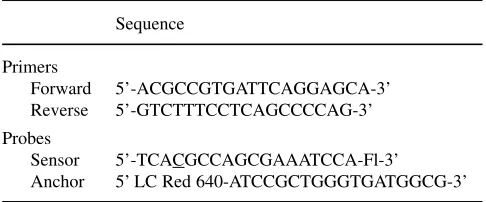
DNA for genotyping was extracted from peripheral blood leukocytes from whole blood or blood clots stored in the HUNT biobank, using the Puregene kit (Gentra Systems Inc.) manually or with an Autopure LS (Gentra Systems Inc.). Laboratory technicians were blinded to the headache status of the samples. COMT genotypes were determined using the LightCycler (Roche Diagnostics Scandinavia AB, Bromma, Sweden) fluorescence resonance energy transfer method [10]. Polymerase chain reaction (PCR) amplifications were per-formed in 20-µl reactions on a LightCycler System, using 2 µl genomic DNA and the LightCycler-FastStart DNA Master Hybridization Probes kit (Roche Diagnostics Scandinavia AB, Bromma, Sweden). PCR primers (Eurogentec, Seraing, Belgium) and fluorescence labelled probes (PROLIGO, Paris, France) are shown in Table 1. Based on melting curve profiles, participants were classified as having Val/Val, Val/Met or Met/Met genotypes. Details on PCR and melting curve condi-tions are available on request.
Table 1 Primers and hybridisation probes used for COMT
Val158Met genotyping
Sequence
Primers
Forward 5’-ACGCCGTGATTCAGGAGCA-3’ Reverse 5’-GTCTTTCCTCAGCCCCAG-3’
Probes
Sensor 5’-TCACGCCAGCGAAATCCA-Fl-3’
Anchor 5’ LC Red 640-ATCCGCTGGGTGATGGCG-3’
Participation
Out of the 92 566 invited individuals, a total of 51 383 subjects (56%) completed the headache questionnaire in Q2. Details of
the non-participants are described elsewhere [7, 10].
In the HUNT biobank a total of 62 664 DNA samples are stored. At the time of the 1995–1997 HUNT study, participants were not sufficiently informed about possible genetic DNA-based research. Therefore, an extensive information campaign about functional genomic research was performed in 2002, and each surviving adult HUNT participant (n=61426) received an information folder and a personal letter asking for re-consent to include genetic research. In total, 1185 (1.9%) persons with-drew their consent [7, 8]. Out of the remaining group of 60 241 participants, COMT gene polymorphism analyses were per-formed on 3048 individuals. Out of the 3048 individuals, a total of 2451 (80%) subjects also had responded to the headache questions and were subjects for the present study.
Out of the 3048 individuals with known COMT genotype, approximately 70% of these were selected completely at ran-dom. The remaining 30% had been randomly selected among an older group of individuals. This latter group was generated in connection with a planned genetic study on diabetes that needed age-matched controls to a diabetic population. Because diabetes patients as a group are older than the general population, some-what older individuals were needed as controls. As a conse-quence, the total group of 3048 individuals was somewhat older than the HUNT population as a whole.
Ethics
The study was approved by the Regional Committee for Ethics in Medical Research, and by the Norwegian Data Inspectorate.
Statistical analysis
Differences between continuous variables were tested with analyses of variance (one-way ANOVA) and between dichoto-mous variables with the χ2test. Analyses used two-tailed
esti-mation of significance, and p<0.05 was considered to be sta-tistically significant. Overall, our sample of 982 headache suf-ferers and 1469 controls had the power to detect a 5%
differ-ence in headache prevaldiffer-ence between genotypes with 95% cer-tainty and 80% power. The sample of 305 migraine patients and 1469 controls had the power to detect a 3% difference in migraine prevalence between genotypes with 95% certainty and 80% power.
Statistical analyses were performed using the Statistical Package for the Social Sciences (SPSS), version 13.0 (SPSS Inc, Chicago).
Results
The distribution of genotypes among the 2451
individu-als was in Hardy-Weinberg equilibrium. Out of these, a
total of 982 persons (346 men and 636 women) with a
mean age of 46.8 years suffered from headache, and the
remaining 1468 individuals with a mean age of 55.5
years were headache-free controls. Among the 982
headache sufferers, 305 (93 men and 212 women) had
migraine and 677 (253 men and 424 women)
non-migrainous headache.
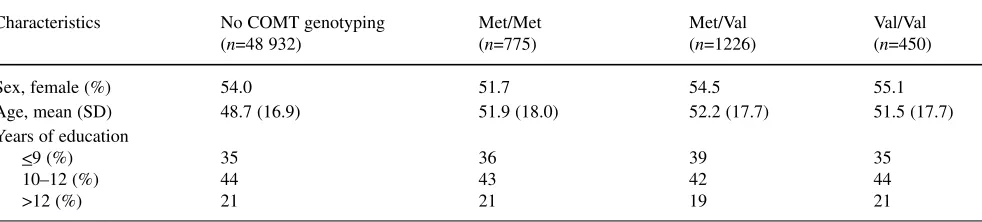
The demographic data according to
COMT
genotypes
are shown in Table 2. No difference in distribution of
gen-der, mean age or education level was found between the
genotype groups. However, the individuals with known
COMT
genotype were significantly older than those
with-out
COMT
data available (
p
<0.01) (Table 2).
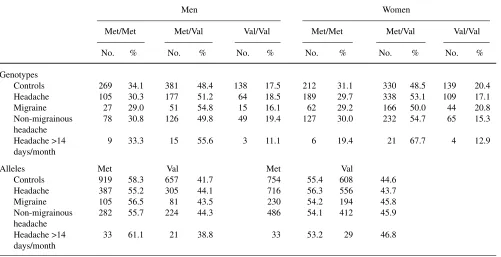
Comparison of allele distribution of
COMT
Val158Met polymorphism by gender failed to detect
sig-nificant differences between headache sufferers and
controls (Table 3). Similarly, the distribution of the
COMT
Val158Met genotypes was similar between
con-trols and headache (all types) and migraine. When the
Met/Met and Val/Met genotypes were pooled, headache
was slightly less likely among women with the Val/Val
genotype (44.0%) than in women with other genotypes
(49.3%) (
p
=0.13). This tendency was explained by a
lower prevalence of non-migrainous headache among
women with the Val/Val genotype than among those
with Val/Met or Met/Met genotypes (26.2%
vs
. 33.6%,
p
=0.04).
Table 2 Distribution of sex, age and education related to COMTgenotypesCharacteristics No COMT genotyping Met/Met Met/Val Val/Val (n=48 932) (n=775) (n=1226) (n=450)
Sex, female (%) 54.0 51.7 54.5 55.1
Age, mean (SD) 48.7 (16.9) 51.9 (18.0) 52.2 (17.7) 51.5 (17.7) Years of education
<9 (%) 35 36 39 35
10–12 (%) 44 43 42 44
Discussion
In this population-based study among 2451 unselected
adults, no significant association between migraine and the
Val158Met polymorphism at the
COMT
gene was found.
Previously, individuals with the
COMT
Val/Val
geno-type have been found to be less susceptible to pain [4],
and in one study migraine was less frequent among those
with the Val/Val genotype [5]. In contrast, the distribution
of the Val/Val genotype and other genotypes were similar
between controls and migraine patients in the present
study. In accordance with our results, no association was
found between migraine with aura and
COMT
gene
poly-morphism in a case-control study of 97 patients with
migraine with aura and 94 healthy controls [13].
Similarly, no relationship to the Val158Met polymorphism
at the
COMT
gene was found in another case-control
study of 103 patients with chronic daily headache with
drug abuse, 101 patients with episodic migraine without
aura and without analgesic abuse, and 117 controls
with-out headache [14]. These conflicting results underline the
importance of testing positive findings by replication in
other populations, because there is a relatively high risk of
positive findings due to coincidence [15].
Of course, non-replications raise concerns about power.
However, our sample of 305 migraine patients and 1469
controls should have 80% power to detect a difference in
migraine prevalence of 3% between genotypes. A
limita-tion of our study is the use of a simplified headache
classi-fication, because headache sufferers were classified into
two groups of either migraine or non-migrainous
headache. Based on our validation study, we have reason to
believe that the majority of individuals with
non-migrain-ous headache suffered from tension-type headache [9].
The observation that
COMT
activity is lower in
females than in males and that
COMT
activity may be
under hormonal control [16, 17] is the reason for
per-forming separate analyses for each gender. The prevalence
of non-migrainous headache tended to be lower among
women with the Val/Val genotype than among those with
the other genotypes. This may be an incidental finding,
but should be investigated in further studies including
patients fulfilling the diagnosis of tension-type headache.
If the findings could be replicated, the gender-specific
finding is of interest in light of the well established
gen-der difference in prevalence of headache, and lower pain
threshold in women [18].
Our study could not confirm a strong association
between headache and the Val158Met polymorphism. To
date, no other functional polymorphisms within the
COMT
gene have been linked to headache. However, two
other different genetic haplotypes of the
COMT
gene have
been found to be involved in pain perception in a recent
case-control study [19], and these may be relevant for
headache prevalence.
In conclusion, in this population-based study
per-formed among 2451 unselected adults, no significant
Table 3 Headache prevalence related to genotype of COMTin men and womenMen Women
Met/Met Met/Val Val/Val Met/Met Met/Val Val/Val
No. % No. % No. % No. % No. % No. %
Genotypes
Controls 269 34.1 381 48.4 138 17.5 212 31.1 330 48.5 139 20.4 Headache 105 30.3 177 51.2 64 18.5 189 29.7 338 53.1 109 17.1 Migraine 27 29.0 51 54.8 15 16.1 62 29.2 166 50.0 44 20.8 Non-migrainous 78 30.8 126 49.8 49 19.4 127 30.0 232 54.7 65 15.3 headache
Headache >14 9 33.3 15 55.6 3 11.1 6 19.4 21 67.7 4 12.9 days/month
Alleles Met Val Met Val
Controls 919 58.3 657 41.7 754 55.4 608 44.6 Headache 387 55.2 305 44.1 716 56.3 556 43.7 Migraine 105 56.5 81 43.5 230 54.2 194 45.8 Non-migrainous 282 55.7 224 44.3 486 54.1 412 45.9 headache
association between migraine and the Val158Met
poly-morphism at the
COMT
gene was found. Among women,
non-migrainous headache tended to be less likely among
with those with the Val/Val genotype than among those
with the other genotypes.
Acknowledgements The Nord-Trøndelag Health Study (the HUNT study) is a collaboration between the HUNT Research Centre, Faculty of Medicine, The Norwegian University of Science and Technology (NTNU); Norwegian Institute of Public Health; and the Nord-Trøndelag County Council
References
1. Ferrari MD, Russell MB (2000) Genetics of migraine. In: Olesen J, Tfelt-Hansen P, Welch KMA (eds) The headaches, 2nd edn. Lippincott Williams & Wilkins, Philadelphia, pp 241–254
2. Russell MB, Olesen J (2000) Genetics of tension-type headache. In: Olesen J, Tfelt-Hansen P, Welch KMA (eds) The headaches, 2nd edn. Lippincott Williams & Wilkins, Philadelphia, pp 561–563
3. Lotta T, Vidgren J, Tilgmann C, Ulmanen I, Melén K, Julkunen I, Taskinen J (1995) Kinetics of human soluble and membrane-bound catechol O-methyltransferase: a revised mecha-nism and description of the thermola-bile variant of the enzyme.
Biochemistry 34:4202–4210
4. Zubieta JK, Heitzeg MM, Smith YR et al (2003) COMT val158 met
Genotype affects µ-opioid neurotrans-mitter responses to a pain stressor. Science 299:1240–1243
5. Erdal ME, Herken H, Yilmaz M, Bayazit YA (2001) Significance of the catechol-O-methyltransferase gene polymorphism in migraine. Mol Brain Res 94:193–196
6. Gürsoy S, Erdal E, Herken H, Madenci E, Alasehirli, Erdal N (2003)
Significance of the catechol-O-methyl-transferase gene polymorphism in fibromyalgia syndrome. Rheumatol Int 23:104–107
7. Holmen J, Midthjell K, Krüger Ø, Langhammer A, Holmen TL, Bratberg GH, Vatten L, Lund-Larsen PG (2003) The Nord-Trøndelag Health Study 1995-97 (HUNT 2): objectives, con-tents, methods and participation. Nor J Epidemiol 13:19–32
8. Holmen J, Kjelsaas MB, Krüger Ø, Ellekjær H, Ross GB, Holmen TL, Midthjell K, Stavnås PA, Krokstad S (2004) [Attitudes to genetic epidemiol-ogy – illustrated by question for re-consent to 61,426 participants at HUNT]. Nor J Epidemiol 14:27–31 9. Hagen K, Zwart JA, Vatten L, Stovner
LJ, Bovim G (2000) Head-HUNT: validity and reliability of a headache questionnaire in a large population-based study in Norway. Cephalalgia 20:244–251
10. Hagen K, Zwart JA, Vatten L, Stovner LJ, Bovim G (2000) Prevalence of migraine and non-migrainous headache – Head-HUNT, a large population-based study. Cephalalgia 20:900–906 11. Headache Classification Committee of
the International Headache Society (1988) Classification and diagnostic criteria for headache disorders, cranial neuralgias, and facial pain. Cephalalgia 8[Suppl 7]:19–28
12. Wittwer CT, Ririe KM, Andrew RV, David DA, Gundry RA, Balis UJ (1997) The LightCycler: a microvol-ume multisample fluorimeter with rapid temperature control. Biotechniques 22:176–181
13. Park JW, Kim YJ, Lee KS (2005) Catechol-O-methyltransferase gene polymorphism of migraine without aura. Cephalalgia 25:867
14. Montagna P, Cevoli S, Marzocchi N, Pierangeli G, Pini LA, Cortelli P, Mochi M (2003) The genetics of chronic headaches. Neurol Sci 24[Suppl 2]:S51–S56
15. Sterne JA, Smith GD (2001) Sifting the evidence – what’s wrong with signifi-cance tests? BMJ 322:226–231 16. Xie T, Ho SL, Ramsden D (1999)
Characterization and implications of estrogenic down-regulation of human catechol-O-methyltransferase gene transcription. Mol Pharmacol 56:31–38 17. Jiang H, Xie T, Ramsden D, Ho SL
(2003) Human catechol-O-methyltrans-ferase down-regulation by estradiol. Neuropharmacology 45:1011–1018 18. Jensen R, Rasmussen BK, Pedersen B,
Lous I, Olesen J (1992) Cephalic mus-cle tenderness and pressure pain thresh-old in a general population. Pain 48:197–203