R E S E A R C H
Open Access
Exploiting social features for improving
cognitive radio infrastructures and social
services via combined MRF and back pressure
cross-layer resource allocation
Evangelos Anifantis
*†, Eleni Stai
†, Vasileios Karyotis and Symeon Papavassiliou
*Correspondence: [email protected] †Equal contributors
School of Electrical and Computer Engineering, National Technical University of Athens (NTUA), 15780 Zografou, Athens, Greece
Abstract
The observed unbalance of spectrum utilization combined with the proliferation of wireless devices and the growth of online social networks call for a joint study of cognitive radios (CRs) and social networking towards improving the operation of both the underlying CR-capable communications infrastructures and of the corresponding dynamic networks. In this work, we address such issue and focus on the twofold direction of resource allocation in CRs and social feature exploitation with the aim of providing a holistic cross-layer optimization framework that jointly considers
information from the social layer as well as the traditional network protocol layers. We combine Markov random field (MRF) cross-layer decisions with back pressure (BP) features for the allocation of resources, in order to improve the operation of CRs that act as social network substrate. Espousing the recent advances in the field of dynamic spectrum allocation, the proposed BP-enhanced MRF (BPeMRF) network optimization serves the purpose of improving in a low complexity manner the capacity of agile infrastructures, which are required to adapt fast according to the demands of the volatile CR environment and the overlaying dynamic online social networks. In addition, within the proposed socially enhanced BPeMRF (SeBPeMRF) approach, we leverage emerging social information to further enhance performance. The obtained results exhibit the efficacy of BPeMRF/SeBPeMRF regarding the above objectives and demonstrate significant promise for further improving the corresponding
infrastructures and services.
Keywords: Cognitive radio networks; Social features; Markov random fields; Back pressure; Cross-layer design; Network enhancement
Introduction
Lately, various studies [1,2] have proved the significant unbalance of spectrum assignment and utilization generated by the traditional static spectrum allocation practices world-wide. Simultaneously, wireless technology and online social networks have experienced tremendous growth, so that nowadays, most of the Internet access takes place through smart handhelds [3]. In addition, wireless data traffic increases considerably, mainly due to the widespread proliferation of online social networks and the associated offered
services/applications [4]. Such trends have motivated the design of more intelligent wireless networks, e.g., cognitive radios (CRs), and are expected to leverage diverse information, while also shape the evolution of the future wireless Internet.
Social networking on its part, i.e., online social networks and mobile social networks [5], has started shaping the current and future trends of wireless traffic, and thus, network engineers have to take into account their features, complications, and other require-ments they impose on the operation of networks. In general, it seems that CRs and social networking are becoming more integrated in the future wireless Internet, in var-ious capacities, and they seem to converge in the sense that CRs may constitute one of the major infrastructures to carry online social network traffic and meet the correspond-ing demands imposed by the latter. In this work, we take this approach one step ahead, and in addition to demonstrating how one can achieve the above, we will also show that features and additional information from the social network layer can be exploited to fur-ther improve the underlying CR infrastructure. In ofur-ther words, this paper will contribute towards creating a promising bond between CRs and social networking for the future wireless Internet.
The CR paradigm [6] has been conceived in a brain-empowered manner to address the spectrum underutilization problem and provide spectrum-agile communications, follow-ing a methodology that mimics the human behavior and by extension the evolutionary processes of physical, biological, and other systems that exhibit social structure and cognition [7]. Their applications include - among others - big social events such as confer-ences, sports finals, etc., where traffic bottlenecks arise quickly when many users attempt to access simultaneously scarce resources, e.g., available channels, in a static/inefficient manner. Above all, CRs can be used to alleviate problems emerging in cyber-physical systems combining wireless infrastructures and online social networks, e.g., to provide on-the-fly traffic offloading of the cellular infrastructure, thus expediting data trans-fers and reducing delays (LTE advanced) in crowded locations. At the same time, the cognition-based operation of CRs requires dynamic reconfigurations and flexible adap-tations in order to conform to higher priority user requirements and support efficiently the anticipated quality of service (QoS) demands by the future services and applications developing in diverse wireless and dynamic online social networks.
Based on the aforementioned observations/emerging trends, we focus on the design and analysis of spectrum-agile communications networks, aiming at supporting the increased QoS requirements imposed by current and future dynamic and online social networks. We propose a network optimization approach for CR networks, which aims at jointly determining the transmission power and channel allocation while achieving optimal scheduling and routing through lightweight and distributed computation. The optimization proposed by our approach is based on a Markov random field (MRF) [8] cross-layer formulation and the inherently distributed Gibbs sampling technique [9] enhanced with back pressure (BP) [10] features, with the goal of increasing capac-ity, avoiding interference, and supporting the development of flexible spectrum-agile infrastructures for dynamic online social networks.
optimal scheduling and determining routing at the higher protocol stack layers. We com-pare the joint mechanism with a traditional BP scheme in order to validate its efficiency and performance. The simulation results follow the lines of the theoretical results, indi-cating the throughput optimal performance of the BPeMRF scheme, similarly to BP, while by leveraging Gibbs sampling, BPeMRF allows for less complex computations than BP.
In addition, we further enhance the BPeMRF algorithm with information available from the social layer, proposing the socially enhanced BPeMRF (SeBPeMRF) algorithm. This approach addresses the bidirectional interplay between resource allocation in CRs and social layer’s operation that seems to offer significant benefits in exploiting social features to enhance the infrastructure adaptively to both the network protocol layers and the social layer. We demonstrate the efficacy of such approach via two use cases in the ‘Case study I: reputation of PUs appearance’ and ‘Case study II: adapting routing efficiency to social layer’s needs’ sections.
The rest of this paper is structured as follows. In the ‘Background and contributions’ section, we describe relevant works and highlight the contributions of our work, while in the ‘System model’ section, we explain the assumed system model. The ‘MRF-based resource allocation framework for centralized CRNs’ section introduces the design of BPeMRF approach by presenting the MRF part as well as the BP features of BPeMRF. In the ‘Exploiting social information in CRN cross-layer optimization and resource allocation’ section, the incorporation of social awareness via SeBPeMRF approach is ana-lyzed, while performance evaluation of the proposed BPeMRF and simulation results via two case studies of the proposed SeBPeMRF are provided in the ‘Simulation results’ section. Finally, the ‘Conclusion’ section concludes the paper.
Background and contributions
CRs received considerable attention the last decade, towards providing a flexible
com-munications paradigm. In response to the immature purely ad hoc CR technology,
regulation bodies have already promoted viable infrastructure-based cognitive radio net-works (CRNs) assisted by centralized spectrum databases, e.g., [11]. Our work aligns with this centralized framework and aims at further improving SU operation. Various cross-layer analyses of centralized CRNs have emerged in the literature [12-15], and compared to them, our work further introduces an MRF-based cross-layered resource allocation approach in a suitable manner for incorporating social information. MRF formulation serves for modeling spatial dependencies and, along with Gibbs sampling, has attracted the attention of diverse research fields due to the inherent capability for addressing a class of problems with large space of possible configurations. Gibbs sampling accompa-nied by MRFs has been initially proposed for image restoration in [9], and it was recently employed on resource allocation problems in wireless networks [16-18]. In this paper, we focus on leveraging MRF structure and Gibbs sampling combined with back pressure fea-tures such that throughput optimal joint scheduling and routing is efficiently achieved along with channel allocation and power control in the secondary network.
solution of the MWM [19]. Greedy maximal scheduling (GMS) (longest queue first) is an alternative that maintains performance close to optimal while being throughput opti-mal for special topologies and can be replaced equivalently by local GMS which uses only local information [19]. Also, [20] presents a broad category of alternative approaches based on randomized schedulers that allow for imperfections and relaxations on their operation. The introduction of imperfections can be exploited for the development of low complexity (e.g., polynomial) and distributed schedulers under a general interfer-ence model. Contrary to the above works approximating MWM, our approach achieves throughput optimality with low-complexity and local information exchange, by avoid-ing solvavoid-ing MWM and relyavoid-ing on a converged Gibbs sampler for obtainavoid-ing the optimal schedule at each time slot.
The proposed replacement of the MWM facilitating the applicability of the back pres-sure algorithm, along with the efficient spectrum utilization achieved via CRNs, renders our proposed approach suitable for allocating resources in dynamic social networks sup-ported by wireless infrastructures. Furthermore, in this framework, social information may be leveraged to either improve the resource allocation algorithm itself or facilitat-ing the social communication and information diffusion. Several works in the literature study this interplay between social information and cross-layer protocol design in wire-less networks. This interplay is most representatively expressed when referring to mobile social networks, explored in [5] where it is proposed that the latter can further lever-age spectrum access opportunities via CRNs enhanced with social information. Spectrum access in CRNs can be efficiently improved via channel recommendation mechanisms performed distributively and mimicking analogous schemes in electronic commerce as proposed in [21,22]. However, channel recommendations are meaningful when secondary users bear a limited view of spectrum opportunities (e.g., absence of a central database providing information for vacant channels and their conditions). Assuming a central database for channel information, [23] proposes a distributed channel access algorithm based on the fact that each user maximizes a utility function with respect to the expe-rienced interference by itself and its social ties. Finally, the impact of social selfishness on the cross-layer design of CRNs has been studied in [24]. Social selfishness refers to the preference of users to relay data belonging only to their social friends and implies new constraints in the cross-layer problem regarding the allocated buffer sizes and the relay rates between user pairs. In [24], the derived algorithm is founded on a weighted BP scheme. Based on the latter algorithm but following the lines of a similar approach in [25], the weighted BP technique is applied for introducing social awareness in our proposed backpressure based resource allocation scheme for CRNs.
The main results and contributions of this paper can be summarized as follows:
• We propose the BPeMRF algorithm performing routing, scheduling, channel allocation, and power control via exploiting BP features and using an MRF decision model. BPeMRF is shown to be throughput optimal and is performed distributively while retrieving the minimum possible information from a centralized spectrum database.
MWM with the distributed Gibbs sampling method which provably converges and does not impact the throughput optimality of the BP algorithm.
• We enhance the BPeMRF algorithm with information from social layer, proposing the SeBPeMRF algorithm. The queue stability and its emerging trade-off with social behavior under SeBPeMRF are analyzed, while two case studies evaluate the two different objectives of incorporating the social information. The first objective is to improve the CRN operation via exploiting information of the social layer, while the second one is to exploit the agility of CRNs towards strengthening the efficiency of routing and information dissemination according to social layer information.
System model
Following the latest trends in dynamic spectrum environments, we adopt a CR database-assisted system model conforming to recent trends for exploiting unlicensed TV whites-paces [11]. Whitespace databases gather spectrum sensing data, provide spectrum awareness, and adapt secondary user (SU) transmit profiles in order to ensure seam-less primary user (PU) operation. Additionally, they can be potentially used to provide social-related and properly adapted information.
We considerN SUs within an unlicensed opportunistic spectrum access model ofM
heterogeneous channels, while each channelmis characterized by its own central fre-quency carrierfmand bandwidthWm. SUs coexist with higher priority PUs, potentially
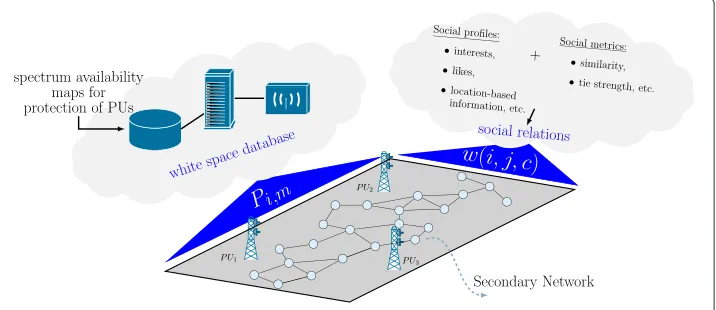
of different technologies, and communicate with a centralized network controller (white space database), as shown in Figure 1, which is responsible for providing them specific operational parameters, i.e., channel availability list and power restrictions per channel depending on primary activity and SUs location. We denote byPi,mthe maximum
per-mitted power at channelmat which nodei can transmit without causing interference
to PUs.
Apart from conforming to regulation limitations - hence, incorporating the underlying limitations posed by primary activity - we go one step ahead by aiming at optimizing the performance of the secondary network. In this direction, we suppose that each SUiis capable of selecting channelmand performing power control under the constraints of
Pi,m. We assume that the range of permitted power is discretized intoLlevels, i.e.,a(Pi) ∈ {aP1,· · ·,aPL}wherea
(i)
P denotes a percentage value (e.g.,aP1 = 0%,aPL =100%) of the
maximum permitted powerPi,m. Thus, using a simplified path loss model and denoting
byPRthrthe SU receiver sensitivity threshold, as determined by hardware specifications, the transmission rangeRmT
iof nodeiover channelmcan be estimated as:
RmT i=d0
a(Pi)Pi,mGtGr PRthr ·
c0 4πd0fm
21η
(1)
wherec0represents the speed of light,d0the line-of-sight (LOS) reference distance, and ηthe path loss exponent. The antenna gains of the transmitter and receiver are denoted byGtandGr, respectively.
Packet collisions at a SU receiver can occur whenever two or more packets are received at the same time. However, we assume that overlapping transmissions in the secondary network are possible due to the capture effect. More precisely, in case of two concur-rent SU transmissions, a SU can still receive a packet without collision if the SINR at the receiver is high enough for successfully decoding the ongoing transmission. Therefore, in our analysis, we adopt the capture threshold model [26], by which SUican successfully transmit tojover channelmif
a(Pi)·Pi,m·G(i,mj)≥PthrR and
a(Pi)·Pi,m·G(i,mj) a(Pi)·Pi,m·G(im,j)
≥Cpthr ∀i=i (2)
whereCpthrdenotes the capture threshold above which the interference from any potential transmitterican be ignored (not strong enough to create a collision).G(i,mj)stands for the channel gain of link(i,j)at channelm, i.e.,
G(i,mj)=Gt·Gr·
c0 4πd0fm
2
·
d0 dij
η
(3)
wheredijis the Euclidean distance between SUsiandj.
Regarding the SU traffic, we consider the existence of a finite number of commodi-ties representing either flows, i.e., SU source-destination pairs, or destinations, within a time-slotted network operation. At each time slott, new data are generated, and trans-mission decisions are made towards delivering all packets to their proper destinations. Specifically, the packets generated exogenously are assumed to arrive at each SUiwith rate λci, where λci = 0 only if i is a source of packets for commodity c. Hence, the instantaneous number of packets arriving at source nodeiat timetfor commoditycis equal toAci(t), whereEAci(t) = λci. The arrival rates are considered upper bounded, i.e., λci ≤ λmax, ∀ i,c. The set of sources for a commodity c is denoted as S(c) and
Aci(t) = 0, ∀t,i ∈/ S(c). Furthermore, we denote the communication traffic in num-ber of packets of every secondary links = (i,j)at timet byμi,j(t) as upper bounded
byμi,j(t) ≤μmaxi,j = maxm WPktms ·log2(1+SNRs)
, wherePktsis the packet size and
SNRs=
Pi,m·G(i,mj)
N0+NP .N0denotes the background noise, whileNPstands for the total additive interference/noise caused by the underlying primary system at each time slott. Similarly, μc
i,j(t)stands for the communication traffic over secondary links =(i,j)regarding only
Furthermore, as shown in Figure 1, we assume the existence of social information overlaying the CRN. This social information is interpreted according to the considered application (e.g., sections ‘Case study I: reputation of PUs appearance’, ‘Case study II: adapting routing efficiency to social layer’s needs’), but it is always quantified via appropri-ate weight values. Specifically, a weightw(i,j,c)is assigned to each pair of secondary link
s = (i,j)and commoditycexpressing a social relation. The definition of social relation regards the similarity among the social profiles of the SUs corresponding to the secondary linksand the commodityc. The term social profile includes all the characteristics of the corresponding SU, i.e., its interests and likes (e.g., section ‘Case study II: adapting routing efficiency to social layer’s needs’) or even its location-based contextual services such as acquired information about reputations and online recommendations (e.g., section ‘Case study I: reputation of PUs appearance’). In our case studies, the social profiles can be stored locally at each SU. Note that, in this work, we are not concerned with the derivation of the social profiles which are considered given. Indicatively, the social profiles can be constructed using real data information, such as Facebook profiles. A detailed description of the properties of the weights’ values is provided in the ‘Exploiting social information in CRN cross-layer optimization and resource allocation’ section.
MRF-based resource allocation framework for centralized CRNs
In this section, we delve into the analysis of the secondary network operation through an MRF formulation which can properly incorporate the inherent spatial dependencies of the examined system model. To improve the secondary network efficacy, the proposed cross-layer BPeMRF framework is introduced by explaining its components and analyzing its main properties.
MRF formulation for secondary networks
Constrained by the underlying limitations posed by primary activity, SUs make adapta-tions and continuously take decisions which unavoidably influence neighboring SUs. In this manner, a knock-on effect is generated by which local decisions give rise to long-range adaptations and essentially can contribute to the overall secondary network performance. This behavior unveils spatial dependencies on SU operation along with a generalized Markov property that motivate our following MRF-centered analysis and formulation.
Based on the maximum transmission range of each SUi, R(Tmaxi ), which can be esti-mated by Equation (1), we define byKthe set of all possible directed secondary links, with cardinalityK. Each links =(i,j) ∈Kis mapped to an MRF sitesand represents a com-munication link with transmitter nodeiand receiver nodej. MRFs describe a probabilistic measure in a family of spatially dependent random variablesXswhich are associated with
a finite number of MRF sitess ∈ S, whereS =. K in our case. Every random variable
Xs takes valuesxs, also referred to as states, from a finite space, whereas the
com-bination of states of all MRF sites describes a configurationω = (x1,. . .,xs,. . .,xn) ∈
= {(x1,. . .,xs,. . .,xn) : xs ∈ ,s ∈ S}that corresponds to one of all possible states
of the whole system. In the same manner for our formulation, the state of a secondary links= (i,j)is expressed by the 2-tuplem,aP swith state space size equal toM×L. It
represents the selected channelmand the real power (after power control) of the trans-mitterias the percentage of the maximum permitted powerPi,m. Thus, for example, if
transmits to nodejat channel 1 (namely, at frequency carrierf1and channel bandwidth W1) with transmission power equal to 0.5×Pi,1.
The main property of MRFs is that the state of each site depends only on a local set of neighbors and is expressed by the following conditional probabilities (also called local characteristics),
P(Xs=xs|Xr =xr,r=s)=P(Xs=xs|Xr =xr,r∈Gs) (4)
whereGs stands for the MRF neighborhood of each site sand satisfies the conditions: ∀s ∈ S,s ∈ Gs andr ∈ Gs if and only ifs ∈ Gr. In our case, we define a neighborhood
systemG = {Gs}s∈Ksuch that two sites (secondary links)sandsare MRF neighbors if and only if their concurrent operation is possible to affect the network performance in terms of packet collisions. Thus, the MRF neighborhood ofsis defined as:
Gs= ⎧ ⎪ ⎪ ⎪ ⎪ ⎪ ⎪ ⎪ ⎪ ⎪ ⎪ ⎪ ⎪ ⎪ ⎪ ⎪ ⎨ ⎪ ⎪ ⎪ ⎪ ⎪ ⎪ ⎪ ⎪ ⎪ ⎪ ⎪ ⎪ ⎪ ⎪ ⎪ ⎩
s= {i,j}: s=sand
⎛ ⎜ ⎜ ⎜ ⎜ ⎜ ⎜ ⎜ ⎜ ⎜ ⎜ ⎜ ⎜ ⎝
i=iori=jori=jorj=j
or
min
m:Pi,m·G(im,j)≥PthrR
Pi,m·G(i,mj)
Pi,m·G( m)
i,j
<Cthr p
or
min
m:Pi,m·G( m)
i,j≥P thr R
Pi,m·G(im,j)
Pi,m·G(i,mj)
<Cpthr ⎞ ⎟ ⎟ ⎟ ⎟ ⎟ ⎟ ⎟ ⎟ ⎟ ⎟ ⎟ ⎟ ⎠ ⎫ ⎪ ⎪ ⎪ ⎪ ⎪ ⎪ ⎪ ⎪ ⎪ ⎪ ⎪ ⎪ ⎪ ⎪ ⎪ ⎬ ⎪ ⎪ ⎪ ⎪ ⎪ ⎪ ⎪ ⎪ ⎪ ⎪ ⎪ ⎪ ⎪ ⎪ ⎪ ⎭ (5)
Any random field with property (4) on a neighborhood systemGcan be also represented as a Gibbs field of the form
P(X=ω)= 1 Ze
−U(ω)
T (6)
with a suitable choice of energy function U(ω)that can be further decomposed into
the contributions of smaller subsets ofS,VC(ω), also called potential functions. Z :=
ω∈e− U(ω)
T denotes the partition function andTa system parameter, also referred to as
temperature. In this work, we leverage the class of pairwise, nearest-neighbor potentials and decompose the system energy into neighbor pair potentials, i.e.,VC =0 ifCis not a
clique or|C|>2, as follows:
U(ω)= s∈S
V{s}(1)(xs)+
{s,s}∈(S×S),s∈Gs
V{s(2,s)}(xs,xs) (7)
Aiming at uniquely specifying our MRF formulation, we design the corresponding sin-gletonV{s}(1)and doubleton potentialsV{s(2,)s}towards capturing via the energy function the different contributions of system configurationsωin the secondary network capacity, as well as the cost of potential packet collisions. Thus, the singleton potential for each link
s=(i,j)with statexs= m,aP s=
m,a(Ps)
is expressed by
V{s}(1)(xs)= ⎧ ⎨ ⎩
δ1>0, if 0<a(Ps)·Pi,m·G(i,mj)<PthrR −λ1· Wm
Cmax ·log2
1+a (s)
P ·Pi,m·G(i,mj)
N0+NP
, otherwise. (8)
δ1 represents a penalty for activating useless links, i.e., incapable of successfully
deliv-ering packets.Cmax denotes the maximum link capacity in the secondary network and
serves for normalization purposes. Similarly, the doubleton potentialV{s(2,)s}is designed to capture the interaction between secondary communication links, e.g., linkswith state
xs= m,aP s= {m,a(Ps)}and linkswithxs = m,aP s =
m,a(Ps), as follows
V{s(2,)s}(xs,xs)=
λ2·δ2>0, if ‘collisionCondition’=1
0, otherwise. (9)
δ2is a large positive constant value that penalizes collisions between two active secondary links by increasing the system energy. The ‘collisionCondition’ describes the possible sce-narios/configurations betweensandsthat can lead to packet collision and is expressed by
a(Ps)=0 anda(Ps)=0 and
i=iori=jori=jorj=j
OR
m=mand
⎛ ⎜ ⎜ ⎝
PthrR ≤ a(Ps)·Pi,m·G(i,mj) !
<Cpthr· a(Ps)·Pi,m·Gi(m,j) !
or
PthrR ≤ a(Ps)·Pi,m·G(im,j)
!
<Cpthr· a(Ps)·Pi,m·Gi(,mj)
! ⎞ ⎟ ⎟ ⎠
It is noted thatλ1andλ2represent non-negative parameters to control the strength of potentials’ contributions.
The above MRF formulation of the secondary network facilitates the estimation of opti-mal solutions exploiting powerful MRF energy minimization techniques in an otherwise difficult to be solved problem. Given that the space of possible configurations can be very large, the MRF formulation can leverage algorithms for the computation of global opti-mum solutions relying on repeated computation of local characteristics (Equation 4). As a result, by finding configurations (i.e., specifying channel allocations and power control at each secondary link) with minimum MRF system energy, we are able to both maximize the offered capacity per link and provide to SUs an efficient scheduling scheme avoiding collisions and, hence, improve the overall secondary network performance.
In this work, we investigate optimal configurations with minimum MRF energy based on a stochastic relaxation methodology, namely Gibbs sampling [9]. The key idea behind Gibbs sampling is that following a visiting scheme, each currently visited MRF site,s, updates its own state according to the local conditional probability distribution
P(Xs=xs|Xr=xr,r=s)=
1
Zs ·
exp
− 1
T(sweepID) ·
C:s∈C VC
ωxs
(10)
where Zs = xs∈exp
"
− 1
T(sweepID)·
C:s∈CVC(ωxs) #
. T(sweepID) represents an
annealing schedule with decreasing rate of temperatureT for each sweep (indexed by
sweepID) that denotes the time interval within which all sites have updated their states. ωxsstands for the configuration which has valuex
sat sitesand agrees withωeverywhere
Potential function via back pressure
In this section, we delve into the design of the potential functions (section ‘MRF formulation for secondary networks’) targeting at introducing throughput optimality in the proposed scheduling scheme (via power control) of the ‘MRF formulation for secondary networks’ section. Towards this direction, we adapt the main idea of the throughput optimal back pressure algorithm [10] which performs routing and link scheduling based on the congestion gradients (queue backlog differentials) computed on every communication link. Specifically, BP chooses for transmission at each time slot, a maximal independent set of links (non-interfering links) that achieves the max-imum sum of queue backlog differentials multiplied with the corresponding link’s communication traffic. At each time slott, after the computation of the communica-tion traffic variables,μci,j(t), ∀s = (i,j), c (section ‘System model’), according to the
chosen schedule, each SU i renews its queue for commodity c following the renewal
relation:
Qci(t+1)≤max
⎧ ⎨ ⎩Qci(t)−
j
μc i,j(t), 0
⎫ ⎬ ⎭+
j
μc
j,i(t)+Aci(t). (11)
Throughput optimality is tied with the strong stability of queues. A queue, Qci, is strongly stable if lim supt−>∞ 1tτt−=10E(Qci(τ)) <∞[27]. If all the queues of the network are strongly stable, then the whole network is strongly stable. The capacity region,C, of the network is defined as the set of source rates{λci,∀i,c}, for which there exists a con-trol algorithm that can stabilize the network [20]. Any algorithm that can support every source rate insideCwhile maintaining stability is called throughput optimal [20].
Aiming to leverage the throughput optimality of the BP algorithmic design, we modify the singleton and doubleton potential functions in Equations 8 and 9 by replacing the constant homogeneous parametersλ1, λ2, with the heterogeneous, time-varying queue backlogs defined on each corresponding site of the MRF graph. In this case, the following proposition holds.
Proposition 1.Define the parameter λ1 in the MRF singleton potentials (Equation 8) separately for each site s = (i,j) and the parameter λ2 in the MRF double-ton potentials (Equation 9) separately for each pair of sites s=(i,j), s= (i,j), asλ1 =
maxmaxc
Q(ic)−Q(jc)
, 0andλ2=maxmaxc
Q(ic)−Q(jc)
, maxc
Q(ic)−Q(jc)
, 1,
while additionally V{s}(1)(xs) = δ1; ∀xs if maxc
Q(ic)−Q(jc) < 0. Then, the proposed BPeMRF is throughput optimal, i.e., it stabilizes the queues, assuming that the arrival rates on the SUs lie inside the capacity regionC.
Proof. The MRF energy minimization problem becomes
min ω∈
s∈S
V{s}(1)(xs)+
s∈S
s∈Gs
V{s(2,)s}(xs,xs)
Sinceδ1andδ2are large positive values, the corresponding configurations that activate
such penalties cannot be part of the minimum energy solution. Note that λ2is tuned
8 and 9. Then, the search space of the optimal solution can be restricted by rewriting our initial minimization problem as
min ω∈
{i,j}∈S
⎡
⎣−λ1·Wm·log2
⎛ ⎝1+ a
(s)
P ·Pi,m·G(i,mj) N0+NP
⎞ ⎠ ⎤ ⎦
subject to ω∈
Since the constraints expressed byguarantee interference avoidance between two active secondary links (based on capture threshold model), the experienced SNR of an active
linksis equal to SNRs=
a(Ps)·Pi,m·G(i,mj)
N0+NP . Sinceμi,j(t) =
Wm
Pkts ·log2
"
1+SNRs #
is the com-munication traffic over sites = (i,j) at tgiven the chosen channel m and the power levela(Ps)(section ‘System model’) and by defining thatμi,j(t) =0 for all{i,j}node pairs
with distance greater than their maximum communication range
"
i.e., di,j>R(Tmaxi ) #
, the minimization problem is rewritten as
min ω∈ i j
−λ1·μi,j(t)
, subject to ω∈
Following the assumption of the proposition, by tuning the parameterλ1of each singleton
asλ1 = max
maxc
Q(ic)−Q(jc)
, 0
for each sites = (i,j), the MRF minimization is transformed to the following maximization:
max ω∈ i j
μi,j(t)·max
max
c
Q(ic)(t)−Q(jc)(t)
, 0
!
subject to ω∈
The final equivalent maximization problem is identical to the back pressure rout-ing/scheduling policy which is throughput optimal [10], thus concluding the proof.
It is important to mention that the proposed design of the potential functions allows for the routing component to be included in the BPeMRF cross-layer scheme, in an exactly similar way as in the BP algorithm, while also leading to throughput optimality regard-ing schedulregard-ing. More specifically, routregard-ing is introduced via the choice of the optimal commodity to be served by each site. Each link (site)s= (i,j)computes its queue back-log differential for all commodities,Rcij(t) = Qci(t)−Qcj(t),∀cand the maximum one among all commoditiesRij(t)=max
maxcRcij(t), 0
is inserted in the parametersλ1,λ2 (Proposition 1) for the decisions regarding power and channel assignments to be made (scheduling is enclosed in the power control) via the MRF energy minimization. Finally, the commodityc∗(i,j) = argmaxcRcij(t)will be chosen for service if the sites = (i,j)is
scheduled to transmit (i.e., the optimization concludes to non-zero power assignment to nodei). Therefore,μci,j(t)=μi,j(t)ifc=c∗(i,j), elseμci,j(t)=0.
distributively on each node based on some globally provided information (spectrum database, section ‘System model’). This fact constitutes an important contribution of the BPeMRF scheme in the fields of CRNs and dynamic social networks where the dynamic network topology requires the repetitive NP-hard computation of the maximal indepen-dent sets of the underlying physical layer graph for the solution of the MWM. However, since the Gibbs sampler needs theoretically an infinite number of sweeps to converge, its finite application will provide an approximation of the optimal MWM solution.
Based on the previous observations, in the ‘Simulation results’ section, we compare the performance of the BPeMRF scheme (approximation of the MWM) with the back pres-sure routing and scheduling algorithm (optimal computation of the MWM). However, contrary to the BPeMRF scheme, BP in its canonical form does not perform channel selec-tion. To tackle this issue and only for comparison reasons, we proceed with the redesign of the BP algorithm as follows.
Let us define a binary functionIs, whereIs(m,t)=1 if the sites=(i,j)uses the channel m at time slot t, else Is(m,t) = 0. Also, mIs(m,t) = 1 (section ‘System model’).
Let μmi,j(t) be the maximum communication traffic of site s = (i,j) over
chan-nel m at time t. Then, scheduling is decided by solving the MWM: maxI(i,j)
mμmi,j(t)Ii,j(m,t)
Rij(t), subject to interference constraints and mIs(m,t) = 1, Is(m,t) ∈ {0, 1}, ∀ s. In order to solve the MWM, we consider the graph of SUs where
each link(i,j)is replaced byMlinks, each one corresponding to a channelm∈ {1. . .M}, and denoted by (i,j,m). Then, we appropriately define the maximal independent sets (setID(t)) over the interference constraints of the new graph, i.e., each site can use only one channel and half-duplex communication, and the constraints of the capture model (section ‘System model’) for the links transmitting at the same channel. Let us denote withμi,j,m(t)=μmi,j(t)the communication traffic of link(i,j,m)andRijm(t)=Rij(t),∀m.
Then according to the above, the initial MWM is equivalent to the MWM defined as maxμ∈ID(t)(i,j,m)μi,j,mRijm(t), and therefore the latter needs to be solved. Each site s=(i,j)for whichμi,j,m(t)=0 for a channelm, serves over channelm, the commodity c∗(i,j)with rateμmi,j(t).
Exploiting social information in CRN cross-layer optimization and resource allocation
In this section, BPeMRF is enhanced via leveraging users’ information from the social layer targeting at a cross-layer improvement of our proposed framework. In order to achieve the social awareness of BPeMRF, the parametersλ1andλ2will be redesigned to incorporate the weight values described in the ‘System model’ section (Figure 1), which are able to express diverse social relationships based on their definition. Specifically, the queue differential corresponding to sites = (i,j)for the commoditycis scaled by the weightw(i,j,c), i.e.,
λa
1=max
max
c
w(i,j,c)"Qi(c)−Q(jc)#, 0 (12)
and similarly,λa2depending on sites{s,s}is expressed by
λa
2=max
max
c
w(i,j,c)"Qi(c)−Q(jc)#, max
c
w(i,j,c)"Qi(c)−Q(jc)
#
The BPeMRF algorithm whereλ1 and λ2 are replaced byλa1 and λa2 correspond-ingly forms the SeBPeMRF algorithm. This approach aims at prioritizing in routing and scheduling commodities and links presenting social relationships of higher qual-ity, i.e., higher values ofw(i,j,c), ∀ i,j,c, while also considering the congestion indices as expressed by the queue differentials. As will be shown via simulation results, it can effectively improve network performance by intensely expressing the heterogeneity of secondary links with respect to their contribution in performance metrics (e.g., routing through socially connecting nodes, delay, throughput, quality of routing, etc.). However, it is proven that network stability in a weighted BP technique is achieved only for a part of the capacity region [25].
Regarding the weightsw(i,j,c), the following assumptions should be satisfied. Firstly, their values are assumed invariant with time. Secondly, for each commodityc, there will be valueswcmin,wc
maxsuch thatwcmin≤w(i,j,c)≤wcmax, ∀i,j. By definingρc=
wc
max
wc
min, ∀c,
it is observed thatρcis a metric of the heterogeneity of the weight values across all
net-work links for the commodityc. Specifically, ifρchas a high value, then the commodity
cmaintains more heterogeneous social relations in the network compared with a small ρcvalue. In the special case where the weights do not depend on the commodities, i.e., w(i,j,c) = w(i,j), ∀ c, thenρc = wmax
wmin, ∀ c, wherewmin = min∀i,jw(i,j), wmax =
max∀i,jw(i,j).
Proposition 2 determines the sufficient condition for queue stability to hold under SeBPeMRF.
Proposition 2.Assumeεc > 0, ∀ c such that ελcc i ≥ (ρ
c−1), ∀ c,i ∈ S(c). If the set {λc
i +εc}∀c,i∈S(c)lies inside the capacity regionC, then strong queue stability holds for the proposed policy.
The proof of Proposition 2 follows similar lines with the proof of Theorem 1 in [25], and therefore, it is briefly described.
Proof.Since by Proposition 1, we have shown that BPeMRF behaves as BP, it suffices to prove the statement of Proposition 2 for the BP algorithm.
We define the Lyapunov functionL(Q(t)) = i,cwc
maxQci(t)2 and we compute the
Lyapunov drift
E(L(Q(t+1))−L(Q(t))|Q(t))=E ⎡ ⎣
i,c
wcmaxQci(t+1)2−Qci(t)2 ((Q(t) ⎤ ⎦
≤Bmax+2
i,c
wcmaxQci(t)λci−2
i,c
wcmaxQci(t)
×E ⎡ ⎣ ⎛ ⎝ j μc
ij(t)−
j
μc
ji(t)
⎞ ⎠((((Q(t)
⎤ ⎦
=Bmax+2
i,c
wcmaxQci(t)λci−2
c
(i,j)
wcmax
×E μcij(t)|Q(t)!(Qci(t)−Qcj(t)),
(14)
whereBmax=max
)
i,cwcmaxE *"
jμcij(t) #2
+"jμc
ji(t)+Aci(t) #2 ((
(Q(t) +,
For the communication traffic variablesμcij(t), ∀i,j,cchosen by SeBPeMRF, it holds that
c
(i,j)
w(i,j,c)μcij(t)"Qci(t)−Qcj(t)#≤ c
(i,j)
wcmaxμcij(t)"Qci(t)−Qcj(t)#, (15)
since for the SeBPeMRFμcij(t) = 0 ifQic(t)−Qcj(t) < 0 and therefore from Rel. (14) it holds that
E(L(Q(t+1))−L(Q(t))|Q(t))≤
Bmax+2
i,c
wcmaxQci(t)λci −2
c
(i,j)
w(i,j,c)μcij(t)"Qci(t)−Qcj(t)#. (16)
Ifλci+c, ∀c,i∈S(c)lie inside the capacity region, then from Corollary 3.9 in [27], there exist communication traffic variablesμˆcij(t)(according to a stationary randomized control policy making decisions on the current network state) which satisfy:
λc
i+c=E ⎡ ⎣
j ˆ
μc ij(t)−
j ˆ
μc ji(t)
⎤
⎦ ∀c,i∈S(c).
As a result, we have
i,c
wcminQci(t)λci+ i,c
wcminQci(t)c
=
c
(i,j)
wcminE μˆcij(t) !
(Qci(t)−Qcj(t))
≤ max μ
c
(i,j)
wcminμcij(Qic(t)−Qcj(t))
≤ max μ
c
(i,j)
w(i,j,c)μcij(Qci(t)−Qcj(t))
=
c
(i,j)
w(i,j,c)μcij(t)(Qci(t)−Qcj(t)), (17)
where μcij(t), ∀ i,j,c are chosen by SeBPeMRF. Now, the Lyapunov drift (Rel. (16)) becomes
E[L(Q(t+1))−L(Q(t))|Q(t)]≤Bmax+2
i,c
wcmax−wcminλciQci(t)
−2
i,c
wcminQci(t)c. (18)
Therefore, if the assumptionc> wcmax−wcmin
wc min λ c i ⇒ c λc
i > ρ
c−1, ∀c,i∈ S(c)is satisfied,
then from Lemma 4.1 of [27], the network is strongly stable.
The two following remarks stem from Proposition 2.
Remark 1.‘Trade-off between social relations and queue stability’
Proposition 2 states that queue stability holds provably only for a part of the capacity region i.e., forεcsatisfying ελcc
i ≥ (ρ
c−1), ∀c,i ∈ S(c)and not forεc > 0, ∀c which is a necessary and sufficient condition for throughput optimality [27]. Via Proposition 2, a trade-off emerges between the social behavior/relations and queue stability. Specifically, whenρcincreases for a commodity c, then εc
λc
lower possible exogenous arrival rates for commodity c. In other words, when the sources and/or the destination of a commodity c maintain more heterogeneous in quality social relations with the rest of the nodes (i.e.,ρchas high value for commodity c), there is less available long-term throughput (i.e., exogenous arrival rate) for this particular commod-ity so that the queues over the network are stabilized, given the maximum service rates of the network links. Thus, a commodity c corresponding to more homogeneous social rela-tionships overall in the network, thus facing with similar weight values over the sites (or ρc → 1), may exploit its best available long-term throughput which also depends on the rest of the sources’ rates.
Remark 2.‘Closer examination of the effect of the weights’ values’
If wcmaxincreases for a commodity c, then this actually means that the set of sites corre-sponding to wcmaxwill be more likely to be scheduled. This fact may lead to performance improvements for commodity c (i.e., throughput, delay, quality of routing etc.) depending also on the location and the number of sites belonging in this set. In general, for constant ρc, increasing the values of wc
max and wcminis expected to affect positively the performance metrics regarding commodity c. On the contrary, for constant wcmaxand decreasing wcmin, the expected effect on the performance related to commodity c is negative depending also on the number and the location of the sites assigned the changed values. This remark is examined via simulations in the case study II that follows. Finally, note that Proposition 2 reflects a worst-case scenario by using the minimum and maximum values of the weights and not their exact values so as to determine sufficient conditions that ensure queue sta-bility. More explicitly, changing the weight values of a small number of links to very high or very low ones may not have the degree of impact as predicted by Proposition 2.
Simulation results
In this section, we evaluate the performance of the proposed BPeMRF and SeBPeMRF approaches through simulations on MATLAB over different networking scenarios. After studying the operation of our proposed framework in a trivial CRN topology to vali-date its applicability, we compare the network stability properties of BPeMRF with the traditional back pressure methodology (namely, based on MWM solution). In addi-tion, two different case studies are examined in the ‘Case study I: reputation of PUs appearance’ and ‘Case study II: adapting routing efficiency to social layer’s needs’ sections. The obtained results provide relevant operational performance indications for the pro-posed BPeMRF/SeBPeMRF approaches and demonstrate the significance/benefits of incorporating social information in CR infrastructures via cross-layer techniques.
For the rest of the experiments, we adopt a logarithmic annealing schedule for Gibbs sampling (similar in spirit to the theoretical annealing schedule [9]) and proceed until convergence or a predefined finite number of sweeps (e.g., 1,000 sweeps). Table 1 summa-rizes the setup of general system parameters (which are defined in the ‘System model’ and ‘MRF-based resource allocation framework for centralized CRNs’ sections) as used in the
following simulations. In the examined networking scenarios, we assumeM=2
homo-geneous licensed channels with central frequency carriersf1=300 MHz,f2=320 MHz and bandwidth equal to 50 kHz. It is noted thatPi,mvalues are determined for each SU
iand channelmbased on the current PUs locations and transmission powers so as to
Table 1 Simulation parameters setup
Parameters Values Definition
Cthr
p 2 Capture threshold - Equation 2
Pthr
R -90dBm SU receiver sensitivity threshold - Equations 1 and 2
N0 -98dBm Background noise - Equation 8
Gt,Gr 1 Antenna gains - Equations 1 and 3
d0 1m LOS reference distance - Equations 1 and 3
η 4 Path-loss exponent - Equations 1 and 3
δ1 5 Positive constant (penalty) - Equation 8
δ2 2 Positive constant (penalty) - Equation 9
Pkts 1,500 bytes Packet size
max{Pi,m} 100 mW maximum SU transmission power T ln(1+sweepID2 ) Annealing schedule - Equation 10
transmit with power equal to 100 mW, while the PU receiver sensitivity threshold is equal to−74.2 dBm. To protect even the PUs receivers located at the boundary of PUs com-munication range (worst-case scenario), we setPi,mvalues such that SU’s signal at each
location is always at least 10 dB lower than the incumbent primary signal.
Proof of concept in CRN environment
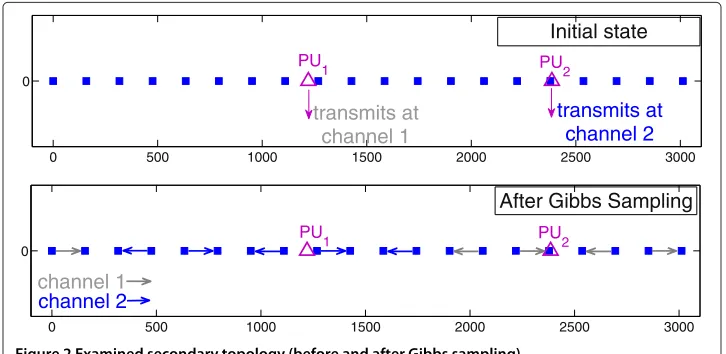
To demonstrate the MRF energy minimization procedure and the underlying convergence behavior that results in global optimal secondary network configurations, we examine the trivial case of a line secondary topology (as shown in Figure 2), where the distance between neighboring SUs allows communication only at their maximum transmission power and thus, optimal configurations can be easily deduced. In the examined
sce-nario, 20 SUs coexist with 2 randomly located PUs overM = 2 homogeneous licensed
channels, while we assumeL = 3 available power levels andλ1 = λ2 = 1. Obviously,
optimality (in terms of maximum network capacity without packet collisions) implies the activation of successive links with one vacant space. Figure 3 illustrates the MRF energy decrease during the annealing schedule and until convergence, whereas the correspond-ing final configuration is depicted in Figure 2. It is observed that convergence is achieved after approximately 1,000 sweeps, while the channels are intelligently allocated to protect
0 500 1000 1500 2000 2500 3000
0
0 500 1000 1500 2000 2500 3000
0
transmits at channel 2
transmits at channel 1
channel 2
PU2 PU1
PU1
Initial state
After Gibbs Sampling
channel 1
PU2
200 400 600 800 1000 1200 −10
0 10 20
Sweeps
System Energy
Figure 3 Convergence to minimum energy configurations (maximum value ofy-axis represents the maximum system energy as occurred at the early sweeps).
PUs’ seamless operation. We note that in the following simulated networking scenarios, if Gibbs sampling has not fully converged by 1,000 sweeps, the best solution found thus far is adopted.
BPeMRF throughput optimality
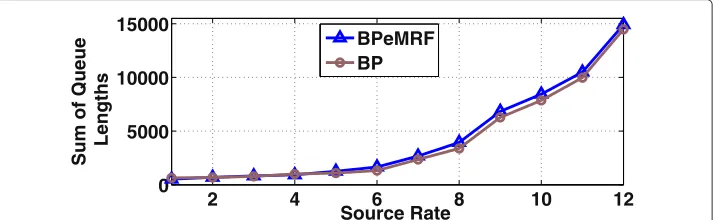
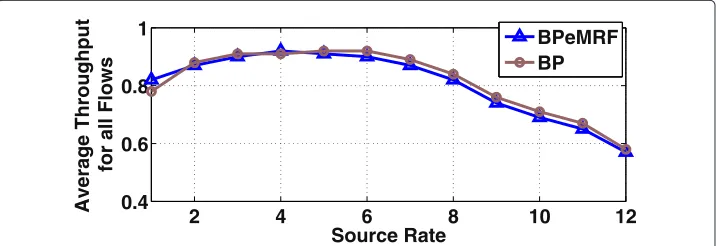
In order to compare the performance of the proposed BPeMRF scheme with the BP algo-rithm, we consider 14 SUs in a 2×7 grid network topology where each SU chooses another SU randomly as its destination node. Since BP does not perform power control, we con-sider only two power levels (L=2, section ‘System model’) for the BPeMRF and apply the redesigned BP described in the ‘Potential function via back pressure’ section over 1,000 time slots. At each time slott, each SU generates with probability 20%,ns=1 : 12 packets
for its corresponding destination. In Figures 4, 5, and 6, the performance of the BPeMRF in terms of the achieved capacity region, delay, and throughput respectively, is compared with BP. It is noted that in this series of experimentsλ1andλ2are tuned according to Proposition 1.
Throughput (Figure 6) is expressed as the fraction of the number of packets that reached the destination divided by those sent by the source for each flow, and then the average over all flows is taken. Delay (Figure 5) is computed as the mean time difference between the packet production by the source and its arrival to the destination for each flow, while also averaged over all flows. According to the definition of the capacity region as the set of source rates for which the sum of queue lengths remains finite (section ‘Potential function via back pressure’), Figure 4 provides an intuition of the set of admissible source rates, as those rates before the sum of queue lengths starts to rapidly increase (i.e., approximately up to source rate 8). From Figure 4, it can be observed that BPeMRF and the throughput
2 4 6 8 10 12
0 5000 10000 15000
Source Rate
Sum of Queue Lengths
BPeMRF BP
2 4 6 8 10 12 50
100 150 200
Source Rate
Average Delay for all Flows
BPeMRF BP
Figure 5 Average end-to-end delay for all flows (source-destination pairs).
optimal BP demonstrate very similar behavior with respect to capacity region which is in accordance with the theoretical results (Proposition 1), although BPeMRF runs for a finite number of sweeps (i.e., at most 1,000 sweeps) which implies non-perfect convergence. Therefore, BPeMRF is suitable for application in CRNs and dynamic social networks as it allows for efficient spectrum reuse and throughput optimal cross-layer network control while avoiding the NP-hard solution of the MWM. Figures 5 and 6 further reinforce the performance equivalence between BPeMRF and BP, since the induced throughput and delay values for both schemes are very close.
Case study I: reputation of PUs appearance
The main idea of the first case study is to demonstrate the benefits in CRNs whose SUs can take advantage of online social networking towards finding appropriate forwarding paths. Due to the high impact of PUs activity on secondary network performance -stemmed from the requirement for ensuring seamless primary network operation - we focus on leveraging information regarding the reputation about PUs (re)appearances at specific locations with the aim of avoiding secondary routing paths across regions with high volatile PU activity. In fact, as recognized in literature [14], the dynamic nature of PUs could trigger severe cascaded secondary network modifications, thus resulting in sig-nificant reconfiguration overhead. To avoid such issues, SeBPeMRF is leveraged towards forwarding data while shaping routing paths consisting of SUs that lie in areas with low reputation for frequent PU (re)appearances.
2 4 6 8 10 12
0.4 0.6 0.8 1
Source Rate
Average Throughput
for all Flows
BPeMRF BP
In the following, we adopt the model of a secondary network assisted by location-based social networking services which can help SUs to share their own experiences regarding spectrum availability in a specific position and acquire online recommendations about
expected PUs appearances. For demonstration purposes, we consider 5×5 secondary
grid topology in a deployment area where direct communication is only possible between
one-hop neighboring nodes andL = 2, while the reputation of PUs appearance at each
locationz=x yTis assumed to follow a two-dimensional normal distributionN(μ,) with probability density function given by
f(x,y)= 1
2πσxσy
-1−ρ2exp
−1
2(z−μ)
T−1(z−μ)
(19)
whereρis the correlation between the corresponding variables that describe the
coordi-nates of each location,μ =
μx
μy
, andis the symmetric positive definite covariance
matrix
σ2
x ρσxσy
ρσxσy σy2
. For the examined scenario, we set the mean vectorμto
corre-spond to the center of the deployment area and the covariance matrix =
1 0.1 0.1 0.5
.
Figures 7 and 8 demonstrate the examined secondary topology and the associated repu-tation of PUs appearances, as well. We note that it is out of scope for this paper to delve into implementation issues regarding the origin of such information, which can be gained by an online social application combined with location-based services, in a distributed fashion after reaching a consensus among SUs, etc.
As proposed in the ‘Exploiting social information in CRN cross-layer optimization and resource allocation’ section, the weight values in parameters {λ1, λ2} can effec-tively incorporate a variety of social relationships according to their definition. Within this framework and aiming at eliminating the anticipated disruptions caused by PU activations, we definew(i,j,c)=w(i,j), ∀c, by using Equation 19 such that
w(i,j)=max.1+σ0×f(xi,yi)−f(xj,yj)
,wm /
∀i,j (20)
where(xi,yi)denotes the location of SUi,σ0stands for a constant value (equal to 100
for the next simulations) to control the heterogeneity of the associated weights andwma
0 100 200 300 400 500 600 0
100 200 300 400 500 600
x−axis (m)
y−axis (m)
0.05 0.1 0.15 0.2
Figure 8 Two-dimensional representation of the associated reputation for PUs appearances in the examined scenario.
constant for ensuring a minimum weight value (equal to 10−6for the examined scenario). Note that only ifj = c, i.e.,jis the final destination of the commodityc, thenw(i,j) =
1+σ0×f(xi,yi)so as to encourage packet delivery to its corresponding destination.
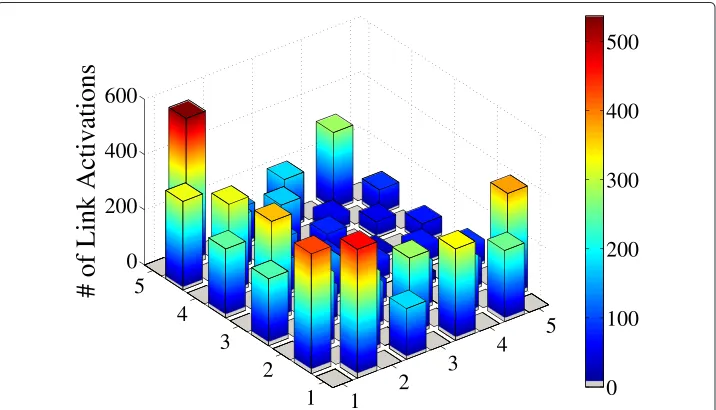
Figure 9 demonstrates the secondary link activations for the examined scenario when only one active flow between SU 11 (source, located at coordinates (1,3) - see also Figure 7) and SU 15 (destination, located at coordinates (5,3) - see also Figure 7) exists in the secondary network. Specifically, at each time slott, the source generates - with prob-ability 50%−ns = 10 packets for its corresponding destination, while the simulations
run over 1,000 time slots. It is observed that by utilizing weight values as defined above and leveraging the proposed SeBPeMRF framework, link activations are higher on the boundaries of the deployment area, thus prioritizing scheduling and routing on regions with lower reputation for PUs (re)appearance (Figures 7 and 8). In this manner, future disruptions caused by PU (re)activations are less probable to occur since the majority of
1
2
3
4
5
1
2
3
4
5
0
200
400
600
# of Link Activations
0
100
200
300
400
500
the data travel through forwarding paths with lower reputation for volatile primary
activ-ity and not through the shortest path, i.e., 11 → 12 →13 → 14→ 15, which crosses
the center of the deployment area. It is noted that the number of link activations nearby the source node is higher, as it was expected, due to two main reasons. First, at the early time, slots packets have not yet arrived at the neighborhood of the destination, and thus link scheduling takes place only where queues are not empty. Secondly, due to the ran-domized nature of the BP-based routing, data are not always transmitted in the direction of the destinationa, implying longer paths and higher number of link activations near the source. On the contrary, in the locality of the destination, the number of link activations is lower since the destination operates as the network sink diminishing the randomization of the forwarding paths.
Case study II: adapting routing efficiency to social layer’s needs
The second case study targets at demonstrating the benefits in a social network overlaying a CRN when the former provides feedback for the cross-layer protocol design of the latter. We assume that the traffic over the CRN is of social nature, e.g., advertisements, and also that there are no privacy issues on this traffic, i.e., the relaying nodes can decode and use themselves any information. Each relay node may segregate this traffic in two categories, namely ‘useful’ and ‘indifferent’, based on the traffic content and its interests [28]. This categorization is not strict, i.e., the nodes define probabilities that each flow’s content may be useful or indifferent. Obviously, each node prefers to relay traffic assigned by itself a higher probability of being useful (based on the social profile corresponding to the node user), and thus balance the cost of forwarding by gaining through learning via preferred information.
For demonstration purposes, we consider 14 SUs in a 2×7 grid network topology with two active flows: one with source node 1 and destination node 13 (Figure 10, red circles) and the other starting from node 2 and ending at node 14 (Figure 10, blue circles). In this case study, commodities are distinguished based on their destination, i.e., there are two commodities, namely 13 and 14. The probability that each flow’s content is useful or indifferent for a specific relay is defined via the use of similarity values. Specifically, since the content of each flow should be aligned with the social profile of its destination, the aforementioned probabilities and as a result the weight values are determined as func-tions of the similarities of the social profiles of the relay nodes with the ones of the flows’ destinations. A variety of similarity measures that can be used is listed in [29]. The simi-larity values used in our simulations are shown in Figure 10, unless differently mentioned, where the notation Sim(i,c)stands for the similarity of nodeiwith destination nodec.
The weight on the secondary links = (i,j)corresponding to commodityctakes the form:
w(i,j,c)=wm+σ0×Sim(j,c) ∀i,j,c (21)
whereσ0is a constant parameter used in combination with similarity values to control the heterogeneity of the weights as in Equation 20 andwmis a constant ensuring a
Figure 10 Topology and similarity values.There exist two flows, one from node 1 to 13 (red circles) and another from node 2 to 14 (blue circles).
social profiles. For the simulation results that follow, at each time slot, each source with probability 20% produces a constant number of packets (ranging from 2 to 16), while each simulation runs for 500 time slots. Note that for all simulations, the links initiating from the sources are assigned the maximum possible weight value (i.e., for similarity equal to 1) for the corresponding flow so as to encourage packet releasing towards the network.
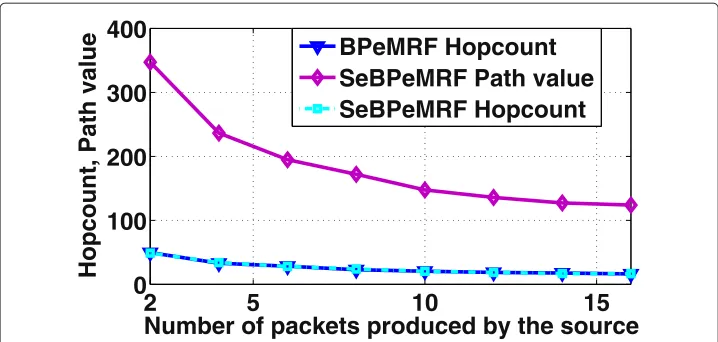
To begin with, we evaluate the improvement in the social layer’s performance that can be achieved via SeBPeMRF algorithm, by comparing BPeMRF with SeBPeMRF with
parameters σ0 = 10, wm = 1. Note that in this case, w
13 max
w13min = w14max
w14min =
11
2
5
10
15
0
100
200
300
400
Number of packets produced by the source
Hopcount, Path value
BPeMRF Hopcount
SeBPeMRF Path value
SeBPeMRF Hopcount
Figure 11 Comparison of the hopcount and the path value between BPeMRF and SeBPeMRF (scenario 1).
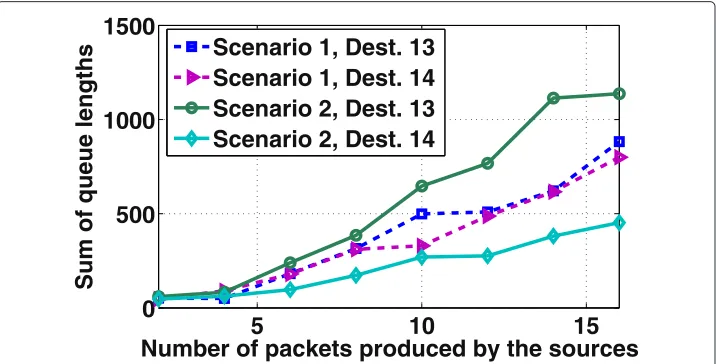
assigned the highest weight value equal to 10 (not including sources and destinations) and the opposite holds for destination 14. Then, the order of the path value compared with the hopcount (the latter is around six to seven times higher than the former for higher loads) illustrates the fact that most packets targeted to node 13 are forwarded from the right hand side of the topology and most packets targeted to node 14 are forwarded from the left hand side of the topology. Thus, SeBPeMRF tries to locate chains of interested nodes which implies that its efficiency will increase in areas where the nodes interested in a specific content are clustered, such as Figure 10. Morever, note that although hop-count initially decreases (this is due to BP’s high delay under light traffic conditions, Figure 5) and then seems to be almost constant, the path value decreases as the input traffic increases due to the formula ofλa1(Equation 12) which also takes into consider-ation the congestion via the queue backlogs. Thus, higher input traffic corresponds to higher congestion which reduces the path values due to the support of alternative links with lower weight values but with less congestion for the specific flow. Figure 12 indicates that BPeMRF and SeBPeMRF behave similarly with respect to the sum of queue lengths corresponding to packets that have not reached their destination, i.e., the loss in capacity