Dr. Neelam Balekar College of Pharmacy,
IPS Academy, A.B. Road Rajendra Nagar, Indore, India- 452012
E-mail: [email protected]
Address for correspondence
Access this article online www.japer.in
Antidiarrheal potential of ethanolic leaf extract of
Malvastrum
tricuspidatum in
albino rats
1. INTRODUCTION
Diarrhea involves an increase in the fluidity, volume and frequency of bowel movements resulting in loss of water and electrolytes. Diarrhea accounts for more than 5.8 million death each year in the developing countries (1). Generally, the treatment of diarrhea is non-specific, and is usually aimed at reducing the discomfort and inconveniences of frequent bowel movements; the world health organization (WHO) has constituted a diarrheal disease control programme (CDD) which includes the study of traditional herbal medicines (2).
The plant Malvastrum tricuspidatum (family- Malvaceae) commonly known as False mallow or kharenti has many medicinal properties viz., leaves are applied to inflammed sores and wound, plant
decoction is given in dysentery, flowers used in cough, chest and lung diseases (3). M. tricuspidatum is used in traditional medicine as an anti-inflammatory, analgesic, in jaundice, and ulcers. It is reported to possess anti-inflammatory, analgesic, antibacterial, hypoglycemic, and antipyretic activity (4). However, there is limited scientific evidence supporting the potential use of M. tricuspidatum as an antidiarrheal agent.
The aim of the present study was to evaluate the possible antidiarrheal (in vivo) properties of the leaves extract of M. tricuspidatum on castor oil-induced diarrhea, castor oil and magnesium sulphate induced enteropooling, and gastrointestinal motility test using the charcoal meal method, in order to establish the claimed biological activity of this plant.
2. MATERIALS AND METHODS 2.1 Plant material and chemicals
Leaves of M. tricuspidatum were collected from local gardens of Indore, Madhya Pradesh, India in January 2009 and duly identified by a plant taxonomist. Voucher specimens are kept under reference no.
Objective: To investigate the in vivo antidiarrheal effect of the ethanolic extract of leaves of Malvastrum tricuspidatum in rats, evaluated by castor oil, magnesium sulphate and charcoal.
Methods: The extract was evaluated for activity by three different approaches castor oil–induced diarrhea, castor oil and magnesium sulphate-induced enteropooling and gastrointestinal motility test using charcoal meal. Initially assayed at the doses 100, 250, and 500 mg/kg, p.o. Atropine (5 mg/kg p.o.), Loperamide (3 mg/kg) was used as a standard drug.
Result: The 500 mg/kg dose of ethanol extract showed significant (p < 0.05) activity against castor oil–induced diarrhea. Hence, this dose level was selected significantly and used in other models. The extract was found to inhibit intrafluid accumulation in castor oil as well as magnesium sulphate induced enteropooling, also a significant reduction in the gastrointestinal motility in charcoal meal test confirming its antidiarrheal activity.
Conclusion: The result support continued investigation of components of ethnomedicinal use of M. tricuspidatum leaves as a valuable natural remedy for the treatment, management and control of diarrhea.
Keywords: Malvastrum tricuspidatum, anti-diarrheal activity, castor oil, charcoal, magnesium sulphate, enteropooling.
ABSTRACT Neelam Balekar*, Gaurav
Parihar, Dinesh Kumar Jain, Shreya Gupta
College of Pharmacy, IPS Academy, Indore, India 452012
SHREGMAT4 at the Herbarium of the Department of Botany, Botanical Survey of India, Pune. Atropine sulphate and loperamide (SD fine, Bangalore) served as a standard drug for castor oil induced diarrhea, enteropooling and small intestine transit time. All the chemicals and reagent used were of analytical grade, castor oil (laxative agents), normal saline solution (0.9% NaCl), charcoal meal (10% activated charcoal in 0.5% w/v sodium carboxy methyl cellulose) and vehicle (0.5% w/v sodium carboxy methyl cellulose) were obtained from Kasliwal Brothers, Indore, India.
2.2 Extraction procedure
The leaves of M. tricuspidatum was shade dried, coarsely powdered and defatted by maceration with petroleum ether for 48 h. The defatted marc was then subjected to Soxhlet extraction with 95% ethanol (2.5 L) at (60-80 ºC). The solvent was filtered through Whatman No. 1 filter paper and evaporated to dryness under vacuum at 40 ºC using rotary evaporator. The ethanolic extract was stored in tightly closed container labeled as MTEE and kept in refrigerator until use. The drug extract was suspended in sodium carboxymethyl cellulose (Na CMC 0.5% w/v).
2.3 Phytochemical analysis
The ethanolic extract was tested qualitatively for presence of different phytoconstituents like tannins, glycosides, flavonoids, saponins, alkaloids, carbohydrates, sterols, proteins using standard methods and screened quantitatively for content of total alkaloid (5), total phenols by Folin-Ciocalteu method and the total flavanoid content (6).
2.4 Animals
Wistar rats of either sex weighing 120-200 g were used. The animals were housed under standard conditions, maintained on a 12 h light/dark cycle and had free access to food and water up to the time of experimentation. The animals were acclimatized to the laboratory environment for one week before the experiments. All experimental protocols were
approved by the Institutional Animal Ethics Committee (IAEC).
2.5 Castor oil induced diarrhea
The method of Teke et al., (2007) was followed; overnight-fasted mice were divided into five groups of six animals each, and diarrhea was induced by administering 1ml of castor oil (S. D. Fine Chem., India) orally to mice. Group I served as control (0.5% sodium carboxymethyl cellulose (Na CMC) suspension, p.o.); Group II (standard) was treated with loperamide (3 mg/kg p.o.), a positive control groups III–V received 100, 250 and 500mg/kg p.o. doses of MTEE. After 1h of treatment, all the animals were challenged with castor oil and placed separately over clean filter papers inside cages. The filter papers were inspected for the presence of diarrheal droppings at hourly intervals for a period of 4h (7).
2.6 Gastrointestinal motility test
Rats were fasted for 18 h and divided into three groups of six animals each, Group I received 0.5% w/v Sodium CMC, group II received atropine (5mg/kg, i.p.), Group III received orally 500 mg/kg extract of MTEE. One hour later castor oil was given orally to all groups. Marker 0.25 ml (10% charcoal suspension in 5% Na CMC) was administered orally 1 h after the administration of castor oil. The rats were sacrificed after thirty minutes and the distance travelled by charcoal meal from the pylorus was measured and expressed as percentage of the total length of the intestine from the pylorus to caecum. This distance was expressed as a percentage of the length of the small intestine (7).
% Inhibition = Mc – Md/Mc × 100 Mc: mean distance travelled by charcoal meal; Md: mean distance travelled by drug or extract.
2.7 Castor oil-induced enteropooling
received loperamide (3mg/kg, p.o.) and group III received MTEE 500 mg/kg p.o., one hour before the oral administration of castor oil. One hour later the rats were sacrificed; the small intestine was removed after tying the ends with thread and weighed. The intestinal contents were collected by milking into a graduated tube and their volume was measured. The intestine was reweighed and the difference between full and empty intestines was calculated (8).
2.8 Magnesium sulphate-induced enteropooling Albino rats of either sex (200-250g) were divided into three groups of six rats each. They were fasted 24 h prior to the experiment, but allowed free access to water. Group I (controls) was treated with (2 ml p.o.) normal saline, Group II was treated with standard drug (Loperamide 3mg/ kg), Group III received MTEE 500 mg/kg p. o. Thirty minutes later, all the rats were challenged with 1ml magnesium sulphate (10 % w/v) orally. After thirty minutes, each rat was sacrificed the small intestine was removed after tying the ends with threads and weighed and the whole length of the intestine from the pylorus to the contents was expelled into a measuring cylinder and the volume measured. The intestine was reweighed and the difference between the full and empty weights calculated (8).
2.9 Statistical analysis
Data were expressed in as the mean ± standard error of mean (S.E.M.) and statistical analysis was carried out employing one way analysis of variance (ANOVA) followed by Tukey-Kramer multiple comparison test at p < 0.05 significance level using “Graphpad Instat” version 3.00 for Windows 95, Graphpad Software, San Diego, California, USA (www.graphpad.com).
3. RESULTS
3.1 Phytochemical investigation of M. tricuspidatum
The percentage yields of the MTEE were found to be 6.78%. Phytochemical analysis of the crude extract
gave positive reaction for each of the following secondary metabolites: Tannins, saponins, terpenes, steroids, alkaloids, flavonoids and carbohydrates. Results from the quantitative estimation of total alkaloids (g %) content was 6.00 ± 0.14, total flavonoid content (mg quercetin equivalent/g of extract) was 16.2 ± 0.3 and total phenolic content (mg tannic acid equivalent/g of extract) was 24.6 ± 0.84.
3.2 Effects of the MTEE on castor oil-induced diarrhea.
Pretreatment of rats with ethanolic extract of M.
tricuspidatum (MTEE 100, 250, and 500 mg/kg, p.o.)
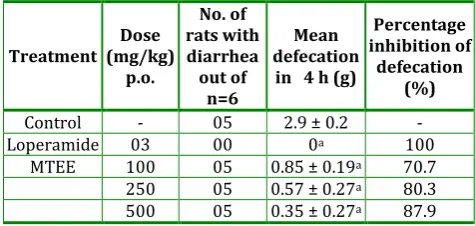
significantly (p < 0.05) reduced the number of diarrheal episodes in a dose-dependent manner when compared with the untreated controls animals which produced copious diarrhea. MTEE treatment showed a reduction in the number of fecal episodes, delayed the onset of diarrhea, reduced the frequency of defecation and the wetness of the fecal droppings (reduction in the no. of wet stool and the general diarrheal scores including the hard and copious stool. Whereas Loperamide (3mg/kg) produced greater (p < 0.05) inhibitory effect in all the diarrheal parameters (Table I).
3.3 Effects of the ethanolic extract of M. tricuspidatum on gastrointestinal motility test The ethanolic extract (MTEE 500 mg/kg p.o.) significantly (p < 0.05) slowed down the propulsion. The percentage intestinal transit produced by MTEE 500 mg/kg p.o. was (34.0 ± 2.5) comparable with the standard antidiarrheal drug, atropine (5 mg/kg, p.o.) which was 30.2 ± 0.8 (Table II).
3.4 Effects of the MTEE on castor oil-induced enteropooling
treated with normal saline (2 ml p.o.). At 500 mg/kg dose, MTEE showed a significant (p < 0.05) reduce in castor oil-induced enteropooling in rats (Table III) compared with the vehicle control. The reduction in the intestinal fluid accumulation by the standard drug loperamide (3mg/kg), produced a marked and significantly greater (p < 0.05) inhibitory effect on fluid accumulation than the control group.
3.5 Effects of the MTEE on magnesium sulphate-induced enteropooling
M. tricuspidatum was found to possess
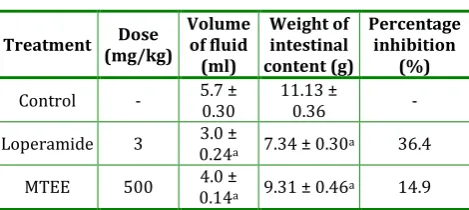
anti-enteropooling activity on magnesium sulphate-induced enteropooling. The extract significantly (p < 0.05) decreased intestinal fluid volume in rats. The extract MTEE significantly inhibited the magnesium sulphate-induced enteropooling in rats when compared with the control group. The standard antidiarrheal drug, loperamide (3 mg/kg, p.o.), produced a more marked and significantly (p < 0.05) greater activity than the MTEE (Table IV). However, the effect of the extract was less potent in comparison to the standard drug, loperamide
4. DISCUSSION
Diarrheas have long been recognized as one of the most common health problems in developing countries (9). Diarrhoea (Greek and Latin: dia, through, and rheein, to flow or run) is the passage of loose or watery stools, usually at least three times in a 24-hour period (10). The main feature of the small intestine is to absorb and excrete materials. An imbalance in the absorptive and secretory mechanisms in the intestinal tract accompanied by intestinal hurry results in frequent loose stools or diarrhea. This study involved evaluation of the anti-diarrheal activity of the ethanolic leaf extract of M.
tricuspidatum preliminary on castor oil induced
diarrhea in albino rats using loperamide as positive control, and then single effective dose 500 mg/kg on gastric motility and enteropooling. Diarrhea is usually considered a result of altered motility and fluid
accumulation within the intestinal tract. Many antidiarrheal agents act by reducing the gastrointestinal motility and/or the secretions. The World Health Organization estimated that 80% of the population of developing countries still relies on traditional medicines. People customarily using the plant(s) or plant-derived preparations consider them to be efficacious against diarrheal disorders without any scientific basis to explain the action of such plants (11).
The use of castor oil induced diarrhoea model in our study, is well justified because the autocoids and prostaglandins are involved, these have been implicated in the causation of diarrhoeas. The liberation of ricinoleic acid from castor oil results in irritation and inflammation of the intestinal mucosa, leading to release of prostaglandins, which stimulate motility and secretion (12).
In this study, the antimuscarinic drug atropine produced a significant reduction in the number of stools and increased intestinal transit time, atropine and the MTEE decreased the propulsive movement in the charcoal meal study, this effect is possibly due to its anti-cholinergic effect (13). However, it did not inhibit castor oil induced enteropooling and gain in weight of intestinal content suggesting thereby that mediators other than acetylcholine are involved in castor oil induced enteropooling. An increase in intestinal transit time with atropine could also result due to reduction in gastric emptying (14).
and hydroelectrolyte secretion (18) , which increase in diarrhea. Phenolics has also shown to prevent the increase in colonic motility induced by corticotrophin-releasing factor through 5-HT3 receptor in the
proximal colon and through 5-HT4 receptors in the
distal colon The site(s) and number of hydroxyl groups on the phenol group are thought to be related to their relative toxicity to microorganisms (19). The secretory diarrhoea is associated with an activation of Cl- channels, causing Cl- efflux from the
cell, the efflux of Cl- results in massive secretion of
water into the intestinal lumen and profuse watery diarrhea (20). The MTEE may inhibit the secretion of the water into the lumen by reverting this mechanism. Anti-dysentric and antidiarrheal properties of medicinal plants were found to be due to tannins, alkaloids, saponins, flavonoids, sterols and/or triterpenes and reducing sugars (16). The preliminary phytochemical analysis of the leaves extract of M.
tricuspidatum reaveled the presence of sugars,
alkaloids, phenols, flavonoides, isothiocynates, thiocarabamate glycosides, tannins (21). The leaves contains lactone (sesquiterpene), malvastrone, was isolated from the leaves and its structure established as 2-(pentyrolactone)-hendecane (22). Many studies indicates the use of sesquiterpene lactone as an antidiarrhoeal agent (23). These constituent may mediated the antidiarrhoeal activity of the leaf extract of M. tricuspidatum. Therefore it is possible that the antisecretory, anti-inflammatory and antioxidant properties of flavonoids could be responsible for the antidiarrhea activity of M. tricuspidatum. Therefore a combination of phytoconstiuents presumably led to a synergistic anti-diarrheal activity in albino rats. The significant inhibition of the castor oil-induced enteropooling in rats suggests that M. tricuspidatum
leaf extract produces relief in diarrhea by spasmolytic activity in vivo and also anti-enteropooling effects. The overall possible mechanism may be due to, inhibition of release of autocoids and prostaglandins thus inhibiting the motility and secretion induced by
castor oil or alteration of the activity of Na+K+ATPase
or activation of chloride channels (24).
Standard drug loperamide, which at present is one of the most efficacious and widely employed antidiarrheal drug. The antidiarrheal activity of the plant extract was not comparable to the standard drug. Loperamide reported to antagonizes diarrheal activity induced by castor oil, prostaglandins or cholera toxin very effectively (25). It also slow down transit in the intestine, reduce colon flow rates and colonic motility.
In conclusion, the remarkable antidiarrhoeal effect of
M. tricuspidatum leaf extract against castor oil induced
diarrhea model attest to a wide range of utility in secretory and functional diarrheas. Whatever, may be the mechanism of action, M. tricuspidatum leaf extract may be useful in a wide range of diarrheal states due to both disorders of transit. Further studies are required to fully investigate the phytoconstituents responsible for this observed antidiarrheal activity.
Table 1: Effect of MTEE on castor oil induced diarrhea.
Treatment (mg/kg) Dose p.o.
No. of rats with diarrhea out of
n=6
Mean defecation
in 4 h (g)
Percentage inhibition of
defecation (%)
Control - 05 2.9 ± 0.2 - Loperamide 03 00 0a 100
MTEE 100 05 0.85 ± 0.19a 70.7
250 05 0.57 ± 0.27a 80.3
500 05 0.35 ± 0.27a 87.9
MTEE = Malvastrum tricuspidatum ethanolic extract ; LOP = Loperamide. ap<0.05= compared to control
group
Results are expressed as mean ± SEM; n=6 in each group comparison made with control (0.5% NaCMC) group and with standard (loperamide 3 mg/kg) group. Data was analyzed by one way ANOVA followed by Tukey Kramer multiple comparison test.
Table 2: Effect of MTEE on gastrointestinal motility test.
Treatment (mg/kg) Dose Movement of charcoal meal (%)
Control - 81.5 ± 6.9 Atropine Sulphate 5 30.2 ± 0.8a
MTEE = Malvastrum tricuspidatum ethanolic extract.
ap<0.05= compared to control group
Results are expressed as mean ± SEM; n=6 in each group comparison made with control (0.5% NaCMC) group and with standard (Atropine sulphate 5 mg/kg) group. Data was analyzed by one way ANOVA followed by Tukey Kramer multiple comparison test.
Table 3: Effect of MTEE on castor oil-induced enteropooling
Treatment (mg/kg) Dose Volume of fluid (ml)
Weight of intestinal contents
(g)
Percentage inhibition
(%)
Control - 1.9 ± 0.3 2.5± 0.6 - Loperamide 3 0.65 ± 0.40a 0.80 ± 0.4a 68
MTEE 500 0.141.6 ± a 1.04 ± 0.49a 54
MTEE = Malvastrum tricuspidatum ethanolic extract.
ap<0.05= compared to control group
Results are expressed as mean ± SEM; n=6 in each group comparison made with control (2 ml normal saline) group and with standard (loperamide 3 mg/kg) group. Data was analyzed by one way ANOVA followed by Tukey Kramer multiple comparison test.
Table 4: Effect of MTEE on magnesium sulphate-induced enteropooling
Treatment (mg/kg) Dose Volume of fluid (ml)
Weight of intestinal content (g)
Percentage inhibition
(%)
Control - 5.7 ± 0.30 11.13 ± 0.36 -
Loperamide 3 0.243.0 ± a 7.34 ± 0.30a 36.4
MTEE 500 0.144.0 ± a 9.31 ± 0.46a 14.9
MTEE = Malvastrum tricuspidatum ethanolic extract.
ap<0.05= compared to control group.
Results are expressed as mean ± SEM; n=6 in each group comparison made with control (2 ml normal saline) group and with standard (loperamide 3 mg/kg) group. Data was analyzed by one way ANOVA followed by Tukey Kramer multiple comparison test.
CONFLICTS OF INTEREST STATEMENT The authors report no conflicts of interest
ACKNOWLEDGMENT
We gratefully acknowledge the financial support by College of Pharmacy, IPS Academy, Indore, India.
REFERENCES
1. Middaugh, L. D., D. Dow-Edwards, A. A. Li, J. D. Sandler, J. Seed, L. P. Sheets, D. L. Shuey, W. Slikker, Jr., W. P. Weisenburger, L. D. Wise and M. R. Selwyn: Neurobehavioral assessment: a survey of use and value in safety assessment studies. Toxicol Sci 76, 250-61 (2003)
2. Akuodor, G.C., I. Muazzam, M. Idris, U.A. Megwas, J.L. Akpan, K.C. Chilaka, D.O. Okoroafor and U.A. Osunkwo: Evaluation of the antidiarrheal activity of methanol leaf extract of Bombax buonopozense in rats. Ibnosina J Med BS 3, 15-20 (2011).
3. Lima T.B., O.N. Silva, L.P. Silva, T.L. Rocha, O.M.F. Grossi-de-Sá, L. Franco and L. Leonardecz: In vivo effects of Cagaita (Eugenia dysenterica, DC.) leaf extracts on diarrheal treatment. J Evid Based Complementary Altern Med 1-11 (2011).
4. Shrivastava C. Diversity of medicinal plants in northern-eastern Uttarpradesh. J. Econ. Taxon. Bot.; 33: 231-274 (2009).
5. Andrade-Cetto A., Heinrich M. Mexican plants with hypoglycemic effect used in the treatment of diabetes. J. Ethnopharmacol.; 99: 325-328 (2005). 6. Selvamathy S.M., Saranya P., Jeyachristy A., Geetha A.,
Amudhavalli K. Antioxidant and free radical scavenging activity of Swertia chirayita. Adv. Pharmacol. Toxicol.; 9: 21-27 (2008).
7. Pal R.S., Aasivakumar G., Girhepunje K., Upadhyay A. In vitro antioxidative activity of phenolic and flavonoid compounds extracted from seeds of Abrus precatoriu. Int. J. Pharm. Pharm. Sci.; 1: 136-140 (2009).
8. Balekar N., Jain D.K., Dixit P., Nair V. Evaluation of antidiarrheal activity of stem bark extract of Albizzia lebbeck Linn.in rats. Songklanakarin J. Sci. Technol.; 34(3): 317-322 (2010).
10. Maridass M. Anti diarrhoeal activity of rare orchid Eulophia epidendraea (Retz.) Fisher Nat. Pharm. Tech.;1(1):5-10 (2011).
11. Owolabi O.J., Omogbai E.K.I., Oduru E.E. Antidiarrhoeal evaluation of the aqueous leaves extract of Costus lucanusianus-Family Costaceae. J. Applied Sci. Res.; 3(12):2052-55 (2007).
12. Umamaheswari A., Shreevidya R., Nuni A. In vitro antibacterial activity of Bougainvillea spectabilis leaves extracts. Ad. Biol. Res.; 2(1-2): 1-5 (2008). 13. Ezeonwumelu J.O.C, Omolo R.G., Ajayi A.M., Agwu E.,
Tanayen J.K., Adiukwu C.P., Oyewale A.A., Adzu B., Okoruwa A.G. and Ogbonnia S.O. Studies of phytochemical screening, acute toxicity and anti-diarrhoeal effect of aqueous extract of kenyan Tithonia diversifolia leaves in rats. British. J. Pharmacol. Toxicol.; 3(3): 127-134 (2012).
14. Rahman Md. K., Barua S, Islam Md. F., Islam Md. R, Sayeed M A, Parvin Mst. S. and Islam Md. E. Studies on the anti-diarrheal properties of leaf extract of Desmodium puchellum. Asian. Pac. J. Trop. Biomed. 2013; 3(8): 639–643 (2013).
15. Sireeratawong S., Khonsung P., NannaU., Vannasiri S., Lertprasertsuke N., Singhalak T.,
Soonthornchareonnon N., and Jaijoy K. Anti-Diarrheal Activity and Toxicity of Learng Pid Samud Recipe Afr. J. Tradit. Complement Altern. Med.; 9(4): 519–529 (2012).
16. Yadav A.K., Tangpu V. Antidiarrheal activity of Lithocarpus dealbata and Urena lobata extracts: therapeutic implications. Pharm. Biol.; 45(3):223– 229 (2007).
17. Venkatesan N., Thiyagarajan V., Narayanan S., Arul A., Raja S., Kumar S.G.V., Rajarajan T., Perianayagam J.B. Antidiarrheal potential of Asparagus racemous wild root extracts in laboratory animals. J. Pharm. Pharmaceut. Sci.; 8(1):39–45 (2005).
18. Belemtougri R.G., Constantin B., Cognard C., Raymond G., Sawadogo L. Effects of two medicinal plants Psidium guajava L. (Myrtaceae) and Diospyros mespiliformis L. (Ebenaceae) leaf extracts on rat skeletal muscle cells in primary culture. J. Zhejiang Univ. Science B; 7(1):56–63 (2006).
19. Daswani P.D., Brijesh S., Tetali P., Antia N.H., Birdi T.J. Antidiarrhoeal activity of Zingiber officinale (Rosc.). Curr. Sci.; 98(2):222–229 (2010).
20. Ataka K., Kuge T., Fujino K., Takahashi T., Fujimiya M. Wood creosote prevents CRF-induced motility via 5-HT3 receptors in proximal and 5-HT4 receptors in
distal colon in rats. Auton. Neurosci.; 133: 136–145 (2007).
21. Hossain H., Howlader MD. S.I., Kantidey S, Hira A, Ahmed A. Antinociceptive and antidiarrhoeal activities of ethanolic leaf extract of Tiliacora acuminata (LAM.) Miers. Turk. J. Pharm. Sci.; 10(3),393-404 (2013).
22. Gangrade N.K., Sheorey R.V., Rawal H., Chouhan S. Investigation of wound healing activity of Malvastrum Tricuspidatum syn Malvastrum coromandelianum on experimental animals. Int. J. Pharm. Life Sci.; 3(12):1-6 (2012).
23. Balekar N., Ghule S., Dixit P., Jain D.K., Tandan V. Immunopotentiating properties of ethanolic extract of Malvastrum tricuspidatum A. Gray whole plant. Indian J. Nat. Prod. Res.; 4(1): 54-60 (2013).
24. Negi J.S., Bisht V.K., Bhandari A.K., Bhatt V.P., Sati M.K., Mohanty J.P., Sundriyal R.C. Antidiarrheal activity of methanol extract and major essential oil contents of Saussurea lappa Clarke. Afr. J. Pharmacy and Pharmacol.; 7(8): 474-477 (2013).
25. Saralaya M. G., Patel P., Patel M., Roy SP, Patel A. N. Antidiarrheal activity of methanolic extract of Moringa oleifera lam roots in experimental animal models. Int. J. Pharm. Res.; 2(2) 35-39 (2010). 26. Nasrin F., Nahar L. Antidiarhoeal activity of Cucumis
sativus leaves. Int. J. Pharm. Drug Ana.; 2(2):106-110 (2012).
How to cite this article: Neelam Balekar*, Gaurav Parihar, Dinesh Kumar Jain, Shreya Gupta; Antidiarrheal potential of ethanolic leaf extract of
Malvastrum tricuspidatum in albino rats; J. Adv.
Pharm. Edu. & Res. 2014: 4(2): 233-239.