A NEW EFFICIENT KEY AGREEMENT SCHEME FOR VSAT SATELLITE
COMMUNICATIONS BASED ON ELLIPTIC CURVE CRYPTOSYSTEM
Jeong-Woo Hong,Sang-Yoon Yoon,Dong-In Park Korea Institute of Science and Technology Information, 335 Gwahangno, Yuseong-Gu, Daejeon 305-806, South Korea e-mail: [email protected], [email protected], [email protected]
Myung-Jin Choi
Satellite Information Research Institute, Korea Aerospace Research Institute, 45 Eoeun-Dong, Yuseong-Gu, Daejeon 305-333, South Korea
e-mail: [email protected]
Eun-Jun Yoon,Kee-Young Yoo*
School of Electrical Engineering and Computer Science, Kyungpook National University, 1370 Sankyuk-Dong, Buk-Gu, Daegu 702-701, South Korea
e-mail: [email protected], [email protected]
Abstract. A satellite communication is suitable for broadcasting service and long-hual transmission based on telecom-munications. In the satellite communication environment, unauthorized user should not have to obtain his/her required services from the satellite communication systems without authentication. Therefore, authentication is an important security technique to prevent illegal service requests. Quite recently, Lee-Lin-Hwang[C. C. Lee, T. C. Lin, M. S. Hwang. A key agreement scheme for satellite communications, Information Technology and Control, 2010, Vol. 39, No. 1, 43-47.]proposed a se-cure scheme based on key agreement scheme with mutual authentication to solve the security problems on the VSAT satellite communications. However, Lee-Lin-Hwang’s scheme is inefficiently designed because it is based on the RSA cryptosystem. Therefore, the scheme cannot be applicable for the low-power satellite communication environments because it involves high communication and computation costs. Based on these motivations, this paper proposes a new efficient and secure key agree-ment scheme for VSAT satellite communications based on elliptic curve cryptosystem (ECC) to minimize the complexity of computational costs between VSAT and HUB and fit VSAT satellite communication environments. Compared with previous schemes, the newly proposed scheme has the following more practical merits: (1) it provides secure session key agreement function by adopting elliptic curve cryptosystem, (2) it can reduce the total execution time and memory requirement due to the elliptic curve cryptography, and (3) it not only is secure against well-known cryptographical attacks but also provides perfect forward secrecy. As a result, the proposed scheme is extremely suitable for use in satellite communication environments since it provides security, reliability, and efficiency.
Keywords:authentication, VSAT, key agreement, satellite communication, elliptic curve cryptosystem.
1. Introduction
In general, a satellite communication is suitable for broadcasting service and long-hual transmission based on telecommunications. Due to the rapid de-velopment of satellite communication technology, a low-cost very small aperture terminal (VSAT) net-work can be used for data, voice, and video communi-cations [1–3]. If we do not apply security technology for the satellite communication systems, it can be vul-nerable to unauthorized access to the transmitted data.
niques can be used to protect data communication in satellite communications [4–6].
+8% (TXLSPHQW
+8%6,7(
96$7
8VHUĜV&HQWUDO &RPSXWHU
96$7
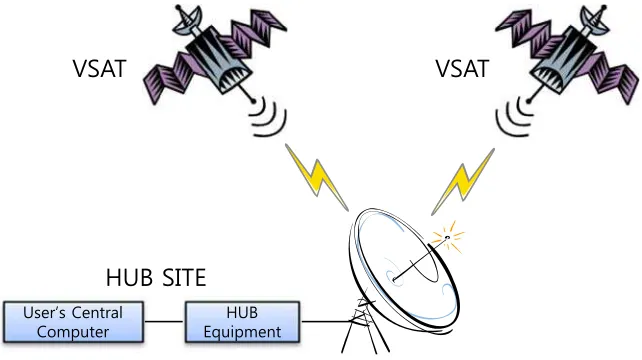
Figure 1. Satellite communication environment
security problems on the VSAT satellite communica-tions (From here, we call this scheme LLH). Com-paring with other key distribution schemes for VSAT satellite communications, LLH scheme is more se-cure and efficient. Nevertheless, we can find out that all previously proposed schemes are inefficiently de-signed because they are based on the RSA cryptosys-tem. It means that the schemes are not efficient and not applicable for the low-power satellite communi-cation environments because they involve high com-munication and computation costs.
Based on these motivations, this paper proposes a new efficient and secure key agreement scheme for VSAT satellite communications based on elliptic curve cryptosystem (ECC) to minimize the complex-ity of computational costs between VSAT and HUB and fit VSAT satellite communication environments. In order to exploit the key block size, speed, and secu-rity jointly, the proposed scheme is based on one-way hash function and elliptic curve cryptography [11– 13]. ECC presents an attractive alternative cryptosys-tem, because its security is based on the elliptic curve discrete logarithm problem (ECDLP) and it operates over a group of points on an elliptic curve. It can offer a level of security comparable to the classical cryptosystems that use much larger key sizes. Gen-erally, the elliptic curve discrete logarithm problem (ECDLP) with an order of 160 bit prime offers ap-proximately the same level of security as the discrete logarithm problem (DLP) with 1024 bit modulus [11– 14]. Therefore, the proposed scheme can reduce the total execution time and memory requirement in com-parison with previous related schemes. By adopting the ECC-based key agreement technique, the pro-posed scheme can provide strong and efficient key
agreement function with the property of perfect for-ward secrecy to reduce the computation loads for the VSAT. To provide practicality, the proposed scheme is composed of three sub-phases, which are initial-ization, VSAT registration, and common key agree-ment. Compared with previous schemes, the newly proposed scheme has the following more practical merits: (1) it provides secure session key agreement function by adopting elliptic curve cryptosystem, (2) it can reduce the total execution time and memory re-quirement due to the elliptic curve cryptography, and (3) it not only is secure against well-known crypto-graphical attacks but also provides perfect forward se-crecy. As a result, compared with related schemes, the proposed scheme has strong security and enhanced computational efficiency. Thus, the proposed scheme is extremely suitable for use in satellite communica-tion environments since it provides security, reliabil-ity, and efficiency.
The rest of this paper is organized as follows: Section 2 introduces the basic concept of VSAT satel-lite communication environment and elliptic curve cryptosystem, respectively. Section 3 briefly reviews the LLH scheme. The proposed scheme is presented in Section 4, while Section 5 discusses the security and efficiency of the proposed scheme. The conclu-sion is given in Section 6.
2. Preliminaries
mod
mod ( , ( )) mod
h
R h
d
v v
h h v h
X g N
S ID N
Y h X h S t N
!
!
! "
HUB ( )d
?
VerifyYh!h X( h, (h Sv"th)) modN ,
v v X Y
, h h X Y
VSAT (Sv)
mod
( , ( )) mod v
R v
v v v v
X g N
Y h X h S t N
!
! "
Common Session Key ( )Rv ( )Rh R Rv hmod
hv h v
W ! X ! X !g # N
?
VerifyYv!h X( v, (h Sv"tv)) modN
Figure 2. Common key generation phase of the LLH scheme
2.1. VSAT Satellite Communication Environment Fig. 1 shows the proposed satellite communica-tion environment. A VSAT network environment has a star configuration. It includes many VSATs and a single HUB. The HUB can communicate with the VSATs via the outbound links (HUB-to-VSAT) [15– 17]. Contrary, a number of remote VSATs can com-municate with the HUB via the inbound links (VSAT-to-HUB). The VSAT satellite communications have the following advantages [18, 19]: (1) high reliability, (2) high quality of transmission, (3) low cost com-munication, (4) good usage rates (e.g. independent of distance), (5) simple network installation, operation, and management. Digital video broadcasting (DVB) return channel system (DVB-RCS) [20, 21] is the best known application of satellite technology, and was standardized by the European Telecommunica-tions Standards Institute (ETSI) [22].
In the satellite communication environment, each VSAT must perform common key generation phase procedure to authenticate the HUB for a transaction. Basically, each VSAT must register with the HUB site to obtain a secret key. Then, the VSAT uses the ob-tained secret key to perform the common key genera-tion procedures with the HUB.
2.2. Elliptic Curve Cryptosystem (ECC)
ECC was first proposed by Koblitz [11] and Miller [12], and its security was based upon the dif-ficulty of elliptic curve discrete logarithm problem (ECDLP). Compared with public key cryptosystem (PKC), ECC offers a better performance because it can achieve the same security with a smaller key size. For example, 160-bit ECC and 1024-bit RSA have the same security level in practice [13]. Thus, ECC-based authentication schemes are more suitable for smart cards and mobile devices than PKC-based ones.
An elliptic curve is a cubic equation of the form as follows:
y2+axy+by=x3+cx2+dx+e (1) wherea,b,c,d, andeare real numbers. In an ellip-tic curve cryptosystem, the ellipellip-tic curve equation is defined as the form of
Ep(a, b) :y2=x3+ax+b(modp) (2) over a prime finite fieldFp, wherea, b∈Fp,p >3,
and4a3+ 27b2 6= 0(modp). Given an integers ∈ F∗
p and a pointP ∈Ep(a, b), the point multiplication sP overEp(a, b)can be defined as
sP =P| +P+{z· · ·+P} s times
. (3)
More details of ECC definitions can be found in [13]. Generally, the security of ECC relies on the difficul-ties of the following problems.
Definition 1. Given two pointsPandQoverEp(a, b),
the elliptic curve discrete logarithm problem (ECDLP) is to find an integers∈F∗
p such thatQ=sP.
Definition 2. Given three pointsP,sP, andtP over Ep(a, b) for s, t ∈ Fp∗, the computational
Diffie-Hellman problem (CDHP) is to find the point stP overEp(a, b).
Definition 3. Given two pointsPandQ=sP+tP overEp(a, b)fors, t ∈Fp∗, the elliptic curve
factor-ization problem (ECFP) is to find two pointssP and tP overEp(a, b).
( , ) Store ( , ) into Database
v v
v v
S h ID d
ID S
HUB ( )d
v ID
v S
VSAT (IDv)
SelectIDv
[Secure Channel]
Figure 3. Proposed VSAT registration phase
3. LLH Scheme
The LLH scheme is composed of two phases: the initiation phase and the common key generation phase.
3.1. Initiation Phase
HUB is assigned to the key distribution center. The HUB generates two prime numberspandq, and computes N = p· q, chooses a random number d, and chooses a small prime e such that e·d ≡ 1 mod (p−1)(q−1). The HUB selects an integer g, which is the primitive element of bothGF(p)and GF(q). The HUB calculates the VSAT’s secret key Sv = IDv−dmodN. Then the HUB storesp,q, d
and publishesN,g,e.
3.2. Common Key Generation Phase
HUB selects a random number Rh, and then
computesXh,Sv, andYhas follows:
Xh=gRh modN, (4)
Sv=IDv−dmodN, (5) Yh=h(Xh, h(Sv⊕th)) modN. (6)
Note thatSvmay be pre-computed to reduce the
computational cost and t is time stamp. Thus, the HUB can store the VSAT’s secret keySv in his/her
database. VSAT randomly chooses a numberRv, and
calculatesXvandYvas follows:
Xv =gRv modN, (7) Yv=h(Xv, h(Sv⊕tv)) modN. (8)
After HUB and VSAT exchanging (Xh, Yh, th)
and (Xv, Yv, tv), HUB can check the validity of
VSAT by checking whether the following equation holds or not:
Yv
?
=h(Xv, h(Sv⊕tv)) modN. (9)
If the above equation holds, HUB computes the common keyWhv = (Xv)Rh = gRvRh modN. In
the same way, VSAT can check the validity of HUB by checking whether the following equation holds or not:
Yh=?h(Xh, h(Sv⊕th)) modN. (10)
If the above equation holds, VSAT computes the common keyWhv = (Xh)Rv =gRvRh modN. The
above procedure is illustrated in Fig. 2.
4. Proposed Scheme
The proposed scheme is composed of three phases: the system initiation phase, the VSAT regis-tration phase and the common key generation phase. 4.1. System Initiation Phase
In this phase, HUB is assigned to the key distri-bution center and generates parameter of the system.
1. HUB chooses an elliptic curveE over a finite fieldFp. LetE(Fp)denote the set of all the point
onE.
2. HUB chooses a base pointP∈E(Fp), such that
the subgroup generated byPhas a large ordern. 3. HUB chooses a secure one-way hash function
h(·), whereh:{0,1}∗→Z∗
p.
4. HUB selects its master keyd.
5. HUB keepsdin private and publishes the param-eter(Fp, E, n, P, h(·)).
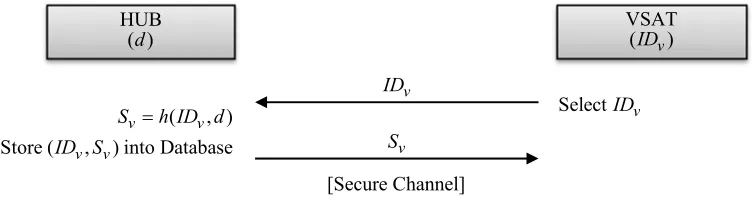
4.2. VSAT Registration Phase
In this phase, VSAT which wants to register at the HUB should obtain its secret keySv. The VSAT
begins its registration at the HUB as follows. 1. VSAT→HUB:IDV
*
Generate random
Generate timestamp
( , , , )
h p
h
h h
h h h v h
r Z
t
X r P
Y h ID X S t
! !
HUB ( ,d Sv)
?
Verify
Verify ( , , , )
h
h h h v h
t
Y !h ID X S t
, , ,
v v v v
ID X Y t
, , ,
h h h h
ID X Y t
VSAT (Sv)
*
Generate random
Generate timestamp
( , , , )
v p
v
v v
v v v v v
r Z
t
X r P
Y h ID X S t
! !
Common Session KeySK !r Xv( h)!r Xh( v)!r r Pv h ?
Verify
Verify ( , , , )
v
v v v v v
t
Y !h ID X S t
Figure 4. Proposed common key generation phase
2. HUB→VSAT:Sv
HUB calculates the VSAT’s secret key Sv = h(IDv, d) and delivers Sv to the VSAT
func-tion through a secure channel. Finally, the HUB securely maintains anIDdatabase table which includes(IDv, Sv).
The above procedure is illustrated in Fig. 3. 4.3. Common Key Generation Phase
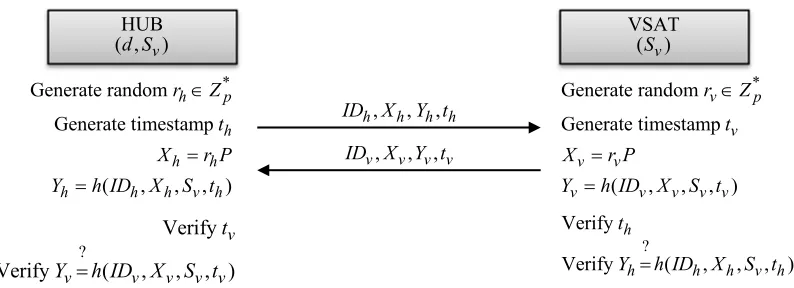
In this phase, both HUB and VSAT agree a com-mon session key after performing a secure mutual authentication procedure. Fig. 4 shows the proposed common key generation phase.
1. HUB→VSAT:(IDh, Xh, Yh, th)
HUB obtains the stored VSAT’s secret keySvin
his/her database. HUB selects a random number rh ∈ Zp∗, generates the current timestamp th,
and then computesXhandYhas follows: Xh=rhP, (11) Yh=h(IDh, Xh, Sv, th). (12)
Finally, HUB sends(IDh, Xh, Yh, th)to VSAT.
2. VSAT→HUB:(IDv, Xv, Yv, tv)
VSAT randomly chooses a numberrv, generates
the current timestamptv, and calculatesXvand Yvas follows:
Xv=rvP, (13) Yv =h(IDv, Xv, Sv, tv). (14)
Finally, VSAT sends(ID , X , Y , t )to HUB.
3. After HUB and VSAT exchanging(IDh, Xh, Yh, th)and(IDv, Xv, Yv, tv), HUB first checks the
validity of the received timestamp tv. If it is
valid, HUB can check the validity of VSAT by checking whether the following equation holds or not:
Yv
?
=h(IDv, Xv, Sv, tv). (15)
If the above equation holds, HUB computes the common session keySK=rh(Xv) =rvrhP.
4. In the same way, VSAT first checks the valid-ity of the received timestamp th. If it is valid,
VSAT can check the validity of HUB by check-ing whether the followcheck-ing equation holds or not:
Yh=?h(IDh, Xh, Sv, th). (16)
If the above equation holds, VSAT computes the common session keySK=rv(Xh) =rvrhP.
To protect (e.g., encrypt) further information ex-changed in the session, VSAT and HUB uses the one-time session keySK.
5. Security and Performance Analysis
5.1. Security Analysis
This subsection provides the proof of correctness of the proposed scheme. First, the security terms [14] needed for the analysis of the proposed scheme are defined as follows:
Definition 4. A strong secret key (Sv) has a value of
Definition 5. A secure chaotic one-way hash function y =h(x)is where givenxto computeyis easy and givenyto computexis hard.
Here, five security properties: guessing attack, replay attack, impersonation attack, secure mutual au-thentication, and perfect forward secrecy, will be con-sidered for the proposed scheme.
1. Guessing attack. In an off-line guessing attack,
an adversary A guesses a long-term secret key and verifies his/her guess, but he/she does not need to participate in any communication dur-ing the guessdur-ing phase. In an undetectable on-line guessing attack, an adversary A searches to verify a guessed long-term secret key in an on-line transaction and a failed guess can-not be detected and logged by the server. Sup-pose that an adversary A intercepts the mes-sages (IDh, Xh, Yh, th) from HUB and wants
to guess the secret key Sv = h(IDv, d)from
the message, where d is the master key d of HUB. First, A chooses a value which is re-garded as S∗
v and checks whether the equation Yh=?h(IDh, Xh, Sv∗, th)holds; if it shows that S∗
v=Sv, thenAfinds the correct secret keySv.
Due to the fact of Definitions 4 and 5, it is dif-ficult to directly find the secret keySv without
knowing the master key dof HUB. Therefore, the proposed scheme can resist the guessing at-tack.
2. Replay attack. A replay attack is that an
unau-thorized party records previous messages and uses them to cheat the receiver in later pro-cesses. The replay attacks fail because the fresh-ness of the messages transmitted in the com-mon key generation phase is provided by the timestamps th and tv. Except for VSAT (or
HUB), only HUB (or VSAT) who can em-bed the secret value Sv and two timestamps in
the hashed message Yv = h(IDv, Xv, Sv, tv)
of Step (1) (or Yh = h(IDh, Xh, Sv, th) of
Step (2)), respectively. For example, suppose that an adversary A intercepts the message (IDh, Xh, Yh, th)from HUB and then stores it
in his/her system. After a while,Asends the old message (IDh, Xh, Yh, th)to VSAT to
imper-sonate HUB. Then, VSAT will detect the replay attack by checking the freshness of the times-tamp th. Therefore, the proposed scheme can
prevent replay attacks.
3. Impersonation attack. In the proposed scheme,
an adversary A can try the impersonation at-tack to forge the (IDh, Xh, Yh, th). Assume
that A pretends that he/she is HUB and forges (IDh, Xh, Yh, th). Firstly,Achooses a random
number rh and computes Xh = rhP. Then, Yh = h(IDh, Xh, Sv, th) is computed and
(IDh, Xh, Yh, th)is sent to VSAT. After VSAT
receives (IDh, Xh, Yh, th)from A, VSAT can
check the validity of HUB by checking whether the equation Yh=?h(IDh, Xh, Sv∗, th)holds or
not. BecauseAdoes not have the secret keySv
andSvis difficult to guess due to the fact of
Def-initions 4 and 5, VSAT will reject the adversary A’s forged message.
4. Secure mutual authentication. Mutual
authen-tication schemes enable participants mutually to authenticate each other’s identity. That is, it means that both the VSAT and HUB are authenticated to each other within the same protocol. After HUB and VSAT exchanging (IDh, Xh, Yh, th) and (IDv, Xv, Yv, tv), both
HUB and VSAT will check if the hashed mes-sageYv or Yh contains the secret valueSv, its
computedXvorXh, and the timestampstvand th, respectively. Since the hashed messages
in-cluded two timestampstvandth, both HUB and
VSAT will believe thei-th random noncetv or th was originally sent from VSAT and HUB,
respectively. HUB and VSAT agree a one-time session keySK = rvrhP to protect (e.g.,
en-crypt) further information exchanged in the ses-sion. By adopting Elliptic Curve Diffie-Hellman key exchange algorithm (e.g.,rvP, rhP, rvrhP, SK = rvrhP, where P is a generator), the
proposed scheme can also provide perfect for-ward secrecy. Therefore, the proposed scheme can provide secure mutual authentication and session key agreement.
5. Perfect forward secrecy.Perfect forward secrecy
means that if long-term private keys of one or more entities are compromised, the secrecy of previous session keys established by honest en-tities is not affected. In the proposed scheme, a disclosed long-lived secret keysdcannot derive the session key SK = rvrhP used before
be-cause without getting the used random integers rvandrh, nobody can compute the used session
keySK. If an attacker wiretaps all conversations of the medium and derives some used random point elements rvP andrhP, he/she could not
Table 1. Efficiency comparisons between the proposed scheme and related schemes
HUB VSAT Total
Park-Lim scheme [7] 7Texp+ 9Tmul+ 2Th 8Texp+ 2Tmul+Th 15Texp+ 11Tmul+ 3Th Tseng scheme [8] 5Texp+ 4Tmul+ 2Th 5Texp+ 4Tmul+ 2Th 10Texp+ 8Tmul+ 4Th LLH scheme [10] 2Texp+ 4Th 2Texp+ 4Th 4Texp+ 8Th Proposed scheme 2Tpm+ 2Th 2Tpm+ 2Th 4Tpm+ 4Th
5.2. Performance Evaluation
In the following, we show the performance of our proposed scheme. The performance evaluation of the proposed scheme mainly concerns the time complex-ity. For convenience, we suppose some notations are used to analyze the computational complexity as fol-lows:
• Texpis the time for executing a modular
exponentiation operation;
• Tpmis the time for executing a elliptic curve
multiplication operation;
• Tmulis the time for modular multiplication.
• This the time for executing the one-way hash
functionh(·);
Table 1 summarizes the comparison among Park-Lim scheme [7], Tseng scheme [8], LLH scheme [10], and the proposed scheme.
Considering the computational complexity in the Park-Lim scheme with ID [7], the total computa-tional complexity required for the HUB is7Texp+
9Tmul+ 2Th. The total computational complexity
re-quired for the VSAT is8Texp+ 2Tmul+Th. The
to-tal complexity for the Park-Lim scheme withID is 15Texp+ 11Tmul+ 3Thas shown in Table 1.
Considering the computational complexity in the Tseng scheme withID [8], the total computational complexity required for the HUB is5Texp+ 4Tmul+
2Th for computing HUB. The total computational
complexity required for the VSAT is5Texp+4Tmul+
2Th. The total computational complexity required for
the Tseng scheme is10Texp+ 8Tmul+ 4Thas shown
in Table 1.
Considering the computational complexity in the LLH scheme withID [10], the total computational complexity required for the HUB is2Texp+ 4Thfor
computing HUB. The total computational complexity required for the VSAT is2Texp+ 4Th. The total
com-putational complexity required for the LLH scheme is 4Texp+ 8Thas shown in Table 1.
In the propose scheme, considering the compu-tational complexity required for the HUB, the HUB is needed to computeXh, Yh, Sv, andSK. Note that Sv may be pre-computed to reduce the
computa-tional cost. Thus, the HUB is only needed to compute
Xh, Yh, andSK on line. They respectively require Tpm,Th, andTpm. Meanwhile, the HUB must check
whether the equationYv=h(IDv, Xv, Sv, tv)holds
or not, which takes1Th. Therefore, the total
compu-tational complexity required for the HUB is2Tpm+
2Th. As for the complexity for the VSAT, the VSAT
is needed to computeXv,Yv, andSK. They
respec-tively require Tpm, Th, and Tpm; it also needs to
check whether the equationYh=h(IDh, Xh, Sv, th)
holds or not with the same cost of Th. Therefore,
the total computational complexity required for the VSAT is2Tpm+ 2Th. Thus, the total computational
complexity required for our scheme is4Tpm+ 4Th.
We should point out that the computation cost of modular exponentiation(Texp) is much more
expen-sive than that of Elliptic curve point multiplication(Tpm).
In conclusion, the proposed scheme is more efficient than others.
6. Conclusions
This paper proposed a new efficient and secure key agreement scheme for VSAT satellite communi-cations based on elliptic curve cryptosystem (ECC) to minimize the complexity of computational costs be-tween VSAT and HUB and fit VSAT satellite commu-nication environments. We have shown that the newly proposed scheme has the following more practical merits compared with previously related schemes: (1) it provides secure session key agreement function by adopting elliptic curve cryptosystem, (2) it can reduce the total execution time and memory requirement due to the elliptic curve cryptography, and (3) it not only is secure against well-known cryptographical attacks but also provides perfect forward secrecy. As a re-sult, we believe that the proposed scheme is extremely suitable for use in satellite communication environ-ments since it provides security, reliability, and effi-ciency.
Acknowledgements
(10035245) and the ITRC program of MKE/NIPA (NIPA-2010-C1090-1021-0002).
References
[1] V. M. Dorofeev, L. Y. Kantor.VSAT applications in Russian satellite communications,International Jour-nal of Satellite Communications, 1993, Vol. 11, No. 4, 223-228.
[2] M. Maggenti, T. T. Ha, T. Pratt.VSAT Networks-an overview,International Journal of Satellite Commu-nications, 1987, Vol. 5, No. 3, 219-225.
[3] L. P. Seidman.Satellites for wideband access,IEEE Communications Magazine, Oct. 1996, Vol. 34, No. 10, 108-111.
[4] M. S. Hwang and W. P. Yang.Conference key dis-tribution schemes for secure digital mobile communi-cations,IEEE Journal on Selected Areas in Commu-nications, Feb. 1995, Vol. 13, No. 2, 416-420. [5] C. C. Lee, M. S. Hwang, I. E. Liao. Security
enhancement on a new authentication scheme with anonymity for wireless environments,IEEE Transac-tions on Industrial Electronics, 2006, Vol. 53, No. 5, 1683-1687.
[6] W. B. Lee, C. K. Yeh.A new delegation-based au-thentication protocol for use in portable communica-tion systems,IEEE Transactions on Wireless Commu-nications, 2005, Vol. 4, No. 1, 57-64.
[7] J. H. Park, S. B. Lim. Key distribution for secure VSAT satellite communications, IEEE Transactions on Broadcasting, 1998, Vol. 44, No. 3, 274-277. [8] Y. M. Tseng.Cryptanalysis and improvement of key
distribution system for VSAT satellite communica-tions,Informatica, 2002, Vol. 13, No. 3, 369-376. [9] X. Yi, Ch. K. Siew, H. M. Sun, H. T. Yeh, Ch. L.
Lin, T. Hwang.Security of Park-Lim key agreement schemes for VSAT satellite communications, IEEE Transactions on Vehicular Technology, March 2003, Vol. 52, No. 2, 465-468.
[10] C. C. Lee, T. C. Lin, M. S. Hwang. A key agree-ment scheme for satellite communications, Informa-tion Technology and Control, 2010, Vol. 39, No. 1, 43-47.
[11] N. Koblitz.Elliptic curve cryptosystems, Mathemat-ics of Computation, 1987, vol. 48, 203-209.
[12] V. Miller.Uses of elliptic curves in cryptography,In: Proc of CRYPTO’85, Lecture notes in computer sci-ence, 1986, vol 218. Springer, Berlin, 417-426. [13] D. Hankerson, A. Menezes, S. Vanstone.Guide to
elliptic curve cryptography,Lecture notes in computer science, 2004, Springer, Berlin.
[14] A. J. Menezes, P. C. Oorschot, S. A. Vanstone. Handbook of applied cryptograph,CRC Press, 1997, New York.
[15] N. Abramson.VSAT data networks.Proceedings of the IEEE, July 1990, Vol. 78, pp. 1267-1274. [16] M. W. Mitchell, R. A. Hedinger.The development of
VSAT performance standards in the United States of
America,International Journal of Satellite Communi-cations, 1993, Vol. 11, No. 4, 195-200.
[17] A. H. Rana, J. S. McCoskey, W. A. Check.VSAT technology, trends, and applications,Proceedings of the IEEE, July 1990, Vol. 78, pp. 1087-1095. [18] D. M. Chitre, J. S. McCoskey.VSAT networks:
ar-chitectures, protocols, and management,IEEE Com-munications Magazine, 1988, Vol. 26, No. 7, 28-38. [19] K. M. S. Murthy, J. Alan, J. Barry, B. G. Evans,
N. Miller, R. Mullinax, P. Noble, B. O’Neal, J. J. Sanchez, N. Seshagiri, D. Shanley, J. Stratigos, J. W. Warner.VSAT user network examples,IEEE Communications Magazine, 1989, Vol. 27, No. 5, 50-57.
[20] Ricardo Castellot Lou, Antonio Javier Sanchez Es-guevillas, Borja de la Cuesta Diego, Belen Carro, Linghang Fan, Zhili Sun.IPv6 networks over DVB-RCS satellite systems,International Journal of Satel-lite Communications and Networking, 2008, Vol. 26, No. 1, 45-56.
[21] D. K. Petraki, M. P. Anastasopoulos, P. G. Cot-tis.Dynamic resource allocation for DVB-RCS net-works,International Journal of Satellite Communica-tions and Networking, 2008, Vol. 26, No. 3, 189-210. [22] ETSI, Digital video broadcasting (DVB); interaction channel for satellite distribution systems, ETSI EN 301 790 v. 1.3.1, Mar. 2003.
Received November 2010