Volume 02, No. 5, May 2016
P
age
8
An Ideal Relay Selection for Co-Operative Ad Hoc Networks
Siddharth Agarwal* & Govind Verma**
*Department of Computer Science & Engineering,M.TECH SRM University NCR Campus Modinagar Ghaziabad Uttar Pradesh
**Department of Computer Science & Engineering, Assistant Professor SRM University NCR Campus Modinagar Ghaziabad Uttar Pradesh
ABSTRACT
Mobile Ad hoc Network is a collection of wireless mobile nodes which are connected in a dynamic manner. These nodes form a temporary network without any infrastructure where all nodes are free to move arbitrarily. The Cooperative Communication (CC) is a technology that exploits multiple nodes to simultaneously transmit the same data. It can save power and extend transmission coverage. However, earlier research work on topology control with CC considers CC mostly in the first aspect of power saving, not that of coverage extension. We identify the challenges in the working of a centralized topology control scheme, named cooperative bridges, which reduces transmission power of nodes as well as increases network connectivity. Prior research on Co-operative bridges only focuses on maintaining the network connectivity, minimizing the transmission power of each node. This may cause inefficient energy routes, reducing the coverage and affecting the overall network performance in cooperative ad hoc networks. In this paper, to address this problem, we have studied topology control problem for energy efficient topology control with cooperative communication. We have proposed efficient energy spanners and ideal relay nodes selection for CC network to relatively increase transmission range and reduce overall power consumption of network.
Keywords - Cooperative, Communication, Topology, Control, NS-2, Ideal Relay etc.
I. INTRODUCTION
The proliferating demand for high-speed wireless networks has stimulated the development of wireless ad-hoc networks. In order to fully use the technological development in radio hardware and integrated circuits, which allow for implementation of more complicated communication schemes, the fundamental performance limits of wireless networks should be reevaluated.
Volume 02, No. 5, May 2016
P
age
9
applied in wireless ad hoc networks. Topology control lets each wireless node to select certain subset of neighbors or adjust its transmission power in order to conserve energy meanwhile maintain network connectivity.
I.1 Topology Control
Topology control have been widely studied and applied in wireless ad hoc networks as one of the key energy saving techniques. In order to save energy and extend lifetime of networks topology control lets each wireless node to select certain subset of neighbors or adjust its transmission power meanwhile maintain network connectivity. Recently, a new class of communication techniques, cooperative communication (CC), has been introduced to allow single antenna devices to take the advantage of the multiple-input-multiple-output (MIMO) systems. This cooperative communication explores the broadcast nature of the wireless medium and allows nodes that have received the transmitted signal to cooperatively help relaying data for other nodes. Recent study has shown significant performance gain of cooperative communication in various wireless network applications: energy efficient routing and connectivity improvement
In this paper, we study the energy efficient topology control problem with CC model by taking the energy efficiency of routes into consideration. Taking advantage of physical layer design that allows combining partial signals containing the same information to obtain the complete data, we formally define cooperative energy spanner in which the least energy path between any two nodes is guaranteed to be energy efficient compared with the optimal one in the original cooperative communication graph. We then introduce the energy-efficient topology control problem with CC (ETCC), which aims to obtain a cooperative energy spanner with minimum total energy consumption.
I.2 Co-operative Communication
The cooperative communication techniques can also be used in topology control. In [35], Cardei et al. first studied the topology control problem under cooperative model (denote by TCC) which aims to obtain a strongly-connected topology with minimum total energy consumption. They proposed two algorithms that start from a connected topology assumed to be the output of a traditional (without using CC) topology control algorithm and reduce the energy consumption using CC model. The first algorithm (DTCC) uses 2-hop neighborhood information of each node to reduce the overall energy consumption within its 2-hop neighborhood without hurting the connectivity under CC model. The second algorithm (ITCC) starts from a minimum transmission power, and iteratively increases its power until all nodes within its 1-hop neighborhood are connected under CC model. Observing that the CC technique can also extend the transmission range and thus link disconnected components. In [36], Yu et al. applied CC model in topology control to improve the network connectivity as well as reduce transmission power. Their algorithm first constructs all candidates of bidirectional links using CC model (called cooperative bridges) which can connect different disconnected components in the communication graph with maximum transmission power.
Volume 02, No. 5, May 2016
P
age
10
control problem: optimum relay selection topology control problem with cooperative communication, which aims to keep the energy efficient paths in the constructed topology and reduce power consumption in network. In future this scheme is implemented and tested in real simulation for result gathering. This paper proposes novel algorithm for optimum relay selection rather selecting all nodes only those nodes will be selected which are capable for large enough to make transmission range within destination node to save power of other nodes hence overall network power consumption is minimize. Every node also store power level of every neighbor node in routing table with routing information. For transmit data packets relay selection is based on highest power level nodes. The nodes having maximum power level in direct neighbor selected for relay transmission. As given in figure proposed algorithm can be given as follow. This will helpful for saving battery power for other nodes in to reduce overall network power consumption
In this paper, we have comprehensively surveyed energy-efficient wireless communications from the information-theoretic and technique- oriented perspectives. As for the information- theoretic aspect, most literature about EE mainly focused on point-to-point scenarios and the impact of practical issues on EE is not fully exploited. Thus, research on EE needs to be extended to multi-user and/or multicell cases as well as considering the practical issues such as transmission associated circuit energy consumption, which is of great significance to practical system design. As for the advanced techniques that will be used in future wireless systems, such as OFDMA, MIMO, and relay, existing research has proved that larger EE can be achieved through energy-efficient design. However, most work is still in the initial stage, and more effort is needed to investigate potential topics such as those listed in this article. For pure relay systems, a critical problem is how to use the relay nodes efficiently, including how many relay nodes are needed for data delivery and how the relay nodes are configured. The EE-SE trade-off of pure relay systems in AWGN relay channels has been investigated, where the optimal power allocation among relay nodes is proposed to maximize EE. It has been shown that the performance (either consumed energy or data rate) depends on the transmission strategy of each node, the locations of the relay nodes, and the data rate used by each node. Two suboptimal communication schemes, common rate and common power schemes, are proposed to capture the inherent constraints of networks, bandwidth, and energy. from, demonstrates the impact of the hop number, node locations, and data rate on EE. Although power allocation, and the number and locations of nodes affect the EE significantly, such joint design is very complex and may not be suitable for some practical scenarios. Some simple and effective relay transmission strategies have been proposed. In order to simplify the relay network, only two-hop communications are set up between the source and destination nodes. Different relay selection schemes have been proposed the best relay node is selected distributive, while in several relay nodes are selected for beam forming based on a simple selection strategy. It is shown that the EE may not increase with the number of relay nodes due to cooperation overhead [3].
Volume 02, No. 5, May 2016
P
age
11
is of size 10 m × 10 m. There is a street between the two stripes of apartments, 10 m wide. It is assumed that the femtocell blocks are not overlapping with each other. Each femtocell block has L floors, where L is chosen randomly (L is selected as 6 in our simulations). If more than one femtocell blocks are deployed, each femtocell block can have a different number of floors. The HeNB and HUE are assumed to be randomly placed in each femtocell. The user benefit of femtocell deployment in suburban areas is the provision of reliable coverage throughout home. With the limitation of a minimum dis- trance to the MeNBs, HeNBs can be deployed within or on the edge of the macro coverage area.
II. RELATED WORK
Topology control has drawn a significant amount of research interests in wireless ad hoc networks [6-12]. Primary topology control algorithms aim to maintain network connectivity and conserve energy by selecting certain subset of neighbors and adjusting the transmission power of wireless nodes. Comprehensive surveys of topology control can be found in [1-4].
Cooperative communication (CC) exploits space diversity through allowing multiple nodes cooperatively relay signals to the receiver so that the combined signal at the receiver can be correctly decoded. Since CC can reduce the transmission power and extend the transmission coverage, it has been considered in topology control protocols. However, prior research on topology control with CC only focuses on maintaining the network connectivity, minimizing the transmission power of each node, whereas ignores the energy efficiency of paths in constructed topologies. This may cause inefficient routes and hurt the overall network performance in cooperative ad hoc networks. Paper [43] address this problem, author introduce a new topology control problem: energy-efficient topology control problem with cooperative communication, and propose two topology control algorithms to build cooperative energy spanners in which the energy efficiency of individual paths are guaranteed. Both proposed algorithms can be performed in distributed and localized fashion while maintaining the globally efficient paths.
Paper [44] introduces a new topology control problem: energy-efficient topology control problem with cooperative communication, and propose two topology control algorithms to build cooperative energy spanners in which the energy efficiency of individual paths are guaranteed.
Chen and Huang [5] first studied the strongly connected topology control problem, which aims to find a connected topology such that the total energy consumption is minimized. They proved such problem is NP-complete. Several following works [8-12] have focused on finding the minimum power assignment so that the induced communication graph has some “good” properties in terms of network tasks such as disjoint paths, connectivity or fault-tolerance. On the other hand, several localized geometrical structures [13-18] have been proposed to be used as underlying topologies for wireless ad hoc networks. These geometrical structures are usually kept as few links as possible from the original communication graph and can be easily constructed using location information.
Volume 02, No. 5, May 2016
P
age
12
network applications: energy efficient routing [21-24], broadcasting [25-27], multicasting [28], connectivity/coverage improvement [29], [30], and relay selection for throughput maximization or energy conservation [31-34].
In this paper, we study the energy efficient topology control problem with CC model by taking the energy efficiency of routes into consideration. Taking advantage of physical layer design that allows combining partial signals containing the same information to obtain the complete data, we formally define cooperative energy spanner in which the least energy path between any two nodes is guaranteed to be energy efficient compared with the optimal one in the original cooperative communication graph. We then introduce the energy-efficient topology control problem with CC (ETCC), which aims to obtain a cooperative energy spanner with minimum total energy consumption.
The cooperative communication techniques can also be used in topology control. In [35], Cardei et al. first studied the topology control problem under cooperative model (denote by TCC) which aims to obtain a strongly-connected topology with minimum total energy consumption. They proposed two algorithms that start from a connected topology assumed to be the output of a traditional (without using CC) topology control algorithm and reduce the energy consumption using CC model. The first algorithm (DTCC) uses 2-hop neighborhood information of each node to reduce the overall energy consumption within its 2-hop neighborhood without hurting the connectivity under CC model. The second algorithm (ITCC) starts from a minimum transmission power, and iteratively increases its power until all nodes within its 1-hop neighborhood are connected under CC model. Observing that the CC technique can also extend the transmission range and thus link disconnected components. In [36], Yu et al. applied CC model in topology control to improve the network connectivity as well as reduce transmission power. Their algorithm first constructs all candidates of bidirectional links using CC model (called cooperative bridges) which can connect different disconnected components in the communication graph with maximum transmission power. Then they apply a 2-layer MST structure (one MST over the CC links to connect the components, the other is inside each component) to further reduce the energy consumption.
III. MODEL AND PROBLEM FORMULATION
Wireless communication technique with a wireless network, of the cellular or ad hoc selection, where the wireless users, may increase their valuable quality of service via cooperation a cooperative communication system, each wireless user is assumed to transmit data as well as act as a cooperative agent for an additional user (Fig. 1).
Cooperative communication means in any system users share and cooperative their resources to enhance their performance jointly with help of each other. This method is very useful for enhance transmission range of a node in mobile adhoc network as diverse channel quality and limited energy and limited bandwidth limitations wireless environment. Due to cooperation, users that know-how a deep weaken in their connection towards the target can utilize quality channels provided by their partners to achieve the preferred quality of service (QoS). This is also identified like the spatial diversity gain, which is in the same way achieved in multiple-input-multiple-output (MIMO) wireless systems.
Volume 02, No. 5, May 2016
P
age
13
diversity. Due to this trade-off, one hopes for a net reduction of transmit power, given every-thing else being constant.
In cooperative communication every user sends both his/her personal bits as well as a few data for his/her neighbor; one may believe this causes loss of rate in the system. However, the spectral efficiency of each user improves because; due to cooperation diversity the channel code rates are able to be improved. Hence one more trade-off is occurred. So whether cooperation is worth the incurred cost, has been studied positively by numerous research studies
Fig.1. Co-operative Communication between two nodes when a node is out of range of other node
For example, in figure 1, node S is unable to communicate with node D, since D is out of its maximum transmission range of S. On the other hand, S can send a cooperation request message and data to adjacent connected nodes R as relay node and then the three nodes all together pass on the data to D. Therefore, D can receive it due to the extended transmission range of nodes S, R, and R.
Here, we explain a cooperative communication model and a network representation for topology control system. In addition, we define two problems: Topology Control considering Extended Links caused by CC and Energy-Efficient Extended Link with CC.
III.1 Cooperative Communication Model
In Cooperative Communication Model PMAX represents every node‟s maximum transmission power limit. Pi is the transmission power of node i.α is the path loss exponent and τ is the minimum average SNR for decoding received data. dij is the distance between node i and node j. For a source node i to communicate with node j directly (figure 1), they must satisfy,
Pi (dij) −H ≥ τ (Pi ≤ PMAX) (3.1)
H denotes the set of a source node and helper nodes. If nodes in H transmit simultaneously, i.e., use cooperative communication, the following formula must be satisfied for correct decoding at destination node j.
i∈H Pi(dij)−H ≥ τ (Pi ≤ PMAX) (3.2)
Volume 02, No. 5, May 2016
P
age
14
for implementing the CC technique can be found in [8]. In figure 1, if node R applies CC with partner S in sort to communicate with D, which is already accessible to R by straight links, the network can decrease the sum of node transmission power. Cardei et al. [26] focus their problem formulation on saving power with CC, not extended CC links.
III.2 Network Model
The wireless network topology is form as a dimensional graph is collection of vertices V and edges E, graph G = (V, E). V = (v1... vn) is a set of random nodes and E is a set of pairs of
nodes as link between them (vi, vj), with vi, vj ∈ V. The notations V (G) and E (G) are used
for the vertex- and edge-set of G. The weight of a directional link from u to v is denoted as w (u → v). Edge (u, v) has weight, w (u, v), which indicates the average power utilization for maintaining a bi-directional link (u, v). N (v) is the set of neighbor nodes within the maximum transmission range of node v. All elements in N (v) are the candidate nodes, which are eligible as helper nodes for v. Node v is capable to communicate directly with its neighbors within 1 hop. R (u) is the set of nodes which are accessible to node u by 1-hop or multi-hop, i.e., have a path to a node u.
III.3 Problem Formulation
Major difficulty in given a wireless multi-hop network G=(V,E) which is restricted under CC connection model, it that assign transmission power Pi for every node vi such that make topology G‟ from this power assignment is a cooperative energy t-spanner of G and the sum of transmission power of all nodes, ∑viεVPi , is minimized. Key point is that the spanner property also guarantees that the induced topology G‟ is strongly connected under CC model.
The wireless network topology is modeled as a 2dimensional graph: graph G = (V, E). V =
(v1...vn) is a set of randomly distributed nodes and E is a set of pairs of nodes (vi,vj), with vi,vj
∈ V . The notations V (G) and E (G) are used for the vertex- and edge-set of G. The weight of
a directional link from u to v is denoted as w (u → v). Edge (u, v) has weight, w (u, v),
which means the average power consumption for maintaining a bi-directional link (u, v). The
average weight for bi-directional CC link, weight w (u,v), is (w(u → v) + w(v → u))/2. N
(v) is the set of neighbor nodes within the maximum transmission range of node v. All
elements in N (v) are the candidate nodes, which are eligible as helper nodes for v. The
power set of N (v) signifies ℘ (N (v)) = {X|X ⊂ N (v)}, which is the set containing all subsets
of N (v). Node v is able to communicate with its neighbors directly within 1 hop. R (u) is the set of nodes which are reachable to node u by 1-hop or multi-hop, i.e., have a path to a node u. The term „connectivity‟ used in this paper means reachability, not the degree of nodes. Definition 1 (Helper node set): H (u) symbolizes the set including all helper nodes of a node
u. H (u) ⊂ N (u) and H (u) ∈℘(N(v)).
Definition 2 (Helper link): A helper link is a direct link between a source node and its helper node.
Definition 3 (Cluster): A component of a graph G is defined as a maximal connected sub
graph of G [21]. In other words, in a network, it is the group of nodes which are mutually
reachable by only direct links with PMAX. For example, figure 1(a) has two components: One
Volume 02, No. 5, May 2016
P
age
15
in this paper. Clusters cannot communicate due to the long distance if CC technology is not applied.
Definition 4 (Node connectivity): Given node u in network G, the node connectivity of u is
the ratio of the number of reachable nodes of u to the number of all nodes
Definition 5 (Network connectivity): Network connectivity is the average node connectivity of all nodes in the network G.
It is assumed that a unique ID is assigned to each node and each node knows its own location information. Node ID and the location information are exchanged among all nodes. The
exchange among clusters is performed via CC technology with PMAX. In the case of sensor
networks, all location information is sent to a sink node which has sufficient resources for computation, and it performs computation for topology control.
IV. PROPOSED WORK
This paper proposed efficient in two phase first phase is to Energy-efficient topology control with cooperative communication and then ideal relay node selection. First phase propose two topology control algorithms which build energy-efficient cooperative energy spanners. To keep the proposed algorithms simple and efficient, we only consider its one-hop neighbors as possible helper nodes for each node when CC is used [43]. Thus, the original cooperative communication graph G contains all direct links and CC links with one hop helpers, instead of all possible direct links and CC-links. In addition, for each pair of nodes vi and vj, we only maintain one link with least weight if there are multiple links connecting them. Here, all links are directional links. Both proposed algorithms are greedy algorithms. The major difference between them is the processing order of links. The first algorithm deletes links from the original graph G greedily, while the second algorithm adds links into G‟‟ greedily. Here, G00 is a basic connected sub graph of G. Both algorithms can guarantee the cooperative energy spanner property of the constructed graph G
IV.1 Greedy method for Deleting Links from network graph
Step 1: Construction of G. Initially, G is an empty graph. First, add every direct links vivj
into G, if node VI can reach node VJ when it operates with PMAX. Then, for every pair of
nodes vi and vj, we select a set of helper nodes Hij for node vi from its one-hop neighbors N (vi), such that the link weigh w (vi,vj) of the constructed CC-link is minimized. Notice that this helper node decision problem is challenging even under our assumption that the transmission powers of VI and its helper node set to maintain CC-link are the same. If we try all combinations of the helper sets to find the optimal helper set which minimizes the total energy consumption of vi and its helpers, the computational complexity is exponential to the size of the one-hop neighborhood N (vi). It is impractical to do so in case of a large number of neighbors. Therefore, we directly use the greedy heuristic algorithm Greedy Helper Set Selection (vi, N (vi), vj), to select the helper set Hij. Then, we compare w (vivj) with p (PG (vi,vj)) which is the current shortest path from node vi to node vj in G. If w (vivj) ≤ p (PG (vi,vj))
Volume 02, No. 5, May 2016
P
age
16
Add this CC-linking vivj into G. If there already exists a direct link vivj, delete it after the new CC-link g vivj is added (since it costs more energy than the CC-link). Notice that if
(4.2)
Node vi cannot communicate with node vj within one-hop even in CC model.
Step 2: Construction of G‟. Copy all links in G to G‟, and sort them in the descending order
of their weights. Start to process all links one by one and delete the link vi vj from G‟ if
G-vivj is still a cooperative energy t-spanner of G.
Hereafter, we use G- e or G+e to denote the graph generated by removing link e from G or adding link e into G, respectively. In addition, when a CC-link g vivj is kept in G‟, all its helper links must be kept in G‟ too.
Step 3: Power Assignment from G‟. For each node vi, its transmission power is decided by
the following equation:
IV.1.1 Greedy method for adding Links
The second topology control algorithm starts with a sparse topology G‟‟ which is strongly connected under CC model. We can use the output of the algorithm in [36] as the initial topology. Then, we gradually add the most efficient link into G‟‟. Here, the energy-efficiency of a link is defined as the gain on reducing energy stretch factors by adding this link. Our algorithm will terminate until the constructed graph G‟ satisfies the energy stretch factor requirement. The detail steps are summarized as follows:
Step 1: Construction of G and G‟‟. The step of constructing G is the same as the one in
Algorithm 1. Then, we call the algorithm in [36] to generate G‟‟, a connected sparse sub
graph of G.
Step 2: Construction of G‟. Initialize G‟=G‟‟, for every link vivjεG but not G‟, compute its
stretch-factor-gain g G‟G (vivj)as follows:
(4.4)
In other words, the total gain of a link vivj is the summation of the improvement of stretch factors of every pair of nodes in G‟ after adding this link In each step, we greedily add the link with the largest stretch-factor-gain into G‟. If there is a tie, we use the link weight to break it by adding the link with the least weight. We repeat this procedure until G‟ meets the stretch factor requirement t.
Step 3:Power Assignment from G‟. For every nodeVI, assign its power level Pi using
equation for Pi.
IV.2 Ideal relay nodes selection
Volume 02, No. 5, May 2016
P
age
17
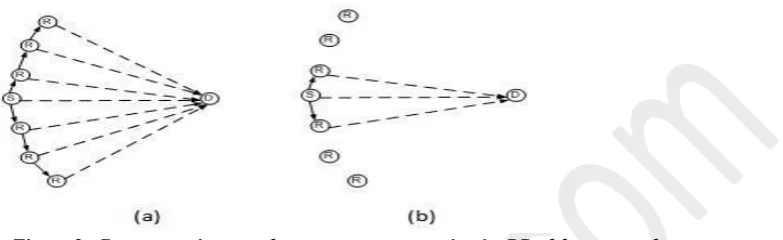
because of power saving fixed transmission range but it can be increase its transmission range with help of its relay nodes and transmit packets. In this example node S uses its all 1-hop neighbors where as other hand only few nodes are enough for sending data till D. hence power of other nodes are useless for this communication if ∑viεVPi for selected neighbors of node S.
Figure 2: Demonstration to reduce energy consumption in CC ad-hoc network
We propose two topology control algorithms which build energy-efficient cooperative energy spanners. To keep the proposed algorithms simple and efficient, we only consider its one-hop neighbors as possible helper nodes for each node when CCis used. Thus, the original cooperative communication graph G contains all direct links and CClinks with one hop helpers, instead of all possible direct links and CC-links. In addition, for each pair of nodes vi and vj, we only maintain one link with least weight if there are multiple links connecting them.
V. CONCLUSION
In this paper, we deliberate a topology control problem in detailed, energy-efficient topology control problem with cooperative communication, which aims to keep the energy-efficient paths in the constructed topology. Also key point has been discussed as in wireless ad-hoc network for effective energy transmission. In this paper, we introduced a new topology control problem: ideal relay selection topology control problem with cooperative communication, which aims to keep the energy efficient paths in the constructed topology and reduce power consumption in network. In future this scheme is implemented and tested in real simulation for result gathering.
Volume 02, No. 5, May 2016
P
age
18
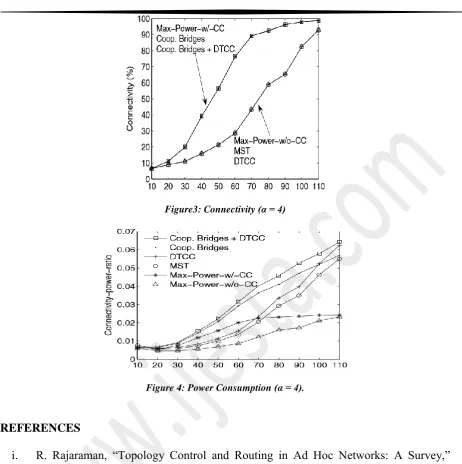
Figure3: Connectivity (α = 4)
Figure 4: Power Consumption (α = 4).
REFERENCES
i. R. Rajaraman, “Topology Control and Routing in Ad Hoc Networks: A Survey,”
SIGACT News, vol. 33, pp. 60-73, 2002.
ii. X.-Y. Li, “Topology Control in Wireless Ad Hoc Networks,” Ad Hoc Networking, S.
Basagni, M. Conti, S. Giordano, and I.
iii. Stojmenovic, eds., IEEE Press, 2003.
iv. C.-C. Shen and Z. Huang, “Topology Control for Ad Hoc Networks: Present
Solutions and Open Issues,” Handbook of Theoretical and Algorithmic Aspects of Sensor, Ad Hoc Wireless and Peer-to-Peer Networks, J. Wu, ed., CRC Press, 2005.
v. A.E. Clementi, G. Huiban, P. Penna, G. Rossi, and Y.C. Verhoeven, “Some Recent
Theoretical Advances and Open Questions on Energy Consumption in Ad-Hoc Wireless Networks,” Proc. Workshop Approximation and Randomization Algorithms in Comm. Networks, 2002.
vi. W.-T. Chen and N.-F. Huang, “The Strongly Connecting Problem on Multihop Packet
Volume 02, No. 5, May 2016
P
age
19
vii. L.M. Kirousis, E. Kranakis, D. Krizanc, and A. Pelc, “Power Consumption in Packet
Radio Networks,” Theoretical Computer Science, vol. 243, nos. 1/2, pp. 289-305, 2000.
viii. A.E.F. Clementi, P. Penna, and R. Silvestri, “On the Power Assignment Problem in
Radio Networks,” Proc. Electronic Colloquium on Computational Complexity (ECCC), 2000.
ix. D. Blough, M. Leoncini, G. Resta, and P. Santi, “On the Symmetric Range
Assignment Problem in Wireless Ad Hoc Networks,” Proc. Second IFIP Int‟l Conf. Theoretical Computer Science, 2002.
x. E. Althaus, G. Caˆlinescu, I. Mandoiu, S. Prasad, N. Tchervenski, and A. Zelikovsly,
“Power Efficient Range Assignment in Ad-Hoc Wireless Networks,” Proc. IEEE Wireless Comm. and Networking (WCNC), 2003.
xi. R. Ramanathan and R. Hain, “Topology Control of Multihop Wireless Networks
Using Transmit Power Adjustment,” Proc. IEEE INFOCOM, 2000.
xii. M. Hajiaghayi, N. Immorlica, and V.S. Mirrokni, “Power Optimization in
Fault-Tolerant Topology Control Algorithms for Wireless Multi-Hop Networks,” Proc. ACM Mobicom, 2003.
xiii. J. Cheriyan, S. Vempala, and A. Vetta, “Approximation Algorithms for
Minimum-Cost K-Vertex Connected Subgraphs,” Proc. Ann. ACM Symp. Theory of Computing (STOC), 2002.
xiv. P. Bose, P. Morin, I. Stojmenovic, and J. Urrutia, “Routing with Guaranteed Delivery
in Ad Hoc Wireless Networks,” Proc. Int‟l Workshop Discrete Algorithms and Methods for Mobile Computing and Comm., 1999.
xv. X.-Y. Li, Y. Wang, and W.Z. Song, “Applications of K-local MST for Topology
Control and Broadcasting in Wireless Ad Hoc Networks,” IEEE Trans. Parallel and Distributed Systems, vol. 15, no. 12, pp. 1057-1069, Dec. 2004.
xvi. X.-Y. Li, P.-J. Wan, and Y. Wang, “Power Efficient and Sparse Spanner for Wireless
Ad Hoc Networks,” Proc. 10th Int‟l Conf. Computer Comm. and Networks (ICCCN), 2001.
xvii. R. Wattenhofer, L. Li, P. Bahl, and Y.-M. Wang, “Distributed Topology Control for
Wireless Multihop Ad-Hoc Networks,” Proc. IEEE INFOCOM, 2001.
xviii. N. Li, J.C. Hou, and L. Sha, “Design and Analysis of a MST-Based Topology Control
Algorithm,” Proc. IEEE INFOCOM, 2003.
xix. Y. Wang and X.-Y. Li, “Localized Construction of Bounded Degree and Planar
Spanner for Wireless Ad Hoc Networks,” Mobile Networks and Applications, vol. 11, no. 2, pp. 161-175, 2006.
xx. N. Laneman, D. Tse, and G. Wornell, “Cooperative Diversity in Wireless Networks:
Efficient Protocols and Outage Behavior,” IEEE Trans. Information Theory, vol. 50, no. 12, pp. 3062-3080, Dec. 2004.
xxi. Nosratinia, T.E. Hunter, and A. Hedayat, “Cooperative Communication in Wireless
Volume 02, No. 5, May 2016
P
age
20
xxii. G. Jakllari, S.V. Krishnamurthy,M. Faloutsos, P.V. Krishnamurthy, and O. Ercetin,
“A Framework for Distributed Spatio-Temporal Communications in Mobile Ad Hoc Networks,” Proc. IEEE Infocom, 2006.
xxiii. Khandani, J. Abounadi, E. Modiano, and L. Zheng, “Cooperative Routing in Static
Wireless Networks,” IEEE Trans. Comm., vol. 55, no. 11, pp. 2185-2192, Nov. 2007.
xxiv. J. Zhang and Q. Zhang, “Cooperative Routing in Multi-Source Multi-Destination
Multi-Hop Wireless Networks,” Proc. IEEE INFOCOM, 2008.
xxv. Ibrahim, Z. Han, and K. Liu, “Distributed Energy-efficient Cooperative Routing in
Wireless Networks,” IEEE Trans. Wireless Comm., vol. 7, no. 10, pp. 3930-3941, Oct. 2008.
xxvi. M. Agarwal, J. Cho, L. Gao, and J. Wu, “Energy Efficient Broadcast in Wireles Ad
Hoc Networks with Hitch-hiking,” Proc. IEEE INFOCOM, 2004.
xxvii. J. Wu, M. Cardei, F. Dai, and S. Yang, “Extended Dominating Set and Its
Applications in Ad Hoc Networks Using Cooperative Communication,” IEEE Trans. Parallel and Distributed Systems, vol. 17, no. 8, pp. 851-864, Aug. 2006.
xxviii. G. Jakllari, S. Krishnamurthy, M. Faloutsos, and P. Krishnamurthy, “On Broadcasting
with Cooperative Diversity in Multi-Hop Wireless Networks,” IEEE J. Selected Area in Comm., vol. 25, no. 2, pp. 484-496, Feb. 2007.
xxix. F. Hou, L.X. Cai, P.H. Ho, X. Shen, and J. Zhang, “A Cooperative Multicast
Scheduling Scheme for Multimedia Services in IEEE 802.16 Networks,” IEEE Trans. Wireless Comm., vol. 8, no. 3, pp. 1508-1519, Mar. 2009.
xxx. L. Wang, B. Liu, D. Goeckel, D. Towsley, and C. Westphal, “Connectivity in
Cooperative Wireless Ad Hoc Networks,” Proc. ACM Mobihoc, 2008.
xxxi. A.K. Sadek, Z. Han, and K.J.R. Liu, “Distributed Relay-Assignment Protocols for
Coverage Expansion in Cooperative Wireless Networks,” IEEE Trans. Mobile Computing, vol. 9, no. 4, pp. 505-515, Apr. 2010.
xxxii. Y. Shi, S. Sharma, and Y. Hou, “Optimal Relay Assignment for Cooperative
Communications,” Proc. ACM Mobihoc, 2008.
xxxiii. Q. Zhang, J. Jia, and J. Zhang, “Cooperative Relay to Improve Diversity in Cognitive
Radio Networks,” IEEE Comm. Magazine, vol. 47, no. 2, pp. 111-117, Feb. 2009.
xxxiv. Wang, Z. Han, and K.J.R. Liu, “Distributed Relay Selection and Power Control for
Multiuser Cooperative Communication Networks Using Stackelberg Game,” IEEE Trans. Mobile Computing, vol. 8, no. 7, pp. 975-990, July 2009.
xxxv. M. Veluppillai, L. Cai, J.W. Mark, and X. Shen, “Maximizing Cooperative Diversity
Energy Gain for Wireless Networks,” IEEE Trans. Wireless Comm., vol. 6, no. 7, pp. 2530-2539, July 2007.
xxxvi. M. Cardei, J. Wu, and S. Yang, “Topology control in ad hoc wireless networks using
Volume 02, No. 5, May 2016
P
age
21
xxxvii. J. Yu, H. Roh, W. Lee, S. Pack, and D.-Z. Du, “Cooperative bridges: topology control
in cooperative wireless ad hoc networks,” in IEEE InfoCom, 2010.
xxxviii. N. Laneman, D. Tse, and G. Wornell, “Cooperative diversity in wireless networks:
efficient protocols and outage behavior,” IEEE Trans.Information Theory, 50(12):3062-3080, 2004.
xxxix. Nosratinia, T.E. Hunter, and A. Hedayat, “Cooperative communication in wireless
networks,” IEEE Comm. Magazine, 42(10):74-80, 2004.
xl. Khandani J. Abounadi E. Modiano and L. Zheng, “Cooperative routing in
static wireless networks,” IEEE Trans. on Communications, 55(11):2185-2192, 2007.
xli. Ibrahim, Z. Han and K. Liu, “Distributed energy-efficient cooperative routing in
wireless networks,” IEEE Trans. on Wireless Communications, 7(10):3930-3941, 2008.
xlii. M. Agarwal, J. Cho, L. Gao, and J. Wu, “Energy efficient broadcast in wireles ad hoc
networks with hitch-hiking,” in IEEE InfoCom, 2004.
xliii. L. Wang, B. Liu, D. Goeckel, D. Towsley, and C. Westphal, “Connectivity in
cooperative wireless ad hoc networks,” in ACM Mobihoc, 2008.
xliv. Ying Zhu, Minsu Huang, Siyuan Chen, and Yu Wang, “Energy-Efficient Topology