Małgorzata Krzystek-Korpacka
1, A–F, Eliza Patryn
2, 3, A, B, Katarzyna Hotowy
1, B,
Elżbieta Czapińska
1, B, Jacek Majda
4, B, Irena Kustrzeba-Wójcicka
1, B,
Anna Noczyńska
2, A, B, Andrzej Gamian
1, 5, AParaoxonase-1 Activity in Overweight and Obese
Children and Adolescents: Association with
Obesity-Related Inflammation and Oxidative Stress
Aktywność paraoksonazy-1 u dzieci i nastolatków z otyłością
i nadwagą: związek ze stanem zapalnym i stresem oksydacyjnym
1 Department of Medical Biochemistry, Wroclaw Medical University, Wroclaw, Poland
2 Department of Endocrinology and Diabetology of Children and Adolescents, Wroclaw Medical University,
Wroclaw, Poland
3 Department of Ophthalmology, AMC Amsterdam, Amsterdam, Netherlands
4 Department of Laboratory Diagnostics, 4 Military Clinical Hospital, Wroclaw, Poland
5 Institute of Immunology and Experimental Therapy, Polish Academy of Sciences, Wroclaw, Poland
A – research concept and design; B – collection and/or assembly of data; C – data analysis and interpretation;
D – writing the article; E – critical revision of the article; F – final approval of article; G – other
Abstract
Background. Paraoxonase-1 (PON1) is a HDL-attached extracellular esterase which is believed to contribute to the anti-atherogenic and anti-inflammatory properties of HDL. A decrease in PON1 is a risk factor for cardiovas-cular disease and has recently been found to be associated with juvenile obesity. The issue of a possible association between enzyme activity and/or its phenotype distribution and obesity-related metabolic abnormalities, inflamma-tion, and oxidative stress has not been addressed yet.
Objectives. To evaluate PON1 activity and phenotype distribution with respect to obesity and obesity-related metabolic disorders, inflammation and oxidative stress in children and adolescents.
Material and Methods. PON1 arylesterase activity was measured spectrophotometrically in 156 children and ado-lescents (47 lean, 27 overweight and 82 obese). Enzyme phenotype was determined using dual substrate (phenyl acetate/paraoxon) method. PON1 activity and phenotype distribution were related to the presence of obesity, met-abolic syndrome, insulin resistance, hyperinsulinemia, hypertriglyceridemia, high blood pressure, low HDL level, impaired fasting glucose and/or glucose tolerance as well as inflammatory and oxidative stress indices.
Results. PON1 arylesterase activity decreased in general and central obesity, high blood pressure, and hyperin-sulinemia conditions and correlated with BMI, CRP, adipocyte fatty acid-binding protein, superoxide dismutase, catalase, glutathione peroxidase, free thiols, and HOMA in a gender-dependent manner. PON1 decreases were independently associated with central obesity in girls, explaining 17% in PON1 variability, and with elevated CRP in boys, explaining 12% in its variability. PON1 phenotype was not associated with frequency of metabolic abnor-malities.
Conclusions. PON1 decreases in central obesity, exacerbating obesity-related inflammation and oxidative stress. The enzyme associations are gender-dependent: obesity and oxidative stress affects PON1 in girls whereas inflam-mation in boys (Adv Clin Exp Med 2013, 22, 2, 229–236).
Key words: paraoxonase-1 (PON1), obesity, metabolic syndrome, children, inflammation, oxidative stress.
Adv Clin Exp Med 2013, 22, 2, 229–236 ISSN 1899–5276
ORIGINAL PAPERS
Paraoxonase-1 (PON1) [EC 3.1.8.1] is a HDL-attached, extracellular esterase synthesized mainly in the liver. PON1 is believed to contribute to the anti-atherogenic and anti-inflammatory proper-ties of HDL; it degrades lipid peroxides, decreases HDL susceptibility to peroxidation, glycation, and homocysteinylation, and increases cholesterol ef-flux from macrophages[1]. In animal models of obesity and the metabolic syndrome, serum ac-tivity of PON1 is diminished. The human PON1 gene presence, in turn, restores the enzyme activ-ity and is associated with decreased plaque volume and number of macrophages, as well as lipid per-oxides [1]. Accordingly, in human obesity PON1 activity decreased and correlated with increases in lipid hydroperoxides in both HDLs and LDLs [2]. PON1 has also been found an independent risk factor for cardiovascular disease in some [3] but not all studies [4].
PON1 phenotype is believed to reflect PON1 association with atherosclerotic risk better than its genotype [3]. A number of PON1 polymorphisms has been described, with Q192R most spectacular-ly affecting the enzyme’s activity. PON1 in indi-viduals homozygous for the Q alloenzyme (A phe- notype of PON1 with Q at 192) has greater anti-oxidant properties while PON1 in heterozygous (AB phenotype of PON1) and homozygous for the R alloenzymes individuals (B phenotype of PON1 with R at 192) has diminished antioxidant proper-ties [1].
Juvenile population is relatively free of poten-tial confounders and the metabolic
abnormali-ties, risk factors for cardiovascular disease, occur already in childhood. Yet, their association with PON1 activity in children and adolescents has been limited to only one study concerning obe-sity [5]. The issue of possible association between PON1 arylesterase activity and/or its phenotype distribution and obesity-related metabolic abnor-malities, inflammation or oxidative stress have not been addressed yet.
Material and Methods
This study is derived from research on oxida-tive stress and inflammation in Polish overweight/ obese children and adolescents [6–10] conducted by the Department of Endocrinology and Diabe-tology of Children and Adolescents in cooperation with Department of Medical Biochemistry, Wro-claw Medical University, WroWro-claw, Poland. Within the original cohort (n = 167), blood samples were available for PON1 evaluation for 156 children and adolescents (age 10–17 years): 109 individuals treated for metabolic disorders associated with pri-mary overweight (n = 27) or obesity (n = 82) and 47 controls, who where lean (BMI < 85th percentile,
normal body build), age- and gender-matched, ap-parently healthy (no visible signs of any illness and unremarkable medical history, CRP within refer-ence range). The control group was recruited from hospital staff children and students from regional secondary school.Overweight/obese patients with hypothalamic obesity, genetic disorders, Cushing’s
Streszczenie
Wprowadzenie. Paraoksonaza-1 (PON1) to zewnątrzkomórkowa esteraza związana z cząsteczkami HDL, która odpowiada za ich antyaterogenne i antyzapalne właściwości. Zmniejszenie aktywności PON1 jest czynnikiem ryzy-ka rozwoju chorób sercowo-naczyniowych. Ostatnie badania wsryzy-kazują na związek między zmniejszeniem aktyw-ności enzymu a otyłością u dzieci i młodzieży. Brakuje jednak danych literaturowych dotyczących aktywaktyw-ności i fenotypów enzymu w zaburzeniach metabolicznych, stanie zapalnym i stresie oksydacyjnym towarzyszących oty-łości w tej grupie wiekowej.
Cel pracy. Ocena aktywności i rozkładu fenotypów PON1 w otyłości dziecięcej oraz związanych z otyłością zabu-rzeniach metabolicznych, stanie zapalnym i stresie oksydacyjnym.
Materiał i metody. Spektrofotometrycznie zmierzono aktywność arylesterazową PON1 u 156 dzieci i nastolatków (47 szczupłych, 27 z nadwagą i 82 otyłych). Fenotyp enzymu określano metodą dwóch substratów względem octanu fenylu i paraoksonu. Aktywność enzymu i rozkład fenotypów odniesiono do występowania otyłości, zespołu meta-bolicznego, insulinooporności, hiperinsulinizmu, hipertriglycerydemii, wysokiego ciśnienia, małego stężenia HDL, nieprawidłowej glikemii na czczo i/lub nietolerancji glukozy, a także stanu zapalnego i stresu oksydacyjnego.
Wyniki. Aktywność PON1 była zmniejszona w otyłości ogólnej i brzusznej, przy wysokim ciśnieniu i hiperinsuline-mii. Aktywność PON1 korelowała z BMI, CRP, białkiem wiążącym kwasy tłuszczowe pochodzącym z adipocytów, dysmutazą nadtlenkową, katalazą, peroksydazą glutationową, wolnymi grupami sulfhydrylowymi oraz wskaźni-kiem HOMA w sposób zależny od płci. U dziewcząt otyłość brzuszna była niezależnym czynniwskaźni-kiem predykcyjnym aktywności PON1, wyjaśniając 17% jej zmienności. U chłopców stężenie CRP wyjaśniało 12% zmienności w aktyw-ności PON1. Nie wykazano związku między fenotypem PON1 a występowaniem zaburzeń metabolicznych.
Wnioski. Aktywność PON1 jest zmniejszona w otyłości brzusznej u dzieci, przyczyniając się do zaostrzenia współ-istniejącego stanu zapalnego i stresu oksydacyjnego. Otyłość wpływa na aktywność enzymu u dziewcząt, a u chłop-ców na stan zapalny (Adv Clin Exp Med 2013, 22, 2, 229–236).
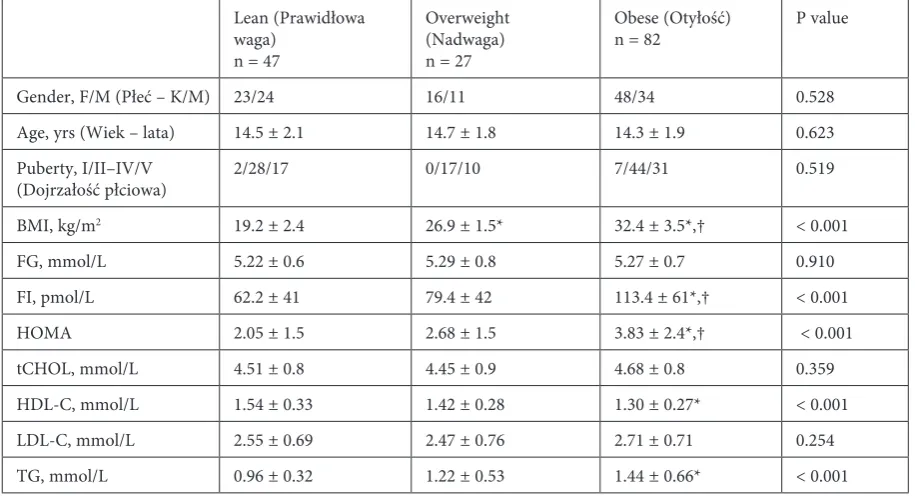
syndrome, growth hormone deficiency, insulinoma, hypothyroidism, and iatrogenic obesity were not included. Blood samples were collected following a complete physical examination of all participants, encompassing the evaluation of anthropometric pa-rameters (measured to the nearest 0.1 kg/0.1 cm), blood pressure and Tanner staging. An oral glucose tolerance test was performed (1.75 g of glucose/1 kg; glucose/insulin measured at baseline-1h-2h) in overweight/obese subjects. Detailed characteristics of study population are presented in Table 1.
Definitions
Overweight and obesity were defined accord-ing to the International Obesity Task Force (IOTF) criteria [11]. BMI was calculated as weight/height squared [kg/m2], referred to the gender- and
age-dependent median BMI values devised for Polish population [12]. BMI was normalized: BMI% = 100×loge(BMI/median BMI), as an optimal
mea-sure of weight changes in growing children [13]. Central obesity was defined as waist circumfer-ence (WC)≥90th percentile for age and gender according to national centile charts [14]; hyperg-lycemia was identified when fasting glucose ≥ 5.55
mmol/L; hyperinsulinemia when fasting insulin ≥ 104.18 pmol/L, or oral glucose tolerance test insulin ≥ 1041.8 pmol/L and/or ≥ 520.88 pmol/L at 2h; insulin-resistance when homeostasis model assessment (HOMA) > 2.7 [15]. Diastolic and/or systolic BP > 90th percentile for age, gender, and height was considered high [16]. Metabolic syn-drome was recognized in 52 individuals when at least three of the following criteria were met: fast-ing glucose ≥ 5.55 mmol/L, triglycerides ≥ 1.24 mmol/L, HDL-C < 1.036 mmol/L, WC > 90th per-centile for age and gender, blood pressure > 90th percentile for age, gender, and height [17].
Ethical Considerations
The study protocol was approved by the Medi-cal Ethics Committee of MediMedi-cal University and was in accordance with the ethical standards stat-ed in the Helsinki Declaration of 1975. Informstat-ed consent was obtained from the study participants and their parents.
Analytical Methods
Sera were collected following a 12-hour fast, centrifuged (15 min., 720×g); whole blood was
col-Table 1. Baseline demographic and metabolic characteristics of study population stratified by weight status
Tabela 1. Charaterystyka demograficzna oraz profil metaboliczny badanej populacji z uwzględnieniem kategorii wagowej
Lean (Prawidłowa waga)
n = 47
Overweight (Nadwaga) n = 27
Obese (Otyłość)
n = 82 P value
Gender, F/M (Płeć – K/M) 23/24 16/11 48/34 0.528
Age, yrs (Wiek – lata) 14.5 ± 2.1 14.7 ± 1.8 14.3 ± 1.9 0.623
Puberty, I/II–IV/V
(Dojrzałość płciowa) 2/28/17 0/17/10 7/44/31 0.519
BMI, kg/m2 19.2 ± 2.4 26.9 ± 1.5* 32.4 ± 3.5*,† < 0.001
FG, mmol/L 5.22 ± 0.6 5.29 ± 0.8 5.27 ± 0.7 0.910
FI, pmol/L 62.2 ± 41 79.4 ± 42 113.4 ± 61*,† < 0.001
HOMA 2.05 ± 1.5 2.68 ± 1.5 3.83 ± 2.4*,† < 0.001
tCHOL, mmol/L 4.51 ± 0.8 4.45 ± 0.9 4.68 ± 0.8 0.359
HDL-C, mmol/L 1.54 ± 0.33 1.42 ± 0.28 1.30 ± 0.27* < 0.001
LDL-C, mmol/L 2.55 ± 0.69 2.47 ± 0.76 2.71 ± 0.71 0.254
TG, mmol/L 0.96 ± 0.32 1.22 ± 0.53 1.44 ± 0.66* < 0.001
* significantly different from lean; † significantly different from overweight. F/M – female to male ratio; BMI – body mass
index; FG – fasting glucose; FI – fasting insulin; HOMA – homeostasis model assessment; tCHOL – total cholesterol; HDL-C – high density lipoprotein cholesterol; LDL-C – low density lipoprotein; TG – triglycerides.
* znamiennie różne od prawidłowej wagi; † znamiennie różne od nadwagi. K/M – stosunek kobiet do mężczyzn;
lected into citrate-tubes and centrifuged (15 min-utes, 720×g). Serum and erythrocytes were stored at –80°C until analysis. Prior to the analysis eryth-rocytes were hemolyzed by dissolving in cold water (1:60 (v/v)) and 15’ incubation on ice. Serum PON1 activity was measured as its arylesterase activity – a rate of phenyl acetate hydrolysis (Sigma-Aldrich, St. Louis, MO), according to the Ary-lesterase/Paraoxonase assay kit protocol (ZeptoM-etrix Co., Buffalo, NY) (intra-assay CV = 3.0%). One unit [U] of enzyme activity was defined as one mmol of released phenol/liter of serum/ minute. Arylesterase activity, not being affected by common PON1 polymorphisms, has been demonstrated to correspond with enzyme con-centration [18]. Dual substrate method [18] was used for PON1 phenotyping: plotting arylesterase activity against paraoxonase activity resulted in separation of two forms of PON1: with low and high paraoxonase activity. The former represents individuals with A phenotype of PON1 and the latter represents individuals with AB and B phe-notype combined. Paraoxonase activity of PON1 was determined as rates of paraoxon hydrolysis (ChemService Inc., West Chester, PA) with Char-lton-Menys et al. method [19] (intra-assay CV = 1.1%). One unit [U] of enzyme activity was de-fined as one μmol of released p-nitrophenol/liter of serum/minute. CRP was measured by a highly sensitive immunonefelometric assay using Cardio-Phase HS-CRP (Dade Behring Marburg GmBH; Marburg, Germany) on BN II Dade Behring ana-lyzer. The activities of copper-zinc superoxide dis-mutase (SOD1), glutathione peroxidase-1 (GPx1), and catalase (CAT) were assessed in erythrocyte lysates. They were expressed in units of activity [U] and standardized to avoid possible artificial differences caused by sample preparation by cal-culating activity per unit of hemoglobin present in hemolysate [U/unit of hemoglobin]. Hemoglo-bin concentration in the hemolysate was assessed spectrophotometrically through the evaluation of hemolyzed erythrocyte samples at 578 nm in the solution of 0.1% ammonia. SOD1 and GPx1 were assessed using RANSOD and RANSEL kits from RANDOX Laboratories Ltd. (Crumlin, UK). Cata-lase activity was measured according to the proce-dure described by Bartosz [20]. Serum free thiol content (THIOL) was determined with Ellman’s reagent (Sigma Chemical Co., USA) [21] and al-bumin level-adjusted, with the aid of bromocresol green method (Stamar, Dabrowa Gornicza, Po-land). For the purpose of correlation analysis the data on adipocyte fatty acid-binding protein (A-FABP) were retrieved from a previous study [10]. Triglycerides, total and HDL-cholesterol were measured with enzymatic-colorimetric methods
(Konelab 60i analyzer; Thermo Electron Oy, Van-taa, Finland) using Triglycérides Enzymatique PAP 150 and Cholestérol Enzymatique PAP from BioMérieux (Marcy-l’Etoile, France) and HDL-C direct (Randox Laboratories Ltd., Crumlin, UK). LDL-C was calculated using Friedewald formula [22]. Glucose was measured by enzymatic amper-ometry using Ebio glucose analyzer with glucose oxidase containing electrodes (Eppendorf AG, Hamburg, Germany). Insulin was measured with a chemiluminescence immunoassay (Immulite 2000 analyzer; DPC, Los Angeles, USA).
Statistical Analysis
Data distribution and equality of variances were tested using Kolmogorov-Smirnov and Levene tests; log-transformation was done when appropri-ate. If not otherwise stated, the data is presented as means with SD and analyzed using ANOVA, t-test for independent samples or Welch-test. Pearson (r) test was used for correlation analysis with out-liers detected (Tukey method) and removed prior to analysis (plots checked for linearity). Analysis of covariance (ANCOVA) was used for adjusting for potential confounders (BMI, age, gender, Tanner stage, and HDL-C). Multiple regression was used to quantify the strength of identified associations (stepwise method; residual plots examined for lin-earity). Frequency analysis was conducted using Fisher or χ2 tests. All p-values were two-sided and
p ≤ 0.05 was considered significant. All the analy-ses were performed using MedCalc® software,
ver-sion 11.5.1.0 (Mariakerke, Belgium).
Results
Arylesterase activity of PON-1 was diminished in association with overweight/obesity, central obe-sity, high blood pressure, and hyperinsulinemia. All these association remained significant follow-ing gender-, age-, and Tanner stage-adjustment; however, the associations with high blood pres-sure and hyperinsulinemia did not persist after the adjustment for HDL-C and/or BMI. The analysis conducted separately for girls and boys revealed that the drop in enzyme activity was statistically significant only in girls, in whom only the associa-tion with general and central obesity remained sig-nificant following HDL-C and/or BMI-adjustment (Table 2).
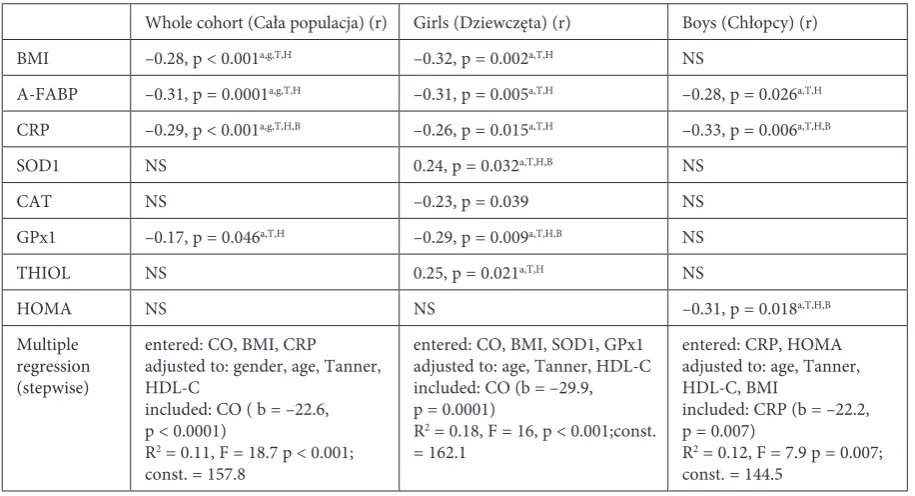
A-FABP, SOD1, CAT, GPx1, THIOL, and CRP, of which SOD1 and GPx1 remained significant also in the adjusted models. In boys, PON1 correlated with A-FABP, CRP, and HOMA with CRP and HOMA remaining significant after the adjustment for potential confounders (Table 3).
Of the variables associated with PON1 activ-ity independently from potential confounders only central obesity was retained in multivariate analysis model, explaining 11% in PON1 variabil-ity in the whole cohort and 17% variabilvariabil-ity in girls. In boys, CRP was independently associated with PON1 activity explaining 12% in its variability (Table 3).
There were no significant differences between individuals with phenotypes A and B of PON1
concerning gender distribution (p = 0.785), weight status (p = 0.770) and the frequency of central obe-sity (p = 0.991), metabolic syndrome (p = 0.393), high blood pressure (p = 0.990), hyperinsulinemia (p = 0.920) and insulin resistance (p = 0.465), nor the elevation of any evaluated metabolic or bio-chemical parameter.
Discussion
The studies conducted in animals consistently demonstrate antiatherogenic properties of PON1 but its association with human cardiovascular dis-ease remains under debate [1]. Data on PON1 and risk factors for cardiovascular disease in juvenile Table 2. Paraoxonase-1 activity in children and adolescents stratified by gender and their metabolic profile
Tabela 2. Aktywność paraoksonazy-1 u dzieci i nastolatków z uwzględnieniem płci i profilu metabolicznego
Parameter (Wskaźnik) Whole cohort (Cała populacja) Girls (Dziewczęta) Boys (Chłopcy)
mean ± SD, n P value mean ±
SD, n P value mean ± SD, n P value Gender (Płeć) girls
boys 146.4 ± 30.9 U, 87139.6 ± 32.6 U, 69 0.188 Weight status
(Kategoria wagowa)
normal overweight obese
159.2 ± 33 U, 47 134 ± 38.9 U, 27a 136.1 ± 24.9 U, 82a
< 0.0001
(a,g,T,H) 161.1, 23128.1, 16a 133.2, 48a
0.001
(a,T,H) 157.3, 24142.5, 11 140, 34
0.098
MetS no
yes 144 ± 34.9 U, 106139.8 ± 24.7 U, 50 0.390 139.5, 61139.9, 26 0.967 150, 45139.7, 24 0.190 Central obesity
(Otyłość brzuszna)
no
yes 157.6 ± 32.8 U, 52135.2 ± 28.9 U, 104 < 0.0001(a,g,T,H,B) 161.6, 24131.3, 63 < 0.001(a,T,H,B) 154.1, 28141.2, 41 0.088
High TG
(Wysokie TG) noyes 140.3 ± 33.5 U, 91145.9 ± 29.6 U, 65 0.287 137.2, 52143.4, 35 0.386 144.2, 38148.8, 30 0.549 Low HDL-C
(Niski HDL-C) noyes 143.3 ± 32.6 U, 144135.5 ± 22.4 U, 12 0.419 137.7, 73128.8, 7 0.484 145.5, 55144.8, 5 0.967 Hyperglycemia
(Hiperglikemia) noyes 141.8 ± 34.6 U, 110144.6 ± 24.7 U, 46 0.481 134.9, 58142.4, 22 0.354 145.9, 38146.6, 24 0.936 High BP
(Wysokie ciśnienie)
no
yes 146.8 ± 31.2 U, 107133.7 ± 32.1 U, 49 0.017(a,g,T) 145, 57129.5, 30 0.034(a,T) 148.7, 50140.4, 19 0.318
Insulin resis-tance (Insulino- oporność)
no
yes 146.1 ± 37.1 U, 80139.1 ± 25.1 U, 76 0.168 138, 37136.5, 44 0.842 149, 31142.5, 32 0.430
Hyperin- sulinemia (Hiperinsu- linizm)
no
yes 148.4 ± 36.1 U, 84135.9 ± 24.8 U, 72 0.012(a,g,T) 146.9, 48130.7, 39 0.020(a,T,H) 150.4, 36142.1, 33 0.270
significant following adjustment to a age, g gender, T Tanner stage, H HDL-cholesterol, and/or B BMI.
MetS – metabolic syndrome; TG – triglycerides; HDL-C – high density lipoprotein cholesterol; BP – blood pressure. znamienne po uwzględnieniu a wieku, g płci, T dojrzałości płciowej (skala Tannera), H cholesterolu HDL, i/lub B BMI.
population are confined to one study which linked the drop in PON1 activity with obesity [5]. The authors confirmed this association, however in the context of central rather than general obesity. Taking into account inflammatory and anti-oxidant properties of PON1 [1], decrease in the enzyme’s activity might exacerbate the inflamma-tion and oxidative stress which accompany juve-nile obesity.
Concerning the other components of the meta-bolic syndrome, the authors also found PON1 to be decreased in high blood pressure and hyperinsuline-mia, which, however, occurred to be mediated by the differences in BMI. Corroborating the findings from adults [23], PON1 arylesterase activity in this cohort inversely but weakly correlated with BMI.
Contrary to the findings in adults [23], the authors observed no correlation between PON1 and HDL-C. Present results might be affected by a low variability of HDL-cholesterol levels in the patients, in whom dyslipidemia manifested mainly by high triglycerides. However, authors’ observa-tions are consistent with findings from general ju-venile population [24] as well as from overweight/ obese children [5]. Ferretti et al. [2] demonstrated obesity-related decreases in PON1 in adults to be independent from co-occurring reduction in HDL particles. Conversely, Birjmohun et al. [4] showed them to be abolished following the adjustment
to HDL-related parameters. These authors have suggested PON1 association with coronary artery disease to be confounded by HDL-cholesterol. However, HDL-C adjustment did not affect the as-sociations observed in this cohort. Together with the observation on diminished PON1 activity de-spite normal HDL-C, the above stated fact might imply that PON1 reduction in juvenile population is potentially relevant for atherosclerosis develop-ment independently from HDL.
In line with stronger antioxidant capacity at-tributed to A phenotype of PON1 [1], a weak asso-ciation between R allele (B phenotype) and a high-er risk for coronary heart disease has been shown in a meta-analysis [25]. Accordingly, the authors sought differences in the frequency of obesity-re-lated metabolic disorders between PON1 pheno-types but found none. They did not differ when it comes to the levels of metabolic and biochemical indices as well.
Koncos at al. [5] demonstrated PON1 asso-ciation with adipocytokines – a positive one with adiponectin and a negative one with leptin. The authors have also found PON1 to negatively cor-relate with another adipose tissue-derived protein – A-FABP, the levels of which increase along with obesity [26]. However, contrary to leptin and adi-ponectin, A-FABP correlation with PON1 lost sig-nificance when BMI-adjusted.
Table 3 Significant associations between PON1 activity and metabolic, inflammatory, oxidative stress indices
Tabela 3. Istotne związki między aktywnością PON1 a wskaźnikami metabolicznymi, zapalenia i stresu oksydacyjnego
Whole cohort (Cała populacja) (r) Girls (Dziewczęta) (r) Boys (Chłopcy) (r)
BMI –0.28, p < 0.001a,g,T,H –0.32, p = 0.002a,T,H NS
A-FABP –0.31, p = 0.0001a,g,T,H –0.31, p = 0.005a,T,H –0.28, p = 0.026a,T,H
CRP –0.29, p < 0.001a,g,T,H,B –0.26, p = 0.015a,T,H –0.33, p = 0.006a,T,H,B
SOD1 NS 0.24, p = 0.032a,T,H,B NS
CAT NS –0.23, p = 0.039 NS
GPx1 –0.17, p = 0.046a,T,H –0.29, p = 0.009a,T,H,B NS
THIOL NS 0.25, p = 0.021a,T,H NS
HOMA NS NS –0.31, p = 0.018a,T,H,B
Multiple regression (stepwise)
entered: CO, BMI, CRP
adjusted to: gender, age, Tanner, HDL-C
included: CO ( b = –22.6, p < 0.0001)
R2 = 0.11, F = 18.7 p < 0.001;
const. = 157.8
entered: CO, BMI, SOD1, GPx1 adjusted to: age, Tanner, HDL-C included: CO (b = –29.9, p = 0.0001)
R2 = 0.18, F = 16, p < 0.001;const.
= 162.1
entered: CRP, HOMA adjusted to: age, Tanner, HDL-C, BMI
included: CRP (b = –22.2, p = 0.007)
R2 = 0.12, F = 7.9 p = 0.007;
const. = 144.5
r – Pearson correlation coefficient; significant following adjustment to a age, g gender, T Tanner stage, H HDL-cholesterol,
and/or B BMI in analysis of covariance (ANCOVA). A-FABP – adipocyte fatty acid-binding protein; CAT – catalase; SOD1 –
Low-grade inflammation is believed to un-derlie obesity as well as related metabolic abnor-malities. Elevated CRP levels are found in obese, insulresistant, dyslipidemic, and/or diabetic in-dividuals and are shown to predict cardiovascular risk independently from LDL-C and HDL-C levels as well as other components of the metabolic syn-drome [27]. Authors’ observation on inverse rela-tion between PON1 and CRP, independent from potential confounders, is consistent with findings demonstrating CRP and inflammatory cytokines to affect serum PON1 activity and directly reduce the number of PON1 transcripts in the liver [28] and supports the results from adults [4,23].
Sumegova et al. [24] reported higher PON1 arylesterase activity in girls than boys in a popula-tion-based study. There was a similar tendency in this cohort, which, however, did not reach statis-tical significance. Nevertheless, the authors found differences between genders concerning PON1 as-sociations. PON1 seems to be more tightly associ-ated with oxidative stress-relassoci-ated obesity in girls whereas in boys – with inflammation. Exclusively in girls, PON1 activity corresponded with
eryth-rocyte antioxidant enzymes and serum free thiol content. The trend of the association differed, being positive for SOD1 and free thiol content and negative for GPx1 and catalase. Accordingly, SOD1 and thiol content were decreased and GPx1 and catalase increased in association with cen-tral obesity in this cohort (unpublished observa-tions). Correlations with GPx1 and SOD1 were BMI-independent but lost their significance only when central obesity was accounted for. Inflam-mation, in turn, mediated an inverse association with HOMA found exclusively in boys. Authors’ observations imply that PON1 might be differ-ently regulated in both genders pointing at obesity and related oxidative stress in girls and inflamma-tion in boys as important factors affecting its ary-lesterase activity.
Summarizing, the authors showed PON1 to decrease in association with central rather than general obesity. The factors independently asso-ciated with decreases in PON1 were found to be gender-dependent: obesity and obesity-related oxidative stress in girls and inflammation in boys.
References
[1] Camps J, Marsillach J, Joven J: The paraoxonases: role in human diseases and methodological difficulties in mea-surement. Crit Rev Clin Lab Sci 2009, 46, 83–106.
[2] Ferretti G, Bacchetti T, Moroni C, Savino S, Liuzzi A, Balzola F, Bicchiega V: Paraoxonase activity in high-density lipoproteins: a comparison between healthy and obese females. J Clin Endocrinol Metab 2005, 90, 1728– 1733.
[3] Mackness M, Mackness B: Paraoxonase 1 and atherosclerosis: is the gene or the protein more important? Free Radic Biol Med 2004, 37, 1317–1323.
[4] Birjmohun RS, Vergeer M, Stroes ES, Sandhu MS, Ricketts SL, Tanck MW, Wareham NJ, Jukema JW, Kastelein JJ, Khaw KT, Boekholdt SM: Both paraoxonase-1 genotype and activity do not predict the risk of future coronary artery disease; the EPIC-Norfolk Prospective Population Study. PLoS One 2009, 4, e6809.
[5] Koncsos P, Seres I, Harangi M, Illyés I, Józsa L, Gönczi F, Bajnok L, Paragh G: Human paraoxonase-1 activity in childhood obesity and its relation to leptin and adiponectin levels. Pediatr Res 2010, 67, 309–313.
[6] Krzystek-Korpacka M, Patryn E, Boehm D, Berdowska I, Zieliński B, Noczyńska A: Advanced oxidation protein products (AOPPs) in juvenile overweight and obesity prior to and following weight reduction. Clin Biochem 2008, 41, 943–949.
[7] Krzystek-Korpacka M, Patryn E, Kustrzeba-Wójcicka I, Chrzanowska J, Gamian A, Noczyńska A: Gender-specific association of serum uric acid with metabolic syndrome and its components in juvenile obesity. Clin Chem Lab Med 2011, 49, 129–136.
[8] Krzystek-Korpacka M, Patryn E, Kustrzeba-Wójcicka I, Chrzanowska J, Gamian A, Noczyńska A: The effect of a one-year weight reduction program on serum uric acid in overweight/obese children and adolescents. Clin Chem Lab Med 2011, 49, 915–921.
[9] Krzystek-Korpacka M, Patryn E, Bednarz-Misa I, Hotowy K, Noczyńska A: Visfatin in juvenile obesity – the effect of obesity intervention and sex. Eur J Clin Invest 2011, 41, 1284–1291.
[10] Krzystek-Korpacka M, Patryn E, Bednarz-Misa I, Mierzchala M, Hotowy K, Czapińska E, Kustrzeba-Wójcicka I, Gamian A, Noczyńska A: Circulating adipocyte fatty acid-binding protein, juvenile obesity, and metabolic syn-drome. J Pediatr Endocr Met 2011, 24, 921–928.
[11] Cole TJ, Bellizzi MC, Flegal KM, Dietz WH: Establishing a standard definition for child overweight and obesity worldwide: international survey. BMJ 2000, 320, 1240–1243.
[12] Palczewska I, Niedźwiecka Z: Wskaźniki rozwoju somatycznego dzieci i młodzieży warszawskiej. Med Wieku Rozw 2002, 2(supl. I), 52.
[13] Cole TJ, Faith MS, Pietrobelli A, Heo M: What is the best measure of adiposity change in growing children: BMI, BMI %, BMI z-score or BMI centile? Eur J Clin Nutr 2005, 59, 419–425.
[15] Atabek ME, Pirgon O: Assessment of insulin sensitivity from measurements in fasting state and during an oral glucose tolerance test in obese children. J Pediatr Endocrinol Metab 2007, 20, 187–195.
[16] National High Blood Pressure Education Program Working Group on High Blood Pressure in Children and Adolescents: The fourth report on the diagnosis, evaluation, and treatment of high blood pressure in children and adolescents. Pediatrics 2004, 114, 555–576.
[17] Cook S, Weitzman M, Auinger P, Nguyen M, Dietz WH: Prevalence of a metabolic syndrome phenotype in adolescents: findings from the third National Health and Nutrition Examination Survey, 1988–1994. Arch Pediatr Adolesc Med 2003, 157, 821–827.
[18] La Du BN, Billecke S, Hsu C, Haley RW, Broomfield CA: Serum paraoxonase (PON1) isoenzymes: the quantita-tive analysis of isoenzymes affecting individual sensitivity to environmental chemicals. Drug Metab Dispos 2001, 29, 566–569.
[19] Charlton-Menys V, Liu Y, Durrington PN: Semiautomated methods for determination of serum paraoxonase activity using paraoxon as substrate. Clin Chem 2006, 52, 453–457.
[20] Bartosz G: Druga twarz tlenu. Wolne rodniki w przyrodzie. Wydawnictwo Naukowe PWN, Warszawa 2004, 2nd ed.
[21] Rice-Evans CA, Diplock AT, Symons MCR: Techniques in free radical research, Elsevier Science Publishers BV, Amsterdam 1991.
[22] Friedewald WT, Levy RI, Fredrickson DS: Estimation of the concentration of low-density lipoprotein cholesterol in plasma, without use of the preparative ultracentrifuge. Clin Chem 1972, 18, 499–502.
[23] Dullaart RP, de Vries R, Sluiter WJ, Voorbij HA: High plasma C-reactive protein (CRP) is related to low paraoxonase-I (PON-I) activity independently of high leptin and low adiponectin in type 2 diabetes mellitus. Clin Endocrinol 2009, 70, 221–226.
[24] Sumegová K, Nagyová Z, Waczulíková I, Zitnanová I, Duracková Z: Activity of paraoxonase 1 and lipid profile in healthy children. Physiol Res 2007, 56, 351–357.
[25] Wheeler JG, Keavney BD, Watkins H, Collins R, Danesh J: Four paraoxonase gene polymorphisms in 11212 cases of coronary heart disease and 12786 controls: meta-analysis of 43 studies. Lancet 2004, 363, 689–695.
[26] Stoffel-Wagner B, Roth CL: Adipocyte fatty acid-binding protein in obese children before and after weight loss. Metabolism 2007, 56, 1735–1741.
[27] Chait A, Han CY, Oram JF, Heinecke JW: Thematic review series: The immune system and atherogenesis. Lipoprotein-associated inflammatory proteins: markers or mediators of cardiovascular disease? J Lipid Res 2005, 46, 389–403.
[28] Feingold KR, Memon RA, Moser AH, Grunfeld C: Paraoxonase activity in the serum and hepatic mRNA levels decrease during the acute phase response. Atherosclerosis 1998, 139, 307–315.
Address for correspondence:
Małgorzata Krzystek-Korpacka Dept. of Medical Biochemistry Wroclaw Medical University Chałubińskiego 10
50-368 Wrocław Poland
Tel. +48 71 784 13 85
E-mail: [email protected]
Conflict of interest: None declared