ISSN (online): 2207-4414
Centre for Islamic Studies and Civilisation Charles Sturt University CRICOS 00005F
Islamic Sciences and Research Academy of Australia
https://ajis.com.au
Are Faith Based Programs Effective in Reducing
Recidivism?
A Case Study of Muslim Parolees in NSW
Salih Yucel and John Paget
To cite this article:
Yucel, Salih and John Paget. “Are Faith Based Programs Effective in Reducing Recidivism? A Case Study of Muslim Parolees in NSW.” Australian Journal of Islamic Studies 2, no. 3 (2017): 1-19.
Published online: 18 October 2017
View related and/or other articles in this issue Submit your article to this journal
ARE FAITH BASED PROGRAMS EFFECTIVE IN
REDUCING RECIDIVISM? A CASE STUDY OF MUSLIM
PAROLEES IN NSW
Salih Yucel
*and John Paget
**Abstract: Although Muslims comprise 5.3% of the NSW population, they account for 9.3% of prisoners in correctional centres. The high rate of Muslim representation in the prison population is the result of long- term neglect of the needs of second and third generation of Muslims by the wider Muslim community and by governments. This article first argues the high rate of the Muslim population in the prisons is not a failure of Muslim community alone, but is a product of a combination of individual, familial and societal failures due to various factors. These factors are multidimensional and need to be identified accurately to fashion appropriate responses. This article proposes a strategy for reintegration of Muslim parolees into society and reducing recidivism in prisons based on the experiences from a parolees mentoring program, which was conducted in 2016 by a community based institution, Islamic Science and Research Academy of Australia (ISRA), in collaboration with Bankstown Community Corrections Centre (a department of NSW Corrective Services). The findings show a mutual collaboration between NSW Corrective Services and faith-based organisations can assist in reducing recidivism in Muslim parolees.
Keywords: Muslim parolees, prison, ISRA, inmates, corrective services, Islam
INTRODUCTION
Between 2011 and December 2016 the prison population in New South Wales grew by 33% or 3,150 prisoners. In contrast, the prison population grew by only 0.7% in the 12 months to December 2017. Over this period, receptions declined by 2.8%, while discharges grew by 12%. At the current low rate of growth, the state’s prison population is expected to reach 13,244 by
December 2018.1
The Report on Government Services 2018 Chapter 8 Table 8A.13 records NSW prison design capacity utilisation of 108.5% in open and 133.0% in secure centres, the highest in
* Associate Professor Salih Yucel is a lecturer in Islamic Studies, Australian Catholic University. ** Associate Professor John Paget, Retired Lecturer, Charles Sturt University.
1 “NSW Custody Statistics: Quarterly Update 2017,” last modified January 30, 2018, http://www.bocsar.
Australia.2 Total capacity utilisation in 206-17 was similarly the highest in Australia. This indicates inmates and staff in NSW correctional centres are enduring substantial overcrowding. The deleterious impacts of prison overcrowding on inmates, staff, families, infrastructure and correctional outcomes are well-documented in international prison literature.3 The impact of
overcrowding in NSW correctional centres has been detailed in the NSW Inspector of Custodial Services’ April 2015 report: Full House: the growth of the inmate population in NSW.4
Prison overcrowding and the increasing costs of incarceration in other jurisdictions have spurred significant criminal justice system reform, including increased attention to the use of community-based supervision for offenders on release, often expressed as re-entry, or justice reinvestment, and community-based, rather than prison-based, sanctions as a less damaging and substantial cheaper form of social control.5 This has been achieved without compromising community safety. For example, from 2006-2012 California reduced its prison population by 23% and violent crime fell by 21%.6 Reforms directed at reducing prison populations have
been complemented by an increased focus on the treatment needs of those with drug, alcohol and mental health problems.
In 2016, 8,010 inmates were released on parole in NSW.7 According to the NSW State
Parole Authority’s reports, in the last five years, the number of parole applications increased by 40.6% and releases rose by 20.4%.8 This report shows the number of parolees most likely will increase in coming years as well. Between 2014 and 2017, the average monthly number of offenders released on parole increased by 35%, from 504 to 682 offenders.9
2 Open prison: “A custodial facility where the regime for managing prisoners does not require them to be
confined by a secure perimeter physical barrier, irrespective of whether a physical barrier exists. Secure prison: “A custodial facility where the regime for managing prisoners requires them to be confined by a secure perimeter physical barrier.” Steering Committee for the Review of Government Service Provision,
Report on Government Services 2018 (Canberra: Productivity Commission, 2018), ch. 8 table 8A.13,
http://www.pc.gov.au/research/ongoing/report-on-government-services.
3 For example, Craig Haney, “The Wages of Prison Overcrowding: Harmful Psychological Consequences
and Dysfunctional Correctional Reactions,” Washington University Journal of Law and Policy 22 (2006); United Nations High Commissioner for Human Rights, Human Rights Implications of Overincarceration
and Overcrowding (Geneva: Human Rights Council, 2015), A/HRC/30/19.
4 Inspector of Custodial Services, Inspector of Custodial Services Annual Report 2015-16 (Sydney, NSW:
Inspector of Custodial Services, 2016), accessed January 27, 2018, http://www.custodialinspector.justice. nsw.gov.au/Documents/Annual%20Report%202015-16.pdf.
5 Ryken Grattet, Jeffrey Lin and Joan Petersilia, “Supervision Regimes, Risk, and Official Reactions to
Parolee Deviance,” Criminology 49 (2011).
6 Marc Maur and Nazgol Ghandnoosh, Fewer Prisoners; Less Crime. A Tales of Three States (Washington,
DC: The Sentencing Project, 2015), accessed February 6, 2018, http://sentencingproject.org/wp- content/uploads/2015/11/Fewer-Prisoners-Less-Crime-A-Tale-of-Three-States.pdf.
7 NSW State Parole Authority, Annual Report 2016, December 1, 2017, 9, accessed January 27, 2018,
http://www.paroleauthority.nsw.gov.au/Documents/ANNUAL%20REPORT%202016.pdf.
8 “Annual Report,” accessed August 6, 2017, http://www.paroleauthority.nsw.gov.au/Pages/publications/
annual-reports.aspx.
MUSLIMS AND THE PRISON POPULATION
According to Australian Bureau of Statistic, Muslims comprise 5.3%10 of the NSW population, but 9.3% of the state prison population is Muslim.11
This high rate of Muslim population in the prisons is not a failure of the Muslim community alone, but rather represents combined individual, family and societal failures due to various factors. These factors are multidimensional and need to be identified accurately in the community and prison in collaboration with appropriate government agencies, experts and the Muslim community. This article proposes a strategy for reintegration of Muslim parolees to the society and reducing recidivism after release from prisons. Finally, it will analyse a parolees mentoring program, which was conducted by a community-based institution, Islamic Science and Research Academy of Australia (ISRA), with the support of Bankstown Community Corrections Centre in 2016.
The high rate of Muslim over-representation in the prison population is partly the result of long-term neglect of the needs of second and third generations of Muslims by the wider Muslim and Australian communities and by governments. The impact of global socio-political factors in the last two decades, such as the war on terror and internal conflicts in the Muslim world, is also undeniable, but these are out of the scope of this article.
Muslim prisoners come from a significantly disadvantaged sector of Australian society. According to a University of South Australia report, compared to other Australians, Muslims in Australia are less likely to own or be purchasing their own home and they earn significantly less at individual and household levels; 25% of Muslim children live in poverty, compared to 14% of all other Australian children. Muslims have higher rates of unemployment than the general population and are less likely to be in the labour market. On subjective measures of well-being, Muslims are less likely to feel safe than other Australians. It is not surprising then, as noted above, that Muslim Australians are over-represented in prisons.12
It is estimated, in 2016, about 350 of NSW parolees were Muslims. They face significant and different challenges and risk factors that may hinder their ability to become law-abiding citizens on release from prison. These include difficulties reintegrating into society, a lack of positive social networks, unemployment, accommodation, and drug and alcohol problems, vulnerability to religious extremism, and an absence of a sense of belonging to the community from social and psychological perspectives. They are characterised by pessimism, low morale, aimlessness and helplessness.
10 Australian Bureau of Statistics, 2016 Census QuickStats, accessed November 8, 2017, http://www.census
data.abs.gov.au/census_services/getproduct/census/2016/quickstat/1GSYD?opendocument.
11 Riaz Hasan, Australian Muslims. A Demographic, Social and Economic Profile of Muslims in Australia
(Adelaide: University of South Australia, 2015), 34, accessed March 13, 2016, https://www.unisa.edu.au/ Global/EASS/MnM/Publications/Australian_Muslims_Report_2015.pdf
While research shows it is important to develop a strategy for involving marginalised and vulnerable groups in the community,13 compared to other major faith denominations, Muslim parolees in NSW have almost no community assistance nor is there any Islamic organisation that provides comprehensive and sustainable post-release support. There is only limited support provided by families and individuals close to the offender. Numerous researchers’ and experts’ reports demonstrate that early pre-release collaboration between Corrective Services, faith- based organisations and prisoners’ families is crucial in ensuring success on parole and reducing recidivism, which will be elaborated in the next section.14
COMMUNITY SUPPORT, REINTEGRATION AND RECIDIVISM
According to the Australian Institute of Criminology, about 60% of those in custody in Australia have been imprisoned previously.15 As a consequence, reducing recidivism is an important goal for a society and the criminal justice system. In New South Wales, this is reflected in the State Plan 2021 Making NSW Number One, which has a goal to reduce reoffending by 5% by 2019.16
Research has shown that community and faith-based programs are effective in reducing the rate of recidivism.17 Based on the result of a survey, which includes 1,697 men and 357 women, Boman and Mowen found family support reduces post-release criminal offending.18 Other research has also argued that community involvement is necessary for reducing the rate of recidivism.19 Garland, Wodahl and Smith found “The sustainability of the modern prisoner reentry movement may rest heavily upon public support. Although little is known about how
13 United Nations Office on Drugs and Crime, Introductory Handbook on the Prevention of Recidivism and
the Social Reintegration of Offenders (Vienna: United Nations Publications, 2012), 80, accessed
November 8, 2017, http://www.unodc.org/documents/justice-and-prison-reform/crimeprevention/ Introductory_Handbook_on_the_Prevention_of_Recidivism_and_the_Social_Reintegration_of_ Offenders.pdf
14 Curt T. Griffiths, Yvon Dandurand and Danielle Murdoch, The Social Reintegration of Offenders and
Crime Prevention (Ontario, CA: National Crime Prevention Centre, 2007); Donnie W. Watson et al., “The
Role of Faith Based Organisations in Ex-Offender Re-entry,” Californian Journal of Health Promotion 6, no. 2 (2008); Annaliese Johnston, Beyond the Prison Gate: Reoffending and Reintegration in Aotearoa
New Zealand (Manukau, Auckland: Salvation Army, 2016); Caitlin J. Taylor, “The Family’s Role in the
Reintegration of Formerly Incarcerated Individuals: The Direct Effects of Emotional Support,” The Prison
Journal 96, no. 3, doi: 10.1177/0032885516635085; Richard Stansfield et al., “The Role of Religious
Support in Reentry: Evidence from the SVORI Data,” Journal of Research in Crime and Delinquency 54, no. 1 (2016).
15 “Recidivism,” accessed August 12, 2017, http://www.aic.gov.au/crime_community/community
crime/recidivism.html.
16 “Reducing Reoffending”, accessed February 20, 2018, http://www.justice.nsw.gov.au/Pages/Reforms/
reducing-reoffending/reducing-reoffending.aspx.
17 United Nations Office on Drugs and Crime, Introductory Handbook, 49-50
18 John H. Boman, and Thomas J. Mowen, “Building the Ties that Bind, Breaking the Ties that Don’t: Family
Support, Criminal Peers, and Reentry Success,” Criminology & Public Policy 16 (2017).
19 See: Gemma Harper and Chloë Chitty, eds., The Impact of Corrections on Re-offending: A Review of
‘What Works,’ 3rd ed. (UK: Home Office Research, Development and Statistics Directorate, 2005);
public opinion toward reentry is shaped, religion is potentially a key contributor.”20 A United
Nations report supports this, noting that community involvement has become indispensable for crime prevention.21 In the US, Congress enacted the Prisoner Reentry Initiative (PRI) in 2004 by allocating USD 300 million to faith-based communities for assisting ex-offenders. Recidivism rates achieved under the PRI were 20% compared to the national rate of 44%.22 Another study evaluated the respondents after four years of parole and found religiosity correlated with non-recidivism at a strength of 0.30.23 Scholars have argued that lack of family
and informal social support negatively affects the post-release adjustment of young people.24 A report prepared for the Public Safety and Emergency Preparedness of Canada advises that communities have a key role to play in the successful reintegration of ex-prisoners.25 According to this report, “family support was overwhelmingly identified as a critical to returning young offenders for material support, motivation, and emotional support” and peer informal support and community support is very important in the period of post-release of inmates. A Colorado Division of Criminal Justice report shows ongoing monitoring of program participants in their communities is crucial for reducing the rate of recidivism.26
The “Second Chance Coalition” (SCC) is a community-based organisation that provides different types of assistance to ex-offenders, such as housing, a job and connecting them to faith-based communities to reduce recidivism. It does so in collaboration with the Minnesota Department of Corrections. An analysis of the SCC identified barriers to success, which include social stigma, lack of basic needs, effects of poverty, a lack of community ties and unrealistic preparedness.27
The scope for Community Corrections as part of the Justice Reinvestment response to unsustainable prison costs is also reflected in research, such as 2013 report The Potential of Community Corrections to Improve Community Safety and Reduce Incarceration.28 As a result
of such research, a significant number of jurisdictions in the United States have invested in community corrections and community-based sanctions to alleviate budget shortfalls, the
20 Brett Garland, Eric Wodahl and Rebecca Gretchen Smith, “Religious Beliefs and Public Support for
Prisoner Reentry,” Criminal Justice Policy Review 28, no. 9 (2017).
21 United Nations Office on Drugs and Crime., Handbook on the Crime Prevention Guidelines: Making them
Work (New York: United Nations Publication, 2010) accessed August 6, 2017, https://www.unodc.org/
pdf/criminal_justice/Handbook_on_Crime_Prevention_Guidelines_-_Making_them_work.pdf.
22 Darrell Wheeler and George Peterson, “Prisoner Reentry,” Health and Social Work 33, no. 2 (2008). 23 Mercer L. Sullivan, “Youth Perspectives on the Experience of Reentry,” Youth Violence and Juvenile
Justice 2 (2004).
24 Ibid.
25 Griffiths, Dandurand and Murdoch, “The Social Reintegration of Offenders and Crime Prevention.” 26 RKC Group and Roger Przybylski, What Works: Effective Recidivism Reduction and Risk-Focused
Prevention Programs (Denvor, CO: Colorado Division of Criminal Justice, 2008), accessed November 8,
2017, https://cdpsdocs.state.co.us/ccjj/Resources/Ref/WhatWorks2008.pdf.
27 Paige Paulson, “The Role of Community Based Programs in Reducing Recidivism in Ex-Offenders”
(Master’s diss., St Catherina University, 2013), 41, accessed November 8, 2017, http://sophia.stkate.edu/ cgi/viewcontent.cgi?article=1249&context=msw_papers.
28 Centre on Sentencing and Corrections, The Potential of Community Corrections to Improve Community
Safety and Reduce Incarceration (New York, NY: The Vera Institute of Justice, 2013). See also NSW Law
problems of prison crowding and even permit the closure of prisons.29 Research studies found the most successful approach in reducing recidivism among offenders is to provide comprehensive community support immediately upon release.30 However, Damian and Abrams argue that “existing literature lacks clarity about the conditions that make this social support matter, the mechanisms through which it operates,” specifically in highly disorganised societies in regard to young offenders.31
The Canadian study referred to previously noted parolees who participated in in-prison and community aftercare programming had a three-year re-incarceration rate of 27%. In comparison, the rate was 75% for those who did not participate or failed to complete the program.32
THE EFFICACY OF PAROLE
Notwithstanding periodic appalling crimes committed by a few offenders on parole, which rightly attract widespread criticism and undermine public confidence in the criminal justice system, parole remains an important feature of sentencing, inmate management and rehabilitation. The NSW Law Reform Commission has noted “having reviewed the evidence we conclude that parole works to reduce re-offending and contributes to protecting community safety and so is in the community’s interest”.33
Building on the NSW Law Reform Commission report, the NSW Government on May 2017 announced a series of changes to the parole system directed at improved management of parolees and community protection. These changes included:
• A voice for victims. registered victims, via the Corrective Services Victims Register, are provided with the opportunity to submit a statement during the State Parole Authority’s (SPA) decision-making process
• Swift and escalating penalties of parole breaches. The management of minor parole breaches has been delegated to Community Corrections officers. The SPA is able to revoke parole if it has concerns about community safety, even in the absence of a breach.
• Mandatory supervision. Supervision has been made mandatory in recognition that supervision is effective in reducing re-offending.34
29 Crime and Justice Institute at Community Resources for Justice, Implementing Evidence Based Practice in
Community Corrections, 2nd ed. (Washington, DC: National Institute of Corrections, 2009), ix.
30 Doris Layton MacKenzie, “Criminal Justice and Crime Prevention,” in Preventing Crime: What Works,
What Doesn't, What's Promising, eds. Lawrence W. Sherman, Denise Gottfredson, Doris MacKenzie, John
Eck, Peter Reuter and Shawn Bushway (Washington, DC: National Criminal Justice Reference Service, 1997), accessed August 6, 2017, https://www.ncjrs.gov/works/chapter9.htm.
31 Damian J. Martinez and Laura S. Abrams, “Informal Social Support Among Returning Young Offenders:
A Metasynthesis of the Literature,” International Journal of Offender Therapy and Comparative
Criminology 57, no. 2 (2013).
32 Griffiths, Dandurand and Murdoch, “The Social Reintegration of Offenders and Crime Prevention,” 17 33 NSW Law Reform Commission, Report 142, xvii.
34 NSW Government, Strengthening Parole (Canberra: NSW Government, 2017), accessed November 8,
In NSW, the efficacy of parole supervision was reported in a 2014 BOCSAR study,35 which recorded that offenders who had received parole supervision upon release from custody took longer to commit a new offence, were less likely to commit an indictable offence and committed fewer offences than offenders who were released unconditionally into the community. This study also reported parolees with a higher than average level of rehabilitation- focused contacts took longer to commit new offences and recorded fewer offences within 36 months of being released compared with their counterparts who received less frequent rehabilitation-focused contacts.36
The October 2014 Victorian Ombudsman discussion paper, Investigation into the rehabilitation and reintegration of prisoners in Victoria, noted, while the parole period is most critical time for parolees returning to their communities, a common failure during this transition is a lack of access to parolee programs in the community. The ombudsman further observed there is ample evidence worldwide that those leaving prison face significant challenges reintegrating into the community.37 Religion and prison are also considered interconnected in the United States.38 A Pew Poll shows 78% of prison chaplains in the US consider religious group support as “absolutely critical” to successful re-entry into society.39
Supporting these findings, the Public Interest Advocacy Centre 2013 research paper Beyond the Prison Gates found people released from prison encountered a number of difficulties, which included:
• Risk and temptation to re-offend due to difficulties fitting back into society and a lack of accommodation options
• Disconnection from society, institutionalisation and a lack of basic living and coping skills
• Feeling isolated from friends and community support networks
• Being exposed to bad influences, making re-offending an easy option
• Having previous legal and criminal problems resurface unexpectedly
• For women, feeling unsafe and vulnerable to abuse and harassment
• Difficulty finding employment
• Difficulties associated with alcohol or substance addiction40
35 Wai-Yin Wan et al., Parole Supervision and Re-Offending: A Propensity Score Matching Analysis
(Sydney: Bureau of Crime Statistics and Research, 2014), 2, accessed November 8, 2017, http://www.bocsar.nsw.gov.au/Documents/parolesupervisionandreoffending.pdf
36 Ibid.
37 Victorian Ombudsman, Investigation into the Rehabilitation and Reintegration of Prisoners in Victoria,
(Victoria: Victorian Government Printer, 2015), 22.
38 Daniel W. Sack, “Guardians as Gatekeepers and Other Issues of the Establishment Clause and Parole,”
Columbia Journal of Law and Social Problems 50, no. 3 (2017).
39 Pew Forum on Religion & Public Life, Religion in Prisons – A 50-State Survey of Prison Chaplains
(Washington, DC: Pew Research Center, 2012), accessed August 6, 2017, http://www.pewforum.org/ 2012/03/22/prison-chaplains-exec/.
40 Luis Schetzer and StreetCare, Beyond the Prison Gates: The Experiences of People Recently Released
from Prison into Homelessness and Housing Crisis (Sydney: Public Interest Advocacy Centre Ltd, 2013),
The NSW Government has successfully implemented community and faith-based parole programs for many years.41 The government recruited 200 additional officers to manage and
supervise parolees. This represents a significant advance in helping parolees.42 The NSW Government also funded Mission Australia AUD 7 million to provide support for 500 parolees over five years in 2012.43 In July 2016, the NSW Government signed a contract to implement
Australia’s first social impact investment to reduce parolee reoffending and re-incarceration. According to NSW Government news release,
The investment funds On TRACC (Transition Reintegration and Community Connection), an intensive support program to provide individual support to parolees, particularly in the first 16 weeks of parole. It aims to support parolees to successful reintegration into the community following their release from prison. Building on support services for parolees provided by Corrective Services NSW, On TRACC will work with up to 3,900 parolees over five years, and will be jointly delivered by Australian Community Support
Organisation (ACSO) and ARBIAS(Alcohol Related Brain Injury Association).44
Prompted by growing security concerns, community representations, media commentary and academic research, NSW Corrective Services has taken some steps to provide assistance to Muslim inmates.45 These steps include assigning two Muslim chaplains to provide pastoral care, hiring Muslim staff and some attempts to reach out to the Muslim community. However, compared to the well-developed collaboration between NSW Corrective Services and other faith groups, Muslims are far behind in providing similar services for Muslim inmates and parolees. Based on our investigation, no faith-based Islamic organisation provides support services for Muslim parolees in NSW.46 There is thus a pressing need for NSW Corrective Services and Islamic organisations to develop a partnership for assisting Muslim prisoners and, in particular, parolees.
ISLAMIC SCIENCES AND RESEARCH ACADEMY OF AUSTRALIA (ISRA)
Established in 2009, ISRA is a product of the intercultural dialogue movement in Australia. It is a platform for cooperation between Australian Muslims and educational institutions in Australia. While ISRA has a strong educational and research emphasis, which is reflected in its close relationship with the Centre for Islamic Studies and Civilisation at Charles Sturt
41 For results of these programs see “Social Impact Investments,” accessed November 26, 2017,
https://www.osii.nsw.gov.au/initiatives/social-benefit-bonds/#social-benefit-bonds-in-nsw.
42 NSW Government, Strengthening Parole.
43 Mike Baird, NSW Government Announces Joint Development Phase for Social Benefit Bonds [media
release], March 20, 2012, accessed November 26, 2017, https://www.treasury.nsw.gov.au/sites/default/ files/mediarelease/20120320--Media---NSW-Government-Announces-Joint-Development-Phase-for- Social-Benefit-Bonds.pdf.
44 “New Social Impact Investment to Reduce Parolee Reoffending and Re-incarceration,”
https://www.osii.nsw.gov.au/news/2016/07/12/new-social-impact-investment-to-reduce-parolee- reoffending-and-re-incarceration/.
45 John Paget, “Aboriginal Conversions to Islam: A Substantial Security Threat or Another Moral Panic?” in
Muslim Identity Formation in Religiously Diverse Societies, ed. Derya Iner and Salih Yucel,.290-307
(Cambridge: Cambridge Scholars Publishing, 2015).
University, ISRA also focuses on community building and cooperation on religious, social, environmental and other major issues in national and international contexts.
According to its website, ISRA is a point of reference for Islamic education, advocacy, resources and information services in Australia with operations and offices in Sydney and Melbourne. It delivers pioneering educational services and conducts research on social and religious issues of relevance to Australian society and the international community.47 ISRA engages and cooperates with individuals, communities and institutions in Australia and abroad to actively contribute to social harmony, cultural diversity and positive religious values. In the last three years, ISRA has conducted three programs for NSW Corrective Services. The first was a six week deradicalisation program for Juvenile Justice and the second was a 20 week program, which was called “Islamic Compass for Life” run at John Morony Correctional Centre for Muslim inmates. These two programs are not within the scope of this article.
The NSW Public Interest Advocacy Centre has noted one of the problems community workers faces in providing services to people released from prison is a lack of resources and organisational capacity.48 This observation was only partially accurate in the case of ISRA, which is able to draw on a team of volunteers. However, it needed to develop its capacity to work more effectively with related agencies.
POST-RELEASE MENTORING
The purpose of the parolees mentoring program draws on the second reading speech for the Parole of Prisoners Act 1966 (NSW), which noted the purpose of parole is “to restore a measure of freedom to the prisoner and to give him guidance and supervision during the period of transition from controlled to uncontrolled living.”49 This is an appropriate statement of
program purpose, with the caveat it is specifically targeted at parolees who identify as Muslims.
The goal of mentoring has been stated to be to support the development of pro-social life styles, thereby reducing an individual’s exposure to or the temptations of risky and problem behaviours.50 Contact with resettlement workers has been shown to be linked to lower than predicted reconviction rates. This link has been assessed to be particularly strong where post release contact was maintained with volunteer mentors.51 Mentors provide a bridge between the ex-offender and their communities and families; this is critical where there has been a degree of estrangement between these parties as a result of the offending behaviour and
47 For detailed information about ISRA, see https://www.isra.org.au. 48 Schetzer and StreetCare, Beyond the Prison Gates, ix.
49 NSW Law Reform Commission, Parole Question Paper 1: The Design and Objective of the Parole System
(Sydney: NSW Law Reform Commission, 2013), 5, accessed March 14, 2016, http://www.lawreform. justice.nsw.gov.au/Documents/current-project/parole/question-paper/qp%201%20-%20design%20and%20 objectives%20of%20the%20parole%20system_final.pdf.
50 National Research Council, Parole, Desistance from Crime and Community Integration (Washington:
National Academies Press, 2007), 59.
51 Kirsty Hudson, Mike Maguire and Peter Raynor, Through the Prison Gate: Resettlement, Offenders
incarceration. This role for the mentors draws on the research, which supports the positive role of perceived levels of family emotional and instrumental support on the likelihood of further self-reported criminal behaviour.52
A 2008 Swedish rapid evidence assessment53 reviewed 18 studies to determine the effect of mentoring on re-offending. While it concluded mentoring reduces re-offending by approximately 4-10%, it observed mentoring was more effective in reducing re-offending when the duration of contact between mentor and mentee was greater and when mentoring was combined with other interventions.54
Research by the US National Research Council argues certain elements are essential for effective mentoring programs, notably a high level of contact between the mentor and person being mentored, and a relationship that defines the mentor as a trusted adviser and supporter, rather than an authority figure.55
The United Kingdom Home Office research into mentoring notes:
A general feature of mentoring programmes is the contact of a less experienced or ‘at risk’ individual with a positive role model. The mentor is more experienced and often older in the hope that the mentor can provide guidance, advice and encouragement that helps to develop the competence and character of the mentee.56
This same research and report documented the evidence on mentoring and assessed that, overall, mentoring reduced reoffending.57
The potential of mentoring to make a positive contribution to the success of parole and hence to State Government objectives to reduce re-offending58 is evidenced in NSW Corrective Services funding for new initiatives to improve re-entry services. These include increasing inmate participation in the pre-release NEXUS program; using social impact investment to work with the non-government sector to provide greater support for prisoners with complex needs; increasing support for high risk parolees; and expanding mentoring.59
It is acknowledged mentoring is a complement to services that address other critical re- integration needs, such as housing, healthcare, substance use treatment and employment. In
52 See Taylor, “The Family’s Role”; Boman and Mowen, “Building The Ties That Bind”; Christy A. Visher,
“Social Networks and Desistance,” Criminology and Public Policy 16, no. 3 (2017); Joyce A. Arditti and Tiffaney Parkman, “Young Men’s Reentry After Incarceration: A Developmental Paradox,” Family
Relations 60 (2011); Doreen Anderson-Facile, “Basic Challenges to Prisoner Reentry,” Sociology
Compass 3, no. 2 (2009).
53 A rigorous method for locating, appraising and synthesising evidence from previous studies.
54 Darrick Jollife and David P. Farrington, The Influence of Mentoring on Reoffending (Stockholm: Swedish
National Council for Crime Prevention, 2008), 6, accessed November 8, 2017, http://www.crim.cam.ac.uk/ people/academic_research/david_farrington/mentorsw.pdf.
55 Ibid., 27.
56 Darrick Jollife and David P. Farrington, A Rapid Evidence Assessment of the Impact of Mentoring on Re-
Offending (UK: Home Office, 2007) 5, accessed November 8, 2017, http://www.youthmentoring.org.nz/
content/docs/Home_Office_Impact_of_mentoring.pdf.
57 Ibid., 15.
58 “Premier’s Priorities,” accessed November 8, 2017, www.nsw.gov.au/improving-nsw/premiers-priorities. 59 Walter Sofronoff, Queensland Parole System Review: Final Report (Brisbane: Qld Government, 2016),
2016, ISRA conducted a mentoring project to assist parolees, which will be critically analysed in the next sections and suggestions offered as to how it might be improved.
ISRA PAROLEES MENTORING PROGRAM
This program is the first of its kind in NSW. ISRA conducted the ten week parolees mentoring program with Bankstown Community Services Centre in 2016. It was a multi- dimensional in regard to the weekly programs, parole-based reintegration program tailored to the cultural needs of Muslim offenders. The program supervisor had extensive relevant expertise, having worked as an imam in one of Sydney’s mosques for six years. He continued his pastoral care service as a Muslim chaplain with NSW Corrective Services for another six years and then Harvard Medical School’s hospitals for seven years before he completed his doctorate. The four main volunteers had provided part-time welfare services to Muslim youth for more than five years.
The program detail was developed over several meetings by a team that included four ISRA volunteers and staff from NSW Corrective Services. The objective was to provide community support for ten Muslim parolees to integrate back into society during their parole periods. The program consisted of three stages. In the first stage, ISRA volunteers prepared the program content in detail and put this before NSW Corrective staff. After approval of the program, Bankstown Community Corrections Centre interviewed parolees and encouraged ten parolees to volunteer to participate in the program. Sexual offenders and drug addicts were excluded because the program location was not appropriate and out of concern for staff who work at ISRA.
At the second stage, each week, two volunteers conducted the program under supervision of the expert at ISRA. The weekly programs were typically designed on the basis of the dynamic risk factors associated with recidivism. In addition, a female staff member from Bankstown Community Corrections Centre liaised with the parolees’ families, particularly with their mothers and wives, to gauge the program’s effectiveness. At the third stage, a survey was conducted; the results were analysed by Bankstown Community Corrections Centre.
The role of a culturally familiar and culturally competent mentor60 reflects the understanding that offender attitudes and beliefs are the key components associated with the success or failure of parole.61 The structure of the parolees mentoring program, which is described below, is
60 The research stresses the importance of cultural competence and ethnic identity in mentoring. See Gabriel
P. Kupermenic and Jessica D. Thomason, “Group Mentoring” in Handbook on Youth Mentoring, ed. David L. Dubois and Michael J. Karcher (US: Sage Publications, 2013), 286.
61 Department of Justice, “Research and Literature,” Community Corrections January-March (2015), 4,
consistent with the best practice principles for transitional support programs detailed in research conducted by Monash University.62
THE OBJECTIVES OF THE PAROLEES MENTORING PROGRAM
• Contribute to CSNSW Reducing Reoffending reforms, specifically improved exit
planning and reintegration support and enhanced community supervision
• Assist Muslims offenders on parole to integrate into society through spiritual, cultural and educational activities
• Reduce risk factors that can lead to reoffending and recidivism
• Provide a culturally familiar pathway for parolees to access community-based services, supports and programs
• Re-connect parolees with positive support networks among their families, communities and friends
• Assist parolees to develop problem-solving skills focussed on personal goals
• Develop the capacity and confidence of parolees to self-manage post-release challenges
• Provide faith-based spiritual, emotional and pastoral support to newly released parolees
• Develop parolees’ latent spiritual, moral and cultural strengths as protective factors to assist reintegration
• Assist parolees to find employment
CONDUCT
A group of 10 parolees were invited to participate in the program. Two of the parolees could not participate – one worked on Saturdays and the other was not interested.
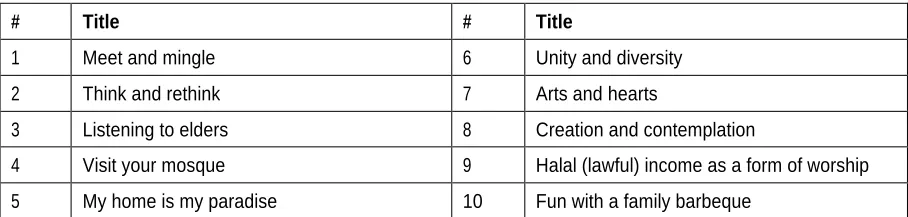
Table 1: Program modules
# Title # Title
1 Meet and mingle 6 Unity and diversity
2 Think and rethink 7 Arts and hearts
3 Listening to elders 8 Creation and contemplation
4 Visit your mosque 9 Halal (lawful) income as a form of worship
5 My home is my paradise 10 Fun with a family barbeque
Initially, the parolees were guarded with the volunteers, assuming they were civil servants or government agency staff, so it was important for volunteers to build trust. Volunteers
62 See Whitelion, Melbourne Citymission, Prison Network Ministries and Prison Fellowship Australia,
prepared food and served it to the parolees, a common gesture in Islamic culture. The first module was delivered as a basic confidence and trust building session.
The second and third modules involved bringing in speakers to provoke thought in the parolees and discussion among all those involved in the program. The fourth module was a form of community and faith engagement, as parolees participated in a mosque’s open day. The fifth module focused on the family and encouraged parolees and volunteers to talk about their families. Leading from this was the Unity and Diversity module, where parolees visited the Muslim section of a cemetery and prayed for all the deceased together, then dispersed to visit the graves of those whom they had known. One parolee visited his father’s grave for the first time in 20 years and broke into tears when talking about the experience.
This was followed by an uplifting module, Arts and Hearts, which involved listening to spiritual music and viewing Islamic arts. Creation and Contemplation involved watching a documentary, which was followed by a lecture and discussion. This lead to the discussion of a halal (lawful and legal) income and how it is considered a form of worship in Islam, like prayer and fasting. The final module was a family barbecue.
The volunteer support team was not there to lecture or preach, but to listen to parolees as they talked about their life stories and their experiences in correctional centres, the community, family and social life. Different topics relating to theology and spirituality were discussed with an expert responding with authority to their questions. At the end of the last module, the parolees completed a survey on the program. According to survey results, the parolees had a positive view of the program. Five wanted to attend similar programs in the future and also provide volunteer work for the community. During the program, the participants had the opportunity to talk about their personal experiences and share their stories. This helped to build trust and friendship between the ISRA team and parolees. It also motivated them to participate and learn from each other. During the ten week program, there were discussions about religion, life in prison, coping strategies and personal issues in their faith, families and social circles. All agreed there was a lack of community support after they were released. Parolees first interpreted the program as a punishment. Three indicated initially they thought it would be another departmentally inflicted requirement, which they had to endure, but after two weeks there was a change in their attitudes. By the end of the program, they had a positive outlook on their participation. They sought to keep in touch with the ISRA team after program completion. Two parolees sincerely asked the ISRA volunteer team to not leave them alone. Parolees regularly provided this very personal feedback throughout their participation in the program. That they felt comfortable to share their views directly with the volunteers indicated the parolees felt safe and were able to trust the ISRA team.
ANALYSIS AND DISCUSSION
financial sources, the program could not be sustained for a long time. The ISRA program was not multidimensional; there was no involvement of psychologists, employment agencies or other services. The parolees mentoring program was community based, for ten weeks and conducted by volunteers only on Saturdays between 1:00 and 3:00pm. For additional support, the team was in contact with the parolees via phone two or three times each week. In comparison, faith-based programs in the US include social workers, psychologists, employment agencies, family organisations, financial sources and may last for up to three years.
Based on the parolees’ feedback during the program and the post-program survey, the parolees’ perception of the program evolved. An initial difficulty was the volunteers found there was no real trust between the parolees and NSW Corrective Services. However, as participation progressed, the parolees’ attitude of suspicion and reticence changed to one of appreciation and more enthusiastic engagement. Five of the parolees wanted to assist with subsequent programs. The survey results and parolees’ feedback indicated the strengths of the program are: the content, trust gained by volunteers, parolees’ satisfaction, and the willingness of parolees and the volunteer team to assist in future programs.
Based on survey and personal feedback provided by the parolees, the dates and timings of the program were not convenient due to their work commitments. All participants indicated an evening scheduling would have been more suitable.
Since all the parolees were male, the team consisted of all male volunteers. However, it would have been valuable to have a female volunteer for contacting the parolees’ mothers or wives and provide spiritual and emotional support. Future programs will need to address this factor and will also require at least one social worker to maintain contact with all parolees after program completion. The team endeavoured to contact the parolees’ families to arrange goodwill visits, but these did not eventuate. A female staff member from Bankstown Community Corrections Centre contacted the families over the phone and advised they had expressed their satisfaction with the program.
To ensure future programs are successful, it is important the program is multi-dimensional and has greater participation and support from the parolees’ families. The program should have three stages: pre-release, post-release and follow-up for a minimum of three years after release into the community. During the pre-release stage, Muslims offenders’ needs should be identified, together with the services and programs to meet those needs. Post-release, multi- dimensional support from various agencies and faith-based organisations is crucial. Finally, it is necessary to provide a continuum of care, which consists of support from families, faith- based organisations, NSW Corrective Services, and housing and employment agencies.
Research has demonstrated that securing employment is a major concern for parolees.63 Nine of the ten Muslim parolees were in part-time or full-time employment. All found accommodation with family or friends.
Research has consistently shown programs that have been implemented with a high degree of fidelity are far more likely to be successful.64 Despite the short time frame and lack of adequate resources, ISRA’s volunteer team’s success is related their fidelity. All team members indicated they were quite satisfied with the results and ready to assist with future programs.
The ISRA parolees mentoring program needs to be developed further with wider collaboration with the parolees’ families, communities, relevant government and non- government organisations.
CONCLUSION
The over-representation of Muslims, mainly young men, in NSW prisons is an alarming criminal justice system problem with potentially significant social and security consequences, with NSW Corrective Services concerned at the risk of radicalisation of Muslim inmates. However, the support provided to Muslims in custody and on parole release by NSW Corrective Services and the community, including the Muslim community, is inadequate. There is little collective and systematic action on the part of Muslim organisations to address the needs of these young men. While NSW Correctional Services has conducted such programs with other faith groups for years, no such program has been conducted with or by Muslim faith groups.
The high rate of Muslim representation in prisons is a societal failure and poses risks to social harmony in the long term. It is a pressing issue that neither the government nor Muslim community can solve in isolation. It can only be addressed with both working collaboratively based on mutual respect and trust.
This article has described how even a modest community and faith-based organisation, in collaboration with NSW Corrective Services and related agencies, can contribute to reducing recidivism, supporting the integrity and success of the parolee system, and reducing the number of Muslim inmates in correctional centres. It has also highlighted the need for mutual and stronger collaboration between the Muslim community, faith-based organisations and NSW Corrective Services.
Until Muslim organisations and NSW Corrective Services, together with other related agencies, develop an adequate and effective program for Muslim parolees to rebuild their lives within society, it is unlikely the over-representation of Muslim inmates in the correctional centres will be reversed.
The ISRA program was the first of its kind and, given its modest structure and staffing, successful. Sustainability and success for future programs requires adequate resources and support from NSW Corrective Services and the Muslim community. Finally, the success of future programs will require paid staff and volunteer participation together with multi-agency engagement.
BIBLIOGRAPHY
Anderson-Facile, Doreen. “Basic Challenges to Prisoner Reentry.” Sociology Compass 3, no. 2 (2009): 183-195.
Arditti, Joyce A. and Tiffaney Parkman. “Young Men’s Reentry After Incarceration: A Developmental Paradox.” Family Relations 60 (2011): 205-220.
Australian Bureau of Statistics. 2016 Census QuickStats. Accessed November 8, 2017. http://www.censusdata.abs.gov.au/census_services/getproduct/census/2016/quickstat/ 1GSYD?opendocument.
Australian Institution of Criminology, “Recidivism,” accessed August 12, 2017, http://www.aic.gov.au/crime_community/communitycrime/recidivism.html.
Baird, Mike. NSW Government Announces Joint Development Phase for Social Benefit Bonds
[media release]. March 20, 2012. Accessed November 26, 2017.
https://www.treasury.nsw.gov.au/sites/default/files/mediarelease/20120320--Media--- NSW-Government-Announces-Joint-Development-Phase-for-Social-Benefit-
Bonds.pdf
Boman, John H. and Thomas J. Mowen. “Building the Ties that Bind, Breaking the Ties that Don’t: Family Support, Criminal Peers, and Reentry Success.” Criminology & Public Policy 16 (2017): 753-774.
Bureau of Crime Statistics and Research. “NSW Custody Statistics: Quarterly Update 2017.” Last modified January 30, 2018. http://www.bocsar.nsw.gov.au/Pages/bocsar_media_ releases/2018/mr-NSW-Custody-Statistics-Quarterly-update-Dec-2017.aspx
Centre on Sentencing and Corrections. The Potential of Community Corrections to Improve Community Safety and Reduce Incarceration. New York: Vera Institute of Justice, 2013.
Crime and Justice Institute at Community Resources for Justice. Implementing Evidence Based Practice in Community Corrections, 2nd ed. Washington, DC: National Institute of Corrections, 2009.
Department of Justice. “Research and Literature.” Community Corrections January-March (2015): 4. Accessed December 13, 2017, http://www.correctiveservices.justice.nsw. gov.au/Documents/community-corrections/Newsletters/newsletter-jan-mar-2015.pdf. Garland, Brett, Eric Wodahl and Rebecca Gretchen Smith. “Religious Beliefs and Public
Support for Prisoner Reentry.” Criminal Justice Policy Review 28, no 9 (2017): 879- 895.
Grattet, Ryken, Jeffrey Lin and Joan Petersilia. “Supervision Regimes, Risk, and Official Reactions to Parolee Deviance.” Criminology 49 (2011): 371-399.
Griffiths, Curt T., Yvon Dandurand and Danielle Murdoch. The Social Reintegration of Offenders and Crime Prevention. Ontario, CA: National Crime Prevention Centre, 2007.
Harper, Gemma, and Chloë Chitty, eds. The Impact of Corrections on Re-offending: A Review of ‘What Works,’ 3rd ed. UK: Home Office Research, Development and Statistics Directorate, 2005.
Hasan, Riaz. A Demographic, Social and Economic Profile of Muslims in Australia. Adelaide:
University of South Australia, 2015. Accessed March 13, 2016,
https://www.unisa.edu.au/Global/EASS/MnM/Publications/Australian_Muslims_Rep ort_2015.pdf
Hudson. Kirsty, Mike Maguire and Peter Raynor. “Through the Prison Gate: Resettlement, Offenders Management and the ‘Seamless’ Sentence.” In Handbook on Prisons, edited by Y. Jewkes. Cullompton: Willan Publishing, 2007.
Inspector of Custodial Services. Inspector of Custodial Services Annual Report 2015-16. Sydney, NSW: Inspector of Custodial Services, 2016. Accessed January 27, 2018. http://www.custodialinspector.justice.nsw.gov.au/Documents/Annual%20Report%20 2015-16.pdf.
Johnston, Annaliese. Beyond the Prison Gate: Reoffending and Reintegration in Aotearoa New Zealand. Manukau, Auckland: Salvation Army, 2016.
Jollife, Darrick and David P. Farrington. A Rapid Evidence Assessment of the Impact of Mentoring on Re-Offending. UK: Home Office, 2007. Accessed November 8, 2017. http://www.youthmentoring.org.nz/content/docs/Home_Office_Impact_of_mentoring. pdf.
Jollife, Darrick and David P. Farrington. The Influence of Mentoring on Reoffending. Stockholm: Swedish National Council for Crime Prevention, 2008. Accessed November 8, 2017. http://www.crim.cam.ac.uk/people/academic_research/david_ farrington/mentorsw.pdf.
Justice, “Reducing Reoffending”, accessed February 20, 2018, http://www.justice.nsw. gov.au/Pages/Reforms/reducing-reoffending/reducing-reoffending.aspx.
Kupermenic, Gabriel P. and Jessica D. Thomason. “Group Mentoring.” In Handbook on Youth Mentoring, edited by David L. Dubois and Michael J. Karcher, 273-290. US: Sage Publications, 2013.
Lattimore, Pamela K., Christopher P. Krebs, Willem Koetse, Christine Lindquist and Alex J. Cowell “Predicting the Effect of Substance Abuse Treatment on Probationer Recidivism,” Journal of Experimental Criminology 1, no. 2 (2005): 159-189.
MacKenzie, Doris L. “Criminal Justice and Crime Prevention.” In Preventing Crime: What Works, What Doesn't, What's Promising, edited by Lawrence W. Sherman, Denise Gottfredson, Doris MacKenzie, John Eck, Peter Reuter and Shawn Bushway. Washington, DC: National Criminal Justice Reference Service, 1997. Accessed August 6, 2017. https://www.ncjrs.gov/works/chapter9.htm.
Martinez, Damian J., and Laura S. Abrams. “Informal Social Support Among Returning Young Offenders: A Metasynthesis of the Literature.” International Journal of Offender Therapy and Comparative Criminology 57, no. 2 (2013): 169-190.
Maur, Marc and Nazgol Ghandnoosh. Fewer Prisoners; Less Crime. A Tales of Three States. Washington, DC: The Sentencing Project, 2015. Accessed February 6, 2018.
National Research Council. Parole, Desistance from Crime and Community Integration. Washington: National Academies Press, 2007.
NSW Government Office of Social Impact Investment. “New Social Impact Investment to Reduce Parolee Reoffending and Re-incarceration.” https://www.osii.nsw.gov.au/ news/2016/07/12/new-social-impact-investment-to-reduce-parolee-reoffending-and- re-incarceration/
NSW Government Office of Social Impact Investment. “Social Impact Investments.” Accessed
November 26, 2017. https://www.osii.nsw.gov.au/initiatives/social-benefit-
bonds/#social-benefit-bonds-in-nsw.
NSW Government. “Premier’s Priorities.” Accessed November 8, 2017, www.nsw.gov.au/ improving-nsw/premiers-priorities.
NSW Government. Strengthening Parole. Canberra: NSW Government, 2017. Accessed
November 8, 2017. http://www.justice.nsw.gov.au/Documents/Reforms/parole-fact sheet.pdf.
NSW Law Reform Commission. Parole Question Paper 1: The Design and Objective of the Parole System. Sydney: NSW Law Reform Commission, 2013. Accessed March 14,
2016, http://www.lawreform.justice.nsw.gov.au/Documents/current-project/parole/
question-paper/qp%201%20-%20design%20and%20objectives%20of%20the%20 parole%20system_final.pdf.
NSW Law Reform Commission. Report 142: Parole. Sydney: NSW Law Reform Commission, 2015.
NSW State Parole Authority. “Annual Reports.” Accessed August 6, 2017, http://www.paroleauthority.nsw.gov.au/Pages/publications/annual-reports.aspx.
NSW State Parole Authority. Annual Report 2016. December 1, 2017. Accessed January 27, 2018. http://www.paroleauthority.nsw.gov.au/Documents/ANNUAL%20REPORT% 202016.pdf
Paget, John. “Aboriginal Conversions to Islam: A Substantial Security Threat or Another Moral Panic?” in Muslim Identity Formation in Religiously Diverse Societies, edited by Derya Iner and Salih Yucel. Cambridge: Cambridge Scholars Publishing, 2015.
Paulson, Paige. “The Role of Community Based Programs in Reducing Recidivism in Ex- Offenders.” Master’s diss., St Catherina University, 2013. accessed November 8, 2017, http://sophia.stkate.edu/cgi/viewcontent.cgi?article=1249&context=msw_ papers.
Pew Forum on Religion & Public Life. Religion in Prisons – A 50-State Survey of Prison Chaplains. Washington, DC: Pew Research Center, 2012. Accessed August 6, 2017. http://www.pewforum.org/2012/03/22/prison-chaplains-exec/.
RKC Group and Roger Przybylski. What Works: Effective Recidivism Reduction and Risk- Focused Prevention Programs. Denvor, CO: Colorado Division of Criminal Justice, 2008. Accessed November 8, 2017, https://cdpsdocs.state.co.us/ccjj/Resources/Ref/ WhatWorks2008.pdf.
Sack, Daniel W. “Guardians as Gatekeepers and Other Issues of the Establishment Clause and Parole.” Columbia Journal of Law and Social Problems 50, no 3 (2017): 380-415.
Advocacy Centre Ltd, 2013. Accessed November 8, 2017. https://www.piac.asn.au/ wp-content/uploads/2013.05.10_hpls_report.pdf.
Sofronoff, Walter. Queensland Parole System Review: Final Report. Brisbane: Qld Government, 2016.
Stansfield, Richard, Thomas J. Mowen, Thomas O’Connor and John H. Boman. “The Role of Religious Support in Reentry: Evidence from the SVORI Data.” Journal of Research in Crime and Delinquency 54, no. 1 (2016): 111-145.
Steering Committee for the Review of Government Service Provision. Report on Government Services 2018. Canberra: Productivity Commission, 2018. http://www.pc.gov.au/ research/ongoing/report-on-government-services
Sullivan, Mercer L. “Youth Perspectives on the Experience of Reentry.” Youth Violence and Juvenile Justice 2 (2004): 56-71.
Taylor, Caitlin J. “The Family’s Role in the Reintegration of Formerly Incarcerated Individuals: The Direct Effects of Emotional Support.” The Prison Journal 96, no. 3 (2011): 331-354 doi: 10.1177/0032885516635085.
United Nations High Commissioner for Human Rights. Human Rights Implications of Overincarceration and Overcrowding. Geneva: Human Rights Council, 2015. A/HRC/30/19.
United Nations Office on Drugs and Crime. Handbook on the Crime Prevention Guidelines:
Making them Work. New York: United Nations Publication, 2010. Accessed August 6, 2017, https://www.unodc.org/pdf/criminal_justice/Handbook_on_Crime_ Prevention_Guidelines_-_Making_them_work.pdf.
United Nations Office on Drugs and Crime. Introductory Handbook on the Prevention of Recidivism and the Social Reintegration of Offenders. Vienna: United Nations Publications, 2012, accessed November 8, 2017, http://www.unodc.org/documents/ justice-and-prison-reform/crimeprevention/Introductory_Handbook_on_the_ Prevention_of_Recidivism_and_the_Social_Reintegration_of_Offenders.pdf
Victorian Ombudsman. Investigation into the Rehabilitation and Reintegration of Prisoners in Victoria. Victoria: Victorian Government Printer, 2015.
Visher, Christy A. “Social Networks and Desistance.” Criminology and Public Policy 16, no. 3 (2017): 749-752.
Wan, Wai-Yin, Suzanne Poynton, Gerard van Door and Don Weatherburn. Parole Supervision and Re-Offending: A Propensity Score Matching Analysis. Sydney: Bureau of Crime
Statistics and Research, 2014. Accessed November 8, 2017,
http://www.bocsar.nsw.gov.au/Documents/parolesupervisionandreoffending.pdf
Watson, Donnie W., Winnie Tsai, Victoria S. Chu, Eugene Williams III, Michele Mouttapa, Aliya Asghar and Michael E. Shaw. “The Role of Faith Based Organisations in Ex- Offender Re-entry.” Californian Journal of Health Promotion 6, no. 2 (2008): 25-35. Wheeler, Darrell, and George Peterson. “Prisoner Reentry.” Health and Social Work 33, no. 2
(2008): 145-147.