1
Calcium Chloride/HCl an Efficient Co-Catalytic System for Synthesis Xanthene
under Microwave Condition
Pramod Kulkarni
Department of Chemistry, Hutatma Rajguru Mahavidyalaya, Rajgurunagar, Pune Maharshtra 410505 India Phone No. 919850658087, Fax :02135222099, [email protected]
Received August 15th, 2017; Accepted January 9th, 2018. DOI: http://dx.doi.org/10.29356/jmcs.v62i1.582
Abstract. Calcium chloride along with one drop of concentrated HCl is a facile and efficient catalyst for the synthesis of aryl 14H-dibenzo[a,j] xanthene derivatives via one-pot condensation of various substituted
benzaldehydes and β-naphthol under microwave and solvent-free conditions. The advantages offered by the present protocol include shorter reaction time, good-to-excellent yields, operational simplicity, cost-effectiveness, and easily available catalysts.
Key words: Calcium chloride; microwave; xanthenes; condensation reaction; β-naphthol.
Resumen. El cloruro cálcico con una gota de HCl concentrado es un catalizador simple y eficiente para la síntesis de derivados arílicos de 14H-dibenzo[a,j] xanteno via condensación en un solo matraz de varios aldehídos sustituídos y β-naftol bajo radiación de microondas y libre de disolventes. Las ventajas del método son tiempos de reacción cortos, rendimientos de buenos a excelentes, simplicidad operacional, rentabilidad y catalizadores facilmente disponibles.
Palabras clave: Cloruro cálcico; microondas; xantenos; reacción de condensación; β-naftol.
Introduction
In order to construct highly functionalized small organic molecules from readily available starting materials in one pot with inherent flexibility, the multicomponent reactions can effectively create molecular complexity and diversity and minimize time, labor, cost, and waste products [1]. Therefore, many organic chemists have focused their attention on multicomponent reactions in the synthesis of heterocyclic and bioactive molecules.
2
Fig. 1. Various methods for the synthesis of xanthene derivatives.
However, most of these methods have the following limitations: use of expensive reagents, low yields or a mixture of products, long reaction time, strongly acidic conditions, use of excess reagents and catalysts, use of a toxic organic solvent, and drastic reaction conditions. Therefore, for the preparation of xanthene derivatives under neutral mild and practical conditions, it is essential to search a new and efficient catalyst with high catalytic activity, short reaction time, recyclability, and simple reaction conditions. The current reaction procedure can be enhanced by facilitating the reaction between 2-naphthol and alkyl/aryl aldehydes by employing various catalysts such as Bronsted acids [25, 26,27], solid-supported reagent [28, 29], metal salt [30, 31], metal triflate [32], I2 [33], phosphosulfonic acid [34], 1,3,5 trichloro-2,4,6-triazinetrion [35], vanadate sulfuric acid [36], HBF4-SiO2 [37], and SelectfluorTM [38]. However, the improvised method may also have the same limitations such as an expensive and toxic catalyst, acidic condition, long reaction time, low yield, the preparation of catalyst required in some cases, and the use of heavy and toxic metals. Hence, it is imperative to find a new and efficient catalyst with high catalytic activity, short reaction time, inexpensive and easy availability, and simple and feasible procedure for the preparation of xanthene derivatives.
In recent years, much attention has been focused on developing more economical and environment-friendly conversion processes. CaCl2 is an inexpensive and commercially available reagent that has been recently shown to be a very good catalyst in organic reactions [39–42]. This study reports an efficient, practical, environmentally benign, and high yielding method for the synthesis of xanthene using CaCl2 as a catalyst.
Results and Discussion
We have reported earlier a highly efficient synthetic route of flavanone, chalcone and dihydropyrimidones under microwave conditions [43–45] for the development of green organic transformation [46–47]. In this study, we report a simple and efficient method for xanthene synthesis under microwave condition that results in high yield and no by-products. First, we studied the condensation reaction between β -naphthol (2 mmol) (1a) and benzaldehyde (1 mmol) in the presence of calcium chloride/HCl as a co-catalytic
system. β-Naphthol and benzaldehyde dissolved in dichloromethane were added to calcium chloride/HCl; they can be adsorbed after evaporating dichloromethane to give a free-flowing powder. Concentrated HCl increases the acidic character of calcium chloride and the reaction rate. The resulting powder was exposed to microwave (400 W; power level: 2). The progress of the reaction was monitored by TLC using using ethyl acetate: pet ether (2:8; 60–80◦C) at intervals of 1 min. After 12 min, it was observed that the reaction proceeded in the forward direction and formed a new product. The reaction workup followed by the recrystallization of the crude
Xanthene s
Cyclodehydratio n14
Cyclocondensati on of 2-teralonen with
2-hydroxyaromati
c aldehyde15
reaction of aryloxymagnesi
um halides with triethylorthofor
mate 16
Phenyl carbonyl coupling reaction of benzaldehyde and acetophenone17
trapping of benzynes by
phenol 18
Carbon monoxide19
Aldehyde Acetal 20
Formamide21
2-naphthol-1-methanol 22
cycloacylation of carbamates23
palladium catalysed cyclization of
3
product from ethanol resulted in the pure product. The structure of the product was confirmed by spectral data. In the 1H NMR and 13C NMR spectra, the aliphatic CH proton of 14-(2-phenyl)-14H-dibenzo[a,j]xanthene (3a) and CH carbon appeared as a singlet at 7.48 ppm and 32.4 ppm, respectively, which was in agreement with the reported values for 14-(2-phenyl)-14H-dibenzo[a,j]xanthene. The aliphatic CH proton was obtained as singlet in all the compounds. Subsequently, to optimize the reaction conditions, varying concentrations of calcium chloride (5, 10, 20 and 40 mol%) were used as 1:1 and 1:2 catalyst. The 5 mol% catalyst gave the maximum yield in a short time interval. The condensation reaction did not take place in the absence of calcium chloride, indicating that a catalyst is necessary for the condensation reaction even under microwave condition.
To examine the applicability of the optimized reaction condition for the synthesis of different dibenzo[a,j]xanthene derivatives, the reaction between β-naphthol and substituted Benzaldehyde (2a-t) was examined (Fig. 2). A smooth one-pot conversion produced a series of corresponding dibenzo[a,j]xanthene (3a-t) (Table 1).
OH
CHO
HO CaCl2
Microwave irradiation
O R
R
1 2 1 3
1drop Conc. HCl
Fig. 2. Synthesis of Xanthene via one-pot condensation between 2-naphthol and benzaldehyde catalyzed by calcium chloride/Conc. HCl under microwave condition
Table 1. Synthesis of aryl 14H-dibenzo[a,j] xanthene derivatives in the presence of calcium chloride/Conc.HCl
as a catalyst from β-naphthol and aromatic aldehydes under microwave conditiona
Entry Aldehydes Product (3a) Time
min
% Yieldb M. P. °C [Ref.]
1 Benzaldehyde 3a 12 96 180–183[29]
2 4-Methyl benzaldehyde 3b 10 86 197–199[29]
3 4-Methoxy benzadehyde 3c 30 85 203–204[29]
4 4-Nitro benzaldehyde 3d 25 91 309–311[29]
5 4-bromobenzaldehyde 3e 18 90 294–297[34]
6 4-Chlorobenzaldehyde 3f 20 89 284–286[34]
7 4-Fluorobenzaldehyde 3g 21 88 239–238[29]
8 4-Hydroxybenzaldehyde 3h 15 84 139–141[29]
9 2-Nitrobenzaldehyde 3i 30 65 292–293[34]
10 2-Methoxybenzaldehyde 3j 45 68 256–258[34]
11 2-Chlorobenzaldehyde 3k 28 70 215–217[34]
12 3-Nitrobenzaldehyde 3l 14 93 211–212[29]
13 3-bromobenzaldehyde 3m 13 95 190–191[34]
14 3-chlorobenzaldehyde 3n 13 94 212–213[31]
15 3-hydroxybenzaldehyde 3o 12 92 244–246[32a]
16 3-methoxybenzaldehyde 3p 11 94 176–177[29]
17 2,5-dimethoxybenzaldehyde 3q 22 83 170–171[37]
18 2,4-dichlorobenzaldehyde 3r 25 81 229–230[37]
19 3,4-dimethoxybenzaldehyde 3s 20 86 196-197[29]
20 n-propyl 3t 21 84 151–153[35]
a: Reaction Conditions: 2 mmole of β-naphthol, 1 mmole substituted benzaldehyde, calcium chloride (0.5 mmol)/ 1 drop conc.HCl irradiated with microwave; b: isolated yield after purification
4
by calcium chloride to form the intermediate Knoevenagel product. Subsequently, the active methylene of the second molecule of β-naphthol reacted with the Knoevenagel product via conjugate Michael addition to generate the intermediate, which underwent intramolecular cyclodehydration to give the desired product.
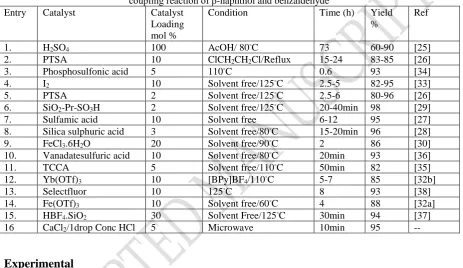
To evaluate the improvement by the use of calcium chloride/HCl over other reported catalysts, the pseudo three-component coupling reaction of β-naphthol and benzaldehyde was used as a representative example (Table 2). However, in most cases, the comparative yield of the desired product obtained with the CaCl2/HCl-catalyzed procedures required short reaction times compared to entry 1, 2, 4 and 5, 7, 9, 12, 13, 14 or low catalyst loading with respect to entry 1, 3, 9, 15 and some methods require high temperature entry 1, 3, 4, 5, 6, 11, 12, 13, 14, 15. These results clearly demonstrate that CaCl2/HCl is an equal or more efficient catalyst for this three-component reaction.
Table 2 . Comparison of efficiency of CaCl2/HCl with reported catalysts in the pseudo three-component
coupling reaction of β-naphthol and benzaldehyde
Entry Catalyst Catalyst
Loading mol %
Condition Time (h) Yield
%
Ref
1. H2SO4 100 AcOH/ 80◦C 73 60-90 [25]
2. PTSA 10 ClCH2CH2Cl/Reflux 15-24 83-85 [26]
3. Phosphosulfonic acid 5 110◦C 0.6 93 [34]
4. I2 10 Solvent free/125◦C 2.5-5 82-95 [33]
5. PTSA 2 Solvent free/125◦C 2.5-6 80-96 [26]
6. SiO2-Pr-SO3H 2 Solvent free/125◦C 20-40min 98 [29]
7. Sulfamic acid 10 Solvent free 6-12 95 [27]
8. Silica sulphuric acid 3 Solvent free/80◦C 15-20min 96 [28]
9. FeCl3.6H2O 20 Solvent free/90◦C 2 86 [30]
10. Vanadatesulfuric acid 10 Solvent free/80◦C 20min 93 [36]
11. TCCA 5 Solvent free/110◦C 50min 82 [35]
12. Yb(OTf)3 10 [BPy]BF4/110◦C 5-7 85 [32b]
13. Selectfluor 10 125◦C 8 93 [38]
14. Fe(OTf)3 10 Solvent free/60◦C 4 88 [32a]
15. HBF4.SiO2 30 Solvent Free/125◦C 30min 94 [37]
16 CaCl2/1drop Conc HCl 5 Microwave 10min 95 --
Experimental
The reagents were purchased from Loba, Merck, SRL, and Signa Aldrich and Spectrochem and used without further purification. The melting points were recorded by the open capillary method and were uncorrected. The reactions were irradiated in a microwave oven (Onidia India Ltd.). 1HNMR and 13CNMR spectra were obtained in CDCl3 on a Bruker AV–300 (300 MHz) spectrometer using TMS as an internal standard. The IR spectra were recorded on a Nicolet Fourier Transform spectrometer. TLC was performed on GF–25U (Anal. Tech) plates and silica gel glass-backed plates.
5
Spectral data of synthesized compounds
1. 14-phenyl-14H-dibenzo[a, j]xanthene 3a: Pale yellow solid, IR (KBr, cm-1) : νmax 3072, 2946, 1592, 1456 cm-1; 1HNMR (300MHz, CDCl
3): δ 6.47(s, 1H, CH), 8.35-6.98 (m, 17H, ArH); 13CNMR (75MHz, CDCl3): δ 38.2, 117.2, 118.3, 122.9, 124.4, 126.5, 126.9, 128.4, 128.8, 129.2, 131.3, 131.7, 145.3, 149.2; ESI-MS(m/z): 348.41[M]+.
2. 14-(4-methylphenyl)-14H-dibenzo[a, j]xanthene 3b: Yellow solid, IR (KBr, cm-1) : νmax 3076, 2905, 1618, 1589 cm-1; 1HNMR (300MHz, CDCl3): δ 2.15 (s, 3H, CH3), 6.45(s, 1H, CH), 8.37-6.94 (m, 16H, ArH); 13CNMR (75MHz, CDCl3): δ 21.2, 37.4, 117.3, 118.3, 122.9, 124.3, 126.8, 128.2, 128.9, 129.1, 129.4, 131.4, 131.6, 136.2, 142.3, 148.9; ESI-MS(m/z): 372.11[M] +.
3. 14-(4-methoxyphenyl)-14H-dibenzo[a, j]xanthene 3c: pink solid, IR(KBr, cm-1) : νmax 3057, 2920, 1583, 1432 cm-1; 1HNMR (300MHz, CDCl3): δ 3.72 (s, 3H, OCH3), 6.43(s, 1H, CH), 8.34-6.56(m, 16H, ArH); 13CNMR (75MHz, CDCl3): δ 36.8, 55.4, 114.2, 117.4, 118.2, 122.4, 124.2, 126.9, 129.1, 129.9, 131.4, 132.0, 149.2, 158.3; ESI-MS(m/z): 388.40[M] +.
4. 14-(4-nitrophenyl)-14H-dibenzo[a, j]xanthene 3d: yellow solid, IR(KBr, cm-1) : νmax 3092, 2956, 1620, 1435 cm-1; 1HNMR (300MHz, CDCl3): δ 6.61(s, 1H, CH), 8.42-6.82(m, 16H, ArH); 13CNMR (75MHz, CDCl3): δ 38.1, 115.3, 115.9, 118.1, 122.2, 124.0, 124.8, 127.3, 128.8, 129.8, 131.4, 146.7, 149.0, 152.5; ESI-MS(m/z): 403.12[M] +.
5. 14-(4-bromophenyl)-14H-dibenzo[a, j]xanthene 3e: Pale yellow solid, IR(KBr, cm-1) : νmax 3025, 1626, 1583 cm-1; 1HNMR (300MHz, CDCl3): δ 6.48 (s, 1H, CH), 7.23-8.33(m, 16H, ArH); 13CNMR (75MHz, CDCl3): δ 37.1, 116.4, 117.9, 126.8, 128.4, 128.9, 129.4, 131.1, 131.7, 132.4, 143.3, 148.5; ESI-MS(m/z): 437.33[M] +. 6. 14-(4-chlorophenyl)-14H-dibenzo[a, j]xanthene 3f: Brown solid, IR(KBr, cm-1) : νmax 3040, 2921, 1616, 1587
cm-1; 1HNMR (300MHz, CDCl
3): δ 6.49(s, 1H, CH), 8.29-7.06 (m, 16H, ArH); 13CNMR (75MHz, CDCl3): δ 37.2, 116.6, 118.0, 126.8, 128.7, 129.1, 129.5, 131.0, 131.3, 132.2, 143.6, 148.7; ESI-MS(m/z): 392.82[M] +. 7. 14-(4-fluorophenyl)-14H-dibenzo[a, j]xanthene 3g: yellow solid, IR(KBr, cm-1) : νmax 3025, 2907, 1623, 1594
cm-1; 1HNMR (300MHz, CDCl3): δ 6.50(s, 1H, CH), 8.31-7.10m(m, 16H, ArH); 13CNMR (75MHz, CDCl3): δ 37.3, 116.7, 118.2, 126.9, 128.8, 129.2, 129.6, 131.2, 131.4, 132.1, 143.8, 148.9; ESI-MS(m/z): 376.23[M] +. 8. 14-(4-Hydroxyphenyl)-14H-dibenzo[a, j]xanthene 3h: pale organge solid, IR(KBr, cm-1) : νmax 3410, 3034,
2935, 1608, 1589 cm-1; 1HNMR (300MHz, CDCl3): δ 6.41 (s, 1H, CH), 8.35-6.54(m, 16H, ArH), 11.08 (s, 1H, OH); 13CNMR (75MHz, CDCl3): δ 36.9, 115.1, 117.7, 118.1, 122.6, 124.4, 126.7, 128.8, 129.1, 129.4, 131.7, 131.8, 137.7, 148.8, 153.9; ESI-MS(m/z): 374.13[M] +.
9. 14-(2-nitrophenyl)-14H-dibenzo[a, j]xanthene 3i: Yellow solid, IR(KBr, cm-1) : ν
max 3088, 2941, 1624, 1437; 1HNMR (300MHz, CDCl3): δ 6.67 (s, 1H, CH), 8.05-7.13(m, 16H, ArH); 13CNMR (75MHz, CDCl3): δ 39.5, 117.8, 118.2, 122.7, 125.0, 125.2, 127.7, 127.9, 128.8, 129.9, 131.3, 132.6, 134.4, 140.4, 147.3, 151.8; ESI-MS(m/z): 403.41[M] +.
10. 14-(2-methoxyphenyl)-14H-dibenzo[a, j]xanthene 3j: Yellow solid, IR(KBr, cm-1) : νmax 3017, 2943, 1589, 1483; 1HNMR (300MHz, CDCl3): δ 3.67 (s, 3H, OCH3), 6.39(s, 1H, CH), 8.36-6.46(m, 16H, ArH); 13CNMR (75MHz, CDCl3): δ 37.3, 55.2, 116.2, 117.4, 117.9, 121.5, 124.8, 125.4, 127.8, 129.5, 131.1, 131.9, 134.3, 142.3, 146.8, 152.2; ESI-MS(m/z): 388.14[M] +.
11. 14-(2-chlorophenyl)-14H-dibenzo[a, j]xanthene 3k: Brown solid, IR(KBr, cm-1) : νmax 3039, 1593, 1453,1413; 1HNMR (300MHz, CDCl3): δ 6.53 (s, 1H, CH), 8.37-7.03 (m, 16H, ArH); 13CNMR (75MHz, CDCl3): δ 37.4, 116.7, 117.3, 122.6, 123.4, 125.6, 126.6, 127.1, 128.1, 128.9, 129.3, 130.4, 131.1, 143.4, 147.8; ESI-MS(m/z): 392.10[M] +.
6
39.2, 105.6, 115.6, 118.4, 119.7, 122.7, 123.4, 127.8, 128.4, 129.6, 130.5, 133.6, 137.8, 137.9, 153.4, 154.4; ESI-MS(m/z): 403.42[M] +.
13. 14-(3-bromophenyl)-14H-dibenzo[a, j]xanthene 3m: Pale yellow solid, IR(KBr, cm-1) : νmax 3059, 1597, 1427,1408; 1HNMR (300MHz, CDCl3): δ 6.45(s, 1H, CH), 7.05-8.29(m,16H, ArH); 13CNMR (75MHz, CDCl3):
δ 37.9, 116.6, 118.4, 122.7, 122.9, 124.6, 126.9, 127.4, 129.2, 129.3, 129.9, 130.2, 131.2, 131.4, 131.6, 147.3, 149.2; ESI-MS(m/z): 437.32[M] +.
14. 14-(3-chlorophenyl)14H-dibenzo[a, j]xanthene 3n: Brown solid, IR(KBr, cm-1) : νmax 3049, 2923, 1617, 1587, 1430; 1HNMR (300MHz, CDCl3): δ 6.44 (s, 1H, CH), 6.93-8.25 (m, 16H, ArH); 13CNMR (75MHz, CDCl3): δ 37.9, 116.2, 118.0, 122.2, 124.4, 126.3, 126.7, 127.2, 128.3, 128.9, 129.2, 129.6, 131.1, 131.4, 134.7, 146.6; ESI-MS(m/z): 392.15[M] +.
15. 14-(3-hydroxyphenyl)-14H-dibenzo[a, j]xanthene 3o: Pink solid, IR(KBr, cm-1) : νmax 3412, 1593, 1510, 1408; 1HNMR (300MHz, CDCl3): δ 6.44(s, 1H, CH), 6.53-8.33(m, 16H, ArH); 13CNMR (75MHz, CDCl3): 37.4, 115.3, 117.6, 118.2, 123.1, 124.6, 127.1, 128.9, 129.3, 129.8, 131.3, 131.7, 137.9, 149.2, 154.3; ESI-MS(m/z): 374.21[M] +.
16. 14-(3-methoxyphenyl)-14H-dibenzo[a, j]xanthene 3p: Yellow solid, IR(KBr, cm-1) : νmax 3064, 3008, 2913, 15781432; 1HNMR (300MHz, CDCl3): δ 3.72(s, 3H, OCH3), 6.42(s, 1H, CH), 8.37-6.50(m, 16H, ArH); 13CNMR (75MHz, CDCl3): δ 37.1, 55.3, 116.1, 117.1, 118.0, 121.2, 124.9, 125.2, 127.9, 129.2, 131.2, 132.0, 134.5, 142.5, 146.9, 152.6; ESI-MS(m/z): 388.16[M] +.
17. 14-(2,5-dimethoxyphenyl)-14-dibenzo[a, j]xanthene 3q: Yellow solid, IR(KBr, cm-1) : νmax 3017, 2930, 2827, 1619, 1589, 1445, 1247; 1HNMR (300MHz, CDCl3): δ 3.65 (s, 3H, OCH3), 3.68(s, 3H, OCH3), 6.41(s, 1H, CH), 8.41-6.86(m, 15H, ArH); 13CNMR (75MHz, CDCl3): δ 31.4, 55.2, 55.7, 111.3, 111.9, 117.3, 118.4, 123.8, 124.6, 128.9, 129.2, 130.1, 132.2, 135.8, 148.4, 148.9, 154.2; ESI-MS(m/z): 418.13[M] +.
18. 14-(2,4-dichlorophenyl)-14-dibenzo[a, j]xanthene 3r: Brown solid, IR(KBr, cm-1) : νmax 3048, 2913, 1623, 1585, 1432; 1HNMR (300MHz, CDCl3): δ 6.64(s, 1H, CH), 6.91-8.34(m, 15H, ArH); 13CNMR (75MHz, CDCl3): δ 35.8, 117.2, 117.8, 124.2, 127.3, 128.2, 129.2, 129.3, 130.6, 131.0, 132.7, 132.9, 143.0, 148.9; ESI-MS(m/z): 427.13[M] +.
19. 14-(3,4-dimethoxyphenyl)-14-dibenzo[a, j]xanthene 3s: Yellow solid, IR(KBr, cm-1) : ν
max 3017, 2910, 1608, 1578, 1419, 1253; 1HNMR (300MHz, CDCl3): δ 3.69 (s, 3H, CH3), 3.74 (s, 3H, CH3), 6.46(s, 1H, CH), 6.89-8.33(m, 15H, ArH); 13CNMR (75MHz, CDCl3): δ 36.3, 55.2, 55.6, 109.9, 113.3, 117.4, 117.9, 121.0, 122.6, 124.2, 126.4, 128.6, 128.9, 131.6, 137.2, 144.3, 146.8, 148.9; ESI-MS(m/z): 418.17[M] +.
20. 14-(n-propyl)-14-dibenzo[a, j]xanthene 3t: White solid, IR(KBr, cm-1) : νmax 3057, 2915, 1594, 1435; 1HNMR (300MHz, CDCl3): δ 1.08 (t, J= 7Hz, 3H, CH3), 1.32(m, 2H, CH2), 1.98(m, 2H, CH2), 4.20(t, J=7Hz, 1H, CH), 8.10-6.84(m, 12H, ArH); 13CNMR (75MHz, CDCl3): δ 15.2, 20.3, 42.4, 43.5, 115.2, 118.4, 122.2, 123.3, 126.7, 128.2, 128.8, 129.2, 133.9, 153.2; ESI-MS(m/z): 324.10[M] +.
Conclusion
7
References
1. Zhu, J.; Bienaymé, H. Eds. Multicomponent Reactions Wiley-VCH: Weinheim, 2005 2. Dadhania, A.; Patel, V.; Raval, D. Journal of Saudi Chemical Society, 2017, 21, S163-S169.
3. Naidu, K. R. M.; Balam, S. K.; Mungara, A. K.; Palanisamy, A.; Shiak, I. K.; Ola, L. Molecules, 2012, 17, 7543-7555.
4. Poupelin, J. P.; Saint-Ruf, G.; Foussard-Blanpin, O.; Narcisse, G.; Uehida-Ernouf, G.; Lacroix, R. Eur. J. Med. Chem., 1978, 13, 67-71.
5. Hideo, T.; Teruomi J. Jpn. Patent 56005480, Jan 20, 1981.
6. Riscoe, M.; Kelly, J.; Winter, R. Current Medicinal Chemistry, 2005, 12, 2539-2549.
7. Pinto, M. M. M.; Sousa, M.; Nasscimento, M. S. J. Current Medicinal Chemistry, 2005, 12, 2517-2538. 8. Zelefack, F.; Guilet, D.; Fabre, N.; Bayet, C.; Chevalley, S.; Ngouela, S.; Lenta, B.; Valentin, A.; Tsamo,
E.; Dijoux-Franca, M. J. Nat. Prod., 2009, 72, 954-957.
9. Saint-Ruf, G.; De, A.; Hieu, H. Bull. Chim. Ther., 1972, 7, 83-86.
10. Saintruf, G.; Hieu, H. T.; Poupelin, J. P. Naturwissenschaften, 1975, 62, 584-585. 11. Banerjee, A.; Mukherjee, A. Stain Technology, 1981, 56, 83-85.
12. Knight,C.; Stephens, T. Biochemical Journal, 1989, 258, 683-689.
13. Klimtchuk, Rodgers, M. A. J.; Neckers, D. C. J. Phys. Chem., 1992, 96, 9817-9820. 14. Beksert, A.; Andrieux, J.; Plat, M. Tetrahderon Lett , 1992, 33, 2805-2806.
15. Jha, A.; Beal, J. Tetrahedron Lett , 2004, 45, 8999-9001.
16. Casiraghi, G.;Casnati, G., Cornia, M. Tetrahedron Lett , 1973, 14, 679-682. 17. Kuo, C.; Fang, J. Synth Commun, 2001, 31, 877-892.
18. Knight, D.; Little, P. Synlett, 1998, 10, 1141-1143.
19. Ota, K.; Kito, T. Bulletin of the Chem Soc of Japan, 1976, 49, 1167-1168. 20. Allan, J.; Giannini, D.; Whitesides, T. J. Org. Chem. , 1982, 47, 820-823. 21. Papini, P.; Cimmarusti, R. Gazz. Chim. Ital, 1947, 77, 142.
22. Sen, R.; Sarkar, N. J. Am. Chem. Soc. , 1925, 47, 1079-1091.
23. Quintá, D.; Garcia, A.; Dominguez, D. Tetrahedron Lett, 2003, 44, 9291-9294. 24. Wang, J.; Harvey, R. Tetrahedron, 2002, 58, 5927-5931.
25. Sama, R. J.; Baruah, J. B. Dyes Pigment, 2005, 65, 91-92.
26. Khosropour,A. R.; Khodaei, M. M.; Moghannian, H. Synlett , 2005, 955-958.
27. Rajita, B.; Sunil Kamar, B.;Thirapathi Reddy, Y.; Narimha Reddy, P.; Sreenivasulu, N, Tetrahedron Lett, 2005, 46, 8691-8693.
28. Seyyedhamzeh, M.; Mirzaei, P.; Bazgir, A. Dyes Pigment, 2008, 76, 836-839. 29. Ziarani, G. M.; Badiei, A. –R.; Azizi, M. Scientia Iranica, 2011, 18, 455-457. 30. Liu, D.; Zhou, S.; Gao, J.; Li, L.; Xu, D. J. Mex. Chem. Soc., 2013, 57, 345-348.
31. Zolfigol, M. A.; Mossavi-Zare, A. R.; Arghavani-Hadi, P.; Zare, A.; Khakyzadeh, V.; Darvishi, G. RSC Advances, 2012, 2, 3618- 3620.
32. a)Cao, Y.; Yao, C.; Qin, B.; Zhang, H. Research on Chemical intermediates, 2013, 39, 3055-3062; b) Su, W.; Yang, D.; BoZhang, C. J. Tetrahedron Lett ,2008, 49, 3391-3394.
33. Das, B.; Ravikanth, B.; Ramu, R.; Laxminarayana, K.; Rao, B. V. J Mol. Catal. A: Chem, 2006, 225, 74-77.
34. Kiasat, A.; Mouradzadegun, A.; Saghanezhad, S. J. Serb. Chem. Soc., 2013, 78, 1291-1299.
35. Behrooz, M.; Mostafa, G.; Sepehr, Z. Bulletin of the Korean Chemical Society, 2011, 32, 1697-1702. 36. Nasr-Esfahani, M.; Abdizadeh, T. Rev. Roum. Chim., 2013, 58, 27-35.
37. Fu, G. –Y.; Huang, Y. –X.; Chen, X. –G.; Liu, X. –L. J of Chin Chem Soc, 2009, 56, 381-385.
38. Kumara, P. S.; Kumara, B. S.; Rajithaa, B.; Reddya, P. N.; Sreenivasulua, N.; Reddy, Y. T. ARKIVOC, 2006, 46-50 .
39. Gangadasu, B.; Narender, P.; Raju, B. C.; Rao, V. J. Ind. Chem., 2006, 45B, 1259-1263. 40. Kaboudin, B.; Zahedi, H.Chem. Lett.,2008, 37, 540-541.
41. Kulkarni, P.;Totawar, B.; Zubaidha, P. Monatsh Chem, 2012, 143, 625-629. 42. Kulkarni, P. Moroccan Journal of Chemistry, 2014, 2, 295-301.
43. Bhosale, D. G.; Kulkarni, P. S. Iranian Journal of Organic Chemistry, 2013, 5, 1061-1064. 44. Kulkarni, P. Current Microwave Chemistry, 2015, 2, 144-149.
45. Kulkarni, P. Journal Marocain de Chimie Hétérocyclique, 2016, 1, 71-78. 46. Jadhav, A.; Kulkarni, P. Der Pharma Chemica, 2017, 9, 55-58.