Effects of modified atmosphere packaging on some quality
attributes of a ready-to-eat salmon sushi
Mol, S.;
Ucok Alakavuk, D.; Ulusoy, S.
*Received: July 2013 Accepted: January 2014
Abstract
Sushi, a very popular food worldwide became a popular ready-to-eat food selling in supermarkets, but it exhibit distinct features, which are associated with microbiological hazards. Therefore, MAP technology, known to reduce aerobic bacteria in fishery products, was used to improve quality of ready-to-eat salmon sushi in this study. Salmon sushi were packaged with air (control), 50%N2 /50%CO2 (MAP-a), and 100% CO2 (MAP-b), stored at 4 ±1°C for 6 days and analyzed every day. During the study, control samples taken the lowest sensory scores. The total color change (∆E) was lower in MAP samples comparing to controls. Likewise, mesophilic and psychrophilic aerobic bacteria counts of gas-treated samples were significantly lower. These results show the positive effect of MAP technology on the quality of salmon sushi. Regarding the improving demand to ready-to-eat sushi selling in supermarkets, this result will be useful in further studies and commercial applications.
Keywords: Sushi, Salmon, Modified atmosphere packaging, Ready-to-eat
-Istanbul University, Faculty of Fisheries, Ordu st. No: 200, 34470 Laleli, Istanbul, Turkey
*Corresponding author's email: [email protected] (Ulusoy)
Introduction
Sushi, comes from Asia, is widely distributed throughout the US and Europe. It is rich in high quality protein and an excellent source of omega-3 fatty acids because of the seafood ingredients (Cysneiros et al., 2009). Since sushi is often served raw, no cooking fat is introduced during its preparation. It is low in fat, concentrated with nutrients, and delicious to consume; therefore it became very popular all over the world (Simpson et al., 2008). People also enjoy the fact that a typical serving of sushi, about 8-10 pieces, is around 350-400 calories (Cysneiros et al., 2009).
The term “sushi” refers to food consisting of cooked rice flavored with vinegar, sugar and salt, and garnished with seafood, roe, and vegetable which may or may not be wrapped with seaweed (Anon, 2000). It is eaten cold, and most of the toppings are raw seafood. Therefore, sushi exhibits distinct features that are associated with microbiological hazards. If storage temperature is not properly maintained, it could contribute to growth and persistence of microorganisms (Anon, 2000; Cysneiros et al., 2009). Thus, microbiological assessment of sushi provides information regarding the product safety (International Commission on Microbiological Specifications for Foods, 1978).
Sushi is a food product that is usually prepared and served at the same time. However, it is necessary to consider industrial production due to the high consumer demand (Simpson et al., 2008). In recent years, selling of this food in supermarkets is easier through sushi machines. Sushi machines provide the mass production of sushi combining the delicate skills used by
sushi chefs, therefore making and selling sushi is more accessible to countries around the world (Cysneiros et al., 2009). The vast majority of supermarkets offer fresh food for take-out, 49% sushi (Sloan, 2007). Pre-packed sushi and sashimi are available in the supermarkets, shops, or in shopping centers. Importers, food manufacturers, restaurant owners and even supermarket entrepreneurs have been attracted to participate in these varieties of business (Anon, 2000). In this context, keeping the quality of this product became important.
To maintain an increased shelf life and keep quality, modified atmosphere packaging (MAP) technique offers technological options to the seafood sector (Rodgers, 2008). The use of gas mixes with high levels of CO2 inhibits or reduces the growth of various aerobic spoilage bacteria in fishery products by extending the lag phase (Lannelongue et al., 1982; Farber, 1991; Reddy et al., 1992). Lengthening shelf-life, reduction of economic losses, and supplying a better quality product are the advantages of MAP technology (Sivertsvik et al., 2002). This technology allows seafood to be delivered to long-distance markets, therefore commercial value may increase (Pastoriza et al., 1996). Since MAP technology facilitates the marketing operations and decrease economic losses, it has been studied to maintain quality of ready-to-eat seafood, in recent years (Mejlholm et al., 2005).
In this study the effect of modified atmosphere packaging on the quality attributes of ready-to-eat salmon sushi (sake) was determined. Sake was chosen as the material; because salmon is a widely available species,
and sake sushi is very popular (Adams et al., 1990). Maintaining safety and decreasing economic losses were aimed.
Materials and methods
Forty frozen individuals of whole salmon samples were obtained from Istanbul wholesale fish market Turkey. They were kept at -20°C for 7 days (FDA, 2001) to prevent possible risk of nematodes, and thawed at +3°C for 12h just before preparing sushi. The thawed salmons were filleted. pH of sushi rice was adjusted as 4 using rice vinegar (Amoy, Ajnomoto Co, Inc. Tokyo, Japan), the rice (Calrose, Reis, Turkey) was spreaded on a dried seaweed sheet (Kaitatuya yaki nori), and salmon flesh was placed over. Dried seaweed (nori) was rolled up with the contents inside, and then cut into to 2cm slices (14 g ±1.98, each). Sushi rolls were placed in plastic plates, and all samples divided into 3 groups. Control samples were packaged under atmospheric conditions, the second group was packaged with 50%CO2: 50% N2, called as MAP-a, and the last group, MAP-b, flushed with 100%CO2. All groups were packaged with the same packaging material (Polinas Polibarr Y10C1B, 90 µ, oxygen transmission rate of 160
cc/m2/day, Manisa, Turkey), using Henkovac model E-173 (Netherlands), and analyzed every day of storage at +4 ±1°C.
The appearance, texture, odor and taste of the samples were evaluated by panelists. Panel room was provided with sufficient light, protected from noise and extraneous odors to prevent the influence of external factors. Five panelists (3 female, 2 male; average age was 32), experienced with sensory tests of seafood but unfamiliar with this study, judged the
samples. Sensory evaluation was carried out individually under controlled conditions of light and temperature according to Huss (1988). Panelists were asked to score odor, taste and texture of salmon sushi using a 0-10 acceptability scale. Considering 10 as the highest sensory point, 5 point regarded as the limit of acceptance (Chytiri et al., 2004). Sushi samples (10 g) were diluted with distilled water (1:1), and pH probe was immersed into this solution. Six readings were made on each sample and the mean was recorded (Olafsdottir et al., 1997). Measurements were carried out with Hanna 211 model pH meter (HANNA Instruments, USA). The color of the salmon flesh was determined using a Konica Minolta chroma meter model CR 400/410 (Minolta Osaka Japan). Hunter L*(brightness), a*(+a=red, -a= green) and b*(+b= yellow, -b= blue) values were measured (Hunter and Harold 1987). Color change (∆E) was calculated
according to the following formula:
√
Fish samples of 25 g from each treatment group were placed in sterile stomacher bags (Seward, West Sussex, UK), 225 ml of sterile peptone water (0.1%) was added and homogenized for 1 min. using a stomacher (Masticator, IUL Instruments; Barcelona, Spain). Appropriate serial dilutions were made in 0.1% peptone water. The total aerobic mesophilic and psychrophilic counts were determined on Plate Count Agar (PCA; Oxoid) after incubation at 37oC for 28-48 h and at 7oC for 10 days, respectively (Baumgart, 1986). The microbiological counts
were expressed as log cfu/g. Tryptose Sulphite Cycloserine Agar (TSC Agar, Merck, Darmstadt, Germany) supplemented with D-cyclocerine (HiMedia, Mumbai, India) was used for enumeration of Clostridium perfringens and the plates were incubated at anaerobic conditions at 37oC for 24-48 h (Rhodehamel and Harmon, 2001a). Bacillus cereus was enumerated on Mannitol-egg yolk-polymyxin Agar (MYP Agar, HiMedia, Mumbai, India) supplemented with egg yolk and Polymixin-B (HiMedia, Mumbai, India). Plates were incubated at 28oC for 48 h (Rhodehamel and Harmon, 2001b).
Salmonella incidence was tested using the method described by Andrews and Hammack (2007)
This study was duplicated, and statistical analyses were carried out according to Bower (2009). ANOVA-test was performed using
SPSS 15.0 (SPSS, Chicago, Illinois, USA), standard errors were mentioned in the figures (n = 6). Differences between the treatments were evaluated (p<.05) and Duncan’s multiple range test was used.
Results
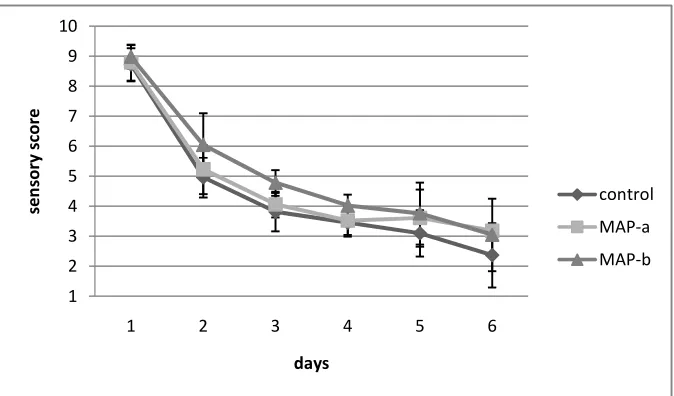
The sensory properties of sushi are very important for the consumer. Sushi rice should be white; fish should look bright, glossy and transparent; fat of fish pieces, especially for salmon must be clearly visible (Anon, 2000). Sensory quality of salmon sushi samples were evaluated regarding these properties. At the 2nd day of storage sensory score of control, MAP-a and MAP-b samples were 4.96, 5.23 and 6.04 (p<.05), respectively (Fig. 1). Likewise, control samples had the lowest sensory scores during the storage (p<.05).
Figure 1: Changes in overall sensory quality of control, MAP-a (50%N2/ 50% CO2), and MAP-b
(100% CO2) (n=6) 1
2 3 4 5 6 7 8 9 10
1 2 3 4 5 6
se
n
so
ry
s
co
re
days
control
MAP-a
MAP-b
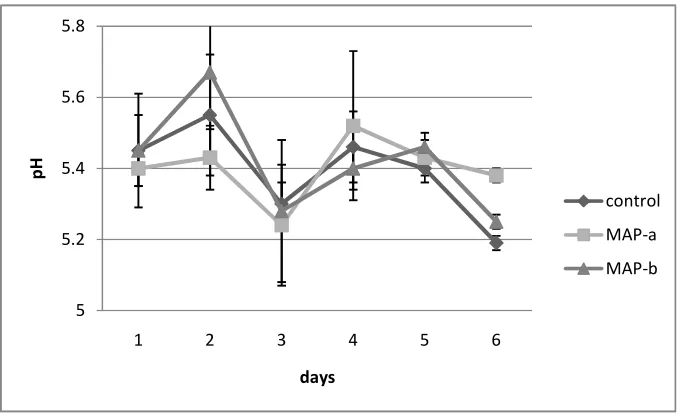
As it was presented in Figure 2, pH values of all groups remained between 5.2-5.7 during the study. Small fluctuations were seen in all
groups during storage, but important increase or decrease was not detected.
Figure 2: Changes in pH of control, MAP-a (50%N2/ 50% CO2), and MAP-b (100% CO2) (n=6)
As to color properties, L* values (brightness) of MAP-b samples were higher than other groups after the 4th day of cold storage (Fig. 3).
Redness (a*) and yellowness (b*) values decreased in all groups during cold storage. Control samples had lower values of a* and b* than MAP groups after the 2nd day of storage. 5
5.2 5.4 5.6 5.8
1 2 3 4 5 6
p
H
days
control
MAP-a
MAP-b
Figure3: Changes in color (L*, a* and b*values) of control, MAP-a (50%N2/ 50% CO2), and
MAP-b (100% CO2) (n=6) 30
35 40 45 50 55 60
1 2 3 4 5 6
L*
days
control
MAP-a
MAP-b
2 4 6 8 10 12 14 16 18
1 2 3 4 5 6
a
*
days
control
MAP-a
MAP-b
15 20 25 30 35
1 2 3 4 5 6
b
*
days
control
MAP-a
MAP-b
All samples were found as free of
B.cereus, C.perfringens, and Salmonella sp., in
this study.
Mesophilic aerobic bacteria count of control samples was higher (p<.05) than MAP
groups during the storage (Fig. 4).
Figure 4: Mesophilic aerobic bacteria counts of control, MAP-a (50%N2/ 50% CO2), and MAP-b
(100% CO2) (n=6)
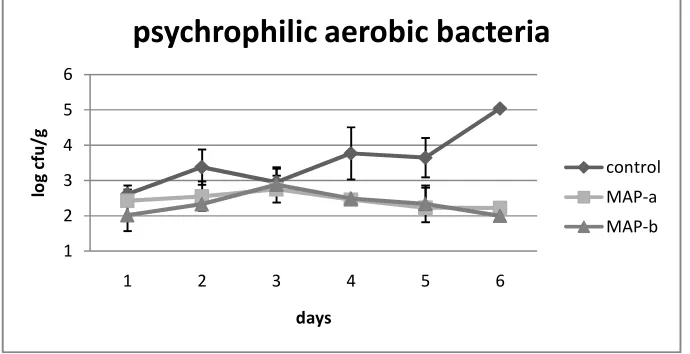
Similarly, psychrophilic aerobic bacteria count of control group increased to 5.04 log cfu/g at the 6th day of cold storage, and MAP
groups contained significantly lower (p<.05) amount of psychrophilic aerobic bacteria than control samples during the storage period (Fig. 5).
Figure 5: Psychrophilic aerobic bacteria counts of control, MAP-a (50%N2/ 50% CO2), and
MAP-b (100% CO2) (n=6) 1.5
2 2.5 3 3.5 4 4.5 5
1 2 3 4 5 6
lo
g
c
fu
/g
days
control
MAP-a
MAP-b
1 2 3 4 5 6
1 2 3 4 5 6
lo
g
c
fu
/g
days
psychrophilic aerobic bacteria
control
MAP-a
MAP-b
Discussion
In this study control samples taken the lower sensory scores than MAP groups during the storage (p<.05), and this result shows the positive effect of MAP on the sensory quality of sushi. Likewise, Steffen et al. (2010) applied modified atmosphere packaging to UV-radiated sushi products and reported increased sensory quality. Similarly, Sivertsvik et al. (1999) reported the important effect of MAP on the sensory quality of salmon. According to another study, sensory qualities of modified atmosphere packed whiting, mackerel and salmon were better than that of control samples (Fagan et al., 2004). In another study, effect of MAP technology on stuffed mussels was studied. Packaging with modified atmosphere positively affected the odor, flavor, texture, and appearance of stuffed mussels and increased sensory quality (Ulusoy and Ozden, 2011). Results of these studies are in agreement with our results, and show the positive effect of modified atmosphere packaging on the sensory quality of seafoods.
pH value increases during the storage of muscle foods, and the fish is considered as spoiled when its pH value is above 7.0 (Gulyavuz and Unlusayin, 1999). On the other hand, pH of fish products can be very different when combined with different ingredients (Metin et al., 2000; Mol, 2005). Therefore, this may not be used as a quality indicator, and should be used in conjunction with other parameters (Ludorff and Meyer, 1973). In this study, pH values of sushi samples were between 5.2-5.7. Since the limit of acceptance is 7.0 for fish (Gülyavuz and Ünlüsayın, 1999),
pH values of the samples did not show the spoilage (Fig. 2). Rice and vinegar were used to prepare sushi samples. These ingredients decreased pH values. Therefore, pH value of samples shown small fluctuations during storage and did not reached to the limit values. Similarly Ulusoy and Ozden (2011) studied the shelf-life modified atmosphere packaged stuffed mussel, prepared with rice and spices. They also reported that pH values never reached to the limits and showed fluctuations during cold storage. Likewise, pH values of 22 different sushi samples sold in Taiwan were reported between 4.51-6.11 (Fang et al., 2003).
As to color, Veiseth-Kent et al. (2010) reported the L*, a*, and b* values of salmon as 44.2-45.6, 13.2-15.1, and 16.7-20.0, respectively. At the first day of our study, color parameters of salmon sushi samples were similar to these ranges (Fig. 3). It is known that color parameters of seafood react differently according to the gas mixture and storage time (Choubert and Baccaunaud, 2006). In MAP-b samples, L* values were higher (p<.05) than
other treatments during the study, showing bright color. Similarly, modified atmosphere packaging resulted in acceptable lightness for salmon fillets even after 14 days of storage at 5°C, according to Amanatidou et al. (2000). Hunter a* and b* values of controls were lower than that of MAP groups in the present study (Fig. 3). Similarly, air-packed salmon fillets were less yellow than those in 100% CO2,in
the study of Fagan et al. (2004). Hansen et al.
(2009) also reported decreasing or stable values of a* and b* during the cold storage of modified atmosphere packaged fish. In the
present study; color change (∆E) was calculated as 15.75, 8.77, and 9.02 for control, MAP-a and MAP-b samples, respectively. Since ∆E ≈ 2.3 corresponds to a just noticeable difference (Sharma, 2003), it might be said that changes in the color was visible in all groups. However, color changes (∆E) in MAP groups were significantly lower than that of the controls (p<.05).
Tan et al. (2008) reported that ready-to-eat retail sushi can act as a possible vehicle for the dissemination of food-borne diseases. Therefore, the incidences of B.cereus, C. perfringens, and Salmonella sp. were inspected, but they were not detected in any of the sushi samples in this study.
Microbiological assessment of sushi provides information regarding the product quality, and the most common method is the determination of the number of aerobic bacteria colonies (Anon, 2000; ICMSF, 1978). Since modified atmosphere packaging generally retard the growth of microorganisms (Brown et al., 1980; Pastoriza et al., 1996; Sivertsvik et al., 1999; Amanatidou et al., 2000; Fletcher et al., 2002; Fernández et al., 2010; ), ready to eat salmon sushi was packed with this technology in the present study. Mesophilic (Fig. 4) and psychrophilic (Fig. 5) aerobic bacteria counts of MAP groups were significantly lower (p<.05) than control samples during the storage period, and it shows the positive effect of MAP technology on the microbial quality of salmon sushi (sake) samples. Chen et al. (2003) studied the effect of MAP on microbial growth of ready-to-eat sushi, stored at ambient temperature (25°C). They reported the greatest microbial growth in air packs, and found lower
amount of air-borne microorganisms in MAP samples, similar to our results. Likewise, mesophilic and psychrophilic aerobic bacteria counts of air packaged salmon were always higher than modified atmosphere packaged samples at same temperature and storage time, according to Sivertsvik et al. (2003 ). In general, psychrotrophic aerobic bacteria counts of MAP seafoods generally reported as lower than air packed samples (Villemure et al., 1986; Križek et al., 2004; Erkan et al., 2006; Erkan et al., 2007 ).
As it was presented in Figure 5, psychrotrophic bacteria counts of MAP sushi samples never reached to 3 log cfu/g. Similarly, high numbers of psychrotrophic bacteria have not been reported for MAP salmon (Sivertsvik ve diğ, 2003). On the other hand, psychrophilic aerobic bacteria counts of MAP-a and MAP-b samples were not significantly different (p>.05) during the cold
storage, in our study. Similar result was obtained for mesophilic aerobic bacteria. Likewise, Fagan et al. (2004) reported no important difference between total viable counts of 100% CO2 and the 60% N2 / 40% CO2 packs of salmon.
During this study sushi samples, packaged with air (control), taken lower sensory scores than MAP-a and MAP-b groups (50%N2 /50%CO2, and 100% CO2, respectively). Panelists gave the highest sensory points to MAP-b samples (p<.05). This result shows the positive effect of MAP on the sensory quality of sushi. The total color change (∆E) was lower (p<.05) in MAP samples comparing to controls, due to the effect of gas mixtures. Likewise, mesophilic and
psychrophilic aerobic bacteria counts of gas treated samples were significantly lower (p<.05) than air packaged ones during the storage period.
These findings show the positive effect of MAP technology on the quality attributes of salmon sushi (sake). It was concluded that, it is possible to offer ready to eat sushi for sale at supermarkets for longer times, when packed with modified atmosphere technology. This result may provide a better opportunity for the marketing of this product. Therefore, demand to ready-to-eat sushi will improve and the consumer can find this tasty food with safer and high quality.
References
Adams, A. A., Abeeh, J. L. and Wekell, M. M., 1990. Health risks of salmon sushi. Lancet, 36(8726), 1328.
Amanatidou, A., Schluter, O., Lemkau, K., Gorris, L. G. M., Smid, E. J. and Knorr, D., 2000. Effect of combined application of high pressure treatment and modified atmospheres on the shelf life of fresh Atlantic salmon. Innovative
Food Science & Emerging Technologies, 1,
87-98.
Andrews, W. H. and Hammack, T. S., 2007.
Salmonella. Bacteriological analytical manual. 8th edition, revision a 1998, (Chapter 5).
Anon., 2000. Sushi & sashimi in Hong Kong. Food and environmental hygiene department risk
assessment studies. (Report no. 2).
Microbiological hazards evaluation. 31P.
Baumgart, J., 1986. Lebensmittel tierischer herkunft, feinkosterzeugnisse, gefrorene, tiefgefrorene und getrocknete lebensmittel, fertiggerichte, hitzekonservierte lebensmittel,
speiseeis, zucker, kakao, zuckerwaren,
rohmassen. In: Mikrobiologische untersuchung von lebensmitteln, unter mitarbeit von jürgen firnhaber, gottfried spicher, J. Baumgart (Ed) 207, Behr’s Verlag Hamburg.
Brown, W. D., Albright, M., Watts, D. A., Heyers, B., Spruce, B. and Price, R. J., 1980. Modified atmosphere storage of rockfish
Sebastes miniatur and silver salmon
Oncorhynchus kisutch. Journal of Food Science,
45, 93.
Bower, J., 2009. Statistical methods for food science: Introductory procedures for the food practitioner. Wiley-Blackwell, pp. 211-235.
Chen, S. C., Lin, C. A., Fu, A. H. and Chuo, Y. W., 2003. Inhibition of microbial growth in ready-to-eat food stored at ambient temperature by modified atmosphere packaging. Packaging
Technology and Science, 16(6), 239-247.
Chytiri, S. Chouliara, I., Savvaidis, I. N. and Kontominas, M. G., 2004. Microbiological, chemical and sensory assessment of iced whole and filleted aquacultured rainbow trout. Food
Microbiology, 21, 157–165.
Choubert, G. and Baccaunaud, M., 2006. Colour
changes of fillets of rainbow trout
(Oncorhynchus mykiss w.) Fed astaxanthin or canthaxanthin during storage under controlled or
modified atmosphere. LWT-Food Science and
Technology, 39, 1203–1213.
Cysneiros, R. M., Arida, R. M., Terra, V. C., Sonoda, E. Y., Cavalheiro, E. A. and Scorza, F. A., 2009. To sushi or not to sushi: can people with epilepsy have sushi from time to time?.
Epilepsy & Behavior, 16, 565–566.
Erkan, N., Özden, Ö., Üçok Alakavuk, D., Yıldırım, ¸S. Y. and Inugur, M., 2006. Spoilage and shelf life of sardines (Sardina
pilchardus) packed in modified atmosphere.
European Food Research and Technology, 222,
667–673.
Erkan, N., Özden, Ö. and Inugur, M., 2007. The effects of modified atmosphere and vacuum packaging on quality of chub mackerel.
International Journal of Food Science and
Technology, 42, 1297–1304.
Fagan, J. D., Gormley, T. R. and Umhuircheartaigh, M. M., 2004. Effect of modified atmosphere packaging with freeze-chilling on some quality parameters of raw whiting, mackerel and salmon portions.
Innovative Food Science & Emerging
Technologies, 5, 205–214.
Fang, T. J., Wei, Q. K., Liao, C. W., Hung, M. J. and Wang, T. H., 2003. Microbiological quality of 18°C ready-to-eat food products sold in
Taiwan. International Journal of Food
Microbiology, 80(3), 241-250.
Farber, J. M., 1991. Microbiological aspects of modified atmosphere packaging technology- A review. Journal of Food Protection, 54(1), 58-70.
FDA, 2001. Fish and Fishery Products Hazards and Controls Guide. 3rd edition. FDA, Center for Food Safety and Applied Nutrition, Office of Seafood, Washington DC, USA.
Fernández, K., Aspé, E. and Roeckel, M., 2010. Scaling up parameters for shelf-life extension of Atlantic Salmon (Salmo salar) fillets using
superchilling and modified atmosphere
packaging. Food Control, 21, 857–862.
Fletcher, G. C., Summers, G., Corrigan, V., Cumarasamy, S. and Dufour, J. P., 2002.
Spoilage of king salmon (Oncorhynchus
tshawytscha) fillets stored under different
atmospheres. Journal of Food Science, 67(6),
2362- 2374.
Gulyavuz, H. and Unlusayin, M., 1999. Su urunleri teknolojisi. SDU Egirdir Su Urunleri
Fakultesi Publications, Ankara, Turkey.pp??
Hansen, A. A., Morkore, T., Rudi, K., Rodbotten, M., Bjerke, F. and Eie, T., 2009. Quality changes of prerigor filleted Atlantic Salmon (Salmo salar L.) packaged in modified atmosphere using CO2 emitter, traditional MAP,
and vacuum. Journal of Food Science, 74(86), 242-249.
Hunter, R. and Harold, R., 1987. The measurement of appearance. (2th ed.).
Wiley-Interscience Publications. John Wiley & Sons, Hunter Associates Lab. Inc. Reston, Va.
Huss, H. H., 1988. Fresh fish quality and quality changes, Food and Agriculture Organization of the United Nations, Danish International Development Agency, No. 29, Rome, FAO Fisheries Series. pp. 63.
ICMSF, 1978. International commission on microbiological specifications for foods.
Microrganisms in foods I. London: Blackie
Academic & Professional.
Kˇrižek, M., Vacha, F., Vorlová, L., Lukáˆsová, J. and Cupáková, S., 2004. Biogenic amines in vacuum-packaged and non vacuum-packaged
flesh of carp (Cyprinus carpio) stored at different temperatures. Food Chemistry, 88, 185–191.
Lannelongue, M., Hanna, M. O., Finne, G., Nickelson, R. and Vanderzant, G., 1982.
Microbiological and chemical changes during storage of swordfish (Xiphias gladius) steaks in
retail packages containing CO2-enriched
atmospheres. Journal of Food Protection, 45, 1197–1203.
Ludorff, W. and Meyer, V., 1973. Fische und fischerzeugnisse. Paul parey verlag. Berlin. pp. 95–111, 176–269.
Mejlholm, O., Bøknæs, N. and Dalgaard, P., 2005. Shelf life and safety aspects of chilled cooked and peeled shrimps (Pandalus borealis) in modified atmosphere packaging. Journal of
Applied Microbiology, 99(1), 66–76.
Metin, S., Erkan, N., Varlik, C., Ozden, O., Baygar, T., Kalafatoglu, H. and Gun, H., 2000. Influence of modified atmosphere packaging on shelf life of fish-salami,
Fleischwirtschaft International, 4, 49-51.
Mol, S., 2005. Preperation and shelf life assessment of ready-to-eat fish soup. European Food
Research and Technology, 220, 305- 308.
Olafsdottir, G., Martinsdottir, E., Oehlensschlager, J., Dalgaard, P., Jensen, B., Undeland, I., Mackie, I. M., Heneha, G. and Nielsen, H., 1997. Methods to evaluate fish freshness in research and industry. Trends in
Food Science & Technology, 81,258-265.
Pastoriza, L., Sampedro, G., Herrera, J. J. and Cabo, M. L., 1996. Effect of carbon dioxide atmosphere on microbial growth and quality of salmon slices. Journal of the Science of Food
and Agriculture, 72(3), 348-352.
Reddy, N. R., Armstrong, D. J., Rhodehamel, E. J. and Kautter, D. A., 1992. Shelf life extension and safety concerns about fresh fishery products packaged under modified atmospheres: A preview. Journal of Food Safety, 12, 87–118.
Rhodehamel, J. and Harmon, S., 2001a. Bacteriological analytical manual. (8th ed.).
Revision A, Chapter 16. U.S. Food and Drug Administration; 2001.
Rhodehamel, J. and Harmon, S., 2001b. Bacteriological analytical manual, (8th ed.).
Revision A, Chapter14. U.S. Food and Drug Administration; 2001.
Rodgers, S., 2008. Technological innovation
supporting different food production
philosophies in the food service sectors.
International Journal of Contemporary
Hospitality Management, 20(1), 19-34.
Sharma, G., 2003. Digital Colour Imaging Handbook. (1.7.2 ed.). CRC Press. ISBN 0-8493-0900-X.
Simpson, R., Carevic, E., Pinto, M. and Cortés, C., 2008. Development of frozen sushi: optimization and shelf life simulation. Journal of
Food Processing and Preservation, 32(4), 681-696.
Sivertsvik, M., Rosnes, J. T., Vorre, A., Randell, K., Ahvenainen, R. and Bergslien, H., 1999. Quality of whole gutted salmon in various bulk packages. Journal of Food Quality, 22, 387-401.
Sivertsvik, M., Jeksrud, W. K. and Rosnes, J. T., 2002. A review of modified atmosphere packaging of fish and fishery products – significance of microbial growth, activities and safety. International Journal of Food Science &
Technology, 37, 107–127.
Sloan, A. E., 2007. Supermarkets take a ‘fresh’ approach. Food Technology, 61, 28-37.
Steffen, H. P., Duerst, M. and Rice, R. G., 2010. User experiences with ozone, electrolytic water (active water) and uv-c light (ventafresh technology) in production processes and for hygiene maintenance in a Swiss sushi factory.
Ozone: Science & Engineering: The Journal of
the International Ozone Association, 32(1), 71-78.
Tan, Y. F., Haresh, K. K., Chai, L. C., Ghazali, F. M. and Son, R., 2008. Prevalence of campylobacter spp. In retailed ready-to-eat sushi.
International Food Research Journal, 15(3),
331-336.
Ulusoy, Ş. and Özden, Ö., 2011. Preservation of stuffed mussels at 4 °C in modified atmosphere packaging. Journal of Aquatic Food Product
Technology, pp. 319-329.
Veiseth-Kent, E., Hildrum, J. I., Ofstad, R., Rørå, A. M. B., Lea, P. and Rødbotten, M., 2010. The effect of postmortem processing treatments
on quality attributes of raw Atlantic salmon (Salmo salar) measured by sensory and instrumental methods. Food Chemistry, 121, 275-281.
Villemure, G., Simard, R. E. and Picard, G., 1986. Bulk storage of cod fillets and gutted cod (Gadus morhua) under carbon dioxide atmosphere. Journal of Food Science, 51: 317– 320.
١