Int. J. Industrial Mathematics Vol. 1, No. 2 (2009)147-161
Numerical Solution of Hybrid Fuzzy Dierential
Equation (IVP) by Improved Predictor-Corrector
Method
R. Ezzatia, S. Siah mansouria
(a) Department of Mathematics, Islamic Azad University, Karaj Branch, Karaj, Iran.
||||||||||||||||||||||||||||||||{ Abstract
In this paper, we study the numerical solution of hybrid fuzzy dierential equations by using the improved predictor-corrector (IPC) three step method. We state the convergence and stability of this method. Numerical examples will be presented to illustrate this method.
Keywords: Fuzzy dierential equations, Fuzzy numbers, Hybrid fuzzy dierential system, Explicit three-step method, Implicit two-step method.
|||||||||||||||||||||||||||||||||
1 Introduction
Fuzzy set theory is a powerful tool for modeling uncertainty and for processing vague or subjective information in mathematical models. Its main directions of development and its applications to the very varied real-world problems have been diverse. Fuzzy dier-ential equations (FDEs) are recently gaining more and more attention in the literature. The rst and the most popular approach in dealng with FDEs is using the Hukuhara dierentiability, or the Seikkala derivative for fuzzy-number-valued functions. Hybrid sys-tems are devoted to modeling, design and validation of interactive syssys-tems of computer programs and continuous systems. That is, control systems that are capable of controlling complex systems which have discrete event dynamics as well as continuous time dynamics can be modeled by hybrid systems. The dierential systems containing fuzzy-valued func-tions and interaction with a discrete time controller are named as hybrid fuzzy dierential systems. Pederson and Sambandham [8, 9] have investigated the numerical solution of hybrid fuzzy dierential equations by using the Runge-kutta method and Euler method, and also they have considered the numerical solution of hybrid fuzzy dierential equations by using the characterization theorem for the improved Euler's method [7]. Recently, the
numerical solution of fuzzy dierential equations by the predictor-corrector method has been studied in [1].
In this paper, we develop a numerical solution of hybrid fuzzy dierential equation initial value problems by using the improved predictor-corrector method, which is more accurate than the one in [8]. In Section 2, we list some basic denitions for fuzzy-valued functions. Section 3 reviews hybrid fuzzy dierential systems. Sections 4 and 5 contain the explicit three-step method and the implicit three-step method for approaching hybrid fuzzy dif-ferential equations, respectively. In Section 6, the IPC three -step algorithm is discussed and in Section 7, convergence and stability theorem are provided. Section 8, contains numerical examples to illustrate this method.
2 Preliminaries
Denition 2.1. [10] Let k(Rn) denote the family of all non-empty, compact, convex
subsets of Rn. Denote by En the set of eu : Rn ! [0; 1] such that eu satises (i) (iv)
mentioned below:
i. eu is normal that is, there exists an y0 2 Rn such that eu(y0) = 1,
ii. eu is fuzzy convex,
iii. eu is upper semi continuous,
iv. [eu]0 = fy 2 Rn: eu(y) > 0g is compact .
We denote the level set [eu] = fy 2 Rn : eu(y) g for 0 < 1. Clearly, the
-level sets [eu]2
k(Rn) .
Denition 2.2. [6] Let I be a real interval. A mapping ey : I ! E1 is called a fuzzy
process and its level set is denoted by
[ey]= [y; y] t 2 I; 0 < 1:
Let ex; ey 2 E1. If there exists ez 2 E1 such that ex = ey+ez, then ez is called the Hukuhara
dierence of ex and ey and is denoted by ex ey. Note that in this paper, the " " sign stands always for the Hukuhara dierence and that ex ey 6= ex + ( 1)ey.
Denition 2.3. [1] The -level set of a triangular fuzzy number eT = (xl; xc; xr) in E1 is
given by
[ eT ] = [xc (1 )(xc xl); xc+ (1 )(xr xc)] where xl xc xr.
Let us recall the denition of Hukuhara dierentiability.
Denition 2.4. Let dH(A; B) be the Hausdor distance between sets A; B 2 k(Rn). The
supremum metric d1 on E1 is dened by
d1( eU; eV ) = supfdH([ eU]; [eV ]) : 2 [0; 1]g
Denition 2.5. [1] Let ef : T ! E1 and y
0 2 T R. We say that ef is Hukuhara
dierentiable at y0 if there exists an element ef0 2 E1 such that for all h > 0 suciently
small, there are ef(y0+ h) ef(y0), ef(y0) ef(y0 h)) and the limits (in the metric d1)
lim
h!0(
e
f(y0+ h) ef(y0)
h ) = limh!0(
e
f(y0) ef(y0 h)
h ) = ef0(y0):
The fuzzy set ef0(y0) is called the Hukuhara derivative of ef at y0.
Recall that eU eV = fW 2 E1 are dened on level sets, where [ eU] [eV ] = [fW ]for
all 2 [0; 1]. Considering the of denition of the metric d1, all the level sets [ ef(0)]
are Hukuhara dierentiable at y0 with Hukuhara derivatives [ ef0(y0)] for each 2 [0; 1],
when ef : T ! E1 is Hukuhara dierentiable at y
0 with Hukuhara derivative ef0(y0).
Denition 2.6. [8] Associated with the dierence equation
Yi+1= am 1yi+ am 2yi 1+ : : : + a0yi+1 m+ hF (ti; h; yi+1; yi; : : : ; yi+1 m);
y0 = 0; y1= 1; : : : ; ym 1= m 1; (2.1)
the characteristic polynomial of the method is dened by
p() = m a
m 1m 1 am 2m 2 : : : a1 a0:
If jij 1 for each i = 1; 2; : : : ; m, and all roots with absolute value 1 are simple roots,
then the dierence method is said to satisfy the root condition.
Denition 2.7. A multistep method of the form Eq. (2.1) is stable if and only if it satises the root condition.
Denition 2.8. An m-step method for solving the initial-value problem is one whose dierence equation for nding the approximation y(ti+1) at the mesh point ti+1 can be
represented by the following equation:
y(ti+1) = am 1y(ti) + am 2y(ti 1) + : : : + a0y(ti+1 m) + h(bmf(ti+1; yi 1)+
bm 1f(ti; yi) + : : : + b0f(ti+1 m; yi+1 m)); (2.2)
for i = m 1; m; : : : ; N 1, such that
a = t0 t1 : : : tN = b; h = (b a)=N = ti+1 ti
and a0; a1; : : : ; am 1; b0; b1; : : : :bm are constants with the starting values
y0 = 0; y1= 1; y2= 2; : : : ; ym 1 = am 1:
When bm = 0, the method is known as explicit, since Eq. (2.2) gives yi+1 explicit in
terms of previously determined values. When bm 6= 0, the method is known as implicit,
Denition 2.9. [6] The fuzzy integral Z b
a ey(t)dt; 0 a b 1;
is dened by
[ Z b
a ey(t)dt]
= [Z b a y
(t)dt;Z b a y
(t)dt];
provided that the Lebesgue integrals on the right-hand side exist.
Remark 2.1. [6] If ef : T ! E1 is Hukuhara dierentiable and its Hukuhara derivative
e
f0 is integrable over [0; 1], then
e
f(t) = ef(t0) +
Z t
t0
e f0(s)ds;
for all 0 t0 t 1.
The Seikkala derivative y0(t) of a fuzzy process ey is dened by
[ey0(t)]= [(y)0(t); (y)0(t)]; 0 < 1:
provided that its equation denes a fuzzy number ey0(t) 2 E1.
Remark 2.2. [6] If ey : I ! E1 is Seikkala dierentiable and its Seikkala derivative ey0
is integrable over [0; 1], then
ey(t) = ey(t0) +
Z t
t0
ey0(s)ds;
for all t0 and t 2 I.
3 The hybrid fuzzy dierential system
Consider the hybrid fuzzy dierential system
ey0(t) = ef(t; y;
k(yk)); t 2 [tk; tk+ 1] k = 0; 1; 2; ;
ey(tk) = eyk; (3.3)
where 0 t0 < t1 < : : : < tk< : : : ; tk ! 1, f 2 C[R+E1E1; E1] and k2 C[E1; E1].
Here we assume the existence and uniqueness of solutions of the hybrid system hold on each [tk; tk+1]. To be specic, the system would look like:
8 > > > > > > < > > > > > > :
ey0
0(t) = ef(t; y0(t); 0(y0)) ey0(t0) = ey0 t0 t t1;
ey0
1(t) = ef(t; y1(t); 1(y1)) ey1(t1) = ey1 t1 t t2;
... ey0
k(t) = ef(t; yk(t); k(yk)) eyk(tk) = eyk tk t tk+1;
By the solution of Eq. (3.3) we mean the following function:
ey(t) = y(t; t0; ey0) =
8 > > > > > > < > > > > > > :
ey0(t) ; t0 t t1
ey1(t) ; t1 t t2
...
eyk(t) ; tk t tk+ 1
...
(3.4)
We note that the solutions of Eq. (3.3) are piecewise dierential in each interval for t 2 [tk; tk+1] for a xed eyk 2 E1 and k = 0; 1; 2 : : : :
4 The Explicit Three-Step Method
In this section, we develop the numerical solution of Eq. (3.3) by using the explicit three-step method given in [1]. Hence, we present the explicit three-three-step method for solving the hybrid fuzzy dierential system (3.3), when f and k in Eq. (3.3) can be obtained via
the Zadeh extension principle from f 2 C[R+ R R; R] and k2 C[R; R]. We assume
that the existence and uniqueness of the solutions of Eq. (3.3) hold for each [tk; tk+1]. For
xed k 2 Z+, we replace each interval [t
k; tk+1] by a set of NK+1 discrete equally spaced
grid points, tk = tk;0 < tk;1 < : : : < tk;N = tk+1 (including the endpoints), at which the
exact solution eY (t) is approximated by some eyk(t).
Fixing k 2 Z+, we can solve the hybrid fuzzy initial value problem
ey0(t) = ef(t; y; k(yk)); tk t tk+1
ey(tk) = eyk (4.5)
by the explicit three-step method as follows. Let the fuzzy initial values be
ey(tk;i 1); ey(tk;i); ey(tk;i+1);
i.e.,
e
f(tk;i 1; y(tk;i 1); k(yk)); ef(tk;i; y(tk;i); k(yk)) ef(ti+1; y(ti+1); k(yk));
which are triangular fuzzy numbers and are shown as
f efl(tk;i 1; y(tk;i 1); k(yk)); efc(tk;i 1; y(tk;i 1)); efr(tk;i 1; y(tk;i 1); k(yk))g;
f efl(tk;i; y(tk;i); k(yk)); efc(tk;i; y(tk;i); k(yk)); efr(tk;i; y(tk;i)k(yk))g;
f efl(tk;i+1; y(tk;i+1); k(yk)); efc(tk;i+1; y(tk;i+1); k(yk)); efr(tk;i+1; y(tk;i+1); k(yk))g:
Consider the following fuzzy equation
ey(tk;i+2) = ey(tk;i 1) +
Z tk;i+2
tk;i 1
e
f(t; yk(t); k(yk)) dt: (4.6)
Similar to [1], if we apply fuzzy linear spline interpolation to e
then we have:
f(t; yk(t); k(yk)) = t tk;i t k;i tk;i 1
e
f(tk;i 1; y(tk;i 1); k(yk)) + tt tk;i 1 k;i tk;i 1
e
f(tk;i; y(tk;i); k(yk)) t 2 [tk;i 1; tk;i]
f(t; yk(t); k(yk)) = ttk;i+1 t k;i+1 tk;i
e
f(tk;i; y(tk;i); k(yk))
+ t tk;i tk;i+1 tk;i
e
f(tk;i+1; y(tk;i+1); k(yk)) t 2 [tk;i; tk;i+1];
therefore, the following results will be obtained:
fl(t; yk(t); k(yk)) = t tk;i t k;i tk;i 1f
l(t
k;i 1; y(tk;i 1); k(yk))
+tt tk;i 1
k;i tk;i 1f l(t
k;i; y(tk;i); k(yk)); t 2 [tk;i 1; tk;i]; (4.7)
fc(t; y
k(t); k(yk)) = t tk;i t k;i tk;i 1f
c(t
k;i 1; y(tk;i 1); k(yk))
+tt tk;i 1
k;i tk;i 1f c(t
k;i; y(tk;i); k(yk)); t 2 [tk;i 1; tk;i]; (4.8)
fr(t; yk(t); k(yk)) = t tk;i t k;i tk;i 1f
r(t
k;i 1; y(tk;i 1); k(yk))
+tt tk;i 1
k;i tk;i 1f r
1(tk;i; y(tk;i); k(yk)); t 2 [tk:i 1; tk;i]; (4.9)
and
fl(t; yk(t); k(yk)) = ttk;i+1 t k;i+1 tk;if
l(t
k;i; y(tk;i); k(yk))
+t t tk;i
k;i+1 tk;if l(t
k;i+1; y(tk;i+1); k(yk)); t 2 [tk;i; tk;i+1]; (4.10)
fc(t; yk(t); k(yk)) = ttk;i+1 t k;i+1 tk;if
c(t
k;i; y(tk;i); k(yk))
+t t tk;i
k;i+1 tk;if c(t
k;i+1; y(tk;i+1); k(yk)); t 2 [tk;i; tk;i+1]; (4.11)
fr(t; yk(t); k(yk)) = ttk;i+1 t k;i+1 tk;if
r(t
k;i; y(tk;i); k(yk))
+t t tk;i
k;i+1 tk;if r(t
k;i+1; y(tk;i+1); k(yk)); t 2 [ti; tk;i+1]: (4.12)
Now, by using Eq. (4.6) we give the following equations:
where
y(tk;i+2) = y(tk;i 1) +
Z tk;i
tk;i 1
ffc(t; yk(t); k(yk)) + (1 )fl(t; yk(t); k(yk))gdt
+ Z tk;i+2
tk;i
ffc(t; yk(t); k(yk)) + (1 )fl(t; yk(t); k(yk))gdt (4.13)
and
y(tk;i+2) = y(tk;i 1) +
Z tk;i
tk;i 1
ffc(t; yk(t); k(yk)) + (1 )fr(t; yk(t); k(yk))gdt
+
Z tk;i+2
ti
ffc(t; yk(t); k(yk)) + (1 )fr(t; yk(t); k(yk))gdt: (4.14)
If Eqs. (4.7)-(4.8) and Eqs. (4.10)-(4.11) are substituted in Eq. (4.13) and also Eqs. (4.8)-(4.9), Eq. (4.11) and Eq. (4.12) in Eq. (4.14), then we get:
y(tk;i+2) = y(tk;i 1) +
Z tk;i
tk;i 1
fft tk;i t
k;i tk;i 1f c(t
k;i 1; y(tk;i 1); k(yk))
+ t tk;i 1
tk;i tk;i 1f
c(t
k;i; y(tk;i); k(yk))g + (1 )ftk;itk;itk;i 1t fl(tk;i 1; y(tk;i 1); k(yk))
+ t tk;i 1
tk;i tk;i 1f
l(t
k;i; y(tk;i); k(yk))ggdt +Rttk;ik;i+2fftk;i+1tk;i+1tk;it fc(tk;i; y(tk;i); k(yk))
+ t tk;i
tk;i+1 tk;if
c(t
k;i+1; y(tk;i+1); k(yk))g + (1 )ftk;i+1tk;i+1tk;it fl(tk;i; y(tk;i); k(yk))
+ t tk;i
tk;i+1 tk;if
l(t
k;i+1; y(tk;i+1); k(yk))ggdt;
and
y(t
k;i+2) = y(tk;i 1) +Rttk;i 1k;i fftk;itk;itk;i 1t fc(tk;i 1; y(tk;i 1); k(yk))
+ t tk;i 1
tk;i tk;i 1f
c(t
k;i; y(tk;i); k(yk))g + (1 )ftk;itk;itk;i 1t fr(tk;i 1; y(tk;i 1); k(yk))
+ t tk;i 1
tk;i tk;i 1f
r(t
k;i; y(tk;i); k(yk))ggdt +Rttk;ik;i+2ftk;i+1tk;i+1tk;it fc(tk;i; y(tk;i); k(yk))
+ t tk;i
tk;i+1 tk;if
c(t
k;i+1; y(tk;i+1); k(yk))g + (1 )ftk;i+1tk;i+1tk;it fr(tk;i; y(tk;i); k(yk))
+ t tk;i
tk;i+1 tk;if
r(t
k;i+1; y(tk;i+1); k(yk))ggdt;
and hence we have:
y(t
k;i+2) = y(tk;i 1) +h2[fc(tk;i 1; y(tk;i 1); k(yk))
+(1 )fl(t
+(1 )fl(t
k;i; y(tk;i); k(yk))] + 2h[fc(tk;i+1; y(tk;i+1); k(yk))
+(1 )fl(t
k;i+1; y(tk;i+1); k(yk))];
and
y(t
k;i+2) = y(tk;i 1) +h2[fc(tk;i 1; y(tk;i 1); k(yk))
+(1 )fr(tk;i 1; y(tk;i 1); k(yk))] + 2h[fc(tk;i; y(tk;i); k(yk))
+(1 )fr(tk;i; y(tk;i); k(yk))] + 2h[fc(tk;i+1; y(tk;i+1); k(yk))
+(1 )fr(tk;i+1; y(tk;i+1); k(yk))];
thus
y(t
k;i+2) = y(tk;i 1) +h2[f(tk;i 1; y(tk;i 1); k(yk))) + f(tk;i; y(tk;i); k(yk)
+4f(tk;i+1; y(tk;i+1); k(yk))] (4.15)
y(tk;i+2) = y(tk;i 1) +h
2[f(tk;i 1; y(tk;i 1); k(yk)) + f(tk;i; y(tk;i); k(yk))
+4f(tk;i+1; y(tk;i+1); k(yk))]: (4.16)
Therefore, the explicit three-step method for solving the hybrid fuzzy initial value problem Eq. (3.3) is obtained as follows:
y(t
k;i+2) = y(tk;i 1) +h2[f(tk;i 1; y(tk;i 1); k(yk)) + f(tk;i; y(tk;i); k(yk))
+4f(tk;i+1; y(tk;i+1); k(yk))];
y(t
k;i+2) = y(tk;i 1) +h2[f(tk;i 1; y(tk;i 1); k(yk)) + f(tk;i; y(tk;i); k(yk))
+4f(tk;i+1; y(tk;i+1); k(yk))];
y(t
k;i 1) = 0; y(tk;i) = 1; y(tk;i+1) = 2;
y(t
5 Implicit two-step method
In this section, the main aim is solving the fuzzy initial value problem ey0
k(t) = ef(t; yk(t); k(yk))
by the implicit two-step method as given in [1]. Let the fuzzy initial values be ey(tk;i 1); ey(tk;i);
i.e.,
e
f(tk;i 1; y(tk;i 1); k(yk)); ef(tk;i; y(tk;i); k(yk));
which are tTriangular fuzzy numbers and are shown as
f efl(tk;i 1; y(tk;i 1); k(yk)); efc(tk;i 1; y(tk;i 1); k(yk)); efr(tk;i 1; y(tk;i 1); k(yk))g;
f efl(tk;i; y(tk;i); k(yk)); efc(tk;i; y(tk;i); k(yk)); efr(tk;i; y(tk;i); k(yk))g:
Consider the following fuzzy equation,
ey(tk;i+1) = ey(tk;i 1) +
Z tk;i+2
tk;i 1
e
f(t; y(t); k(yk)) dt: (5.18)
In a similar manner to [2], by using fuzzy linear spline interpolation for e
f(tk;i 1; y(tk;i 1); k(yk)); ef(tk;i; y(tk;i); k(yk)); ef(tk;i+1; y(tk;i+1); k(yk))
and proceeding as above we have:
[ey(tk;i+2)] = [y(tk;i+2); y(tk;i+2)];
Thus, the implicit two-step method is obtained as follows:
y(tk;i+1) = y(tk;i 1) + h2[f(tk;i 1; y(tk;i 1); k(yk)) + 2f(tk;i; y(tk;i); k(yk))
+f(t
k;i+1; y(tk;i+1); k(yk))];
y(t
k;i+1) = y(tk;i 1) +h2[f(tk;i 1; y(tk;i 1); k(yk)) + 2f(tk;i; y(tk;i); k(yk)
+f(tk;i+1; y(tk;i+1); k(yk))];
y(tk;i 1) = 0; y(tk;i) = 1; y(tk;i 1) = 2; y(tk;i) = 3: (5.19)
6 Improved predictor-corrector three-step method (IPCTSM)
In this section, we present an algorithm for solving Eq. (3.3) based on the explicit three-step method as a predictor and an iteration of the implicit two-three-step method as a corrector.
ALGORITHM (Improved predictor-corrector three-step method (IPCTSM))
Fix k 2 Z+. To approximate the solution of the following hybrid fuzzy dierential system
8 < :
ey0
k(t) = ef(t; yk(t); k(yk)); tk t tk+1;
y(t
k;0) = 0; y(tk;1) = 1; y(tk;2) = 2;
an arbitrary positive integer Nk is chosen.
Step 1. Let h = tk+1 tk
Nk ,
y(tk;0) = 0; y(tk;1) = 1; y(tk;2) = 2;
y(t
k;0) = 3; y(tk;1) = 4; y(tk;2) = 5:
Step 2. Let i = 1. Step 3. Let
y(0)(t
k;i+2) = y(tk;i 1) +h2[f(tk;i 1; y(tk;i 1); k(yk))
+f(tk;i; y(tk;i); k(yk)) + 4f(tk;i+1; y(tk;i+1); k(yk))];
y(0)(t
k;i+2) = y(tk;i 1) +h2[f(tk;i 1; y(tk;i 1); k(yk))
+f(tk;i; y(tk;i); k(yk)) + 4f(tk;i+1; y(tk;i+1); k(yk))]:
Step 4. Let tk;i+2= tk;0+ (i + 2)h:
Step 5. Let
y(tk;i+2) = y(tk;i) + (h2)f(tk;i; y(tk;i); k(yk))
+hf(tk;i+1; y(tk;i+1); k(yk)) + (h2)f(tk;i+2; y(0)(tk;i+2); k(yk));
y(t
k;i+2) = y(tk;i) + (h2)f(tk;i; y(tk;i); k(yk))
+hf(tk;i+1; y(tk;i+1); k(yk)) + (h2)f(tk;i+2; y(0)(tk;i+2); k(yk)):
Step 6. i = i + 1.
Step 7. If i N 2, go to step 3.
Step 8. The algorithm will end and (y(t
k+1); y(tk+1)) approximates the real value of
(Y(tk+1); Y(tk+1)).
7 Convergence
By an application of the methods suggested in [1] (Theorem (6.1) and Theorem (6.2)) and [4] (Lemma (3.1) and Theorem (3.2)), the following results can prove the convergence of the methods provided in sections 4, 5 and 6. For a xed k 2 Z+, to integrate the system (3.3)
in [t0; t1]; : : : [tk; tk+1]; : : :, we replace each interval by a set of Nk+1 discrete equally spaced
For the chosen grid point on [tk; tk+1] at tk;n = tk+ nhk, hk = tk+1Nktk, the exact and
approximate solutions are denoted by [eYk;n] = [Yk;n; Yk;n]; and [eyk;n] = [yk;n; yk;n];
re-spectively.
Theorem 7.1. For any arbitrary xed : 0 1, and k 2 Z+, the implicit
two-step approximates of Eq. (5.19) converge to the exact solution Y(t),Y(t) for Y ; Y 2
C3[t0; tk+1]:
Proof: It is sucient to show lim
h0; ;hk!0y
k;Nk = Y
(t k+1);
lim
h0; ;hk!0y
k;Nk = Y
(t k+1):
The proof is similar to that of Theorem (6:1) in [1].
Theorem 7.2. For any arbitrary xed : 0 1, and k 2 Z+, the explicit
three-step approximates of Eq.(4.17) converge to the exact solution Y(t),Y(t) for Y ; Y 2
C3[t0; tk+1] .
Proof. The proof is similar to that of Theorem (6:2) in [1]. Theorem 7.3. The explicit three-step method is stable.
Proof. For the explicit three-step method, there exists only one characteristic poly-nomial p() = 3 , then it satises the root condition and, therefore, it is a stable
method.
Theorem 7.4. The implicit two-step method is stable. Proof. Similar to Theorem (7.3).
Clearly, according to the above-mentioned theorems, the IPCTSM is convergent and sta-ble.
8 Examples
In this section, we present two examples to illustrate the IPCTSM and also compare the results of this method with Euler`s method.
Example 8.1. [8] Consider the initial value problem 8
> > > > > > > < > > > > > > > :
ey0(t) = ey(t) + m(t)k(y(tk)); t 2 [tk; tk+1]; tk= k;
[ey(0)] = [0:75 + 0:25; 1:125 0:125] 0 1;
[ey(0:1)] = [(0:75 + 0:25)e0:1; (1:125 0:125)e0:1];
[ey(0:2)] = [(0:75 + 0:25)e0:2; (1:125 0:125)e0:2]
where
m(t) =
2(t(mod1)) if t(mod1) (0:5); 2(1 t(mod1)) if t(mod1) > (0:5);
k() = b0 if k = 0; if k 2 f1; 2; g:
Now, by using the example presented in [6], it is clear that for each k = 0; 1; 2; ; the fuzzy initial value problem
8 > > > > > > > < > > > > > > > :
ey0(t) = ey(t) + m(t)
k(y(tk)); t 2 [tk; tk+1]; tk= k;
y(tk) = ytk;
y(tk 1) = ytk 1;
y(tk 2) = ytk 2;
(8.21)
has a unique solution on [tk; tk+1].
For t 2 [0; 1], the exact solution of Eq. (8.20) satises
[y(t)]= [(0:75 + 0:25)et; (1:125 0:125)et]: (8.22)
For t 2 [1; 2], the exact solution of Eq. (8.20) satises the following equation
[y(t)]= y(1)(2t 2 + et 1:5(3pe 4)): (8.23)
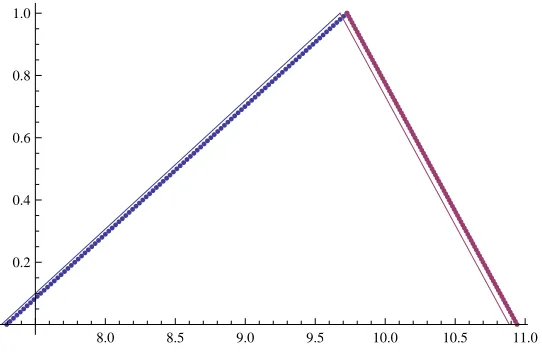
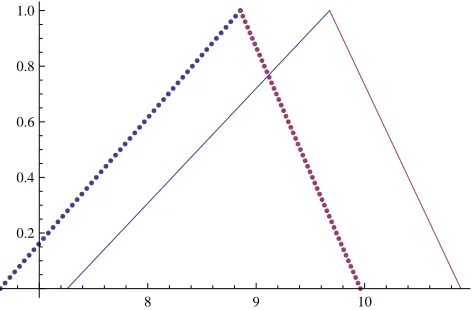
By using the IPCTSM, we have presented the numerical solution of this example at t = 2 in Fig. 1. Also, by using Euler`s method for this example at t = 2 with N = 10 and the initial value as
y(0)]= [(0:75 + 0:25)e; (1:125 0:125)e]; the results are shown in Fig. 2.
8.0 8.5 9.0 9.5 10.0 10.5 11.0
0.2 0.4 0.6 0.8 1.0
8 9 10 0.2
0.4 0.6 0.8 1.0
Fig. 2. The solid line and the dotted line show the initial fuzzy number and the numerical solution by using Euler's method, respectively.
Example 8.2. [8] Consider the initial value problem 8
> > > > > > > > > > > < > > > > > > > > > > > :
ey0(t) = ey(t) + m(t)k(y(tk)); t 2 [tk; tk+1]; tk= k;
[ey(0)] = [0:75 + 0:25; 1:125 0:125] 0 1;
[ey(0:1)] = [ 0:1875e0:1+ 0:9375e 0:1+ (e 0:1+ 0:1875e0:1 0:9375e 0:1); 0:1875e0:1+ 0:9375e 0:1+ (e 0:1 0:1875e0:1 0:9375e 0:1)];
[ey(0:2)] = [ 0:1875e0:2+ 0:9375e 0:2+ (e 0:2+ 0:1875e0:2 0:9375e 0:2);
0:1875e0:2+ 0:9375e 0:2+ (e 0:2 0:1875e0:2 0:9375e 0:2)];
(8.24)
where
m(t) = j sin(t)j;
k() = b0 if k = 0 if k 2 f1; 2; g:
For t 2 [0; 1] and for each k = 0; 1; 2; ; the exact solution of Eq: (8:24) satises in the following equation; see [1],
y(t) = [( 0:1875et+ 0:9375e t) + (e t+ 0:1875et 0:9375e t);
-1 1 2 0.2
0.4 0.6 0.8 1.0
Fig. 3. The solid line and the dotted line show the initial fuzzy number and the numerical solution by using the IPCTSM, respectively .
-1.5 -1.0 -0.5 0.5 1.0 1.5 2.0 0.2
0.4 0.6 0.8 1.0
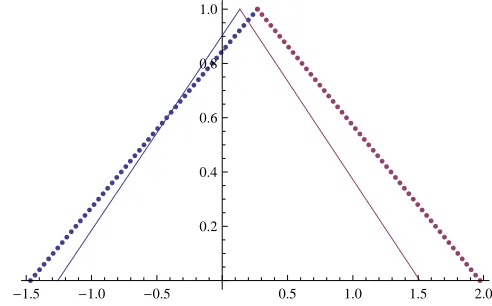
Fig. 4. The solid line and the dotted line show the initial fuzzy number and the numerical solution by using Euler's method, respectively.
9 Conclusion
In this paper, we developed the numerical solution of the hybrid fuzzy dierential system by the improved predictor-corrector method, in which the explicit three-step method is used as a predictor and also an iteration of the implicit two-step method as a corrector. By Theorems (7.1), (7.2), (7.3) and (7.4), we proved that the improved predictor corrector three-step method is convergent and stable. We presented the examples based on examples in [1, 7, 8, 9, 10] to illustrate our results using the improved predictor-corrector three-step method and the Euler method.
References
[1] T. Allahviranloo, S. Abbasbandy, N. Ahmady, E. Ahmady, Improved predictor-corrector method for solving fuzzy initial value problems, Information Sciences 179 (2009) 945-955.
[3] B. Bede, Note on Numerical solutions of fuzzy dierential equations by predic-torcorrector method, Information Sciences, 178 (2008)1917-1922.
[4] P. Diamond, Brief note on the variation of constants formula for fuzzy dier-ential equations, Fuzzy Sets and Systems 129 (2002) 65-71.
[5] P. Diamond, Stability and periodicity in fuzzy dierential equations, IEEE T. Fuzzy Syst. 8 (2002) 853-890
[6] D. Dubois, H. Prade, Fundamentals of Fuzzy Sets, Kluwer Academic Publish-ers, USA, 2000.
[7] O. Kaleva, A note on fuzzy dierential equations, Nonlinear Anal. 64 (2009) 895-900.
[8] S. Pederson, V. Kalaiselvi, Numerical solution of hybrid fuzzy dierential equa-tions by predictor-corrector method, Information Science 88 (2008) 421. [9] S. Pederson, M .Sambandham, The Runge-Kutta method for hybrid fuzzy
dierential equations, Information Science 88 (2008)421.