BOSNIAN JOURNAL OF BASIC MEDICAL SCIENCES 2010; 10 (1): 44-48&
Abstract
Physical capacity of athletes is an important element of success in sports achievements. Aerobic capacity has been accepted as its major component. Maximal oxygen uptake (VOmax) has been regarded by majority of authors as the best indicator of aerobic capacity of an organism, and at the same time, the best indicator of an athlete's physical capacity. Th e aim of the investigation was to analyze the aerobic capacity as an indicator of physical capacity of athletes, diff erences in their aerobic capacity with regard to the kind of sport they are practicing, as well as the diff erences obtained when compared to physically inactive subjects. Th e investigation included the determination of absolute and relative VOmax in the total of male examinees. Th e examinees were divided into two groups of active athletes (football play-ers (n=) and volleyball playplay-ers (n=) of diff erent profi les, while the third group of non-athletes served as control group. Maximal oxygen uptake was determined by performing the Astrand minute cycle test. Peak values of VO max were recorded in the group of football players (,±, l/min), and they were statistically signifi cantly higher (p<,) compared to other examined groups. In the group of volleyball players the oxygen uptake was ,±, l/min, while statistically signifi cantly lower values were reported in the group of non-athletes compared to the groups of athletes (p<,). A similar ratio of VO max ues was also shown by the analysis of values expressed in relative units. Our results showed that peak val-ues of VO max were obtained in football players, and that football as a sport requires higher degree of endurance compared to volleyball. Having considered the morphological and functional changes which are the consequence of the training process, it can be concluded that VO max values are statistically signifi cantly higher in the groups of athletes compared to the group of non-athletes.
KEY WORDS: athletes, maximal oxygen uptake, Astrand test
AEROBIC CAPACITY AS AN
INDICATOR IN DIFFERENT
KINDS OF SPORTS
Goran Ranković1*, Vlada Mutavdžić2,
Dragan Toskić3, Adem Preljević4, Miodrag Kocić2,
Gorana Nedin-Ranković5, Nikola Damjanović2
1 Department of Physiology, Faculty of Medicine, University of Niš, Bulevar Dr. Zoran Đinđić , Niš, Serbia
2 Faculty of Sport and Physical Education, University of Niš, Čarnojevićeva a, Niš, Serbia
3 Faculty of Sport and Physical Education, University of Prishtina, Dositeja Obradovića bb, Leposavic, Serbia
4 Faculty of Sport and Physical Education, University of Prishtina, Dositeja Obradovića bb, Leposavic, Serbia
5 Faculty of Medicine, University of Niš, Bulevar Dr. Zoran Đinđić , Niš, Serbia
BOSNIAN JOURNAL OF BASIC MEDICAL SCIENCES 2010; 10 (1): 45-48
Introduction
Physical capacity of athletes is an important ele-ment of success in sports achieveele-ments. It in-volves a huge number of different capacities, with aerobic capacity being its major component. Physiological basis of physical capacity of an organism incorporates the functional capacity of the organism to increase the level of metabolic processes in keeping with the requirement of physical eff ort being exposed to. Th e metabolic processes in this sense mean the trans-formation of chemical energy into mechanical one (). As energetic capacities of the human organism are cer-tainly the most signifi cant factor determining the limits of physical capacity, as well as practicing the sport, it is allowed to equate the physical capacity with the value of energetic capacity. Aerobic capacity denotes a general extent of metabolic processes occurring in the human organism, and stands for a larger portion of the total energetic capacity. Maximal oxygen uptake (VO max) refers to the intensity of aerobic processes, and actually represents the capacity of the organism to utilize at a certain moment the maximum amount of oxygen (). However, as these two processes are highly interrelated, maximal oxygen uptake has been regarded by major-ity of authors as the best indicator of aerobic capacmajor-ity of the organism, i.e. the functional capacities of cardio-vascular and respiratory systems, as well as the capacity of tissues to utilize oxygen; at the same time, it is the best indicator of the athlete's physical capacity. Maxi-mal oxygen uptake is defi ned as maximum amount of oxygen which the organism consumes per unit of time while performing the exercise of growing intensity, and which cannot be further increased with further rise of exercise intensity. Maximal oxygen uptake as a measure of aerobic capacity has been determined as the interna-tional standard of physical capacity (,). Th e basic unit for measuring the maximal oxygen uptake is its absolute value expressed in liters or millilitres of oxygen per min-ute. However, the absolute value of VOmax is highly aff ected by body weight, and it is, therefore, more objec-tive and generally accepted to express aerobic capacity in relative units – millilitres per kilogram of body mass per minute. Continuing estimation of athletes’ physical capacity is one of the most important tasks of the physi-ology of sport. In that way, one can get insight into the momentary physical capability of athletes and effi ciency of the training process (). Determination of aerobic capacity is possible to perform with great precision by direct measuring of maximal oxygen uptake in
labora-tory tests on maximal physical eff ort. More or less accu-rately, it can be indirectly estimated by means of various submaximal laboratory and fi eld tests. Th e current sub-maximal ergometric tests for the estimation of sub-maximal oxygen uptake performed on a treadmill and bicycle er-gometer meet the criteria according to which they could be classifi ed as the group of ergometric tests; however, they are impractical for testing a large number of exam-inees as they require special conditions and relatively expensive equipment. When the test is to cover a larger number of examinees at the same time or in a short peri-od of time in fi eld conditions, a step bench is the ergom-eter of choice. Unfortunately, the majority of tests which are performed on the step bench (the so-called «step-tests») are non-standard as they do not meet the basic precondition of aerobic capacity indirect estimation – that fi eld conditions for all examinees are the same (). The aim of the investigation was to provide valu-able insight into aerobic capacity i.e. athlete's capa-bility as an indicator of his physical capacity, differ-ence in aerobic capacities of athletes with regard to the kind of sport they were practicing, as well as the differences obtained when compared with physi-cally inactive subjects – the so-called non-athletes.
Material and Methods
The investigation included the determination of absolute and relative VOmax in the total of examinees of male sex. All investigations were undertaken at the Faculty of Sport and Physi-cal Education University of Prishtina in Leposavić. The examinees were divided into two groups of ac-tive athletes of different profiles, while the third group of athletes served as control group. The inves-tigated groups were divided into the following way: . football players (n=)
. volleyball players (n=) . non-athletes (n=)
BOSNIAN JOURNAL OF BASIC MEDICAL SCIENCES 2010; 10 (1): 46-48Results
The values of maximal oxygen uptake are frequent-ly compared to the degree of an athlete's physical work capacity, i.e. his physical capability. Therefore, the determination of maximal oxygen uptake plays the key role in sports functional diagnostics, and practically stands for physical capacity of athletes. As VO max values are highly affected by body weight of examinees, the values of maxi-mal oxygen uptake are expressed both in ab-solute (l/min) and relative (ml/kg/min) values. Peak values of VO max, expressed in absolute units, were recorded in the group of football players (. l/ min), and they were statistically significantly higher (p < ,) compared to other investigated groups. Th e recorded oxygen uptake in the group of volleyball players was , l/min, while non-athletes had statistical-ly signifi cantstatistical-ly lower values (, l/min) when compared to the groups of athletes (p < ,) (Table , Figure ). Data are presented as the mean ± SD.
* p<, vs. non-athletes, p<, vs. volleyball players Data are presented as the mean ± SD.
* p<, vs. non-athletes, p<, vs. volleyball players
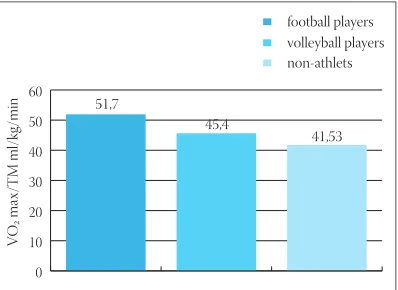
A similar ratio of VO max values was also recorded af-ter the analysis of values expressed in relative units (Ta-ble , Figure ). Th e best results were obtained again by football players (, ml/kg/min) with statistically sig-nifi cant diff erences when compared to the group of vol-leyball players (p < ,), which emphasizes the impor-tance of aerobic capacity for playing football successfully. Somewhat lower values were recorded in the volleyball players (, ml/kg/min), while the lowest values were obtained in non-athletes (, ml/kg/min) whose VO max/BW values were statistically significantly lower in comparison to both groups of athletes (p < ,).
Discussion
New regulations and tough competition require an extraordinary aerobic capacity of each athlete on the field. Sports competition stands for a typical test of athlete's physical capacity. Aerobic capacity is an in-tegral indicator of functional capacities of all systems involved in supply, transportation and energetic oxy-gen transformation (cardio-pulmonal capacity, func-tional muscle capacity to produce ATP in the pres-ence of oxygen) (). Functional impairment of any link in the chain can, to some extent, influence the decrease in the level of athlete’s physical capacity (). As maximum value of aerobic capacity of top ath-letes is achieved between and years of age, after which it linearly decreases with aging (), we cannot expect some signifi cant improvement in VO max in our football and volleyball players. After the age of , a possible increase in VO max, which can be con-ditioned by a period of a training cycle (up to ), is still not enough to meet the world and European stan-dards (, , ). Insuffi cient aerobic capacity precludes the maintenance of high level of aerobic exercise, and therewith the maximal performance in certain sports as
Examinees VO2max/l/min SD
Football players 4,25*# 0,27
Volleyball players 3,95* 0,18
Non-athletes 3,19# 0,21
Examinees VO2max/BW ml/kg/min SD
Football players 51,70*# 1,12
Volleyball players 45,40* 1,69
Non-athletes 41,53# 1,14
TABLE 1. Mean VO2 max values in the groups of athletes and non-athletes expressed in l/min
BOSNIAN JOURNAL OF BASIC MEDICAL SCIENCES 2010; 10 (1): 47-48
Conclusion
Th e investigation into the maximal oxygen uptake provides the relevant data on the health of players, planning and follow-up of the training eff ects, also being useful for the early selection of athletes. For these reasons, the increase in VOmax values as indicators of physical capability of athletes is indispensable for achieving the top sports results. Our results show that the highest VOmax values were obtained in the football players, and that football as a sport re-quires higher degree of endurance compared to volleyball. Taking into consideration the morphological and functional changes as the consequence of the training process, it can be concluded that VOmax values are statistically signifi cantly higher in the groups of athletes compared to the group of non-athletes.
it leads to progressive exhaustion, especially in the last minutes of a match (). High level of aerobic capac-ity is indispensable for achieving success in many sports; therefore, the determination of VOmax is of special importance as it plays the key role in professional sports – it is the refl exion of any athlete's physical capability.
Analyzing our results, it can be observed that maximal oxygen uptake was recorded in the group of football players; it was expressed both in absolute (, l/min) and relative units (, ml/kg/min), which was the expected value having considered the prior facts. Foot-ball, as a representative of sports games, requires an in-termittent performance with intertwining the aerobic and anaerobic exercises. Th e player is thus required to have an efficient energetic system which would sup-port all min maintaining full strength. By compar-ing the relative values, it can be noted that there are statistically significant differences between the vol-leyball and football players, which indicates that VO max values also depend on the kind of sport. Th e data presented by Živanić, related to physiological profi le of football players, show that the average distance made during the match by our fi rst league football players is – km, with aerobic/anaerobic ratio : (). By measuring the maximal oxygen uptake, Diaz et al.
BOSNIAN JOURNAL OF BASIC MEDICAL SCIENCES 2010; 10 (1): 48-48References
() Bowers R.W., Fox E.L. Sports Physiology. rd. ed. Boston: Mc-Graw-Hill; .
() Živanić S., Životić V.M., Mijić R., Dragojević R. Aerobna sposob-nost i njena procena Astrandovim testom opterećenja na bicikl-ergometru. Beograd; Udruženje za medicinu sporta Srbije: .
() Fleg N., Piila I.L., Balady G.J. Assessment of functional capacity in clinical and research applications. Circulation. ;:.
() Fletcher G.F., Balady G., Froclicher V.F. A Statement for Health-care Professionals From the American Heart Association. Circu-lation. ;:-.
() Ponorac N., Matavulj A., Grujić N., Rajkovača N., Kovačević P. Maksimalna potrošnja kiseonika (VOmax) kao pokazatelj fi zičke sposobnosti sportiste. Acta. Med. Medianae. ;(): – .
() Mazic S., Zivotic V.M., Igracki I., Zivanic S., Velkovski S. Jed-nostavan, pouzdan step-test za procenu aerobne sposobnosti. Med. Preg. ; (-): -.
() Wilmore H.J., Costill L.D. Physiology of sport and exercise. nd ed. Champaign IL: Human Kinetics; .
() Shephard R.J. Biology and medicine of soccer: An update. J. Sport. Sci. ;: -.
() Reilly T., Bangsbo J., Franks A. Anthropometric and physiological predispositions for elite soccer. J. Sport. Sci. ;: -.
() Melo R.S. Qualidades Físicas e Psicológicas e Exercícios Técnicos do Atleta e Futebol. Rio de Janeiro, Sprint, .
() Živanić S. Morfo-funkcionalne karakteristike prvoligaških fudbal-era u SCG. Sportska Medicina. ; (): .
() Živanić S., Životić V.M., Malićević S., Mijić R., Ostojić S., Bogdnović S. Morfo-funkcionalne karakteristike prvoligaških fudbalera u SCG. Zbornik sažetaka. Prvi srpski kongres sportskih nauka i medicine sporta. Beograd, Oktobar, .
() Casajus J.A. Seasonal variation in fi tness variables in professional soccer players. J. Sports. Med. Phys. Fitness. ; (): -.
() Ostojić S., Mazić S., Dikić N., Velkovski S. Physiological profi le of elite serbian soccer players. Abstract book. Risk factors and health: From molecule to the scientifi c basis of prevention. Zren-janin, .
() Chamari K., Hachana Y., Kaouech F., Jeddi R., Moussa C.I., Wisl-off U. Endurance training and testing with the ball in young elite soccer players. Br. J. Sports. Med. ; :-.