Engineering and Technology Journal ISSN: 2456-3358
Improved Interference Suppression BFGS-Algorithm in Modern
Satellite, Radio Relay and Troposphericsystems
Kostiantyn V. Herasymenko1, Olena V. Starkova2
1,2
Igor Sikorsky Kyiv Polytechnic Institute
ARTICLE INFO ABSTRACT
corresponding Author:
Kostiantyn V.Herasymenko1
Igor Sikorsky Kyiv Polytechnic Institute
In this paperan approach to the suppression of interference with satellite, radio relay and tropospheric signals is proposed. This approach is based on the idea of the algorithm combining the signals from four radiators with amplitudes and phases such as to form a zero spatial pattern in the direction of the interference signal source. Method implements the BFGS scheme. This approach takes into account most of the process features that can significantly improve the noise immunity of GPS etc. signals receivers.
KEYWORDS: suppression, interference, receiver, satellite navigation signals, radio relay systems, tropospheric systems.
Improved Interference Suppression BFGS-Algorithm In Modern Satellite
In modern conditions relevant research in satellite navigation, namely, providing a relatively high efficiency of the noise immunity based on hardware and software. On the basis of analysis operating experience and development of the civil aviation was found that in our days we can see the increasing of the requirements to safeness. One of the problems is to increase the safety effectiveness of the flight navigation support in the operation and modernization. In technical terms, the system is equipped with modern radar, navigational, computing and other facilities that require timely upgrades. It is connected to the constant increasing in the intensity of flights and with the process of working life and obsolescence caused by the rapid growth of information technology. So according to ICAO complexity of air traffic from 2009 to 2013 it increased by 8-11%. In the component system devices in an
average year of operation worked from 5% to 25% of resource indicators, and obsolescence for the same period is 35%.
Ensuring the immunity of receivers satellite radio navigation signals based on upgrading hardware and software requires the following characteristics of antenna system:
1) The ellipticityof the antennas should beno more than 2;
2) Vector diagram of antennas should ensure simultaneous reception of signals at specified frequencies in the upper hemisphe resectorangles place from 5° to 175°;
3) Thegainofthe antenna radiator (on isotropic radiator with circular polarization) -not less then:
(intheverticalplane) of 15° to 50°; - Minus 7 dB foranglesplacefrom 5° to 15°. Thus, according to the rapid growth of satellite navigation in general and the quality of the signals particularly topical scientific task of improving existing and developing new models and methods of noise suppression satellite navigation, radio relay and tropospheric system signals, the solution of this problem and is devoted to this article.
Spatio-Temporal Methods For Improving Noise Immunity Of Receivers Insatellite, Radio Relay And Tropospheric Systems
In our time there are many methods for improving noise immunity thus formed general theory of space-time adaptive filtering on the basis of which obtained the optimum signal processing of outputs array. These algorithms achieve the potential performance of spatial processing. In order to achieve the specified tactical and technical characteristics is very important to study the characteristics of potential spatial filters depending on the number and location of sources of interference and navigation satellites.Among this algorithms should be the following:
1) The classic method of minimum output power. In the classic antenna interference compensator produce basic antenna output which contains the signal and noise, and additional (compensatory) antenna, which must not contain the desired signal. Such interference canceller is often used as compensator radar side lobes.
2) Algorithm for optimal space-time processing. With this algorithm defined parameters λ signal St(λ)based multi observation ξt(t)at a
certain time interval t= . Higher noise suppression algorithms considered (APA) under conditions known signal-interference environment. In practice, the APA has adopted independently by finding the best implementation of the weights, that is, to adapt to the unknown signal-interference
environment. Algorithms tuning weighting coefficients referred adaptation algorithms. Adaptation algorithms can be divided into direct and tracking. Direct algorithms associated with calculating the correlation matrix interferences are best and provide a minimum of adaptation. Functioning tracking algorithm assumes relatively slow changes of space-time signal-interference environment and usually need more time to adapt.
3) A classic algorithm-adaptation Shyrman Uidrou is best known algorithms of adaptation, but has too much time convergence.
4) Algorithm Adaptation of valuation. The easiest way to significantly reduce time of adaptation - to apply rationing samples taken at capacity.
5) Optimum not following algorithm. A simple model of the algorithm can adequately describe the capture mode or "support" if space-time is optimal algorithm that is fast and provide delight on a specified interval. 6) Algorithm of spatial and temporal resolution
Improved BFGS - Algorithm Of Noise Suppression In Modern Satellite, Radio Relay And Tropospheric Systems
Noise suppression algorithm implements digital adaptive 4 sized array of antennas with the radiation pattern to its zero were oriented toward sources of interference signals. It is assumed that the origin of the spatial radiation pattern will be the depth of at least 40 dB, which meets noise
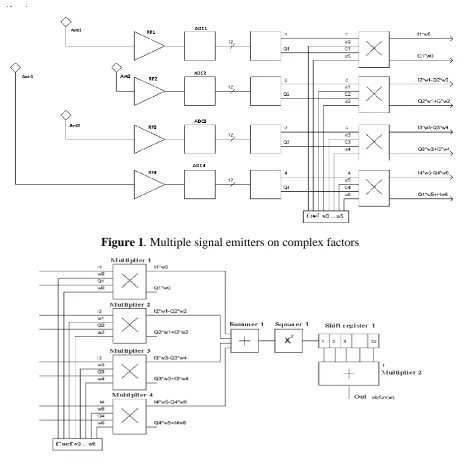
suppression signals to the same level. For each of the frequency bands (L1 or L2) antenna array consists of four elements, is (Ant1...Ant4) in Fig. 1, 2 and located on the sides of a square at a distance of λ/2. All emitters have broad radiation pattern and receive signals in the upper hemisphere. Both bands suppression algorithm is the same.
Figure 1. Multiple signal emitters on complex factors
Figure 2.The calculation of the objective function
The basic idea of the algorithm is – passsignals from four emitters of amplitudes and phases to
amplitude and phase of each element to reduce signal noise. Amplitude and phase for each element are determined by multiplying the signal received from each emitter, the complex weight. Complex factors are selected inertia Quasi-Newton gradient method (BFGS). It is important that the signal noise 0 ... 60 dB higher than the useful signals from navigation satellites. In addition, satellites and sources of noise are separated in space (in the corners). Therefore, the antenna system with variable radiation pattern adaptively reduce power to the total output will suppress its space. Settlements in MatLab confirm this. This diagram leave most of the useful signals from the satellites, so the location does not meet zeros pattern. This will further determine the coordinates.
Figure 1, 2 signals with four antenna outputs after high emitters blocks containing amplifiers, mixers, filters, etc. (HF indicated in Figure 1), are converted to analog signals with bandwidth 15MHts order. Then the signal from each emitter digitized in the ADC, the output of each output 13-bit binary code with a frequency of 81.25 MHz passage. Then the signal in each channel is decomposed into quadrature components I and Q (also 13-bit parallel following a frequency 81.25 MHz).
Quadrature signal components marked I1 Q1, I2 Q2, I3 Q3, I4 Q4 respectively. These signals then used to form a total signal at the output immunity and the algorithm for adaptive suppression. Fig. 1, 2 quadrature signal components used to calculate the objective function objfun. This algorithm will seek toreduce this objective function, respectively, reducing power noise.
The Effectiveness Of The Algorithm Of Noise Reducing Based On BFGS Method, Conjugate Gradient Method And Steepest Descent Method
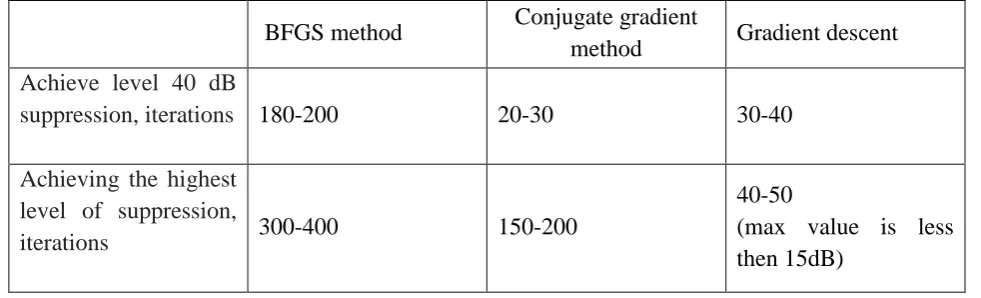
The study tested effectiveness and speed of the algorithm of noise reducing based on BFGS method, conjugate gradient method, and steepest descent method. Comparison of the speed of the algorithm is shown in Tables 1-3. Conjugate gradient method shows a higher rate optimization, BFGS than the method, providing after 30-40 iterations suppression not worse than 40 dB. Gradient descent on speed only slightly inferior conjugate gradient method, but in the case of one and two obstacles can achieve lower levels of noise suppression. Thus, for noise reducing is recommended conjugate gradient method. It is concluded that the uses gradient descent to solve the optimization problem mentioned gradient only on the current step.
Table 1 : The effectiveness of the algorithms for noise reducing for one obstacle
BFGS method Conjugate gradient
method Gradient descent
Achieve level 40 dB
suppression, iterations 180-200 20-30 30-40
Achieving the highest level of suppression,
iterations 300-400 150-200
40-50
Table2 :The effectiveness of the algorithms for noise reducing for two obstacles
Метод BFGS Метод сполучених
градієнтів
Метод найшвидшого спуску
Achieve level 40 dB
suppression, iterations 150-200 20-30 30-40
Achieving the highest level of suppression,
iterations 200-250 100-150
40-50 (max value is less
then 15dB)
Table3 : The effectiveness of the algorithms for noise reducing for two obstacles
Метод BFGS Метод сполучених
градієнтів
Метод найшвидшого спуску
Achieving the highest level of suppression,
iterations 200-250 30-40
50-60 (max value is less
than 2-4dB)
BFGS method relates to the optimization methods that are based on the accumulation of information about the curvature of the objective function for tracking changes of gradient. The method takes into account the quadratic nature of the objective function, and thus many challenges optimization is more effective than gradient descent. The disadvantage of this method at its hardware implementation - calculation of the Hessian dimension [6×6]. In the method of conjugate gradient (Fletcher-Reeves) is based sequence search areas that are linear combinations of current and previous direction destinations, with such directions to make finding combinations. This new direction for calculating search using only current and penultimate gradients. Some optimization problems conjugate gradient method is more efficient than the method BFGS.
Conclusions
Proven performance algorithm with a real antenna system. For this purpose antenna array in the program that implements the electrodynamic
calculations antenna is supplied plane wave at a frequency of 1600.5 MHz from the right circular polarization and parallel polarization plane array (normal incidence wave). For antennas 1-4 calculated amplitude and phase of the received signals. These data are transferred in Matlab, which is calculated by conjugate gradient necessary coefficients. Given the coefficients calculated lattice pattern of the antenna 1-4. It is seen that the resulting optimization factors can get no worse noise suppression of 50 dB.
References
1. Herasymenko K.V. Adaptyvniantennisystemy.
Visnyk Natsional 'nohotekhnichnoho
universytetuUkrayiny«Kyyivs'kyypolitekhnichnyyin
stytut». Seriya – Radiotekhnika. Radio
aparatobuduvannya. K.: 2010, – Yuvileynyyvypusk. P. 179-183. (In Ukraine). 2. Herasymenko K.V. Vdoskonalenyy
orazavadpryymachamsuputnykovoyiradionavihatsi ynoyisystemynaosnoviadaptyvnoyiprostorovoyifil' tratsiyi.Naukovizapysky UNDIZ. 2015. №4(38). P. 49-54. (In Ukraine).
4. Global'najasputnikovajanavigacionnajasistema GLONASS. Interfejsnyjkontrol - 'nyjdokument. Redakcija 5.0M.: Glavkosmos , 2002. 217 p. (In Rissian).
5. Kravchenko Yu. V., Dubas T.I. Analizosnovnykhsposobivznyzhennyaradiolokatsi ynoyipomitnosti ta mozhlyvostiyikhzastosuvannya do nazemnykh ta povitryanykhob ’yektiv. Telekomunikatsiyni ta informatsiynitekhnolohiyi. 2014. №2. P. 19–25. (In Ukraine).
6. Kravchenko Yu. V ., Lavrinchuk O. V. , Zaluzhnyy R. M. Kontseptsiyasyntezulokal 'noyibahatopozytsiynoyiradionavihatsiynoyisystem y.Systemyozbroyennyaiviys'kovatekhnika. 2009. №2(18). P.75–78. (In Ukraine).
teristikalgoritmaglubokojintegracii SRNS/INS. Radiotehnika (Zhurnal v zhurnale). 2001, №7. P.56-63. (In Rissian).
8. Harisov V. N., Bulavskij N.T.Jeksperimental 'nyeissledovanijaalgoritmafil'traciiotnositel'nyhkoo rdinat SRNS GLONASS s ispol 'zovaniemfazovyhizmerenij. Radiotehnika (Zhurnal v zhurnale). 1999, №7. P.40-48. (In Rissian).
9. Harisov V. N., Gorev A.P. Issledovanijaodnoj – etapnogoalgoritmanavigacionno vremenny – hopredelenijdljapriemnika SRNS Radiotehnika (Zhurnal v zhurnale). 2001. №4, С.3-18. (In Rissian).