Journal of Patient-Centered
Journal of Patient-Centered
Research and Reviews
Research and Reviews
Volume 1 Issue 2 Article 6
5-23-2014
In Adult Smokers Unwilling or Unable to Quit, Does Changing
In Adult Smokers Unwilling or Unable to Quit, Does Changing
From Tobacco Cigarettes to Electronic Cigarettes Decrease the
From Tobacco Cigarettes to Electronic Cigarettes Decrease the
Incidence of Negative Health Effects Associated With Smoking
Incidence of Negative Health Effects Associated With Smoking
Tobacco? A Clin-IQ
Tobacco? A Clin-IQ
Jennifer Brown Brandon Brown Peter Schwiebert
Kalyanakrishnan Ramakrisnan Laine H. McCarthy
Follow this and additional works at: https://aurora.org/jpcrr
Part of the Medical Sciences Commons
Recommended Citation Recommended Citation
Brown J, Brown B, Schwiebert P, Ramakrisnan K, McCarthy LH. In adult smokers unwilling or unable to quit, does changing from tobacco cigarettes to electronic cigarettes decrease the incidence of negative health effects associated with smoking tobacco? A Clin-IQ. J Patient Cent Res Rev. 2014;1:99-101. doi: 10.17294/2330-0698.1019
In Adult Smokers Unwilling or Unable to Quit, Does Changing From Tobacco
In Adult Smokers Unwilling or Unable to Quit, Does Changing From Tobacco
Cigarettes to Electronic Cigarettes Decrease the Incidence of Negative Health
Cigarettes to Electronic Cigarettes Decrease the Incidence of Negative Health
Effects Associated With Smoking Tobacco? A Clin-IQ
Effects Associated With Smoking Tobacco? A Clin-IQ
Erratum Erratum
This article mistakenly reports the delivery agent in electronic cigarettes as diethylene glycol instead of propylene glycol. Propylene glycol is a relatively benign substance commonly used in concert smoke machines. Diethylene glycol, a highly toxic substance, was reportedly found in only one e-cigarette cartridge studied in the literature, which may have been due to use of a nonpharmaceutical grade propylene glycol. JPCRR regrets this error.
This topic synopsis is available in Journal of Patient-Centered Research and Reviews:
Aurora.org/Journal 99
Jennifer Brown, MD, Brandon Brown, MD, Peter Schwiebert, MD, Kalyanakrishnan Ramakrisnan, MD, Laine H. McCarthy, MLIS
Family Medicine Residency Program, Department of Family & Preventive Medicine, University of Oklahoma College of Medicine, Oklahoma City, OK
In Adult Smokers Unwilling or Unable to Quit, Does Changing From
Tobacco Cigarettes to Electronic Cigarettes Decrease the Incidence of
Negative Health Effects Associated With Smoking Tobacco? A Clin-IQ
Abstract
Data from a randomized controlled trial and systematic review support the claim that switching from tobacco cigarettes to electronic cigarettes (e-cigarettes) can reduce the short-term negative health effects of smoking. In adult smokers unwilling or unable to quit, exhaled carbon monoxide levels, total number of cigarettes smoked, and exposure to nitrosamine chemicals were reduced within a 12-month period. While the e-cigarette industry remains largely unregulated thus far, these studies provide encouraging hope in the uphill battle toward helping patients make informed and healthy choices. (J Patient-Centered Res Rev. 2014;1:99-101.)
Keywords
electronic cigarettes, e-cigarettes, tobacco, smoking, smoking cessation
Search Terms
adult, smoking, adverse effects of smoking, nicotine administration, nicotine dosage, smoking psychology, smoking cessation
Clinical Question
In adult smokers unwilling or unable to quit, does changing from tobacco cigarettes to electronic cigarettes decrease the negative health effects associated with smoking tobacco?
Answer
Probably, based on current evidence. More research is needed.
Date answer was determined: December 2013
Level of evidence for the answer: A
Inclusion Criteria
Published systematic reviews, meta-analyses, randomized controlled trials and cohort studies comparing the short-term and relatively long-short-term health effects of electronic cigarettes with tobacco cigarettes.
Exclusion Criteria
Pregnant women, children, and individuals with preexisting lung disease.
Summary of the Issues
Tobacco use is projected to kill 1 billion people in the 21st century, making it the single greatest cause of preventable death globally.1 Tobacco use in any form has negative health consequences, the severity of which depends on the amount and duration of smoking as well as the type of nicotine delivery system employed.1 Tobacco cigarette smoke contains thousands of chemical byproducts (including 45 known or suspected carcinogens) that bind to DNA causing genetic mutations. Tobacco also contains nicotine, a highly addictive and psychoactive drug.
Electronic cigarettes (e-cigarettes) or electronic nicotine
delivery systems, first introduced in China in 2006, have spread
worldwide.2 Often made to resemble traditional cigarettes,
e-cigarettes vaporize a solution containing nicotine and flavor
in an agent such as diethylene glycol. The result is a relatively clean nicotine delivery system that should, in theory, have fewer adverse health effects when compared with traditional cigarettes. However, extensive data is lacking, and there remain
significant concerns regarding the purity of the ingredients, device functionality, user modification and general lack of
oversight regarding manufacturing and marketing.2
As popularity of e-cigarettes continues to increase, studies comparing the effects of e-cigarettes and traditional cigarettes on acute adverse health outcomes are emerging.3 This data is essential for recommending their use, particularly in smokers unwilling or unable to quit. The Jan. 8, 2014, tobacco-themed
Correspondence: Laine H. McCarthy, MLIS, Clinical Associate Professor, Department of Family & Preventive Medicine,
University of Oklahoma College of Medicine, 900 NE 10th Street, Oklahoma City, OK, 73104, Phone: 405-271-8000, ext. 32206, Email: [email protected]
issue of The Journal of the American Medical Association
focused on a number of different challenges that health care providers have encountered in the last 50 years regarding tobacco abuse and cessation attempts, and included a call for more research and regulation of e-cigarettes.4
Summary of the Evidence
Studies have shown that risks of these negative health effects are related to the length of time a person smokes and how much they smoke.1 As such, we chose to infer that reducing the extent and duration of tobacco cigarette smoking would, in turn, decrease these negative health effects. While more than 100 online and print publications were reviewed, only one randomized control trial was found that studied e-cigarette use in smokers unwilling or unable to quit.5 Various other publications that studied the safety of e-cigarettes referenced each other, and we chose to use information from two of the most comprehensive resources.3,5
Since long-term effects of e-cigarettes are unavailable, we chose to focus on measurable physiological and chemical
parameters that have been scientifically linked to adverse
health effects of smoking. Nitrosamine is a chemical compound found in latex, rubber, cosmetics and pesticides, as well as in tobacco smoke, snuff and snus, a moist powdery variation of snuff.3 More than 90% of nitrosamine derivatives are known to be highly carcinogenic and have been shown to cause a wide range of cancers.3 Carbon monoxide (CO), another byproduct of the combustion process, reduces the body’s oxygen-carrying capacity and alveolar elasticity, promoting the development of emphysema and chronic obstructive pulmonary disease.3
Cahn et al.,3 examining the evidence concerning the safety
and efficacy of e-cigarettes, stated that only a minority (5,300
of the 10,000-100,000) of the chemicals in cigarette smoke have been detected, whereas all components in e-cigarette
vapor have been identified using gas chromatography and
mass spectrometry. Only two substances in e-cigarettes (nitrosamines and diethylene glycol) are believed to have negative health effects. The researchers noted that maximal levels of nitrosamine in e-cigarettes are comparable to those in a nicotine patch and are much lower than in tobacco cigarettes (Table 1).3 Diethylene glycol is a relatively benign substance commonly used in concert smoke machines, but it also has been associated with lethal toxicity at high levels.6
Caponnetto et al.5 designed a 12-month, prospective, randomized controlled trial to evaluate smoking reduction and/or abstinence among 300 smokers unwilling to quit using two different nicotine strength e-cigarettes: 2 groups
(n=100 each) received nicotine cartridges of different strengths; the third group (n=100) received non-nicotine cartridges for 12 weeks. Participants were not required to change their current smoking habits.
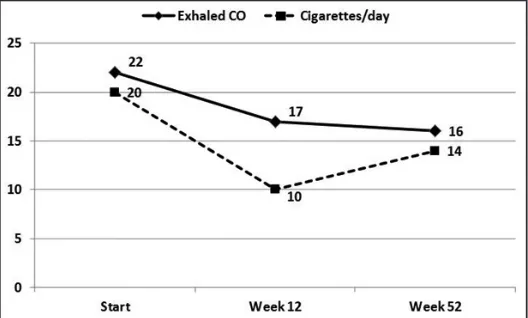
Over the 12-month period, nine follow-up visits were used to determine number of cigarettes smoked daily and exhaled
CO levels. Both parameters decreased in the groups using e-cigarettes (Figure 1). A significant number of “reducers”
(smokers who reduced daily cigarette use by more than
50%) and “quitters” (those abstaining from smoking and had exhaled CO level <7 ppm) did not experience side effects
commonly associated with quitting tobacco smoking. Rates
of hunger (6.5%), insomnia (4%), irritability (3.5%), anxiety
(3%) and depression (2%) were lower than that expected with traditional tobacco smoking cessation methods.4 In addition, no weight gain was reported during this study.
Even though it is a relatively clean nicotine delivery system, e-cigarettes still contain nicotine. Nicotine is an addictive and psychoactive agent that causes physical dependence and tolerance while enhancing attention, concentration
Nicotine delivery systems Nitrosamine level*
Nicotine gum (4 mg) 2.00
Nicotine patch (4 mg) 8.00
Electronic cigarettes 8.18
Snus (moist powdery smokeless tobacco) ~2,010
Light cigarettes ~4,800
Full-strength cigarettes ~6,200
Dipping or smokeless tobacco (straight long cut) ~9,300 Table 1.Nitrosamine levels in various nicotine delivery systems3
*Levels are reported as total nanograms in 1 gram of product.
Aurora.org/Journal 101 Topics
and mood. It is also a sympathomimetic drug that releases catecholamines, increasing heart rate and blood pressure, constricting blood vessels and reducing sensitivity to insulin.1 Nicotine thus has its own negative health effects, but long-term use of nicotine replacement products (gum, patch, etc.) have been shown to be generally well tolerated without evidence of serious adverse consequences.1
Conclusion
In tobacco smokers unwilling to quit, switching to e-cigarettes
decreases exhaled CO level and number of tobacco cigarettes
smoked. Furthermore, users of e-cigarettes are exposed to less carcinogenic nitrosamine than tobacco cigarette
smokers. A reduction in exposure to CO and nitrosamines,
as well as an overall reduction in smoking, helps reduce smoking-related negative health effects.
However, further studies are needed to evaluate the long- and short-term effects of the diethylene glycol chemicals used as delivery agents in e-cigarettes. Improved product regulation and standardization of nicotine levels, safety, use and commercialization are required before e-cigarettes can be
called a “safe” alternative to tobacco cigarette smoking.4 In the meantime, these early studies shed exciting new information on
an addiction that has defied traditional treatment approaches.
Acknowledgments
Clin-IQ (Clinical Inquiry) is a required resident/faculty scholarly activity
that takes questions from community practitioners and feeds the answers back out to improve patient care. L.H.M. received support from Oklahoma
Shared Clinical & Translational Resources, funded by grant number
NIGMS U54GM104938, NIGMS/NIH.
Conflicts of Interest
None
References
1. Henningfield J, Hammond K; World Health Organization. Tobacco:
deadly in any form or disguise. http://www.who.int/tobacco/
communications/events/wntd/2006/Report_v8_4May06.pdf.
Accessed March 25, 2011.
2. O’Connor RJ. Non-cigarette tobacco products: what have we learnt
and where are we headed? Tob Control. 2012;21:181-90.
3. Cahn Z, Siegel M. Electronic cigarettes as a harm reduction strategy
for tobacco control: a step forward or a repeat of past mistakes? J Public Health Policy. 2011;32:16-31.
4. Special theme issue of Journal of the American Medical Association:
50 Years of Tobacco Control. JAMA. 2014;311:145-212.
5. Caponnetto P, Campagna D, Cibella F, et al. EffiCiency and Safety of an eLectronic cigAreTte (ECLAT) as tobacco cigarettes substitute: a
prospective 12-month randomized control design study. PLoS One.
2013;8:e66317.
6. Sosa NR, Rodriguez GM, Schier JG, Sejvar JJ. Clinical, Laboratory,
Diagnostic, and Histopathologic Features of Diethylene Glycol
Poisoning-Panama, 2006. Ann Emerg Med. 2014 Jan 15 [Epub ahead of print].