P.SUDHA et al, International Journal of Computer Science and Mobile Applications, Vol.6 Issue. 3, March- 2018, pg. 64-72 ISSN: 2321-8363 Impact Factor: 5.515
QoS Based Performance Analysis of
Scheduling Algorithms for WiMAX
Mrs. P.SUDHA
Research Scholar,Department of Computer Science, Bharathiar University, Coimbatore, India.
Dr. A.RENGARAJAN
Professor,
Department of Computer Science &Engineering, Veltech Multi Tech DR.RS Engineering College,
Avadi, Chennai - 600062.
Abstract __ WiMAX (Worldwide interoperability for Microwave Access), is one in every of the recent technologies within the wireless world. The most goal of WiMAX is to deliver wireless communications with Quality of Service (QoS) during a secured setting. Owing to this Quality of Service (QoS) has become important issue in present era to differentiate oneself from alternative competitor technology. WiMAX (IEEE 802.16) is one such normal specifies general QoS design with varied components of this design is left undefined. Most significant part of this design is scheduling algorithm and this part is not defined and left open for vendors to implement as per their wants. In contrast to wireless LANs, WiMAX networks incorporate many QoS mechanisms at the MAC level for secured services for knowledge, voice and video. Its quality feature makes it completely different from the opposite IEEE 802.16 protocols that was supported Static WiMAX and provided the Wireless communication at fastened locations. In this paper the performance analysis of Cross Layer Scheduling (CLS), and TCP-Aware Uplink Scheduling (TCP-AUS). Finally CLS algorithm provide better performance compare to TCP-AUS and also increasing throughput, reducing delay and ART with number of MS is increased.
Keywords: Scheduling Algorithm, IEEE 802.16e, WiMAX, ART, Throughput, Delay.
I. INTRODUCTION
P.SUDHA et al, International Journal of Computer Science and Mobile Applications, Vol.6 Issue. 3, March- 2018, pg. 64-72 ISSN: 2321-8363 Impact Factor: 5.515
technology relies on a regular that's IEEE 802.16 that is BWA that provides mobile broadband property. A number of the most benefits of WiMAX over different access network technologies are longer range and additional refined support for Quality of Service (QoS) at the MAC level. Many differing types of applications and services are often utilized in WiMAX networks and also the MAC layer is intended to support this convergence. The quality defines 2 basic operational modes: mesh and point-to-point. Within the former mode, subscriber stations (SS) will communicate to every alternative and to the base stations (BS). Within the point to point mode, the independent agency area unit only allowed to communicate through the BS. Thus, the supplier wills management the environment to confirm the QoS requirements of its customers.
Research Issues and Challenges:
It may be inferred from the above discussion that scheduling in WiMAX networks may be a difficult problem. A number of the key problems concerned are:
Routing: In a mesh network, multiple routes may exist between two nodes. Hence algorithms should evaluate different routing strategies like minimum hop, minimum packet loss, and minimum interference, to ascertain their affect on scheduling.
QoS: None of the algorithms except and consider delay. Also none of the algorithms consider jitter. Delay and jitter are very important for real-time audio and video applications and hence algorithms that address delay and jitter needs to be proposed.
Fairness: New fairness metrics need to be defined that takes into account service level agreements between the service providers and customers. Fairness has to be implemented at the SS level as well as the user level.
Distributed scheduling: A performance analysis of the distributed scheduler was
done. However, more research is required to determine slot assignment for data transfer and hold off exponent values. Also, different distributed scheduling techniques need to be proposed that can do efficient scheduling while taking into account the interference and half-duplex constraints of the nodes.
Adaptive burst profile: WiMAX networks support adaptive burst profile. It is
therefore important to study how burst profiles can be modified to increase the scheduling efficiency.
Overheads: A scheduling scheme is incomplete if the various overheads and
P.SUDHA et al, International Journal of Computer Science and Mobile Applications, Vol.6 Issue. 3, March- 2018, pg. 64-72 ISSN: 2321-8363 Impact Factor: 5.515
II. RELATED WORKS
On traffic characteristics of a broadband wireless internet access have been discussed by R Pries et. al (2009). Traffic analysis and characterization of internet user behavior have been analyzed by M Kihl, et. al. (2010). Packet scheduling for QoS support in IEEE 802.16 broadband wireless access systems have been developed by A Ganz, et. al. (2003). Maximizing Unavailability Interval for Energy Saving in IEEE 802.16e Wireless MANs have been investigated by T.C. Chen, et. al. (2009). Energy-efficient packet scheduling algorithms for real-time communications in a mobile WiMAX system have been studied and analyzed by S.L. Tsao et. al. (2008). A Maximal Power-Conserving Scheduling Algorithm for Broadband Wireless Networks have been analyzed by H.L. Tseng et. al. (2008). Improving Mobile Station Energy Efficiency in IEEE 802.16e WMAN by Burst Scheduling have been discussed by J. Shi et. al. (2006). Energy Efficient Scheduling with QoS Guarantee for IEEE 802.16e Broadband Wireless Access Networks have been investigated by S.C. Huang, et. al. (2010). Tiny MAP: an efficient MAP in IEEE 802.16/WiMAX broadband wireless access systems have been developed by H. S. Kim et. al. (2007). Performance Evaluation of an Uplink Scheduling Algorithm in WiMAX have been analyzed by Yekanlu E. et. al. (2009). Analyzing the Throughput and QoS Performance of a WiMAX Link in an Urban Environment have been analyzed by Daniel, K., et. al. (2009). A survey on scheduling in IEEE 802. 16 mesh mode have been studied and discussed by Miray K (2011). Comparative study of scheduling algorithms in WiMAX have been analyzed by Sabri A. (2011). Overviews of scheduling strategies for PMP mode in IEEE 802.16 have been studied by Murrawat S, et. al. (2012). Comparative study of scheduling algorithms for WiMAX have been studied and discussed by Jain A, et. al. (2008). A comprehensive survey on WiMAX scheduling approaches have been discussed by Chaari L et. al. (2009). Overview of mobile WiMAX technology and evolution have been studied and discussed by Etemad K, (2008). Performance evaluations of the IEEE 802.16 MAC for QoS support have been analyzed by Cicconetti, (2007). Modified EDF algorithm and WiMAX architecture to ensure end to end delay in multihop network have been developed by Sagar V et. al. (2010). Ensuring the QoS requirements in 802.16 scheduling have been analysed by Sayenko A, et. al. (2006). Flexible resource allocation in IEEE 802.16 wireless metropolitan area networks have been discussed and analyzed by Xergias AS, et. al. (2010). An Opportunistic DRR (ODRR) uplink scheduling scheme for IEEE 802.16-based broadband wireless networks have been developed by Rath HK, et. al. (2006). Comparisons of WiMAX scheduling algorithms and proposals for the rtps QoS class have been analyzed by Loutfi, et. al. (2008). Performance analysis of temporary removal scheduling applied to mobile WiMAX Scenarios in tight frequency reuse have been discussed and analyzed by Ball CF, et. al. (2011). Performance evaluations for scheduling algorithms in WiMAX network have been analyzed by Cherng JL, et. al. (2012). Packet scheduling for QoS support in IEEE 802.16 broadband wireless access systems have been developed by Ganz A. et. al. (2003).
III. PERFORMANCE ANALYSIS
P.SUDHA et al, International Journal of Computer Science and Mobile Applications, Vol.6 Issue. 3, March- 2018, pg. 64-72 ISSN: 2321-8363 Impact Factor: 5.515
order to optimally and efficiently make the allocation decision. Wireless technologies, it is likely that the air interface will be the biggest system bottleneck with WiMAX, too. This is why the BS scheduler should make sure that the scarce resources are used effectively.
Cross-Layer Scheduling (CLS): To manage resource allocation and grants an appropriate
QoS per connection, other scheduling schemes are proposed. These scheduling schemes rely on different algorithms to handle different classes of services for matching their QoS requirements. To have a comprehensive introduction, a representative cross-layer scheduling algorithm with QoS support, In this algorithm various metrics of different class are considered to calculate priority of each connection. These metrics are briefly described as below: ·
UGS: PER (Packet Error Rate) and Service Rate. Because it requires guarantee on throughput, latency jitter up to some tolerance of packet loss.
RTPS: PER and Max. Delay after which packet is useless.
NRTPS: PER and min. Reserved Rate (FTP)
BE: No any guarantee needed but PER should be maintained. So, based on these parameters and channel condition priority of particular connection is calculated. First of all fixed number of timeslots are separately allocated for UGS services. After that remaining slots are allocated to particular service among rtPS, nrtPS and BE services according to priority. The queues for real-time Polling Service (rtPS) are managed with an Earliest Deadline First (EDF) algorithm, which is sensitive to delay latency and reliable for real-time services. An opportunistic scheme which is similar to the PF algorithm is deployed for the queues supporting non-real time Polling Service (nrtPS), while the queues for Best Effort (BE) traffic are managed based on a Best-Rate discipline. In order to differentiate the priority of the four types of services such that rtPS > nrtPS > BE, the class coefficients are assigned to the queues of each service type. The algorithm is implemented according to the following formulas. Suppose one frame has Nd time time-slots available. Out of these Nd time-slots, fixed no. of time-slots say Nugs are allocated for UGS connection. Remaining Nr = Nd– Nugs time slots are allocated to connection having highest priority. Priority function is defined as follows:
Qi(t) = ßclass*ri(t)/(Ri(t) * Fi(t) if Fi(t) >1
Qi(t) = ßclass if Fi(t) <= 1
We can set ßclass variable according to priority of a particular class. Generally coefficients are selected such that ßrtPS > ßnrtPs > ßbe. Parameter ri(t)/Ri(t) indicates normalized channel quality of a particular connection. Because Ri(t) indicates maximum possible data rate and ri(t) indicates current data rate. So, this factor considers multiuser diversity gain advantage. Fi(t) is a satisfaction parameter which is defined as follows:
P.SUDHA et al, International Journal of Computer Science and Mobile Applications, Vol.6 Issue. 3, March- 2018, pg. 64-72 ISSN: 2321-8363 Impact Factor: 5.515
Where, Ti - delay
Wi(t) - maximum current delay requirement n(t) - data rate specified for connection Ni - average data rate
Ni(t+1) = Ni(t)(1–1/Tc) + (1/Tc)ri(t), ri(t) is current data rate.
TCP-Aware Uplink Scheduling (TCP-AUS): In this works with only one class of 4 classes
defined for QoS. It deals with BE class. As this class has not any specific QoS requirement it is not advantages to use bandwidth request mechanism for this class and to waste that bandwidth and also, it is not advise to equally allocate remaining bandwidth to all remaining BE connections, because all connections cannot utilize all bandwidth allocate to them and some may have more requirements than allocated. In this connection, works by calculating bandwidth for a particular connection according to sending rate of that connection. Also as sending rate is going to change dynamically, it is not proper to allocate fix amount of bandwidth to a particular connection, so allocate bandwidth properly using following steps:
Step 1: Compute the sending rate.
Step 2: If sending rate < allocated bandwidth Then demand = sending rate
Step 3: If Sending rate = allocated bandwidth Then demand = increase allocated bandwidth proportionately
Step 4: If sending rate > allocated bandwidth Then increase bandwidth until sending rate becomes stable
The main strategy of above step is to allocate bandwidth somewhat larger than actual sending rate of connection so that can safely estimate the sending rate at any given time to detect changes in sending rate its maximum and minimum values are maintained over a period of time and are changed according to the data rate changed. Whenever these values are changed to be above steps used for demand estimation.
IV. RESULTS AND DISCUSSION
OPNET: OPNET is a highly sophisticated simulation software package that enables
P.SUDHA et al, International Journal of Computer Science and Mobile Applications, Vol.6 Issue. 3, March- 2018, pg. 64-72 ISSN: 2321-8363 Impact Factor: 5.515
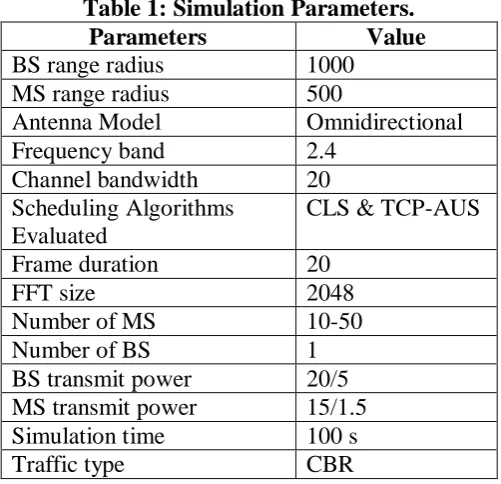
Table 1: Simulation Parameters.
Parameters Value
BS range radius 1000 MS range radius 500
Antenna Model Omnidirectional Frequency band 2.4
Channel bandwidth 20 Scheduling Algorithms
Evaluated
CLS & TCP-AUS
Frame duration 20 FFT size 2048 Number of MS 10-50 Number of BS 1 BS transmit power 20/5 MS transmit power 15/1.5 Simulation time 100 s Traffic type CBR
Throughput: It is usually measured in bits per second (kbps or mbps), and sometimes in data
packets per second or data packets per time slot. It also measures the amount of user demands that are addressed with the machine the throughput can be calculated using the following formula:
∑
∑
Figure 1. Throughput Vs. Number of MS.
Delay: The delay of a network specifies how long it takes for a bit of data to travel across the
P.SUDHA et al, International Journal of Computer Science and Mobile Applications, Vol.6 Issue. 3, March- 2018, pg. 64-72 ISSN: 2321-8363 Impact Factor: 5.515
The delay can be calculated using the following formula:
∑
∑
∑
Where, Delivery Time is the time packet from a frame was delivered, Arrival Time is the time packet arrived at destination and Received Packet is the number of packet successfully arrived in frame n between the start time tn, of frame n and the start time tn+1, of the next frame n+1.
Figure 2. Delay (ms) Vs. Number of MS.
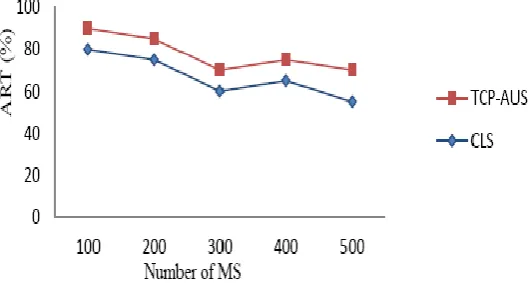
Application Response Time: This is the most important QoS parameter from the user’s
perspective. It is the time between the moments a request is sent by a user to the time that the response is provided to the user. Application Response Time can be calculated using the following formula:
Where, n is the number of concurrent users, r is the number requests per second the server receives and T think is the average think time (seconds).
P.SUDHA et al, International Journal of Computer Science and Mobile Applications, Vol.6 Issue. 3, March- 2018, pg. 64-72 ISSN: 2321-8363 Impact Factor: 5.515
V. CONCLUSION
WiMAX provides wireless transmission of data using a variety of transmission modes, from point-to-point links to portable and fully mobile internet access. The technology provides up to 10 Mbps broadband speed without the need for cables. The technology is based on the IEEE 802.16 standard (also called Broadband Wireless Access) that provided several services such as data, voice, and video services including different classes of Quality of Services (QoS), which in turn were defined by IEEE 802.16 standard. Scheduling in WiMAX became one of the most challenging issues, since it was responsible for distributing available resources of the network among all users. In this paper the performance analysis of Cross Layer Scheduling (CLS), and TCP-Aware Uplink Scheduling (TCP-AUS). Finally CLS algorithm provide better performance compare to TCP-AUS and also increasing throughput, reducing delay and ART with number of MS is increased.
REFERENCES
[1] R Pries, F Wamser, and D Staehle, K Heck, P Tran-Gia, “On traffic characteristics of a broadband wireless internet access”, Next Generation Internet Networks, Vol:1, Iss: 3, PP: 1–7, 2009.
[2] M Kihl, C Lagerstedt, A Aurelius, and P Odling, “Traffic analysis and characterization of internet user behavior”, in Proceedings of International Congress on Ultra-Modern Telecommunications and Control Systems and Workshops (ICUMT) (IEEE, Moscow, 18–20 October 2010), pp. 224–231.
[3] K Wongthavarawat, A Ganz, “Packet scheduling for QoS support in IEEE 802.16 broadband wireless access systems”, Int. J. Commun. Syst, 16(1), 81–96 (2003).
[4] T.C. Chen, J.C. Chen, and Y.Y. Chen, “Maximizing Unavailability Interval for Energy Saving in IEEE 802.16e Wireless MANs,” IEEE Transactions on Mobile Computing, vol. 8, no. 4, pp. 475–487, Apr. 2009.
[5] S.L. Tsao and Y.L. Chen, “Energy-efficient packet scheduling algorithms for real-time communications in a mobile WiMAX system,” Computer Communications, vol. 31, no. 10, pp. 2350–2359, June 2008. [6] H.L. Tseng, Y.P. Hsu, C.H. Hsu, P.H. Tseng, and K.T. Feng, “A Maximal Power-Conserving Scheduling
Algorithm for Broadband Wireless Networks,” in Proc. of IEEE WCNC, 2008, pp. 1877–1882.
[7] J. Shi, G. Fang, Y. Sun, J. Zhou, Z. Li, and E. Dutkiewicz, “Improving Mobile Station Energy Efficiency in IEEE 802.16e WMAN by Burst Scheduling,” in Proc. of IEEE GLOBECOM, 2006.
[8] S.C. Huang, R.H. Jan, and C. Chen, “Energy Efficient Scheduling with QoS Guarantee for IEEE 802.16e Broadband Wireless Access Networks,” in Proc. of the International conference on Wireless Communications and Mobile Computing (IWCMC), pp. 547–552, 2010.
[9] H. S. Kim and S. Yang, “Tiny MAP: an efficient MAP in IEEE 802.16/WiMAX broadband wireless access systems,” Computer Communications, vol. 30, no. 9, pp. 2122–2128, 2007.
[10] OPNET Modeler [Online].Available:http://www.opnet.com/products/modeler/home.html
[11] Yekanlu E. and Joshi A., “Performance Evaluation of an Uplink Scheduling Algorithm in WiMAX”, kinge Institute of Technology Sweden, 2009.
[12] Zarrar Yousaf, F., Daniel, K., and Wietfeld, C. “Analyzing the Throughput and QoS Performance of a WiMAX Link in an Urban Environment”, IN-TECH, pp. 307–320, 2009.
[13] Miray K, Burcu Y, Ibrahim K, Ezhan K. “A survey on scheduling in IEEE 802. 16 mesh mode”, IEEE Commun Surveys Tutorials, 12(2):05–221, Second Quarter, 2011.
[14] Sabri A. “Comparative study of scheduling algorithms in WiMAX”, Int J Sci Eng Res, 2(2):1–6, 2011. [15] Murrawat S, Ting-Zhi S, Iqbal M, Aziz T, Farooq U. “An overview of scheduling strategies for PMP mode
in IEEE 802.16”, Sci. Int. (Lahore), 24(3):307–15, 2012.
[16] Jain A, Verma AK. “Comparative study of scheduling algorithms for WiMAX”, In: Proceedings of the national conference on mobile and pervasive computing, 7–8 August 2008. Chennai, India. p. 10–13. [17] Chaari L, Saddoud A, Maaloul R, Kamoun L. “A comprehensive survey on WiMAX scheduling
P.SUDHA et al, International Journal of Computer Science and Mobile Applications, Vol.6 Issue. 3, March- 2018, pg. 64-72 ISSN: 2321-8363 Impact Factor: 5.515
[18] Etemad K, “Overview of mobile WiMAX technology and evolution”, IEEE Commun Magazine, 31–40, 2008.
[19] Cicconetti. “Performance evaluation of the IEEE 802.16 MAC for QoS support”, IEEE Trans Mobile Comput, 6(1):26–38, 2007.
[20] Sagar V, Das D. “Modified EDF algorithm and WiMAX architecture to ensure end to end delay in multihop network”, Proceedings of IEEE Region 10 Conference, Hyderabad, 19–21 November 2010. p. 1– 6.
[21] Sayenko A, Alanen O, Karhula J, Hamalainen T, “Ensuring the QoS requirements in 802.16 scheduling”, In: Proceedings of 9th ACM international symposium on modeling analysis simulation wireless mobile system. Terromolinos, Spain, 2006. p. 108–117.
[22] Xergias AS, Passas N, Marekos L. “Flexible resource allocation in IEEE 802.16 wireless metropolitan area networks”, In: Proceedings of 14th IEEE workshop on local and metropolitan area networks LANMAN 2005, Chnia, Greece, 18–21 September 2010.
[23] Rath HK, Bhorkar A, Sharma V, “An Opportunistic DRR (ODRR) uplink scheduling scheme for IEEE 802.16-based broadband wireless networks”, In: Proceedings of International Conference on Next Generation Networks (ICNGN), Mumbai, 9 February 2006.
[24] Loutfi, Belghith A, “Comparison of WiMAX scheduling algorithms and proposals for the rtps QoS class”, In: Proceedings of 14th European Wireless Conference, Prague, 22–25 June 2008. p. 1–6.
[25] Ball CF, Treml F, Gaube X, Klein A. “Performance analysis of temporary removal scheduling applied to mobile WiMAX Scenarios in tight frequency reuse”, Proceedings of 16th annual IEEE international symposium on personal indoor and mobile radio communications, PIMRC 2005, Berlin, vol 2, 11–14, September 2011. p. 888–894.
[26] Cherng JL, Chun LC, Liu CH. “Performance evaluation for scheduling algorithms in WiMAX network”, Proceedings of 22nd international conference on advanced information networking and applications, 2012. p. 68–74.