V. Vinodhini, International Journal of Computer Science and Mobile Applications, Vol.7 Issue. 4, April- 2019, pg. 1-8 ISSN: 2321-8363 Impact Factor: 5.515
AN ARTIFICIAL BEE COLONY
ALGORITHM FOR EFFICIENT
ROUTING IN MANET
V. Vinodhini
Assistant Professor, Department of Computer Science and Engineering, Sona College of Technology, Salem, India
Abstract
A mobile ad hoc network (MANET) is a kind of Wireless ad hoc network. The nature of Mobile Ad-Hoc Networks are mobile, wireless and battery powered. MANET is an infrastructure-less network of mobile devices that‟s connected without wires. Each mobile node can move to any other network at any time. So the topology of the MANET changes frequently. Currently, most of the MANET research is based on improving data routing. A MANET data communication must include set of evaluation parameters in terms of data overhead, increasing packet delivery ratio, reducing packet loss and improve throughput. In existing scheme Protected Reliable Routing (PRR) ensures security in all expected parameters. For better routing, Artificial Bee Colony (ABC) Algorithm is proposed in this paper.
Keywords: Mobile Ad-Hoc Network (MANET), Artificial Bee Colony (ABC) Algorithm, Routing Protocols, Protected Reliable Routing (PRR).
1. Introduction
Network is a group of computer devices, peripherals or any other devices that can be connected and communicate with each other. Basically networks are classified into two different types. They are wired networks and wireless networks. Compared to wired network, wireless networks are flexible to communicate from one device to another [13]. MANET is a type of wireless network.
MANET stands for “Mobile Ad-Hoc Network” [1]. A Mobile Ad-Hoc Network is a collection of mobile devices that communicate with each other without any wires (i.e., MANET is an infrastructure-less network of mobile devices that‟s connected without wires). All mobile devices communicate and transfer data within particular range (Base Station- BS) and without any centralized support (i.e., without any wires). All Mobile Ad-Hoc Networks are mobile, wireless and battery powered. In practical Mobile Ad-Hoc Networks are used whenever a temporary network is needed and no fixed infrastructure exists. With the help of wireless networks, the clients can retrieve data (information) and get services even when they travel from one place to another place.
2. CLASSIFICATION OF MOBILE AD-HOC NETWORK
Mobile Ad-Hoc Network is classified into two main types based on the distance of mobile nodes. They are Single hop and Multi hop.
V. Vinodhini, International Journal of Computer Science and Mobile Applications, Vol.7 Issue. 4, April- 2019, pg. 1-8 ISSN: 2321-8363 Impact Factor: 5.515
Figure 1: Single Hop
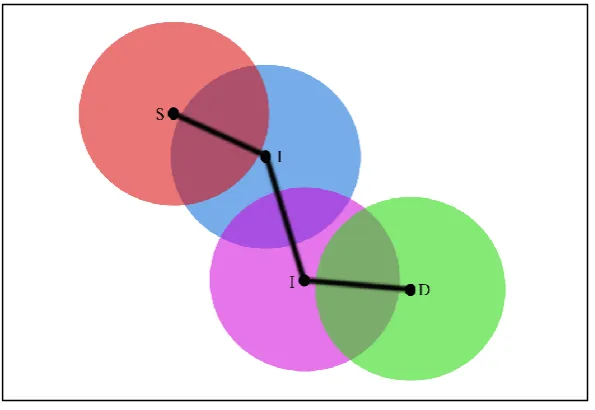
Multi hop: Communication between two nodes accomplished via any other nodes (intermediate nodes or forwarding nodes) is called multi hop. If the source and destination nodes are out of range then they can‟t communicated directly. So the source node sends data to intermediate nodes and finally the data is received to destination node. The figure 2 shows data transmission from Source (S) to Destination (D) using multi hop mobile ad-hoc network model. In this figure the Source (S) and Destination (D) nodes are not placed in the same Base Station. So the source and destination nodes are not directly in communication with each other. First the source node identifies the routes to reach destination nodes. Two intermediate nodes are available in this route. Finally data can be transferred from source to destination through these intermediate nodes. Here routing procedures are needed to find best routes [4] and hence the routing protocols play a major role in MANETs.
Figure 2: Multi Hop
V. Vinodhini, International Journal of Computer Science and Mobile Applications, Vol.7 Issue. 4, April- 2019, pg. 1-8 ISSN: 2321-8363 Impact Factor: 5.515
Figure 3: Topology change when node moves
3. ROUTING PROTOCOLS
A. Routing in MANETsEach mobile node communicates from source to destination through intermediate nodes. Finding the best and nearest path (i.e., route) from source to destination is called Routing. Routing is an important function for any network, whether it is for wired or wireless.
B. Problems with Routing
Data overhead
Packet loss due to transmission errors
Limited bandwidth
Frequent disconnections
Dynamically changing topologies (routes)
Limited battery power
C. Routing Protocols and its types
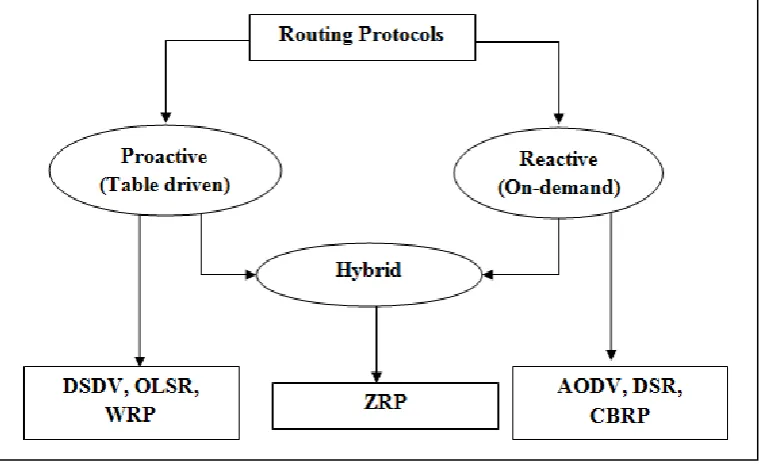
Routing protocol is used to find and maintain routes between nodes in a dynamic topology using minimum resources [2]. The goal of routing protocol is to find shortest path (routes), to reduce routing-related overhead and solve routing problems. In MANET, routing protocols are classified into three different categories [15] [12]. This is illustrated in figure 4.
V. Vinodhini, International Journal of Computer Science and Mobile Applications, Vol.7 Issue. 4, April- 2019, pg. 1-8 ISSN: 2321-8363 Impact Factor: 5.515
4. EXISTING WORK
The existing method uses bee‟s algorithm [14] to solve the issue with attacks expected during the node initialization as well as routing process. The existing bee routing protocol is used to prevent the network from attacks during the network formation, to pick optimized path from the source and the destination nodes which provides secure and fast data delivery during routing process.
Protected Reliable Routing (PRR) is a technique that comprises of two components, namely the node initialization component and the routing component. The node initialization component explains the steps for a new node to join the MANET and routing component defines the procedure to route the data in MANET using PRR scheme.
A. Node Initialization Component
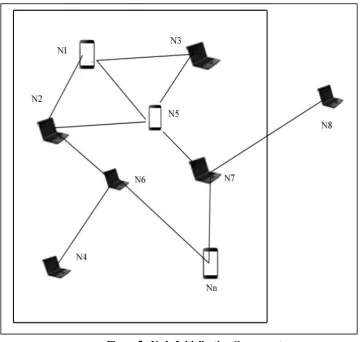
Figure 5: Node Initialization Component
If a new node Nn has to join in Mobile Ad-Hoc NETwork (MANET) with in its particular range (radio range) it first sends requests to all nearest nodes. On receiving the request from a new node, the host node (i.e., the node which is already presents of the MANET) checks whether the request is from authenticated node or not (a malicious node). This process is done by the validation of node id and the signature sent by new node. Once the request is validated the host node sends a reply to the newest node.
V. Vinodhini, International Journal of Computer Science and Mobile Applications, Vol.7 Issue. 4, April- 2019, pg. 1-8 ISSN: 2321-8363 Impact Factor: 5.515 response messages, it selects one IP based on first come first serve (FCFS) and rejects the rest of the IP offered to them. Newest node sends accept message to the host node of the chosen IP which is again authenticated as said before. On receiving accept message from new node the host node sends acknowledgment on account of which the new node is joined to the network. The node joins the network with the IP address provided earlier by the host.
B. Routing Component
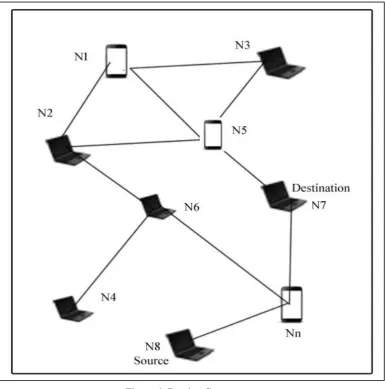
After finding the source node and the destination node, the bee routing technique is used to find the optimal path from source and destination nodes. Initially the objective values of nodes are set to be zero („0‟). Objective value increases by one on each successful data delivery. In forward phase, the data is transferred to destination device (node) via intermediate nodes if any. In backward phase, once the data is delivered successfully, the path details are shared to estimate the paths efficiency based on the objective value. The path with high objective value is finalized as the optimal path.
Figure 6: Routing Component
V. Vinodhini, International Journal of Computer Science and Mobile Applications, Vol.7 Issue. 4, April- 2019, pg. 1-8 ISSN: 2321-8363 Impact Factor: 5.515 optimal path between source node N8 and destination node N7. Once optimal path is found the path is analyzed with certain calculation based on the opinion of the neighboring nodes (intermediate nodes) and the data is transferred.
5. PROPOSED MODEL
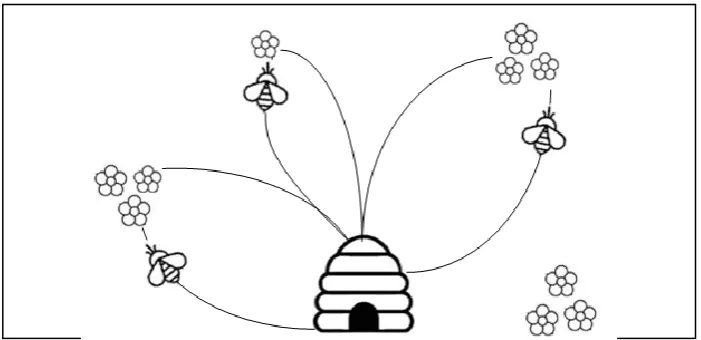
In this paper, the proposed technique Artificial Bee Colony (ABC) Algorithm [9] is used to find the best optimal path between source node and destination node in fastest way. Artificial Bee Colony (ABC) Algorithm is an optimization algorithm that is based on the intelligent behavior of the honey bee foraging activities [6]. The working is based on inspecting the behaviors of real bees on finding the nectar amounts and sharing the information of food sources to the other bees in the hive. These bees‟ tries to find maximum nectar amount stored in the hive. There are three types of agents in the Artificial Bee Colony (ABC) they are Employed Bee (or workers), Onlooker Bee (or foragers) and Scout Bee.
Figure 7: Behavior of bee colony in wildlife
A. The Employed Bee
The Employed Bees are also called workers bees. Employed Bees find the food sources and stores their quality. Each and every employed bee is linked with one food source. After finding food sources they collect it (nectar) and return to hive. After returning to hive they do a waggle dance. This waggle dance contains the details of food sources and its varying directions.
B. The Onlooker Bee
After worker bees dance in front of the hive, there are a set of bees called foragers bees (also called onlooker bees) watching this dance and choose one or more of the workers sources. The onlooker bees search the neighbors (intermediates) to find the better route for the food sources and return to hive [8] [10].
C. The Scout Bee
V. Vinodhini, International Journal of Computer Science and Mobile Applications, Vol.7 Issue. 4, April- 2019, pg. 1-8 ISSN: 2321-8363 Impact Factor: 5.515
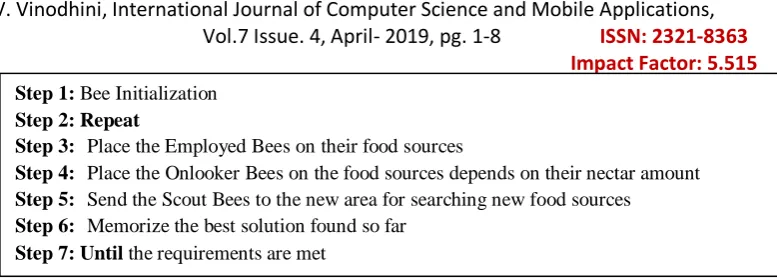
Figure 8 : The Artificial Bee Colony (ABC) algorithm steps
Figure 8 shows Artificial Bee Colony (ABC) algorithm steps. The Artificial Bee Colony (ABC) algorithm starts with bee initialization. This time all 3 types of bees are initialized. Then the employed bees find the destination node from source node in all directions through intermediate nodes. Next these bees get all the path details from source to destination nodes. Then the onlooker bees follows the employed bees and find best routing from source to destination through intermediate nodes using any one of the routing protocol explained in chapter 3. The scout bees send data to destination node which satisfies and improves all expected parameters. Finally the scout bees go to new area and find new nodes then the same process is repeated.
The existing work uses bee‟s algorithm [3] for finding best optimal path (route) and also provides improvement for all expected parameters. In proposed work uses Artificial Bee Colony (ABC) algorithm [7], that provides more improvement for all expected parameters rather than bee‟s algorithm. This algorithm uses three types of bees and all the works are maintained by these three bees. So the working process will be improved by these bees and also the throughput will be improved. So the Artificial Bee Colony (ABC) algorithm is much better than normal bee‟s algorithm.
6. Conclusion
In this paper, the Artificial Bee Colony (ABC) algorithm is proposed for improving routing in efficient way to find better route from source to destination node in Mobile Ad-Hoc Networks (MANETs). In existing work, the Protected Reliable Routing (PRR) is used for better routing and ensures security in all expected parameters in terms of data overhead, increasing packet delivery ratio, reducing packet loss and improve throughput. The Artificial Bee Colony (ABC) algorithm is much more better rather than Protected Reliable Routing (PRR) and its provide better security in all parameters like data overhead, increasing packet delivery ratio, reducing packet loss and improve throughput.
References
[1] D. P. Agarwal and Q-A Zeng,2003, Introduction to Wireless and Mobile Systems, Brooks / Cole Pulishing, ISBN No. 0534-40851-6,436 pages
[2] Azzedine Boukerche, Begumhan Turgut, Nevin Aydin, Mohammad Z. Ahmad, Ladislau Blni and Damla Turgut,2011, Routing protocols in ad hoc networks: A survey, Elsevier Journal of Computer Networks, Vol. 55, pp.3031 - 3080
[3] Baris yuce and Michael.S.packianather,2013,Honey bees inspired optimization method: The bees algorithm, Insects ISSN 2075-4450
[4] H. Deng, W. Li, and D. Agrawal,2002, Routing security in wireless ad hoc networks, Communications Magazine, IEEE, pp. 70-75
[5] Elizabeth M.Royer, and C.K.Toh,2003, A Review of current Routing Protocol for Ad-Hoc Mobile Wireless Networks
[6] D. Karaboga, 2010Artificial Bee Colony Algorithm, Scholarpedia, 5, 6915. Available online:http://www.scholarpedia.org/article/Artificial_bee_colony_algorithm/(accessed on 27 May 2011)
[7] D. Karaboga , B. Basturk ,2008,On the performance of artificial bee colony (ABC) algorithm, Applied Soft Computing 8, pp. 687-697
Step 1: Bee Initialization
Step 2:Repeat
Step 3: Place the Employed Bees on their food sources
Step 4: Place the Onlooker Bees on the food sources depends on their nectar amount
Step 5: Send the Scout Bees to the new area for searching new food sources
Step 6: Memorize the best solution found so far
V. Vinodhini, International Journal of Computer Science and Mobile Applications, Vol.7 Issue. 4, April- 2019, pg. 1-8 ISSN: 2321-8363 Impact Factor: 5.515
[8] Karl O. Jones, Andre Bouffet, 2008,Comparison of Bees Algorithm, Ant Colony Optimisation and Particle Swarm Optimisation for Pid Controller Tuning, International Conference on Computer Systems and Technologies - CompSysTech‟08
[9] D. Karaboga and Ozturk,2011,A novel clustering approach: Artificial Bee Colony (ABC) algorithm, Elsevier, Applied Soft Computing 11, pp. 652-657
[10]Li-Pei Wong, Malcolm Yoke Hean Low, Chin Soon Chong, 2008,A Bee Colony Optimization Algorithm for Traveling Salesman Problem, Second Asia International Conference on Modelling & Simulation, IEEE, pp. 818-823.
[11]Mobile ad hoc network, Retrieved from Wikipedia - https://en.wikipedia.org/wiki/Mobile_ad_hoc_network [12]C.E.Perkins, 2001, AdHoc Networking, Addison-Wesley Publication, Singapore
[13]S. Preethi, and B. Ramachandran, 2011, Energy Efficient Routing Protocols for Mobile AdHoc Networks, International Conference on Emerging Trends in Networks and Computer Communications (ETNCC), IEEE, pp. 136 - 141
[14]S. Ramesh, 2018, Protected reliable routing for MANET using Bees algorithm, Taga Journal, pp. 2241-2253 [15]S. Ramesh, R. Praveen, R. Indira, and P. Ganesh Kumar,2012, A survey on routing methodologies for
ICMANET, Proceedings of the fourth IEEE International Conference on Advanced Computing, Anna University, Chennai, pp. 1 – 6
Biography
Prof.V.Vinodhini – Currently working as Assistant Proffesor at Sona College of Technology in the Department of