The Journal of Public Space ISSN 2206-9658
2018 | Vol. 3 n. 2
https://www.journalpublicspace.org
ISSN 2206-9658 | City Space Architecture / UN-Habitat
EDITORIAL TEAM
Editor in Chief
Luisa Bravo, City Space Architecture, Italy
Scientific Board
Davisi Boontharm, Meiji University, Japan
Simone Brott, Queensland University of Technology, Australia Julie-Anne Carroll, Queensland University of Technology, Australia
Margaret Crawford, University of California Berkeley, United States of America Philip Crowther, Queensland University of Technology, Australia
Simone Garagnani, University of Bologna, Italy
Pietro Garau, University of Rome “La Sapienza”, Italy Carl Grodach, Monash University, Australia
Chye Kiang Heng, National University of Singapore, Singapore Miquel Marti, Universitat Politècnica de Catalunya, Spain Maggie McCormick, RMIT University, Australia
Darko Radovic, Keio University, Japan
Estanislau Roca, Universitat Politècnica de Catalunya, Spain Joaquin Sabate, Universitat Politècnica de Catalunya, Spain Robert Saliba, American University of Beirut, Lebanon Claudio Sgarbi, Carleton University, Canada
Hendrik Tieben, Chinese University of Hong Kong, Hong Kong
Strategic Advisory Board
Cecilia Andersson, UN-Habitat Global Public Space Programme, Kenya Tigran Haas, KTH Royal Institute of Technology, Sweden
Micheal Mehaffy, KTH Royal Institute of Technology, Sweden Laura Petrella, UN-Habitat Global Public Space Programme, Kenya
Advisory Board for Research into Action
Ethan Kent, Project for Public Spaces, United States of America Gregor Mews, Urban Synergies Group, Australia
Luis Alfonso Saltos Espinoza, LASE+CityUrb, Ecuador
Journal Manager
Luisa Bravo, City Space Architecture, Italy
The Journal of Public Space | 2018, Vol. 3 n. 2 | Editorial Team and Policies
Correspondents and Peer Reviewers
Roberto Andrés, Universidade Federal de Minas Gerais, Brazil
Michael Barke, University of Northumbria at Newcastle, United Kingdom Gem Barton, Brighton University, United Kingdom
Simon Bell, Estonian University of Life Sciences, Estonia Christopher Brisbin, University of South Australia, Australia Liz Brogden, Queensland University of Technology, Australia Martin Bryant, University of Technology Sydney, Australia
Glenda Caldwell, Queensland University of Technology, Australia Philippa Carnemolla, University of Technology Sydney, Australia Dave Colangelo, Portland State University, United States of America Debra Cushing, Queensland University of Technology, Australia Pak Damrongsak, Thammasat University, Thailand
Camilo Vladimir de Lima Amaral, Universidade Federal de Goias, Brazil Raul Dias De Carvalho, Queensland University of Technology, Australia
Thomas Fowler, California Polytechnic State University, United States of America Emilio Garcia, University of Auckland, New Zealand
Pedro Ressano Garcia, Universidade Lusófona, Portugal
Morten Gjerde, Victoria University of Wellington, New Zealand Maria Goula, Cornell University, United States of America Adrian Gras-Velazquez, Swarthmore College, United States Kai Gu, University of Auckland, New Zealand
Daniel O'Hare, Bond University, Australia
Phil Heywood, Queensland University of Technology, Australia Konstantinos Ioannidis, Aristotle University of Thessaloniki, Greece Marjut Kirjakka, Aalto University, Finland
Anoma Kumarasuriyar, Queensland University of Technology, Australia Matthew D. Lamb, Pennsylvania State University, United States of America Yoav Lerman, Tel Aviv University, Israel
The Journal of Public Space | 2018, Vol. 3 n. 2 | Editorial Team and Policies
ISSN 2206-9658 | City Space Architecture / UN-Habitat | III Galyna MacLellan, Queensland University of Technology, Australia
Marisha McAuliffe, Queensland University of Technology, Australia Ari Mattes, University of Notre Dame, Australia
Linda Matthews, University of Technology Sydney, Australia John Mongard, The Designbank, Australia
Milica Muminović, University of Canberra, Australia
Nga Nguyen, Vietnam National University Ho Chi Minh City, Vietnam Vitor Oliveira, University of Porto, Portugal
Kaan Ozgun, University of Queensland, Australia Leonardo Parra, Universidad de Los Andes, Colombia
Mark Pennings, Queensland University of Technology, Australia Gavin Perin, University of Technology Sydney, Australia
Helena Piha, Queensland University of Technology, Australia Dorina Pojani, University of Queensland, Australia
Lakshmi Priya Rajendran, Anglia Ruskin University, United Kingdom Renato Rego, Universidade Estadual de Maringá - UEM, Brazil Yodan Rofe, Ben-Gurion University of the Negev, Israel Paul Sanders, Queensland University of Technology, Australia Leigh Shutter, Griffith University, Australia
Massimo Santanicchia, Iceland Academy of the Arts, Iceland Thomas Sigler, University of Queensland, Australia
Claudia Justino Taborda, Queensland University of Technology, Australia Mark Taylor, University of Newcastle, Australia
Goran Vodicka, University of Sheffield, United Kingdom
Bing Wang, Beijing University of Civil Engineering and Architecture, China Margaret Ward, Griffith University, Australia
Katharine Willis, Plymouth University, United Kingdom Zhen Xu, Nanjing Forestry University, China
Yannis Zavoleas, University of Newcastle, Australia
The Journal of Public Space | 2018, Vol. 3 n. 2 | Editorial Team and Policies
FOCUS AND SCOPE
The Journal of Public Space is the first, international, interdisciplinary, academic, open access journal entirely dedicated to public space.
Established on a well-consolidated global network of scholars and professionals, The Journal of Public Space is committed to expand current scholarship by offering a global perspective and providing the opportunity for unheard countries to speak up and to discuss neglected as well as emerging topics that are usually sidelined in mainstream knowledge.
The Journal of Public Space is addressing social sciences and humanities as a major field, and is interested also in attracting scholars from several disciplines. It will perform as a scholarly journal but also as an interdisciplinary platform of discussion and exchange by scholars, professionals, organizations, artists, activists and citizens, whose activities are related to public space.
The Journal of Public Space will be enriched by hosting papers on design projects, art performances and social practices, fostering civic engagement and non-expert knowledge.
TOPICS
Authors are welcome to submit original research articles dealing with themes relating to the vision of the journal, which may include, but are not confined to:
SPACE SOCIETY SYSTEMS
Architecture Urban Planning Urban Design Urban Morphology Urban Resilience Landscape architecture Interior design
Interactive and visual design Art City transformation Infrastructure Environment Ecology Climate change Gender Human scale People Everyday life Social engagement Health and safety Perception and senses Human rights Social justice Education Heritage History Culture Geography Anthropology Ethnography Community empowerment Migrations Conflicts Inclusion/Exclusion Informality
Sub and fringe cultures
Economy Political power Governance
The Journal of Public Space | 2018, Vol. 3 n. 2 | Editorial Team and Policies
ISSN 2206-9658 | City Space Architecture / UN-Habitat | V
POLICIES
Peer Review Process
A double blind peer review process, based on a distinguished board of editors and
editorial advisors, ensures the quality and high standards of research papers. Each paper is assessed by two reviewers and any identifying information in relation to the author is removed during the review process. Reviewers follow an evaluation framework and recommendation guidelines to ensure objectivity and fairness.
Submitted articles should not have been previously published. If publication or
dissemination through presentation has occurred, then the article should acknowledge this and pay due credit to the original source.
Publication Ethics Statement
The Journal of Public Space aligns itself with the Committee on Publication Ethics (COPE) best practice guidelines for dealing with ethical issues in journal publishing.
http://publicationethics.org/
Open Access Policy
The Journal of Public Space is licensed under a Creative Commons Attribution- NonCommercial 4.0 International License. It provides immediate open access to its content on the principle that making research freely available to the public supports a greater global exchange of knowledge.
https://creativecommons.org/licenses/by-nc/4.0/
CONTACT
PublisherCity Space Architecture non-profit cultural association
Via Paolo Giovanni Martini 26/d 40134 Bologna, ITALY
[email protected] www.cityspacearchitecture.org
Partner
UN Habitat - United Nations Human Settlements Program Nairobi, KENYA
www.unhabitat.org
The Journal of Public Space | 2018, Vol. 3 n. 2 | Editorial Team and Policies
Call for papers | 2019 issues
The Journal of Public Space welcomes full papers for 2019 issues, to be published in April, August and December.
Deadline for April issue: January 10, 2019 Deadline for August issue: May 10, 2019
Deadline for December issue: September 10, 2019
Submissions will be ongoing throughout the year. Submission can be made:
- using the OJS platform by registering online. If you are already a registered author you can log in using your username and password;
- by sending an email to the Editor in Chief Luisa Bravo at this email address: [email protected].
Before submitting, please read: - the Focus and Scope of the journal - the Author Guide Lines
Full papers should be between 5.000 and 8.000 words.
The Journal of Public Space ISSN 2206-9658
2018 | Vol. 3 n. 2
https://www.journalpublicspace.org
ISSN 2206-9658 | City Space Architecture / UN-Habitat
Art and Activism
in Public Space
Editor
Luisa Bravo
Guest Editor
Maggie McCormick
Vol. 3 n. 2 | 2018
IN COLLABORATION WITH
BOA MISTURA PLASTIQUE FANTASTIQUE
inCOMMONS + limeSHIFT ANGÉLICA DASS
RICHARD BRIGGS FIONA HILLARY
PLANNING INSTITUTE OF AUSTRALIA
CITY SPACE ARCHITECTURE
The Journal of Public Space | 2018, Vol. 3 n. 2 | Table of Contents
“
A good collaboration produces universal thinking
Robert Rauschenberg
Cover picture:a Boa Mistura, NIERIKA, Guadalajara, Mexico, 2017.
The Journal of Public Space | 2018, Vol. 3 n. 2 | Table of Contents
ISSN 2206-9658 | City Space Architecture / UN-Habitat | VII
TABLE OF CONTENTS
EDITORIAL
Public Urban Happiness, that is the making of our own world
Luisa Bravo 1-4
The Public Voice
Maggie McCormick 5-12
ART AND ACTIVISM Art as a tool for change
Javier Serrano Guerra, Juan Jaume Fernández, Pablo Ferreiro Mederos, Pablo Purón Carrillo
BOA MISTURA
13-40
Soft, Sexy, Fantastic. Inflating public space Daniel Felgendreher
PLASTIQUE FANTASTIQUE
41-74
Investing in Spaces: Luxury, Benevolence or Business?
Nabila Alibhai, Yazmany Arboleda, Elizabeth Thys, Tammy Wilks inCOMMONS + limeSHIFT
The Journal of Public Space | 2018, Vol. 3 n. 2 | Table of Contents
From sidewalk ballet to defending the city Maria del Carmen Mota Utanda
HUMANÆ
97-114
Using drawing as a tool to explore public space Richard Briggs
115-148
A situated practice Fiona Hillary
149-166
VIEWPOINT
Canberra’s first ever Parklet Natalia Weglarz
PLANNING INSTITUTE OF AUSTRALIA
167-172
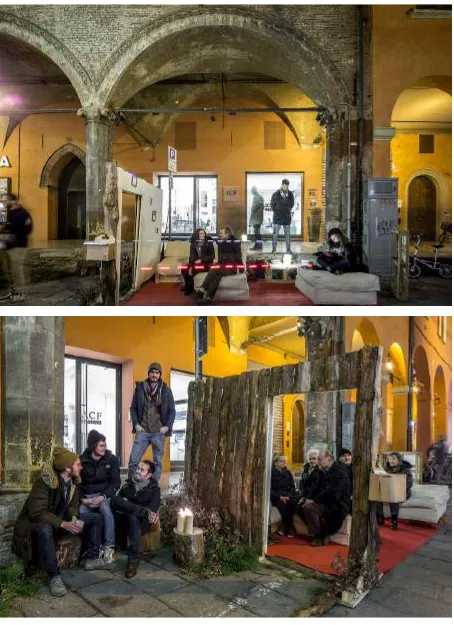
The urban lounge and a green view. A temporary art installation
in Bologna during the Art City White Night 173-178
Luisa Bravo
The Journal of Public Space ISSN 2206-9658
2018 | Vol. 3 n. 2
https://www.journalpublicspace.org
ISSN 2206-9658 | 1 City Space Architecture / UN-Habitat
EDITORIAL
Public Urban Happiness, that is the making
of our own world
Luisa Bravo
City Space Architecture, Italy
The ideal city stands as one of the most fascinating enigmas of the Italian Renaissance. A famous painting by the same name, consisting of a space nearly empty of human activity, which displays a mastery of perspective, is the result of research and speculation in many fields, from architecture and engineering to philosophy and mathematics. The concept
dates at least from the period of Plato: in The Republic, the ideal city, or polis, is based on
justice and human virtue, it is a form of social and political organization that allow individuals to maximize their potentialities, living in accordance with universal laws and truths. In this model, public spaces perform as places for collective coexistence, standing as a physical stage for social justice, democracy and citizenship, a sort of mirror of the living society and its values and virtues.
For centuries the urban environment has been painted, designed, shaped and built in order to answer to specific needs and desires. Visions and drawings of ideal and perfect places still today behave as appealing images, offered to the public domain. During the last
century, well-known icons, made of visionary and seducing scenarios, designed by
avan-garde architects, acted as a vehicle able to symbolize the pursuit of public happiness: working on an urban imaginary, as a body of knowledge, efforts of architects and town planners were oriented to create a new world, based on ideals of progress and prosperity, with streets, squares, architectural complexes and housing estates for our everyday lives, for a wide satisfaction and consumption of urban users. In these visions, the city is not merely a geographical episode, it is actually a model of morality, it is a collective entity pictured as a real holistic subject, an organism endowed with an identity and will of its own, with a superior order in comparison to every single member. Especially in the European culture, the beauty of the city reflects the primary social
purpose which is the making of urbs, intended as the appropriate habitat for the civitas,
open, dynamic, democratic and egalitarian (Romano, 1993).
Far from utopias, the real world hasn’t developed the ability to grant all wishes, often revealing itself unable to find a way to connect innermost emotions of collective expectations to the outward manifestation in the urban realm. Even in their
imperfections, cities expanded beyond what anyone could have imagined, sprawling along territories, scattering over the known borders (Bravo, 2010).
Public Urban Happiness
In our contemporary times, the image of the ideal city is undefinable: the economic and financial crisis, new forms of urban and religious conflicts, problems of social cohesion, conditions of discrimination and insecurity, the massive immigration, the rise of poverty in the middle class and the large protests in many public spaces around the world have produced urban scenarios based on contradictory, unpredictable and uncertain circumstances. Today the city is mostly a place of conflicts and contraddictions where bold activists are standing up against the consolidated power, spreading awareness and shaping new ideals and values: they defend political issues, human and democratic rights, struggle to preserve the uniqueness of specific places, push governments on urgent questions. Their aspirations, as open-minded citizens, can be seen as a right for freedom of expression and search for self-empowerment. The right to the city is far more than the individual liberty to access urban resources: it is a common right to change ourselves by changing the city.
«The freedom to make and remake our cities and ourselves is one of the most precious yet most neglected of our human rights»
David Harvey, 2008: 23
Likewise, artists are more and more exploring the public domain, searching for stories of people and places, shaping a new human-centred knowledge: they play with the individual urban imaginary, searching for interaction, exchange and emotional engagement, so that from a single statement they can shape a collective belief. Therefore, public happiness is no longer a static concept related to the built environment, it is more a dynamic, vibrant and ephemeral condition that permeates urban daily life.
Daniel Kahneman, the Noble Prize for Economics (2002) has established an interesting and emerging field of research called ‘science of happiness’. Working on evolving concepts, such as ‘subjective well-being’, ‘life satisfaction’ and ‘quality of life’, learning by the pioneering political experience (started in 1971) of the small State of Bhutan - based on equitable social development, cultural preservation, conservation of the environment and promotion of good governance - and adopting the goal of Gross National Happiness over Gross National Product, the science of happiness, mainly related to sociology, psychology and anthropology, is starting to influence researchers involved in the urban
field of study1. By applying it to urban daily life and then retrofitting our cities to
happiness, we can tackle the urban challenges of our age (Montgomery, 2013).
The first World Happiness Report, published in 2012, was commissioned for a United Nations Conference on Happiness, under the auspices of the UN General Assembly, with the imprimatur of Columbia University’s Earth Institute and the editing of the institute’s
1 As a part of a research activity, in 2012 I myself promoted a survey intended to understand how people
live in the urban context, in terms of housing, working and leisure, how they experience, every day, space and distance in the city where they live, how they create relationships with other people living in the same neighbourhood or in the same city. Also, the survey is intended as a tool, able to show if issues expected from urban and town planning design were succeeded, through evaluation and comments derived by common people. Well-designed neighbourhoods and efficient cities, in terms of walkability, public transportation, long-distance connections, urban spaces, public facilities, mixed-use density, should make people happy. The assumption is that happiness of urban communities, together with best-planned settlements for urban daily life, should be the main goal of the urban planner and designer
Luisa Bravo
The Journal of Public Space, 3(2), 2018 | ISSN 2206-9658 | 3 City Space Architecture / UN-Habitat
director, Jeffrey Sachs, with two happiness experts, Richard Layard of the London School of Economics and John Helliwell of the University of British Columbia. The General Assembly of the United Nations in its resolution 66/281 (2012) has recognized the relevance of happiness and well-being as universal goals and aspirations in the lives of human beings around the world and the importance of their recognition in public policy objectives. Speaking at the High Level Meeting on “Happiness and Well-Being: Defining a New Economic Paradigm”, during the sixty-sixth session of the General Assembly (2011) the Secretary Ban Ki-moon stated that the world “needs a new economic paradigm that recognizes the parity between the three pillars of sustainable development. Social, economic and environmental well-being are indivisible. Together they define gross global
happiness.”2
In this issue ‘Art and Activism in Public Space’, Vol. 3, n. 2, of The Journal of Public Space we are starting a dialogue with artists and activists that are changing the way we understand and experience the built environment, through creative and inspiring works. This issue is intended to be the first of a series, aimed at opening to a different urban dimension, addressing dreams and public happiness, exploring the invisible, the intangible and the ephemeral in the public domain, that comes after an art performace or a collaborative DIY urbanism and that is able to built a new urban consciousness.
I invited several artists and art collectives, Boa Mistura from Spain, Plastique Fantastique from Germany, inCOMMONS from Kenya and limeSHIFT from USA, Angélica Dass from Brasil, Richard Briggs and Fiona Hillary from Australia. I then invited Maggie McCormick, former Head of the Master of Arts (Art in Public Space) at RMIT University in Australia, to co-curate this issue. By reviewing artists’ work, by reading their approaches and statements, I was able to expand my understanding and to open to a world made of passionate devotion and powerful commitment, while the theoretical exchange with Maggie McCormick set the research context.
This issue marks also a new direction of The Journal of Public Space: City Space Architecture is the new publisher since the journal has recently moved from Australia to Italy. As we conclude our collaboration with the Queensland University of Technology, that supported the establishment of the journal in 2015, we are opening to new contents: we are interested to enrich the discussion around public space, engaging multiple voices and expertise, searching for transdisciplinary innovation. The journal will continue to publish peer reviewed articles and academic research, but will also open to different opportunities to understand and redefine theories and concepts, with practicioners, artists, activists and open-minded citizens, especially from the global South, as this is our mission and one of the pillars at the basis of our collaboration with UN-Habitat, the United Nations Human Settlements Programme.
With this issue I’m officially taking the role of Editor in Chief of The Journal of Public Space, I feel proud and honoured to lead this ambitious endeavour and grateful for the interest and the attention that the journal is attracting. The journey has just begun.
2 The General Assembly of the United Nations in its resolution 66/281 of 12 July 2012 proclaimed 20 March
Public Urban Happiness
References
Bravo, L. (2010), Genius loci and genius saeculi: a sustainable way to understand contemporary urban dynamics, 14th International Planning History Society (IPHS) conference proceedings, Urban
Transformation: controversies, contrasts and challenges, ITU - Urban and Environmental Planning and Research Center, Istanbul, Vol. II, pp. 543-554.
Harvey, D. (2008), The right to the city, in New Left Review, vol. 53, Sept-Oct, pp. 23-40.
Montgomery, C. (2013), Happy city. Transforming our lives through urban design, Ferrar, Straud and Giroux, New York.
Romano, M. (1993), L’estetica della città europea, Einaudi, Torino.
To cite this article:
Bravo, L. (2018). Public Urban Happiness, that is the making of our own world. The Journal of Public Space, 3(2), 1-4, DOI 10.32891/jps.v3i2.1116
This article has been accepted for publication in The Journal of Public Space. Please see the Editorial Policies under the ‘About’ section of the journal website for further information.
The Journal of Public Space ISSN 2206-9658
2018 | Vol. 3 n. 2
https://www.journalpublicspace.org
ISSN 2206-9658 | 5 City Space Architecture / UN-Habitat
EDITORIAL
The Public Voice
Maggie McCormick
Adjunct Professor, RMIT University, Australia Professor, Reutlingen University, Germany [email protected]
Abstract
The Public Voice discusses art and activism in public space through the lens of how art practice is re-territoralising public space. The article begins with a consideration of both commissioned and uncommissioned works that challenge male dominance of public space while retaining a traditional relationship between the artist, art and the public. Through a discussion of ‘relational’ public practices from Relational Aesthetic to Community Art to Social Engagement, the article argues that the kind of ‘relational’ art and activism
undertaken by the collectives, teams and individuals featured in this issue of The Journal of Public Space is linked by spatial practice as a conduit for social change. By framing their practice through a discussion around her own spatial public practice over time, the author emphasises the impact of urbanisation and digitalisation on the changing nature of public space and the public and how the public voice can be mapped through art and activism.
Keywords: public space voice, art, activism, urban, spatial, relational, mapping
TH E JO U R N A L OF PU B L IC SP A C E
To cite this article:
McCormick, M. (2018). The Public Voice. The Journal of Public Space, 3(2), 5-12, DOI 10.32891/jps.v3i2.1107
This article has been accepted for publication in The Journal of Public Space. Please see the Editorial Policies under the ‘About’ section of the journal website for further information.
The Public Voice
Activism and Public Space
Activism can take many forms in public space from large scale public rallies to the individual on their soap box. Activism can be loud or quiet, bombastic or subtle. What links them all as activism is that the action sits outside of the routine of everyday public life. The action aims to disrupt the culture and patterns of public space and reveal it as a space where society’s diversities converge, sometimes through the traces left as people negotiate their individual pathways through the space and sometimes through momentary mutual engagement through quick glances and snippets of conversation with a stranger. Art has the capacity to activate interventions in the public domain that interrupt this everyday social rhythm of the space, to create rhythms that question perceptions embedded in that space, and claim it for the society of people who are the public space itself. Art activism creates moments that foster a new voice for public space.
This issue of The Journal of Public Space: Art and Activism in Public Space focuses on the voice of public space activated through the art practice of six collectives, teams and individuals working across a multiplicity of worldwide public spaces – Boa Mistura, Plastique Fantastique, inCOMMONS + limeSHIFT, Angélica Dass, Richard Briggs and Fiona Hillary. Together they form a snap shot of the bigger universal picture of the changing relationship between art practice, public space and the people within that space through a form of activism advocating that ‘public space in cities is a common good, meant to be open, inclusive and democratic – a right for everybody’ as advocated by Luisa Bravo in her public lecture Stand Up for Public Space.1 While global in their interventions and
outcomes symptomatic of our time, each activation responds to the specificity of the space they are engaging with, while re-territoralising and re-conceptualising public space, its culture and art activism more generally.
Public Space and Art Practice
Traditionally public space has been seen as the city square or park land with its relationship to art through permanent monumental sculptures that recorded limited histories and through that process, claimed the space itself for a particular section of society. Today the nature of such art practice within public space is challenged as are the histories and ideologies, perceptions of people and place, traditionally embedded in these works. For example, this has resulted in public debates around the issue of retaining or removing traditional public sculptures that are now viewed as not representative of public views. A clear example of changing attitudes in the midst of such debates is the Fourth Plinth in Trafalgar Square in London UK.2 Three of the plinths hold statues of a male British general, a male army officer and a male royal. The fourth was also destined to hold a male royal but was held over due to lack of funds. A lucky misfortune. The fourth plinth on the square remained empty until around 1998 when a series of three commissioned works occupied the space. It was with the fourth temporary work Alison Lapper Pregnant
2005, a marble torso-bust by Mark Quinn, that the real challenge was made.3 While
1 Luisa Bravo. Stand Up for Public Space, 2017. https://unhabitat.org/stand-up-for-public-space-luisa-bravo/ 2Fourth Plinth, London UK. https://www.london.gov.uk/what-we-do/fourth-plinth-past-commissions &
https://www.bbc.com/news/uk-england-london-43565870
Maggie McCormick
The Journal of Public Space, 3(2), 2018 | ISSN 2206-9658 | 7 City Space Architecture / UN-Habitat monumental in scale like the other three traditional sculptures, this work was of a person who was female, pregnant and born with no arms and shortened legs. Many other works have followed occupying the Fourth Plinth as a challenge to the historical symbolism of the public space of Trafalgar Square itself. A more detailed discussion around the public place that is Trafalgar Square can be read in Shanti Sumartojo’s The Fourth Plinth: creating and contesting identity in Trafalgar Square, 2005-2010.4
While the Fourth Plinth example fall within officially accepted and commissioned challenges to the status quo, reflective of changing times and attitudes, other public activations are sometimes anonymous, unsanctioned and even illegal. One example of both
commissioned and uncommissioned street works, symptomatic of the growing presence of strong female imagery in the public domain, are the paper paste ups of a Melbourne based street artist, Baby Guerrilla.5 Large scale black and white paste ups defy gravity and the assumptions of the space as they fly across that space and appear unexpectedly overnight on Melbourne’s streets and laneways. Amongst others, Vexta and Swoon are two other women artists working in the public space of streets and lanes. Together they pose a re-territoralising of public space, as did Alison Lapper Pregnant in Trafalgar Square as a reclaiming voice that challenges white male dominance of these public spaces. Swoon sums this up by asking, ‘Have we approached a tipping point in society, where, informed by the input of creative women, we begin to rewrite social narratives for the better?’ in Roland Henry’s Meet the Women Redefining Street Art.6
These examples taken from city squares and streets can be seen as disruptions to the accepted culture of specific public spaces and as such, a form of activism through art practice. While the outcomes create arrhythms in the social pattern of the space, the practice conforms to traditional modes of art making, in thatpeople within the public space are seen as the audience, as observers. Many artists working in the public domain challenge this role of the public as observer. This is clearly evident in the public practice of all the artists included in this issue of The Journal of Public Space. Whether they work as individuals, teams, collectives or community facilitators, forms of ‘relational’ practice link their intent and art process. While their outcomes may vary, in one way or another they aim to engage the public beyond the role of audience so that the public and the space become an integral part of the art intervention itself, of the voice.
Relational Art Practice and Activism
Many people in the art world are familiar with the term ‘relational aesthetics’ coined by Nicolas Bourriaud in the 1990s to describe the tendency to make art based on, or inspired by, human relations and their social context.7 The role of the artist is proposed as a conduit between the audience and the event to create a social experience within a constructed environment. The event itself, what takes place between the participants, is
4 Shanti Sumartojo. The Fourth Plinth: creating and contesting identity in Trafalgar Square, 2005-2010. Sage Journals. 2012. http://journals.sagepub.com/doi/abs/10.1177/1474474012448304
5 Baby Guerrilla, http://babyguerrilla.com/ &
https://blog.whodhavethought.com/2014/05/28/interview-baby-guerilla
6 Roland Henry. Meet the Women Redefining Street Art, The Guardian Australia, 8 January 2015.
The Public Voice
seen as the work of art. Bourriaud’s prime example is the Argentinian born Thai artist Rikrit Tiravanija who in one of his exhibitions cooked Thai food for visitors to the gallery to create an environment in which social exchange took place. The exchange is the art. While Bourriaud’s ‘relational aesthetics’ was substantially referring to such changing practice within the gallery and institutional system, many artists working in the public domain had been working in a ‘relational’ way for some time, albeit labelled in different ways and often with different intentions. The Community Arts movement can be seen as a forerunner of the relational concept. Here a more traditional art outcome was usual, such as a mural or theatre piece, but the process and interaction between the artist and the public was viewed as equal in value. Early community led public art projects grew out of the idea of art as a democratic right that was very much grounded in a
re-territoralising of both art practice and public space. The UK, USA and Australian examples were in this mode. During the 1960s, 1970s and into the 1980s many artists worked collaboratively within a participatory practice model within which art was made by the people themselves. In Melbourne the Community Arts Network embraced this mode of practice that I was a part of, working collaboratively on such large-scale projects as the
Curtain Square Playground 1988. Symptomatic of its time the project engaged hundreds of local people in making and installing ceramic tiles that recorded their diverse connections to the Carlton neighbourhood and the creation of the character of its public domain. In this case the public space of the playground became a voice of the people. Other
Community Arts Network public projects for example engaged poster art as part of political protest, again as a voice of the people. At the time, these examples were a form of radical activism through participatory democracy that rejected earlier efforts to ‘take art to the people’ though the model of educating the general public to appreciate the arts within art establishments. Owen Kelly’smanifesto Community, art and the state: Storming the citadels
19848 was symptomatic of this thinking about the role of art practice, public space, the people and the social and political framework of the times.
While still used as a definition of some practice, the term Community Art has lost its radical edge, its power and meaning in many places over time and we more often now refer to Social Engagement. The practice is diverse in its processes and outcomes and crosses over with concepts of community cultural development, placemaking,
participatory art and social practice reflecting back to the social sculpture of Joseph Beuys. While socially engaged art practice defies a straight forward definition, a recent USA report, Mapping the Landscape of Socially Engaged Practice 2017 sets out some definitions.9 Included are ‘belief in the agency and responsibility of art and artists’ and ‘artists working in collaboration’. While the report is somewhat America centric, these definitions do apply to the action of the artists included in this issue of The Journal of Public Space. Artists, architects, engineers, musicians, photographers, dancers, designers and the public are drawn together, as Boa Mistura say in this issue, with a common sense of ‘responsibility with the city and the time we are in’. While the quote by William S.
Burroughs at the start of the report may be debatable that ‘Artists are the real architects
8 Owen Kelly. Community, art and the state: Storming the citadels. Comedia, UK.1984.
99 Alexis Frasz & Holly Sidford. Helicon Collaborative. Mapping the Landscape of Socially Engaged Practice. 2017.
Maggie McCormick
The Journal of Public Space, 3(2), 2018 | ISSN 2206-9658 | 9 City Space Architecture / UN-Habitat of change, not the political legislators who implement change after the fact’, creative activators within public space certainly play a pro-active part. While the report discusses how every major social movement throughout time has integrated art and activism, what is missing is consideration of the role of the space itself as a key component of art as activism in today’s context.
Spatial = Social Practice
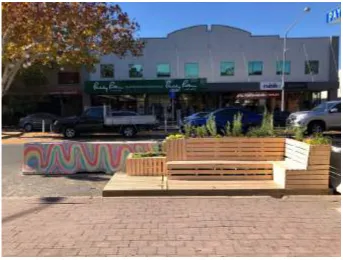
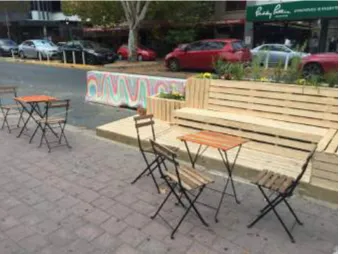
What defines all included in Art and Activism in Public Space beyond most public practice loosely defined as Socially Engaged, is their direct ‘relational’ action with the public space itself, its building, objects and atmosphere, as a conduit to social inclusion and change. This includes not only the practice of the collectives, teams and individuals featured in this issue but also to the projects the viewpoint - Canberra’s first ever parklet by Natalia
Weglarz and The urban lounge and a green view by Luisa Bravo. Both discuss the social impact of spatial interventions that re-interpret the parking space within the city environment.
All aim to reveal the public voice of the space in order to reveal its social voice. Each in their own way is engaged in spatial transformation, most often ephemeral, as an integral part of their social practice. Through this spatial practice each aims to foster shift and change through dialogue and challenge current social paradigms and in the process create a re-territorialisation of public space. This may well be reflective of their own diverse backgrounds, so that a multiplicity of arts, architecture and design inform each other to create a particular kind of urban practice responsive to the city itself. Cities have become central to our understanding of public culture and through this, an understanding of ourselves.
In this issue on Art and Activism in Public Space Boa Mistura redefine the power of the materials of art making and talk of promoting ‘change through colour’ though the paint’s direct ‘dialogue with the place’ and how ‘a layer of paint of barely a few millimetres thick can change the perception that a whole neighbourhood has of a place’. Richard Briggs also uses the material of art making to transform the space though, in his case, drawing
materials. Through immersing himself in the cityscape and observing the people, buildings and objects that occupy that space his ‘urban sketching’ records multiple perceptions of a space. As he says, ‘This approach to documenting the city can then be used to canvas a wider discussion on our built environment’ and by default a rethinking of the possibilities of our shared public space. Like Richard Briggs, Plastique Fantastique address the built environment of public space. They use a sense of play to create a new surprising interface between the built environment of the space and its public. Through the introduction of ephemeral soft inflatable architecture into public space the space itself is challenged by what they call ‘bewildering activities’ of the new architectural interventions ‘squeezing between buildings, squashing under bridges, entwining around lampposts or trees.’
The Public Voice
through diverse colours across the portraits. The process reveals and asserts layered histories and cultures within the public domain through using the camera as a catalyst for a flow of dialogues in the space of streets. In the process people bring the space alive.
Public Space Culture and Urban Practice
Combined together, the voice of the public spaces these collectives, teams and individuals work in supports an important field of urban thinking that re-shapes public space culture. I describe this as a growing sense of urban citizenship or ‘urbaness’, a term I coined in my PhD thesis 2009 to describe a sense of being urban, being connected.10 In a rapidly
urbanising world situated in a rapidly digitalising world it is important to activate public space in such a way that diverse voices shape our vision of the future. Fiona Hillary
quotes Rosi Braidotti on this. Braidotti says, ‘Whatever increases your capacity to act and intervene in the world – intervene in the public sphere – for the love of the world’.11 This reinforces the perspective of Luisa Bravo and Valerio Francia, City Space Architecture, when they say in relation to the ‘We the People, We the Public Space’ exhibition, the intention was ‘to stress the concept that people and public space, intended as the space for
democracy, social justice and equity, are strongly intertwined, so that talking about people is the same thing as talking about public space’. This can be extended to say that talking about public space is the same thing as talking about people - talking about public urban culture. All is reflected in the United Nations’ campaign ‘We the people’ for the Global Goals launched in 2015 and the UN commitment ‘Leaving no one behind’ 2016 and 2017 for inclusive development quoted by Luisa Bravo.12
This Overview is written in this context and framed by the perspective of many years of urban practice in and about public space, engaging in public culture as an artist, curator and academic researcher. As current Adjunct Professor and in my former role as Head of the Master of Arts (Art in Public Space) at RMIT University, Australia, I have published and presented on public space culture many times. My perspective on art and activism in public space has been shaped by my early innovative city space interventions in
Melbourne from 1990 to 2006, as an artist and curator in public space that laid the groundwork for others to follow. In 1990 five important factors coincided - an economic downturn; artists’ disillusionment with the commercial gallery system; a growing
awareness of a new role for art in public space reflected in the City of Melbourne’s fostering of art practice in the public domain; a general emerging understanding of the impact of urbanisation and digitalisation on art and activism. The economic downturn left many shop fronts and buildings in prime locations, empty. Combined with disillusionment with the commercial gallery system, the scenario opened up my interest in
non-conventional city spaces as spaces for art action. Supported by the City of Melbourne and
10 Maggie McCormick. The Transient City; mapping urban consciousness through contemporary art practice. Unpublished PhD thesis. Faculty of Architecture, Building and Planning, The University of Melbourne, Australia. 2009.
11 Rosi Braidotti. The First Supper Symposium paper. 2014.
https://www.youtube.com/watch?v=BXbx_P7UVtE
12 Bravo L. and Francia, V. (2018). We the people, We the public space. An interactive exhibition at the 9th World Urban Forum. The Journal of Public Space. 3 (1), pp. 153-162. doi: https://doi.org/10.5204/jps.v3i1.325.
Maggie McCormick
The Journal of Public Space, 3(2), 2018 | ISSN 2206-9658 | 11 City Space Architecture / UN-Habitat the National Association for the Visual Arts, I initiated No Vacancy in over ten empty shop fronts in one of Melbourne’s prime city street and square locations on Collins and
Swanston Streets. Over time the No Vacancy 1990-1994 concept grew to become
urbanart that ran to 2006 and included claims on multiple public spaces across the city as locations for non-conventional art interventions. These included advertising panels at city tram stops, first floor windows, public stairwells and even a twelve-story empty building. I was not aiming to place conventional art in public space as alternative galleries, rather works designed by myself and others aimed to engage with the space itself and in particular with the reflective surface of glass windows and panels. The relationship between art and public was intertwined in this ‘in-between’ space to create a very different kind of active public art than the until then more familiar static public sculpture in the streets of Melbourne. Through the urbanart practice I went on to draw together global public city space through projects like Kultural Kommuting 1998 that linked public transport and public stairwell spaces in Berlin and Melbourne; melbourneconnectionasia
2004 that linked Melbourne public transport shelter spaces with gallery and artist run spaces across eight Asian cities; Global Fusion 2002 and Global Fusion Close Up 2006 that linked public spaces in Vienna and Melbourne.13 Experiences such as these heightened my awareness of the significance of public space and the power embedded in spatial art practice across global public space and people. My practice through urbanart while emerging out of the public space of Melbourne, took a global focus on urban space and the relationship of art practice to public space culture and urban identity by creating dialogues through establishing spaces for cultural translation amongst artists and between artists and the public.
The evolution of my public space practice from No Vacancy to urbanart paralleled the City of Melbourne’s growing awareness of contemporary modes of art practice in public space that began with permanent contemporary works installed as Swanston Street Walk, to On Site with a series of temporary works installed in prime city public locations. The On Site
catalogue 1990 sets out the intention of the works to ‘explore, challenge, enhance and transform our interpretation of the city’. The key word here is - ‘transform’. The power of temporary installations integrated into the fabric of the city itself became the City of Melbourne’s mantra over many years as the MelbourneLaneway projects 2001 - around 2010 and was adopted by the City of Sydney 2008-2013 and others.14
Mapping the Public Voice
My interest in public space is currently around the public space culture of Skype, the impact of mediation of digital screens on urban identity and what role art practice plays in shaping and mapping this. The connectedness of urban public space and a common sense of being urban, or what I call ‘urbaness’, brought about through urbanisation and
digitalisation, is now a key factor in my artistic and curatorial practice in public space in particular through the lens of the co-curated project SkypeLab (2014 ongoing) and its
13urbanart. National Library of Australia. Pandora Australia’s Web Archive.
http://pandora.nla.gov.au/tep/21443
14 City of Melbourne does not hold an online archive. City of Sydney. Laneway/City Spaces.
The Public Voice
predecessor, Skypetrait (2012-2013).15 I wrote about these concepts in more detail in
Skypeography. Investigating and mapping the public mind space of urbaness in The Journal of Public Space 2018.16 I discuss how mediation by screens is creating new urban concepts across an emerging new spatial geography and its emerging sociologies and cartographies. Unlike my earlier public space practice, my current artistic and curatorial practice is primarily a mapping practice recording my urban cartography through works with titles such as MelBeiVien, MelShangLingen and MelLingen.17 Each records my personal voice through the interconnected urban public space culture of Vienna, Beijing, Shanghai, Reutlingen and Melbourne. My voice can be seen as one amongst many diverse voices. While the voice of the collectives, teams and individuals in this issue of The Journal of Public Space: Art and Activism in Public Space is present in their practice, they do not specifically set out to address their personal voice but rather use their spatial practice to draw out the diverse, common or universal voice. While they are not engaged directly with the new digital public space, their physical activations expand across a network of global spaces, mapped through their web presence and in the process create a global cartography of the re-territoralising of the public voice through art and activism.
15 Maggie McCormick and Henning Eichinger. Skypetrait and SkypeLab. www.skypelab.org
16 McCormick, M. (2018). Skypeography. Investigating and mapping the public mind space of urbaness. The
Journal of Public Space, 3 (1), pp. 3-12. doi: https://doi.org/10.5204/jps.v3i1.315. Abstract
https://www.journalpublicspace.org/article/view/315 & article
https://www.journalpublicspace.org/article/view/315/303
17 Maggie McCormick. MelShangLingen and MelLingen can be viewed on pages 42-45 and pages 64 and 65.
SkypeLab: transcontinental faces and spaces. Kerber. Germany, USA, 2016.
The Journal of Public Space ISSN 2206-9658
2018 | Vol. 3 n. 2
https://www.journalpublicspace.org
ISSN 2206-9658 | 13 City Space Architecture / UN-Habitat
Art as a tool for change
Javier Serrano Guerra, Juan Jaume Fernández, Pablo Ferreiro Mederos,
Pablo Purón Carrillo
Boa Mistura
[email protected]Abstract
Each of the more than twenty countries in which we have worked represents a unique experience that has made us learn and gradually generate a participatory methodology in which we involve communities not only in the design process but in the execution of a urban art piece. More than fifteen years of work with the aim of humanizing the city and generating great changes from simple artistic activities.
Keywords: urban art, change, participation, inspiration, identity
THE JOURNA
L OF PUBLIC SPACE
To cite this article:
Guerra, J. S., Fernández, J. J., Mederos, P. F., Carrillo, P. P. (2018). Art as a tool for change. The Journal of Public Space, 3(2), 13-40, DOI 10.32891/jps.v3i2.1108
This article has been accepted for publication in The Journal of Public Space. Please see the Editorial Policies under the ‘About’ section of the journal website for further information.
Art as a tool for change
14
More than fifteen years have gone since we painted our first murals on the streets of our neighbourhood in Madrid to this day, freshly landed back in Madrid from the 9th World
Urban Forum in Kuala Lumpur. Much learning and personal evolution separate us from our first works. When, at the end of the 90s, we got together in our neighbourhood in the outskirts of Madrid to paint graffiti, we could never have imagined the many
experiences that we would have the opportunity to live around the world, thanks to it. Our trip started in a very spontaneous way, while we shared our free afternoons as high school students. Graffiti was our common point and the way we had fun. A few years later, each of us followed a different path in college. We are formed as Artists, Advertisers, Architects and Civil Engineers, but always finding time to get together to paint in the street, being more and more aware of how much we liked that.
When we finished our university studies, climbing on a crane painting twenty five meters above ground in Berlin, we made the decision to join forces to devote ourselves
completely to what we liked the most. We rented a small studio space in the heart of Madrid, which is still our refuge today. Little by little, the first job opportunities began to emerge, and we took ‘Boa Mistura’ as the collective name. For us, this Portuguese word meaning ‘good mix’ represents the loss of each one's personal ego. Boa Mistura is the union of our abilities and interests always in favour of a common result.
We began to dedicate every hour in the day, and every day of the week, to designing and painting, maturing and evolving different lines of work, feeling more and more
comfortable with the job we created. In 2011, an opportunity came to us that changed our way of understanding our work forever: we were invited by Ricky Lee Gordon, gallery owner and South African urban artist to make an artistic residency in Cape Town. There we had the opportunity to know the township of Khayelitsha, one of the largest slums in South Africa, inhabited by some 400,000 people in very basic metal houses. It was the first time we faced a reality like that. Despite the need, the shortcomings and the social problems, we were fascinated by the strong sense of unity and community of those people.
There we were able to intervene in the barracks of the Velokhaya cycling school, a cultural and sports centre that has become a refuge for many young people in the community, helping them to escape from their complicated family situations.
Amos, the founder of the school and a natural-born community leader, encouraged all of the students to participate in the painting process. This was the first time we opened our working process to other people. We painted accompanied by dozens of kids and
neighbourhood volunteers. It was a real turning point in our career: we realized that when people participate personally in the process of transformation of the place they live, they begin to feel proud of it. If they are able to change their environment, why not change other negative aspects that surround their lives?
They told us in the Woodstock neighbourhood:
“Changes, however small, can generate big changes. Maybe it's your job. What you are going to do here, can be the spark that ignites this great change”.
This is how the Crossroads project was born.
Javier Serrano Guerra, Juan Jaume Fernández, Pablo Ferreiro Mederos, Pablo Purón Carrillo
The Journal of Public Space, 3(2), 2018 | ISSN 2206-9658 | 15 City Space Architecture / UN-Habitat and in the execution. In addition, we often elaborate more than one proposal so that they are the ones who choose by voting which of them will be the one that is finally executed. For us, it is not only about sensitizing the inhabitants, it is also about being transparent and generating a participatory process both in the identification and in the formulation of the work.
Since we passed through South Africa, we have visited more than 20 countries putting into practice what we have learned, learning new things and adding new layers to our work: from the favelas of Sao Paulo in Brazil, to the overpopulated cities of China; from the narrow lanes of the Casbah (old city) of Algeria to the arid boundaries of the Atacama desert in Antofagasta, Chile; from Bogotá, the massive hives inhabited by displaced people of the armed conflict of Colombia to the blocks of the periphery of Guadalajara, in Mexico. Each of these places have represented a unique and completely new experience, but at the same time we find that there is a discourse that unites the lives of all the people who inhabit them.
Each of those places has told us a story of overcoming and courage, the story of people in the most vulnerable situations and often forgotten by institutions, who struggle every day to build a community and protect their values. We, through our work, simply try to reinforce their identity and promote change through colour, but it is always us who take the greatest learning. Now we know that everyone, regardless of where they were born or what their life is like, has an enormous potential inside that deserves to share with the world. We call it "the diamond inside", once again, taken from the learning that our experience in South Africa implied.
We have understood that in our work, when living in the street, the human factor is something of capital importance.
We seek inspiration in people, to generate works that in turn inspire others and thus, in a kind of loop, humanize this world in which we live.
We use painting as a tool to dignify the space and completely modify the urban landscape, giving it a new story. We find paint interesting as a work tool because of its enormous evocative power and the immediacy of results. There is no quicker and simpler way to completely alter a place. It is universal and accessible to everyone. No specific training is needed to apply it, and it has a very playful nature, so it is a perfect tool to stimulate participation in our projects.
One of the things that we preserve from our roots in the world of graffiti is the
perception of the street as the best scenario in which we can intervene: it is a free space, spontaneous and constantly changing. In the street there are no intermediaries between the receiver and the art piece. For us, urban art in the city is no more than a reflection of a healthy society that knows how to express its ideas in a creative way. That is why we are attracted by the idea that our works are part of the public space, we want to add our point of view to the common story of our time.
After several years working in the street we have realized that often, the way in which the planning of new urban infrastructures is addressed is not usually very sensitive to the urban fabric in which it is inserted. This has resulted in urban barriers, residual zones and areas of marginality.
Art as a tool for change
16
message of empowerment and optimism. We have to be aware that the aesthetics of everything around us influences our lives and our state of mind.
The noise, the smells, the speed, the culture and the overdose of stimuli are implicit concepts in the life of the cities. We take all that information and use it as a creative base to play and generate a beautiful message.
“If you live surrounded by trash and dirt, that's what you will feel inside you”.
Another lesson we take from Cape Town.
The permanence in time does not worry us, we assume that it is something characteristic of urban development. The ephemeral nature of art seems beautiful and romantic to us, it flows with the history of spaces. Our work is alive, and like any living being, it is born, ages and ends up dying.
For us the most important thing is that the work is connected in some way to the specific enclave, so that it only makes sense there. Therefore, before starting to sketch the
design, we do a previous research work to immerse in the place, the culture and the people that make up the community where the work will remain anchored. We like that it is the locals themselves who give us their perspectives of the context and from here we start to build a work that is coherent with all that wealth. We try that the final result articulates a dialogue with the place and the people who will live with it.
Sometimes we underestimate the capacity for transformation of small actions, but a layer of paint of barely a few millimetres thick can change the perception that a whole
neighbourhood has of a place, and that is something we have learned from experience. A good example of this was our visit to Hamar, in Norway, where we intervened in 1200sqm of pavement used as parking to reclaim it as a space for people. We were inspired by the Scandinavian fabric prints, which the Norwegians wore so proud, and we put a jersey in the square. With that spot of colour, the inhabitants of the area began to perceive and use the esplanade as a plaza. Thanks to that first artistic experience, the transition to create a true square in that space, with the help of several groups of architects and town planners, was much simpler.
The same happens with one of our latest works: Nierika, located in the Mexican city of Guadalajara. When we now see that colossal space of colour where children play, it is hard to imagine that just a few months ago it was a degraded and desert place where the sale of drugs proliferated.
We remembered arriving there with empty hands and that immediately the exuberance of the Mexican culture overwhelmed us. The violent colours of its painting, the infinite extension of the cities, the hospitality of its people, its thousands of sounds and flavours and its historical legacy. We wanted to take a bit of all that strength to a space that seemed to have lost its identity. And as always, it was the residents of the Infonavit Independencia neighbourhood that helped us channel all these ideas into three powerful words that we drew on the facades that face the square: FUI, SOY, SERÉ. (I was, I am, I will be). Past, present and future.
As a common thread, we use the iconography of the Wixárica culture, native of northern Jalisco.
Javier Serrano Guerra, Juan Jaume Fernández, Pablo Ferreiro Mederos, Pablo Purón Carrillo
The Journal of Public Space, 3(2), 2018 | ISSN 2206-9658 | 17 City Space Architecture / UN-Habitat communicate with their ancestors to guide their steps in a firm and successful way
towards the future.
Therefore, we use shapes and colours inspired by these Nierikas to draw, from the floor of the immense square, the three screaming words in the buildings that surround it, as a call to pride, to keep alive the identity that differentiates us as people, neighbourhood or culture, in the generations to come.
Once the concept of the project was decided, we faced those 4500sqm with the help of several unemployed residents of the neighbourhood, volunteers from the neighbourhood and several groups of students from the University of Guadalajara. The process provided a unique opportunity for interaction between very different people for several weeks. For that reason only, for us the project has already been a success.
At the end of the execution, that abandoned esplanade has become the new meeting point in the neighbourhood and one important landmark in the city. It is a place where conferences, concerts, flea markets and picnics take place. We said goodbye to the square as proud parents, happy to have been present in that exciting moment of change. It is a work that no longer belongs to us but has a life of its own.
We love what we do.
We do not know how to live in another way. Today, the studio has grown (we are currently seven people in the team) and, with it, the desire to continue giving a spin to that wheel of inspiration that is our job.
Art as a tool for change
18
Boa Mistura is a multidisciplinary team with roots in graffiti art. Born in late 2001, Madrid, Spain. The term ‘Boa Mistura’ comes from the Portuguese ’good mixture’, referring to the diversity of backgrounds and points of view from each member. We were fifteen years old when we first met, while painting the walls of our neighbourhood. We became friends since then. We painted our first mural in the late 2001 and in January 2010 we opened our own studio in Madrid, where we work hard with passion and love. We develop our work mainly in the public space. We have carried out projects in South Africa, USA, UK, Brazil, Mexico, Georgia, Chile, Algeria, Norway, Kenya, China, Serbia or Panamá. Our headquarters is in Madrid, but we spend the day from here to there, living among paint buckets, computers and ping-pong matches.
We love what we do. We understand our work, as a tool to transform the street and to create bonds between people. We feel a responsibility with the city and time we are living in.
Art as a tool for change
| The Journal of Public Space, 3 (2), 2018 | ISSN 2206-9658 City Space Architecture / UN-Habitat
19
NIERIKA
Guadalajara, Mexico. November 2017
http://www.boamistura.com/#/project/nierika
The housing is located at the north of Guadalajara.
It is estimated to have around 2.500 inhabitants, living in 1.024 apartments, distributed in 66 similar towers. It was built by the Infonavit in the early 80’s and today represents one of the several stigmatized areas of the city, due to the explicit drug dealing problem. The neighbors tells us that the Municipality has never allocated economic resources to its maintenance. Our perception is that of an abandoned place, with a very complex living dynamic, but with a lot of possibilities to work in order to reverse this dynamic, creating a new usage memory among the neighbors and create appropriation.
The project covers 1000 sqm of the sport courts, while the facades of the buildings are
almost 5000 sqm, distributed among three buildings, two facades and a huge floor that
have become one of the most depressed areas of the Colonia Infonavit Independencia in a large square for neighbors.
The creation process has included the community since the beginning of the project, in January 2017, through some surveys that inspired two lines of work that were put to a vote among the neighbors, being they themselves who chose what was going to be painted
in their place. During the execution, carried out during November 2017, five neighbors
were hired in unemployment to be part of the team, in addition to the many neighbors
who joined selflessly, as well as students from the University of Guadalajara, who
accompanied the process of principle to end.
The work is based on the wixárika worldview, the majority indigenous people in the Jalisco area and the adjacent states. In the wixárika universe, everything is related, everything and everyone is in constant communication. People, plants, animals, the Sun, the air, water, the earth … all together we are part of the same universe, full of links that unite us with each other. That is why, for this concept of community, by the strength of community bonds to understand the world and by geographical proximity, we have chosen the Wixárika people as inspiration for our work.
Javier Serrano Guerra, Juan Jaume Fernández, Pablo Ferreiro Mederos, Pablo Purón Carrillo
| The Journal of Public Space, 3 (2), 2018 | ISSN 2206-9658
21
“
The niérika allows the wixaritari to put order in their daily life,
to live in unity in a world in which, otherwise, it would be chaotic and unpredictable.
It also allows them to relate the present with the past, and, for this reason,
it allows them to live with awareness of their history
and know that they are the ones who will design their own future.
”
Luz Chapela
FUI, SOY, SERÉ (I was, I am, I will be) are the words that shout the three facades that surround the plaza, and that represent the strength of the identity of the Mexican people.
The richness of his past, the firmness to keep him alive in the present and the knowledge
that in the hands of the people of today is keeping his identity beating in the future. One of the main instruments of the niérika, is the Hi’ikuri (Peyote).
In the work, two of the main instruments to access the Nierika are also represented: On the two central facades, the Hi’íkuri, as the peyote is called in the Wixárika culture. Its ritual consumption is associated with the ability to see, to understand the world from the divine revelations. It provides a way to understand the world beyond the obvious.
On the floor of the square, the Tsi + kri, a Nierika of utmost importance.
Legend has it wixárika that Kayumarie, one of the gods of creation, looked through the
Tsik + ri to see the world in its entirety, and know that it was exactly what he wanted to
Art as a tool for change
The color in the Wixárika culture is also a guide, and an element of protection. The colors of the work make reference to the fundamental triad of the wixárika conception:
Blue: TUTUTZI MAXA KWAXI (The creador)
Red: TATEWARI (God of fire)
Green: TUKUTZI NAKAWE (Grandmother Earth)
The process has been developed together with the Department of Culture of Guadalajara, that took the challenge of activate the area through “Cultura Itinerante” activities, “Arte sin Paredes” and “Festival Sucede”. The goal was to settle a more open social fabric, capable of embrace outside incentives, and prepare the community for the upcoming project.
Our first contact with the neighbors was through one of the surveys that let us to study
the context of the area and create two design options. After that, both design options
were presented to the neighbors, so that they could vote. They finally chose Nierika.
The last stage was the execution, and also was conceived collaboratively. Six unemployed neighbors were instructed to work in heights, and then hired to work with us.
As Nierika, we felt the work and it’s development like a transgenerational mirror. A place built on bridges between different social realities working together. This way of building cities should be a model today, in order to develop the society of the future.
Credits
The work has been possible thanks to the support of the Madrid City Council, Guadalajara City Council, FIL Guadalajara, Pinturas Prisa and, in particular, to the
Javier Serrano Guerra, Juan Jaume Fernández, Pablo Ferreiro Mederos, Pablo Purón Carrillo
| The Journal of Public Space, 3 (2), 2018 | ISSN 2206-9658
Javier Serrano Guerra, Juan Jaume Fernández, Pablo Ferreiro Mederos, Pablo Purón Carrillo
| The Journal of Public Space, 3 (2), 2018 | ISSN 2206-9658