Nordsieck representation of high order predictor-corrector Obreshkov
methods and their implementation
Behnaz Talebi
Faculty of Mathematical Sciences, University of Tabriz, Tabriz, Iran. E-mail: [email protected]
Ali Abdi∗
Faculty of Mathematical Sciences, University of Tabriz, Tabriz, Iran. E-mail: a [email protected]
Abstract Predictor-corrector (PC) methods for the numerical solution of stiff ODEs can be extended to include the second derivative of the solution. In this paper, we con-sider second derivative PC methods with the three-step second derivative Adams-Bashforth as predictor and two-step second derivative Adams-Moulton as corrector which both methods have order six. Implementation of the proposed PC method is discussed by providing Nordsieck representation of the method and preparing an starting procedure, an estimate for local truncation error and a formula for chang-ing stepsize. Efficiency and capability of the method are shown by some numerical experiments.
Keywords. PEC methods, Adams methods, Nordsieck representation, Local error estimation, Variable
stepsize.
2010 Mathematics Subject Classification. 65L05.
1. Introduction
Many codes have been introduced for solving
y′(x) =f(x, y), y(x0) =y0, x∈I:= [x0, x], (1.1)
where f : I×Rm → Rm and m is the dimensionality of the system, in the class of linear multistep methods (LMMs) which use first derivatives of the solution (for instance [6,9,15]). Adams methods [7,14] for the numerical integration of (1.1) are an special case of LMMs which are usually implemented in predictor-corrector (PC) form.
For problems in which
g(x, y) :=fx(x, y) +fy(x, y)·f(x, y) =y′′,
can be calculated along withf(x, y), at a moderate additional cost, second derivative methods become feasible which can be of high order of accuracy. In this class of the
Received: 13 November 2017 ; Accepted: 23 October 2018.
∗Corresponding author.
methods, some successful methods have been introduced that have good properties, especially for stiff problems [1, 2, 3, 4, 5, 8, 10, 11, 12, 13, 16, 17]. Here, we will use second derivative Adams methods as PC pairs which k–step second derivative Adams-Bashforth method (ABM)
yn =yn−1+h(ˆa1fn−1+ ˆa2fn−2+· · ·+ ˆakfn−k)
+h2(ˆb1gn−1+ ˆb2gn−2+· · ·+ ˆbkgn−k),
(1.2)
is used for predicted part and (k−1)–step second derivative Adams-Moulton method (AMM)
yn =yn−1+h(a0fn+a1fn−1+· · ·+ak−1fn−k+1)
+h2(b0gn+b1gn−1+· · ·+bk−1gn−k+1),
(1.3)
is used for corrected part. Here, fn−i = f(xn−i, yn−i) and gn−i = g(xn−i, yn−i), i= 0,1, . . . , k.
In this paper, we describe a nice approach to the implementation of the PECE (predict-evaluate-correct-evaluate) mode of PC formulas (1.2)–(1.3) with k= 3 in a variable stepsize environment using Nordsieck representation. Fork= 3, the coeffi-cients of the methods (1.2) and (1.3) are chosen so that these methods have order six. In this way, the resulting ABM and AMM take the forms
yn =yn−1− 949
240hfn−1+ 38
15hfn−2+ 581
240hfn−3+ 637 240h
2g
n−1
+9 2h
2g
n−2+ 173 240h
2g
n−3,
(1.4)
and
yn =yn−1+ 101 240hfn+
8
15hfn−1+ 11
240hfn−2− 13 240h
2g
n
+1 6h
2gn
−1+ 1 80h
2gn
−2,
(1.5)
respectively.
The paper is organized along the following lines. In Section 2, Nordsieck represen-tation of the PC pairs (1.4) and (1.5) is obtained. This leads to a discussion of the variable stepsize mode of the proposed method and implementation issues including starting procedures, local error estimation and stepsize control. These are explained in Section 3. Finally, some numerical results are given in Section 4 to show efficiency of the method.
2. Nordsieck representation of the PC pairs
For a Nordsieck method of orderp, the input and output data at the step number
nare in the form
Np,n−1=
y(xn−1)
hy′(xn−1) .. .
hpy(p)(xn−1) +O(h
p+1) and N
p,n=
y(xn)
hy′(xn) .. .
hpy(p)(xn) +O(h
p+1),
respectively. So, for our method which is of order six, the output vector must have seven components including values at the current pointxn and previous pointsxn−1 andxn−2. We choose the output vector as
Yn =
yn hfn h2gn
hfn−1
h2gn
−1
hfn−2
h2gn−2 =
y(xn) hy′(xn) h2y′′(xn)
hy′(xn−1)
h2y′′(xn
−1)
hy′(xn−2)
h2y′′(xn−2)
+O(h7). (2.1)
Wherey(x) is the exact solution of the equationy′=f(x, y) at the pointx. By using Taylor expansion for each component of the vector in the right hand side of (2.1), we have
y(xn)
hy′(xn)
h2y′′(xn)
hy′(xn−1)
h2y′′(xn−1)
hy′(xn−2)
h2y′′(xn−2) =T
y(xn)
hy′(xn)
h2
2!y′′(xn)
h3
3!y′′′(xn)
h4
4!y (4)(x
n) h5
5!y (5)(x
n) h6
6!y (6)(xn)
+O(h7), (2.2)
where T =
1 0 0 0 0 0 0
0 1 0 0 0 0 0
0 0 2 0 0 0 0
0 1 −2 3 −4 5 −6
0 0 2 −6 12 −20 30
0 1 −4 12 −32 80 −192
0 0 2 −12 48 −160 480
.
So, we obtain the relation between the vectorsYn andNn given by
Yn =T N6,n. (2.3)
• First stage
At the first stage, we obtain an approximation using predictor equation
yn∗ =yn−1− 949
240hfn−1+ 38
15hfn−2+ 581
240hfn−3+ 637 240h 2gn −1 +9 2h 2gn
−2+ 173 240h
2gn
−3.
(2.4)
Since the valuesyn−1, fn−1, gn−1, fn−2, gn−2, fn−3, and gn−3 are available, the vector representing input and output data at the step numbern, are in the form
Zn−1≈
y(xn−1)
hf(xn−1)
h2g(x
n−1)
hf(xn−2)
h2g(xn
−2)
hf(xn−3)
h2g(xn
−3)
and Zn ≈
y(xn) hf(xn) h2g(x
n) hf(xn−1)
h2g(xn
−1)
hf(xn−2)
h2g(xn
−2) , (2.5)
respectively. Now we define the vectorZn∗: The first component of it is yn∗
obtained by predictor equation (2.4) and the next two components are related to the evaluate step, and the last four components arehf(xn−1),h2g(xn−1),
hf(xn−2), andh2g(xn−2). So it can be written in the form
Zn∗=H Zn−1, (2.6)
where H=
1 −949240 637240 3815 92 581240 173240
0 0 0 0 0 0 0
0 0 0 0 0 0 0
0 1 0 0 0 0 0
0 0 1 0 0 0 0
0 0 0 1 0 0 0
0 0 0 0 1 0 0
.
We note thatZn∗ means the vector of predicted values andZn−1 is the vector of values at the previous step.
• Second step
The second step is to evaluate functionsf and g at the point (xn, yn∗) and add them into the formula (2.6). To do this, we define the vectors
E1= [
0 hf(xn, y∗n) 0 0 0 0 0
]
,
and
E2= [
0 0 h2g(xn, yn∗) 0 0 0 0
]
,
then we define a new vector of two stages predict-evaluate in the form
To write (2.7) in terms of Nordsieck vectors, at first we note that by Taylor expansion, we have
E1=e2 [
0 1 2 3 4 5 6]N6,n−1+O(h7),
and
E2=e3 [
0 0 1 3 6 10 15]N6,n−1+O(h7),
where the vectorse2ande3 are the second and third columns of the identity matrix of dimension seven, respectively. Now, the Nordsieck representation of (2.7) is
N6∗,n=P N6,n−1,
with
P=T−1HT +T−1e2 [
0 1 2 3 4 5 6]
+ 2T−1e3 [
0 0 1 3 6 10 15],
which is the upper triangular Pascal matrix.
• Third step
In this step, we include the correction equation. The Nordsieck representation for PEC Adams method of order six is
N6,n=P N6,n−1+δ1T−1α+δ2T−1β, (2.8)
where α and β are equal to vectors a0e1+e2 and b0e1+e3, that are the corresponding coefficients a0 = 101240 and b0 = −24013 from the terms 101240hfn and−24013h2gn, respectively, in the correction equation (1.5). Here, the error estimationsδ1 andδ2with
δ1=hf(y∗n)−[0 1 2 3 4 5 6]N6,n−1,
δ2=h2g(yn∗)−2[0 0 1 3 6 10 15]N6,n−1.
represent the correction of the first and second derivatives, respectively.
• Fourth step
Finally, we include the final step which is related to the functions evaluations at (xn, yn)
fn=f(xn, yn), gn=g(xn, yn),
to be used in the next time step.
3. Practical implementation of the method
In this section, we concentrate on the implementation issues for our method. Nord-sieck PC method (2.8) in the variable stepsize mode is in the form
where
T1= [101
240 1 0 −
23
12 −
33
16 −
17 20−
1 8 ]
,
T2= [
−13
240 0 1 2 1
13 16
3 10
1 24
]
.
andD(θn) is the rescaling matrix defined by
D(θn) := diag(1, θn, θ2n, . . . , θpn),
withθn as the ratio of consecutive stepsizes,θn=hn/hn−1, andhn=xn−xn−1.
3.1. Starting procedure. For the method of orderp= 6 (2.8), a starting procedure of order six is required to approximate the initial Nordsieck vectorN6,0 which is an approximation to the vector
[
y(x0) hy′(x0)
h2
2!y
′′(x
0) · · ·
h6
6!y (6)(x
0) ]T
.
Since the first three components of this vector is known, we need to approximate only the last four components of that. To do that, we carry out one step of a Runge–Kutta method with abscissa vectorecwhich gives sufficient output information,ye1≈y(x0+
h0) andYie ≈y(x0+ecih0),i = 1,2, . . . , s. We can obtain a reliable approximations by using some linear combination of these information as
h3y(3)(x0) =a1y(x0) +a2hy′(x0) +a3h2y′′(x0) +a4h2g(eY1) +a5h2g(eY2)
+a6h2g(Ye3) +a7h2g(Ye4) +O(h7),
h4y(4)(x0) =b1y(x0) +b2hy′(x0) +b3h2y′′(x0) +b4h2g(Ye1) +b5h2g(Ye2)
+b6h2g(Ye3) +b7h2g(Ye4) +O(h7),
h5y(5)(x0) =c1y(x0) +c2hy′(x0) +c3h2y′′(x0) +c4h2g(Ye1) +c5h2g(Ye2)
+c6h2g(Ye3) +c7h2g(Ye4) +O(h7),
h6y(6)(x0) =d1y(x0) +d2hy′(x0) +d3h2y′′(x0) +d4h2g(Ye1) +d5h2g(Ye2)
+d6h2g(Ye3) +d7h2g(Ye4) +O(h7).
3.2. Local error estimation. The local truncation error of a method of orderp, in the step numbern, is defined by
LTE(xn) =Cphp+1y(p+1)(xn) +O(hp+2),
where Cp is the error constant of the method. In order to control the stepsize, we need to estimate the local truncation error for each step. Here, the estimation of LTE is produced by using the Milne device which is based on the difference of the predictor and corrector approximations: Denoting the error constants for the Adams-Bashforth and Adams-Moulton of orderpbyCp∗ andCp, respectively, we have
y∗n=y(xn)−Cp∗h
p+1y(p+1)(x
yn=y(xn)−Cphp+1y(p+1)(xn) +O(hp+2),
which using the Milne device implies
y(xn)−yn = Cp Cp−Cp∗
(y∗−yn) +O(hp+2).
Forp= 6, we haveC6∗= 53
4725,C6= 1
9450, and so
y(xn) =yn+
1
105(yn−y
∗
n) +O(h
8).
Hence∥LTE(xn)∥can be estimated as
∥LTE(xn)∥=
1
105∥(yn−y
∗ n)∥.
3.3. Stepsize control. After estimating the local truncation error, we can control the stepsize by monitoring this estimation. For the given absolute and relative toler-ances,AtolandRtolrespectively, we use the following control
∥LTE(xn)∥ ≤Rtol·max{∥yn∥,∥yn+1∥}+Atol, (3.2) to control the stepsize in the proceeding fromxn to xn+1. If the control (3.2) is not satisfied, the current step is repeated with the halved stepsize. Otherwise, the current step is accepted and we carry our the next step with the new stepsize as
hn+1=θn+1hn,
where
θn+1= min {
2, α
( tol
∥LTE(xn)∥
)1 7}
.
In our numerical experiments we have usedAtol=Rtol=tol, and the safety factor
α= 0.9 to guard against unnecessary step failures.
4. Numerical experiments
In this section we present the results of numerical experiments to show efficiency of the constructed method of order six in the variable stepsize mode.
Computational experiments are done by applying our method on the following problems.
P1. The modified Kepler problem
y′1=∂H∂y(y)
3 , y′2=∂H∂y(y)
4 , y′3=−∂H∂y(y)
1 , y′4=−∂H∂y(y)
withH(y) = y 2 3+y24
2 −
1
r − ϵ
2r3 andr= √
y2
1+y22 whereϵis a positive or negative small number. The initial conditions are
y1= 1−e,
y2= 0,
y3= 0,
y4= √
1 +e
1−e.
In the numerical results, we takeϵ= 0.01 ande= 0.6.
P2. The famous Lorenz equations provide a simple example of a chaotic system. They are given by
y′1=σ(y2−y1),
y′2=ry1−y2−y1y3,
y′3=y1y2−by3,
where σ, r and b are positive parameters. Following Lorenz, we set σ = 10, b = 8/3, r= 28,y(0) = [0,1,0]T andx∈[0,50].
P3. The third problem is the Kepler’s problem also known as the one-body problem which describes the motion of a single planet moving around a heavy sun. The problem is given by
y′1=y3,
y′2=y4,
y′3= −y1 (y2
1+y 2 2)3/2
,
y′4= −y2 (y2
1+y 2 2)3/2
,
and the initial values are prescribed to be
y1= 1−e,
y2= 0,
y3= 0,
y4= √
1 +e
1−e,
where e is the eccentricity of an ellipse on which the orbit lies. With these initial values, all points in the orbit lie on the ellipse
(y1+e)2+
y2 2 1−e2 = 1.
The results of numerical experiments for these problems are presented in Tables
Table 1. Numerical results for problem P1 solved by the method (3.1) withh0= 10−2andx∈[0,500].
tol ns nrs hmin hmax ge
10−10 9787 185 ≈6.92×10⁻⁴ ≈2.11×10⁻¹ 6.8136×10⁻¹²
10−11 13365 5 ≈3.27×10⁻⁴ ≈1.48×10⁻¹ 6.4037×10⁻¹²
10−12 18583 6 ≈1.56×10⁻⁴ ≈1.04×10⁻¹ 5.8367×10⁻¹³
10−14 35896 8 ≈3.64×10⁻⁵ ≈5.33×10⁻² 5.2873×10⁻¹⁵
Table 2. Numerical results for problem P2 solved by the method (3.1) withh0= 10−2andx∈[0,50].
tol ns nrs hmin hmax ge
10−7 4952 592 ≈1.32×10⁻³ ≈2.65×10⁻² 3.7237×10⁻⁸
10−8 5289 278 ≈6.47×10⁻⁴ ≈2.05×10⁻² 4.5766×10⁻⁹
10−9 6474 48 ≈3.05×10⁻⁴ ≈1.71×10⁻² 6.0246×10⁻¹⁰
10−10 8923 9 ≈1.46×10⁻⁴ ≈1.26×10⁻² 4.7838×10⁻¹¹
Table 3. Numerical results for problem P3 solved by the method (3.1) withe= 0.5,h0= 10−3and x∈[0,10π].
tol ns nrs hmin hmax ge
10−10 759 331 ≈4.98×10⁻⁴ ≈1.85×10⁻¹ 1.6253×10⁻⁷
10−11 1050 488 ≈1.79×10⁻⁴ ≈1.14×10⁻¹ 1.0812×10⁻⁸
10−12 1448 677 ≈2.51×10⁻⁴ ≈8.95×10⁻² 1.3658×10⁻⁹
10−14 2778 1313 ≈4.87×10⁻⁵ ≈5.07×10⁻² 1.3166×10⁻¹¹
Table 4. Numerical results for problem P3 solved by the method (3.1) withe= 0.75,h0= 10−3 andx∈[0,10π].
tol ns nrs hmin hmax ge
10−10 1074 580 ≈1.58×10⁻⁴ ≈1.79×10⁻¹ 1.7627×10⁻⁷
10−11 1482 766 ≈1.19×10⁻⁴ ≈1.30×10⁻¹ 3.5347×10⁻⁸
10−12 2045 1083 ≈6.19×10⁻⁵ ≈9.38×10⁻² 1.8575×10⁻⁹
10−14 3942 2159 ≈1.29×10⁻⁵ ≈5.17×10⁻² 1.3269×10⁻¹¹
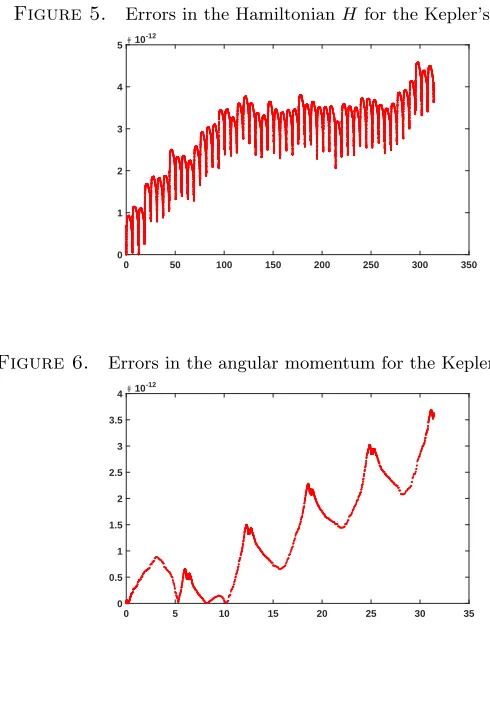
It is known that Kepler’s problem is a Hamiltonian problem and by Figures1and
2, we can see that the method does not preserve the structure for the tolerance equals to tol = 10−4. While by decreasing the tolerance to tol = 10−14, Figures 3 and 4
Figure 1. Solution of Kepler’s problem withe= 0.5,tol= 10−4, and xmax= 50π.
y1
-2 -1.5 -1 -0.5 0 0.5
y2
-1 -0.5 0 0.5 1
Figure 2. Solution of Kepler’s problem withe= 0.75,tol= 10−4, and xmax= 50π.
y1
-2 -1.5 -1 -0.5 0 0.5
y2
-0.8 -0.6 -0.4 -0.2 0 0.2 0.4 0.6 0.8
Figure 3. Solution of Kepler’s problem withe = 0.5,tol= 10−14, and
xmax= 10π.
y1
-1.5 -1 -0.5 0 0.5
y2
-1 -0.5 0 0.5 1
quantities
H(y) =1 2(y
2 3+y
2 4)−(y
2 1+y
2 2)−
1/2,
as the “Hamiltonian” of system and
Figure 4. Solution of Kepler’s problem withe= 0.75,tol= 10−14, and xmax= 10π.
y1
-2 -1.5 -1 -0.5 0 0.5
y2
-0.8 -0.6 -0.4 -0.2 0 0.2 0.4 0.6 0.8
as the “angular momentum” of system which are constant over the integration, have been plotted. This figures confirm that the method is capable to conserve these quantities of the system.
Figure 5. Errors in the HamiltonianH for the Kepler’s problem.
0 50 100 150 200 250 300 350
#10-12
0 1 2 3 4 5
Figure 6. Errors in the angular momentum for the Kepler’s problem.
0 5 10 15 20 25 30 35
#10-12
5. Conclusion
A predictor-corrector method of order six based on the three-step second deriva-tive Adams-Bashforth and two-step second derivaderiva-tive Adams-Moulton was analyzed. Using Nordsieck technique, variable stepsize mode of the method was introduced and its practical implementation was discussed by preparing a starting procedure, an es-timation for the local truncation error, and changing stepsize strategy. Some system of differential equations were successfully tested.
References
[1] A. Abdi,Construction of high-order quadratically stable second-derivative general linear meth-ods for the numerical integration of stiff ODEs, J. Comput. Appl. Math.,303(2016), 218–228. [2] A. Abdi, M. Bra´s, and G. Hojjati,On the construction of second derivative diagonally implicit
multistage integration methods, Appl. Numer. Math.,76(2014), 1–18.
[3] A. Abdi and G. Hojjati, An extension of general linear methods, Numer. Algor., 57 (2011), 149–167.
[4] A. Abdi and G. Hojjati,Implementation of Nordsieck second derivative methods for stiff ODEs, Appl. Numer. Math.,94(2015), 241–253.
[5] A. Abdi and G. Hojjati, Maximal order for second derivative general linear methods with Runge– Kutta stability, Appl. Numer. Math.,61(2011), 1046–1058.
[6] J. C. Butcher,A modified multistep method for the numerical integration of ordinary differential equations, J. Assoc. Comput. Mach.,12(1965), 124–135.
[7] J. C. Butcher.Numerical methods for ordinary differential equations, Wiley, New York, 2008. [8] J. C. Butcher and G. Hojjati,Second derivative methods with RK stability, Numer. Algor.,40
(2005), 415–429.
[9] J. R. Cash,On the integration of stiff systems of O.D.E.s using extended backward differentia-tion formulae, Numer. Math.,34(1980), 235–246.
[10] J. R. Cash,Second derivative extended backward differentiation formula for the numerical in-tegration of stiff systems, SIAM J. Numer. Anal.,18(1981), 21–36.
[11] W. H. Enright, Second derivative multistep methods for stiff ordinary differential equations, SIAM J. Numer. Anal.,11(1974), 321–331.
[12] A. K. Ezzeddine, G. Hojjati, and A. Abdi, Sequential second derivative general linear methods for stiff systems, Bull. Iranian Math. Soc.,40(2014), 83–100.
[13] A. K. Ezzeddine, G. Hojjati, and A. Abdi,Perturbed second derivative multistep methods, J. Numer. Math.,23(2015), 235–245.
[14] E. Hairer, S. P. Nørsett, and G. Wanner, Solving ordinary differential equations I. Nonstiff problems, Springer-Verlag, Berlin, 1993.
[15] S. M. Hosseini and G. Hojjati,Matrix free MEBDF method for the solution of stiff systems of ODEs, Math. Comput. Model.,29(1999), 67–77.
[16] M. Hosseini Nasab, G. Hojjati, and A. Abdi, G-symplectic second derivative general linear methods for Hamiltonian problems, J. Comput. Appl. Math.,313(2017), 486–498.
![Table 2. Numerical results for problem P2 solved by the method(3.1) with h0 = 10−2 and x ∈ [0, 50].](https://thumb-us.123doks.com/thumbv2/123dok_us/8943386.1852754/9.612.140.473.391.466/table-numerical-results-problem-p-solved-method-h.webp)