http://www.sciencepublishinggroup.com/j/ajpa doi: 10.11648/j.ajpa.20180606.11
ISSN: 2330-4286 (Print); ISSN: 2330-4308 (Online)
Angular Correlations of Particle Momentum in the Hot
Dense Medium
Zirui Wang
1, Yuhuan Li
21
The High School Affiliated to Renmin University of China, Beijing, China
2School of Science, Tianjin University, Tianjin, China
Email address:
To cite this article:
Zirui Wang, Yuhuan Li. Angular Correlations of Particle Momentum in the Hot Dense Medium. American Journal of Physics and Applications. Vol. 6, No. 6, 2018, pp. 142-146. doi: 10.11648/j.ajpa.20180606.11
Received: September 23, 2018; Accepted: October 19, 2018; Published: December 21, 2018
Abstract:
The early universe consists of element particles such as quarks and gluons after the big bang. Understanding their interactions is crucial for the physics, especially their interaction strength: do they behave like a gas or like water? A lot of experiments and theoretical calculations have been performed in labs, using different particles to study the properties of the early universe. Luckily, scientists can create this state of matter on earth by proton-proton collisions (or nucleus-nucleus collisions). As this matter produced in the particle collisions last only a very short of time ~ fm/c where c is the speed of light. How to probe this medium becomes difficult? This work suggests that people can study the momentum correlations between particles moving in the opposite direction in the hot medium. If the early universe is a STRONGLY coupled medium, then the medium will change both particles’ momentum. After they move out of the hot medium, their momentum angular is NOT pi anymore. In summary, the hot medium random interactions will change the momentum angular between two particles even their initial momentum is in the opposite direction. This work employs the Langevin equation to simulate their evolutions in the hot medium, and get good results.Keywords:
Early Universe, Langevin Equation, Momentum Angular Correlations, Particle Collisions1. Introduction
The concept of quark was first proposed by M. Gell-Mann in Quark Model in 1964 [1]. Quarks are smallest and elementary constituent unit of matter. There are six kinds of quarks, up(u), down(d), strange(s), charm(c), bottom(b) and top(t). Each quark may carry three kinds of colors. The interactions between quarks are dominated by color interactions.
Quantum Chromodynamics(QCD) is the fundamental theory of strong interaction among quarks and gluons. Because the non-Abelian nature of QCD theory, quarks and gluons are confined (color confinement) within the hadrons at low energy scale, while asymptotic at high energy scale. For this reason, a new state of matter has been proposed, Quark Gluon Plasma(QGP). The fundamental degrees of freedom are the quark and gluon, instead of hadrons in this new state. And people believe, this state will exist at extremely high temperature or high density. According to
lattice simulation of QCD(LQCD), there exist a phase transition from hadronic matter to QGP matter around a critical temperature T ~155 MeV [2]. Above the critical temperature, it will be QGP phase. Such a new state of high temperature or high density prevailed in the very early Universe after Big Bang. And this may also exists in the center of neutron/quark stars. In the laboratory, this phase transition is expected to be realized by relativistic heavy ion collisions at the Relativistic Heavy Ion Collider(RHIC) and the Large Hadron Collider(LHC).
Because the QGP phase formed in Heavy ion collisions expands rapidly, and with the temperature and density decrease, the system will again transform into the hadron state. So people cannot observe it directly in the experiment. In the past twenty years, there are four main sensitive signatures been proposed: strange enhancement [3], quark number scaling of collective flow [4, 5], Jet quenching [6, 7] and quarkonia suppression [8, 9].
mainly created in the initial impact of the collisions and the production process is controlled by perturbative QCD [10]. After production, the heavy quarks will interact with the medium (consisting of quarks and gluons). So it will carry the message of medium, and can be a perfect signature.
The bound states of a heavy quark and its antiquark are generally named as quarkonia, such as J/Ψ, Υ. While the open heavy flavor means the bind of one heavy quark with other flavor quarks, like D, B. Different from usual light hadrons, the quarkonium masses are mainly determined by the bare heavy quark mass. This allows us to draw non-relativistic potential model to deal with their properties [9, 11–13]. The quarkonia usually carry large binding energy, can survive at the early stage of the fireball. D mesons consisting of one heavy quark and light quark, is produced in the later stage of the fireball, so they carry more information of the medium.
High energy elementary collisions, such as pp, pA
collisions, have been proposed to study the cold nuclear effects (including the nuclear absorption [14], Cronin effect [15] and shadowing effect [16, 17]) for high energy nucleus-nucleus collisions [18, 19]. One amazing results in pp collisions is the long-range ridge structure in two particle azimuthal correlations with a large pseudo-rapidity in high multiplicities [20, 21]. Such phenomenon have been discovered in AA collisions and interpreted as a signature of QGP collective motion. The long-range ridge structure appears in those elementary collisions indeed challenge the theorists. Some people propose that there may also exist deconfined state in high multiplicity pp collisions (at the colliding energy of 7 TeV or 13 TeV).
Heavy quark pairs are produced with the back-to-back momentum at the leading order in the hard scattering (gg →cc!, qq! → cc!), and the back-to-back angular correlation has been observed in the finial state of DD# correlation [22]. In high energy nuclear collisions, a very hot and dense partonic medium is produced in the early stage, even in high multiplicity pp collisions. The interaction between charm quark and light parton will modify the angular correlations and this will influence the finial DD# angular correlation [23, 24]. So, the correlation between DD# can be an ideal probe to study the existence of the deconfined medium produced in high multiplicity pp collisions.
In the following, authors numerically solve the Langevin equation to simulate the evolutions of charm quarks in hot medium. After diffusions, the charm quarks fragment into
D or D# mesons. Authors analyze the results in Section three, and give the final conclusion in Section four.
2. Framework of Langevin Equation for
Heavy Quark Evolutions
Light quarks (u, d) can be produced thermally in the hot medium, and the light quarks reach chemical equilibrium. However, the evolutions of initially produced heavy quarks in Quark Gluon Plasma are controlled by a transport equation.
Or it can be treated as a Brownian motion, studied with the Langevin equation. The Langevin equation has been successfully used to describe the collective flows v% [25, 26], nuclear modification factor R'' [27, 28] of heavy flavors. The non-relativistic Langevin equation can be expressed as:
()**+
(,= −η0p*+ + ξ+ (1)
Where η0 and ξ+ are the drag coefficient and the noise variable of the hot medium on heavy quarks. And ξ+ satisfies the correlation relation
〈ξ4(t)ξ7(t8)〉 = κδ47δ(t − t8) (2)
κ is the diffusion coefficient of heavy quarks in momentum space, which is connected with spatial diffusion coefficient D by κ = 2T%/D. The diffusion coefficient has given by several models: a leading-order pQCD, a pQCD-motivated one gluon exchange model [30], in-medium T-matrix formalism [31] and lattice QCD [32]. Heavy flavor phenomenology in heavy ion collisions provides a unique opportunity to extract the transport coefficient of QCD medium, like heavy quark diffusion coefficient D.
Both the drag coefficient η0 and diffusion coefficient κ depend on the local temperature T. The drag coefficient in Langevin equation can be determined by the fluctuation-dissipation relation [29]
η0(p) =%=>< (3)
Where T is the temperature of the bulk medium
and E = @mA% + |p*+|%is the heavy quark energy.
In order to solve the Langevin equation for heavy quark diffusions in QGP numerically, it should be discretized as below
p*+(t + ∆t) = p*+(t) − η0(p)p*+Δt + ξ+Δt (4)
XA(t + Δt) = X**+A(t) +)**+>Δt (5)
〈ξ4(t)ξ7(t − nΔt)〉 = <
G,δ47δHI (6)
As long as the time step Δt for numerical evolutions is small enough, one can assume free motions for heavy quarks with a constant velocity v*+A=)**+> during this time step, and update the heavy quark momentum by Eq.(4) at the end of each Δt due to hot medium effects. The medium-induced radiative energy loss [33, 34] and parton elastic collisions [35] of heavy quarks can be included in the terms of the drag force η0(p) and the noise ξ+ , where ξ4(t)4JK,%,L in Eq. (6) is sampled randomly based on a Gaussian function with the width Mκ/Δt.
heavy ion collisions turns out to be a very strong coupling system. Which can be described well by hydrodynamics [36, 37]. The hydrodynamic model also works in high multiplicity pp collisions [38]. The motion of heavy quark is controlled by Langevin equation. The effect of hot medium to heavy quark evolution can be obtained by solving the coupled Langevin equation with the hydrodynamics.
Experimental studies of charm mesons D and baryonΛ are important to understand the hadronization mechanism in QGP. So far as people know, the particles at very low p= is
controlled by the QGP expansions. The coalescence mechanism plays an important role at the intermediate p=
region (3 P p=P 8 GeV/c). The coalescence mechanism
has been successfully used to describe the elliptic flow [39] and the enhancement of the baryon to meson ratio [40–42]. It is also extended to heavy flavor sector, to describe the J/Ψ, D mesons [43, 44]. With increasing p=, the coalescence
mechanism is not important any more, and the fragmentation mechanism takes over [45].
3. Numerical Calculations and Analyze
Aim to simplify the problem, one can just treat the medium with a static, homogeneous disk, with an uniform temperature T~0.3 GeV. The charm quarks are produced with back-to-back momentum in the center of the medium, as showed in Figure 1. Assume that charm and anti-charm quarks move along the x-axis, in the opposite direction, please see Figure 1.
If there is no deconfined medium produced in pp collisions, the angular between c and c! quarks will remain the same as the initial value which is π.
Figure 1. Heavy quark pair produced inside the hot medium (insider the circular) with back-to-back initial momentum. And will random motion in hot medium. The radius of the circle is taken as the proton radius ~1 fm.
However, with the strong interactions and also random kicks from the thermal medium, the correlations between charm and anti-charm quark momentum disappear with time. Note that there is no interactions between c and c!, and the momentum evolutions of c and c #are independent from each other. When charm and anti-charm quarks move out of the hot medium, they will become D mesons by coalescence or fragmentation. Authors neglect the effects of charm quark hadronization, and assume that D meson momentum is the same with the charm quarks.
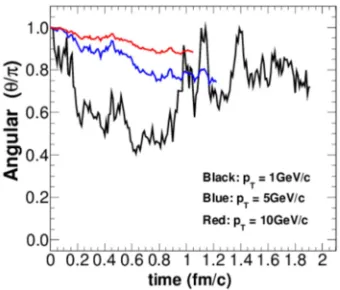
Figure 2 indicates that the charm quark momentum correlation can be strongly modified by the possible bulk medium produced in proton-proton collisions, due to the color interactions between charm quarks and the deconfined medium. The initial transverse momentum of charm and anti-charm is taken as 1, 5, 10GeV/c respectively, as shown with black, blue and red lines in Figure 2. With p= = 1
GeV/c, the angular between charm and anti-charm quarks drops faster compared with the situations of p= = 5 GeV/c
and 10 GeV/c. This comparison reveals that the charm quark with smaller p= can be easily thermalized by the bulk
medium (only reach kinetic equilibrium). which is a natural result of the Langevin equation. The drag coefficient is proportional to the inverse of the energy E or transverse momentum p= (see Eq.(3)). Charm quarks with smaller
momentum can suffer energy loss more easily, which will reduce the correlation between charm and anti-charm quark momentum. The angular between charm and anti-charm with p= = 1GeV/c becomes partially random, but their
angular still remains θU! V 0.4π. Charm and anti-charm
quarks already loss part of the initial correlations due to the random kicks from the bulk medium.
Figure 2. (Color Online) Time evolution of the angular between charm
W and anti-charm W̅ quark momentum in the deconfined medium produced in proton-proton collisions. Charm and anti-charm quark momentum is taken as 1, 5, 10 GeV/c respectively, with opposite direction. Deconfined medium temperature is taken as a constant typical value of TQGP = 0.3 GeV. The parameter indicating the coupling strength between heavy quark and the bulk medium is taken as C = 1.
Heavy quarks with different momentum can suffer different energy loss in the hot medium. Figure 3shows the heavy quark momentum at time t compared with its initial value. The black, blue and red lines are for charm quarks with transverse momentum p= = 1, 5, 10 GeV/c respectively.
From the comparison between p= = 5 GeV/c and 10 GeV/c,
charm quarks with larger momentum can suffer weaker energy loss, and the ratio of p(t)/p0 is larger, see the red line. For the line of p= = 1GeV/c, the value of p(t)/p0 in the later
stage even becomes lager than unit, which means charm quarks with p= = 1 GeV/c can reach kinetic thermalization
noise term in Langevin equation, then all the three lines will drop down monotonously with time.
Figure 3. (Color Online) Energy loss of heavy quarks with different initial momentum as a function of time. The parameters of this figure is the same with Figure 2.
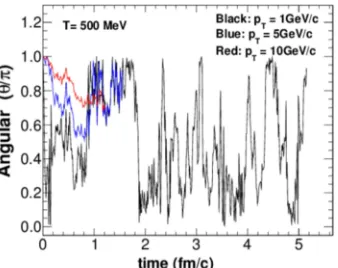
The hot medium effects on charm quark momentum correlation become more distinct at high temperature. In the realistic situation, the fireball produced in heavy ion collisions or pp collisions is a fast cooling system with strong expansion. Therefore, charm quarks evolve in a cooling system. For simplicity, this article put the charm quark in a hotter medium with a temperature of T = 0.5 GeV, and study the angular correlation between charm and anti-charm quarks, please see Figure 4. With higher temperature, the interactions between heavy quarks and the bulk medium become stronger, and charm quarks can be more easily thermalized in momentum space. For the charm quarks with large momentum such asp= = 10 GeV/c, their angular correlation
is partially lost, and the angular between p*+ and p*+! only
remains larger than 0.6π. For the charm quarks with very small momentum p= = 1 GeV/c, when they move out of the
hot medium, their momentum angular becomes completely random, which indicates that p*+ is totally independent with p*+! when they travel through the medium. This is a strong
signal of charm quark kinetic thermalization and the existence of the QGP in pp collisions. Charm quarks with lower momentum in higher temperature are easier to be thermalized by the bulk medium.
Figure 4. (Color Online) Time evolution of the angular between charm W
and anti-charm W̅ quark momentum in the deconfined medium in proton-proton collisions. Medium temperature is now taken as 0.5 GeV, where charm quarks can be thermalized easily, and the angular between
W and W̅ becomes random when they move out of the hot medium.
4. Conclusions
In summary, authors investigate the momentum correlations of heavy quark pairs in the small colliding system, such as proton-proton (pp) collisions, via Langevin equation. With the production of deconfined hot medium, heavy quarks moving in the opposite direction can suffer energy loss and their momentum correlations will be modified after moving out of the hot medium. The charm (anti-charm) quarks with lower momentum are easier to lose the angular correlation and reach kinetic thermalization in the hot medium. Therefore, the momentum correlations )**+Y⋅)**+Y#
|)**+Y||)**+Y| of D . D
# mesons can be a
clear probe of the early stage of the proton-proton collisions. Next work will extend this idea to more realistic calculations where Langevin equation will be coupled with hydrodynamic equations for the QGP evolutions, and present more quantitative results in the future works.
Acknowledgements
The authors want to thank Prof. Mao and Prof. Chen for the extensive discussions about the motivation of this work, and reading the manuscript. The authors also want to thank Yongsun Wu for the help in writing the C++ codes and the figure plot.
References
[1] M. Gell-Mann, Phys. Lett. 8, 214 (1964).
[2] A. Bazavov et al., Phys. Rev. D 85, 054503 (2012).
[3] F. Antinori et al. [NA57 Collaboration], J. Phys. G 37, 045105 (2010).
[4] A. Adare et al. [PHENIX Collaboration], Phys. Rev. Lett. 98, 162301 (2007).
[5] Z. w. Lin and C. M. Ko, Phys. Rev. C 65, 034904 (2002). [6] J. Adams et al. [STAR Collaboration], Phys. Rev. Lett. 91,
072304 (2003).
[7] K. Adcox et al. [PHENIX Collaboration], Phys. Rev. Lett. 88, 022301 (2002).
[8] T. Matsui and H. Satz, Phys. Lett. B 178, 416 (1986). [9] H. Satz, J. Phys. G 32, R25 (2006).
[10] S. S. Adler et al. [PHENIX Collaboration], Phys. Rev. Lett. 94, 082301 (2005).
[11] J. Zhao and B. Chen, Phys. Lett. B 776, 17 (2018).
[12] H. W. Crater, J. H. Yoon and C. Y. Wong, Phys. Rev. D 79, 034011 (2009).
[13] X. Guo, S. Shi and P. Zhuang, Phys. Lett. B 718, 143 (2012). [14] C. Gerschel and J. Hufner, Phys. Lett. B 207, 253 (1988). [15] J. W. Cronin, H. J. Frisch, M. J. Shochet, J. P. Boymond, R.
[16] A. H. Mueller and J. w. Qiu, Nucl. Phys. B 268, 427 (1986). [17] F. H. Liu, H. L. Lao and R. A. Lacey, Int. J. Mod. Phys. E 25,
no. 06, 1650036 (2016).
[18] A. Andronic et al., Eur. Phys. J. C 76, no. 3, 107 (2016). [19] B. Chen, T. Guo, Y. Liu and P. Zhuang, Phys. Lett. B 765, 323
(2017).
[20] V. Khachatryan et al. [CMS Collaboration], JHEP 1009, 091 (2010).
[21] V. Khachatryan et al. [CMS Collaboration], Phys. Rev. Lett. 116, no. 17, 172302 (2016).
[22] C. Lourenco and H. K. Wohri, Phys. Rept. 433, 127 (2006). [23] X. Zhu, N. Xu and P. Zhuang, Phys. Rev. Lett. 100, 152301
(2008).
[24] X. Zhu, M. Bleicher, S. L. Huang, K. Schweda, H. Stoecker, N. Xu and P. Zhuang, Phys. Lett. B 647,366(2007).
[25] M. He, R. J. Fries and R. Rapp, Phys. Rev. C 86, 014903 (2012).
[26] B. Chen, Phys. Rev. C 95, no. 3, 034908 (2017).
[27] S. Cao, G. Y. Qin and S. A. Bass, Phys. Rev. C 88, 044907 (2013).
[28] B. Chen and J. Zhao, Phys. Lett. B 772, 819 (2017).
[29] S. Cao, G. Y. Qin and S. A. Bass, J. Phys. G 40, 085103 (2013).
[30] P. B. Gossiaux and J. Aichelin, Nucl. Phys. A 830, 203C (2009).
[31] H. van Hees, M. Mannarelli, V. Greco and R. Rapp, Phys. Rev. Lett. 100, 192301 (2008).
[32] H. T. Ding, A. Francis, O. Kaczmarek, F. Karsch, H. Satz and W. Soeldner, Phys. Rev. D 86, 014509(2012).
[33] X. N. Wang and M. Gyulassy, Phys. Rev. Lett. 68, 1480 (1992).
[34] R. Baier, Y. L. Dokshitzer, A. H. Mueller, S. Peigne and D. Schiff, Nucl. Phys. B 483, 291 (1997).
[35] G. Y. Qin, J. Ruppert, C. Gale, S. Jeon, G. D. Moore and M. G. Mustafa, Phys. Rev. Lett. 100,072301 (2008).
[36] H. Song, S. A. Bass, U. Heinz, T. Hirano and C. Shen, Phys. Rev. Lett. 106, 192301 (2011).
[37] T. Hirano, P. Huovinen and Y. Nara, Phys. Rev. C 83, 021902 (2011).
[38] W. Zhao, Y. Zhou, H. Xu, W. Deng and H. Song, Phys. Lett. B 780, 495 (2018).
[39] D. Molnar and S. A. Voloshin, Phys. Rev. Lett. 91, 092301 (2003).
[40] R. C. Hwa and C. B. Yang, Phys. Rev. C 67, 034902 (2003). [41] R. J. Fries, B. Muller, C. Nonaka and S. A. Bass, Phys. Rev.
Lett. 90, 202303 (2003).
[42] V. Greco, C. M. Ko and P. Levai, Phys. Rev. Lett. 90, 202302 (2003).
[43] V. Greco, C. M. Ko and R. Rapp, Phys. Lett. B 595, 202 (2004).
[44] T. Song, H. Berrehrah, D. Cabrera, W. Cassing and E. Bratkovskaya, Phys. Rev. C 93, no. 3, 034906(2016).