A. Sanofer Nisha et al, International Journal of Computer Science and Mobile Applications, Vol.2 Issue. 1, January- 2014, pg. 142-155 ISSN: 2321-8363
©2014, IJCSMA All Rights Reserved, www.ijcsma.com 142
PART-BASED PEDESTRIAN
DETECTION AND TRACKING USING
HOG-SVM CLASSIFICATION
Miss. A. Sanofer Nisha
(1)Mrs. K. Thulasimani
(2)ME II Year AP/CSE
Department of Computer Science and Department of Computer Science and
Engineering Engineering
Government College of Engineering Government College of Engineering
Tirunelveli Tirunelveli
Abstract
Pedestrian detection is an essential and challenging task in any intelligent video surveillance system. Despite the challenges, pedestrian detection remains an active area of research in computer vision and a number of approaches have grown steadily in recent years. The major challenge is the development of reliable on-board pedestrian detection systems. This paper proposes a pedestrian detection system that uses a part-based approach. The system is based on a two-stage classifier. Candidates are detected using a Haar cascade classifier and then part-verification is done using the cascade object detector. The Histogram of oriented gradients is found for the whole input and it is combined with the classification done using Support Vector Machine (SVM). The location of the human is detected using a background subtraction algorithm. The detected human are traced by determining the centroid point of the blob and keeping track of its location. The tracking provides the identity of the human location and the location that the human has traversed. The robustness of this system relies on the combination of a HOG and SVM classification.
A. Sanofer Nisha et al, International Journal of Computer Science and Mobile Applications, Vol.2 Issue. 1, January- 2014, pg. 142-155 ISSN: 2321-8363
©2014, IJCSMA All Rights Reserved, www.ijcsma.com 143
1. INTRODUCTION
Pedestrian detection is a key problem in computer vision, with several applications that have the
potential to positively impact quality of life. People are among the most important components
of a machine’s environment, and endowing machines with the ability to interact with people is
one of the most interesting and potentially useful challenges for modern engineering. Detecting
and tracking people is thus an active area of research[10]-[18]. Just in the US, nearly 5,000 of the
35,000 annual traffic crash fatalities involve pedestrians [6], hence the considerable interest in
building automated vision systems for detecting pedestrians [7]. Applications include robotics,
entertainment, surveillance, care for the elderly and disabled and content-based indexing. In this
paper, we focus on a particular type of system, pedestrian protection systems (PPSs). The
objective of a PPS is to detect the presence of both stationary and moving people in a specific
area of interest in order to prevent collisions.
The main challenges of a PPS[19] involve detection of pedestrians. These challenges are
summarized by the following points:
Various styles of clothing in appearance.
The presence of occluding accessories.
Frequent occlusion between pedestrians.
Performance in terms of system reaction time and robustness.
Tracking is a method to build a track from a temporal sequence of data. Tracking applies to
concurrent inflow of data. Generally tracking is the observing of persons or objects on the move
and supplying a timely ordered sequence of respective location data to a model e.g. Capable to
serve for depicting the motion on a display capability. Tracking can be employed in a lot of
fields such as Computer graphics, Automotive engineering and Satellite tracker.
Though a large amount of objects can be tracked and there exist lots of methodologies to track,
human tracking has remained an active area of research for a large amount of time. Because
A. Sanofer Nisha et al, International Journal of Computer Science and Mobile Applications, Vol.2 Issue. 1, January- 2014, pg. 142-155 ISSN: 2321-8363
©2014, IJCSMA All Rights Reserved, www.ijcsma.com 144
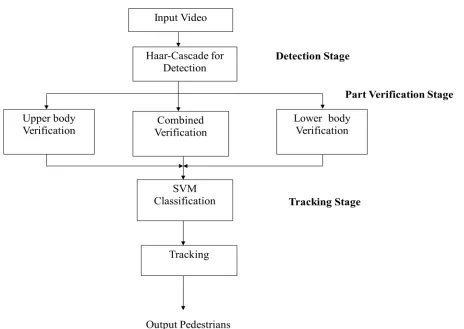
The diagram is a simplification that covers the structure of most of the systems, so particular
module organizations presented in some papers, for example, interchanging tracking and
verification stages, have not been included.
Fig1. Architecture for an On-board Pedestrian detection system
This architecture is then used as a common framework in which we review the different
proposals in the literature, making it easier to understand the requirements, responsibilities, and
advantages of the techniques in each module.
In this paper, a new approach is proposed for detecting humans. The humans are detected using a
haar cascade detector. The HOG and SVM combination makes the system more accurate. The
SVM classifiers have been learnt for entire pedestrians [9] and also for rigidly connected
assemblies of sub-images [8]. Next, the human is tracked using a background subtraction
algorithm that finds the centroid point of the object and keeps track of the path.
2. EXISTING METHODS
A important stream of research within computer vision which has gained a lot of importance in
the last few years is the understanding of human activity from a video. Understanding human
A. Sanofer Nisha et al, International Journal of Computer Science and Mobile Applications, Vol.2 Issue. 1, January- 2014, pg. 142-155 ISSN: 2321-8363
©2014, IJCSMA All Rights Reserved, www.ijcsma.com 145
2.1Human detection
Before the complexity of human activity can be understood, we first need automatic methods for
finding humans in an image or a video. Once the human is detected, depending on the
application, the system can do further processing to go into the details of understanding the
human activity.
The relevant literature can be divided into two techniques:
The Method that requires background subtraction or segmentation and
The techniques which can detect humans directly from the input without such
pre-processing.
2.1.1 Using Background Subtraction
Background subtraction techniques usually find the foreground object from the video and then
classify it into categories like human, animal, vehicle etc., based on shape, color, or motion or
other features.
The real-time Pfinder system [1] for detecting and tracking humans was invented. The
background model used a gaussian distribution in the YUV space at each pixel, and the
background model is continually updated. The person is modeled using multiple blobs with
spatial and colors components and the corresponding Gaussian distributions. Since the blob was
dynamically changing, its spatial parameters were constantly estimated with a Kalman filter.
A system[2] which first detects moving objects by computing optic flow only in regions selected
by frame differencing. The optic flow velocity is then used to compute a time to collision with
respect to a fixed reference point in the image. The proposed method does not have real-time
performance.
A method where a moving object is classified as human based on the spatial uniqueness [3] of
the image motion, temporal uniqueness of the human motion, and the temporal motion
continuity. First, the moving object is detected by background subtraction, and then the three
factors are evaluated.
A system that works based on a shape-based approach [4] for classification of objects is used
A. Sanofer Nisha et al, International Journal of Computer Science and Mobile Applications, Vol.2 Issue. 1, January- 2014, pg. 142-155 ISSN: 2321-8363
©2014, IJCSMA All Rights Reserved, www.ijcsma.com 146
for threat assessment. The target intruder is classified as human or animal or vehicle based on the
shape of its boundary contour.
A method to detect and track a human body in a video. First, background subtraction is
performed to detect the foreground object, which involves temporal differencing [5] of the
consecutive frames. Other features of the technique include shadow removal.
2.1.2 By Direct Detection
Direct techniques operate on (features extracted from) image or video patches and classify them
as human or non-human. We can also classify techniques based on the features which are used to
classify a given input as human or not. These features include shape (in the form of contours or
other descriptors), color (skin color detection), motion, or combinations of these.
A technique that focused on detecting periodic motions and is applicable to the detection of
characteristic periodic biological motion patterns [25] such as walking. The video from a moving
camera is first stabilized and frame differencing and thresholding is performed to detect
independently moving regions.
A paper that uses the fact that the relative positions[26] (geometric distances) of various body
parts are common to all humans, although the pixel values may vary because of the clothes or the
illumination.
A paper that deals with the direct detection of humans from static images[27] as well as video
using a classifier trained on human shape and motion features was invented. The training dataset
consists of images and videos of human and non-human examples. The paper restricts itself to
the case of pedestrians (where humans are always in upright walking poses).
A paper that focuses on human motion patterns [28] for robust detection since they are relatively
independent of appearance and environmental factors was in practice. The method is not suitable
for detecting partially occluded humans.
2.2Human Tracking
Tracking is a method to build a track from a temporal sequence of data. Tracking applies to
A. Sanofer Nisha et al, International Journal of Computer Science and Mobile Applications, Vol.2 Issue. 1, January- 2014, pg. 142-155 ISSN: 2321-8363
©2014, IJCSMA All Rights Reserved, www.ijcsma.com 147
A system where the multiframe validation[29] and tracking algorithm relies on Kalman filter
theory to provide spatial estimates of detected pedestrians and Bayesian probability to provide an
estimate of pedestrian detection certainty over time.
The system is to improve robustness in multiobject tracking by coupling object detection and
tracking in a non-Markovian hypothesis selection framework[30]. Our approach does not rely on
a Markov assumption, but can integrate information
over long time frames to revise its decision and recover from mistakes in the light of new
evidence.
3. PROPOSED SYSTEM
Pedestrian detection is an essential and challenging task in any intelligent video surveillance
system. The major challenge is the development of reliable on-board pedestrian detection
systems. This paper proposes a pedestrian detection system that uses a part-based approach. The
system is based on a two-stage classifier. The Haar cascade classifier detects humans based on
Haar-like features and the cascade object detector verifies the humans by doing part verification.
It does upper body and lower body verification and combines the results to verify the identity of
a human. Part-based detection systems perform extremely well with occlusion. The number of
high false positives per frame(FPPF) is reduced. In this project, blob tracking is used to calculate
A. Sanofer Nisha et al, International Journal of Computer Science and Mobile Applications, Vol.2 Issue. 1, January- 2014, pg. 142-155 ISSN: 2321-8363
©2014, IJCSMA All Rights Reserved, www.ijcsma.com 148 The System consists of the following stages:
Detection Stage
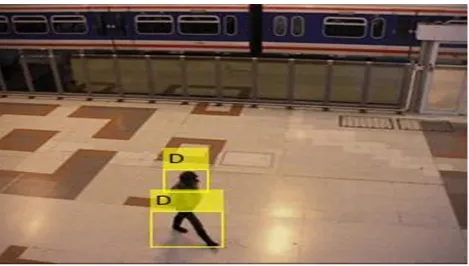
The detection stage is implemented using the haar-cascade detector. The input
video is processed frame-by-frame and the objects are detected. Unlike HOG features, Haar-like
features do not benefit from having much background included. Another interesting element in
the training phase is the choice of data sets used to train the cascade classifier. When the
bounding boxes of candidate pedestrians have been obtained, they are passed to the verification
stage.
A. Sanofer Nisha et al, International Journal of Computer Science and Mobile Applications, Vol.2 Issue. 1, January- 2014, pg. 142-155 ISSN: 2321-8363
©2014, IJCSMA All Rights Reserved, www.ijcsma.com 149
The Haar-Cascade detector is trained using closely cropped humans. Hence the ROI is obtained
by the haar-cascade detector which is passed to the verification stage for verifying the body
parts. The detected humans are passed to the verification stage for part verification.
Part-Verification Stage
The function of this stage is to verify the identity of the human by processing the whole human
and its body parts to confirm the human identity. In this project, the upper body and lower body
are used to verify the identity of the human.
The cascade object detector detects the parts of the body. There are many optional properties
such as ScaleFactor and MinSize used for defining the range of the detector. The
CascadeObjectDetector can be used to detect various parts such as nose, mouth and so on. In this
project, the upper and lower bodies of the human si detected.
A. Sanofer Nisha et al, International Journal of Computer Science and Mobile Applications, Vol.2 Issue. 1, January- 2014, pg. 142-155 ISSN: 2321-8363
©2014, IJCSMA All Rights Reserved, www.ijcsma.com 150
The cascade object detector detects the upper and lower bodies of the human which increases the
accuracy of the detection.
HOG-SVM Classification
The HOG descriptors are found for the whole input and it is used for classifying using
SVM. Most of the papers use the HOG-SVM solution presented by Dalal and Triggs [20]. It is
much more robust and generally detects pedestrians in harder situations, while keeping a low
number of false positives. Its problem lies in processing speed. We combine the speed of the
Haar detector with the robustness of a part-based HOG-SVM detector. The base for the method
used in this paper was first presented by Geismann and Schneider [21], but is also covered by
others in various versions [22], [23].
Fig 5. HoG descriptors for the images
Our algorithm uses classic dense HOG descriptors (as opposed to the sparse descriptors used in
[21]). They are calculated using integral images in an effort to speed up the process, as described
in [24]. Since HOG works best if some amount of background is introduced to the detection
A. Sanofer Nisha et al, International Journal of Computer Science and Mobile Applications, Vol.2 Issue. 1, January- 2014, pg. 142-155 ISSN: 2321-8363
©2014, IJCSMA All Rights Reserved, www.ijcsma.com 151
detection stage. Then the content of the ROIs is scaled so it matches the size the SVMs were
trained with. At this point the HOG is calculated and passed on to the SVMs. As in the detection
stage, each SVM is trained with the INRIA training set.
Tracking Stage
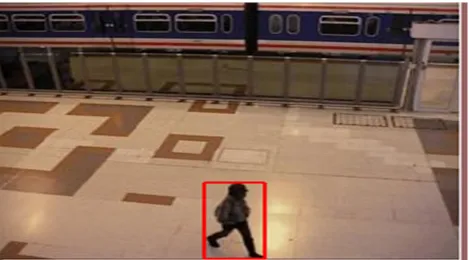
The tracking stage is used to detect or trace the path of the object. In this system, the movement
of the human is tracked using a background subtraction algorithm. The centroid point of the blob
is calculated and the tracking mechanism is performed using the centroid point. It determines the
motion and displays the path traversed by the human.
Fig 6. Tracking of a single human
The tracking can be done for single and multiple humans. The tracking process is done by doing
background subtraction for the input video. The centroid point of the human is found out and the
A. Sanofer Nisha et al, International Journal of Computer Science and Mobile Applications, Vol.2 Issue. 1, January- 2014, pg. 142-155 ISSN: 2321-8363
©2014, IJCSMA All Rights Reserved, www.ijcsma.com 152
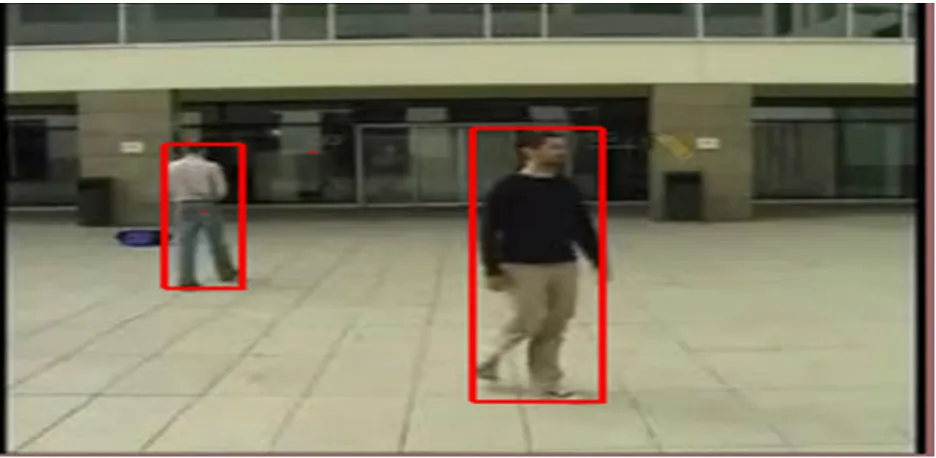
The tracking process can be improves further by tracking multiple humans which is done by
taking a lot of considerations.
Fig 7. Tracking of multiple humans
This is done by doing background subtraction for the input video. The humans found by the
background subtraction algorithm are known as blobs. The centroid points of the blobs are
calculated and the locations of the blobs are tracked based on time. Hence the sequential motion
of the humans can be determined by drawing bounding box around the object.
The analysis of the false positives per frame versus true positives per frame is calculated and the
performance is evaluated.
REFERENCES
1. C. R. Wren, A. Azarbayejani, T. Darrell, and A. P. Pentland. Pfinder: real-time tracking
of the human body. IEEE Transactions on Pattern Analysis and Machine Intelligence,
A. Sanofer Nisha et al, International Journal of Computer Science and Mobile Applications, Vol.2 Issue. 1, January- 2014, pg. 142-155 ISSN: 2321-8363
©2014, IJCSMA All Rights Reserved, www.ijcsma.com 153
2. H. Elzein, S. Lakshmanan, and P. Watta. A motion and shapebased pedestrian detection
algorithm. IEEE Intelligent Vehicles Symposium, pages 500–504, 2003.
3. T. Haga, K. Sumi, and Y. Yagi. Human detection in outdoor scene using spatio-temporal
motion analysis. International Conference on Pattern Recognition, 4:331–334, 2004.
4. D. J. Lee, P. Zhan, A. Thomas, and R. Schoenberger. Shape-based human intrusion
detection. SPIE International Symposium on Defense and Security, Visual Information
Processing XIII, 5438: 81–91, 2004.
5. Jianpeng Zhou and Jack Hoang. Real time robust human detection and tracking system.
IEEE Computer Society Conference on Computer Vision and Pattern Recognition, 3:149
– 149, 2005.
6. U. Shankar, “Pedestrian roadway fatalities,” Department of Transportation, Tech. Rep.,
2003.
7. D. Geronimo, A. M. Lopez, A. D. Sappa, and T. Graf, “Survey on pedestrian detection for advanced driver assistance systems,” IEEE Trans. Pattern Analysis and Machine
Intelligence, vol. 32, no. 7, pp. 1239–1258, 2010.
8. Mohan, C. Papageorgiou, and T. Poggio. Example-based object detection in images by
components. ieee Transactions on PAMI, 23(4):349–361, 2001.
9. C. Papageorgiou and T. Poggio. A trainable system for object detection. International
Journal of Computer Vision, 38(1):15–33, 2000.
10. P. Dollar, C. Wojek, B. Schiele, and P. Perona, “Pedestrian detection: An evaluation of
the state of the art,” IEEE Trans. Pattern Anal. Mach. Intell., vol. 34, no. 4, pp. 743–761,
Apr. 2012.
11. D. Geronimo, A. Lopez, A. Sappa, and T. Graf, “Survey of pedestrian detection for
advanced driver assistance systems,” IEEE Trans. Pattern Anal. Mach. Intell., vol. 32,
no. 7, pp. 1239–1258, Jul. 2010.
12. A. Møgelmose, A. Prioletti, M. M. Trivedi, A. Broggi, and T. B. Moeslund, “A two
stage part-based pedestrian detection system using monocular vision,” in Proc. 15th IEEE
A. Sanofer Nisha et al, International Journal of Computer Science and Mobile Applications, Vol.2 Issue. 1, January- 2014, pg. 142-155 ISSN: 2321-8363
©2014, IJCSMA All Rights Reserved, www.ijcsma.com 154
13. A. Prioletti, P. Grisleri, M. Trivedi, and A. Broggi, “Design and implementation of a
high performance pedestrian detection,” presented at the IEEE Intell. Veh. Symp., Gold
Coast, Australia, 2013, Paper WePO2T1.25.
14. N. Dalal and B. Triggs, “Histograms of oriented gradients for human detection,” in Proc.
IEEE Comput. Soc. Conf. CVPR, 2005, vol. 1, pp. 886–893.
15. S. Krotosky and M. Trivedi, “On color-, infrared-, and multimodal-stereo approaches to
pedestrian detection,” IEEE Trans. Intell. Transp. Syst., vol. 8, no. 4, pp. 619–629, Dec.
2007.
16. A. Broggi, P. Cerri, S. Ghidoni, P. Grisleri, and H. Jung, “A new approach to urban
pedestrian detection for automatic braking,” IEEE Trans. Intell. Transp. Syst., vol. 10, no. 4,
pp. 594–605, Dec. 2009.
17. P. Geismann and G. Schneider, “A two-staged approach to vision-based pedestrian
recognition using Haar and HOG features,” in Proc. IEEE Intell. Veh. Symp., 2008, pp. 554–
559.
18. T. Gandhi and M. Trivedi, “Pedestrian protection systems: Issues, survey, and
challenges,” IEEE Trans. Intell. Transp. Syst., vol. 8, no. 3, pp. 413–430, Sep. 2007.
19. D. Geronimo, A. Lopez, A. Sappa, and T. Graf, “Survey of pedestrian detection for
advanced driver assistance systems,” IEEE Trans. Pattern Anal. Mach. Intell., vol. 32, no. 7,
pp. 1239–1258, Jul. 2010.
20. N. Dalal and B. Triggs, “Histograms of oriented gradients for human detection,” in
Computer Vision and Pattern Recognition, 2005. CVPR 2005. IEEE Computer Society
Conference on, vol. 1. Ieee, 2005, pp. 886–893.
21. P. Geismann and G. Schneider, “A two-staged approach to vision based pedestrian
recognition using Haar and HOG features,” in Intelligent Vehicles Symposium, 2008 IEEE.
IEEE, 2008, pp. 554–559.
22. X. Yuan, X. Shan, and L. Su, “A Combined Pedestrian Detection Method Based on
Haar-Like Features and HOG Features,” in Intelligent Systems and Applications (ISA), 2011 3rd
A. Sanofer Nisha et al, International Journal of Computer Science and Mobile Applications, Vol.2 Issue. 1, January- 2014, pg. 142-155 ISSN: 2321-8363
©2014, IJCSMA All Rights Reserved, www.ijcsma.com 155
23. W. Yongzhi, X. Jianping, L. Xiling, and Z. Jun, “Pedestrian Detection Using
Coarse-to-Fine Method with Haar-Like and Shapelet Features,” in Multimedia Technology (ICMT),
2010 International Conference on. IEEE, 2010, pp. 1–4.
24. F. Porikli, “Integral histogram: A fast way to extract histograms in cartesian spaces,” in
Computer Vision and Pattern Recognition, 2005. CVPR 2005. IEEE Computer Society
Conference on, vol. 1. IEEE, 2005, pp. 829–836.
25. R. Cutler and L. S. Davis. Robust real-time periodic motion detection, analysis, and
applications. IEEE Transactions on Pattern Analysis and Machine Intelligence, 22(8):781–
796, 2000.
26. Akira Utsumi and Nobuji Tetsutani. Human detection using geometrical pixel value
structures. Fifth IEEE International Conference on Automatic Face and Gesture Recognition,
page 39, 2002.
27. P. Viola, M. J. Jones, and D. Snow. Detecting pedestrians using patterns of motion and
appearance. IEEE International Conference on Computer Vision, 2:734–741, 2003.
28. H. Sidenbladh. Detecting human motion with support vector machines. Proceedings of
the 17th International Conference on Pattern Recognition, 2:188–191, 2004.
29. I. Alonso, D. Llorca, M. Sotelo, L. Bergasa, P. de Toro, J. Nuevo, M. Ocaña, and M.
Garrido, “Combination of feature extraction methods for SVM pedestrian detection,” IEEE
Trans. Intell. Transp. Syst., vol. 8, no. 2, pp. 292–307, Jun. 2007.
30. B. Leibe, K. Schindler, and L. Van Gool, “Coupled detection and trajectory estimation