23 | http://mojes.um.edu.my/ EISSN: 2289-3024
MALAYSIAN ONLINE JOURNAL OF EDUCATIONAL SCIENCES
JANUARY 2019, 7 (1)INTRODUCTION
The information age that we live in is characterized by infinite changes in all aspects of life such as political, economic, cultural, social and technological fields (Pheeraphan, 2013). Technological developments and social changes have also led to the changes in the aims of education. Therefore, effective education systems have become the main factor enabling countries to compete with the other countries at an international level (Guimaraes de Castro, 1999). Today, students are expected to improve themselves, use, interpret and explain the meaning of the information (Parlar, 2012). Within this framework, it is clear that education systems have moved from traditional instruction to student centered instruction.
EVALUATION OF 5TH GRADE TURKISH MATHEMATICS CURRICULUM ACCORDING TO STUDENTS’ AND TEACHERS VIEWS
Gürbüz OCAK
Faculty of Education, Turkey
*Mustafa Enes TEPE
Ministry of Education, Turkey *[email protected]
ABSTRACT
This study aimed to evaluate all aspects of the 2018 Mathematics curriculum for 5th grade students in secondary school. In the study, concurrent nested design, one of the mixed research methods, was used. The participants for this study consisted of 204 5th grade students and 10 mathematics teachers in their 2017/2018 academic year. Quantitative data were collected with a 56-item student self-efficacy perception questionnaire and for qualitative data a semi-structured teacher interview form was developed by the researcher. The results obtained were compared with the 2005 and 2013 Mathematics curriculum. In analysing the 2005 and 2013 curriculum document analysis technique was used. For the 2018 Mathematics curriculum, some statistics such as percentage, frequency and arithmetic mean were used in the analysis of quantitative data. In the analysis of qualitative data, content analysis technique was used. It was emphasized in the study that the objectives of 2018 mathematics curriculum were appropriate to the student level and that the students were sufficient in terms of objectives. Moreover, the reduction in the number of objectives is regarded as a positive development by the teachers. Meanwhile, most of the students stated that geometric objects are the most difficult subject in the sub-learning field. This result is similar to the results obtained from interviews with teachers. Problems with equipment deficiency, crowded classes, and measurement evaluation process were observed to still continue.
24 | http://mojes.um.edu.my/ EISSN: 2289-3024
MALAYSIAN ONLINE JOURNAL OF EDUCATIONAL SCIENCES
JANUARY 2019, 7 (1)The rapid changes in society, economy, technology and culture called for fundamental changes in Turkish education systems. In this content, the new curriculum was put into practice in 2004-2005 academic year and have been implemented in primary and secondary schools with ongoing changes since 2004. Mathematics curriculum is one of the new curriculums which have been developed for primary schools (MEB, 2005). The Mathematics curriculum encourages students to participate actively with the guidance of the teachers in the activities conducted and to ensure that even the students with learning difficulties can participate in the classes. Gömleksiz and Kan (2007) emphasized that the mathematics curriculum adopts contemporary learning approaches such as constructivism, activity, student-centeredness and thematic approach, as well as multiple-intelligence theory and sensitive teaching for individual differences. Baki (2006) indicates that in the teaching process, mathematical thinking and mathematics should be used as a means of communication.
In literature, there are some studies examining the opinions on the new mathematic curriculum which was put into practice in 2005 and have been implemented with ongoing changes since then. In some studies (Acar, 2008; Bal, 2008; Butakın & Özgen, 2007; Duru & Korkmaz, 2010), new Mathematics curriculum was evaluated in terms of teachers’ opinions, while in some other studies both teachers’ and students’ views were obtained (e.g. Bal, 2009; Güleş Dağlar & Delil, 2012; Sezzgin-Memnun & Akkaya, 2010).
Michael Scriven emphasized that evaluation is only one of the factors in the process of curriculum development and a starting point used in determining the value of the curriculum (Fitzpatrick, Sanders & Worthen, 2012). From this point of view, the evaluation of educational programs, the determination of their effectiveness and the improvement of their effectiveness are almost instinctive efforts for educational scientists since evaluating the curriculums is an important feedback mechanism used to make the curriculums better (Lunenburg & Irby, 2006). Therefore, the purpose of study was to compare the 2018 5th grade students’ 2018 Mathematics curriculum with the previous ones in terms of program
structure, aims, content, teaching-learning process and evaluation dimensions. It was aimed to develop a different understanding in curriculum evaluation process and a new model was proposed in the field of curriculum evaluation. It can be assumed that the proposed model is similar to the logic of informal evaluation because it is formally based on observing, interviewing, and focusing on participants. Informal evaluation is a way of evaluation conducted using variables and tools such as interviews with individual or group, observation, questionnaire (Dessinger & Moseley, 2004). This study collected both quantitative and qualitative data. Therefore, the model can be said to be in line with the blended evaluation logic, which is a mixture of formal and informal evaluation (Dessinger & Moseley, 2004). From this point of view, formal and informal evaluation types were included in the study. Qualitative analysis of the data obtained from the teachers with the semi-structured interview form was suitable for the informal evaluation approach while the quantitative data obtained from the students by the standardized questionnaire was in the form of a formal approach. The blended evaluation approach defines the model from the formal direction. In addition the study also obtained the opinions and suggestions of the teachers about the program. Therefore, it can also be said that a participant-oriented evaluation has been used in the study.
METHODOLOGY
Research Model
25 | http://mojes.um.edu.my/ EISSN: 2289-3024
MALAYSIAN ONLINE JOURNAL OF EDUCATIONAL SCIENCES
JANUARY 2019, 7 (1)Participants
The participants of the study consisted of 5th grade students and Mathematics teachers. For obtaining
the quantitative data, 204 5th grade students studying at 6 different primary schools in Afyonkarahisar,
Turkey in their 2017-2018 academic year were selected. Meanwhile, the participants to gather the qualitative data consisted of 10 Mathematics teachers. In determining the teachers for this study, convenience sampling technique was used, and therefore the teachers who were teaching the 5th grade mathematics curriculum and were willing to participate in the study were chosen. Through this method, the study obtained more detailed information related to the curriculum from teachers experience with the Mathematics curriculum directly.
Data Collection Tool
In the study, a questionnaire was used to determine the students’ self-efficacy perceptions related to 2018 Mathematics curriculum for the 5th grade students. Moreover, a semi-structured interview form
was utilized to determine the teachers’ opinions related to the 2018, 5th grade Mathematics Curriculum
in detail. In addition, the previous Mathematics curriculum was examined while comparing the findings with the previous studies.
Questionnaire: In preparing the questionnaire, the objectives of the 2018 Mathematics curriculum and 5th grade Mathematics class course book were examined. All the objectives related to the first four
units in the curriculum were evaluated with the content of the course book, and then transformed into indicators of student behavior. For example, the objective in the curriculum with the number of “M.5.1.1.1.” expressed that “Student reads and writes natural numbers up to nine digits”. This objective was transformed into student behaviour as “I can read and write a nine digit number”. The same procedure was repeated for the other determined 54 objectives and all the objectives were then transformed into student behavior.
This questionnaire was used to respond to statements from a five-item Likert range between I do not know at all= 1, I slightly know=2, I partially know= 3, I rather know= 4 and I completely know= 5.The items were developed to cover the twelve learning areas of the Mathematics course. These learning areas are as shown in Table 1.
Table 1
Sub Learning Areas and Distribution of Objectives
Learning Areas Sub Learning Areas Number of Objectives
Numbers and Operations
Natural Numbers 3
Operations with Natural Numbers 12
Fractions 6
Operations with Fractions 2
Decimal Representation 6
Percentages 4
Geometry and Measure
Basic Geometrical Concepts 6
Triangles and Quadrilaterals 4
Length and Time Measure 3
Area Measure 4
Geometrical Objects 3
Data Processing Data Gathering and Evaluation 3
26 | http://mojes.um.edu.my/ EISSN: 2289-3024
MALAYSIAN ONLINE JOURNAL OF EDUCATIONAL SCIENCES
JANUARY 2019, 7 (1)application with a total of 56 items. Each item in the form was examined in terms of content and technical aspects and it was determined by the experts’ opinions whether the items measured the related characteristics or not. As a result, the reliability of the questionnaire was tried to be improved. The Cronbach Alpha coefficient of the questionnaire was found as .88. The Cronbach alpha value higher than .70 means that the questionnaire is a reliable measurement (Büyüköztürk, 2002). Therefore, the questionnaire was found to be reliable.
Semi-Structured Interview Form: 8 interview questions were prepared based on the relevant literature and in a way to detail the research problem. The questions were about how the curriculum affects teachers' opinions on mathematics teaching, teachers’ opinions on the skills (objectives), on the themes/units, on learning areas, on the implementation of the suggested activities in the curriculum, on evaluation activities. In addition, teachers’ suggestions for the effective implementation of the curriculum were taken. Therefore, it was aimed to evaluate the four dimensions of the curriculum.
Procedure
In the study, firstly the related literature was reviewed and data collection tools were prepared. In the process of preparing the questions for the teachers and the standards for students, aims, objectives, content, teaching and learning process and evaluation dimensions of the 2018 5th grade Mathematics
curriculum were examined.
Secondly, interview questions were prepared for teachers. Then, the standards were determined for the students. In the next step, the prepared questionnaire was applied to 20 students as a pilot study. According to the findings, the necessary changes were then made. The final version of the semi structured interview form was given with the suggestions of the curriculum development experts. Next, the prepared questionnaire and the semi structured interview form were applied to the students and teachers, respectively in the spring term of 2017-2018 academic year. The interview duration lasted 40 minutes.
In the last step, the quantitative data findings were related to the findings obtained from teachers, and therefore the aims, content, teaching and learning process and evaluation dimensions were evaluated. Moreover, the obtained findings were compared to the aims, content, teaching and learning process and evaluation dimensions of the 2005 and 2013 mathematics curriculum using the data obtained from the studies on the 2005 and 2013 mathematics curriculum evaluation. The comparison presented which problems of the previous curriculum could be overcomed, and the negative and the positive sides of the revised curriculum were determined.
Data Analysis
27 | http://mojes.um.edu.my/ EISSN: 2289-3024
MALAYSIAN ONLINE JOURNAL OF EDUCATIONAL SCIENCES
JANUARY 2019, 7 (1)FINDINGS
This section presents the quantitative and qualitative findings related to each sub problem of the study in tables.
Findings Obtained from Mathematics Lesson Self Efficacy Perception Scale Prepared for 5th
Grade Students
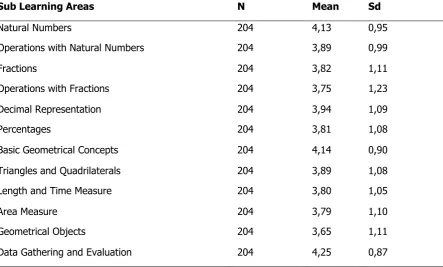
To assess the students’ self-efficacy perceptions about learning areas in mathematics lesson, descriptive statistics were conducted and means and standard deviations were presented in Table 2.
Table 2
Mean and standard deviation for the learning areas in mathematics lesson
Sub Learning Areas N Mean Sd
Natural Numbers 204 4,13 0,95
Operations with Natural Numbers 204 3,89 0,99
Fractions 204 3,82 1,11
Operations with Fractions 204 3,75 1,23
Decimal Representation 204 3,94 1,09
Percentages 204 3,81 1,08
Basic Geometrical Concepts 204 4,14 0,90
Triangles and Quadrilaterals 204 3,89 1,08
Length and Time Measure 204 3,80 1,05
Area Measure 204 3,79 1,10
Geometrical Objects 204 3,65 1,11
Data Gathering and Evaluation 204 4,25 0,87
Considering the mean values shown in the Table, it can be concluded that the students have perceptions on mathematics sub learning areas in varying degrees of strength. As seen, the mean value of “Geometric Objects” factor is (=3.65) at the lowest level, which means “I rather know” and “Data Gathering and Evaluation” factor is ( =4.25) at the highest level, which means “I completely know”.
Teachers Opinions on 5th Grade Mathematics Curriculum Objectives Dimension
In this sub problem of the study, it was aimed to determine the primary school teachers’ opinions related to appropriateness of the 5th grade Mathematics curriculum objectives in terms of students’ age,
cognitive level, being compatible with the aims and the time allocated for the objectives. The general opinions of the teachers about the 5th grade Mathematic curriculum content dimension were gathered
28 | http://mojes.um.edu.my/ EISSN: 2289-3024
MALAYSIAN ONLINE JOURNAL OF EDUCATIONAL SCIENCES
JANUARY 2019, 7 (1)Table 3
Teachers’ Opinions on 5th Grade Mathematic Curriculum Objectives Dimension
Themes Categories Frequency
Positive Opinions Being appropriate for student level 5 Being appropriate for student age 3 Clear and understandable objective expressions 4
Sufficient time 3
Negative Opinions Being inappropriate for student level 2 Insufficient time allocated for objectives 1
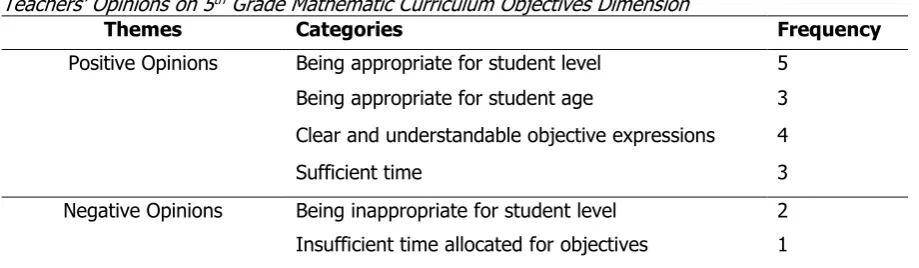
As seen in Table 3, teachers have positive and negative opinions on the revised 5th grade Mathematics curriculum. Teachers emphasized most (f=5) that they find the objectives appropriate for student level. In this category, teachers indicated that it is easier to acquire the objectives for the students at 5th grade level since they know some of these objectives at 4th grade level. For example one of the teachers (T5) said, “I do not think there are inappropriate objectives for the student level. But I think that every student can acquire the objectives when the missing parts in learning are completed and they motivated to learn”. Similarly, T2 indicated, “The objectives are already at appropriate level for student level. When we examine the 4th grade objectives, it is very close to and related to the 5th grade objectives”.
Another positive opinion related to the objectives (f=4) is that objectives are clear and understandable. T10 expressed her opinions as follows: “The expressions of the objectives in the mathematics curriculum are clear and understandable. All the teachers who examine the objectives understand the same
meanings”. On the other hand, T9 said, “Yes, the objective expressions are very clear and
understandable”.
Three of the teachers emphasized that the time allocated for the objective are sufficient. In this issue, T2 expressed his opinions as “Yes it is enough and there is still time for different activities within 5 hours”. Similarly, T5 indicated “Course hours are sufficient for the general aspects of the objectives”.
The least emphasized category (f=2) among positive opinions is that the objectives are in accordance with general aims. In this category, teachers have stated that curriculum objectives are appropriate. For example, T6 expressed, “I think that the objectives are in line with the general aims of the curriculum. As the objectives are learned step by step, general objectives can be reached”. Another teacher (T5) indicated, “We cannot expect the objectives to be contrary to the aims of the curriculum since the objectives are prepared in accordance with the aims and by passing through certain filters. For this reason, I think objectives are appropriate to reach the general aims”.
On the contrary, some teachers (f=3) expressed negative opinions on the objectives of the curriculum. Two of the teachers have stated that the objectives are not appropriate for the student level while one teacher expressed that the time allocated for the objectives is insufficient. T4 said, “Students have difficulties in multiplying and dividing in mind. They have the same difficulty in calculating the percentage of a number”. In addition T6 stated, “They have difficulties in calculating geometric objects and time”.
Teachers’ Opinions on the 5th Grade Mathematics Curriculum Content Dimension
29 | http://mojes.um.edu.my/ EISSN: 2289-3024
MALAYSIAN ONLINE JOURNAL OF EDUCATIONAL SCIENCES
JANUARY 2019, 7 (1)Table 4
Teachers’ Opinions on 5th Grade Mathematic Curriculum Content Dimension
Themes Categories Frequency
Positive Opinions Being appropriate for student level Being actual 4 3
Sufficient course hour 3
Sufficient course book 1
Negative Opinions Being inappropriate for student level Insufficient course 1 1
Being uninterested 3
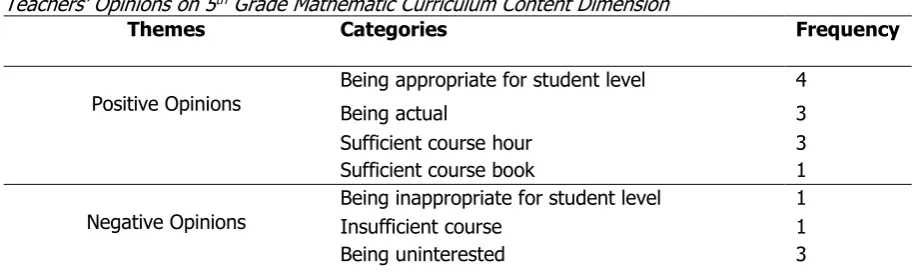
Table 4 showed that teachers’ opinions on the 5th grade Mathematics curriculum content dimension are
grouped into two themes as positive opinions and negative opinions. In content dimension, most of the teachers (f=4) have stated that content is appropriate for student level. Some teachers (f=3) indicated that the content is actual while 3 teachers have emphasized that the time is sufficient for content dimension. In addition one teacher indicated that the course book is sufficient. In this category, teachers emphasized the learnability of the curriculum. It is stated for the content dimension that the content is very appropriate to student level, which is emphasized most. Moreover, teachers have drawn attention to the point that students learn the content easily since they are familiar with the subjects at the first grade primary school curriculums. About this issue, some teachers’ opinions are as follows: “I think the content is appropriate for the student level, especially at the 5th grade level” (T2). “The activities and examples are determined as a result of many commission studies and are selected as a result of very detailed studies conducted through different forms. For this reason, it cannot be expected that the
samples and activities are incompatible” (T10). “Most subjects attract the attention of the students.
They are bored because they have difficulty in some issues, such as decimal numbers. It depends on the student, of course” (T6).
On the other hand, some teachers (f=5) expressed negative opinions on the content dimension. Among these, it is seen that most of the negative opinions (f=3) are grouped under the idea that content is uninteresting. For example, T10 stated that “Mathematics is not interesting for most students. There is a prejudice for students as mathematics is often described as abstract and difficult subject”. Accordingly, T2 said, “The subject should be more interesting”.
Another negative opinion (f=1) about the content is that the time allocated for the content is insufficient.
Teachers’ Opinions on the 5th Grade Mathematics Curriculum Teaching and Learning
Process Dimension
30 | http://mojes.um.edu.my/ EISSN: 2289-3024
MALAYSIAN ONLINE JOURNAL OF EDUCATIONAL SCIENCES
JANUARY 2019, 7 (1)Table 5
Teachers’ Opinions on 5th Grade Mathematic Curriculum Teaching and Learning Process Dimension
Themes Categories Frequency
Positive Opinions The possibility of implementing modern approaches 2
Negative Opinions Implementation difficulties caused by lack of material and infrastructure 6
Insufficient time 2
As seen in Table 5, teachers have positive and negative opinions on the teaching and process dimension of the curriculum. While teachers expressed positive opinions on the possibility of implementing modern approaches (f=2), they stated negative opinions on the issues of implementation difficulties caused by lack of material (f= 6) and infrastructure and insufficient time (f=2).
The negative opinions of the teachers are as follows: “I cannot use the smart board in every class. There were not smart boards at schools that I worked at before. These differences lead us to use classical methods as direct instruction and, question and answer” (T8). “Project tasks are not functional. It takes a lot of time to follow and deal with the projects when the class is crowded” (T1).
Teachers’ Opinions on 5th Grade Mathematics Curriculum Assessment and Evaluation
Dimension
In the fifth sub problem, teachers’ opinions on the 5th grade mathematics curriculum assessment and evaluation dimension were obtained. The opinions of the teachers and the frequencies are as seen in Table 6 below.
Table 6
Teachers’ Opinions on 5th Grade Mathematic Curriculum Assessment and Evaluation Dimension
Themes Categories Frequency
Negative Opinions Implementation difficulty Being insufficient in evaluating high order thinking skills 3 5 Insufficient time 2
As seen in Table 6, teachers' opinions on the assessment and evaluation dimension of the renewed 5th
grade Mathematics curriculum were collected under negative opinions theme. The negative opinions theme consists of three categories as the implementation difficulty (f=5), being insufficient in evaluating high order thinking skills (f=3) and insufficient time (f=2). The teachers’ negative opinions about these themes are as follows: “The assessment tools have various situations such as being subjective, requiring long process, continuous observation and follow-up. Therefore, they increase the workload of the teachers and it becomes very difficult for teachers to use them, especially for the ones who have high course load. Within this context, to increase the work load of the teachers by these assessment tools decrease their usability.” (T5). “It is difficult to conduct assessment and evaluation because they quickly forget what they have learned. I need to do revision all the time. When we do revision, there is not enough time to do the measurement and to teach the subjects” (T9).
31 | http://mojes.um.edu.my/ EISSN: 2289-3024
MALAYSIAN ONLINE JOURNAL OF EDUCATIONAL SCIENCES
JANUARY 2019, 7 (1)time and it is not economical. Students should be supported and time should be allocated for them individually. In crowded classrooms, it is generally expected that students will be able to achieve the objectives by using the expository method and in this case, the average of the mathematics courses of
our country decreases. Besides, 2 teachers indicated that the time allocated for the assessment and
evaluation is insufficient. T6 stated, “Assessment and evaluation is very difficult since student forget easily what they have learnt. The time becomes insufficient when we make a lot of revision”.
Teachers’ General Opinions on 5th Grade Mathematics Curriculum
In the last sub problem of the study, teachers’ general opinions on the 5th grade Mathematics curriculum were assessed. The general opinions of the teachers and the frequencies are as shown in Table 7 below.
Table 7
Teachers’ General Opinions on 5th Grade Mathematic Curriculum
Themes Categories Frequency
Positive Opinions Changes made in the process Compatibility between values education and 5
content 2
Negative Opinions Problems caused by course book 3
Insufficient assessment and evaluation 2
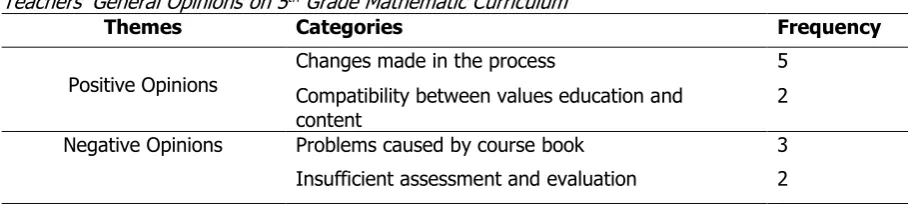
Table 7 showed that teachers’ general opinions on the 5th grade Mathematics curriculum were examined under two themes as positive and negative opinions. Teachers stated that most (f=5) of the changes made in the process to be very positive. Among these changes, teachers expressed that the decrease in objective number, the increase in course hour and the authority of the teachers in determining the activities instead of using guide book were positive changes. The opinions on this theme are as follows: “I think it is a correct decision to decrease the objectives. Because in the previous system, we tried to give a lot of information in a short time. And the guide books lost their practicality. In todays’ technology it is possible to reach sources which are more functional than the guide books. Moreover, the increase in the course hour is very effective” (T10). “Simplification studies were very good. Because students entering abstract operations stage are not yet ready for deductive and inductive thinking. In this way, the students' self-esteem is less damaged” (T3).
Another positive opinion under this theme is that the values education is compatible with the content. On this issue T1 stated, “The book is useful in the general sense. The introduction part of the activities is very successful in terms of values education”. Similarly, T8 indicated, “Values education is related to acquiring affective qualities, which can only be gained through content. The book is more effective than the books we used in the past years”.
In the theme of negative opinions about the curriculum teachers indicated that there are some problems caused by course book. The continuous change in book selection, the lack of visuals in the course book and the lack of necessary documents required for revision are determined as the negative sides of the course book. For example, T1 stated, “The course book is insufficient. It is forbidden to make students buy a different source book. This situation is troubling for us because the parents appreciate the teacher
who solve more questions and give too much homework”. On the other hand T8 indicated, “There
should be a work book. The course book is insufficient for revision”.
32 | http://mojes.um.edu.my/ EISSN: 2289-3024
MALAYSIAN ONLINE JOURNAL OF EDUCATIONAL SCIENCES
JANUARY 2019, 7 (1)DISCUSSION
According to the results of the questionnaire conducted with the students, students found themselves less adequate in geometric objects sub-learning area compared to other sub-learning areas. Therefore, it can be concluded that students have the most difficulties in geometric objects. Geometric objects sub learning area is included in all class levels from the first grade to fifth grade. It is thought that the difficulty in geometric objects is a result of the fact that objectives requiring abstract operations and three-dimensional thinking take place at the fifth grade level for the first time. On the other hand, students find “Data gathering and evaluation” sub field easier compared to the others sub-fields.
Secondly, teachers have stated that the objectives of the mathematics curriculum are appropriate for the students’ level and the time allocated for this course is enough to acquire the objectives. When the studies on 2005 and 2013 mathematics curriculum were examined, teachers have indicated that the objectives in these curriculums were more intense (Şen, 2017; Yenilmez & Sölpük, 2014; Danışman & Karadağ, 2015). Nacar (2015) found that according to 60% of the teachers, the objectives of 2013 5th
grade Mathematics curriculum in the year were in accordance with the students’ readiness level and were sufficient. On the contrary, for 15% of the teachers, the objectives were not in accordance with the students’ readiness level and were not sufficient. Şen (2017) have emphasized that the decrease in objective numbers in the 2017 curriculum can be an advantage for the teachers since they try to follow the curriculum. In a similar study, Bilen (2015) found that for Mathematics teachers the objectives in Mathematics curriculum were simplified and the number of the objectives was decreased. These findings show similarities with the findings obtained from the qualitative findings of this study. On the other hand, in this study, teachers have emphasized that it is easier for student to acquire the objectives at 5th grade since they are familiar with some objectives during 4th grade. Therefore, it can be assumed
that the first grade and the second grade Mathematics curriculum objectives are compatible with each other.
Teachers have stated positive views related to Mathematics curriculum for the 5th grade in terms of
content dimension. In the study conducted by Nacar (2015), teachers faced problems while implementing the curriculum and this situation was influenced by reasons such as the inadequacy of the physical infrastructure of the schools and the crowded classes. Therefore, it can be argued that similar problems will continue to appear in the crowded classes.
Teachers' opinions on the assessment and evaluation dimension of the renewed 5th grade mathematics curriculum were seen to be negative. The negative opinions were as implementation difficulty, being insufficient in evaluating high order thinking skills and insufficient time. In their study Demirtaş, Arslan, Eskicumalı and Kargı (2015) mentioned that alternative assessment techniques were used in the 2006 Mathematics curriculum. However, there was no information about this in the 2013 curriculum. Moreover, it has been stated that the evaluation methods are applicable but they are inadequate for the measurement. Similarly, Butakin and Özgen (2007) found that teachers have difficulties in implementing the new curriculum in the crowded classrooms. As a similar conclusion, in this study teachers have stated that they have difficulties in implementing process-based approaches such as peer assessment and projects.
33 | http://mojes.um.edu.my/ EISSN: 2289-3024
MALAYSIAN ONLINE JOURNAL OF EDUCATIONAL SCIENCES
JANUARY 2019, 7 (1)CONCLUSIONS
This study aimed to evaluate the 2018 5th grade Mathematics curriculum according to students’ and
teachers’ opinions. In the study, firstly students’ self-efficacy perceptions on mathematics learning areas were determined. The findings showed that the mean value of the “Geometric objects” factor was the lowest while it was the highest for “Data gathering and evaluation” factor.
Secondly, teachers’ opinions on the 5th grade Mathematics curriculum objectives dimension in 2018 were
obtained. Teachers have stated that the objectives of the mathematics curriculum are appropriate for the student’s level and age, clear and understandable and the time allocated for this course is enough to acquire the objectives. Moreover, they have expressed that content is appropriate for students’ level and the time is sufficient for the content. On the other hand, some teachers found the objectives inappropriate for the students’ level and the time for the objectives to be insufficient.
For the content dimension, teachers generally have positive ideas such as it. Being appropriate for the students’ level, being actual, being sufficient for course hour and course book. On the other hand, students stated the content dimension as negative ideas, such as it being inappropriate for student level, insufficient course hour and being uninterested in the content.
In the teaching and learning process dimension, teachers stated that it is possible to implement the modern approaches. On the contrary, some of the teachers expressed negative ideas as implementation difficulties and insufficient time to implement these approaches.
Teachers' opinions on the assessment and evaluation dimension were collected under negative opinions theme. The negative opinions theme consisted of three categories: 1) implementation difficulty, 2) being insufficient in evaluating high order thinking skills and 3) insufficient time.
Lastly, this study tried to see the teacher’s responses on things related to curriculum in general. Teachers have stated positive ideas that the changes made on the curriculum were positive, the values education is compatible with the content. On the other hand, teachers have expressed that there are some problems caused by course book and the assessment and evaluation are insufficient.
REFERENCES
Acar, T. (2008). Application effectiveness of alternative assessment approaches in new primary education mathematic programme, (Unpublished master thesis). Yüzüncü Yıl University, Science and Technology Institute, Turkey.
Baki, A. (2006). Mathematics education: From theory to implementation. Trabzon: Derya Publishing Bal, A. P. (2008). The evaluation of new mathematic curriculum in term of teachers’ perspectives.
Çukurova University Social Sciences Institute Journal, 17(1), 53-68.
Bal, A. P. (2009). The evaluation of measurement and evaluation approaches used in fifth grade mathematics instruction in terms of students and teachers’ opinions, (Unpublished doctoral thesis), Çukurova University Social Sciences Institute, Adana.
Bilen, N. (2015). Evaluation of mathematical models and modeling in the fifth-grade mathematics curriculum based on teachers' view. (Unpublished Master Thesis), Atatürk University, Educational Sciences Institute, Erzurum.
Butakin, V. & Özgen, K. (2007). Evaluation of the effectiveness of the new elementary mathematics curriculum (4th and 5th grade) in practice, Dicle University Ziya Gökalp Journal of Educational Sciences,8, 82-94.
Creswell, J. (2013). Qualitative, quantitative and mixed method research approaches. (S.B. Demir, Trans.). Ankara: Egiten Press.
34 | http://mojes.um.edu.my/ EISSN: 2289-3024
MALAYSIAN ONLINE JOURNAL OF EDUCATIONAL SCIENCES
JANUARY 2019, 7 (1)Demirtaş, Z., Arslan, S., Eskicumalı, A. & Kargı, G. (2015). Teachers’ opinions about the renewed fifth grade mathematics curriculum and comparison of two versions. Procedia – Social and Behavioral Sciences, 174, 1782 – 1790.
Dessinger, J. C. & Moseley, J. L. (2004). Confirmative evaluation: practical strategies for valuing continuous improvement. San Francisco: John Wiley and Sons
Duru, A. & Korkmaz, H. (2010). Teachers’ vıews about a new mathematıcs currıculum and dıffıcultıes encounterıng currıculum change, Hacettepe Universiy, Journal of Education Faculty, 38, 67-81. Fitzpatrick, J. L., Sanders, J. R., & Worthen, B. R. (2012). Program evaluation alternative approaches
and practical guidelines. Upper Saddle River, NJ: Pearson Education.
Gömleksiz, N. M., & Kan, Ü. A. (2007). Basic principles and approaches of the new elementary curriculum. East Anatolia Region Researches, 5(2), 60-66.
Guimaraes de Castro, M. H. (1999). Education for the 21st Century: The challenge of quality and equity. (G. Howells, Trans). Brazil: National Institute of Educational Studies and Research.
Dağlar, S., & Delil, A. (2012). Evaluation of 6th grade elementary mathematics program by students and teachers. Celal Bayar University Education Faculty Journal, 1-2, 67-93.
Halat, E. (2007). Views of pre-service elementary teachers on the use of WebQuest in mathematics teaching. Elementary Education Online, 6(2), 264–283.
Lunenburg, F., & Irby, B. (2006). The principal ship: Vision to evaluation. United States of America: Thomson Wadsworth.
Ministry of National Education, (2005). Elementary mathematics course (Grades 6, 7 and 8) curriculum. Ankara: State Books Directorate Publishing.
Ministry of National Education, (2013), Mathematics course (Grades 5, 6, 7 and 8) Curriculum. Ankara: State Books Directorate Publishing.
Ministry of National Education, (2018). Mathematics course (Grades 5, 6, 7 and 8) Curriculum. Ankara: State Books Directorate Publishing.
Memnun, D., & Akkaya, R. (2010). Seventh grade students’ opinions about the Mathematics course. The Journal of Theoretical Educational Science, 3(2), 100-117.
Mitchell, M. L., & Jolley, J. M. (2010). Research design explained. (7th ed.). Belmont, CA: Wadsworth Publishing.
Nacar, N. (2015). Examination of secondary school 5th grade mathematics curriculum according to teachers' views (Ankara province sample), (Unpublished master’s thesis). Gazi University, Educational Sciences Institute, Ankara.
Parlar, H. (2012). Information society, change and new educational paradigm. Yalova, Journal of Social Sciences, 2(4), 193-209.
Pheeraphan, N. (2013). Enhancement of the 21st century skills for Thai higher education by integration of ICT in classroom. Procedia-Social and Behavioral Sciences, 103, 365-373.
Şen, Ö. (2017). Matematik dersi ortaokul öğretim programlarının karşılaştırılması: 2009-2013-2017 [Comparison of elementary school mathematics curricula: 2009-2013-2017]. Current Research in Education, 3(3), 116-128.
Parrot, M. A. S. & Eu, L. K. (2018). Teaching and learning calculus in secondary schools with the TI-Nspire. Malaysian Online Journal of Educational Sciences, 2(1), 27-33.
Yapıcı, M., & Demirdelen, C. (2007). İlköğretim 4.sınıf sosyal bilgiler öğretim programına ilişkin öğretmen
görüşleri [Teachers' opinions on 4th grade social studies curriculum]. Gazi University Turkish
Journal of Educational Sciences, 43(3), 261-274.